
Available Online at www.ijpret.com 771
INTERNATIONAL JOURNAL OF PURE AND
APPLIED RESEARCH IN ENGINEERING AND
TECHNOLOGY
A PATH FOR HORIZING YOUR INNOVATIVE WORK
ANALYSIS OF KEY-POINT METHOD AND BLOCK-BASED METHOD FOR TAMPER
DETECTION
KSHIPRA TATKARE1, VANITA MANE2
1.ME Student, RAIT ,Nerul , Navi Mumbai and India 2.Assistant Professor, RAIT, Nerul , Navi Mumbai and India
Accepted Date: 05/03/2015; Published Date: 01/05/2015
Abstract: Digital tampered photo images can be found everywhere in newspapers, books, magazines, posters, advertisements, courtrooms and all over the Internet. The main problem is to find out the image is an original or tampered, so to carry out this, there should be some science which is termed as Digital Forensics. Digital image forensics is of two types: Active approach and Passive approach. Active image forensics requires the pre-embedded information such as watermark or digital signature while Passive image forensics which detects the tampering without any pre-embedding of information. Most of the images available are without any watermark or digital signature so we focus on Passive image forensics. In Passive image forensics there are three categories: Image Splicing, Image Retouching and Copy-Move. A copy-move forgery is performed by copying a region from an image and pasting it in the same image. Two types of copy-move forgery detection techniques exist and they are the Block based and Key-point based. This paper presents the analysis on Block-based and Key-Point Copy-Move forgery detection techniques. As follows. Section II presents related work and literature survey. Section III shows Copy-Move Forgery Detection techniques in brief. Section IV addresses the analysis of Block-Based and Key-Point based Copy-Move Forgery Detection
Keywords:Copy-Move forgery detection; passive; Block-based; Key-point-based techniques. Finally, Section V concludes the paper.
Corresponding Author: MS. KSHIPRA TATKARE
Access Online On:
www.ijpret.com
How to Cite This Article:
Kashipra Tatkare, IJPRET, 2015; Volume 3 (9): 771-778
Available Online at www.ijpret.com 772 INTRODUCTION
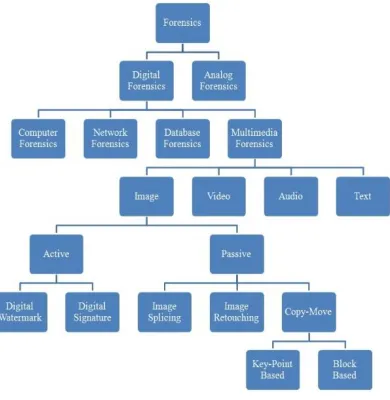
Digital Forensics is a sub branch of forensic science focusing on the investigation and recovery of material found in digital devices. Image forgery detection is a branch of Digital Forensics science which focuses on identifying and recovering tampering in an image. The goals of Image Forgery Detection are Identify image tampering methods, Assess methods which are available for protecting images, Assess image authentication techniques and Identify directions for future work. The classification of Forensics is shown in following fig.1.
Fig. 1 Classification of Forensics
Passive Image Forgery Detection
Passive image forensics is detection of tampering without any pre-embedding of image information. So, there is no requirement of knowledge of an Original image in passive authentication. In Passive image forensics there are three categories: Image Splicing,
Image Retouching and Copy-Move [6].
Image Splicing
Available Online at www.ijpret.com 773
Image Retouching
Image retouching is a process consists of Rotation, Scaling and Blurring of an Image. Enhancing of an image includes changing the color of an object, changing the weather conditions and Blurring out objects.
Copy-Move
Copy-Move forgery is the process in which a part of an image is cropped and pasted on another part of the same image. Copy-Move forgery is performed to hide certain details or duplicate objects within an image.
I. Copy-move forgery detection
We found two categories of Copy-Move forgery detection in literature and that are Block-Based method and Key-point Based method. Block based CMFD methods, the image will be divided into overlapping blocks of specified size and a feature vector will be calculated for these blocks. The common processing pipeline for the detection of copy-move forgeries is as follows:
Fig. 2 Processing Pipeline of CMFD [1]
The process of pipeline for CMFD consists of blocks of Feature Extraction followed by Matching followed by Filtering and Post-Processing, each block explanation is as follows: [1].
Feature Extraction
Available Online at www.ijpret.com 774
input data into the set of features is called feature extraction. Feature extraction involves simplifying the amount of resources that will be required to describe a large set of data accuracy [1].
Matching
High matching between two feature descriptors is interpreted as a cue for a duplicated region. For block-based methods, most authors propose the use of lexicographic sorting in identifying similar feature vectors. In lexicographic sorting a matrix of feature vectors is created so that each feature vector becomes a row in the matrix. This matrix is then row-wise sorted. Thus, the most similar features appear in consecutive rows. Other authors use the Best-Bin-First search method derived from the kd-tree algorithm to get approximate nearest neighbours. In particular, key-point based methods often use this approach. Matching with a kd-tree yields a relatively efficient nearest neighbour search. Typically, the Euclidean distance is used as a similarity measure. In literature, it has been shown that the use of kd-tree matching leads, in general, to better results than lexicographic sorting, but memory requirements are higher [1].
Filtering
Filtering is used to reduce the probability of false matches. For instance, a noise suppression measure involves the removal of matches between spatially close regions. Neighbouring pixels often have similar intensities, which can lead to false forgery detection [1].
Postprocessing
The goal of this last step is to only preserve matches that exhibit a common behaviour. We can consider matches that belong to a copied region. These matches are spatially close to each other in both the source and the target blocks (or key points). Furthermore, matches that originate from the same copy-move action should exhibit similar amounts of rotation, translation and scaling.
Classification of CMFD Techniques
In literature we found two categories of CMFD, that are Block-Based method and Key-point based method.
A. Key-point Based Method
Available Online at www.ijpret.com 775
forgery can be reported if regions of matches cluster into larger areas. The Key-point based features SIFT and SURF shows better results [1].
a. Scale invariant Feature Transform(SIFT)
In the SIFT method the SIFT features are extracted from the image which will be then matched with each other to find the forged duplicate regions present in an image. The drawback of this method is the high dimensionality which we get from SIFT descriptors [6]. SIFT algorithm is consisting of following steps:
Construct Scale Space, Take Difference of Gaussians, Locate DoG Extrema, Sub Pixel Locate Potential Feature Points, Filter Edge and Low Contrast Responses, Assign Keypoints Orientations, Build Keypoint Descriptors, Go Play with Your Features [12].
b. Speed Up Robust Features (SURF)
In the SURF method the features are extracted and descriptors are obtained by SURF algorithm and the Nearest Neighbour approach is used for feature matching for identifies the copy move forgery in digital images. This detection method is found to be scale invariant and rotation and is robust enough to noise, jpeg compression and blurring. This is achieved by the use of integral images. In SURF the keypoint detection uses basic Hessian-matrix approximation. The keypoint descriptors are obtained by using Haar wavelet responses in the neighbourhood of the specified keypoint [6].
B. Block Based Method
For feature extraction, block-based methods subdivide the image in rectangular regions. For each such region, a feature vector is calculated. Similar feature vectors are matched. In the Block based features DCT, DWT, KPCA, ZERNIKE and PCA features perform very well.
a. Discrete Cosine Transform (DCT)
In this algorithm, exploits DCT coefficients as features that can be robust against JPEG compression and Gaussian additive noise. To minimize the cost of the computation and to reduce the complexity of the comparisons, DCT coefficients were sorted lexicographically [7].
b. Principal Component Analysis (PCA)
Available Online at www.ijpret.com 776
involves computing the corresponding covariance matrix of the feature matrix, by obtaining a new linear basis through eigenvectors of the covariance matrix, and obtaining a projection of each block onto those basis vectors that have higher Eigen values, thereby reducing the dimensions of the feature vectors [7].
c. ZERNIKE
Of various types of moments which defined in the literature, ZERNIKE moments have been shown to be superior than the others in terms of insensitivity to image noise, information content, and ability which provide trusty image representation. The result of ZERNIKE moments is algebraically invariant against rotation. [13].
Applications of CMFD Techniques can be in following area:
1. Investigation
2. Criminal Investigation [6]
3. Surveillance Systems
4. Intelligence Services
5. Medical Imaging
6. Journalism
II. COMPARISON AND ANALYSIS
We have selected two existing methods of CMFD Techniques for comparison.
Methods Parameters
Key-Point Based Approach Block-Based Approach
CMFD Techniques SIFT and SURF DCT, DWT, PCA, KPCA and
ZERNIKE
Matching Technique kd-tree algorithm Lexicographic Sorting
algorithm
Memory Required Significantly Higher Lower than Key-Point Based
False-Positive detection Minimum or no May generate because of
JPEG Compression
Number of high-contrast
selfsimilarities of non-copied regions.
Available Online at www.ijpret.com 777
Best result for the
category(Rough, Smooth, Structure).
Rough Smooth
Above discussed methods in table shows differences due to different texture of the copied regions. In Literature we can find the categories as smooth, rough and structure. The Key-point Based methods require sufficient entropy in the copied region to develop their full strength. In the category rough, SIFT and SURF are consistently either the best performing features or at least among the best performers. Conversely, for copied regions from the category smooth, the best block-based methods often outperform SURF and SIFT at image or pixel level. The category structure ranges between these two extremes.
SUGGESTION
If we able to minimize the false-positive detection which is generate because of JPEG Compression of an image, then Block based methods can be superior on Key-point based methods.
ACKNOWLEDGMENT
The Copy-Move forgery detection plays very important role in Digital Forensics Science. In this report we analyse two Copy-Move forgery detection techniques which are Key-point based and block based methods. Through Key-point based and block based methods we can easily find out if Copy-Move forgery is performed on an image. There is very small performance difference in these categories. Thus, we can conclude that the Key-point based methods are very suitable to category of rough images like SIFT; SURF and the Block based methods are very suitable to category of Smooth images like ZERNIKE.
REFERENCES
1. Vincent Christlein, Christian Riess, Johannes Jordan, Corinna Riess, Elli Angelopoulou, “An Evaluation of Popular Copy-Move Forgery Detection Approaches”, Proceedings of the IEEE TRANSACTIONS ON INFORMATION FORENSICS AND SECURITY, pages 125, November 2012.
Available Online at www.ijpret.com 778
3. Aliya M. Salim AND Dimple Shajahan , “A Review On Different Techniques On Image Forgery Detection And Removal Of Tampered Region”, International Journal Of Advanced Research In Engineering And Technology, Volume 5, Issue 2, Pages 101 - 108, February 2014.
4. Vivek Kumar Singh and R.C. Tripathi, “Fast and Efficient Region Duplication Detection in Digital Images Using Sub-Blocking Method”, International Journal of Advanced Science and Technology, VOL. 35, Pages 93 - 102, October 2011.
5. Wei Wang, Jing Dong, and Tieniu Tan, “A Survey of Passive Image Tampering Detection”, Springer-Verlag Berlin Heidelberg, LNCS 5703, Pages 308322, 2009.
6. S. Devi Mahalakshmi, Dr. K. Vijayalakshmi and E. Agnes “A Forensic Method for Detecting Image Forgery”, IEEE International Conference on Emerging Trends in Computing, Communication and Nanotechnology, Pages 590 -594, 2009.
7. Osamah M. Al-Qershi and Khoo Bee Ee, “Passive Detection of Copy-Move Forgery in Digital Images: State-of-the-art”, Forensic Science International Conference, Volume 231, Issues 13, Pages 284295, 10 September 2013.
8. Salma Amtullah and Dr. Ajay Koul, “Passive Image Forensic Method to detect Copy Move Forgery in Digital Images”, IOSR Journal of Computer Engineering (IOSR-JCE), Volume 16, Issue 2, Ver. XII, Pages 96-104, Mar-Apr. 2014.
9. Najah Muhammad, Muhammad Hussain, Ghulam Muhamad and George Bebis, “A Nonintrusive Method for Copy-Move Forgery Detection”, Springer-Verlag Berlin Heidelberg, Part II, LNCS 6939, Pages 516 525, 2011.
10.Yanjun Cao, Tiegang Gao, Li Fan and Qunting Yang, “A robust detection algorithm for copy move forgery in digital images”, Forensic Science International Conference, 214, Pages 33 43, 2012.
11.Somayeh Sadeghi, Hamid A. Jalab, and Sajjad Dadkhah,“Efficient Copy-Move Forgery Detection for Digital Images”, World Academy of Science, Engineering and Technology, Volume 6, pages 539 - 542, 2012.
12.David G. Lowe,“Distinctive Image Features from Scale-Invariant Keypoints”, International Journal of Computer Vision, Volume 60, Pages 91 - 110, 2004.
![Fig. 2 Processing Pipeline of CMFD [1]](https://thumb-us.123doks.com/thumbv2/123dok_us/8729026.1745975/3.612.176.428.369.506/fig-processing-pipeline-of-cmfd.webp)
