Organized by S.V.B.I.T., Gandhinagar. Available Online at www.ijpret.com10
INTERNATIONAL JOURNAL OF PURE AND
APPLIED RESEARCH IN ENGINEERING AND
TECHNOLOGY
A PATH FOR HORIZING YOUR INNOVATIVE WORK
EFFECTS OF DIFFERENT STABILIZERS ON DRY DENSITY OF SOIL
RUDRADATT JADHAV1, MAYUR JOSHI1, NIL SHAH1, MEET VAGHELA1, SACHIN
BHAVSAR2
1. U. G. Student, Civil Department, SVBIT, Gandhinagar, Gujarat – 382650
2. Lecturer, Civil Department, SVBIT, Gandhinagar, Gujarat – 3822650
Accepted Date: 22/12/2018; Published Date: 01/02/2019
Abstract:During construction work some of the fundamental properties of soil are not at the desirable scale to be use. Replacement of such soil is not a cost effective option so it is better to stabilize to gain desirable properties for construction work. From the fundamental properties of soil one of the property named as dry density co-relates with many other properties so in this present research paper we have stabilized locally available soil with lime and cement for which we have used standard proctor test to evaluate its dry density. Stabilized soil with the combination of cement and lime gives more than 6% of improvement in dry density than actual value of soil without stabilization.
Keywords: Fundamental properties, engineering properties, dry density, standard proctor test, stabilization, stabilizers
Corresponding Author: RUDRADATT JADHAV
Access Online On:
www.ijpret.com
How to Cite This Article:
Rudradatt Jadhav, IJPRET, 2019; Volume 7 (6): 10-20
PAPER-QR CODE
SPECIAL ISSUE FOR
2
ndNATIONAL CONFERENCE ON
Organized by S.V.B.I.T., Gandhinagar. Available Online at www.ijpret.com11
1. INTRODUCTION
1.1Soil Stabilization
1.1.1 Definition: - “Soil stabilization is a technique aimed at increasing or keeping the stability of soil mass and chemical adjustment of soil to enhance their engineering properties.” (Sachin N. Bhavsar et al. 2014)
1.1.2 Introduction: Stabilization allows for the founding of design criteria as well as the determination of the proper chemical additive and admixture rate to be used in order to achieve the preferred engineering properties. Benefits of the stabilization process can include higher resistance values, decrease in plasticity, lower permeability, reduction of road thickness, elimination of diggings material hauling or handling. Stabilization of expansive soils with admixtures controls the potential of soils for a change in volume, and increases the strength of soils. Soil stabilization is done by various systems by adding fly ash, rise husk ash, chemicals, fibres, adding lime, by different geo materials like geo synthetic, geo grid and geo form. Soil stabilization allows engineers to distribute a larger load with less material over a longer life cycle. (Sachin N. Bhavsar et al. 2014)
1.2 Dry Density
1.2.1 Definition: - Normal soil consists of solids, water (moisture) and air. Usually we calculate bulk density of soil by finding out the weight of soil per unit volume. A bulk density of over 1.6 gm/cm3 is not helpful for root growth because the soil is compacted enough. Dry density is bulk density -moisture content. (Book: Soil mechanics, R. P. Rethaliya, Atul prakashan, edition: 2015- 2016)
2. LITERATURE
2.1 A.H. Alavia et al., 2009, in this paper author concluded that, Soil stabilizer mix by using radial basis function (RBF) neural network is utilized to contract comprehensive and accurate models to be able to relate the maximum dry density and optimum moisture content of stabilized soil to the properties of natural soil. By chemical stabilization, the chemical such as lime, cement and asphalt or combination of these obtain better result in dry density as 1.52 ton/m3 to 2.2 ton/m3.
2.2 P. Talukdar, B. Sharma, 2014, in this paper author concluded that, by static compaction method like conventional proctor test for 3 fine grained inorganic soil the maximum dry density is obtained as 14.35, 14.18 and 17.57gm/m3.
From the study, an equipment static pressure of around 820 kN/m2 has been obtained. This
Organized by S.V.B.I.T., Gandhinagar. Available Online at www.ijpret.com12 2.3 Murad Abu – Farshkh et al., 2007, in this research paper author concluded that, Geo synthetics have increasingly been used to reinforce many earth structure and now a well-accepted means to improve engineering properties of various type of soil. By using
soil – geo-synthetic reinforcement design the reduction interface shear resistant causes by the increase in modelling moisture content suggests that interface shear parameter 95% maximum dry density and moisture content 2% above optimum value.
2.4 F.G. Bell, 1996, in this research paper author concluded that, By lime stabilization of clay minerals and soil it increase in optimum moisture content and decrease in maximum dry density by adding lime.
2.5 Sachin N. Bhavsar, 2014, in this research paper author concluded that, the maximum dry density of soil is increased by replacing some stabilizers in some proportion. By replacing the brick dust as a stabilizers, it increase the maximum dry density of soil. And by replacing 30%, 40% and 50% brick dust the maximum dry density of soil is obtained as 1.81, 1.875 and 1.937 gm/cm3. Only black cotton soil without replacing any stabilizers it gives maximum dry density
as 1.71 gm/cm3 which is low as compare as replacement of soil by stabilizers.
2.6 Sachin N. Bhavsar, Ankit J. Patel, 2014, in this paper author concluded that, by replacement of soil by stabilizer the value of maximum dry density is increased by 11.69%. As same after stabilization maximum dry density increased by 5.84%.
For the replacement of soil by 30% marble powder the result of maximum dry density is obtained as 1.91gm/cm3 and by 30% brick dust the result of maximum dry density is obtained
as 1.81 gm/cm3.
2.7 Sachin N. Bhavsar, Ankit J. Patel, 2014, by replacement of soil by stabilizer the value of maximum dry density is increased by 13.45%. By replacement of soil by 40% marble powder
gives the maximum dry density as 1.94gm/cm3 and by 40% brick dust gives the maximum dry
density as 1.875gm/cm3.
Organized by S.V.B.I.T., Gandhinagar. Available Online at www.ijpret.com13
3. METHODOLOGY AND MATERIALS
3.1Methodology: -
Selection of stabilizer
Analysis of impact of stabilizer on engineering properties of soil
Selection of appropriate amount of stabilizer
Fixing mix proportion of soil + Stabilizer to get maximum Advantages of stabilizer
Organized by S.V.B.I.T., Gandhinagar. Available Online at www.ijpret.com14
3.2 materials: -
3.2.1 Locally available soil: - Soil is a combination of biological matter, minerals, gases, liquids, and organisms that together support life. Earth’s body of soil is the pedosphere, which has four significant functions: it is an average for plant growth it is a means of water storage, supply and distillation it is a modifier of earth’s atmosphere it is habitat for organisms all of which, in turn, modify soil.
Fig 3.1 Soil
3.2Cement:-
Type- Ordinary Portland cement Grade-53grade
Chemical composition: Cao+SIO2+AL2O3
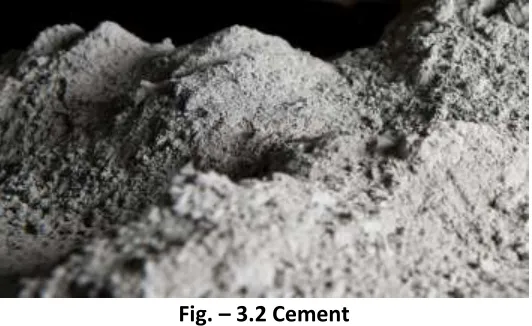
A cement is a binder, a substance used for assembly that sets, hardens, and adheres to other ingredients to bind them together. Cement is seldom used on its own, but rather to bind sand and gravel (aggregate) together. Cement mixed with fine aggregate product mortar for masonry, or with sand and gravel, produces concrete.
Organized by S.V.B.I.T., Gandhinagar. Available Online at www.ijpret.com15 3.3 Lime:-
Type-Sprout
Chemical composition: Ca (OH) 2
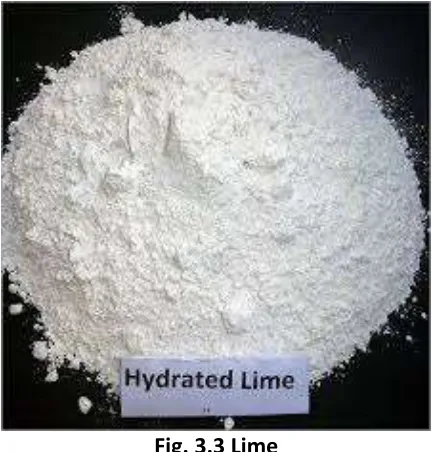
Lime is a calcium-containing inorganic mineral in which oxides, and hydroxides prevail. In the strict sense of the term, lime is calcium oxide or calcium hydroxide. It is also the name of the natural mineral (native lime) CaO which occurs as a produce of coal seam fires and in changed limestone xenoliths in volcanic ejecta. The word lime creates with its earliest use as erection mortar and has the sense of sticking or following.
Fig. 3.3 Lime
4. TEST PROCEDURE
4.1 Standard Proctor Test (Indian Standard 2720 – Part-7, 1980):
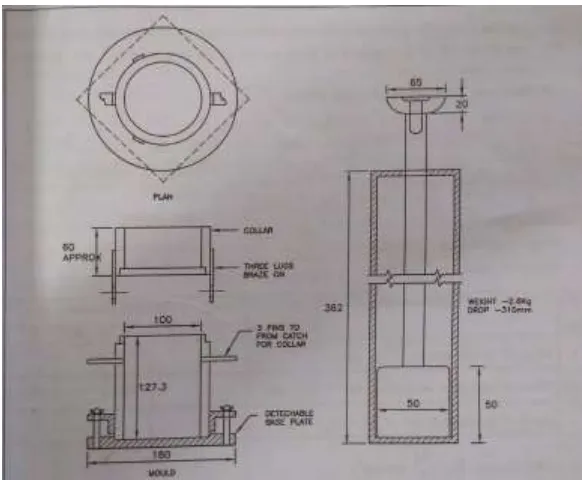
Equipment’s for Proctor’s Test
1. Compaction mould, capacity 1000ml.
2. Rammer, mass 2.6 kg
3. Detachable base plate 4. Collar, 60mm high 5. IS sieve, 4.75 mm
6. Oven
7. Desiccator
8. Weighing balance, accuracy 1g
Organized by S.V.B.I.T., Gandhinagar. Available Online at www.ijpret.com16 10.Straight edge
11.Spatula 12.Graduated jar
13.Mixing tools, spoons, trowels, etc.
Procedure
1. Take about 20kg of air-dried soil. Sieve it through 20mm and 4.7mm sieve.
2. Calculate the percentage retained on 20mm sieve and 4.75mm sieve, and the percentage passing 4.75mm sieve.
3. If the percentage retained on 4.75mm sieve is greater than 20, use the large mould of 150mm diameter. If it is less than 20%, the standard mould of 100mm diameter can be used. The following procedure is for the standard mould.
4. Mix the soil retained on 4.75mm sieve and that passing 4.75mm sieve in proportions determined in step (2) to obtain about 16 to 18 kg of soil specimen.
5. Clean and dry the mould and the base plate. Grease them lightly. 6. Weigh the mould with the base plate to the nearest 1 gram.
7. Take about 16 – 18 kg of soil specimen. Add water to it to bring the water content to about 4% if the soil is sandy and to about 8% if the soil is clayey.
8. Keep the soil in an air-tight container for about 18 to 20 hours for maturing. Mix the soil thoroughly. Divide the processed soil into 6 to 8 parts.
9. Attach the collar to the mould. Place the mould on a solid base.
10. Take about 2.5kg of the processed soil, and hence place it in the mould in 3 equal layers. Take about one-third the quantity first, and compact it by giving 25 blows of the rammer. The blows should be uniformly distributed over the surface of each layer.
11. The top surface of the first layer be scratched with spatula before placing the second layer. The second layer should also be compacted by 25 blows of rammer. Likewise, place the third layer and compact it.
12. The amount of the soil used should be just sufficient to fill the mould ad leaving about 5 mm above the top of the mould to be struck off when the collar is removed.
13. Remove the collar and trim off the excess soil projecting above the mould using a straight edge.
14. Clean the base plate and the mould from outside. Weigh it to the nearest gram. 15. Remove the soil from the mould. The soil may also be ejected out.
16. Take the soil samples for the water content determination from the top, middle and bottom portions. Determine the water content.
Organized by S.V.B.I.T., Gandhinagar. Available Online at www.ijpret.com17
(Fig 4.1 Standard Proctor test Equipment’s)
5. RESULTS AND DISCUSSION
5.1 100% SOIL
TABLE 5.1 MDD & OMC RESULTS FOR 100% SOIL
As per above results it is observed that maximum dry density for 100% soil achieved is of 83.55 gm/cm3 for optimum moisture content of 12.5 %.
100% SOIL
Water Content 10% 12% 13% 14% 16%
W1(gm) 3603 3603 3603 3603 3603
W2(gm) 5458 5567 5514 5664 5539
W(gm) 1855 1964 1911 2061 1936
γb = W/V(gm/cm3) 84.35 89.31 86.9 93.72 8804
Container No. 3 5 10 30 5
M1(gm) 9 20 37 13 20
M2(gm) 27 42 62 52 37
M3(gm) 26 38 61 47 35
W=(M2-M3/M3-M1) 0.058 0.11 0.125 0.14 0.13
Organized by S.V.B.I.T., Gandhinagar. Available Online at www.ijpret.com18
5.295% Soil & 5% Cement
Table 5.2 MDD & OMC For 95% Soil And 5% Cement
95% Soil + 5% Cement
Water Content 10% 12% 14% 15% 16% 17%
W1(gm) 3603 3603 3603 3603 3603 3603
W2(gm) 5528 5445 5636 5663 5650 5499
W(gm) 1925 1842 2033 2006 2047 1896
γb = W/V(gm/cm3) 87.53 83.76 92.45 93.67 93.08 86.22
Container No. 6 5 10 30 8 44
M1(gm) 26 20 37 13 31 10
M2(gm) 40 49 54 36 55 45
M3(gm) 39 38 52 34 53 41
W=(M2-M3/M3-M1) 0.076 0.026 0.13 0.095 0.09 0.129
γd = γb/1+W 81.34 81.63 81.81 85.54 85.39 76.36
As per above results it is observed that maximum dry density for a mixture of 95% Soil and 5% cement, is of 85.54 gm/cm3 for optimum moisture content of 10 %.
.
5.390% Soil + 5% Cement + 5% Lime
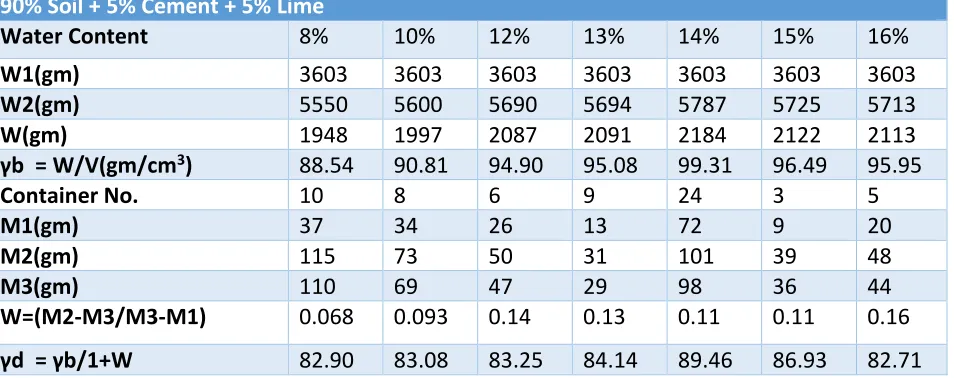
Table 5.3 MDD & OMC For 90% + 5% Cement + 5% lime
90% Soil + 5% Cement + 5% Lime
Water Content 8% 10% 12% 13% 14% 15% 16%
W1(gm) 3603 3603 3603 3603 3603 3603 3603
W2(gm) 5550 5600 5690 5694 5787 5725 5713
W(gm) 1948 1997 2087 2091 2184 2122 2113
γb = W/V(gm/cm3) 88.54 90.81 94.90 95.08 99.31 96.49 95.95
Container No. 10 8 6 9 24 3 5
M1(gm) 37 34 26 13 72 9 20
M2(gm) 115 73 50 31 101 39 48
M3(gm) 110 69 47 29 98 36 44
W=(M2-M3/M3-M1) 0.068 0.093 0.14 0.13 0.11 0.11 0.16
γd = γb/1+W 82.90 83.08 83.25 84.14 89.46 86.93 82.71
Organized by S.V.B.I.T., Gandhinagar. Available Online at www.ijpret.com19
6. CONCLUSION
By observations of above results it is clearly identified that for 100% soil MDD is 83.55 gm/cm3,
for replacement of soil by 5% of cement to its dry weight MDD is 85.54 gm/cm3, and for
replacement of soil by 5% cement and 5% lime MDD is 89.46 gm/cm3. Which shows continuous
improvement in the dry density of soil after stabilizing it with cement and lime. It is also observed that the combination of cement and lime gives higher value of dry density than cement stabilized soil. By above results it is conclude that for further improvement of soil in fundamental as well as in engineering properties we can apply stabilization to the soil with combination of cement and lime.
7. REFERENCES
1. A.H. Alavia, A.H. Gandomia,b, M. Gandomic and S.S. Sadat Hosseinid, “Prediction of maximum dry density and optimum moisture content of stabilised soil using RBF neural networks”, The IES Journal Part A: Civil & Structural Engineering Vol. 2, No. 2, May 2009, 98– 106, p – 98 to 106
2. Ankit J. Patel Sachin N. Bhavsar, 2014, “Analysis of Clayey Soil using Waste Material”, International Journal for Innovative Research in Science & Technology| Volume 1 | Issue 6 | November 2014 ISSN (online): 2349-6010, p – 125 to 130.
3. F.G. Bell, “Lime stabilization of clay minerals and soils”, Department of Geology and Applied Geology, University of NataL Private Bag XIO, Dalbridge, 4014, South Africa
4. Received 12 April 1995; accepted 19 January 1996, p – 223 to 237.
5. Murad abu – Farsakh, Julian coronel, Mingjiang Tao, “Effect of Soil moisture content and dry density on cohesive soil – geosynthetic interaction using large direct shear test”, Journal of materials in civil engineering ASCE/July 2007, p – 540 – 549.
6. P. Talukdar & B. Sharma, “Determination Of Compaction Characteristics Of Soil By Static Compaction Method”, north east students geo-congress on advances in geotechnical engineering-2014 (nes –geocongress 2014) 18th october 2014, iit-guwahati, p – 1 to 8.
7. Sachin N. Bhavsar, Hiral B. Joshi, Priyanka k. Shrof, Ankit J. Patel, “Effect Of Burnt Brick Dust On Engineering Properties On Expansive Soil”, International Journal of Research in Engineering and Technology eISSN: 2319-1163 | pISSN: 2321-7308, p – 433 to 441.
Organized by S.V.B.I.T., Gandhinagar. Available Online at www.ijpret.com20 Management (IJAIEM) Web Site: www.ijaiem.org Email: [email protected] Volume 3, Issue 11, November 2014 ISSN 2319 – 4847, p – 200 to 206.
9. Fig 3.1 soil: - https://www.cityfirewood.co.nz/products/top-soil
10. Fig 3.2 Cement: -
https://www.google.co.in/url?sa=i&rct=j&q=&esrc=s&source=images&cd=&cad=rja&uact=8&v ed=2ahUKEwjXko_G0ubdAhUCdysKHah_ApcQjRx6BAgBEAU&url=https%3A%2F%2Fwww.cityfir
ewood.co.nz%2Fproducts%2Ftop-soil&psig=AOvVaw1rQV6R8NS08-aRqiA-OSLH&ust=1538531462639787
11. Standard Proctor Test (Indian Standard 2720 – Part-7, 1980)
12. Fig 3.3 Lime: - https://theconstructor.org/geotechnical/compaction-test-soil-proctors-test/3152/
13. Fig 4.1 Standard Proctor test Equipment’s, Book: Soil mechanics, R. P. Rethaliya, Atul prakashan, edition: 2015 - 2016