Please cite this article as: H. Bonakdari, M. Tooshmalani, Z. Sheikh, Predicting Shear Stress Distribution in Rectangular Channels Using Entropy Concept, International Journal of Engineering (IJE), TRANSACTIONS C: Aspects Vol. 28, No. 3, (March 2015) 360-367
International Journal of Engineering
J o u r n a l H o m e p a g e : w w w . i j e . i r
Predicting Shear Stress Distribution in Rectangular Channels Using Entropy Concept
H. Bonakdari*a, M. Tooshmalanib, Z. Sheikha
a Department of Civil Engineering, Razi University, Kermanshah, Iran b Water and Wastewater Research Center, Razi University, Kermanshah, Iran
P A P E R I N F O
Paper history:
Received 16 August 2014
Received in revised form 15 November 2014 Accepted 18 December 2014
Keywords: Tsallis Entropy Open Channel Shear Force Channel Wall Channel Bed
A B S T R A C T
This study makes use of the Tsallis entropy to predict the shear stress distribution in rectangular channels. Given a definition of the Tsallis entropy, it is maximized using the probability density function, which then is used to attain a novel shear stress equation. This is then employed for calculating the shear stress distribution in rectangular channels in different aspect ratios and finally, for viability, these calculations are compared with some relevant experimental results. This derived shear stress equation is capable of describing the variation of shear stress in both the wall and the bed of channels. The comparison shows that this equation appears to be efficient for predicting the shear stress distribution in rectangular open channels. The shear force percentage and mean values of the bed and wall shear stress calculated by the proposed equation have good agreement with the experiments.
doi: 10.5829/idosi.ije.2015.28.03c.04
1. INTRODUCTION1
The distribution of boundary shear stress throughout the cross section is important in predicting flow resistance and sediment transport [1]. Boundary shear stress in rectangular channels has been investigated in many studies. However, using laboratory equipment to measure shear stress seems to be complicated, time consuming and also expensive. For a given cross section, as shear stress is related to the hydraulics of flow and the structure of secondary flow cells and because it is not possible to measure these parameters directly, many researchers have used some equations such as Reynolds averaged Navier-Stokes equations [2-4], logarithmic equation [5], geometry equation [6, 7], besides experimental methods [8, 9], to introduce some theoretical equations for predicting the boundary shear stress distribution in open channels.
Given the capacity of entropy concept in solving complex problems, it has been applied widely for problems in hydrology, hydraulic and water resources
1*Corresponding Author’s Email: [email protected] (H.
Bonakdari)
[10-13]. The entropy concept provides an excellent vehicle for introducing probability into hydraulics, making dealing with uncertainties inherent in hydraulic processes possible and helping to develop sampling schemes in addition to the modelling and the estimation of parameters mentioned earlier. Based on the Shannon entropy [14], Chiu [15] proposed a new approach to the problem by introducing the principles of the maximum entropy and the probability concept into hydraulics, in order to develop new equations for estimating the distribution of both velocity and shear stress in open channels. Based on this Chiu’s work, some more researches like those of Chiu [16] and Sterling and Knight [17] used the Shannon entropy principle to predict shear stress distribution in open channels.
Previous studies have shown that entropy can provide an effective tool for finding new avenues in hydrology and water resources research [18]. Tsallis [19] proposed a generalization of the celebrated Boltzman - Gibbs entropic measure. It is one of a family of functions for quantifying the diversity, uncertainty or randomness of a system. The Tsallis entropy is a generalization of the Shannon entropy.
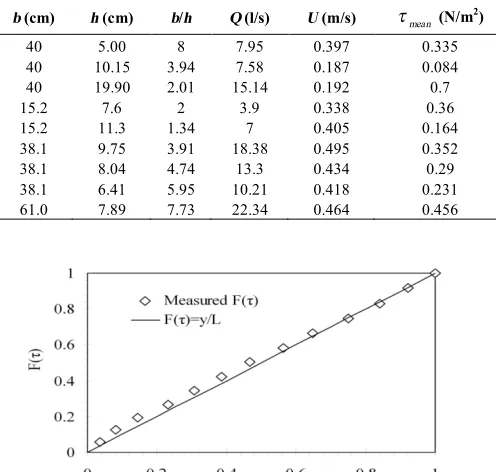
TABLE 1. Summary of experimental data.
b (cm) h (cm) b/h Q (l/s) U (m/s) tmean (N/m2)
) (w mean
t (N/m2)
) (b mean
t (N/m2) References
40 5.00 8 7.95 0.397 0.335 0.295 0.417 Tominaga et al. [5]
40 10.15 3.94 7.58 0.187 0.084 0.078 0.098 Tominaga et al. [5]
40 19.90 2.01 15.14 0.192 0.7 0.667 0.766 Tominaga et al. [5]
15.2 7.6 2 3.9 0.338 0.36 0.34 0.378 Knight et al. [8]
15.2 11.3 1.34 7 0.405 0.164 0.41 0.465 Knight et al. [8]
38.1 9.75 3.91 18.38 0.495 0.352 0.548 0.640 Knight et al. [8]
38.1 8.04 4.74 13.3 0.434 0.29 0.481 0.567 Knight et al. [8]
38.1 6.41 5.95 10.21 0.418 0.231 0.359 0.415 Knight et al. [8]
61.0 7.89 7.73 22.34 0.464 0.456 0.37 0.529 Knight et al. [8]
Figure 1. Estimated cumulative probability function of shear stress using experimental results of Tominaga et al. [5].
The main objective of this study was to develop a new shear stress distribution equation for open channel flows using the Tsallis entropy concept. A general formula for a shear stress distribution was derived using the entropy maximization principle and the calculus of variation. Then the measured data obtained from an open channel were used to test the validity and applicability of the model. The predicted values of the cross-sectional shear stress were in good agreement with the experimental data.
2. MATERIAL AND METHODS
2. 1. Experimental Data In this research a combination of the lab test results by Tominaga et al. [5] and Knight et al. [8] was used. The most important flow conditions and shear stress measurements are tabulated in Table 1 (b = channel width, h = depth of flow, b/h = aspect ratio, Q = discharge, U = mean velocity, tmean= average shear stress, tmean(w)= average shear stress at wall, tmean(b)= average shear stress at bed).
2. 2. Cumulative Probability Function Depending on the hydraulic conditions, the shear stress changes at every point in the channel boundaries; therefore it is hypothesized that shear stress is random at each point of the channel boundary. In order to employ entropy theoretically, a cumulative probability function of shear
stress is required. If the channel boundary changes from 0 to L, it is assumed that at a point where the distance is
y from the boundary, it can be stated hypothetically that the probability of shear stress is equal to or less than (t
is y/L) or that the shear stress cumulative probability function can be defined as the ratio of y to L, as follows [Equation (1)]:
L y d f
F( ) ( ) /
0
= =
ò
tt t
t (1)
where F(t) is the cumulative probability function of shear stress, t is the shear stress, y denotes the distance from the boundary and L represents the total wetted perimeter. The probability density function is shown in Equation (2):
t t
t t
d dy L d dF
f( )= ( )=1 (2)
To verify the hypothesis, the cumulative probability function (F(t)) was calculated from the shear stress experimental results in a rectangular open channel obtained by Tominaga et al. [5]. Figure 1 compares the cumulative probability function (F(t)) for b/h=7.37 derived from Tominaga’s results against the ratio (y/L). The outcome thus obtained shows that the cumulative probability function (F(t)) obeys the ratio proposed by Equation (1). Comparable results were observed for the other cases.
2. 3. Tsallis Entropy The Tsallis information entropy is the measure of uncertainty in the information. Tsallis [19] introduced a generalized form of entropy,
H, for a continuous variable, expressed quantitatively in terms of probability as (Equation (3)):
) 1 ( 1 1 1
1
1 1
1 1
-= =
-= úû ù êë
é
-=
å
å
mi n
i i n
i m
i m P P
P m
H (3)
where n is the number of the sampling points, Pi=P(ti), i
= 1, 2,…, n are the probabilities of shear stress t =ti, i =
1,2,… n, and m is a real number. H is the maximum if
Pi=1/n for m≥0, whereas it is the minimum for m<0. In a
and t =tmax) the Tsallis entropy can be expressed as (Equation (4)): úû ù êë é -=
-=
ò
ò
max-0
1 max
0 1 ( )(1 ( ) )
1 )) ( ( 1 1
1 t t
t t t t
t f f d
m d f m
H m m (4)
2. 3. 1. Principle of Maximum Entropy To identify the probability density function, f(t), the entropy maximization principle may be applied, formulated by Jaynes [20]. This principle implies that when making inferences based on incomplete information, in order to depict the probability distribution, one must have the maximum entropy permitted by the information available, which is expressed in the form of constraints. With the maximization of the entropy, a continuous random variable can be obtained using a technique of mathematical maximization from the calculus of variation such as the method of Lagrange multipliers. By applying this method, the maximization of the shear stress probability density function, f(t), can be obtained. This must satisfy the attributes of the probability function [15]. Therefore the two constraints on f(t), those of probability and continuity, include Equation (5) and Equation (6), as follows:
1 ) (
max
0
1=
ò
=t t t d f C (5) mean d f
C =
ò
tmaxt t t =t 02 ( ) (6)
where τmean is the mean value of shear stress and f(t)
is the shear stress probability density function.
2. 3. 2. Probability Density Function To define the shear stress probability density function, f(t), the Tsallis entropy expressed by Equation (4) should be maximized, subject to the constraints of Equations (5) and (6). Lagrange coefficients are used for maximizing the entropy function for m>0 [Equation (7)], as follows:
( )
(
)
[ ] [ ] 0) ( ) ( ) ( ) ( ) ( 1 ) ( 1 1 )
( 1 2
1 = ¶ ¶ + ¶ ¶ + úû ù êë é -¶ ¶ -t t t l t t l t t t f f f f f f m f m (7)
where l1 and l2 are the Lagrangian multipliers. So, we get Equation (8):
(
)
÷ø ö ç
è
æ + +
-= -t l l
t 1 2
1 1 1 1 ) ( m m m f m (8)
By replacing, 1
1 1 l l + -= ¢
m , the Equation (8) can be
expressed in the form of Equation (9):
[
]
11 2 1 ) ( ÷ -ø ö ç è
æ - ¢+
= m
m m
f t l lt (9)
This equation is the probability density function.
2. 3. 3. Using Tsallis Entropy to Estimate Shear Stress Equation By substituting the probability density function [Equation (9)] into the constraint [Equation (1)], we obtain Equation (10):
[
]
ò
÷ =ø ö ç
è
æ - ¢+
= t l lt - t
t 0 1 1 2 1 ) ( L y d m m
F m (10)
After integrating them, we get Equation (11):
2 1 2 2 l l l l l
t - ¢
ú ú û ù ê ê ë é + ÷ ø ö ç è æ ¢ = k k L y k k (11) where 1 -= m m
k , m an exponent parameter in the
Tsallis equation with real values, L equals to the total wetted perimeter and y is the channel wall direction which changes from 0 to L. Equation (11) describes the shear stress distribution in the open channels. Singh and Luo [21] proposed the value of m = 3/4. The two other parameters are l¢ and l2, which can be evaluated by substituting the Equation (9) into the constraints, Equation (5) and Equation (6), to get Equation (12) and Equation (13):
[
] [ ]
k k kk2 max
2t l l
l
l¢+ - ¢ = (12)
[
]
[
]
[ ]
1 max 2 2 1 max 2 2 2 max 2 2 max 1 1 1 1 1 1 t l l t l l l t l l l t k k k k k k = ¢ + + + ¢ + -+ ¢ + + (13)where tmax and tmean are the maximum and mean shear
stress values on the wall and the bed of the channel.
2. 4. Shear Force Percentage The shear force percentage carried by channel walls ,%SFw, results from integration over the wall boundary shear stress at channel walls. Knight et al. [9] proposed an empirical relationship for the prediction of the shear force percentage carried by the walls [Equation (14)], as follows:
(
)
(
3.23log / 1 4.6052)
exp
%SFw=Csf - Pb C2Pw+ + (14)
where Csf =1 for Pb/Pw <6.546, unless
(
)
0.28471 / 5857 .0 b w
sf P P
C = and in a subcritical flow
5 . 1 2=
(
b w)
w w
mean SF P P
gRS 0.01% 1 /
) ( = + r t (15)
(
)
÷÷ ø ö çç è æ + -= w b w b mean P P SF gRS / 1 1 % 01 . 0 1 ) ( r t (16)[
0.7108]
) max( ) / ( 0372 . 2 % 01 .
0 w b w
w SF P P
gRS =
r t
(17)
[
0.3287]
) max( ) / ( 1697 . 2 ) % 01 . 0 1 ( -
-= w b w
b SF P P
gRS
r t
(18)
where tmean(w) and tmean(b) are the average shear stress at the wall and bed, respectively, r is the fluid density, g
represents the gravitational acceleration, R is the hydraulic radius, S denotes the bed slope, Pb and Pd are
the wetted perimeter corresponding to the bed and wall of the channel, respectively, tmax(w) and tmax(b)are maximum shear stress at the wall and bed, respectively. Thereby, for a given channel, depending on the water depth and the bed slope, the transverse distribution of shear stress can be estimated.
2. 5. De inition of y Axis Considering the turbulent flow in a prismatic channel, Einstein [22] suggested separating the shear forces on the bed and sidewall. He divided the cross section to two distinct regions, the region influenced by the channel bed and that influenced by the channel walls. Based on this hypothesis, Guo and Julien [2], Khodashenas and Paquier [7], Knight et al. [9], Sterling and Knight [17], and Yang and Lim [23] predicted separately the shear stress on the channel wall and the bed.
In a rectangular channel, the maximum shear stress on the bed is located in the middle of the channel bed. At the channel corners the shear stress tends to reach a minimum value. The distribution of the side wall shear stress in a rectangular open channel has the maximum value almost in the middle of the side wall and decreases to a minimum value towards the channel corners and the free surface [24, 25]. The variation of the shear stress obtained by this method is more realistic than that obtained by other methods, because zero stress is obtained in the corner. Based on Equation (11) and investigating the given results above, y should be defined as follows [Equation (19)]:
2 1 2
2 ( /2) l
l l
l l
t - ¢
ú ú û ù ê ê ë é + ÷ ø ö ç è æ ¢ = k w w k w P y k k (19)
where Pw is the total wetted perimeter area at the
channel wall based on the Khodashenas and Paquier [7] proposition, yw changes as 0<yw≤Pw/4, i.e. by changing
yw in this range, the equation is calculated on half of the
wall and on the other half the shear stress is estimated as symmetrical to the other (see Figure 2). It is the same for the opposite wall. Again, based on Equation (11), the shear stress on the channel bed can be estimated as follows [Equation (20)]:
2 1 2
2 ( ) l
l l
l l
t - ¢
ú ú û ù ê ê ë é + ÷ ø ö ç è æ ¢ = k b b k b P y k k (20)
where Pb is the wet area on the channel bed and yb
changes as 0<yb≤Pb/2. In this case, shear stress can be
estimated for half of the channel bed and estimated symmetrically on the other half.
3. RESULTS AND DISCUSSION
3. 1. Validation of Proposed Equation In analyzing the shear stress relation Equation (11) that resulted from maximizing the Tsallis entropy, we aimed at estimating the shear stress distribution along the whole wet wall in a rectangular open channel. The experimental data of Tominaga et al. [5] and Knight et al. [8] were used to validate the proposed equation. Figures 3 and 4 show the shear stress distribution in a rectangular channel with different b/h ratios. The straight lines represent the shear stress values obtained by the proposed equation, and the points are the experimental data. Figure 3 shows the results for the non-dimensionalized mean wall shear stress from the proposed model against the experimental results. As shown in Figure 3, the maximum difference in the results is observed on the free surface and near the corner. Indeed, a precise experimental estimation of the shear stress is extremely difficult. In the central region of the wall channel (0.2<y/h<0.8) the shear stress becomes more uniform around the boundary and the maximum shear stress value is located almost in the middle of the side wall. Consequently, the predicted distribution can be taken as the better estimate. The distribution of the side wall shear stress in a rectangular open channel has the maximum value on y/h=0.5 and decreases to zero towards the channel corners and on nearing the free surface [7, 24].
Figure 3. Shear stress distribution along wall of rectangular channel with different b/h.
Figure 4. Shear stress distribution along bed of rectangular channel with different b/h.
0 0.2 0.4 0.6 0.8 1 1.2
0 5 10 15 20
b/h
tmean(b)
/
r
gRS
Eq. Prasad and Manson (2002) Eq. Knight et al. (1984) Present model Lane (1953) Ghosh and Roy (1970) Knight (1981) Noutsopoulos and Hadjipanos (1982) Knight et al. (1984) Galip et al. (2006) Myers (1978)
Cruff (1965) Kartha and Leutheusser (1970)
Figure 5. Dimensionless mean bed shear stress in rectangular channel with different b/h.
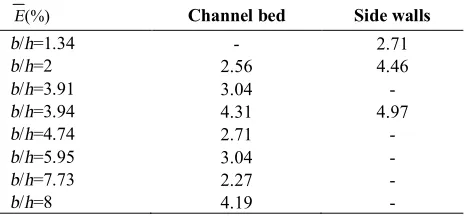
TABLE 2. Average measured error in height flow depths on rectangular channel bed and walls.
(%)
E Channel bed Side walls
b/h=1.34 - 2.71
b/h=2 2.56 4.46
b/h=3.91 3.04 -
b/h=3.94 4.31 4.97
b/h=4.74 2.71 -
b/h=5.95 3.04 -
b/h=7.73 2.27 -
b/h=8 4.19 -
As shown in Figure 4, in all cases the shear stress distribution follows the same behaviour on the channel bed, the maximum shear stress is observed in the middle of the channel bed (x/(b/2)=1), however, the shear stress value changes accordingly. Due to the secondary current effect on the shear stress distribution, this approach overestimates the shear stress value near the corner. At the channel corners the shear stress tends to reach a minimum value. Table 2 illustrates the average error for height aspect ratios on rectangular channel bed and walls.
Mean values of the bed and wall shear stress, tmax(b)
and tmax(w), were non-dimensionalized by rgRS and
plotted against the aspect ratio. Figures 5 and 6 show the comparison of the predictions of the present model for the dimensionless mean bed and sidewalls shear stress for different ratios of b/h with experimental measurements for a rectangular open channel. The existing experimental data in rectangular open channels have been documented by Khodashenas et al. [26]. This data set comprises those of Knight et al. [8], Prasad and Manson [23], Ghosh and Roy [24], Lane [26], Cruff [27], Kartha and Leutheusser [28], Myers [29], Knight [30], Noutsopoulos and Hadjipanos [31] and Galip et al. [32]. The experimental data are taken from the references listed in the legend of Figure 5. The results of the present model have good agreement with the experimental data. All equations seem to be suitable predictor of the mean bed shear stress for channels with
b/h>5. As can be seen from Figure 5, as the aspect ratio (b/h) increases, the dimensionless bed shear stress becomes uniform. This is due to a decrease in the intensity of the secondary current in the cross section, which is well predicted by all models.
The calculated distribution of the wall shear stress is compared in Figure 6 with representative measurements made in rectangular open channel. The data set includes those of Ghosh and Roy [24], Lane [26], Cruff [27], Kartha and Leutheusser [28], Myers [29], Knight [30], Noutsopoulos and Hadjipanos [31], Galip et al. [32] and Knight and Hamed [33]. The shear stress is normalized by the rgRS and the data points shown here have been taken off through the published measurements. The measurements display considerable scatter for b/h<6 so that it is difficult to compare the different models. The computed values by the present model are lower than the experimental data for channels with b/h < 6. The measurements of Knight [30] and Noutsopoulos and Hadjipanos [31] show the highest values for 2<b/h<6 and a tendency to increase as the b/h is increased.
0 0.2 0.4 0.6 0.8 1 1.2
0 5 10 15 20
b/h
tmean(w)
/
r
gRS
Eq. Prasad and Manson (2002) Eq. Knight et al. (1984) Present model Lane (1953) Ghosh and Roy (1970) Knight (1981) Noutsopoulos and Hadjipanos (1982) Knight et al. (1984) Galip et al. (2006) Myers (1978)
Cruff (1965) Kartha and Leutheusser (1970)
Figure 6. Dimensionless mean sidewall shear stress in rectangular channel with different b/h.
0 20 40 60 80 100
0 2 4 6 8 10
Pb/Pw
%
SFw
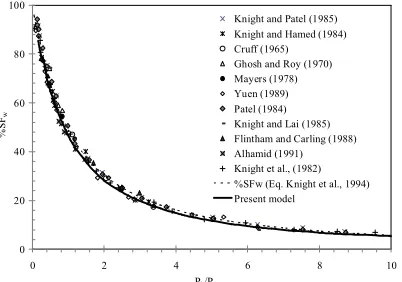
Knight and Patel (1985) Knight and Hamed (1984) Cruff (1965) Ghosh and Roy (1970) Mayers (1978) Yuen (1989) Patel (1984) Knight and Lai (1985) Flintham and Carling (1988) Alhamid (1991) Knight et al., (1982) %SFw (Eq. Knight et al., 1994) Present model
Figure 7. Comparison of shear force percentage of Equation (17) with those of various works.
The data set includes those of Knight et al. [34], Ghosh and Roy [24], Cruff [27], Knight and Hamed [33], Myers [29], Knight and Patel [35], Yuen [36], Patel [37], Knight and Lai [38], Flintham and Carling [39] and Al Hamid [40]. The calculated SFw% decreases
monotonically with the Pb/Pw ratio. As can be seen in
Figure 7, the shear force percentage calculated from the proposed equation seems better correlated with the experimental measurements and the Knight et al. [9] empirical equation.
Based on all these considerations, it may be concluded that if m=3/4, Equation (17) seems to be efficient for predicting the shear stress distribution in a rectangular open channel as well as for estimating the velocity distribution, as proposed by Singh and Luo [21].
4. CONCLUSION
By maximizing theTsallis entropy in an equal chance probability case, this study introduces a novel equation to predict the shear stress distribution at the boundary in
rectangular open channels. This equation includes the variables l' and l2, where these parameters can be
estimated at the boundary conditions. Selected experimental results obtained for a rectangular channel were used to validate the proposed equation. The comparisons between the predicted and these experimental results were in good agreement. The calculated mean values of the bed and wall shear stress for different aspect ratios were also compared with the
validated experimental measurements. These
comparisons demonstrated a close correlation between the results of the actual experiments and those attained by use of the proposed equation, and thus obtained shear force percentages were in good agreement also with the data in literature.
6. ACKNOWLEDGMENTS
The authors would like to express their appreciation to Ellen Vuosalo Tavakoli for final editing of the English text.
7. REFERENCES
1. Mohammadi, M., "Resistance to flow in a v-shaped bottom channel", International Journal of Engineering-Transactions B: Applications, Vol. 17, No. 4, (2004), 341.
2. Guo, J. and Julien, P.Y., "Shear stress in smooth rectangular open-channel flows", Journal of Hydraulic Engineering, Vol. 131, No. 1, (2005), 30-37.
3. Bonakdari, H., Larrarte, F. and Joannis, C., "Study of the shear stress in narrow channels: Application to sewers", Urban Water Journal, Vol. 5, No. 1, (2008), 15-20.
4. Javid, S. and Mohammadi, M., "Boundary shear stress in a trapezoidal channel", International Journal of Engineering-Transactions A: Basics, Vol. 25, No. 4, (2012), 323. 5. Tominaga, A., Nezu, I., Ezaki, K. and Nakagawa, H.,
"Three-dimensional turbulent structure in straight open channel flows",
Journal of Hydraulic Research, Vol. 27, No. 1, (1989), 149-173.
6. Mohammadi, M., "Shape effects and definition of hydraulic radius in manning's equation in open channel flow",
International Journal of Engineering, Vol. 10, No. 3 (2001) 127-136.
7. Khodashenas, S.R. and Paquier, A., "A geometrical method for computing the distribution of boundary shear stress across irregular straight open channels", Journal of Hydraulic Research, Vol. 37, No. 3, (1999), 381-388.
8. Knight, D.W., Demetriou, J.D. and Hamed, M.E., "Boundary shear in smooth rectangular channels", Journal of hydraulic engineering, Vol. 110, No. 4, (1984), 405-422.
9. Knight, D., Yuen, K. and Alhamid, A., "Boundary shear stress distributions in open channel flow", Physical mechanisms of Mixing and Transport in the Environment, (1994), 51-87. 10. Jain, M. and Dhakad, M.R., "Maximum entropy analysis for
11. Bonakdari, H., "Simple method for the estimation of discharge by entropy in narrow compound sewers", Canadian Journal of Civil Engineering, Vol. 39, No. 3, (2012), 339-343.
12. Bonakdari, H. and Moazamnia, M., "Modeling of velocity fields by the entropy concept in narrow open channels", KSCE Journal of Civil Engineering, (2014), 1-11.
13. Hosseini, M. and Emamjomeh, H., "Entropy-based serviceability assessment of water distribution networks, subjected to natural and man-made hazards", International Journal of Engineering-Transactions B: Applications, Vol. 27, No. 5, (2013), 675.
14. Shannon, C.E., "A mathematical theory of communication",
ACM SIGMOBILE Mobile Computing and Communications Review, Vol. 5, No. 1, (2001), 3-55.
15. Chiu, C.-L., "Entropy and probability concepts in hydraulics",
Journal of Hydraulic Engineering, Vol. 113, No. 5, (1987), 583-599.
16. Chiu, C.-L., "Application of entropy concept in open-channel flow study", Journal of hydraulic engineering, Vol. 117, No. 5, (1991), 615-628.
17. Sterling, M. and Knight, D., "An attempt at using the entropy approach to predict the transverse distribution of boundary shear stress in open channel flow", Stochastic Environmental Research and Risk Assessment, Vol. 16, No. 2, (2002), 127-142.
18. Singh, V., "The use of entropy in hydrology and water resources", Hydrological Processes, Vol. 11, No. 6, (1997), 587-626.
19. Tsallis, C., "Possible generalization of boltzmann-gibbs statistics", Journal of Statistical Physics, Vol. 52, No. 1-2, (1988), 479-487.
20. Jaynes, E.T., "Information theory and statistical mechanics",
Physical review, Vol. 106, No. 4, (1957), 620.
21. Singh, V.P. and Luo, H., "Entropy theory for distribution of one-dimensional velocity in open channels", Journal of Hydrologic Engineering, Vol. 16, No. 9, (2011), 725-735. 22. Einstein, H.A., "Formulas for the transportation of bed load",
Transactions of the American Society of Civil Engineers, Vol. 107, No. 1, (1942), 561-577.
23. Yang, S.-Q. and Lim, S.-Y., "Boundary shear stress distributions in trapezoidal channels", Journal of Hydraulic Research, Vol. 43, No. 1, (2005), 98-102.
24. Ghosh, S. and Jena, S., "Boundary shear distribution in open channel compound", in ICE Proceedings, Thomas Telford. Vol. 49, (1971), 417-430.
25. Khodashenas, S.R., Abderrezzak, K.E.K. and Paquier, A., "Boundary shear stress in open channel flow: A comparison among six methods", Journal of Hydraulic Research, Vol. 46, No. 5, (2008), 598-609.
26. Lane, E.W., "Progress report on studies on the design of stable channels by the bureau of reclamation, American Society of Civil Engineers, (1953).
27. Cruff, R., "Cross-channel transfer of linear momentum in smooth rectangular channels", (1965).
28. Kartha, V.C. and Leutheusser, H.J., "Distribution of tractive force in open channels", Journal of the Hydraulics Division, (1970).
29. Myers, W., "Momentum transfer in a compound channel",
Journal of Hydraulic Research, Vol. 16, No. 2, (1978), 139-150.
30. Knight, D.W., "Boundary shear in smooth and rough channels",
Journal of the Hydraulics Division, Vol. 107, No. 7, (1981), 839-851.
31. Noutsopoulos, G.C. and Hadjipanos, P.A., "Discussion of" boundary shear in smooth and rough channels"", Journal of the Hydraulics Division, Vol. 108, No. 6, (1982), 809-812. 32. Seckin, G., Seckin, N. and Yurtal, R., "Boundary shear stress
analysis in smooth rectangular channels", Canadian Journal of Civil Engineering, Vol. 33, No. 3, (2006), 336-342.
33. Knight, D.W. and Hamed, M.E., "Boundary shear in symmetrical compound channels", Journal of Hydraulic Engineering, Vol. 110, No. 10, (1984), 1412-1430.
34. Knight, D., Patel, H., Demetriou, J. and Hamed, M., "Boundary shear stress distributions in open channel and closed conduit flows", Proceedings of Euromech 156-The Mechanics of Sediment Transport, Vol., No., (1982), 33-40.
35. Knight, D.W. and Patel, H.S., "Boundary shear in smooth rectangular ducts", Journal of Hydraulic Engineering, Vol. 111, No. 1, (1985), 29-47.
36. Yuen, K., "A study of boundary shear stress, flow resistance and momentum transfer in open channels with simple and compound trapezoidal cross sections", University of Birmingham, (1989),
37. Patel, H.S., "Boundary shear in rectangular and compound ducts", University of Birmingham, (1984),
38. Knight, D.W. and Lai, C.J., "Turbulent flow in compound channels and ducts", Proceedings of the 2nd International Symposium on Refined Flow Modelling and Turbulent
Measurements, Hemisphere, Washington, Vol. I2, No.,
(1985), 1-10.
39. Flintham, T. and Carling, P., "Prediction of mean bed and wall boundary shear in uniform and compositely rough channels", in International Conference on River Regime. Hydraulics Research Limited, Wallingford, Oxon UK., (1988). 267-287
Predicting Shear Stress Distribution in Rectangular Channels Using Entropy Concept
H. Bonakdaria, M. Tooshmalanib, Z. Sheikha
a Department of Civil Engineering, Razi University, Kermanshah, Iran b Water and Wastewater Research Center, Razi University, Kermanshah, Iran
P A P E R I N F O
Paper history:
Received 16 August 2014
Received in revised form 15 November 2014 Accepted 18 December 2014
Keywords: Tsallis Entropy Open Channel Shear Force Channel Wall Channel Bed
ﺪﯿﮑﭼ
دزادﺮﭘﯽﻣﯽﻠﯿﻄﺘﺴﻣيﺎﻫلﺎﻧﺎﮐردﯽﺷﺮﺑﺶﻨﺗﻊﯾزﻮﺗﯽﻨﯿﺑﺶﯿﭘﻪﺑﺲﯿﻟﺎﺴﺗﯽﭘوﺮﺘﻧآزاهدﺎﻔﺘﺳاﺎﺑﻪﻌﻟﺎﻄﻣﻦﯾا
.
ﯽﭘوﺮﺘﻧآﻒﯾﺮﻌﺗ
ﺶﻨﺗﻪﺒﺳﺎﺤﻣياﺮﺑﺪﯾﺪﺟﻪﻟدﺎﻌﻣﮏﯾنآﮏﻤﮑﺑﺎﺗهﺪﺷﻢﻤﯾﺰﮐﺎﻣ،لﺎﻤﺘﺣاﯽﻟﺎﮕﭼﻊﺑﺎﺗزاهدﺎﻔﺘﺳاﺎﺑودﻮﺷﯽﻣﻪﺋاراﺲﯿﻟﺎﺴﺗ
ددﺮﮔﻪﺋاراﯽﺷﺮﺑ
.
ﺞﯾﺎﺘﻧﺎﺑتﺎﺒﺳﺎﺤﻣﻦﯾاوهﺪﺷﻪﺒﺳﺎﺤﻣﻒﻠﺘﺨﻣدﺎﻌﺑاﺖﺒﺴﻧﺎﺑﯽﻠﯿﻄﺘﺴﻣيﺎﻬﻟﺎﻧﺎﮐردﯽﺷﺮﺑﺶﻨﺗﻊﯾزﻮﺗﺲﭙﺳ
دﻮﺷﯽﻣﻪﺴﯾﺎﻘﻣﻂﺒﺗﺮﻣﯽﻫﺎﮕﺸﯾﺎﻣزآ
.
لﺎﻧﺎﮐيﺎﻫهراﻮﯾدوﻒﮐردﯽﺷﺮﺑﺶﻨﺗﻊﯾزﻮﺗﻪﺒﺳﺎﺤﻣﻪﺑردﺎﻗﻪﻠﺻﺎﺣﯽﺷﺮﺑﺶﻨﺗﻪﻟدﺎﻌﻣ
ﺪﺷﺎﺑﯽﻣ
.
دﯽﻣنﺎﺸﻧﻪﺘﻓﺮﮔترﻮﺻﻪﺴﯾﺎﻘﻣ
ﺪﺷﺎﺑﯽﻣﯽﻠﯿﻄﺘﺴﻣﻊﻃﺎﻘﻣردﯽﺷﺮﺑﺶﻨﺗﻊﯾزﻮﺗﯽﻨﯿﺑﺶﯿﭘﻪﺑردﺎﻗﻪﻟدﺎﻌﻣﻦﯾاﻪﮐﺪﻫ
.
ﺞﯾﺎﺘﻧﺎﺑﯽﺑﻮﺧﻖﺑﺎﻄﺗ،يدﺎﻬﻨﺸﯿﭘﻪﻟدﺎﻌﻣﻂﺳﻮﺗهﺪﺷﻪﺒﺳﺎﺤﻣهراﻮﯾدوﻒﮐﯽﺷﺮﺑﺶﻨﺗﻂﺳﻮﺘﻣﺮﯾدﺎﻘﻣوﯽﺷﺮﺑيوﺮﯿﻧﺪﺻرد
درادﯽﻫﺎﮕﺸﯾﺎﻣزآ
.