Volume 2, Issue 9, September 2013
Page 36
Abstract
As the popularity of digital media is growing, and world is becoming smaller, all due to the internet connectivity and WWW phenomena, the copyright protection of intellectual properties have become a necessity for prevention of illegal copying and content integrity verification. Digital watermarking is a technique of embedding some information (usually hidden copyright notices) into an image.
The proposed approach a Robust Digital image watermarking algorithm using two levels discrete wavelet transform with Singular value decomposition. Second level DWT is performed on HL sub-band. To increase and control the strength of the watermark, we used a scale factor. One of the main contributions of the proposed technique is in decomposing the host image. Primarily the proposed technique aims to improve the robustness of the other watermarking techniques and keeps the watermarked image imperceptible. Experimental results clearly show that proposed scheme is quite resilient to various image processing attacks.
Keywords: Watermarking, Wavelet transform, singular value decomposition (SVD), Peak signal to noise ratio (PSNR),
Normalized cross correlation (NCC).
1.
Introduction
Over the past two decades, there has been a tremendous growth in computer networks and more specifically, the World Wide Web. Apart from that, it is becoming a challenge to provide the ownership for the creators from the unauthorized persons who are duplicating their data or work. This along with the exceptional increase in Computer performance has facilitated extensive distribution of multimedia data such as images over the internet quite easily. Publishers, artists, and photographers, however, may be unwilling to distribute pictures over the Internet due to a lack of security, images can be easily duplicated and distributed without the owner’s consent. Digital watermarks have been proposed as a way to tackle this tough issue [13,15].
The copyright protection of the digital media is very important because it has identified the protection of intellectual property rights. If a copyright has some problems such as copied, modified and attack, the other person is claiming that they had owned the multimedia objects. Copyright protects is usually embedded with information about the multimedia that is the copyright of owner. There are many solutions that have been proposed like Cryptography [16], Steganography and Watermarking.
The introduction of image processing tools has resulted in increased vulnerability for unauthorised copying, modifications of digital images. Besides, the data hiding technologies for digital data like digital watermarking have attracted immense attention recently [4-9].
Digital Watermarking is defined as the process of hiding a piece of digital data in the cover data which is to be protected and extracted later for ownership verification, since it makes possible to identify the author of an image by embedding secret information in it[13]. Some of the important applications of watermarking technique are copyright protection, ownership verification, finger printing, and broadcast monitoring. Digital watermarking provides a possible solution to the problem of easy editing and duplication of images, [2-3].
Depending upon the domain in which the watermark is inserted, these techniques are basically classified into two categories, i.e., spatial-domain and transform-domain methods. Embedding the watermark into the spatial domain component of the original image is an easy technique as watermark is inserted directly onto the pixel level. It provides some advantages of low complexity and easy implementation. However, the spatial-domain methods are generally fragile to image processing operations or other attacks. Transform domain techniques are used to embed the watermark by modulating the magnitude of coefficients in a transform domain, such as discrete cosine transform, discrete wavelet transform (DWT), and singular value decomposition (SVD) [3-6]. The transform domain techniques are usually preferred over spatial domain techniques because they are much more I secure in presence of noise.
A digital watermark is an unnoticeable signal added to digital data, known as cover work, which can possibly be identified at a later stage for ownership proof.
Ideal properties of a digital watermark:
1.
A digital watermark should be imperceptible, meaning that it should be perceptually invisible to prevent obstruction of the original image.Goodput Enhanced Digital Image
Watermarking Scheme Based on DWT and
SVD
Ambika Agarwal
1, Neha bora
2and Nitin Arora
31Assistant Professor, Dept. of IT, Uttaranchal Institute of Technology, Uttaranchal University, Dehradun, Uttarakhand, INDIA
Volume 2, Issue 9, September 2013
Page 37
2.
Watermarks should be robust to filtering, additive noise, compression, cropping and other forms of image manipulations.Watermarks can be categorized into non blind, semi-blind and blind schemes on basis of the requirements for watermark extraction [7]. Some of the conventional wavelet watermarking techniques embeds the watermark in the components of the first level DWT. Other techniques, that perform a second level decomposition, obtain the approximation sub-band from the first level decomposition, and then decompose it further [8][9].
This paper, proposed an embedding scheme uses a two level decomposition. One of the main contributions of the proposed technique is in decomposing the host image. Primarily the proposed technique aims to improve the robustness of the other watermarking techniques and keeps the watermarked image imperceptible.
The rest of the paper is organized as follow. Section II describes the related work. Section III describes the proposed technique watermark embedded and extraction process in Section IV we shows theexperimental results against various attacks. Conclusion and future work arepresented in section V and all the used references are describes in section VI.
2.
R
ELATEDW
ORKXia, Boncelet, and Arce [14] proposed a watermarking scheme based on the Discrete Wavelet Transform (DWT). This algorithm proposed that decoding process involved taking the DWT of a potentially marked image. Sections of the watermark were extracted and correlated with sections of the original watermark. If the cross-correlation was above a threshold, then the watermark was detected. Otherwise, the image was decomposed into finer and finer bands until the entire, extracted watermark was correlated with the entire, original watermark. This technique proved to be more robust than the DCT method when embedded zero-tree wavelet compression and half-toning were performed on the watermarked images.
S.Ramakrishnan, T.Gopalakrishnan, K.Balasam [1] proposed a hybrid image watermarking algorithm which satisfies both imperceptibility and robustness requirements and used singular values of Wavelet Transformation’s HL and LH sub bands to embed watermark. Further to increase and control the strength of the watermark, an optimal watermark embedding method is developed to achieve minimum watermarking distortion. A secret embedding key is designed to securely embed the fragile watermarks, so that the new method is robust to counterfeiting.
Chih-Chin Lai and Cheng-Chih Tsai [2] proposed an image-watermarking technique to satisfy both imperceptibility and robustness requirements. To achieve this, they proposed a hybrid image-watermarking scheme based on discrete wavelet transform (DWT) and singular value decomposition (SVD). The proposed approach is not embedded watermark directly on the wavelet coefficients but rather than on the elements of singular values of the cover image’s DWT sub-bands.
3.
B
ACKGROUNDR
EVIEW ANDP
ROPOSEDW
ORK3.1 DWT
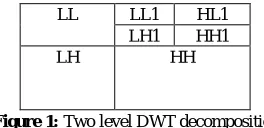
Discrete wavelet transform is a multi-resolution decomposition of a signal. The low pass filter applied along a certain direction extracts the low frequency (approximation) coefficients of a signal. On the other hand, the high pass filter extracts the high frequency (detail) coefficients of a signal [11]. In 2D applications, for each level of decomposition, first perform the DWT in the vertical direction, followed by the DWT in the horizontal direction. After the first level of decomposition, there are 4 sub-bands: LL1, LH1, HL1, and HH1. Each component undergoes two levels of decomposition. LH1, HL1, and HH1 contain the highest frequency bands present in the image tile, while LL1 contains the lowest frequency band. The two-level DWT decomposition is shown in Figure 1.
LL LL1 HL1
LH1 HH1
LH HH
Figure 1: Two level DWT decomposition 3.2 SVD
Singular value decomposition is a linear algebra technique used to solve many mathematical problems [8].
Any image can be considered as a square matrix without loss of generality. So SVD technique can be applied to any kind of images. SVD approach has found use in watermarking field because of the fact that singular values obtained after decomposition of the image matrix are very stable and do not change on introduction of small perturbations[14].
The SVD belongs to orthogonal transform which decompose the given matrix into three matrices of same size [11]. To decompose the matrix using SVD technique it need not be a square matrix. Let us denote the image as matrix A. The SVD decomposition of matrix A is given using equation
T
A U S V U and V are unitary matrices such that
U*UT = I V*VT = I
Where, I is an Identity matrix.
S is the diagonal matrix having in its main diagonal all non-negative singular values of A. These positive singular values can be used to embed watermark. The order of singular matrix S is same as original matrix A[2].
3.3 PROPOSED APPROACH
Volume 2, Issue 9, September 2013
Page 38
3.3.1
Watermark embedding Process:
1) Use one-level DWT to decompose the cover image A into four sub-bands (i.e., LL, HL, LH, and HH). Further apply next one-level DWT to decompose the HL subband into four subbands (i.e., LL1, HL1, LH1, and HH1).
2)Apply SVD to HL1 subband i.e
1
T H L
A
U S V
(1) 3) Modify the singular values of HL1 subband with Watermark image, i.e.
*
T
W W W
S
W
U
S V
(2) Where, α denotes the scale factor. To control the strength of the inserted watermark scale factor is used [12]. 4) Obtain modified DWT coefficients, i.e.
*
T
H L W
A
U S
V
(3) 5) Obtain the watermarked image AW by performing two level inverse DWT.
3.3.2 Watermark extraction Process:
1) Use first level Haar DWT to decompose the watermarked image Aw into four subbands: LL, HL, LH, and HH. Further obtained LL1, HL1, LH1 and HH1 subbands by performing 2nd level DWT on HL subband.
2) Apply SVD to the HL1 subband, i.e.,
* * *
*
H L T W WA
U
S
V
(4) 3) Compute difference
*
T
W W W W
D
U
S
V
(5) 4) Extract the watermark, i.e.
W
D
S
W
(6)4.
EXPERIMENTAL RESULTS
For testing the performance of our proposed watermarking schemes for gray scale images, we are using two standard test
images, gray level test images of Lena image [512x512] for cover images and for watermark we are using cameraman image
[128x128] pixel.
Quality of the watermarked image is calculated using peak signal to noise ratio (PSNR). PSNR of an image can be
calculated using the mean squared error. The mean squared error (MSE) between the original image and the watermarked
image is given by:
1 11
( , )
'( , )
M N i JMSE
I i j
I i j
MN
(7)where, I(i , j)and I’(i , j) denote the pixel value at position(i, j)of the original image I and the watermarked image I’. Both having sizes M x N pixels. Thus, Peak signal to noise ratio (PSNR) can be given by
MSE
PSNR
2 10255
log
10
(8)To test the robustness of the proposed scheme, the watermarked image is tested against various image processing attacks like cropping (CR), rotation (RO), Gaussian noise (GN, variance 0.01), salt & pepper noise (S & P, 0.05), Median filtering (MF, [3 3]), Average filtering (AF), JPEG compression(JPEG, 30%), Contrast Adjustment (CA, 1.5) and histogram equalization (HE). Normalized correlation (NC) is employed to evaluate the robustness of the algorithm. The Normal Correlation (NC) between the embedded watermark, W (i, j) and the extracted watermark W*(i, j) is
given by,
Mw i Nw j Mw i Nw j Mw i Nw j j i W j i W j i W j i W NC 1 1 2 * 1 1 2 1 1 * )] , ( [ )] , ( [ )] , ( )].[ , ( [ (9)Here W and Wf are the original watermark and extracted watermark.
Volume 2, Issue 9, September 2013
Page 39
Table 1: shows the scale factor, PSNR and NC without any image processing attack
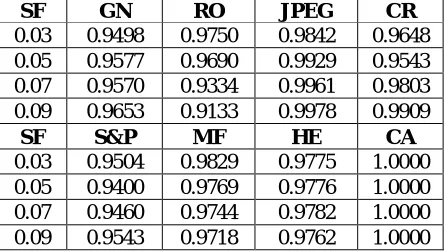
Table 2:
Normalized Correlation Values of Extracted Watermarks against Different Attacks
Experimental results shown in Table II describe the resilient nature of the watermarking scheme for aforementioned attacks.
As the scale factor is gradually increased from 0.01 to 0.07 we can observe an increase in the normalized correlation values
of the extracted watermarks also signifying degradation in the watermarked image quality as increasing the scale factor
adversely affects the imperceptibility of the embedded watermark. Table III also suggests that we obtain moderate results in
case of rotation Gaussian noise introduction.
Table 3:
Experimental Result under Gaussian Noise and Rotation (NC values)
Standard
Variance
0.01
6
20
60
100
Proposed
Scheme
0.95
0.86
0.86
0.86
0.86
Rotation
(Anti clockwise)
45
○135
○225
○315
○Proposed
Scheme
0.86 0.87 0.88 0.85
To test the robustness of the watermarking scheme, to a greater extent, we subject the watermarked image to various image
processing attacks varying different parameter and keeping the scale factor constant (0.05). In case of Gaussian noise we
vary the standard variance. In case of rotation we rotate the watermarked image clockwise at various angles. JPEG
compression is one of the most important attacks which can have extremely adverse effect on the watermarked image as well
as the embedded watermark. Lastly, we carry out cropping of the watermarked image and extract corresponding watermark.
Results of all these attacks have been provided in the above mentioned tables. From Table III it is clear that there is no
significant degradation in the extracted watermark quality even in the presence of a large amount of noise, this proves the
robustness of the proposed scheme. Moreover, it ensures watermark delivery in every condition. Table II show the
robustness of the proposed scheme for the aforementioned attacks. The proposed scheme is clearly resilient to various image
processing attacks. MATLAB 7.6 software is being used to carry out all the experiments.
(c) (d)
Scale Factor
PSNR
NC
0.01
69.6876
1
0.03
51.8430
1
0.05
46.0586
1
0.07
42.5685
1
0.09
40.0637
1
SF
GN
RO
JPEG
CR
0.03
0.9498
0.9750
0.9842
0.9648
0.05
0.9577
0.9690
0.9929
0.9543
0.07
0.9570
0.9334
0.9961
0.9803
0.09
0.9653
0.9133
0.9978
0.9909
SF
S&P
MF
HE
CA
Volume 2, Issue 9, September 2013
Page 40
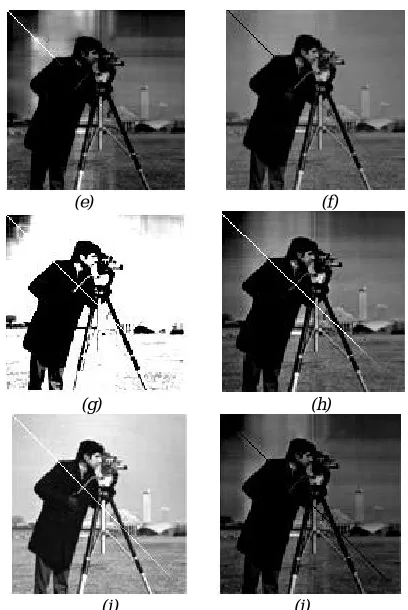
(e) (f)
(g) (h)
(i) (j)