• No results found

Fast Automatic Smoothing for Generalized Additive Models

N/A
N/A
Protected

Academic year: 2020

Share "Fast Automatic Smoothing for Generalized Additive Models"

Copied!
27
0
0

Loading.... (view fulltext now)

Full text

(1)

Fast Automatic Smoothing for Generalized Additive Models

Yousra El-Bachir

[email protected]

Anthony C. Davison

[email protected]

EPFL-FSB-MATH-STAT

Ecole Polytechnique F´

ed´

erale de Lausanne

Station 8, CH-1015 Lausanne, Switzerland

Editor:

Manfred Opper

Abstract

Generalized additive models (GAMs) are regression models wherein parameters of

proba-bility distributions depend on input variables through a sum of smooth functions, whose

degrees of smoothness are selected by

L

2

regularization. Such models have become the

de-facto standard nonlinear regression models when interpretability and flexibility are

re-quired, but reliable and fast methods for automatic smoothing in large data sets are still

lacking. We develop a general methodology for automatically learning the optimal degree

of

L

2

regularization for GAMs using an empirical Bayes approach. The smooth functions

are penalized by hyper-parameters that are learned simultaneously by maximization of a

marginal likelihood using an approximate expectation-maximization algorithm. The latter

involves a double Laplace approximation at the E-step, and leads to an efficient M-step.

Empirical analysis shows that the resulting algorithm is numerically stable, faster than the

best existing methods and achieves state-of-the-art accuracy. For illustration, we apply it

to an important and challenging problem in the analysis of extremal data.

Keywords:

Automatic

L

2

Regularization, Empirical Bayes, Expectation-maximization

Algorithm, Generalized Additive Model, Laplace Approximation, Marginal Maximum

Like-lihood

1. Introduction

State-of-the-art machine learning methods achieve impressive accuracy, but their opacity

can make them unattractive when their results contradict intuition or lack a ready

ex-planation. Methods that are interpretable by humans and easy to diagnose and debug

are needed for difficult decision-making problems in healthcare, legal settings, finance, risk

management, and many other areas. One possibility is the use of generalized additive

mod-els, a class of interpretable data-driven models used in smooth regression (Duvenaud et al.,

2011; Ba et al., 2012; Tsang et al., 2018; Mutny and Krause, 2018).

Generalized additive models (GAMs) are a class of supervised learning tools that

de-scribe the relationship between output variables and inputs using a sum of smooth functions

(Hastie et al., 2009, Chapter 9). They were introduced by Hastie and Tibshirani (1986), who

represented the smooth functions by scatterplot smoothers and trained them sequentially

by backfitting (Breiman and Friedman, 1985). The corresponding

R

(R Core Team, 2019)

package

gam

implements the methods in Hastie and Tibshirani (1990), which select the level

of smoothness by stepwise regression using approximate distributional results. Backfitting

c

(2)

allows smooth terms to be represented by local regression smoothers (Cleveland et al., 1993),

but inference based on the resulting fit is awkward. Yee and Wild (1996) later proposed

modified vector backfitting, whereby several smooth functions are learned simultaneously.

Their method, embodied in the

R

package

VGAM, first learns the linear components and then

learns the nonlinear part by training a vector additive model on the resulting partial

resid-uals. In the

R

package

gamlss, Rigby and Stasinopoulos (2005) learn the smooth functions

sequentially by combining backfitting with two algorithms, which optimize the penalized

likelihood of the regression weights. The first algorithm generalizes that of Cole and Green

(1992), whereas the second generalizes that of Rigby and Stasinopoulos (1996) and is

prefer-able when the parameters of the distribution are orthogonal with respect to the information

matrix. All these approaches invoke backfitting, which dissociates learning of the regression

model from that of the smoothing hyper-parameters. This may be statistically inefficient,

and accuracy may be increased by learning the appropriate degree of smoothing as part of

the regression training. An alternative representation of the smooth functions that enables

automatic smoothing is via basis function expansion using reduced rank smoothing; this is

the foundation upon which we build our methodology.

1.1. Model Set-up

We suppose that independent observations come from a probability distribution whose

parameters depend on generalized additive models. Let

Y

i

denote a random variable with

realized value

y

i

and probability distribution function

F

i

(

y

i

;

θ

i

) that depends on a parameter

vector

θ

i

= (

θ

i

(1)

, . . . , θ

(

i

P

)

)

R

P

; so for the training set

y

= (

y

1

, . . . , y

n

)

T

, the full parameter

vector is

θ

= (

θ

1

, . . . ,

θ

n

)

T

R

nP

with sub-vectors

θ

(

p

)

= (

θ

(

1

p

)

, . . . , θ

(

p

)

n

)

T

R

n

for

p

=

1

, . . . , P

. In the Gaussian model for example,

P

= 2,

θ

(1)

=

µ

is the mean and

θ

(2)

=

σ

is

the standard deviation, and we have

θ

= (

µ

1

, σ

1

, . . . , µ

n

, σ

n

)

T

.

For a probability distribution with

P

parameters, each

θ

(

p

)

has an additive structure,

which we now describe. Let

X

(

i

p

)

denote the

i

-th row of a feature matrix corresponding

to a regression weight vector

w

(

p

)

that includes an offset. The superscript

refers to an

intermediate notation for the regression elements that will become clear when we define the

full feature matrices corresponding to the untransformed input variables and the smooth

functions. Let

q

p

>

0 denote the number of unknown smooth functions

f

(

p

)

j

contributing

to

θ

(

p

)

, and let

x

1

,

x

2

, . . .

denote the vectors of input variables. In spatio-temporal settings

for example,

x

1

may denote the spatial location of a site and

x

2

may denote the time. The

components

θ

(

i

p

)

of

θ

(

p

)

are represented using the additive structure

θ

i

(

p

)

=

X

i

(

p

)

w

(

p

)

+

q

p

X

j

=1

f

j

(

p

)

(

x

i

1

, x

i

2

, . . .

)

,

i

= 1

, . . . , n.

(1)

Each of the

f

j

(

p

)

can be a function of one or more inputs, and is parametrized by an expansion

of basis functions

b

(

k

p

)

(

x

),

f

j

(

p

)

(

x

) =

K

X

k

=1

˜

(3)

where

w

˜

(

p

)

= ( ˜

w

(

1

p

)

, . . . ,

w

˜

K

(

p

)

)

T

R

K

is the column vector of unknown regression weights

that expand

f

j

(

p

)

, and

b

(

p

)

(

x

) =

{

b

1

(

p

)

(

x

)

, . . . , b

(

K

p

)

(

x

)

}

T

R

K

is a

K

-dimensional vector

of basis functions selected from a dictionary of readily-available functions, such as cubic

regression splines. The basis dimension

K

is chosen manually, and typically is allowed to

grow slowly with the size

n

of the training set. We assume that the smooth functions are

subject to a sum-to-zero identifiability constraint

n

X

i

=1

f

j

(

p

)

(

x

ij

) = 0

,

(3)

which leads to good coverage for confidence intervals (Nychka, 1988). In this setting, the

components of

θ

(

p

)

in (1) become

θ

i

(

p

)

=

X

i

(

p

)

w

(

p

)

, where

w

(

p

)

R

d

p

denotes the regression

weights including their parametric part indicated with superscript

and smooth part

indi-cated by a tilde in (2), and

X

(

p

)

R

n×d

p

denotes the corresponding feature matrix. We

assume that some of the columns of

X

(

p

)

have been centered to absorb the identifiability

constraint (3) on the smooth functions before training.

A GAM is characterized by the additivity of its functions of inputs and by their

smooth-ness. The latter is controlled by penalizing the curvature of the functions, using roughness

penalties on the

f

j

(

p

)

of the form

PEN(

λ

(

j

p

)

) =

λ

(

j

p

)

Z

f

j

(

p

)

00

(

t

)

2

d

t

R

,

(4)

where the regularization hyper-parameter

λ

(

j

p

)

>

0 controls the degree of smoothness, and

the integral is taken over the input range values. If the basis functions are twice

differen-tiable, the element-wise integration

S

(

j

p

)

=

Z

b

(

p

)

00

(

x

)

b

(

p

)

00T

(

x

) d

x

defines a known symmetric and semi-positive definite smoothing matrix

S

(

j

p

)

R

K×K

. The

penalty in (4) thus becomes quadratic,

PEN(

λ

(

j

p

)

) =

λ

(

j

p

)

w

(

p

)

T

S

(

j

p

)

w

(

p

)

.

On defining analogous quantities for any of the parameter vectors

θ

(1)

, . . . ,

θ

(

P

)

, and

stacking the regression weights and the smoothing hyper-parameters to form

w

R

d

and

λ

R

q

with

d

=

P

P

p

=1

d

p

and

q

=

P

P

p

=1

q

p

, the full functional parameter vector and

curvature penalties are parametrized by

θ

w

=

Xw

R

nP

,

PEN(

λ

) =

P

X

p

=1

q

p

X

j

=1

PEN(

λ

(

j

p

)

) =

w

T

S

λ

w

R

,

(5)

where the

i

-th row block of the full feature matrix

X

R

nP

×d

is

X

i

= diag

X

(1)

i

, . . . ,

X

(

i

P

)

(4)

and the full smoothing matrix

S

λ

= diag

λ

1

(1)

S

(1)

1

, . . . , λ

q

(

P

P

)

S

(

q

P

P

)

R

d×d

(6)

is block diagonal.

Learning the regression weights involves balancing the conflicting goals of providing a

good fit to the data and avoiding overfitting. For a given

λ

, this is achieved by maximizing

the penalized log-likelihood for

w

,

`

P

(

w

;

y

,

λ

) =

`

L

(

θ

w

;

y

)

1

2

w

T

S

λ

w

,

(7)

where the log-likelihood

`

L

may be written equivalently in terms of

θ

or of

w

.

Let

U

L

(

w

;

y

)

R

d

and

H

L

(

w

;

y

)

R

d×d

, or

U

L

(

θ

;

y

)

R

P n

and

H

L

(

θ

;

y

)

R

P n×P n

, denote

the gradient and negative Hessian of

`

L

with respect to

w

or to

θ

. The corresponding

penalized quantities are

U

P

(

w

;

y

,

λ

) =

U

L

(

w

;

y

)

S

λ

w

,

H

P

(

w

;

y

,

λ

) =

H

L

(

w

;

y

) +

S

λ

,

(8)

=

X

T

U

L

(

θ

;

y

)

S

λ

w

,

=

X

T

H

L

(

θ

;

y

)

X

+

S

λ

.

The negative Hessian is used to compute standard errors and confidence intervals. For

simplicity we sometimes suppress the dependence upon

y

and

λ

from the notation.

Maxi-mization of the penalized log-likelihood (7) provides an estimate for

w

for a given value of

the smoothing hyper-parameters

λ

. In Section 1.2 we briefly summarize the main classical

optimization methods for embodying learning of

λ

in that of the regression weights.

1.2. Classical Optimization

The two learning strategies for generalized additive models are performance iteration (Gu,

1992) and outer iteration (O’Sullivan et al., 1986), and optimize a criterion for the

smooth-ing hyparameters whilst updatsmooth-ing the regression weights. The updatsmooth-ing step in

per-formance iteration consists of one iteration for the regression weights, often performed by

iterative least squares (Nelder and Wedderburn, 1972), followed by one full optimization

for the smoothing hyper-parameters. Since the smoothness selection is applied to an

in-termediate estimate of the regression model, its score changes from iteration to iteration

and convergence of the overall optimization is not guaranteed, as shown by Wood (2008,

2011). The updating step in outer iteration comprises one update for the smoothing

hyper-parameters followed by one full optimization for the regression weights. Since the former

are obtained from a converged and so a fixed regression model, the convergence of outer

iteration is guaranteed, but each updating step is computationally more expensive, and the

dependence between the regression weights and the smoothing hyper-parameters makes the

calculations much more challenging.

(5)

2009; Wood, 2011). Use of marginal likelihood overcomes these limitations but involves

intractable integrals. Despite the widespread use of GAMs, automatic learning of their

smoothing hyper-parameters remains an open problem. The reliable method (Wood, 2011)

and its generalization (Wood et al., 2016), implemented in the

R

package

mgcv, combine

the advantages of the marginal likelihood approach with the good convergence of outer

iteration. However, these approaches are challenging to set up, difficult to extend to new

families of distributions, and computationally expensive for large samples. Methods

specif-ically designed for large (Wood et al., 2015) and big (Wood et al., 2017) data sets are based

on performance iteration, and so offer no guarantee of convergence to a local optimum. In

this paper we overcome these limitations by presenting an approach that is simpler, faster

and achieves state-of-the-art accuracy.

The rest of the paper is organized as follows. Section 2 introduces our proposed

au-tomatic smoothness selection procedure, which is based on an approximate

expectation-maximization algorithm. Section 3 assesses its performance with a simulation study.

Sec-tion 4 provides a real data analysis on extreme temperatures, and SecSec-tion 5 closes the paper

with a discussion.

2. Automatic Smoothing

The Bayesian perspective provides an interpretation for the roughness penalty that underlies

the weighted

L

2

regularization in the penalized log-likelihood (7), as we now describe. Let

S

λ

denote the generalized inverse of

S

λ

, and suppose that the regression weights have

an improper

N

(0

,

S

λ

) multivariate Gaussian prior density (Kimeldorf and Wahba, 1970;

Silverman, 1985),

π

(

w

;

λ

) = (2

π

)

(

d−m

)

/

2

|

S

λ

|

1

+

/

2

exp

1

2

w

T

S

λ

w

,

(9)

where

m

is the number of zero eigenvalues of

S

λ

, and

|

S

λ

|

+

is the product of its positive

eigenvalues. With

f

here denoting the density of the data, the log-posterior density for

w

is

`

(

w

|

y

;

λ

)

=

log

f

(

y

|

w

;

λ

)

π

(

w

;

λ

)

log

f

(

y

;

λ

)

=

`

P

(

w

;

y

,

λ

) +

1

2

log

|

S

λ

|

+

d

m

2

log (2

π

)

log

f

(

y

;

λ

)

.

(10)

The roughness penalty in (5) now appears as the key component of the logarithm of the

prior (9), and the penalized log-likelihood (7) appears as the log-posterior (10) (up to a

constant depending upon

λ

but not upon

w

). The smoothing hyper-parameters can hence

be learned from the last term on the right of (10), the marginal density of

y

,

L

M

(

λ

;

y

) =

f

(

y

;

λ

) =

Z

f

(

y

,

w

;

λ

) d

w

=

Z

f

(

y

|

w

;

λ

)

π

(

w

;

λ

) d

w

.

This integral is equivalent to

L

M

(

λ

;

y

) =

E

π

(

w

;

λ

)

{

f

(

y

|

w

;

λ

)

}

, which is the expectation of

the likelihood function under the prior density of the regression weight vector.

(6)

selection problem to an optimization problem, where the optimal

λ

maximize the

log-marginal likelihood

`

M

(

λ

;

y

)

=

log

L

M

(

λ

;

y

)

1

2

log

|

S

λ

|

+

+ log

Z

exp

`

P

(

w

;

y

,

λ

) d

w

,

(11)

where

indicates equality up to a constant not depending upon

λ

.

The

multidimen-sional integral over

w

is generally intractable, and its accurate and efficient computation is

challenging. The two classical strategies for this are stochastic integration methods based

on importance sampling, and deterministic methods based on quadrature or the Laplace

method. Importance sampling is a Monte Carlo integration technique under which the

inte-gral is treated as an expectation, but its performance relies on the choice of the distribution

from which to sample, and its accuracy increases only with the number of samples.

Quadra-ture involves a discretization of the integrand over the domain of integration, and amounts

to calculating a weighted sum of the values of the integrand. Both methods perform well

when the dimension

d

of the regression weight vector

w

is small, but become

computa-tionally infeasible when

d

becomes large (Vonesh et al., 2002). The most commonly used

deterministic integration method is Laplace approximation, which yields an analytical

ex-pression for (11) by exploiting a quadratic Taylor expansion of the log-integrand around

the maximum penalized likelihood estimate,

`

M

(

λ

;

y

)

=

1

2

log

|

S

λ

|

+

+

`

P

(

w

ˆ

λ

;

y

,

λ

)

1

2

log det

HP

(

w

ˆ

λ

;

y

,

λ

) +

O(n

1

),

(12)

where

w

ˆ

λ

denotes the maximizer of

`

P

for a given

λ

. However, optimization of the

re-sulting approximate log-marginal likelihood (12) is awkward. Each updating step includes

intermediate maximizations, involves unstable terms that need careful and computationally

expensive decompositions, and requires the fourth derivatives of the log-likelihood to obtain

the Hessian matrix of the log-marginal likelihood in the Newton–Raphson method (Wood,

2011; Wood et al., 2016). These difficulties make Laplace approximation computationally

demanding for smoothness selection, and limit its extension to complex models. In Section

2.1 we present a simpler alternative that is easier to implement, faster and very accurate.

Although we illustrate our ideas on generalized additive models, our automatic

smooth-ing method extends to the general settsmooth-ing of

L

2

regularization if we replace the smoothing

matrices with identity matrices. Hyper-parameter optimization based on marginal

likeli-hood in other contexts is a long-standing problem addressed by MacKay (1992, 1999), Neal

(1996), Tipping (1999, 2001), Faul and Tipping (2001), Qi et al. (2004), McHutchon and

Rasmussen (2011) and many others.

2.1. Approximate Expectation-maximization

(7)

at the best estimate

λ

k

at iteration

k

yields

`

M

(

λ

;

y

)

Q

(

λ

;

λ

k

)

K

(

λ

;

λ

k

)

,

where

indicates equality up a constant, and

Q

(

λ

;

λ

k

)

=

E

π

(

w

|

Y

;

λk

)

(

`

P

(

w

;

Y

,

λ

) +

1

2

log

|

S

λ

|

+

)

,

(13)

K

(

λ

;

λ

k

)

=

E

π

(

w

|

Y

;

λk

)

`

(

w

|

Y

;

λ

)

=

E

π

(

w

|

Y

;

λk

)

log

π

(

w

|

Y

;

λ

)

.

The E-step corresponds to the analytic calculation of the function

Q

, which is maximized

with respect to

λ

at the M-step to provide

λ

k

+1

, as input for the next EM iteration. Jensen’s

inequality implies that

K

(

λ

;

λ

k

)

6

K

(

λ

k

;

λ

k

) for all

λ

, and since

Q

(

λ

k

+1

;

λ

k

)

>

Q

(

λ

k

;

λ

k

),

we have

`

M

(

λ

k

+1

;

y

)

>

`

M

(

λ

k

;

y

). The EM algorithm thus transfers optimization of the

log-marginal likelihood

`

M

to that of

Q

, and ensures that

`

M

increases after every M-step.

Under mild conditions, the algorithm is guaranteed to reach at least a local maximum

(Dempster et al., 1977). We first construct the function

Q

used at the E-step.

2.2. E-step

Applying Bayes’ rule to the posterior for

w

, the non-trivial element of the function

Q

in

(13) is

E

π

(

w

|

Y

;

λk

)

`

P

(

w

;

Y

,

λ

)

=

Z

`

P

(

w

;

y

,

λ

)

π

(

w

|

Y

=

y

;

λ

k

) d

w

=

Z

`

P

(

w

;

y

,

λ

) exp

`

P

(

w

;

y

,

λ

k

) d

w

Z

exp

`

P

(

w

;

y

,

λ

k

) d

w

.

(14)

Both integrals are intractable. Since

`

P

may not be positive, the numerator cannot be

expressed as the integral of an exponential function, so direct Laplace approximation is

impracticable. Tierney et al. (1989) overcome this by approximating similar ratios using

the moment generating function, since (14) is the expectation of a scalar function,

`

P

, of the

regression weights, which are here treated as random variables with joint probability density

proportional to exp

`

P

(

w

;

y

,

λ

k

), the posterior density conditional on

y

as seen from (10).

For any

w

, let

`

t

(

w

;

y

,

λ

,

λ

k

) =

t`

P

(

w

;

y

,

λ

) +

`

P

(

w

;

y

,

λ

k

)

,

t

R

.

The conditional moment generating function of

`

P

(

w

;

Y

,

λ

) is thus

M(

t

) =

E

π

(

w

|

Y

;

λk

)

h

exp

t`

P

(

w

;

Y

,

λ

)

i

=

R

exp

t`

P

(

w

;

y

,

λ

)

f

(

y

,

w

;

λ

) d

w

R

f

(

y

,

w

;

λ

) d

w

=

Z

exp

`

t

(

w

;

y

,

λ

,

λ

k

) d

w

Z

exp

`

0

(

w

;

y

,

λ

,

λ

k

) d

w

(8)

Expression (15) is a ratio of two intractable integrals, each of which can be approximated

using the Laplace method. Let

ˆ

w

t

= arg max

w

`

t

(

w

;

y

,

λ

,

λ

k

)

,

w

ˆ

k

= arg max

w

`

P

(

w

;

y

,

λ

k

) = arg max

w

`

0

(

w

;

y

,

λ

,

λ

k

)

denote the maximizers of

`

t

(

w

;

y

,

λ

,

λ

k

) and

`

P

(

w

;

y

,

λ

k

), and write the negative Hessian

matrix as

H

t

(

w

;

λ

,

λ

k

) =

t

H

P

(

w

;

λ

) +

H

P

(

w

;

λ

k

), where

H

P

is given in (8).

Second-order Taylor expansion of

`

t

(

w

;

y

,

λ

,

λ

k

) around

w

ˆ

t

yields the following approximation for

the numerator of (15),

Z

exp

`

t

(

w

;

y

,

λ

,

λ

k

) d

w

=

exp

`

t

(

w

ˆ

t

;

y

,

λ

,

λ

k

)

Z

exp

(

1

2

(

w

w

ˆ

t

)

T

H

t

(

w

ˆ

t

;

λ

,

λ

k

)(

w

w

ˆ

t

)

)

d

w

{1 +

O(n

1

)}

=

(2π)

d/

2

det

H

t

(

w

ˆ

t

;

λ

,

λ

k

)

1

/

2

exp

`

t

(

w

ˆ

t

;

y

,

λ

,

λ

k

){1 +

O(n

1

)},

where the determinant is well-defined because

H

t

(

w

ˆ

t

;

λ

,

λ

k

) is positive definite at

con-vergence. On similarly applying Laplace approximation to the denominator of (15), the

conditional moment generating function becomes

M(t)

=

exp

`

t

(

w

ˆ

t

;

y

,

λ

,

λ

k

)

`

P

(

w

ˆ

k

;

y

,

λ

k

)

det

H

t

(

w

ˆ

t

;

λ

,

λ

k

)

1

/

2

det

HP

(

w

ˆ

k

;

λ

k

)

1

/

2

{1 +

O(n

2

)},

(16)

where the relative approximation error is

O

(

n

2

) rather than

O

(

n

1

) because the error

terms in the numerator and denominator almost cancel (Tierney et al., 1989, Theorem 1).

The conditional expectation (14) is obtained by differentiating (16) with respect to

t

and

evaluating the result at

t

= 0.

Whereas Tierney et al. (1989) and Steele (1996) suggest numerical computation of

such derivatives, we shall calculate them analytically.

We need d

`

t

(

w

ˆ

t

;

λ

,

λ

k

)

/

d

t

and

d det

H

t

(

w

ˆ

t

;

λ

,

λ

k

)

/

d

t

, both evaluated at

t

= 0. To simplify the notation we use d

0

·

/

d

t

to

denote d

·

/

d

t

|

t

=0

, and similarly for

0

·

/∂t

.

Calculation of

d

0

`

t

(

w

ˆ

t

;

λ

,

λ

k

)

/

d

t

.

Since

w

ˆ

t

depends upon

t

,

d

`

t

(

w

ˆ

t

;

y

,

λ

,

λ

k

)

d

t

=

`

P

(

w

ˆ

t

;

y

,

λ

) +

t

w

ˆ

t

∂t

·

∂`

P

(

w

ˆ

t

;

y

,

λ

)

w

+

w

ˆ

t

∂t

·

∂`

P

(

w

ˆ

t

;

y

,

λ

k

)

w

,

where

·

denotes the scalar product. Since

w

ˆ

t

=

w

ˆ

k

at

t

= 0, and

w

ˆ

k

maximizes

`

P

(

w

;

y

,

λ

k

),

we obtain

d

0

`

t

(

w

ˆ

t

;

y

,

λ

,

λ

k

)

d

t

=

`

P

(

w

ˆ

k

;

y

,

λ

)

.

(17)

Calculation of

d

0

det

H

t

(

w

ˆ

t

;

λ

,

λ

k

)

/

d

t

.

This requires

0

w

ˆ

t

/∂t

, which we obtain by implicit differentiation of

`

t

(

w

;

y

,

λ

,

λ

k

). At

w

=

w

ˆ

t

, we have

∂`

t

(

w

;

y

,

λ

,

λ

k

)

/∂

w

|

w

=

wt

ˆ

=

0

d

R

d

, so differentiating with respect to

t

and setting

t

= 0 yields

U

P

(

w

ˆ

k

;

λ

)

H

P

(

w

ˆ

k

;

λ

k

)

·

0

w

ˆ

t

(9)

As

U

P

(

w

ˆ

k

;

λ

) =

U

P

(

w

ˆ

k

;

λ

k

) +

S

λk

w

ˆ

k

S

λ

w

ˆ

k

=

S

λk

S

λ

ˆ

w

k

, we get from (18) that

0

w

ˆ

t

∂t

=

H

1

P

(

w

ˆ

k

;

λ

k

)

S

λk

S

λ

ˆ

w

k

.

(19)

Let

θ

ˆ

t

=

X

w

ˆ

t

R

nP

and

θ

ˆ

k

=

X

w

ˆ

k

. Using the chain rule and (19), the derivative of the

negative Hessian

H

L

,i

of the unpenalized log-likelihood corresponding to a data-point

y

i

is

d

0

H

L

,i

(

θ

ˆ

t,i

;

y

i

)

d

t

=

P

X

p

=1

X

(

i

p

)

·

0

w

ˆ

(

p

)

t

∂t

H

L

,i

(

θ

ˆ

k,i

;

y

i

)

∂θ

i

(

p

)

,

i

= 1

, . . . , n.

(20)

Applying Jacobi’s formula to d det

H

t

(

w

ˆ

t

;

λ

,

λ

k

)

/

d

t

and evaluating the result at

t

= 0

yields

d

0

det

H

t

(

w

ˆ

t

;

λ

,

λ

k

)

dt

= det

H

P

(

w

ˆ

k

;

λ

k

)

×

Tr

H

1

P

(

w

ˆ

k

;

λ

k

)

(

H

P

(

w

ˆ

k

;

λ

) +

d

0HL

dt

(

w

ˆ

t

)

)

,

(21)

where the last derivative term can be computed using (20).

On inserting (21) and (17) into the derivative of (16) with respect to

t

and evaluating

the result at

t

= 0, we find after a little algebra that

Q(

λ

;

λ

k

) =

1

2

log

|

S

λ

|

+

+

1

2

Tr

H

1

P

(

w

ˆ

k

;

λ

k

)

(

HP

(

w

ˆ

k

;

λ

) +

d

0HL

(

w

ˆ

t

)

dt

)

+

`

P

(

w

ˆ

k

;

y

,

λ

)

n

1 +

O(n

2

)

o

.

The order

O

(

n

2

) of the relative error in

Q

over the usual

O

(

n

1

) error for Laplace

approx-imation may suggest that the approximate E-step provides a potentially better

approxima-tion to the funcapproxima-tion to be maximized for the smoothing hyper-parameters. We discuss this

further in Appendix A.

The proposed approach is clearly an outer iteration optimization, since

Q

is defined in

terms of the maximizer

w

ˆ

k

rather than its intermediate estimate, as in the performance

iteration optimization; see Section 1.2. As we shall see, this approximate E-step greatly

simplifies the M-step; the crux is that

w

ˆ

k

depends on

λ

k

alone, and not on

λ

.

2.3. M-step

The M-step entails the calculation of the gradient and Hessian matrix of

Q

with respect to

the smoothing hyper-parameters

λ

. We first show that the derivative of

0

w

ˆ

t

/∂t

in (19)

with respect to

λ

equals

w

ˆ

k

/∂

λ

k

. As

w

ˆ

k

is the solution to the equation

U

P

(

w

ˆ

k

;

λ

k

) =

0d

,

taking the derivative with respect to the

j

-th component

λ

k,j

of

λ

k

yields

w

ˆ

k

∂λ

k,j

=

H

P

1

(

w

ˆ

k

;

λ

k

)

S

j

w

ˆ

k

=

∂∂

0

w

ˆ

t

∂λ

j

∂t

,

(22)

since

S

λk,j

/∂λ

k,j

=

S

j

=

S

λ

/∂λ

j

. Combining (22) with (20) yields

d

0

H

L

,i

(

θ

ˆ

t,i

;

y

i

)

∂λ

j

d

t

=

P

X

p

=1

X

(

i

p

)

·

w

ˆ

(

p

)

k

∂λ

k,j

H

L

,i

(

θ

ˆ

k,i

;

y

i

)

∂θ

(

i

p

)

=

H

L

,i

(

ˆ

θ

k,i

;

y

i

)

∂λ

k,j

(10)

and

d

0

H

L

∂λ

j

d

t

(

w

ˆ

t

) =

H

L

∂λ

k,j

(

w

ˆ

k

)

.

(23)

Let

w

ˆ

(

k

j

)

denote the block of

w

ˆ

k

corresponding to

S

j

and the smooth function

f

j

. Using (23),

the components of the gradient of the function

Q

at the E-step are

G

j

(

λ

;

λ

k

)

=

∂Q

(

λ

;

λ

k

)

∂λ

j

=

1

2

Tr

S

λ

S

j

c

k,j

,

(24)

where

c

k,j

=

w

ˆ

(

k

j

)

T

S

j

w

ˆ

(

k

j

)

+ Tr

H

1

P

(

w

ˆ

k

;

λ

k

)

(

S

j

+

H

L

∂λ

k,j

(

w

ˆ

k

)

)

R

.

By construction in (6),

S

λ

is a block-diagonal matrix whose blocks are of the general form

S

=

λ

j

S

j

, which implies that Tr(

S

λ

S

j

) = rank(

S

j

)

j

, and yields the closed form

ˆ

λ

k

+1

,j

=

rank(

S

j

)

c

k,j

,

j

= 1

, . . . , q,

(25)

where

c

k,j

>

0 by positivity of the smoothing hyper-parameters. The Hessian matrix of

Q

is therefore diagonal with negative elements

rank(

S

j

)

/

(2

λ

2

j

)

<

0, so (25) are always

maximizers. The components of

λ

are positive, so it might be thought necessary to set

ρ

=

log

λ

component-wise before the approximate EM optimization, and then back-transform

afterwards. This would have led to finding the roots of

˜

G

j

(

ρ

;

ρ

k

) =

∂Q

(exp

ρ

; exp

ρ

k

)

∂ρ

j

=

G

j

(

λ

;

λ

k

) exp

ρ

j

,

which are also the roots of

G

j

in (24), with Hessian components

(

c

k,j

exp

ρ

j

)

/

2

<

0, so the

positivity constraint need not be explicitly included. The diagonality of the Hessian matrix

of

Q

allows embarrassingly parallel computation of the M-step, which provides substantial

speedup when

q

, the number of smooth functions, is large.

Overall, the

k

-th iteration of the approximate EM algorithm consists in

1. using the current best estimate

λ

k

to maximize the penalized log-likelihood (7) to get

ˆ

w

k

;

2. computing

λ

k

+1

, possibly in parallel, using (25);

3. updating

k

+ 1 to

k

.

Learning of the regression weights is incorporated into Step 1, which is based on the Newton–

Raphson algorithm. Given the trial value

w

l

, each iteration involves

(11)

b) evaluating the updating step

w

l

+1

=

w

l

+

α

l

,

l

=

H

P

1

(

w

l

;

λ

k

)

U

P

(

w

l

;

λ

k

)

,

where

α

is the learning rate. At step a), the positive definiteness of

H

P

(

w

l

;

λ

k

) is guaranteed

by increasing eigenvalues smaller than a certain positive tolerance to that tolerance. The

stability of the algorithm is ensured by successively halving

α

at Step b) until the penalized

log-likelihood increases.

At convergence of the Newton–Raphson algorithm,

w

ˆ

k

=

w

l

+1

, and the identifiability

of the regression weights must be checked to ensure that

H

P

(

w

ˆ

k

;

λ

k

) is invertible, since

this matrix is required for calculating the smoothing hyper-parameters. By definition, the

regression model is identifiable if and only if its weights are linearly independent, so we

deal with lack of identifiability by keeping only the

r

:= rank

H

P

(

w

ˆ

k

;

λ

k

)

6

d

linearly

independent regression weights. An efficient and stable method to find these is QR

de-composition with column pivoting (Golub and Van Loan, 2013, Section 5.4.2). The QR

factorization finds a permutation matrix

P

R

d×d

such that

H

P

(

w

ˆ

k

;

λ

k

)

P

=

QR

, where

the first

r

columns of

Q

form an orthonormal basis for

H

P

. As the permutation matrix

tracks the moves of the columns of

H

P

, the

r

identifiable weights are the first

r

components

of the re-ordered vector

P

T

w

ˆ

k

. Thus the remaining

d

r

weights are linearly dependent

and should be excluded from the model, together with the corresponding columns of

X

and

rows and columns of

S

λk

.

Steps 1–3 are iterated until the gradient of the approximate log-marginal likelihood is

sufficiently small. Oakes (1999) showed that this gradient can be written in terms of that

of

Q

, as

∂`

M

(

λ

;

y

)

/∂

λ

=

G

(

λ

;

λ

k

)

|

λk

=

λ

. Since

G

(

λ

k

+1

;

λ

k

) = 0, the convergence criterion

is equivalent to checking that for each

j

,

G

j

(

λ

k

+1

,j

) =

1

2

(

c

k,j

c

k

+1

,j

)

< ,

where

is a small tolerance. Furthermore, the diagonality of the Hessian of

Q

allows one to

check convergence independently for each smoothing hyper-parameter, so that only

uncon-verged ones need be updated. In practice, the smoothing hyper-parameters may be large

enough that significant changes in some components of

λ

yield insignificant changes in the

penalized log-likelihood, which suggests deeming convergence when there is no significant

change in

`

P

. The full optimization is summarized in the three-step iteration, whose

lead-ing computational costs in the worst-case scenario are

O

(

nd

2

) for the computation of the

Hessian of the log-likelihood,

O

(

d

3

) for its inversion, and

O

(

nd

2

) for its derivative.

(12)

0.0

0.2

0.4

0.6

0.8

1.0

0

2

4

6

8

Smooth functions

x

f

j

(

x

)

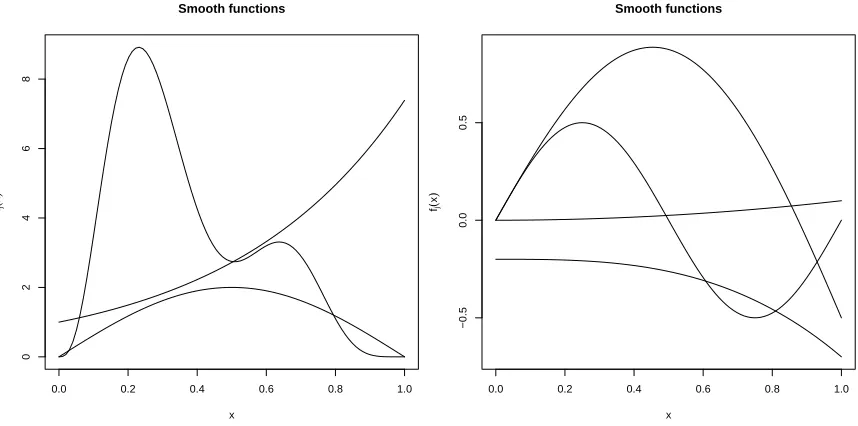
Figure 1: Original

f

j

for

j

= 1

, . . . ,

3.

0.0

0.2

0.4

0.6

0.8

1.0

−0.5

0.0

0.5

Smooth functions

x

f

j

(

x

)

Figure 2: Original

f

j

for

j

= 4

, . . . ,

7.

determinant in (12), which is unstable when the components of

λ

differ in magnitude.

Fur-thermore, avoiding evaluation of the Hessian matrix of

`

M

bypasses computation of the

fourth derivatives of the log-likelihood

`

L

, which may be difficult to calculate,

computation-ally expensive and numericcomputation-ally unstable (Wood, 2011; Wood et al., 2016). Moreover, the

diagonality of the Hessian matrix of

Q

allows parallelization of the M-step and update of

the unconverged smoothing hyper-parameters only, giving an additional shortcut.

We assess the performance of the proposed methodology in Section 3.

3. Simulation Study

We generated

R

= 100 replicates of training sets of

n

= 25000 examples from a variety of

probability distributions with parameters that depend on smooth functions of inputs. Let

x

1

, . . . ,

x

7

be independent vectors of

n

identically distributed standard uniform variables.

Figures 1 and 2 illustrate the seven smooth functions we considered,

f

1

(

x

)

=

10

4

x

3

(1

x

)

6

n

(1

x

)

4

+ 20

x

8

o

,

f

2

(

x

) = 2 sin(

πx

)

,

f

3

(

x

) = exp(2

x

)

,

f

4

(

x

)

=

0

.

1

x

2

,

f

5

(

x

) = sin(2

πx

)

/

2

,

f

6

(

x

) =

0

.

2

x

3

/

2

,

f

7

(

x

) =

x

2

/

2 + sin(

πx

)

.

With the functional parameters

µ

(

x

i

1

, x

i

2

, x

i

3

) =

3

X

j

=1

f

j

(

x

ij

)

,

σ

(

x

i

4

, x

i

5

, x

i

6

) =

6

X

j

=4

f

j

(

x

ij

)

,

ξ

(

x

i

7

) =

f

7

(

x

i

7

)

,

i

= 1

, . . . , n,

we generated

n

training examples from the following models:

(13)

Poisson distribution with rate exp

{

µ

(

x

1

,

x

2

,

x

3

)

/

6

}

,

Exponential distribution with rate exp

{

µ

(

x

1

,

x

2

,

x

3

)

/

6

}

,

Gamma distribution with shape exp

{

µ

(

x

1

,

x

2

,

x

3

)

/

6

}

and scale exp

{−

σ

(

x

4

,

x

5

,

x

6

)

}

,

Binomial distribution with probability of success 1

/

[1 + exp

{−

µ

(

x

1

,

x

2

,

x

3

) + 5

}

/

6],

Generalized extreme value (GEV) distribution with location

µ

(

x

1

,

x

2

,

x

3

), scale exp

σ

(

x

4

,

x

5

,

x

6

)

and shape

ξ

(

x

7

); see Section 4.1 for further details.

We fit the six models using cubic regression splines with evenly spaced knots in the input

range values. We used ten basis functions for each of the smooth functions

f

j

. We computed

the integrated mean squared error between the true and learned functional parameters,

represented by hats, for each of the

r

replicates

MSE(

θ

ˆ

(

p

)[

r

]

) =

1

n

n

X

i

=1

θ

i

(

p

)[

r

]

θ

ˆ

(

i

p

)[

r

]

2

,

where

θ

ˆ

(

p

)

is

µ

ˆ

,

σ

ˆ

or

ξ

ˆ

. Table 1 summarizes the results for the proposed approach,

multgam,

and three state-of-the-art methods implemented in the

R

packages

mgcv

gam (Wood, 2011;

Wood et al., 2016) using the Newton–Raphson method,

mgcv

bam (Wood et al., 2015),

and

INLA

(Rue et al., 2009). The routines used from

mgcv

are based on Version 1.8-22,

and those used from

INLA

are based on Version 18.07.12 run with eight threads, using

log-gamma priors and the random walk parametrization of order two. We also tried both Stan

algorithms (Carpenter et al., 2017), a fully Bayesian approach with Markov chain Monte

Carlo sampling and an approximate variational Bayes approach, through the

R

package

brms

(Burkner, 2017) Version 2.4.0, but a single replicate for a single functional parameter

model run with four cores took five and three hours respectively, so the full simulation

study would have taken more than four months, which is infeasible. Another widely-used

R

package,

VGAM, does not offer automatic smoothing, and choosing

λ

manually for each

f

j

for each model would have been tedious and error-prone. Use of the

R

package

gamlss

Version 5.1-0 turned out to be infeasible. Some results for the Gauss, Gamma and GEV

models are missing from Table 1 because the corresponding packages do not support them.

Moreover,

multgam

failed on 17 replicates for the GEV model, whereas

mgcv

gam failed on

46 replicates, so the values shown are based on 83 and 54 training sets respectively.

Table 1 shows that

multgam

is the only package which supports all the classical models,

and its small errors and low variances demonstrate the high accuracy and reliability of its

estimates. The proposed method is competitive with both methods in

mgcv, whereas

INLA

is less accurate. The new method is considerably better for the GEV model; it could fit 83

of the replicates, compared to 54 for

mgcv

gam, and the estimates themselves were more

accurate and less variable. The only model where all the methods give equally poor results

is the binomial.

(14)

Model

Package

µ

ˆ

σ

ˆ

ξ

ˆ

Gauss

multgam

2

.

47

2

.

93

0

.

04

0

.

01

mgcv

gam

2

.

47

2

.

93

0

.

04

0

.

01

Poisson

multgam

1

.

63

4

.

56

mgcv

gam

1

.

61

4

.

67

mgcv

bam

1

.

62

7

.

33

INLA

9

.

91

7

.

48

Exponential

multgam

3

.

67

114

.

02

mgcv

gam

3

.

75

115

.

26

mgcv

bam

3

.

69

123

.

74

INLA

11

.

95

87

.

06

Gamma

multgam

1

.

78

9

.

27

0

.

02

0

.

01

Binomial

multgam

38

.

51

0

.

99

mgcv

gam

38

.

51

0

.

99

mgcv

bam

38

.

51

0

.

99

INLA

38

.

51

0

.

99

GEV

multgam

3

.

58

8

.

61

0

.

15

0

.

11

0

.

41

1

.

06

mgcv

gam

3

.

63

8

.

56

0

.

27

77

.

63

0

.

67

336

.

54

Table 1: Means (

×

10

2

) over 100 replicates of the integrated mean squared errors of the

learned functional parameters for a variety of models and

R

packages. The

vari-ances (

×

10

6

) appear as subscripts.

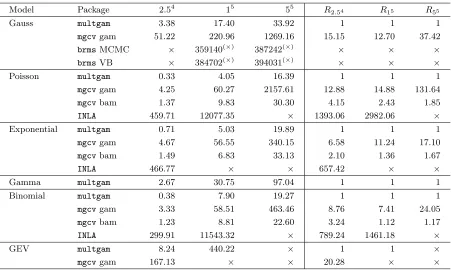
model at sizes unmatched by existing software. The package

INLA

fails with a half-million

observations for all the models. Surprisingly, the proposed method is faster than

mgcv

bam,

which is specifically designed for large data sets and exploits parallel computing, whereas

multgam

performs the M-step serially for fair comparison. Furthermore, the speed of

mgcv

bam should be balanced by lack of reliability of the performance iteration algorithm; see

Section 1.2. Table 2 shows that speed and reliability need not be exclusive. One reason why

mgcv

gam is slow is that it evaluates the fourth derivatives of the log-likelihood. Except

for the GEV model, these are not difficult to compute, but they can entail significant

computational overhead, shown by the difference in performance between

multgam

and

mgcv

gam.

Overall, the new approach gives a large gain in speed with no loss in accuracy, and in

some cases, it is the sole approach feasible. In Section 4 we apply it to real data.

4. Data Analysis

Figure

Figure 1: Original fj for j = 1, . . . , 3.
Table 1: Means (×10−2) over 100 replicates of the integrated mean squared errors of thelearned functional parameters for a variety of models and R packages
Table 2: Times (s) for a variety of models and three training set sizes n = 2.5×10⁴, 5×105,5 × 105
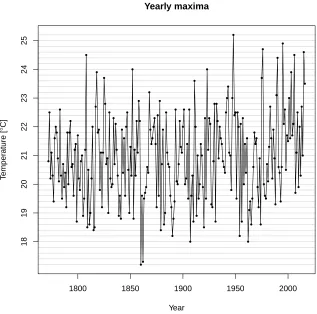
Figure 3: Annual maxima for the CET data.
+3

References

Related documents

With cloud and managed security services, integrated technologies and a team of security experts, ethical hackers and researchers, Trustwave enables businesses to transform the

The above univariate analysis gives an interpretation of individual features and their individual relationships with the outcome. The SFS gives the best feature subset as explained

The PDQ-Endeca Connector Attribute Discovery configures the Endeca project directly from an Oracle DataLens Administration Server.. This component is implemented as a DSA

rapae number significantly decreased (compare with control) in treatments with Calypso and Decis (Table 2).. Efficiency of insecticides against caterpillars of small cabbage white

When you return to the Dashboard, you will see the hostname of the Domain Controller or other Windows machine that you installed the Connector on the 'System Settings &gt; Sites

Firstly, this paper introduces the background and reasons of the financing difficulties of start-up enterprises in China's current economic situation and compares the

The PPP is procurement tool by which a public entity relies on the skills and performance of a private entity to implement a project.. The main difference with standards