EFFECT ON STRENGTH PROPERTIES OF
CONCRETE BY USING WASTE WOOD ASH AS
PARTIAL REPLACEMENT OF CEMENT
Purnima Bajpai
1, Ankit Brar
2, Apoorva Nara
3, Nihil Dudeja
4 1234Assistant Professor, The Northcap University, Gurgaon
ABSTRACT
With increasing industrialization, the industrial by products (wastes) are being accumulated to a large extent,
leading to environmental and economic concerns related to their disposal (land filling). Wood ash is the residue
produced from the incineration of wood and its products (chips, saw dust, bark) for power generation or other
uses. The use of Wood Ash (WA) in cement concrete mix will make it cost effective and environment friendly
disposal of the product. Cement is an energy extensive industrial commodity and leads to the emission of a vast
amount of greenhouse gases. By reducing the demand of cement, natural reserves of limestone can be
preserved, energy can be saved and pollution due to CO2 can be reduced. Utilization of wood ash as a partial
substitution for cement is one of the promising method to increase the strength and thermal insulation for
cement blocks.
The strength parameters (compressive strength and split tensile strength ) of concrete with blended WA cement
have been evaluated and studied. Water-to-binder ratio 0.45 and four different replacement percentages of
WA(5%, 10%, 15% and 20%) including control specimens for 0.45 water-to-cement ratio was considered.
Results of compressive strength and split tensile strength showed that the strength properties of concrete
mixture decreased marginally with increase in wood ash contents, but strength increased with later age.
Keywords: Compressive
strength, wood ash, water cement ratio,
I. INTRODUCTION
The phenomenal pace of population growth and urbanization drives the cement requirement to many fold in the
past three decades. The leaps and bounds of progress of scientific achievements in the mentioned period with
such a rapid change in technologies had initiated a global emphasis on greener cleaner and environment friendly
techniques in all fields. The quantum jump in production of cement results in alarming level release of CO2 to
the atmosphere. One way of addressing this issue is to reduce the CO2 emission from cement manufacturing
process by replacing cement with locally available by products which are pozzolanic in nature. Wood ash (WA)
is also a similar waste materials produced from wood burning industries which is mainly used as a fertilizer for
soil. Significant quantities of wood ash is currently landfilled near the industries that uses wood as a fuel
partially or fully which poses a threat to the environment in many ways to life stock around.
The thermal combustion greatly reduces the mass and the volume of the waste thus providing an
the usage of forest and timber waste product as fuel is related to the ash produced in significant amount after the
combustion of such wastes. It is commonly observed that the hardwood produce more ash than softwood and the
bark and leaves generally produce more ash as compared to the inner part of the trees. On an average burning of
wood produces 6–10% of ash by the weight of wood burnt and its composition can be highly variable depending
on geographical location and industrial processes. The most prevailing method for disposal of the ash is land
filling which accounts for 70% of the ash generated, rest being either used as soil supplement (20%) or other
miscellaneous jobs (10%).As wood ash primarily consists of fine particulate matter which can easily get air
borne by winds, it is a potential hazard as it may cause respiratory health problems to the dwellers near the dump
site or can cause ground water contamination by leaching toxic elements in the water. As the disposal cost of the
ashes are rising and volume of ash is increasing, a sustainable ash management which integrate the ash within
the natural cycles needs to be employed.
Extensive research is being conducted on industrial by products and other agricultural material ash like wood ash
or rice husk ash which can be used as cement replacement in concrete. Due to current boom in construction
industry, cement demand has escalated which is the main constituent in concrete. Also, the cement industry is
one of the primary sources which release large amounts of major consumer of natural resources like aggregate
and has high power and energy demand for its operation. So utilization of such by product and agricultural
wastes ashes solves a twofold problem of their disposal as well providing a viable alternative for cement
substitutes in concrete . Researchers have conducted tests which showed promising results that wood ash can be
suitably used to replace cement partially in concrete production . Hence, incorporating the usage of wood ash as
replacement for cement in blended cement is beneficial for the environmental point of view as well as producing
glow cost construction entity thus leading to a sustainable relationship.
II. NEED FOR STUDY
Wood ash contains amorphous silica making it fit as cement replacing material due to its high pozzolanic
activity. In many countries, the wood industries generate a large amount of waste products in the worldwide.
The low costs, the proximity of the sources and the potential pollution from wood wastes have led to studies into
the possible use of the wood ash as fibres in concrete. Incorporating the usage of wood ash as replacement for
cement in blended cement is beneficial for the environmental point of view as well as producing low cost
construction entity thus leading to a sustainable relationship. As the disposal cost of the ashes are rising and
volume of ash is increasing, a sustainable ash management which integrate the ash within the natural cycles
needs to be employed
III. OBJECTIVES OF THE STUDY
The basic aim of this study was to investigate the effect of wood ash obtained from uncontrolled burning of
wood shavings on the strength development of concrete (Compressive strength and Split Tensile strength) by
using waste wood ash as partial replacement of cement
The objective of the study is to find the compressive strength and split tensile strength of concrete with blended
wood ash cement. The water-to-binder ratio will be taken as 0.45 and four different replacement percentages of
comparison for the optimum replacement ratio.
IV. LITERATURE SURVEY
In many countries, the wood industries generate a large amount of waste products in the worldwide. The low
costs, the proximity of the sources and the potential pollution from wood wastes have led to studies into the
possible use of the wood shavings as fibers in concrete.
These types of materials have several potential applications such as acoustic and thermal insulation, fire
resistance cladding etc. Soroushian et al. [1] reported that the flexural strength and flexural toughness values of
wood fiber-cement composites were higher than the values for neat cement. In the same study, they also
reported that the dynamic modulus of elasticity of neat cement decreases with increasing freezing and thawing
cycles while the dynamic moduli of wood fiber-cement composites remains relatively constant over the same
number of freezing and thawing cycles. Several studies mention the use of wood-ash as fillers in concrete or
mortars [2, 3], without revealing a great improvement in mechanical properties.
Jennifer et al. [4] studied the effects of the aqueous in organic compound treatments on newspaper and Kraft
fibers for enhancing some selected mechanical properties of wood fiber-cement composites. Their study
indicated that certain chemical treatments react better with different wood fiber types resulting in selected
mechanical property enhancement.
In another study, Soroushian and Marikunte [5] reported the effects of moisture on the flexural properties of
wood fiber-cement composites. Flexural strength decreased with increasing moisture contents. In addition, dry
wood cement specimens appeared to have lower flexural toughness values compared to wet wood
fiber-cement specimens. Lee and Hong [6] and Blankenhorn et al. [7] used compressive strength as an indicator of
wood fibercement compatibility. Lee and Hong showed compressive strength to be linearly proportional to the
maximum hydration temperature, but independent of hydration time. While, Blankenhorn et al. indicated that as
hydration time increased, compressive strength increases. In 1986, Rowlands et al. [8] found that strength and
stiffness are increased in both tension and flexure by adding wood fiber reinforcement.
V. METHODOLOGY
For the study, four different proportion of concrete mixes (WA replacement of 5%, 10%, 15% and 20% by
weight of cement) including the control mixture were prepared with water to binder ratio of 0.45 for design
compressive strength of 20 N/mm2. For the compression test, blocks were casted in cube of dimension 15 *15
*15 cm for 0.45 water–binder ratio and for each replacement percentage. For split tensile strength test, cylinders
were casted with diameter being15 cm and height being 30 cm for 0.45 water–binder ratio and for each
replacement percentage. After casting all the test specimens were stored at room temperature and then
de-molded after 24 h, and placed into a water-curing tank with a temperature of 24–34 _C until the time of testing.
For each replacement percentage two specimens were casted for 7 days and two specimens were casted for 28
days test. The average result is reported in the paper.
Test carried on the hardened concrete were compressive strength test, split tensile strength test for7 days and 28
days strength determination. For compressive strength and split tensile strength, digital compression testing
VI. RESULTS AND DISCUSSION
6.1.Cube test result
Samples with 5%, 10% , 15% and 20% replacement of cement with wood ash were casted. The cubes were
casted as per the procedure specified in IS 516:1959 and IS 456:2000. The strength of 2 samples were tested at 7
and 28 days using compression testing machine. The compressive strength values were compared with that of
conventional concrete mix of M20.Following the mix design specified inIS: 10262 (1982), samples were casted.
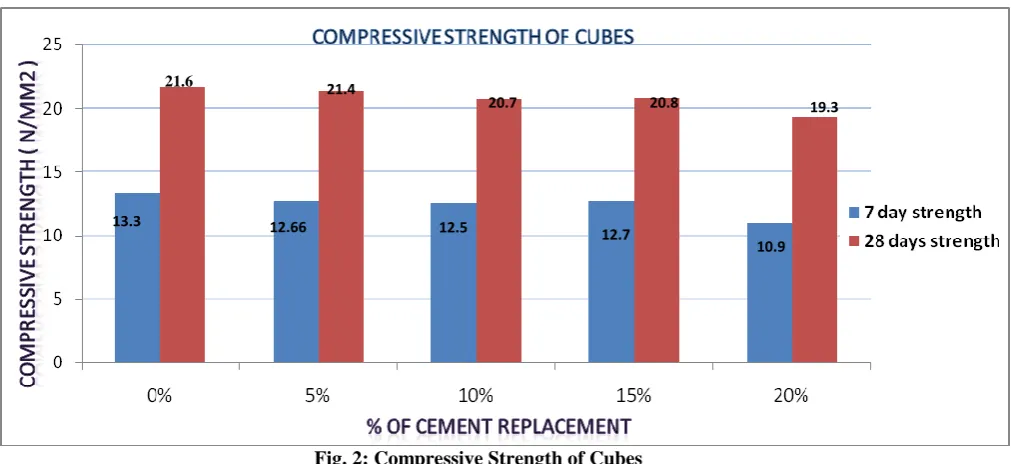
The obtained results are shown in fig 2.
Fig. 2: Compressive Strength of Cubes
The 7 day compressive strength of control specimen of M20 concrete was obtained as 13.325 N/mm2and the 28
day compressive strength was obtained as 21.66 N/mm2 . Analysis of data shows that compressive strength of
wood ash blended cement concrete decreased with increasing wood ash content in the concrete. This trend was
observed for 0.45 water to binder ratio .The 28 day compressive strength of cube with 20% of cement
replacement is only 19.3 N/mm2 which is lesser than 20 N/mm2. This trend of compressive strength is justified
due to the reason that a particle acts more as a filler material within the cement paste matrix than in the binder
material. As the replacement percentage is increased, surface area of filler material to be bonded by cement
increases, thereby reducing strength.
Split tensile strength of cylinder test cylinders
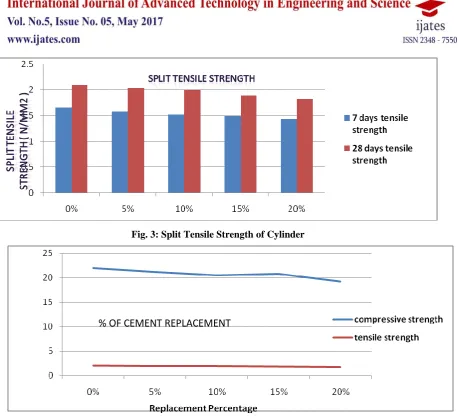
Fig. 3 presents the split tensile strength of wood ash blended cement concrete for 0.45 water–binder ratio.
Analysis of data shows that split tensile strength of the wood ash blended cement concrete reduced with
increasing wood ash content in the concrete but the reduction was less pronounced when compared with
reduction in compressive strength. This reduction can be attributed to filler activity of the wood ash particle in
the concrete and poor bonding by wood ash particle in mortar matrix due to high surface area. 21.6
13.3 2
12.66 21.4
20.7 20.8 19.3
12.5 12.7
Fig. 3: Split Tensile Strength of Cylinder
Fig. 4 Strength parameters at 28 days for 0.45 water–binder ratio.
REFERENCES
[1] Rowlands R.E., Van Deweghe R.P., Laufenberg T.L., Frueger G.P., “Fiber-reinforced wood composites”,
Wood Fiber Sci. 18 (1), 1986, pp. 39-57.
[2] Tamba S., Jauberthie R., Lanos C., Rendell F., "Lightweight wood fiber concrete", Concrete Sci Eng.
3:53-7, 2001.
[3] Coutts R.S.P. and Warden P.G., "Effect of compaction on the properties of air-cured wood fiber reinforced
cement", Cement and concrete composites, Vol. 12, Issue 3, 1990, pp. 151-156.
[4] Saxena NS, Pradeep P, Mathew G, Thomas S, Gustafsson M, Gustafsson SE. Thermal conductivity of
styrene butadiene rubber compounds with natural rubber prophylactics waste filler. Eur Polym J
1999;35:1687–93.
[5] Bouguerra A, Laurent JP, Goual MS, Queneudec M. The thermal conductivity of solid aggregates using the
transient plane source technique. J Appl Phys 1997;30:2900–4.
[6] Kim K-H, Jeon S-E, Kim J-K, Yang S. An experimental study on thermal conductivity of concrete. Cement
Concrete Res 2003;33:363–371
[7] Van Geem, M. G., “Thermal Transmittance of Concrete Block Walls with Core Insulation, ” Journal of
Thermal Insulation, Vol. 9, January 1986.
[8] Walter, H., “Coated Tree Aggregate Usable in Wood Concrete Technology and Method of Making the
Same.”U.S. Patent 5.019.170- May 28, 1991.
[9] Kosny, J., Christian, J. “The Optimum Use of Insulation Masonry Blocks for Building Foundations.”
Building Research Journal - vol. 2., #2., November 1993.
[10]Kosny, J., Desjarlais, A., “Influence of Wall System Details on the Thermal Performance of Residential