Vol. 6, No. 4, 2014 Article ID IJIM-00501, 7 pages Research Article
Evaluating the efficiency and classifying the fuzzy data: A DEA
based approach
S. Kordrostami ∗†, G. Farajpour‡, M. Jahani Sayyad Noveiri §
————————————————————————————————–
Abstract
Data envelopment analysis (DEA) has been proven as an efficient technique to evaluate the perfor-mance of homogeneous decision making units (DMUs) where multiple inputs and outputs exist. In the conventional applications of DEA, the data are considered as specific numerical values with explicit designation of being an input or output. However, the observed values of the data are sometimes im-precise (i.e. input and output variables cannot be measured im-precisely) and data are sometimes flexible (measures with unknown status of being input or output are referred to as flexible measures in the literature). In the current paper a number of methods are proposed to evaluate the relative efficiency and to identify the status of fuzzy flexible measures. Indeed, the modified fuzzy DEA models are suggested to accommodate flexible measures. In order to obtain correct results, alternative optimal solutions are considered to deal with the fuzzy flexible measures. Numerical examples are used to illustrate the procedure.
Keywords: Data envelopment analysis; Fuzzy numbers; Flexible measures; Inputs, Outputs.
—————————————————————————————————–
1
Literature review
D
aparametric technique to measure the relativeta envelopment analysis (DEA) is a non-efficiency of a set of similar units referred to as decision making units (DMUs). In the standard DEA, it is assumed that the input versus out-put status of each performance measure related to the DMUs has been known. However, in some situations the role of a variable may be flexible. There are some papers investigating flexible mea-sures, among them are Beasley [3] who presented a formulation to evaluate universities in the UK∗Corresponding author. [email protected]
†Department of Applied Mathematics, Lahijan branch,
Islamic Azad University, Lahijan, Iran.
‡Department of Industrial Engineering, Parand branch,
Islamic Azad University, Tehran, Iran.
§Department of Applied Mathematics, Lahijan branch,
Islamic Azad University, Lahijan, Iran.
where the variable ”research funding” is assumed as both an input and an output. The alterna-tive and corrected version of Beasley’s model was suggested by Cook et al. [5]. Then, Cook and Zhu [6] proposed a different method to classify inputs and outputs by considering flexible mea-sures in the CCR ratio model. A revised model was introduced by Toloo in 2009 [10]. Afterwards, Toloo [11] suggested another method by consider-ing alternative solutions. Amirteimoori and Em-rouznejad [1] also stated Cook and Zhu’s model overestimating the efficiency and suggested an ap-proach to determine the status of flexible mea-sures. Moreover, Amirteimoori and Emrouznejad [2] indicated that the proposed model by Toloo [10] is infeasible in some situations.
Furthermore, there are many contexts on fuzzy data envelopment analysis; for instance, see Wang and Chin [12], Hatami-marbini et al. [7]. Naba-hat and Esmaeeli [9] suggested a technique to
evaluate the efficiency in the presence of flexi-ble and fuzzy measures in order to classify flex-ible measures. In fact, they applied the α-level based approach but fuzzy DEA models built on the basis ofα-level sets require the situation of a series of LP models and thus considerable compu-tational efforts. Therefore, in the current paper the fuzzy expected value approach [12] is mod-ified for containing the flexible measures in the DEA analysis. Indeed, the modified fuzzy DEA models are proposed to identify the status of flex-ible measures.
The current paper is organized as follows: In Sec-tion 2, the proposed methods by Cook and Zhu [6] and Toloo [11] to determine the status of flex-ible measures are mentioned briefly. Moreover, a summary of fuzzy DEA problem utilized and extended in this paper will be stated. Section 3 provides the suggested models. Numerical exam-ples are presented in Section 4 to illustrate the procedure. Conclusions are reached in Section 5.
2
Preliminaries
In this section, we review the previous studies on flexible measures and the fuzzy data envelopment analysis in brief.
2.1 Flexible measures
Assume the purpose is to evaluate the efficiency ofn decision making units; (DM Uj;j= 1, ..., n)
in which there are m inputs xij, i = 1, ..., m, s
outputs yrj, r = 1, ..., s and l flexible measures
wlj, l = 1, ..., L. Cook and Zhu [6] proposed the
following mathematical programming model to determine the status of flexible measures.
M ax ∑s
r=1uryro+∑Ll=1dlγlwlo
∑m
i=1vixio+∑Ll=1(1−dl)γlwlo
s.t. ∑s
r=1uryrj+∑Ll=1dlγlwlj
∑m
i=1vixij+∑Ll=1(1−dl)γlwlj ≤
1, j = 1,2, ..., n
dl ∈ {0,1},∀l, ur, vi, γl≥0, ∀r, i, l.
(2.1) Then, they transformed the mentioned model into the mixed integer linear programming by us-ing the Charnes- Cooper transformation [4] and changing of variable. Readers are referred to Cook and Zhu [6] for more information regard-ing this.
Furthermore, Toloo [11] introduced a new mixed integer linear programming model to overcome
the problem of not considering alternative op-timal solutions in the previous models. Toloo’s model is as follows:
M in θo
s.t ∑∑nj=1λjxij ≤θoxio ∀i n
j=1λjykj ≥yko ∀k ∑n
j=1λjwlj ≤θowlo+Md¯l ∀l ∑n
j=1λjwlj ≥wlo−M(1−d¯l) ∀l
¯
dl∈ {0,1} ∀l λj ≥0∀j
(2.2) where M is a large positive number.
2.2 The fuzzy Data Envelopment Analysis model
In this subsection, the issue of evaluating the ef-ficiency of DMUs in the presence of fuzzy inputs and outputs is mentioned.
Consider there are n DMUs that consume m in-puts to produce s outputs. Assume ˜xij, (i =
1, ..., m) and ˜yrj, (r = 1, ..., s)indicate inputs and
outputs of thejth DMU(j= 1, ..., n), respectively characterized by trapezoidal fuzzy numbers ˜xij =
(xlij, xMij , xNij, xuij) and ˜yrj = (yrjl , yrjM, yrjN, yrju)with
xlij ≥ 0 and yrjl ≥ 0 for i = 1, ..., m, r = 1, ..., s and j= 1, ..., n.
Wang and Chin [12] showed the efficiency of DM Ujas:
θj = ∑s
r=1ur(yLrj+yrjM +yrjN +yrjU) ∑m
i=1vi(xLij +xMij +xNij +xUij)
, j= 1, ..., n.
(2.3) Indeed, they used the fuzzy expected value of a fuzzy variable that is defined by Liu and Liu [8]. Readers can refer to Wang and Chin [12], Liu and Liu [8] for more information. Wang and Chin [12] proposed the following LP for determining the efficiency from an optimistic point of view.
M ax ∑s
r=1ur(yrol +yroM+yNro+yuro)
∑m
i=1vi(xlio+xioM+xNio+xuio)
s.t. ∑s
r=1ur(ylrj+yrjM+yNrj+yrju)
∑m
i=1vi(xlij+xijM+xNij+xuij) ≤
1, j= 1, ..., n.
ur, vi ≥0 i= 1, ..., m , r= 1, ..., s.
transformation [4] as follows:
M ax ∑sr=1ur(yrol +yroM +yroN +yrou)
s.t. ∑∑mi=1vi(xlio+xMio +xNio +xuio) = 1 s
r=1ur(yrjl +yrjM +yNrj+yrju)− ∑m
i=1vi(xlij+xMij +xNij +xuij)≤0, j = 1, ..., n
ur, vi ≥0 i= 1, ..., m , r= 1, ..., s.
(2.5) In the next Section we will extend the fuzzy DEA model by considering flexible measures.
3
Fuzzy DEA models with
clas-sifying Inputs and outputs
As the previous section, consider n DMUs consume varying amounts of m different in-puts to produce s different outputs. As-sume ˜xij (i = 1,2, ..., m), ˜yrj (r = 1,2, ..., s)
and ˜wlj(l = 1,2, ..., L)represent the fuzzy
in-put , outin-put and flexible measure of the jth DM Uj(j = 1,2, ..., n), respectively. All
in-put, output and flexible data are assumed to be characterized by trapezoidal fuzzy numbers ˜
xij = (xlij, xMij , xNij, xuij),˜yrj = (ylrj, yMrj, yNrj, yurj)
and ˜wlj = (wljl , wMlj, wljN, wulj),respectively with
xlij ≥ 0, yrjl ≥ 0 and wllj ≥ 0, for i = 1, ..., m, r= 1, ..., sand l= 1, ..., L.
3.1 A method for determining the sta-tus of fuzzy flexible measures
The following model is suggested to evaluate the performance ofDM Uo and to classify inputs and
outputs: Max ∑s r=1 ∑m i=1
ur(yl
ro+yroM+yNro+yuro)+
∑L
l=1γldl(wllo+wMlo+wNlo+wulo) vi(xlio+xMio+xNio+xiou)+∑Ll=1γl(1−dl)(wllo+w
M lo+w
N lo+w
u lo) s.t.∑ s r=1 ∑m i=1
ur(yrjl +yMrj+yNrj+yrju)+
∑L
l=1γldl(wllj+w M lj+w
N lj+w
u lj) vi(xl
ij+xMij+xNij+xuij)+
∑L
l=1γl(1−dl)(wllj+wMlj+wNlj+wulj)
≤1,
j= 1, ..., n , dl∈ {0,1}, ur, vi, γl≥0
i= 1, ..., m , r= 1, ..., s, l = 1, ..., L. (3.6)
It is clear that model (3.6) is nonlinear. Thus, it can be linearized, the same as Cook and Zhu [6], by using the Charnes-Cooper transformation [4] and the changing of variable δl=dlγl as follows:
M ax ∑sr=1ur(yrol +yroM+yNro+yuro)
+∑Ll=1δl(wllo+wloM +wNlo +wlou)
s.t ∑mi=1vi(xlio+xMio +xNio +xuio)
+∑∑Ll=1γl(wlol +wloM +wNlo +wlou)− L
l=1δl(wllo+wloM +wNlo +wlou) = 1, ∑s
r=1ur(ylrj+yrjM +yrjN +yrju)
+∑∑Ll=12δl(wljl +wljM +wNlj +wulj)− m
i=1vi(xlij +xMij +xNij +xuij)
−∑L
l=1γl(wljl +wljM +wNlj +wulj)≤0
0≤δl ≤M dl
δl ≤γl ≤δl+M(1−dl)
dl∈ {0,1}, vi, ur≥0, ∀r, i;γl, δl ≥0, ∀l.
(3.7) M is a large positive number. Where dl = 1,
factorldesignates as an output and it is an input where dl= 0.
3.2 An alternative method to deter-mine the status of fuzzy flexible measures
In this subsection an alternative method is pro-posed to classify inputs and outputs and to iden-tify the efficiency. Actually, model (2.2) will ex-tend to evaluate the efficiency when fuzzy data are presented.
M in θ
s.t ∑nj=1λj(xlij +xMij +xNij +xuij)≤
θ(xlio+xMio +xNio +xuio) i= 1, ..., m
∑n
j=1λj(yrjl +yrjM +yNrj+yrju)≥
(ylro+yMro +yroN +yrou) r= 1, ..., s
∑n
j=1λj(wllj+wljM +wljN +wulj)≤
θ(wl
lo+wMlo +wloN+wlou) +Md˜l l= 1, ..., L ∑n
j=1λj(wllj+wljM +wNlj +wulj)≥
(wl
lo+wloM+wNlo +wulo)−M(1−d˜l),
l= 1, ..., L d˜l∈ {0,1} ∀l , λj ≥0 ∀j.
(3.8) If ˜dl= 1, factor l is an output and when ˜dl = 0,
it is an input.
Table 1: Data for numerical Example4.1.
DMU Input-1 Input-2 output-1 flexible-1
1 (12,14,16,19) (1.1,2.3,3.6,4.3) (6,8,10,11) (2,3,4,5)
2 (3,6,7,9) (1.9,2.6,3.7,4.8) (12,15,16,18) (1,4,6,10)
3 (5,6,7,8) (1.6,3.4,4.1,5.5) (2,3,6,9) (1,3,4,8)
4 (1,3,4,6) (3.5,4.1,5.2,6.7) (7,10,12,14) (1,2,3,4)
5 (5,7,8,10) (1,4,5,6) (4,6,8,10) (1,2,4,5)
Table 2: The results of models (3.7) and (3.8).
DMU Flexible as Input Flexible as output Efficiency of model (3.7) Efficiency of model (3.8) d∗
1 0.8059 0.767 0.8059 0.767 0
2 1 1 1 1 0 or 1
3 0.3891 0.7326 0.7326 0.3891 1
4 1 1 1 1 0 or 1
5 0.6386 0.4762 0.6386 0.4762 0
Table 3: Inputs and the flexible measure of higher education institutions.
DMU x˜1 x˜2 w˜1
1 (432,530,600) (30,50,100) (70,250,400)
2 (800,2600,4760) (220,300,340) (1090,1480,1890)
3 (118,310,490) (15,25,30) (12,36,80)
4 (300,1640,2900) (60,400,800) (780,900,1120)
5 (100,490,924) (50,80,120) (50,100,170)
6 (800,2600,4550) (270,460,1250) (2000,2900,3910)
7 (330,430,500) (0,0,0) (40,280,560)
8 (200,800,1600) (101,120,150) (301,770,1190)
9 (200,400,900) (8,30,60) (17,40,60)
10 (30,500,1100) (60,86,110) (112,340,570)
Table 4: Outputs of higher education institutions.
DMU y˜1 y˜2 y˜3
1 (70,140,220) (18,28,32) (0,0,0)
2 (130,370,635) (24,65,124) (8,17,24)
3 (36,46,54) (4,8,14) (2,4,6)
4 (200,280,375) (6,50,94) (0,0,0)
5 (43,92,140) (14,32,49) (1,10,12)
6 (56,350,646) (41,160,310) (2,3,5)
7 (38,73,98) (20,40,60) (10,11,12)
8 (40,194,375) (12,34,50) (0,0,0)
9 (26,70,80) (2,15,30) (0,0,0)
10 (44,87,100) (32,40,45) (4,14,30)
trapezoidal fuzzy numbers, the above models are also applicable to crisp and triangular measures.
Now, suppose inputs, outputs and flexible mea-sures of DMUs are triangular fuzzy numbers. We indicate inputs, outputs and flexible measures as ˜xij = (xlij, xMij, xuij), ˜yrj = (ylrj, yMrj, yurj) and
˜
wlj = (wljl , wMlj , wulj), respectively with xlij ≥ 0,
Table 5: The results of models (3.9) and (3.10)
DMU Flexible as Input Flexible as output Efficiency of model (3.9) Efficiency of model (3.10) d∗
1 1 1 1 1 0 or 1
2 0.6047 0.6689 0.6689 0.6047 1
3 1 0.7379 1 0.7379 0
4 0.6428 0.723 0.723 0.6428 1
5 1 0.9173 1 0.9173 0
6 0.7246 1 1 0.7246 1
7 1 1 1 1 0 or 1
8 0.8668 1 1 0.8668 1
9 1 0.5591 1 0.5591 0
10 1 1 1 1 0 or 1
respectively as shown below:
M ax ∑sr=1ur(yrol + 2yroM +yrou)+ ∑L
l=1δl(wlol + 2wloM+wulo)
s.t ∑mi=1vi(xiol + 2xMio +xuio)+ ∑L
l=1∑Lγl(wllo+ 2wloM +wulo)−
l=1δl(wllo+ 2wMlo +wlou) = 1 ∑s
r=1ur(ylrj+ 2yMrj +yrju)+ ∑L
l=1∑2δl(wllj+ 2wljM +wlju)− m
i=1vi(xlij + 2xMij +xuij)− ∑L
l=1γl(wllj+ 2wljM+wlju)≤0
0≤δl ≤M dl
δl ≤γl ≤δl+M(1−dl)
dl∈ {0,1}, vi, ur≥0, ∀r, i;γl, δl≥0, ∀l.
(3.9) and
M in θ
s.t ∑nj=1λj(xijl + 2xMij +xuij)≤
θ(xlio+ 2xioM +xuio) i= 1, ..., m
∑n
j=1λj(yrjl + 2yrjM +yrju)≥
(ylro+ 2yroM+yuro) r= 1, ..., s
∑n
j=1λj(wllj+ 2wljM +wulj)≤
θ(wlol + 2wloM+wulo) +Md˜l l= 1, ..., L ∑n
j=1λj(wljl + 2wMlj +wulj)≥
(wllo+ 2wMlo +wulo)−M(1−d˜l) l= 1, ..., L
˜
dl∈ {0,1} ∀l , λj ≥0∀j.
(3.10) Therefore, the status of flexible measures, where triangular fuzzy numbers exist, will be deter-mined by solving model (3.9) and (3.10).
4
Numerical Examples
In this section two numerical examples are stated to illustrate the proposed approach.
Example 4.1 Assume there are 5 DMUs with
two inputs, one output and one flexible measure in which all data are trapezoidal numbers. Data are given in Table 1. Models (3.7) and (3.8) are calculated.
Results of model (3.7) and model (3.8) are given in the Table 2. As can be seen in Table 2, the results of selecting a flexible measure as input or output are the same for DM U2 and DM U4.
Thus they should not be considered to classify in-puts and outin-puts. It is clear, 2 DMUs treat flexi-ble measure as input while only one DMU consid-ers it as output. Therefore, the flexible measure is considered as input according to the majority role.
Example 4.2 Suppose we wish to evaluate in-stitutions of higher education. Two factors, gen-eral expenditure (x˜1) and equipment expenditure
(x˜2) are assumed as inputs; undergraduate
stu-dents (y˜1), postgraduate research (y˜2) and
post-graduate teaching (y˜3) are considered as outputs,
and research income (w˜1) is a flexible measure.
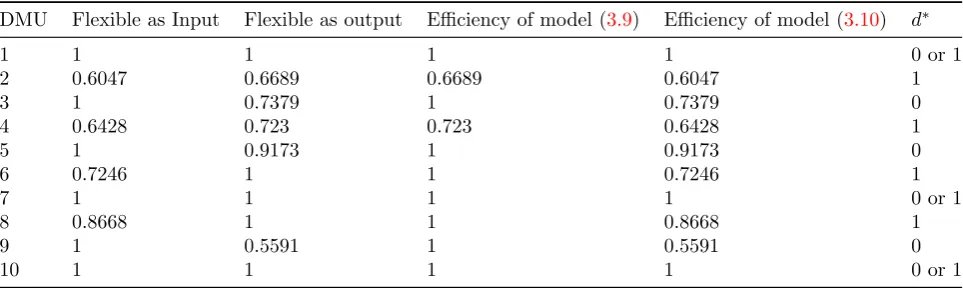
All inputs, outputs and flexible measures are tri-angular fuzzy numbers. Inputs and the flexible measure are shown in Table 3and outputs can be seen in Table 4.
The results of models (3.9) and (3.10) are shown in Table 5. As can be seen in Table 5, 3 DMUs consider the flexible measure as input while 4 DMUs assume it as output, and the flex-ible measure can be deemed as input or output without any effect on efficiency in DMUs 1, 7, and 10. According to the majority role, the flexible measure is considered as an output.
selected in comparing the results of selecting a flexible measure as input or output. Thus, the resulted maximum amount of comparing them is also one. Therefore, DMUs with this condition will be eliminated from consideration to deter-mine the status, conveniently as shown in Toloo [11].
5
Conclusions
In real applications, there are many situations in which measures can play either the role of input or output while measures are vague. For this pur-pose, the present paper has been proposed two models to evaluate the performance and to deter-mine the status of fuzzy flexible measures where flexible and fuzzy data exist. Actually, fuzzy DEA models have been modified and extended. In the proposed models, similar to the prior mod-els for evaluating the efficiency of DMUs and clas-sifying flexible measures, selecting suitableMis a significant subject for calculating accurate effi-ciency. Numerical examples have been provided to illustrate the technique.
References
[1] A. Amirteimoori, A. Emrouznejad, Flexible Measure In Production Process: A DEA-Based Approach, RAIRO Operations Re-search 45 (2011) 63-74.
[2] A. Amirteimoori, A. Emrouznejad,Notes on ’Classifying inputs and outputs in data en-velopment analysis’, Applied Mathematics Letters 25 (2012) 1625-1628.
[3] J. Beasley, Determining teaching and re-search efficiencies, Journal of operational Research Society 46 (1995) 441-452
[4] A. Charnes, W. W. Cooper, Programming with linear fractional functions, Naval Re-search Logistics Quarterly 9 (1962) 181-186.
[5] W. D. Cook, R. Green, J. Zhu, Dual role factors in DEA, IIE Transactions 38 (2006) 1-11.
[6] W. D. Cook, J. Zhu, Classifying inputs and outputs in data envelopment analysis, Eu-ropean Journal of Operational Research 80 (2007) 692-699.
[7] A. Hatami-marbini, A. Emrouznejad, M. Ta-vana, A taxonomy and review of the fuzzy DEA literature: Two decades in the making, European Journal of Operational Research 214 (2011) 457-472.
[8] B. Liu, Y. K. Liu, Expected value of fuzzy variable and fuzzy expected value models, IEEE Transactions on Fuzzy Systems 10 (2002) 445-450.
[9] M. Nabahat, F. Esmaeeli Sangari, Classi-fying Inputs and Outputs with Fuzzy Data, Journal of Mathematics Research 4 (2012) 46-50.
[10] M. Toloo, On classifying inputs and outputs in DEA: a revised model, European Journal of Operational Research 198 (2009) 358-360.
[11] M. Toloo, Alternative solutions for classify-ing inputs and outputs in data envelopment analysis, Computers and Mathematics with Applications 63 (2012) 1104-1110.
[12] Y. M. Wang, K. S. Chin, Fuzzy data envel-opment analysis: A fuzzy expected value ap-proach, Expert Systems With Applications 38 (2011) 11678-11685.
Ghasem Farajpour is an assistant professor of industrial engineering department in Islamic Azad Uni-versity, Parand branch. He com-pleted his Ph. D degree in Islamic Azad University of Tehran. His re-search interests include Data En-velopment Analysis, Supply Chain and efficiency systems.