A Distributed Rendezvous Point Source (RPS) For Congestion
Control in A Reliable Hybrid Multicast Protocol (RHMP)
Moses Okechukwu Onyesolu
a,
Obikwelu Raphael Okonkwo
b, Anthony
Chukwuemeka Achuenu
ca,b
Department of Computer Science, Nnamdi Azikwe University, Awka, Anambra State, Nigeria. c
Department of Computer Science, Auchi Polytechnic, Auchi, Edo State, Nigeria
Abstract : Multicast protocols can be classified as either reliable or unreliable both uses a best effort method of setting up, maintaining and tearing down the multicast distribution tree. Pragmatic General Multicast (PGM), Reliable Hybrid Multicast Protocol (RHMP) and Elastic Reliable Multicast (ERM) are examples of reliable multicast protocols. PGM and ERM sends flood messages to the Rendezvous Point source (RPS) from the source node towards the stub nodes which then forward it to leaf nodes, leaf nodes that are not interested sends a prune message while any leaf node that misses a packet sends a message to the RPS through the stub node requesting for the missed multicast packet. A repair multicast packet is then forwarded to all leaf nodes that requested for it. For a large distribution tree congestion might occur in the RPS if there is much failure and the leaf node keeps requesting for repair data. In a distributed RPS such as the reliable hybrid multicast protocol (RHMP) the stub nodes originates the flood message to the leaf and uninterested leaf sends prune message, any stub that has one or more interested leaf sends a join message to the RPS. If a leaf node in the multicast distribution misses a multicast packet it requests a repair packet its stub node sends the repair data. A simulation model was developed to mimic the behaviour of PGM, ERM and RHMP in different network size using hierarchical network and the control bandwidth overhead (CBO) for each of the multicast protocols was calculated at the source node, stud node and leaf nodes, CBO was use as the cost metric. The result shows that the RHMP uses less CBO than PGM and ERM in a sparsely and densely populated network at the source and leaf nodes but more CBO is used at the stub nodes but since more than one stub nodes act as the RPS to the leafs connected to it, RHMP was found out to be better than the PGM or ERM.
Keywords: PGM; ERM; reliable multicast; Hybrid multicast; join; RPS; flood and prune,
I. Introduction
Reliable multicast makes sure that the multicast packets get to its destination and in the right order. Pragmatic General Multicast (PGM) and Elastic Reliable Multicast (ERM) places more emphasis on the Rendezvous Point source (RPS) or the source node which co-ordinates the multicast process, this can become stressful for the RPS if they are much failure rate within the distribution tree with leaf node requesting for repair data. A lot of mechanism such as Control NAK (Unterbrunner et al, 2011), resending the multicast packets (Unterbrunner et al, 2011) getting repair data for nodes closest to the requesting node (Kaur and Sachdeva, 2012). These methods reduce the control bandwidth overhead (CBO) but the distributed RPS method eliminates most of the problem inherent in the existing method for congestion control in a multicast process.
This paper is organized into five parts: Sections 1, introduces the concept of reliable multicast and the cost of CBO associated with reliable multicast protocols, section 2, discusses the justification for this research, related works is described in section 3. Object oriented analysis and design (OOAD) methodology was used in section 4. While section 5, analyzed the control bandwidth overhead (CBO), at the source, sub and leaf node for RHMP, PGM and ERM protocol.
II. Justification of this Research
if the packet failure rate is high the RPS will use more CBO message to ensure that multicast packet gets to their destinations, thereby overloading the RPS, but a situation where every stub node act as an RPS in a decentralized manner makes the workload on the source /RPS less and all the source / RPS has to do is to ensure load balancing among the connected stubs.
III. Related Works
Karim et al. (2004) presented a framework for systematic testing of multicast congestion control protocols. It was based on the systematic testing of robustness by evaluation of synthesized scenarios (STRESS) applied to multicast routing, modeling of sequence, numbers, traffic, and congestion window. It was also characterized by a high degree of interleaving between events and long-term effects of individual events. An automated search engine to generate all possible error scenarios was created and finally a valuable tool to expedite the development and standardization of multicast protocols was developed.
Read (2006) carried out a Multicast Performance Evaluation between PGM and Multicast Dissemination Protocol with Congestion Control (MDP-CC) under varying network conditions and he concluded that PGM was superior in performance to MDP-CC though MDP-CC is not an equal match to PGM
Mir et al (2014) evaluated the fault tolerance on Protocol independent multicast (PIM) and Core base tree (CBT) both of which are unreliable multicast protocols, some of their performance evaluation parameter include the end – to – end delay, network source usage and the overhead bandwidth cost, their result showed that PIM out performed CBT as the network size increase.
Emad et al (2011) focused on user-centric mobileTV service considering the users’ consumption style, the cost reduction of network resources and the enhancement of End-Users Quality of Experience (QoE). A scenario where each user is able to access his mobile TV content AnyTime, AnyWhere and from Any Device (ATAWAD), considering the eMBMS (Evolved
diffusion. In multicast TV delivery, clients join/leave the multicast TV source of channels according to their requests. However, during Nomadic Access (NA), the multicast tree has to be reconstructed according to the new demands. optimizing the investment cost of multicast sources (streaming points) opens the way to an enhancement of the Quality of Experience (QoE) of End-User.
Jayanta et al (2004), proposed an efficient hybrid multicast routing protocol suitable for high mobility applications and it addresses the scalability issue of ODMRP protocol by separating data forwarding path from join query forwarding path, they incorporated a low overhead local clustering technique to classify all nodes into core and normal categories. When multicast routes to destination nodes are unavailable, join-query messages are sent to all nodes in the network and data packets are forwarded by the core nodes to the destination nodes using Differential Destination Multicast by (Ji, and Corson, 2001).
BAKER et al, 2011, gave a general overview on multicast protocols in Ad Hoc Networks, describing how they work, showing the reasons for developing these protocols and comparing the protocols to explain the advantages and limitations.
Flooding and prune is one technique use to set up, maintain and tear down the multicast tree, in a multicast network, but it is discovered to have some draw backs such as contention, because neighboring nodes tend to retransmit flood message, redundant retransmission can also occur where node re-broadcast a flood message to other nodes that have already received it especially in flooding a wireless network based CSMA/CA as illustrated by (Youssef et al, 2015).
IV. Methodology Materials and Methods
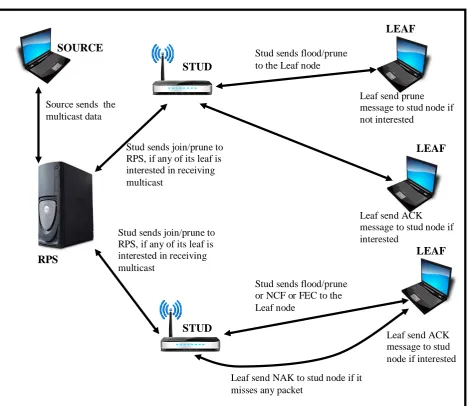
Figure 1 : Model/Architecture of the proposed Reliable Hybrid Multicast Protocol (RHMP)
The stub nodes originates the flood message to the leaf nodes and if any leaf node under a stub indicates an interest the stub node sends a join message to the RPS or source but once the multicast process is started and any of the leafs misses some multicast packet it sends a NAK to the stub which in turn send a repair data FEC to the leafs that requires them therefore the stub nodes stores a version of the multicast packets for a particular amount of time from which it can send a repair data if there is need for it.
The overall total number of CBO was calculated for each of the multicast protocols for a three tier, four ties, five tier and six tier hierarchical network in a controlled environment and the test data use for each of the instances of the multicast protocol being analysis is show in Table 1.
STUD STUD SOURCE
LEAF
LEAF
LEAF RPS
Leaf send ACK message to stud node if interested
Leaf send prune message to stud node if not interested
Leaf send ACK message to stud node if interested Stud sends flood/prune
or NCF or FEC to the Leaf node
Source sends the multicast data
Stud sends flood/prune to the Leaf node
Leaf send NAK to stud node if it misses any packet
Stud sends join/prune to RPS, if any of its leaf is interested in receiving multicast
Table 1: Test Data for the Multicast Protocols
RANGE OF CONNECTED LEAFS Number of Leafs
STUD1 STUD2 STUD3 STUD4 STUD5
1 – 5 1 2 3 1 4
6 – 10 6 7 8 7 9
11 – 15 11 13 14 13 12
16 – 20 16 17 18 17 19
21 – 25 21 22 23 22 24
26 – 30 26 27 28 27 29
31 - 35 31 32 33 32 34
36 – 40 36 37 38 37 39
40 - 45 41 42 43 41 44
46 - 50 46 47 48 46 49
> 51 51 70 83 52 110
V.Result
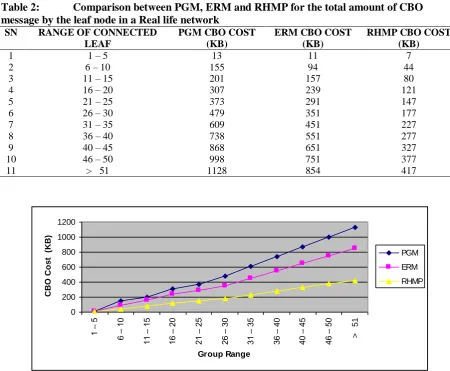
From the above description the overall CBO used PGM, ERM and RHMP multicast protocols for a three tier hierarchical network is presented in table 2
Table 2: Comparison between PGM, ERM and RHMP for the total amount of CBO message by the leaf node in a Real life network
SN RANGE OF CONNECTED
LEAF
PGM CBO COST (KB)
ERM CBO COST (KB)
RHMP CBO COST (KB)
1 1 – 5 13 11 7
2 6 – 10 155 94 44
3 11 – 15 201 157 80
4 16 – 20 307 239 121
5 21 – 25 373 291 147
6 26 – 30 479 351 177
7 31 – 35 609 451 227
8 36 – 40 738 551 277
9 40 – 45 868 651 327
10 46 – 50 998 751 377
11 > 51 1128 854 417
Figure 2: A graph showing the comparison between PGM, ERM and RHMP for the total amount of CBO message by the leaf node
0 200 400 600 800 1000 1200
1
–
5
6
–
10
11
–
1
5
16
–
2
0
21
–
2
5
26
–
3
0
31
–
3
5
36
–
4
0
40
–
4
5
46
–
5
0
>
5
1
Group Range
C
B
O
C
o
s
t
(
K
B
)
PGM
ERM
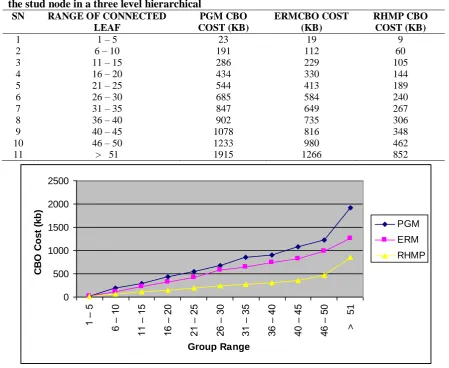
Table 3 Comparison between PGM, ERM and RHMP for the total amount of CBO message by the stud node in a three level hierarchical
SN RANGE OF CONNECTED
LEAF
PGM CBO COST (KB)
ERMCBO COST (KB)
RHMP CBO COST (KB)
1 1 – 5 23 19 9
2 6 – 10 191 112 60
3 11 – 15 286 229 105
4 16 – 20 434 330 144
5 21 – 25 544 413 189
6 26 – 30 685 584 240
7 31 – 35 847 649 267
8 36 – 40 902 735 306
9 40 – 45 1078 816 348
10 46 – 50 1233 980 462
11 > 51 1915 1266 852
Figure 3: A graph showing the comparison between PGM, ERM and RHMP for the total amount
of CBO message by the stud node in a three level hierarchical network
Analyzing Figure 3 and Table 3 they show that the RHMP uses more control bandwidth overhead than PGM and ERM at the stud nodes. RHMP uses less CBO at the stub nodes because the CBO is distributed across the stub nodes in RHMP reliable multicast data transport.
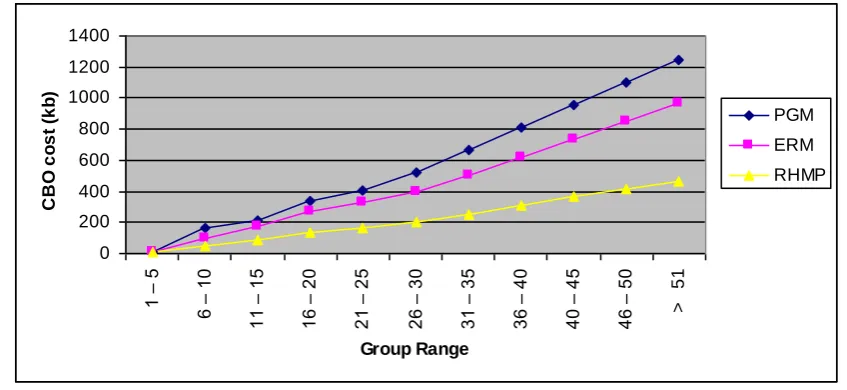
Table 4 Comparison between PGM, ERM and RHMP for the total amount of CBO message by the server/ source in a Real life network
SN RANGE OF CONNECTED
LEAF
PGM CBO COST (KB)
ERMCBO COST (KB)
RHMP CBO COST (KB)
1 1 – 5 14 9 5
2 6 – 10 164 94 46
3 11 – 15 217 175 88
4 16 – 20 335 267 134
5 21 – 25 408 326 165
6 26 – 30 526 393 198
7 31 – 35 669 506 253
8 36 – 40 812 619 308
9 40 – 45 957 734 363
10 46 – 50 1102 849 418
11 > 51 1246 967 462
0 500 1000 1500 2000 2500
1
–
5
6
–
10
11
–
1
5
16
–
2
0
21
–
2
5
26
–
3
0
31
–
3
5
36
–
4
0
40
–
4
5
46
–
5
0
>
5
1
Group Range
C
B
O
C
os
t
(k
b)
.
PGM
ERM
Figure 4: A graph showing the comparison between PGM, ERM and RHMP for the total amount
of CBO message by the server/ source
Analyzing figure 4 and table 4 it shows that the RHMP uses less control bandwidth overhead than PGM and ERM in reliable multicast data transport.
Conclusion
The stress level at the RPS is much for PGM and ERM than the RHMP because of the overall CBO consume / generated. The stress level at the leaf for PGM and ERM is also more than that of RHMP, but the stress level at the stub node is much for RHMP than PGM and ERM because of the CBO consumed at the stub node. The Reliable hybrid multicast protocol (RHMP) is better since it is a decentralized form of RPS multicasting thereby managing bandwidth resource in the network infrastructure.
References
[1.] Vamsi K Paruchuri, Arjan Durresi and Raj Jain (2003), “Optimized Flooding Protocol for Ad hoc Networks”, https://arxiv.org/ftp/cs/papers/0311/0311013.p df
[2.] Jayanta Biswas, Mukti Barai and S. K. Nandy (2004), “Efficient hybrid multicast routing protocol for ad-hoc wireless networks”, Proceedings of the 29th Annual IEEE International Conference on Local Computer Networks (LCN’04) 0742-1303/04
[3.] L. Ji, and M.S. Corson, “Differential Destination Multicast - A MANET Multicast Routing Protocol for Small Groups”, In
University Journal of Science GU J Sci 24(3):451-462 (2011) www.gujs.org pp. 2-3 [5.] Youssef Saadi, Bouchaib Nassereddine,
Soufiane Jounaidi and Abdelkrim Haqiq (2015), “Wireless Mesh Networks Capacity Improvement Using CBF”, International Journal of Wireless & Mobile Networks (IJWMN) Vol. 7, No. 3, Jun 2015 pp.1-2 [6.] Karim Seada, Ahmed Helmy, and Sandeep
Gupta, (2004) “A Framework for Systematic Evaluation of Multicast Congestion Control Protocols” IEEE Journal on selected areas in communications, vol. 22, no. 10, December 2004
[7.] Emad Abd-Elrahman1, Hossam Afifi2, Hassnaa Moustafa3, Mamadou Tourd Diallo3 and Nicolas Marechal3 “ (2011) Optimization of TV Multicast Delivery
[8.] Read .N, (2006) “A Multicast Performance Evaluation between PGM and MDP-CC under Varying Network Conditions” ttps://vlebb.leeds.ac.uk/bbcswebdav/orgs/SCH _Computing/FYProj/reports/0506/Read.pdf [9.] Mir N, Musa S, Torresand R, Swamy S (2014)
“Evaluation of PIM and CBT multicast protocols on fault-tolerance”, International Journal of computing and Networking Technology, Scientific Publishing Center, University of Bahrain
[10.]Jia W, Zhao W, Xuan D, and Xu G “an efficient fault-tolerant multicast routing
[11.]Kaur K, and Sachdeva M (2012), “Performance matrices for evaluation of multicast routing” 2012 interntional conference on Advances in engineering, Science and Management (ICAESM) PP. 582-587
[12.]Unterbrunner P, Alonso D, Kossmann G, (2011) “E-Cast: Elastic Multicast” Technical report,