RESEARCH ARTICLE
Psychometric evaluation of Persian version of Activities-specific
Balance Confidence scale for elderly Persians
Hoory Hassan1, Homa Zarrinkoob1*, Sadegh Jafarzadeh2, Alireza Akbarzade Baghban3
1- Department of Audiology, School of Rehabilitation, Shahid Beheshti University of Medical Sciences, Tehran, Iran 2
- Department of Audiology, School of Rehabilitation, Tehran University of Medical Sciences, Tehran, Iran
3- Department of Basic Sciences, School of Rehabilitation, Shahid Beheshti University of Medical Sciences, Tehran, Iran
Received: 11 Jun 2014, Revised: 23 Jun 2014, Accepted: 24 Jun 2014, Published: 25 Mar 2015
Abstract
Background and Aim: Disequilibrium is a common complaint in the elderly. The activities-specific balance confidence (ABC) scale is a suitable tool for assessing the level of confidence in balance whilst performing daily activities. The purpose of the study was translation, cultural adaptation and evaluation of the reliability and validity of the Activities-Specific Balance Confidence Scale for elderly Persians.
Methods: This was a descriptive, cross-sectional (test development) study. The ABC scale was translated based on the native protocol of the international quality of life assessment and was adapted to conditions found in Iranian culture. Upon confirmation of face validity, the questionnaire was given to 142 Persians aged between 60 and 92 years, selected via simple sampling. After one week, 56 participants were asked to complete the questionnaire again. Finally, reliability was evaluated using internal consistency and test-retest reproducibility. Results: Three items out of 16 were modified to adapt the scale to Iranian culture. Changes were approved by the original author. Reliability was
confirmed using a Cronbach alpha coefficient of 0.96 and an Intraclass correlation coefficient of 0.97.
Conclusion: The Persian version of the ABC scale is equivalent to the original content of the scale. In addition, it is compliant with the terms of Persian culture. It has high validity and reliability. It is suitable for assessing the level of balance confidence in the elderly in clinical or research settings.
Keywords: Psychometrics; activities-specific balance confidence scale; elderly; Persian; validity; reliability
Introduction
Disequilibrium and dizziness are the most common disorders of old age [1]. In general, aging process leads to biological changes in the body different cells, and after that gradual changes occur in the structure and function of various parts, including organs involved in maintaining balance [2]. Imbalance in the elderly can be divided into two factors: internal and external. Internal factors include disorder in different body organs (such as vision, musculoskeletal and vestibular systems),
psychological disorders and complex
medications. External factors are related to the environment. Due to the complexity of the concept of equilibrium, and the factors causing
*
imbalance in the elderly, the general term imbalance caused by aging (presbyastasis) is used to describe imbalance in old age [1]. One of the most common consequences of an imbalance in the elderly is falling down. Moeller et al. suggest that 30 to 50% of people over age 65 experience fall each year and its prevalence increases with increasing age and balance disorders [1]. However, these figures are probably lower than the actual value because often only cases of falls resulting in bodily injury or loss of performance requirements are recorded. The prevalence of cases such as fractures, soft tissue injury, dislocation of joints and movement disorders have been reported in 15 to 20% of cases. Psychological disorders are also the consequences of falls that reduce the activity and independence of older people and are destructive effects of physical damage [1]. Legters reported that in various individuals who have experienced falls, there is loss of confidence in balance and fear of falling (with an incidence of 50 to 60%) that in the 25 to 33% of them, this fear leads to avoiding behavior. Moreover, fear of falling is observed between 12 to 65% of elderly who do not have a history of falls or injuries [3].
According to the study of Glover and Prideaux, the number of elderly in the world in 2006 is estimated at about 688 million people and it is predicted that by 2050 this figure will increase up to 2 billion. That includes about 20% of the world's total population [4]. Therefore, due to the growing elderly population in the world, dealing with common problems in old age and its consequences seems necessary. To fix balance disorders one should consider the relationship between equilibrium organ damage, and executive dysfunction and its consequences in patient's life. To identify and assess the impairment, various balance tests such as posturography, electrocochleography (ECOG), and videonystagmography (VNG) are used.
However, for better management and
appropriate interventions, acquisition of information on balance disorders, lifestyles and self-perceived disability is also necessary [5]. In this area, there are a number of standardized
questionnaires that measure the effect of balance disorders on the individuals’ performance [3]. One questionnaire appropriate for study of the elderly to ensure their balance is activities-specific balance confidence (ABC) scale consisting of 16 questions on specific activities. ABC is introduced in 1995 by Powell and Myers in University of Waterloo in Ontario, Canada, to measure balance confidence of older people. In this test, subjects are asked to trust their balance while performing 16 activities with different levels of difficulty rated based on a scale of zero to 100 [2]. Average score will be considered as a final point. This standardized questionnaire has been widely translated into Korean [6], Chinese [7], Swedish [8], French [9], and Brazilian-Portuguese [10] to be used in research and clinical settings. For example, ABC has been used to check the reliability of balance in patients with multiple sclerosis [11], Parkinson's disease [12], cerebral infarction [9] and those with unilateral and bilateral vestibular disorders [8].
On the other hand, the obtained information will help to select appropriate methods of balance rehabilitation and monitoring by the therapists.
Methods
ABC scale consists of 16 questions and has no subscales. In this test the elderly will be asked to rate the confidence to their balance while performing an activity that has 16 different levels of difficulty based on the scale from zero to 100. The mean scores will be considered as the final score. Zero point is as the lowest score (the lowest level of confidence to balance and the highest fear of falling) and score of 100 is as the highest score (the highest level of confidence and the lowest balance of fear of falling). According to the study of Meyer et al. points resulting from ABC scale are placed in three groups; scores above 80 indicate a high potential in terms of physical function, scores between 50 and 80 indicate the average ability of physical performance and scores below 50 indicate poor physical function [13]. Lojoie et al. in their study reported that scores below 67 on the ABC scale can be a criterion for prediction of falls [14]. After seeking permission from the original ABC scale developers, we perfomed this cross-sectional study into two main phases. The first phase was translation and cultural adaptation and the second was to evaluate the psychometric properties.
Translation and cultural adaptation were carried out according to the protocol of international quality of life assessment (IQOLA) [15]. For this purpose, two fluent translators unfamiliar with the questionnaire independently translated the original version of ABC scale from English to Persian. Then they were asked at a meeting of researchers to grade to the difficulty of translation based on a 100-point scale (the point 0 referred to a completely simple translation and the point 100 a completely hard translation). Scores below 30 were considered as a simple translation of the Persian translation and agreed to be considered as easy.
The resulting version was presented to two other translators who independently rated the quality
of Persian translation (in the sense of clarity in terms of non-professional translation of words and adapt the content of the original version) on a scale of zero to 100 (zero poor quality and 100 high quality). Average rating was three and four points above criteria 90. Therefore, final translation was given to two other fluent translators who back-translated the scale to English. English translation obtained of this stage accompanied with the Persian translation and the original version, were presented to 12 experts in the field of balance (nine audiologists, two occupational therapists and one physiotherapist) who were asked to rate quality of the translation and cultural adaptation of all parts of final Persian translation on a scale from zero to 100 points. Questions or parts of them in terms of quality of translation and cultural adaptation with score less than 90, were discussed at the meeting and necessary modifications were made on them. The Persian translation was assessed in terms of full compliance with the cultural conditions of the elderly Persian language, and its semantic equivalence, conceptual and used technical terms were confirmed by the experts.
To assess face validity the Persian version of ABC (ABC-P) scale was administered to 10 elderly who were representative of the study population. They were asked to read each of the questions and express their understandings of the questions and their guidelines.
elderly. The study participants were aware of the study aims and upon informed consent they were ensured of securing confidentiality of their personal information. Other data were collected through interviews. Of 142 participants, 65 returned the questionnaire within a week. Scores of each question of ABC-P and scores obtained from each time of assessment were used to perform test-retest measure internal consistency. Normal distribution of data in different groups of the sample was assessed by Kolmogorov-Smirnov test. The ABC-P mean scores of different groups of samples were analyzed using t-test. The statistical differences of scores from ABC-P scale in four educational categories were evaluated using ANOVA and Tukey tests. Spearman's correlation test was used to assess correlation between scale scores and individual response to 4-choice question: "Are you afraid of falling?" Cronbach's alpha coefficient was calculated to obtain the internal consistency of the scale for each question and ABC-P total score. Data were analyzed using SPSS 20.
Results
One hundred and forty two elderly aged 60 to 92, (mean=67.746, SD=0.61) participated in this study. Mean scores of ABC-P scale was obtained in the range of 10.63 to 100, mean=75.32, SD=19.79. The highest score was for Question 1 (walk around the house) and the lowest score was for question 16 (walk on a wet or slippery surface).
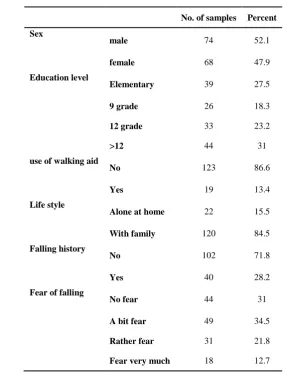
Seventy four percent of participants were male and 68 were female. Other characteristics of the subjects are shown in Table 1.
Mean scores of ABC-P in males was significantly higher than that of females (p<0.001), and in the elderly over 75 years it significantly was lower than that of elderly lower than 75 years of age (p=0.007). The mean scores of ABC-P in elderly people who in their daily active ties used auxiliary devices (such as a cane, walker or help other people) was significantly lower than the seniors who rely on themselves in daily activities (p<0.001). The mean scores for history of falls in older people during the past year was significantly lower than
seniors who have not had such an experience (p=0.002). Mean scores of ABC-P of the elderly who lived alone at home with their families was below the seniors who lived with their relations (p>0.05), but this difference was not significant. Mean scores of ABC-P decreased with increasing levels of education. The effect of education on ABC-P scale scores was significant (p<0.001). The significance of scores was determined by Tukey test. The mean scores were significantly lower for the elderly with primary school education than elderly with 12 grade and higher (p<0.05). The mean scores for the elderly who had higher 12 grade was significantly higher than elderly with 9 grade (p<0.05).
was changed to "walk in a public parking". Question 16 referred to walking on icy sidewalk in accordance with Canada's climate. In Iran there would be less probability of being in a position that the elderly is forced to walk on icy grounds. Instead, the phrase "walk on wet or slippery surface" was used. At the end of panel expert, questions 2, 9, 11, 14 and 15 which includes two-part activities (such as walk up or down staris, get into or out of a car, walk up or down a ramp, step onto or off an escalator) are divided into two parts A and B. Given that, some elderly may consider separate scores for each part of a two-part activities. This change is intended to facilitate understanding of aging and comfort in calculating scores by professionals, was done (according to scoring guidelines, lowest scores should be used in calculations
because it limits the total activity(.
According to the results of face validity, understanding of content of questions and the situation in which everyone should draw, adapted with the aim of original version. Only some of the elderly had difficulty in understanding the guideline of scale, so changes in appearance of it was applied. That is firstly, the phrase "How sure you do not lose your balance, when "were repeated at the beginning of all the questions, because although some elderly were first noted that should answer to their balance confidence during the questioned activities, but forgetting their desired task. Secondly, initial expression and guide of participants which had repetitive phrases and repeated explanations, was modified more briefly without changing the content.
Table 1. Demographic characteristics of the participants
No. of samples Percent
Sex
male 74 52.1
female 68 47.9
Education level
Elementary 39 27.5
9 grade 26 18.3
12 grade 33 23.2
>12 44 31
use of walking aid
No 123 86.6
Yes 19 13.4
Life style
Alone at home 22 15.5
With family 120 84.5
Falling history
No 102 71.8
Yes 40 28.2
Fear of falling
No fear 44 31
A bit fear 49 34.5
Rather fear 31 21.8
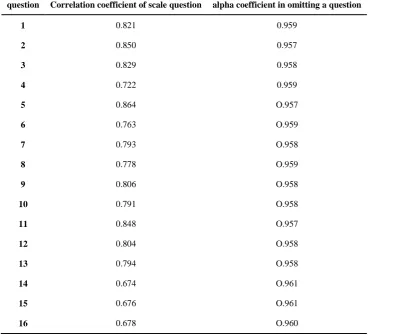
ABC-P scale reliability was assessed by calculating the internal consistency and test-retest reliability. Strong question-scale correlation was found among all 16 questions (Table 3). Cronbach's alpha coefficient for ABC-P total score was 0.96.
Intra-class correlation coefficient (ICC) was used to assess the correlation between the scores of the participants, during the second round of evaluation within a week was 0.97 (with confidence interval of 0.95, with 0.98 upper limit and 0.95 lower limit).
Discussion
The purpose of this study was implementation the process of translation and cultural adaptation of ABC in the Persian speaking elderly and assessment validity and reliability of it. Following the translation of ABC based on IQOLA protocol, the final Persian translation was given to experts in the field of balance and in a meeting, the quality of translation and the cultural adaptation were discussed. This part of the adaptation process is important because the final Persian version of ABC that had a good quality from the translator perspective, placed at the disposal of experts in the field of balance and the quality of the translation and cultural adaptation checked from their perspective. In this study, the content of the questions 3, 10 and 16 were changed due to cultural issues. Question 3 was changed from "bend over and pick up slippers from the front of a closet floor to "bend over and pick up slippers from the floor" with the argument that picking up slippers from a closet is not a common activity among the Iranian elderly. Mak et al. in their study aimed to develop a Chinese version of the ABC
scale, changed Question 3 in the same manner as in the culture of Hong Kong's slippers is used outdoors [7]. In the study of Marques et al. for the preparation of the Brazilian Portuguese version of ABC, Question 3 was also modified, so that it could be applied to similar situations [10]. In Iran many stores in shopping centers have not parking space, hence Question 10 was modified to "walking in a public parking". Marques et al. in their study did not change question 10, but due to economic conditions of the Brazilian society, they modified questions 12 and 13 and replaced the word "mall" to "bustling atmosphere", with the argument that all people in Brazil have no buying power. They also modified Question 8 from "walk outside the house to a car parked in the driveway” to “bus parked in front of the house", because, in their view, many of the Brazilian people have not private car [10]. Mak et al. in their study instead of the word "car" in questions 8 and 9 used "public transportation by" because people of Hong Kong have used public transportation more than private car [7]. In Question 16 that refer to “walk outside on icy sidewalks” that consistent with climatic conditions of Canada. In two mentioned studies and the present study, this question has changed to "walk on wet and slippery surface".
In this study to assess the face validity, 10 elderly as representatives of the target population were asked about the clarity, simplicity and ambiguity of the ABC-P questions and guidelines. However, they reported that understanding the basic guide was difficult to some of them. the guide of participants in order to understand more easily for the elderly was corrected without changing
Table 2. Original and modified items in cultural adaptation scale of activities-specific balance confidence
No. of item original items of the ABC scale Modified items of the ABC-P scale
3 bend over and pick up slippers from the front of a closet floor bend over and pick up slippers from the floor
10 walk across a parking to the mall walk in a public parking
the content, and the phrase "How confident are you that you will not lose your balance or become unsteady when you" at the beginning of all the questions were repeated since elderly do not forget that what should be rated. In The study of Jarlsater and Mattsson with the aim of providing the Swedish version of the ABC on unilateral vestibular disorders have been conducted, to assess the face validity, in addition to assess intelligibility of questions, the patient were asked whether content of the questions scale covers all of their balance problems. Some of them said that it is better to questions about activities that need to move their head, walking in open environments and long trips in the car also be asked [8]. This is the difference between study groups in their study, in contrast to our study is justified.
Scale reliability has been one of the most
important features of a tool to be applicable in research and clinical settings. The scores obtained from the scale in terms of reliability must have two characteristics. First, the rates that are subject to the same phenomenon, or concept, must be constant or have small error, Second in multi-questions scales like present scale, changes in test scores must be coordinator [15]. In this study ABC-P scores of these two aspects have been studied. Reliability of ABC-P was evaluated by internal consistency of the scale and Cronbach's alpha coefficients. Cronbach's alpha value for each of the questions was in the range of 0.67 to 0.86 and 0.96 for the entire scale. This correlation between the questions and the total scale, means that no inappropriate questions, that reduces the overall Cronbach's alpha coefficients and internal consistency were exist, and participants'
Table 3. Internal consistency of Persian version of activities-specific balance confidence
question Correlation coefficient of scale question alpha coefficient in omitting a question
1 0.821 0.959
2 0.850 0.957
3 0.829 0.958
4 0.722 0.959
5 0.864 O.957
6 0.763 O.959
7 0.793 O.958
8 0.778 O.959
9 0.806 O.958
10 0.791 O.958
11 0.848 O.957
12 0.804 O.958
13 0.794 O.958
14 0.674 O.961
15 0.676 O.961
perceptions of the scale are the same [15]. In the original version of the ABC scale Cronbach's alpha coefficient was 0.96 [2]. This is another confirmation of the equivalence scale ABC-P with the original version. Cronbach's alpha coefficient of ABC in other languages and populations is consistent with our study. For example, the Cronbach's alpha for the Chinese version of ABC was 0.97 [7], for the Korean version 0.99 [6], the Swedish version in elderly patients with cerebral infarction 0.95 [11], for 5-question scale version of ABC (ABC-5) in patients with Parkinson's disease 0.93 [12], and for the Canadian French version in elderly patients with cerebral infarction 0.93 [9].
The ICC for the results of 56 elderly that completed the ABC-P two times a week, was 0.97 that indicates a high correlation between the results of two sets of evaluation. The ICC for the original version has been 0.92 [2]. Therefore, there is no measurement error in the ABC-P or at a small scale [15].
ICC for the Chinese version of ABC is 0.99 [7], for the Korean version 0.70 [6] for the Swedish version in elderly patients with cerebral infarction 0.83 [11], the 5-question scale version of ABC (ABC-5) in patients with Parkinson's disease more than 0.91 [12] and for the Brazilian Portuguese version of ABC 0.94 [10]. However, the ICC values in different studies depending on the type and version of the study group are different. The results of several studies suggest that the ABC scale has good psychometric properties in different languages and populations.
The mean (±SD) of confidence level of perceived balance in Persian-speaking elderly in present study was 75.32 (SD=19.79) and the range of 10.63 to 100. The highest score was for question 1, and lowest for questions 15 and 16, respectively. In the original version of the ABC, distribution rates and the highest and lowest points in this case have been reported as well.
Conclusion
The ABC-P scale to assess the level of confidence in the balance in the Persian speaking elderly, has good reliability and
validity, and can be used in clinical and research activities.
Acknowledgments
We are grateful to professors/doctors Mohtaram Najafi, Mansoureh Adel Ghahreman, Fahime
HajiabolHassan, Mahdi Akbari, Nima
Rezazadeh, Moslem Shabani, Ashkan Irani, Aliasghar Jamehbozorgi, Abbas Rahimi and Abdoreza Sheibanizadeh who have helped us in the implementation of this research and the elderly who participated in the study.
REFERENCES
1. Olsson Möller U, Midlöv P, Kristensson J, Ekdahl C, Berglund J, Jakobsson U. Prevalence and predictors of falls and dizziness in people younger and older than 80 years of age--a longitudinal cohort study. Arch Gerontol Geriatr. 2013;56(1):160-8.
2. Powell LE, Myers AM. The Activities-specific Balance Confidence (ABC) Scale. J Gerontol A Biol Sci Med Sci. 1995;50A(1):M28-34.
3. Legters K. Fear of falling. Phys Ther. 2002;82(3):264-72.
4. Glover P, Prideaux B. Implications of population ageing for the development of tourism products and destinations. JVM. 2009;15(1):25-37.
5. Gill-Body KM, Beninato M, Krebs DE. Relationship among balance impairments, functional performance, and disability in people with peripheral vestibular hypofunction. Phys Ther. 2000;80(8):748-58.
6. Jang SN, Cho SI, Ou SW, Lee ES, Baik HW. The validity and reliability of Korean Fall Efficacy Scale (FES) and Activities-specific Balance Confidence Scale (ABC). Arch JKGS. 2003;7(4):255-68.
7. Mak MK, Lau AL, Law FS, Cheung CC, Wong IS. Validation of the Chinese translated Activities-Specific Balance Confidence scale. Arch Phys Med Rehabil. 2007;88(4):496-503.
8. Jarlsäter S, Mattsson E. Test of reliability of the dizziness handicap inventory and the activities-specific balance confidence scale for use in sweden. Eur J Physiother. 2003;5(3):137-44.
9. Salbach NM, Mayo NE, Hanley JA, Richards CL, Wood-Dauphinee S. Psychometric evaluation of the original and Canadian French version of the activities-specific balance confidence scale among people with stroke. Arch Phys Med Rehabil. 2006;87(12):1597-604. 10. Marques AP, Mendes YC, Taddei U, Pereira CA,
Assumpção A. Brazilian-Portuguese translation and cross cultural adaptation of the activities-specific balance confidence (ABC) scale. Braz J Phys Ther. 2013;17(2):170-8.
11. Nilsagård Y, Carling A, Forsberg A. Activities-specific balance confidence in people with multiple sclerosis. Mult Scler Int. 2012;2012:613925.
13. Myers AM, Fletcher PC, Myers AH, Sherk W. Discriminative and evaluative properties of the activities-specific balance confidence (ABC) scale. J Gerontol A Biol Sci Med Sci. 1998;53(4):M287-94. 14. Lajoie Y, Girard A, Guay M. Comparison of the reaction
time, the Berg Scale and the ABC in non-fallers and fallers. Arch Gerontol Geriatr. 2002;35(3):215-25. 15. Bullinger M, Alonso J, Apolone G, Leplège A, Sullivan
M, Wood-Dauphinee S, et al. Translating health status questionnaires and evaluating their quality: the IQOLA Project approach. International Quality of Life Assessment. J Clin Epidemiol. 1998;51(11):913-23. 16. Munro BH. Statistical methods for health care research.