IPA
International Journal of Psychology Vol. 12, No. 1, Winter & Spring 2018
PP. 81-90
Iranian Psychological
Association
The Effectiveness of Time Perspective Therapy
in Reducing Depressive Symptoms
Golita Emsaki, PhD* Department of Psychology
University of Isfahan [email protected]
Negar Karimian, PhD Department of Psychology
University of Isfahan
Abolghasem Nouri, PhD Department of Psychology
University of Isfahan
Time perspective therapy is a therapy based on the time perspective theory and it aims to balance the time perspective. Since depressed patients usually have a distorted time perspective, it has been hypothesized that this kind of therapy may help them. This study aims to investigate the effectiveness of time perspective therapy on depression symptoms. Eight female depressed patients entered the group therapy and were compared with a control group of eight female patients. Both groups were asked to answer the Beck Depression Inventory in a pretest phase. Then the patients in the experimental group attended group therapy for six sessions. After that, both groups were asked to answer the same questionnaire in the post-test phase. The results showed that patients who entered the group therapy became significantly better compared with the control group. The findings suggest that time perspective therapy can be effective in reducing depressive symptoms in depressed female students.
Keywords:depression, time perspective therapy, female students
According to the time perspective theory (Gonzalez & Zimbardo, 1985; Zimbardo & Boyd, 1999; Keough, Zimbardo & Boyd, 1999), our view of ourselves, our world, and our relationships is filtered through temporally based cognitive
processes. We tend to divide our personal experiences into the categories of past, present, and future (Keough, Zimbardo & Boyd, 1999;Worrell, Mello, 2007).
The time perspective is a non-conscious process whereby personal and social experiences are allocated into selected temporal categories or frames to give order, coherence, and meaning to those events. These past, present, and future temporal frames are used to encode, store, and recall the experienced events, as well as to form expectations, goals, contingencies, and imaginative scenarios (Keough, Zimbardo & Boyd, 1999). Boyd and Zimbardo (2005) postulate that there is a healthy balance between the orientation of the past, the present, and the future. This balance could reflect one‘s capabilities to learn from the past, to adapt to the present, and to prepare for and engage in goal-oriented behavior in the future (Van Beek et al, 2010). However, specific orientations may be used too much and others may be used too little, leading people to become biased in their time perspective (Keough, Zimbardo & Boyd, 1999).
The time perspective may be related to clinical psychology and psychiatry, and a lack of historicity and continuity is regarded as a core feature of personality pathology (Livesley, 2003).
The past positive perspective comprises a warm and positive attitude to the past. This scale has a positive correlation with happiness, and high self-esteem and a negative correlation with depression, aggression, and anxiety (Zimbardo & Boyd, 1999).
Present hedonistic is characterized by joy and excitement in the current moment without scarifying today for tomorrow. A high score on this scale is related to a lack of impulse control and novelty-seeking (Zimbardo & Boyd, 1999).
Present fatalistic reflects the view that the future has been determined and the person‘s actions cannot change it. This subscale is related to depression, anxiety, and aggression. Laghi et al. (2009) and Van Beek et al. (2010) also found that higher scores in the present fatalistic orientation are associated with less extraversion, consciousness, higher neuroticism, and an increased risk of suicidal ideation.
The future orientation is characterized by planning for achieving future goals. This scale has a positive correlation with consciousness and stability preference, and a negative correlation with novelty-seeking depression and anxiety
(Zimbardo & Boyd, 1999). Suicidal patients lack the ability to envision a positive future and a high tendency to positive future thinking seems to be protective against suicide (Van Beek et al, 2010).
The goal of time perspective therapy is balancing the time perspective that is accomplished by: 1) boosting past positives, 2) training to increase the present hedonism orientation, and 3) making both short-term and long-term plans for a future positive orientation (Zimbardo, et al, 2012).
for the future (American Psychiatric Association, 2000), it seems that time perspective therapy can help them to reduce the severity of depression by balancing their time perspective.
Method ZimbardoTime Perspective Inventory
The Zimbardo Time Perspective Inventory (ZTPI) was designed based on the time perspective theory and it assesses five factors. These five factors include: past positive, past negative, present fatalistic, present hedonistic and future orientations. This self-report questionnaire consists of 56 questions which are rated on a 5-point Likert scale. Its four-week test retest reliability was estimated between .7 and .8 which future subscale had the best reliability (r = .8) and after that present fatalistic (r = .76), past positive (r = .76), present hedonistic (r = .72) and past negative (r = .70) had the best reliability respectively (p = .01) (Zimbardo & Boyd, 1999). In addition to test–retest reliability, the structural, predictive, convergent, and discriminant validity of the ZTPI scores were examined, and Zimbardo and Boyd concluded that ‗‗the ZTPI is a reliable and valid measure of Time Perspective‘‘ (Worrel & Mello, 2007).
This questionnaire was translated into Persian by Taj et al. (2005), and its reliability was estimated with medical students in a two-week interval. The reliabilities were as follows: present hedonistic: r = .86, past negative: r = .80, past positive: r = .79, future: r = .75, present fatalistic: r = .66.
Beck Depression Inventory
The Beck Depression Inventory-II (BDI-II; Beck et al., 1996)
is a 21-item self-report instrument developed to measure the severity of depression in adults and adolescents. Higher scores represent greater depression severity (range: 0–63), and the minimal, mild, moderate, and severe symptom severity ranges have been specified (Van Beek et al, 2010). Its reliability and validity is reported as agreeable in many research studies (Marnat, 2009; Shaver & Brennan, 1991).
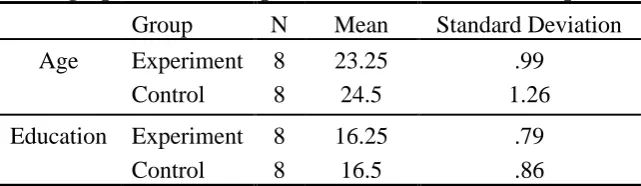
Their descriptive results are presented in Table 1.
Table 1
Demographic Data of Experimental and Control Groups
Group N Mean Standard Deviation
Age Experiment 8 23.25 .99
Control 8 24.5 1.26
Education Experiment 8 16.25 .79
Control 8 16.5 .86
It was necessary to test the normality and homogeneity of variance before applying the data to an Analysis of Co-variances. The Shapiro–Wilk test of normality and the Levene test of homogeneity of variance were not rejected; accordingly, we were permitted to use this parametric test.
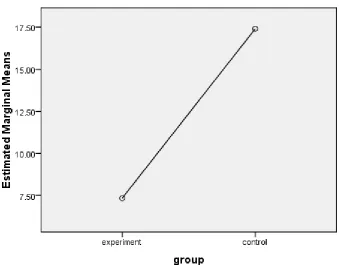
The results of the ANCOVA showed that even after controlling the effect of the pre-test there is a significant difference between the two groups in the BDI-II in the post-test stage (F=19.068, p<.05). The observed power of 0.98 showed that the sample size was enough for this conclusion (Table 2). Figure 1 can illustrate these differences in a better way.
Table 2
ANCOVA for investigating the difference in the total scores of BDI-IIbetween 2 groups (* p < .05)
Dependent variable
source df Mean square
F sig Partial eta square
Observed power
Beck posttest
Beck pretest
Figure 1. Difference among Estimated Marginal Means of 2 Groups
Discussion
The aim of this study was to investigate the effectiveness of time perspective group therapy on depression. Time perspective therapy is a relatively new method of therapy. The present study is one of the first in Iran to address this kind of therapy. The result showed that time perspective therapy is effective in reducing depression in female university students. This was concordant with the findings of Zimbardo et al. (2013) who
perspective and the present fatalistic time perspective are both related to depression, unhappiness, low self-esteem, aggression, and suicidal ideations, while the past positive and future time perspectives have a negative correlation with depression, aggression, and anxiety (Zimbardo et al , 1999., Van Beek et al, 2010).
So, a reduction in depression symptom severity was expected after a therapy which targets the patient‘s time perspective. Depression is an outcome of distortions of someone‘s time perspective. The loss of continuity, a lack of ideas about the future, and being cut off from the past appear to cause depression. The hopelessness in depressed patients appears to consist of two factors: preoccupation with a negative past and a lack of a positive future. The goal of time perspective therapy is to reduce the negative past and present fatalistic time perspectives, and instead to increase the positive past and future time perspectives, thus alleviating symptoms of depression.
Acknowledgement
We highly appreciate Professor Philip Zimbardo, Dr Rosemary Sword and Ms Marjan Haghighatjoo who kindly help us in administering Time Perspective Therapy. We also thank the counseling center of Isfahan University which provided depressed patients and help us in holding the sessions.
References
American Psychiatric Association. (2000). Diagnostic and
statistical manual of mental disorders (4th ed., text rev.).
Washington, DC: Author.
Boyd, J. N., & Zimbardo, P. G. (2005). Time Perspective, Health, and Risk Taking.In: Strathman, A., aJoireman, J. (Eds.). Understanding Behavior in the Contextof Time: Theory, Research, and Application. Mahwah, NJ: Lawrence ErlbaumAssociates Inc.
Keough, K. A., Zimbardo, P. G., & Boyd, J. N. (1999). Who‘s Smoking, Drinking and Using Drugs? Time Perspective as a Predictor of Substance Use. Basic and Applied Social Psychology. 21(2), 149-164.
Laghi, F., Baiocco, R., D‘Alessio, M., & Gurrieri, G. (2009). Suicidal ideation and time perspective in high school students. European Psychiatry, 24, 41-46.
Livesley, W. J. (2003). Diagnostic Dilemmas in Classifying Personality Disorder. In: Phillips, K. A., First, M. B., and Pincus, H. A. (eds). Advancing DSM: Dilemmas in
Psychiatric Diagnosis. Washington, DC: American
Psychiatric Association
Shaver, R. P., & Brennan, K. A. (1991). Measures of Personality and Social Psychological Attitudes. Volume 1. San Diego, California: Elsevier.
Taj, M., Mokri, A., & Fotohi, A. (2005). Delay Discounting (DD) in Correlation with Time Perspective in Medical Interns. Iranian Journal of Psychiatry and Clinical Psychology, 11(3), 327-334
Van Beek, W., Berghuis, H., Kerkhof, A., & AartjanBeekman, A. (2010). Time perspective, personality and psycho pathology: Zimbardo‘s time perspective inventory in psychiatry. Time and Society, 20(3), 364–374.
Worrell, F. C., & Mello, Z. R. (2007). The Reliability and Validityof Zimbardo Time PerspectiveInventory Scores in Academically Talented Adolescents.Educational and Psychological Measurement, 67(3), 487-504
Zimbardo, P. G., Sword, R. M., & Sword, R. K. (2012). The Time Cure: Overcoming PTSD with the New Psychology of Time Perspective Therapy-Therapist Guide, Jossey Bass, an Imprint of Wiley Publishing.
Zimbardo, P. G., & Boyd, J. N. (1999). Putting time in perspective: a valid, reliable, individual- differences metric. Journal of Personality and Social Psychology, 77(6), 1271- 1288.