I J H S
ijhs.shmu.ac.ir doi: 10.22100/ijhs.v2i2.92
Original Article
International Journal of Health Studies
Association between Objectively Sleep Pattern and Obesity in the Elderly
Shima Abdollahi1,2, Omid Toupchian3, Kamal Azam4, Majid Rahmati5, Kurosh Djafarian6*1 Nutrition and Food Security Research Center, Shahid Sadoughi University of Medical Sciences, Yazd, Iran. 2 Dept. of Nutrition, School of Health, ShahidSadoughi University of Medical Sciences, Yazd, Iran.
3 Dept. of Cellular and Molecular Nutrition, School of Nutritional Sciences and Dietetics, Tehran University of Medical Sciences, Tehran, Iran. 4 Dept. of Epidemiology and Biostatistics, School of Public Health, Tehran University of Medical Sciences, Tehran, Iran.
5 Dept. of Medical Biotechnology, School of Medicine, Shahroud University of Medical Sciences, Shahroud, Iran.
6 Dept. of Clinical Nutrition, School of Nutritional Sciences and Dietetics, Tehran University of Medical Sciences, Tehran, Iran.
Received: 18 February 2016 Accepted: 25 March 2016
Abstract
Background: Previous studies on the relationship between sleep patterns and obesity in the elderly are limited and have conflicting results. Moreover, few studies have measured sleep patterns objectively. In this study, we investigated objective sleep patterns and their relationship with obesity in the elderly in Tehran, Iran.
Methods: In this cross-sectional study, 88 elderly (≥60 years old) who were members of health homes of zone 5 in Tehran, Iran, were included by simple random sampling method in 2014. Sleep patterns were objectively assessed using waist actigraphy for a mean of 4.3 ± 1.7 days). Height, weight, and waist circumference (WC) were measured by standard methods and body mass index (BMI) was calculated. Data entry and statistical analyses were performed using SPSS version 21.
Results: Mean actigraphy-assessed sleep duration, sleep efficiency (percentage of time in bed spent sleeping), and sleep latency (time required to fall asleep) were 427 ± 62 min, 71.3 ± 18%, and 14.2 ± 3.8 min, respectively. A negative relationship was found between BMI and sleep duration (r = −0.2, p = 0.03), BMI and sleep efficiency (r = −0.3, p=0.01), and WC and sleep efficiency (r = −0.2, p = 0.04). Also, a positive association was observed between BMI and sleep latency (r = 0.4, p = 0.006).
Conclusions:In the elderly, actigraphy-assessed sleep duration was associated with obesity and the sleep efficiency was poor in obese participants. It seems that sleep patterns and BMI are correlated with each other. However, there is a need for prospective studies to affirm causal relationships between these constructs.
Keywords: Sleep, Obesity, Aged, Actigraphy.
*Corresponding to: K Djafarian, Email: [email protected]
Please cite this paper as: Abdollahi S, Toupchian O, Azam K, Rahmati M, Djafarian K. Association between objectively sleep pattern and obesity in the elderly. Int J Health Stud 2016;2(2):4-8.
I
ntroduction
Aging is associated with many physiological changes, including changes associated with increased adiposity and obesity.1,2 Additionally, the results of some cross-sectional studies have shown that changes in circadian rhythms, as well as the use of multi-drug therapy, can cause sleep disorders during aging.3,4It has been reported that more than 50% of the elderly have trouble falling asleep or staying asleep.5 In the elderly, insomnia is more often related to increasingly frequent awakening during sleep rather than longer durations of awakening.6 Adequate length and quality of sleep is important for normal daily metabolic and hormonal functioning, as well
7
the amount and quality of sleep is associated with obesity.8-11 Kim et al. showed that poor sleep quality is an independent risk factor for obesity.9Knuston et al. mentioned that sleep deprivation is associated with increased risk of obesity, impaired glucose metabolism, and risk of type 2 diabetes.12 Although some studies have shown negative linear associations between sleep time and body mass index (BMI),13-18others have proposed that sleep time and BMI have a U-shaped relationship.10,11,19-21 While It seems that objective measurements have shown sleep patterns to be associated with obesity in the elderly, 22-24some studies have failed to show this correlation.14,25
According to our review of the literature, only a limited number of studies have assessed the relationship between sleep patterns and obesity in the elderly, as most of the previous studies have instead focused on children or adolescents. 26-28
Also, most epidemiological studies have assessed sleep duration by self-reporting methods that show high rates of false estimation. However, the American Sleep Disorders Association has presented the actigraphy method as a more reliable way for assessing sleep-wake patterns, sleep efficiency (SE), and sleep onset latency in adults based on the person’s movement.29-33
The present study sought to objectively evaluate sleep patterns using actigraphy and to investigate the relationship between sleep patterns and obesity in in the elderly.
Materials and Methods
This cross-sectional study involved elderly participants who were residents of health homes located in zone 5 of Tehran, Iran. A total of 90 elderly (≥60 years old) participants were selected by simple random sampling based on the proportional populations of each facility. participants recruitment started in February 2014 and was completed in August 2014. After obtaining informed consent from all the participants, they were enrolled in the study. Individuals with any health condition that made them unable to use the Actiwatch devices, such as physical or mental disorders, mental retardation, Alzheimer’s disease, Cognitive impairment, or the use of sedative drugs, and people unwilling to participate in the study were excluded.
5 | International Journal of Health Studies 2016;2(2) Participants were measured without shoes and wearing minimal
clothing. Body weight was measured using a digital scale with an accuracy of 100 g. Height was measured in a relaxed position and freely hanging arms using a wall-mounted height chart with an accuracy of 0.5 cm. Waist circumference (WC) was measured using a non-elastic tape from the middle of the last rib to the iliac crest. BMI was calculated by dividing weight (in kg) by height (in m) squared. Obesity was defined as a BMI of 30 kg/m2 or higher.
Sleep patterns were objectively evaluated using the GT3X Actiwatch device (Pensacola, Florida, USA). The validity and reliability of this method has been demonstrated in previous studies.10,11,24,34TheActiwatch is a small device worn on the wrist or waist.35,36Due to the possible hand vibrations in the elderly, we asked participants to wear the device on their waist. The accelerometer sensors in the device measured the number of bodily accelerations based on the person’s movement for each minute and information can be stored for a long time.31,37Participants were asked to wear the Actiwatch continuously over a period of 3 to 7 consecutive nights. During the actigraphy period, participants were asked to record information about what time that they went to bed, what time they woke up in the morning, and what time they removed the Actiwatch. This information was used to ensure the accuracy of the stored data. The stored data on each Actiwatch was then transferred to the computer and the row data was analyzed using ActiLife software, version 4.4.0 (Pensacola, Florida, USA). Collected data from participants with less than two nights were excluded from analysis. Nocturnal sleep duration was categorized into groups of <5 h, 5 h to 8 h, and >8 h.
The actigraphy data was transferred to Excel 2013 from the ActiLife software. The Kolmogorov-Smirnov test was used to examine the normal distribution of data. Continuous data were expressed as means and standard deviations, and categorical variables were presented as numbers and percentages. Independent sample t-tests were used to compare continuous parametric data. The Pearson correlation coefficient test was used to examine the relationship between the normal variables of sleep pattern and obesity. Participants were categorized into two groups based on BMI: obese (BMI ≥30 kg/m2) and non-obese (BMI <30 kg/m2). Actigraphically measured nocturnal sleep duration was divided into three categories. The
Chi-square test was used to compare categorical data betwen the obese and non-obese groups. Analyses of variance (ANOVA) followed by Tukey post-hoc tests were conducted to examine between-group differences for BMI and WC values. The alpha value was set at 0.05 to indicate statistical significance for all comparisons. All data analyses were conducted using SPSS (version 21; SPSS Inc., Chicago, Illinois, USA).
Results
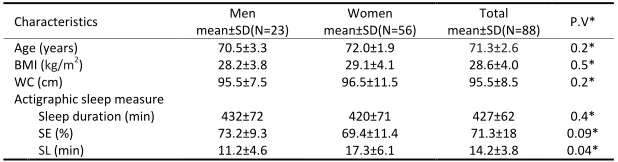
In total, 88 participants (56 women and 32 men) completed the study, and the final data for 2 participants were excluded because of gaps in their sleep duration data. The mean age of the participants was 71.3 ± 2.6 years (with a range of 60–93 years). The mean BMI and WC were 28.6 ± 4.0 kg/m2 and 95.5 ± 8.5 cm, respectively. A total of 25 participants (28.4%) had a BMI equal to or higher than 30 kg/m2 and were classified as obese. The characteristics of the participants are presented in Table 1.
For the 59 participants (67%), the study period included 3 continuous nights, and all other participants had data for 7 nights. The mean time of actigraphy recording was 4.3 ± 1.7 nights.
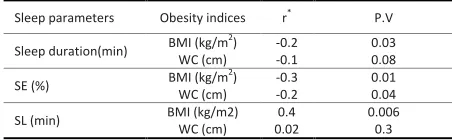
There were no significant differences between men and women in their actigraphy data, except for sleep latency, which was higher in women (P = 0.04). Table 2 shows the correlation between anthropometric measurements and sleep parameters. WC was not associated with sleep duration or sleep latency in the studied population. A significant negative correlation was observed between sleep duration and BMI (p = 0.03), between sleep efficiency and BMI (P = 0.01), and between sleep efficiency and WC (P = 0.04). Also, there was a significant positive correlation between sleep latency and BMI (P = 0.006). Table 3 shows the relationship between the categories of actigraphic sleep duration and obesity. We found that short sleepers (<5 h), were significantly more obese than longer sleepers (P = 0.002). The percentage of people who slept 5–8 hours per night in the obese group was higher than for non-obese participants, but the observed difference was not significant. Obese participants had lower sleep efficiency (P = 0.04) and greater sleep latency than non-obese participants.
Table 1. Characteristics of the study population by gender, N =88
Characteristics Men
mean±SD(N=23)
Women mean±SD(N=56)
Total
mean±SD(N=88) P.V*
Age (years) 70.5±3.3 72.0±1.9 71.3±2.6 0.2*
BMI (kg/m2) 28.2±3.8 29.1±4.1 28.6±4.0 0.5*
WC (cm) 95.5±7.5 96.5±11.5 95.5±8.5 0.2*
Actigraphic sleep measure
Sleep duration (min) 432±72 420±71 427±62 0.4*
SE (%) 73.2±9.3 69.4±11.4 71.3±18 0.09*
SL (min) 11.2±4.6 17.3±6.1 14.2±3.8 0.04*
*Independent t-Test
Discussion
In the present study, reduced sleep duration was associated with greater BMI. An association between reduced sleep duration and obesity has been supported by previous studies on younger participants.21,38Although some studies did not find evidence for an association between sleep duration and obesity,14,25,39studies conducted by van den Berg et al.11 and Patel et al.10 among elderly participants using actigraphy showed a negative relationship between sleep duration and obesity, which supports our findings. In the study by VenDen Berg et al., long sleepers (≥8 hrs) had higher BMI and we found amarginally significant correlation between these variables. The same relationship has been reported by other studies.11,40In contrast to our findings, a number of studies have shown a U-shaped relationship between sleep duration and obesity, indicating that longer and shorter sleep durations alike are associated with higher BMI.19-21
Magee et al., in a self-report sleep duration study, found that shorter and longer sleep durations were associated with an increased risk of obesity in middle-aged adults (55–64 years old), but not in older adults.41Similarly, Stranges et al. found an association between sleep duration and BMI in a cross-sectional study.40
There are several possible explanations for the relationship between shorter sleep duration and obesity. Sleep deprivation can cause changes in hormone levels, such as decreases in leptin and increases in ghrelin, as well as altering glucose metabolism. Leptinhave an appetite reducing effects while ghrelin can increases appetite42 and any changes in serum levels of mentioned hormones can alter human appetite and facilitate the weight gain and obesity over time.12,19,43-45 Moreover, it seems that people with short sleep durations have greater opportunities to consume more calories, which could
secretion by affecting the hypothalamic–pituitary–adrenal axis that has a secondary role in increasing the accumulation of abdominal fat and systemic obesity.49Inversely, obesity can lead to respiratory problems and obstructive sleep apnea, which are associated with shorter sleep duration and poorer sleep quality in obese individuals.50The relationship between sleep duration and obesity may therefore be bidirectional. Bradlyet al.51has suggested that sleep problems in patients with obstructive sleep apnea may be due to an overactive sympathetic nervous system, which in turn stimulates the beta receptors in adipose cells, prevents leptin production, and subsequently alters appetite.
The mechanisms linking longer sleep duration to obesity has not been studied as thoroughly, but it is likely that the mechanisms involved such a relationship would differ from those involved in the relationship between shorter sleep duration and obesity.11
Few past studies have measured of SE. Among the participants in our study, SE was inversely associated with BMI and WC. Moreover, obese participants had lower SE. A number of studies support our findings.11,52-54Katherine et al. reported that sleep fragmentation over two nights, despite no changes in total sleep time, can alter insulin sensitivity, glucose hemostasis, and morning cortisol levels.55Tasali et al. showed that the suppression of slow wave sleep in young healthy adults can increase insulin resistance.56These processes can contribute to obesity. However, it seems that the relationship between SE and obesity, like that of sleep duration and obesity, is bidirectional. Polysomnographic findings have indicated that obese people, even in the absence of sleep apnea, have lower SE and higher SL.57Similar results have been seen in a study by Vgontzas.50One explanation for this may be that obese people have circadian abnormalities related to endocrine and metabolic processes that contribute to sleep disorders. In addition, laboratory studies have found that plasma levels of cytokines are elevated in obese participants, which might be responsible for sleep disturbances.
Our study has some key strengths, including the use of an objective assessment of sleep patterns using actigraphy, and a focus on an older population that has been neglected in most previous studies.The main limitation of our study was the rather small sample size which did not allow us to divide the sample into more numerous groups based on sleep duration. Because of the cross-sectional design, we were unable to investigate causality. Also, our data did not account for participant dietary habits and physical activity that may mediate the relationship between sleep pattern and obesity. In addition, while many studies agree on the validity ofactigraphy in normal participants,29,31,58some recent studies have raised new concerns about it.59Bland and Altman showed that actigraphy overestimated total sleep time, sleep latency, and sleep efficiency while underestimating the number of awakenings.60One explanation for their findings could be that, with actigraphy, lack of motion is interpreted as sleep, so errors will occur when participants wake up but remain motionless.61
The present study found a link between obesity and both
Table2. Association between obesity indices and sleep characteristics, N= 88
Sleep parameters Obesity indices r* P.V
Sleep duration(min) BMI (kg/m
2)
WC (cm)
-0.2 0.03 -0.1 0.08
SE (%) BMI (kg/m
2)
WC (cm)
-0.3 0.01 -0.2 0.04
SL (min) BMI (kg/m2) WC (cm) 0.02 0.4 0.006 0.3
*Pearson correlation
Abbreviations: BMI, body mass index; WC, waist circumference; cm, centimeters; min, minutes; SE, sleep efficiency; SL, sleep latency.
Table 3. Sleep pattern of the participants by BMI, N= 88
P.V Total N= 88 Nonobese (BMI<30 ) N= 63 Obese
(BMI≥30 )
N= 25 Sleep parameters
Actigraphic sleep duration
0.002*
34 (38.6) 26 (41.2)
8 (32)
≤5 h, n (%)
0.09*
22 (25) 15 (23.8)
7 (28) 5-8 h, n (%)
0.06*
32 (36.3) 22 (35)
10 (40)
≥8 h, n (%)
0.04**
71.3 ±18 77.1 ±21.2
63.2 ±16.1 SE (%), mean± SD
0.08**
14.2 ±3.8 11.3 ± 7.4
16.6 ± 9.1 SL (min), mean± SD
*Chi Square Test,**Independent t-Test
7 | International Journal of Health Studies 2016;2(2) elderly are a common phenomenon and researchers agree about
the adverse effects of obesity, future studies should focus on larger elderly populations to assess the relationship between sleep patterns and obesity prospectivelyand to determine the extent to which sleep duration can alter metabolic processes, or What is the normal weight for prevention of sleep disorders.
Acknowledgement
The authors of this article thank all of the participants in the study. Tehran University of Medical Sciences is also acknowledged for providing financial and material support. Ethic committee of Tehran University of Medical Sciences was approved our study (approved number: 93-02-161-26401).
Conflict of Interest
The authors declared that they have no conflict of interest.
References
1. Carlson AJ, Stieglitz EJ. Physiological Changes with Aging. Drug Studies in the Elderly: Springer; 1986:49-67.
2. Hughes VA, Frontera WR, Roubenoff R, Evans WJ, Singh MA. Longitudinal changes in body composition in older men and women: role of body weight change and physical activity. Am J ClinNutr 2002;76:473-81.
3. Ohayon MM, Carskadon MA, Guilleminault C, Vitiello MV. Meta-analysis of quantitative sleep parameters from childhood to old age in healthy individuals: developingnormative sleep values across the human lifespan. Sleep 2004;27:1255-73.
4. Reid KJ, Martinovich Z, Finkel S, Statsinger J, Golden R, Harter K, et al. Sleep: a marker of physical and mental health in the elderly. Am J Geriatr Psychiatry 2006;14:860-6.
5. Crowley K. Sleep and sleep disorders in older adults. Neuropsychol Rev 2011;21:41-53. doi:10.1007/s11065-010-9154-6.
6. Dijk DJ, Duffy JF, Czeisler CA. Age-related increase in awakenings: impaired consolidation of nonREMsleep at all circadian phases. Sleep 2001;24:565-77.
7. Van Cauter E, Spiegel K, Tasali E, Leproult R. Metabolic consequences of sleep and sleep loss. Sleep Med 2008;9:23-8. doi:10.1016/S1389-9457(08)70013-3.
8. Gildner TE, Liebert MA, Kowal P, Chatterji S, Josh Snodgrass J. Sleep duration, sleep quality, and obesity risk among older adults from six middle‐ income countries: findings from the study on global ageing and adult health (SAGE). Am J Hum Biol. 2014;26:803-12. doi:10.1002/ajhb.22603. 9. Kim M. Association between objectively measured sleep quality and obesity in
community-dwelling adults aged 80 years or older: a cross-sectional study. Journal of Korean medical science. J Korean Med Sci 2015;30:199-206.
doi:10.3346/jkms.2015.30.2.199.
10. Patel SR, Blackwell T, Redline S, Ancoli-Israel S, Cauley JA, Hillier TA, et al. The association between sleep duration and obesity in older adults.Int J Obes (Lond. 2008;32:1825-34. doi:10.1038/ijo.2008.198
11. Van den Berg JF, Neven AK, Tulen JH, Hofman A, Witteman JC, Miedema HM, et al. Actigraphic sleep duration and fragmentation are related to obesity in the elderly: the Rotterdam Study. Int J Obes (Lond) 2008;32:1083-90.
doi:10.1038/ijo.2008.57.
12. Knutson KL, Spiegel K, Penev P, Van Cauter E. The metabolic consequences of sleep deprivation. Sleep medicine reviews. Sleep Med Rev 2007;11:163-78.
doi:10.1016/j.smrv.2007.01.002
13. Bjorvatn B, Sagen IM, Øyane N, Waage S, Fetveit A, Pallesen S, et al. The association between sleep duration, body mass index and metabolic measures in the Hordaland Health study. J Sleep Res 2007;16:66-76. doi:10.1111/j.1365-2869.2007.00569.x.
14. Gangwisch JE, Malaspina D, Boden-Albala B, Heymsfield SB. Inadequate sleep as a risk factor for obesity: analyses of the NHANES I. Sleep. 2005;28:1289-96.
15. Gupta NK, Mueller WH, Chan W, Meininger JC. Is obesity associated with poor sleep quality in adolescents?. Am J Hum Biol 2002;14:762-8.
doi:10.1002/ajhb.10093.
16. Hasler G, Buysse DJ, Klaghofer R, Gamma A, Ajdacic V, Eich D, et al. The association between short sleep duration and obesity in young adults: a 13-year prospective study. Sleep 2004;27:661-6.
17. Kohatsu ND, Tsai R, Young T, Vangilder R, Burmeister LF, Stromquist AM, et al. Sleep duration and body mass index in a rural population. Arch Intern Med 2006;166:1701-5. doi:10.1001/archinte.166.16.1701.
18. Vioque J, Torres A, Quiles J. Time spent watching television, sleep duration and obesity in adults living in Valencia, Spain. Int J ObesRelatMetabDisord 2000;24:1683-8.
19. Chaput JP, Després JP, Bouchard C, Tremblay A. Short sleep duration is associated with reduced leptin levels and increased adiposity: results from the Quebec family study. Obesity (Silver Spring). 2007;15:253-61.
doi:10.1038/oby.2007.512.
20. Patel SR, Ayas NT, Malhotra MR, White DF, Schernhammer ES, Speizer FE, et al. A prospective study of sleep duration and mortality risk in women. Sleep 2004;27:440-4.
21. Taheri S, Lin L, Austin D, Young T, Mignot E. Short sleep duration is associated with reduced leptin, elevated ghrelin, and increased body mass index. PLoS Med 2004;1:210-17. doi:10.1371/journal.pmed.0010062
22. Anderson KN, Catt M, Collerton J, Davies K, von Zglinicki T, Kirkwood TB, et al. Assessment of sleep and circadian rhythm disorders in the very old: the Newcastle 85+ Cohort Study. Age Ageing 2014;43:57-63.
doi:10.1093/ageing/aft153.
23. Kim M, Sasai H, Kojima N, Kim H. Objectively measured night‐to‐night sleep variations are associated with body composition in very elderly women. J Sleep Res 2015;24:639-47. doi:10.1111/jsr.12326.
24. Patel SR, Hayes AL, Blackwell T, Evans DS, Ancoli-Israel S, Wing YK, et al. The association between sleep patterns and obesity in older adults.Int J Obes (Lond) 2014;38:1159-64. doi:10.1038/ijo.2014.13.
25. Gottlieb DJ, Punjabi NM, Newman AB, Resnick HE, Redline S, Baldwin CM, et al. Association of sleep time with diabetes mellitus and impaired glucose tolerance. Arch Intern Med 2005;165:863-7.
doi:10.1001/archinte.165.8.863.
26. Ward TM, Gay C, Anders TF, Alkon A, Lee KA. Sleep and napping patterns in 3-to-5-year old children attending full-day childcare centers. J PediatrPsychol 2008;33:666-72. doi:10.1093/jpepsy/jsm102.
27. Werner H, Molinari L, Guyer C, Jenni OG. Agreement rates between actigraphy, diary, and questionnaire for children's sleep patterns. Arch PediatrAdolesc Med 2008;162:350-8. doi:10.1001/archpedi.162.4.350. 28. Wiggs L, Stores G. Sleep patterns and sleep disorders in children with autistic
spectrum disorders: insights using parent report and actigraphy. Dev Med Child Neurol 2004;46:372-80.
29. Ancoli-Israel S, Cole R, Alessi C, Chambers M, Moorcroft W, Pollak C. The role of actigraphy in the study of sleep and circadian rhythms. Sleep 2003;26:342-92.
30. Morgenthaler T, Alessi C, Friedman L, Owens J, Kapur V, Boehlecke B et al. Practice parameters for the use of actigraphy in the assessment of sleep and sleep disorders: an update for 2007. Sleep 2007;30:519-29.
31. Sadeh A, Acebo C. The role of actigraphy in sleep medicine. Sleep Med Rev 2002;6:113-24. doi:10.1053/smrv.2001.0182.
32 Tryon WW. Issues of validity in actigraphic sleep assessment. Sleep 2004;27:158-65.
33. Vallieres A, Morin CM. Actigraphy in the assessment of insomnia. Sleep 2003;26:902-6.
34. Freedson PS, Melanson E, Sirard J. Calibration of the Computer Science and Applications, Inc. accelerometer. Med Sci Sports Exerc 1998;30:777-81.
36. Pruitt LA, Glynn NW, King AC, Guralnik JM, Aiken EK, Miller G, et al. Use of accelerometry to measure physical activity in older adults at risk for mobility disability. J Aging Phys Act 2008;16:416-34.
37. Cellini N, Buman MP, McDevitt EA, Ricker AA, Mednick SC. Direct comparison of two actigraphy devices with polysomnographically recorded naps in healthy young adults. ChronobiolInt 2013;30:691-8.
doi:10.3109/07420528.2013.782312.
38. Cappuccio FP, Taggart FM, Kandala NB, Currie A, Peile E, Stranges S, et al. Meta-analysis of short sleep duration and obesity in children and adults. Sleep 2008;31:619-26.
39. Stamatakis KA, Kaplan GA, Roberts RE. Short sleep duration across income, education, and race/ethnic groups: population prevalence and growing disparities during 34 years of follow-up. Ann Epidemiol 2007;17:948-55.
doi:10.1016/j.annepidem.2007.07.096.
40. Stranges S, Cappuccio FP, Kandala N-B, Miller MA, Taggart FM, Kumari M, et al. Cross-sectional versus prospective associations of sleep duration with changesin relative weight and body fat distribution the Whitehall II study. Am J Epidemiol 2008;167:321-9. doi:10.1093/aje/kwm302
41. Magee CA, Caputi P, Iverson DC. Is sleep duration associated with obesity in older Australian adults? J Aging Health 2010;22:1235-55.
doi:10.1177/0898264310372780.
42. Wren AM, Seal LJ, Cohen MA, Brynes AE, Frost GS, Murphy KG, et al. Ghrelin enhances appetite and increases food intake in humans. J ClinEndocrinolMetab 2001;86:5992.
43. Imaki M, Hatanaka Y, Ogawa Y, Yoshida Y, Tanada S. An epidemiological study on relationship between the hours of sleep and life style factors in Japanese factory workers. J PhysiolAnthropolAppl Human Sci 2002;21:115-20.
44. Kim S, DeRoo LA, Sandler DP. Eating patterns and nutritional characteristics associated with sleep duration. Public Health Nutr 2011;14:889-95.
doi:10.1017/S136898001000296X.
45. Nishiura C, Noguchi J, Hashimoto H. Dietary patterns only partially explain the effect of short sleep duration on the incidence of obesity. Sleep 2010;33:753-7.
46. Nedeltcheva AV, Kilkus JM, Imperial J, Kasza K, Schoeller DA, Penev PD. Sleep curtailment is accompanied by increased intake of calories from snacks. Am J ClinNutr 2009;89:126-33. doi:10.3945/ajcn.2008.26574
47. Schmid SM, Hallschmid M, Jauch‐Chara K, Born J, Schultes B. A single night of sleep deprivation increases ghrelin levels and feelings of hunger in normal‐weight healthy men. J Sleep Res 2008;17:331-4. doi:10.1111/j.1365-2869.2008.00662.x
48. Spiegel K, Tasali E, Penev P, Van Cauter E. Brief communication: Sleep curtailment in healthy young men is associated with decreased leptin levels, elevated ghrelin levels, and increased hunger and appetite. Ann Intern Med 2004;141:846-50. doi:10.7326/0003-4819-141-11-200412070-00008
9. Spiegel , eproult R, ’Hermite-Bal riau M, Copinschi G, Penev PD, VanCauter E. Leptin levels are dependent on sleep duration: relationships with sympathovagal balance, carbohydrate regulation, cortisol, and thyrotropin. J ClinEndocrinolMetab 2004;89:5762-71. doi:10.1210/jc.2004-1003
50.Vgontzas AN, Tan TL, Bixler EO, Martin LF, Shubert D, Kales A. Sleep apnea and sleep disruption in obese patients. Arch Intern Med 1994;154:1705-11. doi:10.1001/archinte.1994.00420150073007
51. Phillips BG, Kato M, Narkiewicz K, Choe I, Somers VK. Increases in leptin levels, sympathetic drive, and weight gain in obstructive sleep apnea. Am J Physiol Heart CircPhysiol 2000;279:H234-H7.
52. Lauderdale DS, Knutson KL, Rathouz PJ, Yan LL, Hulley SB, Liu K. Cross-sectional and longitudinal associations between objectively measured sleep duration and body mass index the CARDIA sleep study. Am. J. Epidemiol 2009;170:805-13. doi:10.1093/aje/kwp230.
53. Mezick EJ, Wing RR, McCaffery JM. Associations of self-reported and actigraphy-assessed sleep characteristics with body mass index and waist circumference in adults: moderation by gender. Sleep Med 2014;15:64-70.
doi:10.1016/j.sleep.2013.08.784.
54. Tworoger SS, Davis S, Vitiello MV, Lentz MJ, McTierman A. Factors associated with objective (actigraphic) and subjective sleep quality in young adult women. J Psychosom Res 2005;59:11-9.
doi:10.1016/j.jpsychores.2005.03.008
55. Stamatakis KA, Punjabi NM. Effects of sleep fragmentation on glucose metabolism in normal subjects. Chest 2010;137:95-101. doi:10.1378/chest.09-0791
56. Tasali E, Leproult R, Ehrmann DA, Van Cauter E. Slow-wave sleep and the risk of type 2 diabetes in humans. Proceedings of the National Academy of Sciences 2008;105:1044-9. doi:10.1073/pnas.0706446105
57. Resta O, FoschinoBarbaro MP, Bonfitto P, Giliberti T, Depalo A, Pannacciulli N, et al. Low sleep quality and daytime sleepiness in obese patients without obstructive sleep apnoea syndrome. J Intern Med 2003;253:536-43. doi:10.1046/j.1365-2796.2003.01133.x.
58. Sadeh A, Hauri PJ, Kripke DF, Lavie P. The role of actigraphy in the evaluation of sleep disorders. Sleep 1995;18:288-302.
59. Sadeh A. The role and validity of actigraphy in sleep medicine: an update. Sleep Med Rev 2011;15:259-67. doi:10.1016/j.smrv.2010.10.001.
60. Bland JM, Altman DG. Statistical methods for assessing agreement between two methods of clinical measurement. Lancet 1986;327:307-10.
doi:10.1016/S0140-6736(86)90837-8.