Research Article
© 2017 Asem et.al. This is an open access article licensed under the Creative Commons Attribution-NonCommercial-NoDerivs License (http://creativecommons.org/licenses/by-nc-nd/3.0/).
The Effectiveness of Four-Factor Therapy: The Relationship of
Therapy, Therapy Expectation, Increasing Awareness and
Ordered Behavior on Reducing Marriage Conflicts
Fatemeh Modaresi Asem
Farah Lotfi Kashani
Shahram Vaziri
Islamic Azad University of Rood-e-Hen, Cancer Research Center, Shahid Beheshti Medical Sciences University
Doi: 10.1515/ajis-2017-0014
Abstract
Marriage conflicts lead to reduction of marriage, health and the healthy relationship with children. The side-effects of dissatisfaction with mental and physical health of spouses and children show the necessity of marriage interactions improvement and codification of various plans. This research attempts to present new results by investigating the effectiveness of four-factor therapy: the effect of therapy, therapy hope and expectation, increasing awareness, and ordered-behavior in marriage conflicts. This research is a semi-experimental based on the research type, 26 people were selected randomly among 40 people who were volunteering to take part in the therapy group and they were distributed into two groups experiment and control. The people who were in the experiment group experience than 2-hour sessions of group tetrahedron psychotherapy and the 54-questions questionnaire of marriage conflicts were applied in both groups as a pre-test and post-test questionnaire. Multi-variable covariance analysis was deployed in order to analyze the data. The data showed the significant difference between the scores of experimental group and control group and these results show the effectiveness of four-factor psychotherapy as an effective approach for reducing marriage conflicts and for improvement of couples' relationships. The four-factor components of therapy can be effective on reducing marriage conflicts separately. Actually, this approach creates a relationship therapy (the hope creation in relationship improvement) and by this method the couple get noticed of their problem and understand how to modify their behavior and subsequently how to organize it.
Keywords: Marriage Conflicts, Four-Factor Therapy, Relationship Therapy, The Hope and Expectation of Therapy, Increasing Awareness, Organizing.
1. Introduction
Family is the most fundamental and the main element of the community. A healthy community can be achieved through healthy family and healthy family can be achieved through mental health of that community individuals and when the individuals have a desired relation with each other (Sadock, Kaplan, 2003). However, conflict is something unavoidable. A negative emotional condition can be achieved through inability by selecting at least one of the two compatible and incompatible objectives and in this situation the healthiness or unhealthiness of a relation depends
on the way of solving conflict and the way of its distribution (Karaırmak & Duran, 2008). The conflict
physical negative reactions get dominated on couple’s relations (Davis & Crouter, 2006) and this leads to the rising dissatisfaction of at least of the couple to the existed relationship (Halford, 2001). Conflict or contradiction is the enemy of family members’ unity and integrity and can have destructive effects on a child's life and the whole of the family (Tavakolizadeh, Nejatian & Soori, 2015).
As the inability in family management and solving conflicts can destroy intimacy and leads to the other problems such as divorce, better understanding of marriage conflict and helping the spouses to deal with it and teach them how to control it has a great importance in marriage affairs. In this regard, the four-factor therapy emphasizes on the four clear and effective factors of therapy (without ineffective theoretical differences) and provides an obvious and independent framework for reducing marriage conflicts based on the systematic common process of psychotherapy that isn’t special for a particular approach. Among all of these factors the most important one is relationship therapy (Saltzman & Norcross, 1990). The therapy expectation and hope help the referents motivate themselves in order to satisfy the objectives and rearrange the obstacles as the challenges that should be dealt with (Snyder, 2000). Increasing awareness is the achievement to a definition and this definition should be accepted and this accepted definition should navigate the process and the result of psychotherapy and in order to make this therapy effective the psychotherapist should experience in the expected cultural framework of the patient and the attitudes and values of the patient shouldn’t be disorganized (Lotfi, Kashani, 2011). Organizing behavior (thought, behavior, and emotion) is on the basis of the fact that while having information about a problem or disturbance is the required condition for change, but it can’t lead to therapy changes alone. The patient should realistically exercise efficient behavior, emotional adjustment and information processing besides obtaining new information (Jooditback, 1995). Over the 15 previous years the researches that are done by this method have shown that the four-factor therapy was effective in reducing distress of patients who had breast cancer (Lotfi, Kashani, Vaziri & Poozesh, 2013), changing of defensive mechanisms (Lotfi, Kashani, Vaziri & Jamshidi Far, 2014), reducing the distress of patients who had open-heart surgery (Lotfi, Kashani, Vaziri and Shams, 2015), increasing sexual activities (Lotfi, Kashani, Vaziri & Saberian, 2015) and increasing marriage satisfaction (Lotfi, Kashani, Vaziri & Doost, 2013). Based on the mentioned facts we want to improve couples' relationships and also decrease marriage conflicts by emphasizing on the four-factor.
2. Methods
The statistical society of this research was consisted of the couples that visited a Yarigar psychological clinic in Tehran city as a result of marriage conflicts and problems in the first half of 2015. Among the studied society (the couples who want to participate in therapy sessions) 26 couples were selected at random among 40 couples and they were distributed into two groups of experiment and control. The experiment group experience 10 sessions of four-factor therapy and there wasn’t any interference by evidence group. The tests were performed by applying marriage conflicts questionnaire (revised MCQ-R) before and after the research (2 months after the research).
questionnaire (and the sub-scales) was evaluated and as all the questions were appropriate none of them was eliminated (Sanaiee, 2001).
The stages of interference were as follows: in the first stage, the volunteers who had marriage conflicts and problems were invited. Based on the research type 26 of the individuals were selected and they were divided into two groups of control and experiment. The people of experiment group,
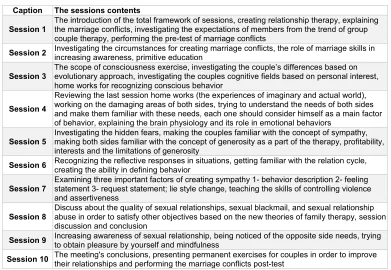
experience ten 2-hour sessions (based on Table 1) that these sessions were held for group
psychotherapy and was based on four-factor therapy. At the end of the sessions the questionnaires were redistributed among two groups and the individuals answered them and by applying the statistical analysis the effectiveness of group psychotherapy was investigated based on a four-factor therapy approach.
Table 1. The summery of couple therapy based on four-factor approach
Caption The sessions contents
Session 1
The introduction of the total framework of sessions, creating relationship therapy, explaining the marriage conflicts, investigating the expectations of members from the trend of group couple therapy, performing the pre-test of marriage conflicts
Session 2 Investigating the circumstances for creating marriage conflicts, the role of marriage skills in increasing awareness, primitive education
Session 3
The scope of consciousness exercise, investigating the couple’s differences based on evolutionary approach, investigating the couples cognitive fields based on personal interest, home works for recognizing conscious behavior
Session 4
Reviewing the last session home works (the experiences of imaginary and actual world), working on the damaging areas of both sides, trying to understand the needs of both sides and make them familiar with these needs, each one should consider himself as a main factor of behavior, explaining the brain physiology and its role in emotional behaviors
Session 5
Investigating the hidden fears, making the couples familiar with the concept of sympathy, making both sides familiar with the concept of generosity as a part of the therapy, profitability, interests and the limitations of generosity
Session 6 Recognizing the reflective responses in situations, getting familiar with the relation cycle, creating the ability in defining behavior
Session 7
Examining three important factors of creating sympathy 1- behavior description 2- feeling statement 3- request statement; lie style change, teaching the skills of controlling violence and assertiveness
Session 8 Discuss about the quality of sexual relationships, sexual blackmail, and sexual relationship abuse in order to satisfy other objectives based on the new theories of family therapy, session discussion and conclusion
Session 9 Increasing awareness of sexual relationship, being noticed of the opposite side needs, trying to obtain pleasure by yourself and mindfulness
Session 10 The meeting's conclusions, presenting permanent exercises for couples in order to improve their relationships and performing the marriage conflicts post-test
3. Research Findings
The descriptive data of marriage conflicts sub-scales are presented in Table 2 in a classified format
(pretest, after test, experiment group and control group).
Table 2. The descriptive summary of marriage conflicts scores in a classified format
Variable Group Amount Average Deviation Standard
Cooperation
Experiment
Pretest 13 16/92 4/80
After test 13 9/61 6/60
Follow up 13 9/68 6/57
Control
Pretest 13 17/30 4/38
After test 13 17/69 4/25
Follow up 13 17/76 4/38
Sexual Relationship
Experiment
Pretest 13 19/61 6/27
After test 13 16/76 7/59
Follow up 13 16/81 7/14
Control
Pretest 13 18/34 7/90
After test 13 17/30 7/24
Follow up 13 17/45 7/23
Emotional Reactions
Experiment
Pretest 13 16/93 5/21
After test 13 11/91 4/80
Follow up 13 11/92 5/01
Control
Pretest 13 18/98 5/40
After test 13 19/76 3/99
Follow up 13 20/03 4/19
Attract Children Support
Experiment
Pretest 13 17/69 6/95
After test 13 17/30 6/64
Follow up 13 17/35 6/70
Control
Pretest 13 14/61 5/57
After test 13 15/15 6/17
Follow up 13 15/23 6/12
Relation with Their Relatives
Experiment
Pretest 13 16/76 5/52
After test 13 12/31 6/56
Follow up 13 12/39 6/61
Control
Pretest 13 15/72 5/83
After test 13 14/69 6/06
Follow up 13 14/85 6/00
Relation with the Children and His Spouse Relatives
Experiment
Pretest 13 12/31 4/56
After test 13 11/53 3/75
Follow up 13 11/53 3/78
Control
Pretest 13 12/69 5/06
After test 13 13/84 5/20
Follow up 13 13/92 5/21
Separating Financial Affairs from each Other
Experiment
Pretest 13 14/61 3/46
After test 13 11/15 3/63
Follow up 13 11/35 3/79
Control
Pretest 13 14/23 3/93
After test 13 12/69 3/30
Follow up 13 13/04 3/31
Effective Relationship
Experiment
Pretest 13 16/53 7/18
After test 13 9/23 7/31
Follow up 13 9/29 7/29
Control
Pretest 13 15/01 6/77
After test 13 15/92 6/31
Table 3. Multivariate covariance statistical analysis test
Statistical indicator
The effect Test Value F
The Hypothesis Degree of Freedom
The Error Degree of Freedom
Significance Level
Groups Difference
Pilei effect 0.87 7/59 8 9 0.003
Lambda Wilks 0.13 7/59 8 9 0.003
Hoteling effect 6/74 7/59 8 9 0.003
The greatest root 6/74 7/59 8 9 0.003
The results in Table 3 show that there is a significant effect of the group factors, by applying
multivariate covariance statistical analysis test. This effect shows that there is a difference, at least between one of the marriage conflicts components by comparing a control group against experiment group (Lambda Wilks = 0.87, p < 0.05).
As it is clear from Table 4 results, the resulted significance level is lower than the obtained (by
Bonferroni correction, which is obtained by dividing the significance level of 0.05 by 8 marriage components) significance level of 0.006 for the conflicts of cooperation, emotional reaction and effective relation.
The amount of experiment group effect (practical significance) for the conflicts of cooperation, emotional reaction and effective relation are respectively 0.38, 0.59 and 0.41 that, for example 0.41 means that 41 percent of total variance in an experiment group was related to the couples effective relation interference moreover the high potentiality of statistical test shows that the 0 hypothesis is rejected correctly with a high possibility. In order to perform the durability test, correlated T-test was applied to test the difference between post-test and follow up stages.
Table 4. One-way variance analysis tests that applied in the multivariate covariance statistical
analysis test
Variables Statistical indicators The Source of Variable SS df F Significance Level The Effect Amount Power Test
Cooperation Group 277/36 1 10/11 0.005 0.38 0.85
Sexual Relationship Group 152/100 1 6/01 0.02 0.27 0.63
Emotional Reactions Group 336/27 1 23/58 0.0001 0.59 0.99
Attract Children Support Group 7/52 1 0.63 0.44 0.03 0.11
Relation with Their Relatives Group 57/16 1 3.21 0.016 0.14 0.32 Relation with the Children and
His Spouse Relatives Group 52/79 1 2.13 0.16 0.11 0.28
Separating Financial Affairs
from each Other Group 51/53 1 3.10 0.09 0.16 0.38
Effective Relationship Group 324/78 1 17/02 0.0001 0.41 0.99
Table 5. Comparing the averages of the post-test stage with follow up stage
Variables Statistical indicators df The Difference of Averages T-Score Significance Significance Level
Cooperation 25 0.07 1/44 0.13 0.05
Sexual relationship 25 0.15 1/69 0.10 0.05
Emotional reactions 25 0.26 1/98 0.06 0.05
Attract children support 25 0.06 1/34 0.19 0.05
Relation with their relatives 25 0.12 1/51 0.14 0.05
Relation with the children and his spouse
relatives 25 0.04 0.86 0.39 0.05
separating financial affairs from each other 25 0.27 1/99 0.06 0.05
Effective relationship 25 0.08 1/45 0.11 0.05
As the results of the Table 5 show based on the fact that the significance level for all of sub scales
with the confidence level of 95% for each of 8 marriage conflicts components.
4. Discussion and Conclusion
This research objective was to investigate the effectiveness of four-factor therapy: the effect of therapy, therapy hope and expectation, increasing awareness and ordered-behavior in marriage conflicts. Based on the study of Lotfi and Kashani in 1997 the four factor approach is the result of common elements of different theoretical systems and unlike the differences in theoretical orientations, techniques and therapy methods all of them were remarkably useful for referents and they have very similar therapy results (Lambert, 1989; Mayer, 1990; Jagr et al. 1996). The results of (Lotfi, Kashani, Vaziri & Poozesh 2013) and (Lotfi, Kashani, Vaziri & Akbar, 2011) confirm the effectiveness of the four common factors of all therapy approaches.
Relationship therapy and the appropriate aspects of relation are very important factor of psychological therapy s of couple’s conflicts (Saltzman & Norcross, 1990). The results of other researchers showed that relationship therapy is impressive on increasing cooperation and the psychological status of the referents (Lambert & Barley, 2001; Kadera, Lambert & Andrews, 1996; Karver, Handelsman, Fields & Bickman, 2006; Carson, Gil & Baucom, 2004; Wysocki & Harris et. al, 2006). Relationship therapy that was based on reflection, understanding, sympathy, precision, etc. (Lawson, 2008; Hendrix & Hunt, 1999) paves the way for the couples to disclose the facts and as a result they were able to gradually announce their unstated marriage relationships. In previous studies, the researchers emphasize to the encouragement of referents to disclosing the issues by practical relationship therapy (Hendrix & Hunt, 1999). Relationship therapy is considered (as a precondition for change and the process of change) based on the existed problem, the content that should be changed, sympathy, honesty and respect and by behavioral methods such as subjective imaging, organized sensitivity removing, assertiveness and the home works that are provided in therapy sessions (Vactle, 1990) and the resulted relationship will lead to the transformation of constructive personality, improvement of emotional status, the augmentation of effective relationship, creating trust and increasing susceptibility, the reduction of depression and also the improvement of mental and social performance (Rogers, 1959), Vizer & Arou, 1998; Lotfi & Kashani, 2011; Hans Strub, William Henry et. Al, 1994).
Awareness is the stage that a person analyze and investigate himself (Fisch, Privman, Ramot et.al, 2009) and it has a significant role in couples relationships and also in selecting the methods and creating the inclinations for the continuation of therapy (Miller, Bobner & Zarski, 2000; Johnson & Whiffen, 2003). Awareness can influence on all couples interactions and solve their problems. As the studies showed that recognition and awareness (as a dependent variable) has a significant role in individuals interaction and more awareness leads to the improvement and transformation of relations and also help them apply a constructive solution in facing with conflicts and marriage problems (Acitelli, 1992; Croyle & Waltz, 2002; Ehrlich, 2001; Marton & Booth, 1997; Miller, Wackman & Nunnally, 1976). Teaching awareness can help the couples understand the internal and external realities freely and with the least distortion and prepare them to face with a wide range of emotions, thoughts and experiences (the desired and undesired). The results of various studies that have investigated the effectiveness of teaching awareness intensification (about the couples relationships’ skills, depression and distress reduction of the women who had breast cancer) are confirmed this reality (Heinrichs, Zimmermann et. al, 2012; Beatty, Koczwara, Rice & Wade, 2010, Moein Al-Dini 2013). Increasing awareness leads to the improvement of correct sexual relationship, the attention to the opposite side and the attempt to obtain pleasure by yourself that these findings align with Rahaiee (2011), Sharif (2011) and Lotfi and Kashani (2011) findings.
& Iravani, 2016). Hope strategies (in an individual or group format) are considered impressive methods in reducing marriage conflicts (Vilaythong, et. al, 2003; Ripley & Worthington, 2002; Worthington, et. al, 1997; DiBlasio, et. al, 1991). The couples learn in sessions to advance hope based on the attempt by emphasizing on own change instead of the other (K F, 2004). Hope can increase the couple’s cooperation and is a stronger drive for transformation (Snyder, 2000; Enright, 2001). Hope has a high correlation with positive emotion (Snyder, 1995) and self-volubility (Worthington, et. al, 1997) and this is another strong evidence for its effectiveness on couple’s relations improvement and makes them deal with problems and challenges motivational and also make them design new paths and this reality is confirmed in different studies (Ripley & Worthington, 2002; Worthington & Hook, 2007; Kelly & Iwamasa, 2006; Ripley & Worthington, 2011; Davis, Lebow & Sprenkle, 2012). High hopes empowers individuals in solving the problems (Chang, 1998) and makes them happier (Wells, 2005) and make them have a better feeling toward the future (Robinson, 2012) thus, hope is a key for transformation of referents (Snyder, 1991) and the role of therapist is nurturing referents capabilities, applying their intrinsic creativity in a more correct way and solving the referents problems and hope can help them remarkably in nurturing and creating mental health as a strength point of psychology (Feldman & Snyder, 2005).
Ordered-behavior can lead to selection of effective methods and also can create an organization and can help us in achieving new methods of thought, emotion and behavior (Vivekananda, 2000). In this research it was recognized that Self-organizing can be as a factor in navigating behavior toward a specified objective and different researches align with this studies result (Mann, et. al, 2013; Wills & Bantum, 2012; Isasi & Wills, 2011; Stobbeleir, Ashford & Buyens, 2011; Duckworth, et. al, 2001). Ordered-behavior can have an important role in increasing the long-term effect of behavior change, improvement of emotional experience and relationships and also increasing positive behaviors. In other words, the ordered-behavior can provide an opportunity for exercising new relationships and feedback skills that these findings match the other research results (Stadler, et. al, 2010; Ryan & Deci, 2006; Reid, et. al, 2005). Based on this factor, it was trying to apply the potential capabilities of couples in a way that makes them capable of organizing their behaviors based on their knowledge, ability and experience after learning key skills and as a result, they are able to decrease the conflicts and improve the relations (with a spouse and their children) quality. By applying the self-organizing process, each of the couples will be encouraged to select an objective and they can cope with a problem and moderate his behavior by achieving into that specified objective (Halford, 2001; Wilson, et. al, 2005). As a result the effectiveness of behavior self-organizing in decreasing marriage conflicts has been proven in different studies (Halford, 2001; Shadish, et. al, 1993; Epstein & Baucom, 1993; Schilling, et. al, 2003; Fincham, et. al, 1990; Karney & Bradbury, 1995).
All in all it can be said that in an appropriate relationship therapy, a proper chance will be provided for the couples to get noticed of the behavior and the feeling that they were unaware of it before and can obtain a new attitude toward current situation and have more awareness of their feelings that all of these are considered a part of the therapy. In this process the psychological situation of each couple will be improved by creating hope and the improvement expected and finally this can create their behavioral changes and also provide the circumstances for improvement by adjusting their behaviors (Lotfi & Vaziri, 2011).
References
Sadock BJ. Kaplan and Sadock's synopsis of psychiatry(2003). Behavioral sciences/clinical psychiatry. Baltimore, MD: Williams and Wilkins.
Karaırmak Ö, Duran NO (2008). Gender differences in attachment styles regarding conflict handling behaviors among Turkish late adolescents. International Journal for the Advancement of Counselling. 30(4):220-34. Davis KD, Crouter AC, McHale SM (2006). Implications of Shift Work for Parent‐Adolescent Relationships in
Dual‐Earner Families. Family Relations. 55(4):450-60.
Halford W (2001). Brief couple therapy for couples. New York: Guilford publications.
Jossey- Bass.
Snyder CR (2000). Handbook of hope: Theory, measures, and applications: Academic press.
Lambert MJ, Barley DE (2001). Research summary on the therapeutic relationship and psychotherapy outcome. Psychotherapy: Theory, research, practice, training. 38(4):357.
Kadera SW, Lambert MJ, Andrews AA (1996). How much therapy is really enough?: A session-by-session analysis of the psychotherapy dose-effect relationship. The Journal of psychotherapy practice and research. 5(2):132.
Karver MS, Handelsman JB, Fields S, Bickman L (2006). Meta-analysis of therapeutic relationship variables in youth and family therapy: The evidence for different relationship variables in the child and adolescent therapy outcome literature. Clinical psychology review. 26(1):50-65.
Carson JW, Carson KM, Gil KM, Baucom DH (2004). Mindfulness-based relationship enhancement. Behavior therapy. 35(3):471-94.
Wysocki T, Harris MA, Buckloh LM, Mertlich D, Lochrie AS, Taylor A, et al (2006). Effects of behavioral family systems therapy for diabetes on adolescents’ family relationships, therapy adherence, and metabolic control. Journal of Pediatric Psychology. 31(9):928-38.
Lawson WA (2008). Improving Couple Communication Through the Imago Getting the Love You Want Workshop for Couples.
Hendrix H, Hunt H (1999). Imago relationship therapy: Creating a conscious marriage or relationship. Preventive approaches in couples therapy. 169-95.
Fisch L, Privman E, Ramot M, Harel M, Nir Y, Kipervasser S, et al (2009). Neural “ignition”: enhanced activation linked to perceptual awareness in human ventral stream visual cortex. Neuron. 64(4):562-74.
Miller AJ, Bobner RF, Zarski JJ (2000). Sexual identity development: A base for work with same-sex couple partner abuse. Contemporary Family Therapy. 22(2):189-200.
Johnson SM, Whiffen VE (2003). Attachment processes in couple and family therapy: Guilford Press.
Acitelli L (1992). Gender differences in relationship awareness and marital satisfaction among young married couples.
Croyle KL, Waltz J (2002). EMOTIONAL AWARENESS AND COUPLES'RELATIONSHIP SATISFACTION. Journal of Marital and Family Therapy. 28(4):435-44.
Ehrlich FM (2001). Levels of self-awareness: Countertransference in psychoanalysis, couple, and family therapy. Contemporary Psychoanalysis. 37(2):283-96.
Marton F, Booth SA (1997). Learning and awareness: Psychology Press.
Miller S, Wackman DB, Nunnally EW (1976). Couple Workbook: Increasing Awareness and Communication Skills: Interpersonal Communication Programs.
Heinrichs N, Zimmermann T, Huber B, Herschbach P, Russell DW, Baucom DH (2012). Cancer distress reduction with a couple-based skills training: a randomized controlled trial. Annals of Behavioral Medicine. 43(2):239-52.
Beatty LJ, Koczwara B, Rice J, Wade TD (2010). A randomised controlled trial to evaluate the effects of a self-help workbook intervention on distress, coping and quality of life after breast cancer diagnosis. Medical Journal of Australia. 193(5):S68.
Higgins RL, Snyder CR (1991). Reality negotiation and excuse-making. Handbook of social and clinical psychology: The health perspective. 79-95.
Feuz C (2012). Hoping for the best while preparing for the worst: a literature review of the role of hope in palliative cancer patients. Journal of Medical Imaging and Radiation Sciences. 43(3):168-74.
Berendes D, Keefe FJ, Somers TJ, Kothadia SM, Porter LS, Cheavens JS (2010). Hope in the context of lung cancer: relationships of hope to symptoms and psychological distress. Journal of pain and symptom management. 40(2):174-82.
McClement SE, Chochinov HM (2008). Hope in advanced cancer patients. European Journal of Cancer. 44(8):1169-74.
Cheavens JS, Feldman DB, Woodward JT, Snyder C (2006). Hope in cognitive psychotherapies: On working with client strengths. Journal of cognitive Psychotherapy. 20(2):135-45.
Scheier MF, Carver CS (2001). Adapting to cancer: The importance of hope and purpose.
Vaziri S, Kashani FL (2016). Sexuality after breast cancer: need for guideline. Iranian journal of cancer prevention. 2012;5(1):10.
Taherian B, Ghojavand K, Iravani MR. The Effect of Training Hope Therapy on Reduction of Marital Boredom of Married Women. Iranian Journal of Positive Psychology ISSN 2423-6985. 2(1).
Vilaythong AP, Arnau RC, Rosen DH, Mascaro N. Humor and hope: Can humor increase hope? Humor. 2003;16(1):79-90.
Ripley JS, Worthington Jr EL (2002). Hope-focused and forgiveness-based group interventions to promote marital enrichment. Journal of Counseling and Development: JCD. 80(4):452.
DiBlasio FA, Benda BB (1991). Practitioners, religion and the use of forgiveness in the clinical setting. Journal of Psychology and Christianity.
K F (2004). Comparing effectiveness of rational-e motive-behavior marital counseling, reality marital counseling and combination of them on marital conflicts. [PhD Thesis]. Tehran: School of Education and Psychology, The University of Allameh Tabatabaee.
Enright RD (2001). Forgiveness is a choice: A step-by-step process for resolving anger and restoring hope: American Psychological Association.
Snyder CR (1995). Conceptualizing, measuring, and nurturing hope. Journal of Counseling and Development: JCD. 73(3):355.
Worthington Jr EL, Hook JN, Ripley JS, Miller AJ (2007). The Hope-Focused Approach to Couple Therapy and Enrichment. Journal of Psychology & Christianity. 26(2).
Kelly S, Iwamasa GY (2006). Enhancing behavioral couple therapy: Addressing the therapeutic alliance, hope, and diversity. Cognitive and Behavioral Practice. 12(1):102-12.
Ripley J, Worthington E, Maclin VL, Carson D, Casado-Kehor M (2011). The hope-focused approach to couple enrichment and counseling. Case studies in couple therapy: Theory based approaches. 369-81.
Davis SD, Lebow JL, Sprenkle DH (2012). Common factors of change in couple therapy. Behavior therapy. 43(1):36-48.
Chang EC (1998). Hope, problem‐solving ability, and coping in a college student population: Some implications for theory and practice. Journal of clinical psychology. 54(7):953-62.
Wells M (2005). The effects of gender, age, and anxiety on hope: Differences in the expression of pathways and agency thought: Texas A & M University-Commerce.
Robinson CA (2012). “Our best hope is a cure.” Hope in the context of advance care planning. Palliative and Supportive Care. 10(02):75-82.
Snyder C, Irving LM, Anderson JR (1991). Hope and health. Handbook of social and clinical psychology: The health perspective. 162:285-305.
Feldman DB, Snyder CR (2005). Hope and the meaningful life: Theoretical and empirical associations between goal-directed thinking and life meaning. Journal of Social and Clinical Psychology. 24(3):401.
Vivekananda K (2000). Integrating models for understanding self injury. Psychotherapy in Australia. 7(1):18. Mann T, De Ridder D, Fujita K (2013). Self-regulation of health behavior: social psychological approaches to
goal setting and goal striving. Health Psychology. 32(5):487.
Wills TA, Bantum EOC (2012). Social support, self-regulation, and resilience in two populations: General-population adolescents and adult cancer survivors. Journal of Social and Clinical Psychology. 31(6):568. Isasi CR, Wills TA (2011). Behavioral self-regulation and weight-related behaviors in inner-city adolescents: a
model of direct and indirect effects. Childhood Obesity (Formerly Obesity and Weight Management). 7(4):306-15.
De Stobbeleir KE, Ashford SJ, Buyens D (2011). Self-regulation of creativity at work: The role of feedback-seeking behavior in creative performance. Academy of Management Journal. 54(4):811-31.
Duckworth AL, Grant H, Loew B, Oettingen G, Gollwitzer PM (2011). Self‐regulation strategies improve self‐ discipline in adolescents: Benefits of mental contrasting and implementation intentions. Educational Psychology. 31(1):17-26.
Stadler G, Oettingen G, Gollwitzer PM (2010). Intervention effects of information and self-regulation on eating fruits and vegetables over two years. Health Psychology. 29(3):274.
Ryan RM, Deci EL (2006). Self‐regulation and the problem of human autonomy: does psychology need choice, self‐determination, and will? Journal of personality. 74(6):1557-86.
Reid R, Trout AL, Schartz M (2005). Self-regulation interventions for children with attention deficit/hyperactivity disorder. Exceptional Children. 71(4):361.
Wilson KL, Charker J, Lizzio A, Halford K, Kimlin S (2005). Assessing how much couples work at their relationship: the behavioral self-regulation for effective relationships scale. Journal of Family Psychology. 19(3):385.
Shadish WR, Montgomery LM, Wilson P, Wilson MR, Bright I, Okwumabua T (1993). Effects of family and marital psychotherapies: A meta-analysis. Journal of Consulting and Clinical Psychology. 61(6):992. Epstein N, Baucom DH (1993). Cognitive factors in marital disturbance.
Schilling EA, Baucom DH, Burnett CK, Allen ES, Ragland L ( 2003). Altering the course of marriage: the effect of PREP communication skills acquisition on couples' risk of becoming maritally distressed. Journal of Family Psychology. 17(1):41.
Fincham FD, Bradbury TN, Beach SR (1990). To arrive where we began: A reappraisal of cognition in marriage and in marital therapy. Journal of Family Psychology. 4(2):167.