Effect of Temperature and Pressure on Correlation Energy in a
Triplet State of a Two Electron Spherical Quantum Dot
A. Rejo Jeice*, K.S. Joseph Wilsona *
Department of Physics, Annai Velankannai College, Tholayavattam-629157, India
aDepartmant of Physics, Arul Anandar College, Madurai-625514, India
Abstract
The combined effect of hydrostatic pressure and temperature on correlation energy in a triplet state of two electron spherical quantum dot with square well potential is computed. The result is presented taking GaAs dot as an example. Our result shows the correlation energies are i)negative in the triplet state contrast to the singlet state ii) it increases with increase in pressure iii)further decreases due to the application of temperature iv) it approaches zero as dot size approaches infinity and v) it contribute 10% decrement in total confined energy to the narrow dots. All the calculations have been carried out with finite models and the results are compared with existing literature.
2013 JNS All rights reserved
Article history: Received 22/9/2013 Accepted 3/11/2013 Published online 1/12/2013
Keywords:
Spherical quantum dot Temperature
Correlation energy Effective1mass approximation
*Corresponding author: E-mail address:
[email protected] Phone: 0452-2456029 Fax: 0452-2459181
1. Introduction
The development of low dimensional semiconductor system (LDSS) has found wider application in many areas of nanoscience nowadays [1, 2]. Semiconductor quantum dot (QD) is an excellent system to investigate the confinement effects [3, 4].The fabrication of semiconductor quantum structures in quasi zero dimension will show exotic electron behavior due to electronic confinement [5].The energy levels of the confined electron in a QD are discrete as in an atom [6, 7].Hence QD is called as artificial atoms [8]. The confinement will affect due to correlation energy
(CE). The confinement increases in the singlet state [9] and it decreases in the triplet state due to the presence of CE [10].The correlation effects were treated to various degrees of theoretical sophistication by several authors [11,12].The CE (electron-electron coulomb interaction energy) plays a vital role in varying the physical properties of LDSS such as optical and transport phenomena. Hence the interaction in a QD is especially interesting.
[13-25].Kirak et al.[13] studied the effects of the hydrostatic pressure and temperature on the binding energy and nonlinear optical properties for a SQD with parabolic confinement. He found that the binding energy increases by increasing pressure and decreases by temperature. A.M. Elabasy[14, 15] founded that the binding energy of the donor electron, associated with the donor ion, decreases with enhancing the temperature. Karimi et al. [16] indicate that the hydrogenic impurity, hydrostatic pressure and temperature increase the energy difference between the sub-bands in a multilayered SQD. Kospoglu et al. [17] found that an increment in temperature results in a decrement in donor impurity binding energy while an increment in the pressure for the same temperature enhances the binding energy in a cylindrical quantum wire. Yesilgul et al. found that the photo ionization cross-section increased as temperature increased. Conversely, hydrostatic pressure decreased, the photo ionization cross-section increased on a QD[18] and Quantum well[19].Safarpour et al. [20] found that the electronic energy levels in a SQD increases as the pressure increases and decreases as the temperature increases. Elmeshad et al. [21] studied the effects of the hydrostatic pressure and temperature on the exciton binding energy confined inside a cylindrical GaAs QD. Rezaei et al. found that hydrostatic pressure and temperature have a great influence on the binding energy in a two-dimensional QD [22] and spherical Gaussian QD [23].
In the above all investigation, the effect of temperature and pressure on the CE in a SQD is neglected. Rejo Jeice et al.[10] studied the CE in a triplet of a two electron SQD. Sivakami et al. [24] studied the effect of hydrostatic pressure and temperature on CE in the finite barrier model. The calculations were restricted to the singlet state. More over in the previous paper one of the authors
had studied the effect of hydrostatic pressure and polaronic mass on the CE in a SQD [25].
The purpose of the present work is to extend the calculation of Ref. [10] to the (1s-1p) triplet state in a two electron SQD and to investigate theoretically the effects of hydrostatic pressure and temperature on it. The plan of the present work is as follows. In section 2 we present the mathematical models and details of calculations. The results obtained are presented in section 3 with a detailed discussion of the results. Conclusions are presented in section 4.
2. Models and calculations
2.1. Two electrons in a spherical quantum dot
Here we consider two electrons in a Spherical quantum dot (SQD) in the finite barrier model. In the effective mass approximation, the hydrostatic pressure and temperature dependent Hamiltonian is given1by
[9], → → → → ∗ ∗ − + + + + = | | ) , ( , , , , ) , ( 2 ) , ( 2 2 1 , 2 2 1 2 2 2 1 r r T P e T P r V T P r V T P m p T P m p H b w D D ε r r (1)
We write H=H1+H2+H1 with
H1=
→ →
−
|
|
)
,
(
1 2, 2
r
r
T
P
e
b wε
where, m*(P,T), εw,b(P,T), VD( i,P,T) are the
hydrostatic pressure and temperature dependent effective-mass, dielectric constant and confining potential, respectively. The two subscripts d and b stand for the potential dot (GaAs) and the potential barrier (Ga1-xAlxAs), respectively. The values of
m*(P,T),εw,b(P,T), are taken from Refs. [15, 26] and
temperature. In our numerical calculations, we use atomic units in which mo= e2=ħ2=1.The confining potential is given by,
VD(ri,P,T)= 0 r1r2≤R
V0 r1r2≥R (2)
where V0=Qc∆Eg(x,P,T) is the barrier height, Qc is the conduction band offset parameter which is taken to be 0.6[27].The band gap difference depends of the concentration of Al. In our case Ga
1-xAlxAs is the barrier medium in which GaAs dot is embedded. The total energy band gap difference [1] between the GaAs dot and the Ga1-xAlxAs barrier media, as a function of x, is given by
∆Eg(x)=1.155x+0.37x2 eV (3)
In the present work, we have chosen x=0.3 and 0.4 and the value of V0 turns to be 227.88meV and 312.72 meV respectively. The eigen functions for the two lowest lying states within the dot is given by [6]
i i i i r r N α α ) sin(
1
r
i≤
R
( )
i=
s
r
r
1ψ
(4)i i r
r
e
A
i iβ
β −1
r
i≥
R
θ α α α α cos ) cos( ) ( ) sin( 2 2 − i i i i i i i i r r r r
N ri≤ R
( )
i =p rr
1
ψ
θ
β
β
β cos ) ( 1 12 ii
r i i i i e r r iA −
+ ri≥R
where N1 ,N2 ,A1 and A2 are normalization constants and αi and βi are given
by
α
i=
2
m
∗(
P
,
T
)
E
(
P
,
T
)
and))
,
(
)
,
(
(
2
m
V
0P
T
E
P
T
i
=
−
∗
β
Matching the wave function and their derivatives at the boundary and imposing the Ben Daniel and Duke boundary condition [28] the 1s-state and 1p-state energies are obtained. Using the E1s and E1p state energies the triplet state confined energies (Binding energy) and the CE is found out.
In the two-electron system we calculate the CE using the perturbation method. Here H1 is the perturbation term and ε0 is the static dielectric constant. In our problem we have considered one electron in the ground state (i.e. 1s-state) and another in the excited state (1p-state).Therefore we may obtain a triplet state and the total spin of the system is 1. In this situation the wave function of the triplet state is [9].
[
(
)
(
)
(
)
(
)
]
2
1
)
,
(
r
1r
2 1sr
1 1pr
2 1sr
2 1pr
1A
r
r
ψ
r
ψ
r
ψ
r
ψ
r
ψ
=
−
This is spatially anti-symmetric. In Eq. (6)
)
(
1sr
iψ
andψ
1p(
r
i)
are (with i=1, 2) as given in equations (4) and (5). + + + + + − − − ∗ ⋅ − − = − − 2 2 2 2 3 2 2 3 2 2 2 2 4 2 2 5 2 2 4 2 2 3 1 2 3 1 1 2 1 10 1 5 1 2 1 4 ) 2 sin( 2 2 ) 2 cos( 1 2 4 ) 2 sin( 2 2 2 3 4 ) 2 sin( 3 2 3 1 R R e R R R R R R R e R R R R
β
β
β
α
α
α
α
α
α
α
α
β
α
α
α
β β (6) 2 1 2 1 2 1 *( , )ψ
( , )τ
τ
ψ
A rr rr A rr rr d dWe obtain the correlation energy for the triplet state is1given4by
where
ψ
A(
r
r
1,
r
r
2)
is given in Eq.(6).In order to evaluate some of the integrals we use mean value theorem. After a lengthy, but straight forward algebra we obtain ∆E. The evaluation of ∆E (first order correction) is tedious for triplet state and the expression is lengthy. Hence we refrain from giving it here. However the evaluation of is given in Ref [10] and the results obtained are given in table 2 and figure 1-3.2.2. Effect of Temperature and Pressure
The hydrostatic pressure and temperature dependent conduction band effective mass of GaAs and Ga1-x AlxAs can be written as[29,30]
∆
+
+
+
=
Γ − Γ 1 0 *(
,
)
(
(
,
)
)
2
1
)
,
(
P
T
E
E
P
T
E
P
T
m
m
g g
e
Where E =7.51eV, is the energy related to the momentum matrix element.∆0=0.341 eV is the spin-orbit splitting, me is the free electron mass and
EgГ(P,T) is the pressure and temperature dependent
energy gap for the GaAs QD at the τ-point and is
given by[31,32]
EgГ(P,T)= EgГ(0,T)+bP+CP2 (8) where
b=1.26X10⁻²eVbar-1, C=3.77X10⁻⁵eVbar-2 and
)
204
(
10
405
.
5
(
519
.
1
)
,
0
(
2 4+
×
−
=
− ΓT
T
T
E
g (9) The effective mass of Ga1-x AlxAs is given by [33]x
PT
m
T
P
m
b*(
,
)
=
d*(
)
+
0
.
083
(10)
where x is the aluminum composition. The variation of dielectric constant with pressure and temperature is given as [34], 12.74exp(-1.73X10⁻³P)exp[9.4x10⁻⁵(T-75. 6)]
T≤200K
εd,b(P,T) (11) 13.18exp (-1.73X10⁻³P)exp 20.4x10⁻⁵(T-300)] T≥200K.
The corresponding dielectric constant of Ga1-x AlxAs is given as εb(P,T)= εd(P,T)-3.12x
(12)
From equ.(2) the pressure and temperature dependent barrier height, the band gap difference is given by
∆Eg(x,P,T)=∆Eg (x)+D(x)P+G(x)T (13) where D(x)=[-(1.3x10⁻³)x]eV/kbar and G(x)=[-(1.15x10⁻⁴)x]eV/K. The variation of dot size with pressure is given [35] by
R(P)=R0(1-1.5082 x10⁻³P) (14)
In the numerical work the pressure used was 0-4 GPa, which corresponds to 40 kbar. We have not considered pressures beyond 4 GPa, because of a direct to indirect band gap transition of GaAs at about 4 GPa [36].Also the aluminum concentration is also x≤ 0.4.Since the indirect band gap nature in Ga1-xAlxAs.
3. Result and Discussion
The results obtained are shown in Tables 1-2 and
Figs. 1-5. We have computed the combined effect
of hydrostatic pressure and temperature effects on the SQD. The various parameters used in the 2 1 2 1 2 1 0 2 2 1 * ( , ) | | ) ,
( r r drdr r
r e r r
E A r r r r ψA r r r r
ε ψ
− =
calculation and their values at various temperatures are given in Table 1.
Table 1. Variation of the effective mass and dielectric constant for the GaAs and Ga1-xAlxAS at aluminium
compostion, x = 0.4.
T
(K) Effective mass Dielectric constan Barrier height (meV) GaAs Ga1-x AlxA GaAs Ga1-x AlxA
0 0.067 0.100 12.65 11.402 312.72
100 0.066 0.100 12.77 11.521 309.96
200 0.064 0.098 12.91 11.642 307.20
300 0.063 0.096 13.18 11.764 304.44
400 0.061 0.095 13.45 11.886 301.68
500 0.059 0.093 13.73 12.011 298.92
600 0.057 0.091 14.01 12.136 296.16
From it, we find that the increase in temperature will decreases the values of both the effective mass and the barrier height and increase the value of dielectric constant of GaAs and Ga1-xAlxAs.
Table 2. Temperature and pressure dependent correlation energies in a spherical quantum dot. Pressure
(GPa)
Correlation Energy (meV)
T=0K T=600K
R=50Å R=65Å R=100Å R=150Å R=50Å R=65Å R=100Å R=150Å
0 -43.99 -24.56 -15.09 -9.63 -40.02 -22.24 -13.99 -8.79
1 -44.50 -24.84 -15.17 -9.69 -41.13 -21.34 -14.37 -8.94
2 -44.94 -25.57 -15.27 -9.77 -41.79 -23.45 -14.65 -9.38
3 -45.67 -25.71 -15.36 -9.89 -42.67 -23.98 -14.93 -9.65
4 -46.05 -25.97 -15.57 -9.92 -43.57 -24.65 -15.38 -9.97
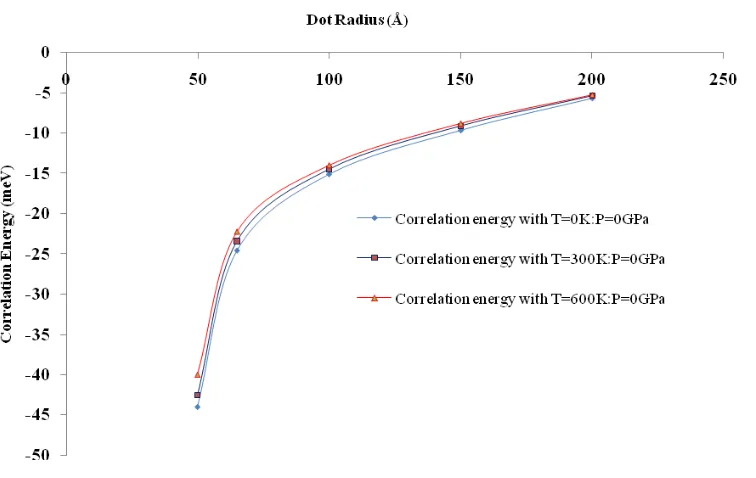
Table 2 we have presented the temperature and pressure dependent correlation energies in a SQD. We notice that the correlation energy decreases as the dot size increases, a feature that is well known in literature [9,10].The CE decreases as the temperature increases and it increases as the pressure increases. Also we observe that the CE is negative as expected for the triplet state. This is a consequence of the exchange interaction in the
Fig. 1. Variation of correlation energy with different dot radius for different temperatures T=300 K and 600 K without the pressure when x=0.4
As the result the effective Bhor radius increases causing the potential barrier height to decrease. For larger dot size it shows 3D behaviour. For the smaller dot radii there is 5% decrease in correlation due to application of temperature. We found that the CE is higher for smaller dot size of higher aluminum concentration. It approaches to zero as the dot radius tends to infinity. Also we found that there is no CE for dot radii less than 50Å, because no bound 1p state is possible since the barrier height itself is 312.72 meV when x=0.4.
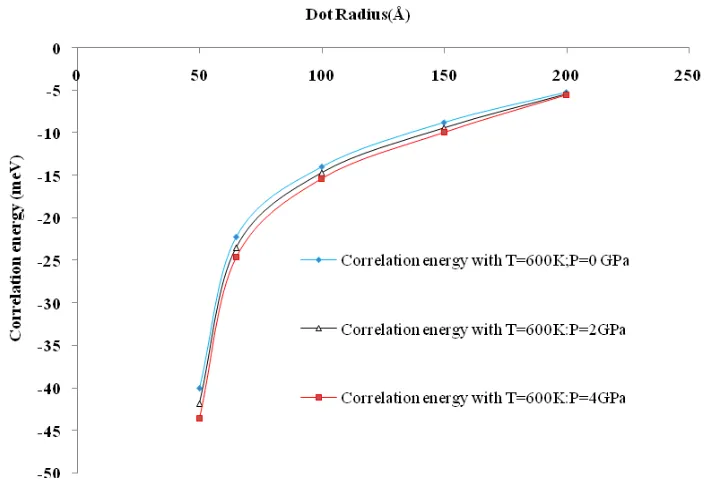
Fig. 2. Variation of correlation energy with different dot radius for the temperature T = 600 K with and without the pressure when x=0.4.
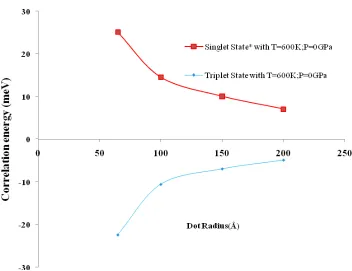
For the smaller dot radii there is 4.5% increase in correlation due to application of pressure. Thus the simultaneous application of pressure and temperature, it is observed that the CE decreases for all dot sizes. Fig.3 presents the variation of CE with different dot radius for the temperature T=600 K and P=0GPa for the singlet and triplet state. Here we have considered the value of aluminum concentration as x=0.3 in order to compare with the reference singlet state energies [24]. We observe
Fig. 3. Variation of correlation energy with different dot radius for the temperature T=600 K and P=0 GPa when x=0.3 (*Ref. [9])
There is no CE for to triplet state for the dot radii less than 65Å, because no bound 1p state is possible since the barrier height itself is 227.88 meV when x=0.3.
In Fig.4 we have presented the variation of CE with the applied pressure at different temperatures (T=300 and 600 K) and dot radii (R=50 and100 Å).The correlation energies linearly increases with pressure. This is due to increase in effective mass and dielectric constant and barrier height. For smaller dot radius the variation of
correlation energy is higher as compare to larger dot radii.
Fig. 4. Variation of correlation energy versus pressure with different temperatures (T=300 and 600 K) and dot radii (R=50 and 100 Å).
Fig. 5. Variation of correlation energy as a function of temperature with different pressures (P =0 and 4 GPa) and dot radii(R= 50 Å and 100 Å).
This is due to increases in effective mass, dielectric constant and barrier height. Liang et al. found the ground state binding energy of the neutral
repulsion in an exciton–donor complex system. Moreover, we observed that the influence of pressure on the correlation energy is more obvious than temperature which is also due to columbic repulsion. The important conclusion that emerges from the result of Table 2 and Figures 1-5 is that the pressure and temperature effects are important formaller dots and should be consider in the studies of LDSS.
4. Conclusion
In the present study we investigated the effects of hydrostatic pressure and temperature on the CE in the triplet state of GaAs/Ga1-x AlxAs for a two electron SQD by using a perturbation approach within the effective mass approximation. The important conclusions that emerge are i) the correlation energies are important for smaller dot size. ii) it is negative for triplet state and if contribute 10% decrement in total confined energy to the narrow dots.iii) the effect of hydrostatic pressure increase the correlation effects may be used to tune the output of optoelectronic devices without modifying the physical size of the quantum dot and iv) the effect of high temperatures is quite significant in small dot radii due to thermal broadening in the mixed quantum state.
Acknowledgements
The authors would like to thank Prof.K.Navaneethakrishnan, School of Physics, Madurai Kamaraj University, Madurai, India for his valuable and useful suggestions.
References
[1]V.V. Mitin, V.A. Kochelap, M.A. Stroscio, Micro Electronics and Optoelectronics, Cambridge Univer- sity Press, Cambridge (1999).
[2] B.K. Ridley, Electrons and Phonons in semiconductor Mult- ilayers, Cambridge University Press, Cambridge (1997).
[3] A.A. Avetisyan, K. Moulopoulos, A.P.Djotyan, Philos.Mag.86 (2006) 2493-2509.
[4] D.R. Ferry, S.M. Goodnick, Tran- sport in nano structures, Cambridge University Press, Cambridge (1997).
[5] M.A. Kastner. Ann. Phys.(Leipzig) 9 (2000) 885-894.
[6] A.John Peter, S.Saravana Kumar, physica E, 41 (2008) 138-141.
[7] D.Gammon, Nature 405, (2000) 899-900. [8] S.Bednarek, B.Szafran, J. Adamowski, Phys. Rev.B, 59,(1999) 13036-13042.
[9] A. Sivakami, K. Navaneethakrishn an, Physica E, 40 (2008) 649-653.
[10]A. Rejo Jeice, K. Navaneethakris hnan, Brazilian J. Phys. 39 (2009) 526-530.
[11]B.Szafran, J.Adamowski, S. Bednarek, Physica E, 5 (2000) 185-195.
[12]G.Canteele,D.Ninno, G.Iadonisi, Phys. Rev.B, 64 (2001) 125325-125332.
[13]M. Kirak, Y.Altinok, S.Yilmaz Jour.of Lumin. 136 (2013) 415-421.
[14]A.M.Elabasy, Physica Scripta, 46 (1992) 473-475.
[15]A.M.Elabasy, Physica Scripta, 59 (1999) 328-330.
[16]M.J. Karimi, G.Rezaei, M. Nazari, J.of Lumin.145 (2014) 55-60.
[17]E. Kasapoglu, F.Ungan, H.Sari ,I.Skmen Physica E, 42 (2010) 1623-1626.
[18]U.Yesilgul, E.Kasapoglu, H.Sari I.Sökmen Superlat. and Microstr. 48 (2010) 509-516.
[19]U.Yesilgul, Sakiroglu, E. Kasapoglu, H.Sari ,I.Sökmen Superlat. and Microstr. 48 (2010) 106-113.
[21]N.Elmeshad, H.Abdelhamid, H. Hassanein, S.Abdelmola ,S.Said, Chin. J. Phys.47 (2009) 92-96.
[22]G.Rezaei, S.Shojaeian Kish Physica E 45 (2012) 56-60.
[23]G.Rezaei,S.F.Taghizadeh ,A.A. Enshaeian, Physica E 44 (2012) 1562-1566
[24]A. Sivakami, M. Mahendran, Physica B 405 (2010) 1403-1407.
[25] A. Sivakami, A.Rejo Jeice, K. Navaneethakrishnan, Internat. J. of mod. phys. B 24 (2010) 5561-5569.
[26]G. Samara, Phys. Rev. B 27 (1983) 3494-3505.
[27] R.S. Daries Bella, K.Navaneetha krishnan, Solid state Commun.130 (2004) 773-776.
[28] Y.Li,O. Voskoboynikov, J.L. Liu, C.P. Lee, S.M. Sze Nanotech 1 (2001) 562-565.
[29] Liangliang Lu, Wenfang Xie, Zhewei Shu Physica B 406 (2011) 3735–3740.
[30] E.Kasapoglu, Physics Letters A 373 (2008) 140-143.
[31] B.Welber, M.Cardona, C.K.Kim ,S.Rodriquez,Phys.Rev. B 12 (1975) 5729-5738.
[32] D.E.Aspnes, Phys.Rev.B 14 (1976) 5331-5343.
[33] A.Sivakami,V.Gayathri, Super lat. and microstr, 58 (2013) 218-227.
[34] A.John Peter, K.Navaneethakris hnan, Superlat. and microstr.43 (2008) 63-71.
[35] S.Adachi, GaAs and Related Materials, first ed., World Scientific, Singapore, 1994.
[36] Sr. Gerardin Jeyam, K.Navaneet hakrishnan, Solid State Commun. 126 (2003) 681-685.