IJMF
Online ISSN: 2383-0042
Iranian Journal of Materials Forming
Journal Homepage: http://ijmf.shirazu.ac.ir
Microstructure and its Relationship to Mechanical Properties in Equal Channel
Angular Rolled Al6061 Alloy Sheet
s
M. Mahmoodi and A. Naderi
School of Mechanical Engineering, Semnan University, Semnan, Iran
A R T I C L E I N F O A B S T R A C T
Article history:
Received 18 December 2018 Revised 17 January 2019 Accepted 19 January 2019
Equal channel angular rolling (ECAR) is a severe plastic deformation (SPD) technique which has been used to produce metal sheets with ultra-fine grain structure. In the present work, the relationships between the mechanical properties and microstructure of samples during the ECAR process have been investigated. The Rietveld method was applied to analyze the X-ray diffraction pattern and to determine the microstructural characteristics including the crystallite size, microstrain, and dislocation density. It was observed that the average crystallite size and dislocation density increased by increasing the strain during the ECAR process. The results showed that ECAR is a procedure intended to obtain meaningful structural refinement appearing in a crystallite. It can be justified by using Taylor equation that the mechanical properties are related to the dislocation density. The ECAR process strongly increases the yield strength and microhardness due to an increase in the dislocation density over a wide range of strain.
© Shiraz University, shiraz, Iran, 2019 Keywords:
ECAR
X-ray diffraction Rietveld method Dislocation density Al6061
1. Introduction
In recent decades, the severe plastic deformation (SPD) process, as a new method to obtain ultrafine grained (UFG) metals, has attracted increasing attention due to its sufficient mechanical properties [1-3]. Among SPD processes, the equal channel angular rolling (ECAR) process has many certain advantages due to its continuity and applicability on industrial sheets [4-6].
The ECAR process is a SPD method that leads to the UFG structure and improved mechanical properties of the material. This process is presented for the continuous forming of sheets and strips, and like ECAP can apply large amounts of strain to the material with no change in the cross-section of the piece.
Corresponding author
E-mail addresses: [email protected] (M. Mahmoodi)
Lee et al [7] were the first to introduce the ECAR process based on equal channel angular pressing (ECAP). Chung et al [8, 9] investigated the control of the thickness uniformity of Al 6063 alloy in the ECAR process. Cheng et al [10, 11] studied the drawability of ECARed AZ31 magnesium alloy sheet and its improvement at room
temperature. The effect of the ECAR process on the
strength and electrical conductivity of pure copper was illustrated by Habibi et al [12].
The principle of the ECAR process is displayed schematically in Fig. 1 As can be seen in Fig. 1, a large plastic strain is applied on a sheet in the shear zone without changing the cross-section through the multi-pass operation to achieve a UFG metal. Where the strips were fed through the feeding roll and guide roll with and without 180° rotation in the feed direction between subsequent passes.
IJMF Iranian Journal of Materials Forming
Online ISSN: 2383-0042
Published by: S hiraz University, Shiraz, Iran
Fig. 1. The principle of the ECAR process.
Although there are several studies concerning the effect of the ECAR process on the microstructural characteristics and mechanical properties of metals [13-15], the details of the relation between these two features, especially the role of the dislocation density and its effect on the mechanical properties in the ECAR process, have not been specified yet. This relation has been determined in other deformation processes like the ECAP [16-18].
The present paper provides original experimental data focusing on the study of the microstructure and mechanical properties of Al6061 alloy treated by the ECAR process. The Rietveld method and Taylor equation based on the x-ray diffraction (XRD) pattern are used to compute the microstructure parameter and yield strength, respectively. Moreover, the relation between microstructure parameters and mechanical properties has been evaluated.
2. Principle and Equipment of Experimental Setup
In this work, a 2 mm thick sheet of Al6061 alloy was used (Table 1). Firstly, the strips of 400×40×2 mm
(length × width × thickness) were prepared. The samples were solution heat treated at 530˚C for 4 h and quenched at room temperature. The ECAR was conducted at room
temperature (∼30˚C) at a channel oblique angle of 120°
in two different routes: A and C. In route A, the
specimens were passed without any rotation, while in route C, they were passed into two consecutive passes with 180° rotation.
Table1. The chemical composition of Al6061 alloy
Mn Fe Cu Si Mg Al Element
0.1 0.4 0.25 0.68 1.14 Bal. Wt.%
The samples were processed by ECAR after the 1st,
3rd, and 5th pass to investigate their microstructure and
mechanical properties. Using (1) the effective strains imposed to the material have been shown in Table 2.
ε 2N √3⁄ K cot φ 2⁄ (1)
In Eq. 1, N is the number of passes, the oblique angle and K = 0.975 is the thickness ratio. This formula is obtained from the modified Segal model for calculation of shear deformation [19].
Table 2. The effective strain of ECARed specimens in different passes and the channel oblique angle of 120° Effective strain
1 pass 3 passes 5passes
=120 0.65 1.95 3.27
After the ECAR processing, the samples were sliced perpendicularly to the longitudinal axis and the surfaces were prepared before the XRD and EBSD tests. In order to observe the microstructure, the samples were electro-etched in Barker’s reagent at a voltage of 20 V and current of 0.2 mA. The distribution of the grain diameters and the grain boundary disorientations were determined using the EBSD technique. The electron backscatter diffraction (EBSD) was performed using the Hitachi SU-70 equipment. The EBSD scans were in areas of 400µm×400µm with a 1.5 µm step size. XRD measurements were conducted for the radiation angle, in the range of 20 to 90 degrees, and a scan rate of 0.02
o/sec by Buker D8 diffractometer using CuKα radiation
(wavelength = 1.54056Å). Uniaxial static tensile tests according to ASTM-E8 were carried out at room
SANTAM STM400 testing machine. The micro-hardness was measured by Vickers micromicro-hardness tester with the pyramidal diamond indenter subjected to a 100g load.
The XRD pattern was analyzed via the Rietveld method to compute the microstructural parameters of the samples subjected to the ECAR process. In this regard, the MAUD software has been applied to determine the micro-strain, crystallite size, and dislocation density. More information about the method of analyzing in MAUD is found in another paper [20-23]. Furthermore, the MAUD software based on Eq.2 computes the value
of the dislocation density from average crystallite
size (D) and microstrain (〈 〉/ ).
3√2 〈 〉/ ⁄ (2)
Where b is the Burgers vector for the face-centered
cubic (FCC) structures and it is obtained by the equation
√
( a is the lattice parameter) and K=6π.
3. Results and Discussion
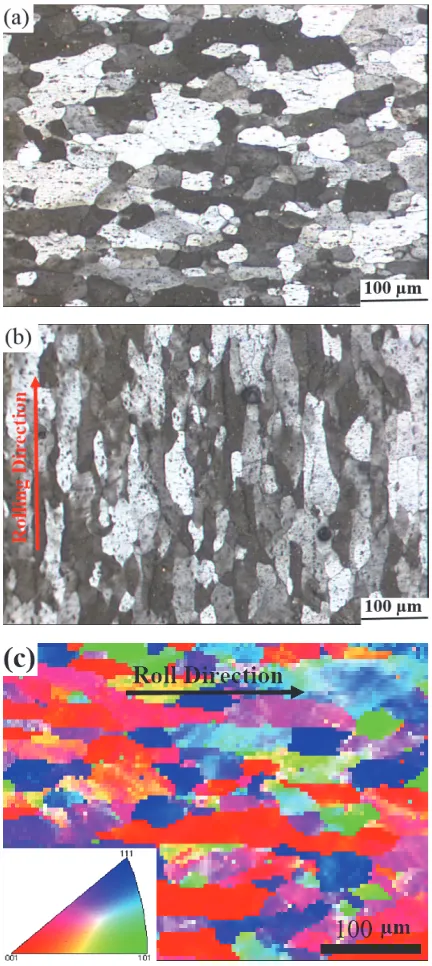
Figure 2 shows the optical micrographs of the initial and the three-pass ECARed samples. In the figure, the effect of the ECAR process on the grain refinement of Al6061 alloy is shown. The smaller grain size and uniform microstructure of the ECARed sheets compared to the initial sample can be seen. An elongated structure mainly oriented in the ECAR rolling direction was found just after the 3rd pass
(Fig. 2b). It is in good consistency with the EBSD graph (Fig. 2c). This figure shows the statistical variations of the grain size and crystallographic orientations obtained from the EBSD analysis after consecutive passes, respectively. The average grain size is about 25 μm with a disorientation angle greater than 15°. At the beginning of the ECAR process, dislocations start to arrange into the sub-grains which are likely to transform to ultra-fined grains with higher high-angle grain boundaries in next passes [24-27].
Fig. 2. Optical micrographs of the a) Initial sample, b) Three-pass and
c) Three-pass EBSD graph of the ECARed sample in route A.
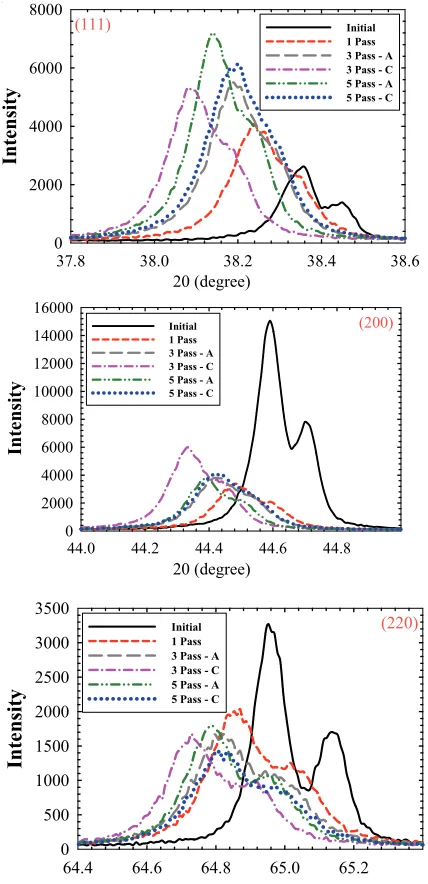
as-received specimen strongly presents the crystal orientation of (200) basal plane with a high peak value of (200) plane in the section perpendicular to the normal direction. On the other hand, the distribution of the diffract peak for the ECARed specimens is similar except for the intensity values.
Thus applying the ECAR on Al6061 alloy sample changed its crystal orientation. This change increases by increasing the number of the passes through the channels.
20 (degree)
20 (degree)
20 (degree)
20 (degree)
Fig. 3. X-ray diffraction patterns for different ECARed conditions.
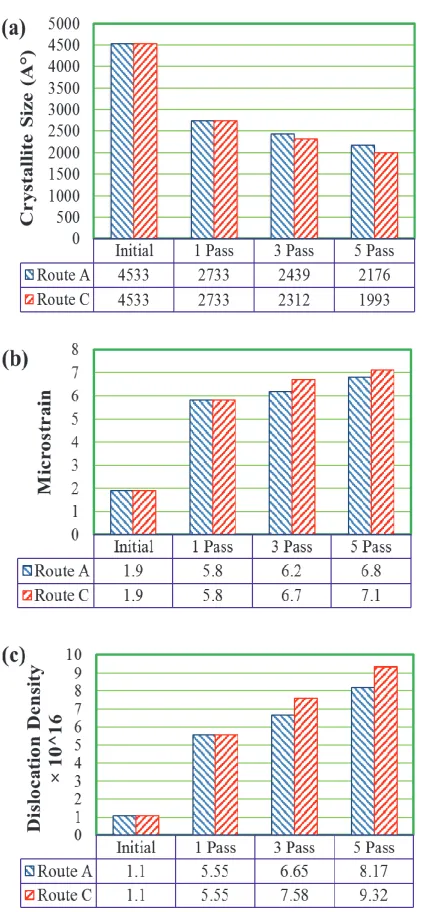
Figure 4 shows the results of the Rietveld analysis of the XRD pattern by using the MAUD software for the variation of the average crystallite size, microstrain and dislocation density versus the number of the ECAR processes. Considering the results of Fig. 4, the microstructure characteristics of ECARed Al6061 alloy samples change significantly during the ECAR. At the first rolling passes, the dislocation density increases, then dislocations form minor boundaries. Subsequently, these minor boundaries convert to high-angle boundaries. According to the results of the Rietveld analysis, increasing the number of the ECAR passes decreases the crystallite size and increases the values of the micro-strain and dislocation density irrespective of the processing route. Moreover, the changes are more severe on the first pass compared to other passes. However, between the passes of the ECAR via route C, the grain size reduced further in comparison with route A. The micro-strain increased further via route C. This means that route C was more effective than route A in the propagation of the dislocations, forming minor boundaries, converting these boundaries to boundaries with higher angles at a greater number of passes and the HAGBs fractions.
37.8 38.0 38.2 38.4 38.6
In tens it y 0 2000 4000 6000 8000 ) (111) Initial 1 Pass 3 Pass - A 3 Pass - C 5 Pass - A 5 Pass - C
44.0 44.2 44.4 44.6 44.8
Int en si ty 0 2000 4000 6000 8000 10000 12000 14000 16000 (200) Initial 1 Pass 3 Pass - A 3 Pass - C 5 Pass - A 5 Pass - C
64.4 64.6 64.8 65.0 65.2
Int en sit y 0 500 1000 1500 2000 2500 3000 3500 Initial 1 Pass 3 Pass - A 3 Pass - C 5 Pass - A 5 Pass - C
(220)
77.6 77.8 78.0 78.2 78.4
Fig. 4. The values of the microstructure parameters obtained by analyzing the XRD pattern versus the number of the
ECAR processes, a) average crystallite size, b) microstrain and c) dislocation density.
Previous studies have shown that for FCC metals and alloys processed by SPD, the yield strength and dislocation density have similar trends as a function of the strain [28,29]. The relationship between the yield
strength ( and dislocation density has been
presented by Taylor equation (Eq. 3).
(3)
Where , , and are the friction stress (for
Al6061, is 20 MPa), the Taylor factor (for untextured polycrystalline materials is 3), the shear modulus (for Al alloy is 26400 MPa), and a constant value (
0.24 , respectively.
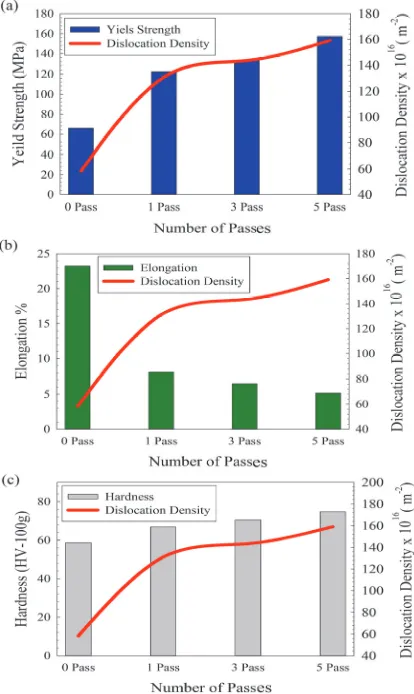
In this paper, the outputs of the Taylor equation and mechanical tests have been compared to investigate the main strengthening mechanism in ECARed Al6061 alloy. The results of the yield strength obtained by experiment and the Taylor equation have been shown in Fig. 5 as can be seen, the yield strength obtained by the tensile tests and Taylor equation are in good consistency with each other. It shows that the interaction between the dislocations is the main strengthening mechanism. This is in good agreement with other researches on FCC metals processed by SPD [28-30]. Moreover, the results show that route C creates greater yield strength in the samples compared with route A.
Fig. 5. The yield strength obtained via experiment and Taylor equation
Fig. 6. The variation of mechanical properties, a) Yield strength, b) Elongation, c) Hardness, and dislocation
density in terms of the number of passes in Al6061 alloy.
The significant strengthening was due to the rapid increase of the dislocation density followed by dislocation rearrangement into subgrains and strain hardening, which contribute to the strengthening [31]. In general, the energy stored in the ECARed samples as a result of applying the equivalent shear strain leads to an increase in the dislocation density and reduces the crystallite size. However, the increasing rate of the dislocation density reduced due to the recovery and dislocation interaction. These changes have increased the yield strength of the specimens and reduced their elongation. However, some researchers believe that the high strength and elongation reduction in the ECARed specimen can be related to the presence of a high dislocation density as well as a large number of twins [10]. Kim et al [32] showed that the contribution of some precipitation to the strengthening during the ECAP process, however, seems to be small compared with that of substructure refinement to the strengthening.
4. Conclusions
Based on the research performed on the correlation between the microstructure and mechanical properties of Al6061 alloy sheets processed by equal channel angular rolling, the following results were obtained:
The results of the X-ray diffraction showed that applying the ECAR process changes the crystal orientation of the samples.
The Rietveld analysis of the X-ray diffraction pattern showed that applying the ECAR process caused the microstrain and dislocation density to increase, while the crystallite size decreased.
The good consistency between the yield strength obtained by the tensile test and Taylor equation showed that the interaction between the dislocations is the main strengthening mechanism in the ECAR process.
By analyzing the correlation between the
dislocation density as a microstructure characteristic and the mechanical properties, it was found that by increasing the dislocation density during the ECAR process, the strength and hardness increased and the elongation decrease.
5. References
[1]A. Azushima, R. Kopp, A. Korhonen, Severe plastic deformation (SPD) processes for metals, CIRP Ann, 2008; 57: 716–735.
[2]R. N. Chari, B. M. Dariani, A. F. Arezodar, Numerical and experimental studies on deforamion behavior of 5083 aluminum alloy strips in equal channel angular rolling,
Proc Inst Mec Eng, B J Eng Manuf , 2016, https://doi.org.
[3]M. H. Farshidi, M. Kazeminezhad, The effects of die geometry in tube channel pressing: Severe plastic deformation, Proc Inst Mech Eng, L J Mater Des Appl, 2016; 230 (1): 263–272.
[4]M. Mahmoodi, M. Sedighi, D.A. Tanner, Experimental study of process parameters' effect on surface residual stress magnitudes in equal channel angular rolled aluminum alloys, Proc Inst Mech Eng, B J Eng Manuf , 2012; 34: 483– 487.
[5]M. Mahmoodi A. Naderi, Applicability of artificial neural network and nonlinear regression to predict mechanical properties of equal channel angular rolled Al5083 sheets,
[6]M. Honarpisheh, E. Haghighat, M. Kotobi, Investigation of residual stress and mechanical propeties of equal channel angular rolled St12 strips, Proc Inst Mech Eng, L J Mater
Des Appl, 2016. DOI: 10.1177/1464420716652436.
[7]J. C. Lee, H. K. Seok, J. Y. Suh, Microstructural evolutions of the Al strip prepared by cold rolling and continuous equal channel angular pressing, Acta Mater, 2002; 50: 4005–4019.
[8]Y. H. Chung, J. W. Park, K.H. Lee, An Analysis of Accumulated Deformation in the Equal Channel Angular Rolling (ECAR) Process, Metal and Material International,
2006; 12: 289-292.
[9]Y. H. Chung, J. W. Park, K. H. Lee, Controlling the Thickness Uniformity in Equal Channel Angular Rolling (ECAR), Mater. Sci. Forum, 2007; 539: 2872–2877.
[10] Y. Q. Cheng, Z. H. Chen, W.J. Xia, Improvement of drawability at room temperature in AZ31 magnesium alloy sheets processed by equal channel angular rolling, J Mater
Eng Perform, 2008; 17: 15–19.
[11] Y. Q. Cheng, Z. H. Chen, W. J. Xia, Drawability of AZ31 magnesium alloy sheet produced by equal channel angular rolling at room temperature, Mater, Charact, 2007; 58: 617–622.
[12] A. Habibi, M. Ketabchi, Enhanced properties of nano-grained pure copper by equal channel angular rolling and post-annealing, Mater, 2012; 34: 483–487.
[13] M. Mahmoodi, A. Naderi, G. Dini, Correlation between structural parameters and mechanical properties of Al5083 sheets processed by ECAR, J Mater Eng Perform, 2017; 26: 6022–6027.
[14] M. Kotobi, M. Honarpisheh, Uncertainty analysis of residual stress measured by slitting method in equal-channel angular rolled Al-1060 strips, J Strain Anal Eng Des, 2016; 52 (2): 83-92.
[15] M. Mahmoodi, S. Lohrasbi, Investigation of residual stresses distribution in equal channel angular rolled aluminum alloy by means of the slitting method, J Strain
Anal Eng Des, 2017; 52 (6): 389-396.
[16] N. Anjabin, A.K. Taheri, Physically based material model for evolution of stress–strain behavior of heat treatable aluminum alloys during solution heat treatment,
Mater Des, 2010; 31: 433–437.
[17] J. Gubicza, N. Q. Chinh, Z. Horita, Effect of Mg addition on microstructure and mechanical properties of aluminum,
Mater Sci Eng, A, 2004; 387-389: 55–59.
[18] J. Gubicza, N. Q. Chinh, J. L. Labar, Correlation between microstructure and mechanical properties of severely deformed metals, J Alloys Compd, 2009; 483: 271–274.
[19] V. M. Segal, Materials processing by simple shear,
Materials Science and Engineering A, 1995; 197: 157-164.
[20] L. Lutterotti, Total pattern fitting for the combined size-strain-stress-texture determination in thin film diffraction,
Nucl Instrum Methods Phys Res, Sect B, 2010; 268: 334–
340.
[21] P. Sahu, M. De, S. Kajiwara, Microstructural characterization of stress-induced martensites evoluted at low temperature in deformed powders of Fe-Mn-C alloys by Rietveld method, J Alloys Compd, 2002; 346: 158–169.
[22] G. Dini, A. Najafizadeh, S. M. Monir-Vaghefi, Grain size effect on the martensite formation in a high-manganese TWIP steel by the Rietveld method, J Mater Sci Technol,
2010; 26: 181–186.
[23] M. R. Rezaei, M. R. Toroghinead, F. Ashrafizadeh, Production of nano-grained structure in 6061 aluminum alloy strip by accumulative roll bonding, Mater Sci Eng, A, 2011; 529: 442–446.
[24] M. Mahmoodi, The effect of ECAR parameters on residual stresses and mechanical-microstructural properties of Al sheets, PhD Thesis, Iran University of Science and
Technology, Iran, 2011.
[25] M. Janecek, J. Cizek, M. Dopita, Mechanical properties and microstructure development of ultrafine-grained Cu processed by ECAP, Mater Sci Forum, 2008; 584–586: 440–445.
[26] J. Tu, T. Zhou, L. Liu, L. Shi, Effect of rolling speeds on texture modification and mechanical properties of the AZ31 sheet by a combination of equal channel angular rolling and continuous bending at high temperature, Journal of Alloys
and Compounds, 2018; 768: 598-607.
[27] T. Kvackaj, A. Kovacova, R. Kocisko, Microstructure evolution and mechanical performance of copper processed by equal channel angular rolling, Materials Characterization,
2017; 134: 246–252.
[28] J. Gubicza, N. Q. Chinh, T. G. Langdon, Microstructure and strength of metals processed by severe plastic deformation, Ultrafine Grained Materials IV, 2006; 231– 236.
[29] N. Hansen, X. Huang, Microstructure and flow stress of polycrystals and single crystals, Acta Mater, 1998; 46: 1827–1836.
[30] Z. Y. Zhong, H. G. Brokmeier, W. M. Gan, Dislocation density evaluation of AA7020-T6 investigated by in-situ synchrotron diffraction under tensile load, Mater Charact, 2015; 108: 124–131.
[31] Y. Miyajima, S. Okubo, H. Abe, Dislocation density of pure copper processed by accumulative roll bonding and equal channel angular pressing, Mater Charact, 2015; 104: 101–106.
[32] W. J. Kim, J. K. Kim, T. Y. Park, S. I. Hong, D. I. Kim, Y. S. Kim, J. D. Lee, Enhancement of Strength and Superplasticity in a 6061 Al Alloy Processed by Equal-Channel-Angular-Pressing, Metallurgical and Materials
و
رد
ﻲﻜﻴﻧﺎﻜﻣ
صاﻮﺧ
ﺎﺑ
نآ
طﺎﺒﺗرا
و
رﺎﺘﺧﺎﺳوﺮﻜﻴﻣ
ر
مﻮﻴﻨﻴﻣﻮﻟآ
ژﺎﻴﻟآ
ق
6061
رد
درﻮﻧ
ﺪﻨﻳآﺮﻓ
زا
ﻞﺻﺎﺣ
لﺎﻧﺎﻛ
ﻪﻳواز
نﺎﺴﻤﻫ
يﺎﻫ
راد
يدﻮﻤﺤﻣدﻮﻌﺴﻣ
،
ﻧﻲﻠﻋ
يردﺎ
ﻧاد
ﻲﺳﺪﻨﻬﻣهﺪﻜﺸ
ﺎﻨﻤﺳ،نﺎﻨﻤﺳهﺎﮕﺸﻧاد،ﻚﻴﻧﺎﻜﻣ
ناﺮﻳا،ن
.
هﺪــﻴﻜﭼ
ﻪﻳوازنﺎﺴﻤﻫلﺎﻧﺎﻛرددرﻮﻧ
) راد
ECAR
ﺑﻪﻧادﺰﻳرقﻮﻓرﺎﺘﺧﺎﺳﺎﺑيﺰﻠﻓقروﺪﻴﻟﻮﺗﺖﻬﺟﻪﻛﺖﺳاﺪﻳﺪﺷﻚﻴﺘﺳﻼﭘمﺮﻓﺮﻴﻴﻐﺗﺪﻨﻳآﺮﻓﻚﻳ (
ﻪ رﺎﻛ
يرﺎﺘﺧﺎﺳوﺮﻜﻴﻣوﻲﻜﻴﻧﺎﻜﻣصاﻮﺧﻦﻴﺑطﺎﺒﺗراهﺪﺷﻪﺋارارﺎﻛرد .ﺖﺳاهﺪﺷﻪﺘﻓﺮﮔ
ﻪﻧﻮﻤﻧ
ﺪﻨﻳآﺮﻓﻲﻃردﺎﻫ
ECAR
.ﺖﺳاﻪﺘﻓﺮﮔراﺮﻗﻲﺳرﺮﺑدرﻮﻣ
ﺶﻧﺮﻛوﺮﻜﻴﻣ،ﺖﻴﻟﺎﺘﺴﻳﺮﻛهزاﺪﻧاﻞﻣﺎﺷيرﺎﺘﺧﺎﺳوﺮﻜﻴﻣصاﻮﺧﺎﺗﺖﺳاﻪﺘﻓﺮﮔراﺮﻗهدﺎﻔﺘﺳادرﻮﻣﺲﻜﻳاﻪﻌﺷاشاﺮﭘيﻮﮕﻟاﻞﻴﻠﺤﺗﺖﻬﺟﺪﻟﻮﺘﻳرشور
ﻲﻳﺎﺠﺑﺎﻧﻲﻟﺎﮕﭼو
ﺎﻧﻲﻟﺎﮕﭼوﺖﻴﻟﺎﺘﺴﻳﺮﻛهزاﺪﻧاﻂﺳﻮﺘﻣﻪﻛﺪﺷهﺪﻫﺎﺸﻣ .ددﺮﮔﻦﻴﻴﻌﺗﺎﻫ
.ﺖﺳاﻪﺘﻓﺎﻳﺶﻳاﺰﻓا،ﺪﻨﻳآﺮﻓﻲﻃردﺶﻧﺮﻛﺶﻳاﺰﻓاﺎﺑﻲﻳﺎﺠﺑ
ﺪﻨﻳآﺮﻓﻪﻛ ﺪﻧدادنﺎﺸﻧﺞﻳﺎﺘﻧ
ECAR
ﺑﺖﻴﻟﺎﺘﺴﻳﺮﻛﻚﻳرديرﺎﺘﺧﺎﺳحﻼﺻاﻚﻳﻪﺑ ﻲﺑﺎﻴﺘﺳدﺖﻬﺟﻪﻛ ﺖﺳايرﺎﻜﻫار
ﻪ
ﺎﺑ .ﺖﺳاهﺪﺷﻪﺘﻓﺮﮔرﺎﻛ
ﺑ ﻪ رﺎﻛ
ﻲﻣرﻮﻠﻴﺗﻪﻄﺑاريﺮﻴﮔ
ﻨﻃﺎﺒﺗراردﻲﻳﺎﺠﺑﺎﻧﻲﻟﺎﮕﭼﺎﺑﻲﻜﻴﻧﺎﻜﻣصاﻮﺧﻪﻛدادنﺎﺸﻧناﻮﺗ
ﺪﻨﻳآﺮﻓ .ﺪ
ECAR
ﻲﻳﺎﺠﺑﺎﻧﻲﻟﺎﮕﭼﺶﻳاﺰﻓاﻞﻴﻟدﻪﺑ
ردﺎﻫ
ﻲﻣﺶﻳاﺰﻓاارقروﻲﺘﺨﺳوﺮﻜﻴﻣوﻢﻴﻠﺴﺗمﺎﻜﺤﺘﺳاتﺪﺷﻪﺑ،ﺶﻧﺮﻛزاﻲﻌﻴﺳوهدوﺪﺤﻣ
.ﺪﻫد
هژاو
:يﺪﻴﻠﻛيﺎﻫ
مﻮﻴﻨﻴﻣﻮﻟآ،ﻲﻳﺎﺠﺑﺎﻧﻲﻟﺎﮕﭼ،ﺪﻟﻮﺘﻳرشور،ﺲﻜﻳاﻪﻌﺷاشاﺮﭘ
6061