EFFECT OF TOPPING UNDER DIFFERENT NITROGEN LEVELS ON EARLINESS AND YIELD OF COTTON
Muhammad Farrukh Saleem*, Munir Ahmad*, Shakeel Ahmad Anjum*, Muhammad Aown Sammar Raza** and Abdul Shakoor*
ABSTRACT:- Cotton is perennial plant with indeterminate growth habit. However it has been adopted as annual, so efforts like topping and optimum nitrogen levels to modify its architecture can play a role in improving its success as annual. A field experiment to study the effect of topping under different nitrogen levels on earliness and yield of cotton (Gossypium hirsutum L.) was conducted at Agronomic Research Area, University of Agriculture, Faisalabad, during kharif
-1
2013. The crop was sown on ridges on May 24, 2013 using seed rate of 20 kg ha . The experiment was laid out in Randomized Complete Block Design (RCBD) with factorial arrangement having three replications. Treatments included four topping levels: control (no topping), topping at 90 cm, 120 cm and 150 cm height; three
-1
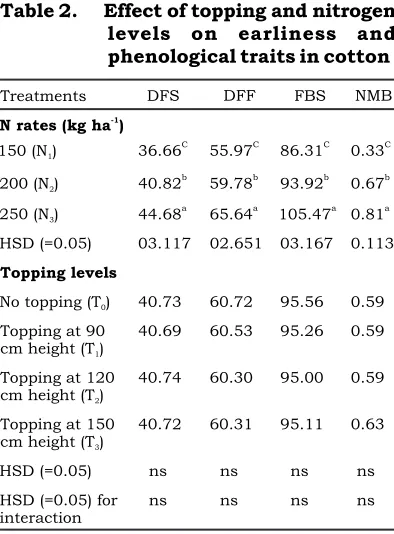
nitrogen levels: 150, 200 and 250 kg ha . Net plot size was 6 m × 3 m. Maximum days to first floral bud initiation (44.68), appearance of first flower (65.64), first boll splition (105.47) and monopodial branches per plant (0.81) were recorded at 250 kg
-1
N ha . Minimum days for first floral bud initiation (36.66), appearance of first flower (55.97), first boll splition (86.31) and monopodial branches per plant (0.33) were
-1
recorded with application of 150 kg N ha . While topping did show non-significant effect on these earliness related parameters. Number of sympodial branches was significantly affected by topping only; with maximum values recorded in no topping closely followed by topping at 150 cm height. Values showed that 90 cm tall plants
-1
produced maximum seed cotton yield when supplied with 150 kg N ha ; 120 cm tall
-1
plants gave maximum seed cotton with 200 kg N ha while 150 cm tall cotton plants
-1
needed 250 kg N ha for highest seed cotton production. In conclusion, cotton growth can be manipulated successfully for better performance by topping provided N dose is monitored.
Key Words: Gossypium hirsutum; Growth Manipulation; Nitrogen Fertilizer; Seed Cotton; Yield; Yield Components; Pakistan.
INTRODUCTION
Earliness of cotton is defined as early appearance of first flower, early boll formation; early boll opening and early termination of crop (Chaudhry and Guitchounts, 2003). Pruning and topping can cause readjustments of assimilate partitioning in plants resulting in strengthening of repro-ductive growth and inhibiting
vege-tative growth; this may lead to early maturity of cotton (Dai et al., 2003). Although number of main stem nodes stopped to form after topping but topping and pruning increased the biomass allocation to reproductive organs like green and opened bolls (Yang et al., 2008). Through pruning and topping, decrease in plant height and number of main stem nodes, and increase in number of retained bolls * Department of Agronomy, University of Agriculture Faisalabad, Pakistan.
** Department of Agronomy, University College of Agriculture and Environmental Sciences, The Islamia University of Bahawalpur, Pakistan.
and cotton yield was noted (Ma et al., 2004).
In some cotton producing countries pruning of sympodial branches, mecha-nical topping of the main stem and spray of growth regulators are used to control lodging and excessive growth; to increase earliness, to make mechanical harvesting easy and to enhance yield (Abou-El-Nour et al., 2001). Topping at 120 cm height resulted in increased number of fruiting sites and retended bolls, decreased number of aborted sites and increased boll weight and boll percentage and ultimately high seed cotton yield (Obasi and Msaakpa, 2005). Topping showed a higher seed cotton yield, lint index, fiber length, lesser aphid, jassid and thrips population but ginning percentage remained unaffected (Shwetha et al., 2009).
Nitrogen plays an important role in plant growth processes. It is an integral part of chlorophyll, protein and nucleic acids (Marschner, 1986). Nitrogen is known as a key limiting nutrient which is used for cotton production on irriga-ted arid land (Kienzler, 2010).
Nitrogen is necessary in producing plant dry matter and energy rich compounds used in regulation of photosynthesis and plant production which ultimately affect boll develop-ment, boll weight and number of bolls per plant (McConnell and Mozaffari, 2004). Due to high nitrogen, decreased lint percentage, increased boll weight, mineral uptake and photosynthate assimilation in sink was noted (Sawan et al., 2006). Nitrogen is required for cotton production in large amounts more consistently than all other nutrients (Hou et al., 2007). Nitrogen is well known for its role in vegetative growth of crop; its role in cotton is more critical due to its indeterminate growth habit. Further, topping at
different heights will altogether change growth behavior of cotton making it inevitable to re-define nitrogen dose.
Present study was conducted to ascertain the behavior of detopped cotton crop under different nitrogen doses.
MATERIALS AND METHOD
An experiment was conducted to study the effect of topping under different nitrogen levels on earliness and yield of Bt. cotton at Agronomic Research Area, University of Agricul-ture, Faisalabad, during kharif 2013. Randomized Complete Block Design (RCBD) with factorial arrangements having three replications was applied. Net plot size was 6 m × 3 m and seed was placed manually at 30 cm distance on one side of 75 cm apart ridges. There were four lines in each plot. The experi-mental treatments comprised three
-1 nitrogen rates viz., N (150 kg ha ), N 1 2
-1 -1
(200 kg ha ) and N (250 kg ha ) and four 3 topping levels viz., T control (no topping), 0 T (topping at 90 cm height), T (topping at 1 2 120 cm height) and T (topping at 150 cm 3 height). Seedbed was prepared by cultivating one time with rotavator and two times with tractor mounted cultivator each followed by planking then 75 cm apart ridges were made by tractor mounted ridger. The crop was sown on sandy clay loam soil on May 24, 2013 @
-1
20 kg seed ha . Full dose of phosphorus
-1 -1
(115 kg ha ) and potassium (95 kg ha ) and one third dose of nitrogen (as per treatment) was applied at sowing while one third at 30 days after sowing (DAS and remaining nitrogen was applied at flowering (60 DAS). Weeds were controlled by one pre emergence herbicide {Dual Gold (S Metachlore) at
-1
one post emergence broad spectrum herbicide (Roundup (Glyphosate) at
-1
3000 ml ha ) using shield (90 days after sowing). Insects were controlled by spraying proper insecticides
(Imidach--1
loprid @ 625 ml ha ) at 70 and s 90 DAS after sowing). Upper 3-4 cm portion of terminal bud of main stem was removed when plant height was 3-4 cm more as per treatment to maintain the plant height according to treatments (70-100 DAS) by regular visits. All other agronomic practices were kept normal and uniform for all the treatments. When seedlings were established, ten true representative plants were selected randomly from each plot and tagged them to record the following data.
Number of Days from Sowing to First Floral Bud Initiation (Squaring)
It was recorded from the ten selected plants of each plot when bud became visible having a pin head size of about 3 mm. The data were recorded from the selected plants when 50% selected plants showed squaring.
Number of Days from Sowing to Appearance of First Flower
This was noted from the repre-sentative plants when 50% of the selected plants showed flowering with the creamy white or yellowish color of the flower.
Number of Days from Sowing to First Boll Splition
It was noted when the lint was seen within the boll with squares (boll locks) around (cracked boll) and took the average of the selected plants for accuracy.
Earliness Index (%)
Earliness index (%) or maturity coefficient was calculated from the
following formula (Singh, 2004).
Weight of seed cotton from first pick Earliness index (%)=
Total seed cotton weight from all the picks
Number of Sympodial Branches per Plant
This was recorded by counting the sympodial branches from the selected plants of each plot and average was taken.
Number of Monopodial Branches per Plant
It was counted from the selected plants at the time of second picking and took the average.
Number of Opened Bolls per Plant
This was recorded by counting the opened bolls at first and second picking of selected plants and took the average.
Boll Weight (g)
Average boll weight (g) was calculated by dividing the total seed cotton yield per plant by the number of opened bolls per plant of the respective plant (of the selected plants) and then average was taken.
Seed Cotton Yield
Seed cotton yield per plant was calculated by weighing the seed cotton yield from the selected plants of each plot of all the picks in grams by electrical balance and then the average of the selected plants was taken and subsequently yield per hectare was calculated.
compared by using Tukey's HSD (Honestly significant difference) test at 5% probability.
RESULTS AND DISCUSSION
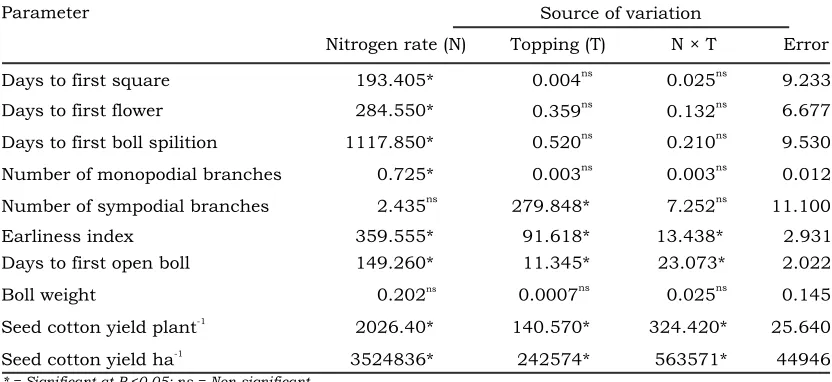
Nitrogen rate significantly affected all phenological events as well as number of monopodial branches of cotton crop while, effect of topping and their interactive effect remained non-significant in this regard (Table 1). Maximum days to first square, days to flowering, days to first boll spilition and number of monopodial branches were recorded with higher nitrogen
-1
dose (250 kg ha ). Application of 200 -1
kg N ha (medium dose) showed second best response after 250 kg N
-1
ha while minimum was recorded -1 with low dose of nitrogen (150 kg ha ) (Table 2). It indicates that increased rate of nitrogen delayed the onset of squaring, flowering and boll spilition and increased the monopodial branches per plant thus leading to delayed maturity (i.e., earliness decreased). This may be attributed to the role of nitrogen towards vegetative
growth as nitrogen is a part of chloro-phyll. There may be a reason that more nitrogen application caused more vegetative growth so light penetration decreased which caused delay in phases of crop growth.
Effect of nitrogen rate, topping as well as their interaction was signifi-cant on earliness index (Table 1). At
-1
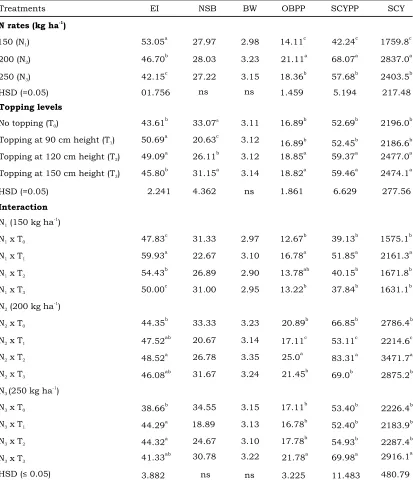
150 kg N ha maximum earliness index was recorded when topping was done at 90 cm height followed by earliness index when topping was done at 120 cm height. Minimum earliness index was noted in control which was at par with the earliness index noted in plants topped at 150 cm height. The low nitrogen level caused less vegetative growth and more reproductive growth which caused more earliness. When topping was done at less height there was more light penetration resulting in more and early boll opening so, earliness index was more, While when height increased as in all other treatments there was less light penetra-tion and delay in boll opening so, earli-ness was decreased.
Source of variation Parameter
Nitrogen rate (N) Topping (T)
ns
0.359
N × T
ns
0.132
Error
Days to first square 193.405* 0.004ns 0.025ns 9.233
Days to first flower 284.550* 6.677
Days to first boll spilition 1117.850* 0.520ns 0.210ns 9.530
Number of monopodial branches 0.725* 0.003ns 0.003ns 0.012
Number of sympodial branches 2.435ns 279.848* 7.252ns 11.100
Earliness index 359.555* 91.618* 13.438* 2.931
Days to first open boll 149.260* 11.345* 23.073* 2.022
Boll weight ns
0.202 0.0007ns 0.025ns 0.145
-1
Seed cotton yield plant 2026.40* 140.570* 324.420* 25.640
-1
Seed cotton yield ha 3524836* 242574* 563571* 44946 Table 1. Mean sum of square for topping and nitrogen levels on earliness and yield
related traits in cotton
-1 When N was applied @ 200 kg ha maximum earliness index was recorded with topping at 120 cm height which was at par with earliness index when topping was done at 90 cm and 150 cm height. While minimum earliness index was recorded in control. However, 120 cm tall plants
-1
with 200 kg N ha performed better and light penetration being caused more earliness index. In 90 cm height where earliness index was minimum more nitrogen caused unwanted vegetative growth or sprouting of branches from top nodes leading less penetration and less earliness index. Similarly in no topping and topping at 150 cm height more nitrogen was used for vegetative growth than for reproductive growth so light penetration was less which decreased earliness index.
-1
At 250 kg N ha and 120 cm height,
maximum earliness index was recorded which was at par with 90 cm and 150 cm height. While minimum earliness index was recorded at control which was at par with earliness index when topping was done at 150 cm height. The reason is that with taller plants more nitrogen was used for vegetative growth which caused less light penetration resulting in less earliness index.
A comparison of all interaction values showed maximum earliness index in plots where plants were applied
-1
with 150 kg N ha and topping was done at 90 cm height because this treatment combination allowed enough vegetative growth to allow more light penetration resulting in more earliness index. Pruning and topping causes readjust-ments of assimilate partitioning in the plant towards reproductive part that resulted increased cotton yield, which enhanced reproductive growth and hinders vegetative growth. Both the hindrance of vegetative growth and enhancement of reproductive growth have been known as the driving factors of the cotton crop for early maturity or short lifespan (Xu et al., 2001; Dai et al., 2003). In some cotton growing countries, mechanical or chemical topping increased earliness (El-Shahawy, 2000). Excessive nitrogen resulted in delayed maturity, more vegetative growth and lowered yield (McConnell et al., 1996). A combination of topping and pruning improved light penetration and air circulation (Waggoner and Moss, 1963).
Number of sympodial branches per plant was significantly affected by topping but not by nitrogen rate (Table 3). Maximum number of sympodial branches per plant was recorded at T which was at par with T 0 3 followed by T and minimum number 2 of sympodial branches per plant was
-1 N rates (kg ha )
Topping levels
Treatments DFS DFF FBS NMB
150 (N )1
C
36.66 C
55.97 C
86.31 C
0.33
200 (N )2
b
40.82 59.78b 93.92b 0.67b 250 (N )3
a
44.68 a
65.64 a
105.47 a 0.81
HSD (=0.05) 03.117 02.651 03.167 0.113
No topping (T )0 40.73 60.72 95.56 0.59
Topping at 90 cm height (T )1
40.69 60.53 95.26 0.59
Topping at 120 cm height (T )2
40.74 60.30 95.00 0.59
Topping at 150 cm height (T )3
40.72 60.31 95.11 0.63
HSD (=0.05) ns ns ns ns
HSD (=0.05) for interaction
ns ns ns ns
Table 2. Effect of topping and nitrogen levels on earliness and phenological traits in cotton
Means followed by same letter do not differ significantly at 5% probability level.
Means followed by same letter do not differ significantly at 5% probability level.
ns = Non-significant, NSB = Number of sympodial branches, EI = Earliness index (%), OBPP = Opened bolls per plant, -1
BW = Boll weight (g), SCYPP = Seed cotton yield per plant (g), SCY = Seed cotton yield (kg ha )
recorded with T . Because sympodial 1 branches grow in an acropetal pattern so, where height of plant was more,
number of sympodial branches per plant was also more. With topping of plants, number of sympodial branches -1
N rates (kg ha )
Topping levels
-1 N (150 kg ha )1
-1 N (200 kg ha )2 Treatments
150 (N ) 1 200 (N )2 250 (N )3 HSD (=0.05)
No topping (T )0
Topping at 90 cm height (T )1 Topping at 120 cm height (T )2 Topping at 150 cm height (T )3 HSD (=0.05)
Interaction
N x T1 0 N x T1 1 N x T1 2 N x T1 3
N x T2 0
-1 N (250 kg ha )3 N x T2 2 N x T2 3
N x T3 0 N x T3 1 N x T3 2 N x T3 3 HSD (≤ 0.05) N x T2 1
EI a 53.05 b 46.70 c 42.15 01.756 b 43.61 a 50.69 a 49.09 b 45.80 2.241 c 47.83 a 59.93 b 54.43 c 50.00 b 44.35 a 48.52 ab 46.08 b 38.66 a 44.29 a 44.32 ab 41.33 3.882 ab 47.52 27.97 28.03 27.22 a 33.07 c 20.63 b 26.11 a 31.15 4.362 31.33 22.67 26.89 31.00 33.33 26.78 31.67 34.55 18.89 24.67 30.78 ns NSB ns 20.67 BW 2.98 3.23 3.15 ns 3.11 3.12 3.12 3.14 ns 2.97 3.10 2.90 2.95 3.23 3.35 3.24 3.15 3.13 3.10 3.22 3.14 OBPP c 14.11 a 21.11 b 18.36 1.459 b 16.89 b 16.89 a 18.85 a 18.82 1.861 b 12.67 a 16.78 ab 13.78 b 13.22 b 20.89 a 25.0 b 21.45 b 17.11 b 16.78 b 17.78 a 21.78 3.225 c 17.11 SCYPP c 42.24 a 68.07 b 57.68 5.194 b 52.69 b 52.45 a 59.37 a 59.46 6.629 b 39.13 a 51.85 b 40.15 b 37.84 b 66.85 a 83.31 b 69.0 b 53.40 b 52.40 b 54.93 a 69.98 11.483 c 53.11 SCY c 1759.8 a 2837.0 b 2403.5 217.48 b 2196.0 b 2186.6 a 2477.0 a 2474.1 277.56 b 1575.1 a 2161.3 b 1671.8 b 1631.1 b 2786.4 a 3471.7 b 2875.2 b 2226.4 b 2183.9 b 2287.4 a 2916.1 480.79 c 2214.6 Table 3. Effect of topping and nitrogen levels on earliness and yield related traits
in cotton
in T . The 120 cm tall plants performed 1 better because more nitrogen was available to support more fruits and light penetration was enough to support more boll opening and thus more yield but in 90 cm height, more nitrogen caused unwanted vegetative growth or sprouting of branches from top nodes and thus less light penetration leading to less number of opened bolls and yield. Similarly in no topping and topping at 150 cm height more nitrogen was used for vegetative growth than for reproductive growth.
-1
At 250 kg N ha , maximum boll opening, seed cotton yield per plant and per hectare were recorded in T 3 than all other topping levels. Taller plants (topping at 150 cm height) used more nitrogen for reproductive growth due to enough height to support fruits, while light penetration in this case further facilitates boll opening leading to more seed cotton yield.
A comparison of all interaction values showed maximum number of opened bolls, seed cotton yield per plant and per hectare in plots where -1 plants were applied with 200 kg N ha in T . Because at this height plants 2 showed maximum bolls' retention, less boll abortion and more repro-ductive growth due to optimum nitrogen dose and more light penetration to open more bolls and more seed cotton yield. With higher doses of nitrogen number of bolls and flowers increased but seed cotton yield might have decreased due to excessive shedding of lower bolls (Boquet et al., 1994; Soomro et al., 1997).
Maximum seed cotton yield can be obtained with optimum nitrogen dose (Seilsepour et al., 2013) against the minimum either with excessive (Howard et al., 2001) or with lower doses.
ceased to increase due to controlled height of main stem. Growth of main stem nodes was ceased after topping (Yang et al., 2008).
Nitrogen rate and topping did not significantly affected boll weight of cotton (Table 3). These results were in contrast to results that nitrogen significantly affected boll weight (Saleem et al., 2010; Seilsepour et al., 2013). However, non-significant effects of topping and pruning were also noted on boll weight (Ma et al., 2004).
Nitrogen (N), topping (T) and their interaction (N×T) affected the number of opened bolls, seed cotton yield per plant and seed cotton yield signifi-cantly (Table 3). At T , maximum 3 number of opened bolls, seed cotton yield per plant and seed cotton yield were recorded when cotton plants were topped at 90 cm height, while minimum values for all these para-meters were recorded in T at same 0 nitrogen level. It shows that at low level of nitrogen, as height increased number of opened bolls per plant, seed cotton yield per plant and per hectare yield decreased. The reason is that at low nitrogen level, nutrients were available for fruit development in plots where minimum height was maintained so number of opened bolls, seed cotton yield per plant and seed cotton yield per hectare were more but when height was more at same nitrogen level, more nutrients were used for vegetative growth than reproductive growth so number of opened bolls and seed cotton yield decreased.
-1
Topping improved the yield (Renou et al., 2011) due to more biomass allocation to reproductive organs, such as green and opened bolls (Yang et al., 2008). Pruning and topping caused increase in cotton yield mainly due to readjustments in assimilate partitioning in the plant, which increased reproductive growth and inhibits vegetative growth. Both the inhibition of vegetative growth and strengthening of reproductive growth have also been identified as the driving factors for early maturity (Xu et al., 2001; Dai et al., 2003).
There were significant effects of nitrogen rates and topping levels on earliness and yield of cotton. With increased nitrogen dose, maturity was delayed; while topping caused early maturity i.e., as plant height increased maturity was delayed. Overall it was concluded that topping at 120 cm height
-1
with 200 kg N ha was most beneficial to get maximum seed cotton yield.
LITERATURE CITED
Abou-El-Nour, M.S., O.M.M. Wassel and S.M. Ismail. 2001. Response of Giza 80 cotton cultivar to some cultural practices to control exces-sive vegetative growth. Egyptian J. Agric. Res. 79: 191-204.
Boquet, D.J., E.B. Moser and G.A. Breitenbeck. 1994. Boll weight and within-plant yield distribu-tion in field-grown cotton given different levels of nitrogen. Agron. J. 86: 20-26.
Chaudhry, M.R. and A. Guitchounts. 2003. Cotton Facts. International Cotton Advisory Committee. First edn. p. 14. Dai, J., W. Zheng and J.S. Yang. 2003.
Review on growth and application of cotton monopodial branches. (In Chinese.) China Cotton. 30: 2-5.
El-Shahawy, M.I.M. 2000. Attempts to control excessive vegetative growth of cotton. Egypt J. Agric. Res. 78: 1181-1193.
Hou, Z., P. Li, B. Li, Z. Gong and Y. Wang. 2007. Effects of fertigation scheme on N uptake and N use efficiency in cotton. Plant Soil. 290: 115-126.
Howard, D.D., C.O. Gwathmey, M.E. Essington, R.K. Roberts and M.D. Mullen. 2001. Nitrogen fertilization of no-till cotton on loss-derived soils. Agron. J. 93: 157-163. Kienzler, K. 2010. Improving the
nitro-gen use efficiency and crop quality in the Khorezm region, Uzbekistan. Ph.D. diss., ZEF/ Rheinische Friedrich-Wilhelms-Universita¨t Bonn, Germany, Bonn. 228p.
Ma, F.Y., H.T. Cheng, S.K. Li, H. Zhang, J.Y. Yang, Z. Zheng, et al. 2004. A study on the fitness of cotton on canopy regulated by topping under high yield condition. (in Chinese.). Sci. Agr. Sin. 37: 1843-1848.
Marschner, H. 1986. Minerals nutri-tion of higher plants. Academic press Inc. San. Diego. USA. p. 148-173. McConnell, J.S., W.H. Baker and B.S.
Frizzell. 1996. Distribution of residual nitrate-N in long term fertilization studies of an alfisol cropped for cotton. J. Environ. Qual. 25: 1389-1394.
McConnell, J.S. and M. Mozaffari. 2004. Yield, petiole nitrate and node development responses of cotton to early season nitrogen fertilization. J. Plant Nutr. 27: 1183-1197.
Obasi, M.O. and T.S. Msaakpa. 2005. Influence of topping, side branch pruning and hill spacing on growth and development of cotton (Gossypium barbadense
JARTS. 106: 155-165.
Renou, A., I. Tereta and M. Togola. 2011. Manual topping decreases bollworm infestations in cotton cultivation in Mali. Crop Protec-tion. 30: 1370-1375.
Saleem, M.F., M.F. Bilal, M. Awais, M.Q. Shahid and S.A. Anjum. 2010. Effect of nitrogen on seed cotton yield and fiber qualities of cotton
(Gossypium hirsutum L.) cultivars.
J. Anim. Pl. Sci. 20: 23-27.
Sawan, Z.M., M.H. Mahmoud and A.H. El-Guibali. 2006. Response of yield, yield components, and fiber properties of Egyptian cotton
(Gossypium barbadense L.) to
nitrogen fertilization and foliar-applied potassium and mepiquat chloride. J. Cotton Sci. 10: 224-234. Seilsepour, M., M. Rashidi and P.
Yarmohammadi-Samani. 2013. Response of biological growth and fiber quality of cotton to different application rates of nitrogen. Middle East J. Sci. Res. 14: 838-842.
Shwetha, N.S., A.S. Halepyati and B.T. Pujari. 2009. Effect of detopping, removal of monopodia and plant spacings on nutrient uptake, quality parameters and economics of Bt cotton (Gossypium hirsutum
L.). Karnataka J. Agric. Sci. 22: 892-893.
Singh, P. 2004. Cotton breeding. Kalyani Publishers Ludhiana New Dehli Nodia (U.P.) Hyderabad Chennei Kolkata Cuttack India. p. 118-295.
Soomro, A.R., A.W. Soomro, W.A. Siddique, R.U. Khan and A.S. Arain. 1997. Nitrogen requirement of cotton in Sindh. The Pakistan Cottons. 41: 6-10.
Steel, R.G.D., J.H. Torrie and D. Dickey. 1997. Principles and procedure of statistics. A
biomet-rd
rical approach. 3 edn. McGraw Hill Book Co. Inc., New York. p. 352-358.
Waggoner, P.E. and D.N. Moss. 1963. Radiation in the plant environ-ment and photosynthesis. Agron. J. 55: 36-39.
Xu, L.H., G.F. Li, X.H. He and D.Y. Yang. 2001. Regularity of accumulation and distribution of dry matter in monopodial branches retained cotton plants. J. Agric. Sci. 17: 153-157. Yang, Y., Z. Ouyang, Y. Yang and X. Liu.
2008. Simulation of the effect of pruning and topping on cotton growth using 2K model. Field Crops Res. 106: 126-137.
AUTHORSHIP AND CONTRIBUTION DECLARATION S. No
1.
2.
3.
4.
5.
Contribution to the paper
Concieved the idea, Technical input, Overall management of the article
Concieved the idea, Data collection
Result and Discussion
Wrote abstract, Introduction, Methodology and references
Data entry in SPSS and analysis Author Name
Dr. Muhammad Farrukh Saleem
Dr. Munir Ahmad
Dr. Shakeel Ahmad Anjum
Dr. Aown Sammar Raza
Mr. Abdul Shakoor