Cornell International Law Journal
Volume 40
Issue 3
Fall 2007
Article 3
Efficient and Inefficient Debt Restructuring: A
Comparative Analysis of Voting Rules in Workouts
Hyun Chul Lee
Follow this and additional works at:
http://scholarship.law.cornell.edu/cilj
Part of the
Law Commons
This Article is brought to you for free and open access by the Journals at Scholarship@Cornell Law: A Digital Repository. It has been accepted for inclusion in Cornell International Law Journal by an authorized administrator of Scholarship@Cornell Law: A Digital Repository. For more information, please [email protected].
Recommended Citation
Lee, Hyun Chul (2007) "Efficient and Inefficient Debt Restructuring: A Comparative Analysis of Voting Rules in Workouts,"Cornell International Law Journal: Vol. 40: Iss. 3, Article 3.
Efficient and Inefficient Debt
Restructuring: A Comparative Analysis
of Voting Rules in Workouts
Hyun Chul Leet
Introduction ... 662
I. Two Rules on Voting in Workouts ... 666
A. Workouts: Reorganization Outside of Bankruptcy ... 666
B. Voting: A Solution to Holdouts ... 668
1. The Assent Scheme and the Voting Scheme ... 668
2. Classifying the Voting Scheme ... 669
C. Two Statutory Interventions with Voting: Prohibition and M andate ... 670
1. The United States: The Voting Prohibition Rule ... 670
2. South Korea: The Mandatory Voting Rule ... 670
II. The Mandatory Voting Rule of South Korea ... 671
A. Background ... 671
1. Crisis of Corporate Insolvencies ... 671
2. Incompetence of Bankruptcy Institutions ... 672
3. Contractual Approach Towards Voting in Workouts: The A ccord ... 676
B. Legislative Requirements for Voting in Workouts ... 677
1. Scope of Application ... 677
2. Workout Procedure and Voting Requirement ... 678
3. Impact on Corporate Ownership and Control ... 678
4. Exit Right of Dissenting Creditors ... 679
5. Linkage to Bankruptcy ... 679
III. Analysis of the Two Rules ... 679
A. Framework of the Analysis ... 679
1. Two Wealth Effects of a Workout ... 679
2. Value-Diversion, Divergence, and Inefficient W orkouts ... 68 1 3. Example, Denotation, and Assumptions ... 682
B. The Analysis ... 683
1. The Voting Prohibition Rule ... 683
2. The Mandatory Voting Rule ... 684
3. Comparing the Two Rules ... 686
t Partner, Kim & Chang (Seoul, South Korea); Lecturer on Law, Harvard Law School (Spring 2008, Fall 2003); SJ.D., LL.M. I would like to express appreciation to Young Moo Kim and Reinier H. Kraakman for their general guidance and inspiration to date. Helpful comments on the manuscripts were received from Chang-Hoon Baek, Howell Jackson, Reinier Kraakman, Sun-Ha Kweon, and Mark Roe.
Cornell International Law Journal
C. Evaluating the Mandatory Voting Rule ... 687 1. Aligning Controlling Creditors with Efficiency ... 687
2. Trade-offs: Facilitating Workout and Reducing
Bankruptcy Costs ... 688 D. Comparing with Analysis on Control Transfer Rules .... 689 C onclusion ... 690
Introduction
The United States and South Korea have contrasting legal rules gov-erning workouts, or voting in debt restructuring: the Voting Prohibition Rule of the United States' and the Mandatory Voting Rule of South Korea.2 In the United States, the Trust Indenture Act has long prohibited voting in a bond workout.3 In stark contrast, South Korea has a unique statute that mandates voting in workouts among financial institutions4 in an effort to resolve the twin problems of corporate insolvency crises and incompetent bankruptcy institutions. A workout is a contract-based debt restructuring for insolvent companies that functions as an alternative to bankruptcy.5 Workouts are designed to preserve the value of financially distressed but economically viable companies by avoiding bankruptcy procedures.6 Oth-erwise efficient workout attempts often fail in large part because numerous creditors -individually non-pivotal actors -opportunistically (but ration-ally) opt to stay out of workout arrangements.7 The voting procedure is thought to help resolve the holdout problem.8
1. See Mark J. Roe, The Voting Prohibition in Bond Workouts, 97 YALE L.J. 232, 232-35 (1987). The phrase "Voting Prohibition Rule" is the author's own terminology for the U.S. system of bankruptcy and workout.
2. See generally Corporate Restructuring Promotion Act, Law No. 6504 (2001) (S. Korea). The phrase "Mandatory Voting Rule" is the author's own terminology for the CRPA.
3. See Corporate Restructuring Promotion Act, No. 6504 (2001), ch. Ill, art. 19, 21,
22 (S. Korea).
4. See Corporate Restructuring Promotion Act, ch. 1, art. 1.
5. See John McConnell & Henri Servaes, The Economics of Pre-Packaged Bankruptcy, in CORPORATE BANKRUPTCY: ECONOMIC AND LEGAL PERSPECTIVES 322, 322 (Jagdeep S. Bhandary & Lawrence A. Weiss eds., 1996). Arrangements for debt restructuring in workouts include, among other things, extending a maturity date, exchanging debt for equity, forgiving interest, and providing additional debt. For a list of similar workout debt restructuring arrangements, see id.
6. See Stuart C. Gilson, Managing Default: Some Evidence on How Firms Choose
Between Workouts and Chapter 11, in CORPORATE BANKRUPTCY: ECONOMIC AND LEGAL
PER-SPECTIVES, supra note 5, at 308, 319 (observing that "[d]istressed firms can preserve
more of their value by restructuring their debt privately, when possible, and thus avoi[d] chapter 11").
7. See Robert Gertner & David Scharfstein, A Theory of Workouts and the Effects of
Reorganization Law, 46 J. FIN. 1189, 1191 (1991) (noting that creditors "with small
stakes have an incentive to hold out"); Roe, supra note 1, at 236 (noting that the buoy-up effect for the holdouts causes workout attempts to fail).
8. See Gertner & Scharfstein, supra note 7, at 1211 (arguing that "the voting proce-dure can be used to internalize the effects" of reorganization and "get around the holdout... problem").
2007 Efficient and Inefficient Debt Restructuring
Encountering unprecedented large-scale corporate insolvencies in the late 1990s, South Korea enacted the Corporate Restructuring Promotion Act,9 mandating a binding vote in workouts. This law established a vote-based workout mechanism, binding financial institutional lenders to a workout arrangement if favored by a three-fourths majority.10 In contrast, the U.S. method laid out in the Trust Indenture Act11 prohibits the use of a binding vote in a bond workout to change core terms of a bond issue.' 2 This provision, aimed at protecting the interests of individual minority bondholders from insiders' machinations, has stopped workout reorganiza-tion via voting in cases where bond issues are the major form of corporate debt.13 U.S. scholars and academics have challenged this U.S. voting pro-hibition.14 For example, Professor Mark Roe asserts that the voting prohi-bition could contribute to unnecessary bankruptcies and, thus, should be repealed. 15
The dramatic divergence between the United States and South Korean legislative solutions offers an intriguing opportunity to examine the impli-cations that the two approaches may have for the efficiency of workout reorganization. This article develops a framework for analyzing and com-paring the contrasting legal rules in these two jurisdictions.
Part I explains the two contrasting legal rules in the United States and South Korea that govern voting in workout restructuring. In the absence of statutory intervention, parties may elect whether to remain in an assent-based voluntary workout (which may be labeled the "Assent Scheme")16 or to contract for a voting procedure (which may be labeled the "Voting Scheme").17 Legislators may intervene, however, in two distinct ways. The United States' Voting Prohibition Rule mandates the Assent Scheme by blocking any contract for voting in workouts,'8 whereas South Korea's Mandatory Voting Rule makes the Voting Scheme compulsory, providing a statutory ground for the binding force of voting in workouts.19
Part II describes the corporate insolvency crisis that led South Korea to enact legislation that introduced the Mandatory Voting Rule as well as the major features of that legislation. In the late 1990s, the South Korean
econ-9. See generally Corporate Restructuring Promotion Act. South Korea promulgated
this Act in response to serious financial emergencies. 10. Id. ch. IIl, art. 17(2).
11. Trust Indenture Act of 1939 § 316(b), 15 U.S.C. § 77 (2003).
12. The core terms subject to the voting prohibition include principal amount, inter-est rate, and maturity date. Roe, supra note 1, at 232.
13. Id. at 250-52. 14. See, e.g., id.
15. See id. at 277-79 (asserting that the protection of individual investors through the voting prohibition needs to be reconsidered in light of the current situation where institutional investors hold most public debts).
16. In the absence of any basis of voting for a workout (contractual or statutory), a workout has to proceed on a consensual basis with dissenters being able to stay out of the debt restructuring. See infra Part I.B.1.
17. See id.
Cornell International Law Journal
omy abruptly suffered a wave of corporate insolvency, unprecedented in its scope and scale, that eventually lead to an economic crisis in South Korea.20 In 1997 alone, eight of the thirty largest business conglomerates in South Korea (widely known as chaebol)2 1 became insolvent.22 Although such chaebol badly needed rapid reorganization, they were very reluctant to file for corporate reorganization, South Korea's counterpart to the Ameri-can chapter 11 bankruptcy, in large part because court practices did not permit incumbent managers and controlling shareholders to continue run-ning companies during bankruptcy proceedings or to retain ownership in their companies after reorganization.23 Also, lenders were not inclined to rely on bankruptcy institutions because they did not believe that these courts had the levels of expertise, experience, and flexibility necessary for handling complex business issues involving conflicts of interest.2 4 Faced with rigid court practices, insolvent companies sought an alternate reor-ganization procedure through the Composition Act, a debt renegotiation procedure initially overseen by the courts, despite the fact that the proce-dure's legal effect is limited to unsecured debts.25 Although the Composi-tion Act very seldomly had been used before the South Korean economic crisis, the Composition Act instantly was favored by insolvent chaebol when they were informed that the procedure would leave control and own-ership intact.26 This attempt to circumvent the more traditional method
was later rejected by the Seoul District Court.2 7
20. Sandor E. Schnick, Globalization, Bankruptcy and the Myth of the Broken Bench,
80 AM. BANKR. L.J. 219 n.7 (2006).
21. A chaebol is a group of companies under common control of a controlling family or an individual, who usually holds less than majority ownership but exercises effective control by a complicated pyramid and cross ownership structure. It is a common form of corporate organization, governance, and ownership in South Korea. Pursuant to the Monopoly Regulation and Fair Trade Act, the Fair Trade Commission of South Korea announces the list of the thirty largest chaebol in terms of asset size every April. See Hwa-Jin Kim, Living with the IMF: A New Approach to Corporate Governance and
Regula-tion of Financial InstituRegula-tions in Korea, 17 BERKELEY J. INT'L L. 61, 63-64 (1999). Kim characterizes chaebol as "large groupings of related corporations under highly concen-trated family or individual control and a unique pattern of unrelated diversification."
Id. at 63.
22. See id. at 65 (listing the eight companies as Hanbo, Sammi, Jinro, Dainong, Kia, New Core, Haitai, and Halla). The author was personally involved in the bankruptcy and workout procedures of many of the insolvent chaebol, as a member of a South Korean law firm representing them. A substantial portion of the accounts regarding the South Korean bankruptcy crisis in this paper is based on the author's own experience as a lawyer for these companies.
23. Elinor Kim, Corporate Insolvency Law and Practice in South Korea in the Aftermath
of the Asian Financial Crisis, CONN. J. INT'L. L. 155, 159-61 (2005).
24. Id. at 177. 25. Id. at 161. 26. Id. at 163.
27. In New Core, the Seoul District Court held that corporations who were members of the sixty-four largest chaebol whose borrowings exceeded twenty-five billion were not eligible to file for compulsory composition. See Sohn Sung-Tae, Seoul District Court
Rejects Composition Application for Corporations with Borrowings over 25 Billion Won,
KOREA ECON. DAILY, April 9, 1998, available at http://news.naver.com/news/read.php? mode=LSD&officeid=015&articleid=0000090365§ionid=101&menuid=101.
2007 Efficient and Inefficient Debt Restructuring
Dissatisfied with the existing bankruptcy institutions, corporate bor-rowers and financial lenders often engaged in workouts, establishing a vot-ing-based workout mechanism by an agreement entitled the Corporate Restructuring Accord.28 Corporate borrowers and financial lenders, how-ever, encountered serious holdout problems with non-signatories, such as foreign creditors, as well as certain procedural defects.2 9 Against this back-drop, the South Korean Legislature enacted the Corporate Restructuring Promotion Act. This new law required a statutory vote-based workout mechanism that would apply to debts held by all financial institutional creditors.30 After Hynix Semiconductor Company (formerly known as Hyundai Electronics Company) utilized this mechanism,3 1 a number of insolvent companies went through the vote-based workouts under the law.3 2
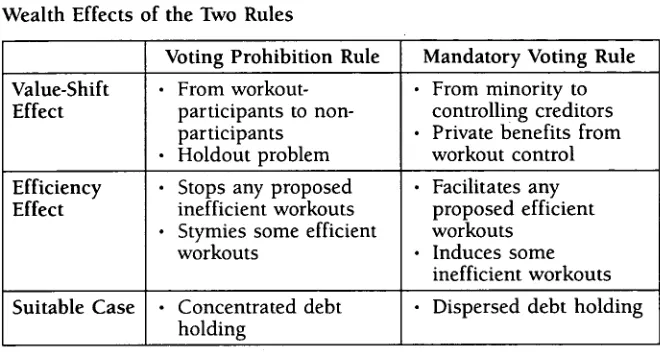
Part III of this paper analyzes the implications of the U.S. and South Korean legal rules for efficiency of debt restructuring. The analysis begins by identifying two effects that a workout may have on the parties' wealth. A workout may well have a significant impact on the total value of a corpo-rate borrower (the efficiency effect). On the other hand, a workout may also affect the allocation of such value among creditors (the value-diversion effect). Each of the two voting rules has its own value-diversion effect which in turn influences the efficiency effect. Under the Voting Prohibi-tion Rule, value may flow from the participating creditors to the non-partic-ipating creditors because the participants' concessions in a workout may boost the financial ability of corporate borrowers to repay the creditors who hold oUt.3 3 In contrast, under the Mandatory Voting Rule, value may shift from minority creditors to majority creditors.3 4 With debt
restructur-The court reasoned that compulsory composition was designed for small companies.
Id.
28. Kim, supra note 23, at 168.
29. See id. at 168 n. 135; see generally Corporate Restructuring Promotion Act. 30. See Kim, supra note 23, at 168-69.
31. See History of Hynix Semiconductor Co., http://www.hynix.com/eng/Olabout/ 01_profile/profile_- 06.jsp (last visited Aug. 25, 2007). Hynix Semiconductor Company changed its name in March 2001 and emerged early from the CRPA in July 2005. See id. 32. From September 2001 to June 2007, seventy-one companies with three hundred or more employees underwent the CRPA restructuring procedures. Forty-nine of these companies successfully finished the CRPA process. See Lee Sun-Young, Seventy Percent
Success Rate for Big Firm Restructuring, KOREA HERALD, July 18, 2007, available at http://
www.kdb.co.kr/weblogic/Board?BID=25&NID=26663&ACTION=VIEW&NPAGE=16. 33. See Roe, supra note 1, at 236 (observing that a workout will leave a company to pay debt to the holdout bondholders in full).
34. Empirical evidence suggests that there are substantial private benefits of control.
See, e.g., Michael J. Barclay & Clifford G. Holderness, Private Benefits from Control of Public Corporations, 25 J. FIN. ECON. 371, 372 (1989). Barclay and Holderness suggest
Cornell International Law Journal
ing binding on all creditors, majority creditors who control the voting pro-cedure may disproportionately benefit from the reorganization, which I label "private benefits from control of workout."
This analysis also shows when efficient or inefficient workouts may take place under each rule.- The Mandatory Voting Rule will facilitate any proposed efficient workout, but it also enables some inefficient workouts to take place. The latter may happen when majority creditors favor a workout plan, not because it enhances the total value of a company, but because the workout procedure provides an opportunity to capture disproportionate benefits. The Voting Prohibition Rule, however, prevents any inefficient proposed workout, and in this regard, it is superior to the Mandatory Vot-ing Rule. The disadvantage of the VotVot-ing Prohibition Rule is that it may fail to facilitate some efficient workouts when the efficiency gain is not greater than the value shifted to the non-participants. Thus, there is a trade-off between the facilitation of efficient workouts and the deterrence of ineffi-cient workouts. This article identifies certain circumstances under which one of the two rules is superior to the other. When creditors are numerous and not individually pivotal to the workout, the Mandatory Voting Rule may be more appropriate because the holdout problem may be acute. In contrast, when a handful of financial institutions hold the majority of debt claims with a few minor bondholders, the Voting Prohibition Rule is better suited because major creditors may successfully negotiate a workout with each other.
Under the Mandatory Voting Rule, reducing private benefits from con-trol will align the majority creditors' incentives more closely with the over-all efficiency of a workout. The workout procedure under the Mandatory Voting Rule can be perceived as, in effect, alternative bankruptcy reorgani-zation because of the mandatory voting. Ironically, although the Mandatory Voting Rule is designed to establish an effective mechanism for facilitating reorganization outside of bankruptcy, it may result in a less attractive type of workout in terms of saving bankruptcy costs. A workout is a bargain to the parties, and a voting scheme can still be a part of the bargain as long as it is based on the consensus of the participants.35 Therefore, there is good reason to suspect that the Mandatory Voting Rule in South Korea may not fall completely within the nature of a workout.
I. Two Rules on Voting in Workouts
A. Workouts: Reorganization Outside of Bankruptcy
Financial stress of an otherwise economically viable company requires an orderly reorganization of its capital (i.e., debt and equity).36 Compa-nies can undertake reorganization either within, or outside of, bankruptcy
35. See Corporate Restructuring Promotion Act, Law No. 6504, ch. ll, art. 17(2) (2001) (S. Korea).
36. See Lucian Arye Bebchuk, A New Approach to Corporate Reorganizations, 101 HARv, L. REv. 775, 776 (1988).
2007 Efficient and Inefficient Debt Restructuring
procedures. Chapter 11 of the American Bankruptcy Code3 7 sets the reor-ganization framework within bankruptcy, but reorreor-ganization outside of bankruptcy is referred to as a workout.38
When a company is financially stressed, both the underlying financial difficulty and the possibility of an ensuing bankruptcy procedure involve substantial costs.3 9 Suppliers and consumers are reluctant to transact with a company in financial distress,40 and skilled workers may leave the firm. Instead of concentrating solely on business operations, managers divert their time and attention to bankruptcy-related matters.4 1 Furthermore, the direct costs associated with filing for a bankruptcy petition are not negligi-ble.4 2 Financial constraints force a debt-stricken company to pass up oth-erwise efficient investment opportunities.4 3 The prolonged duration of the bankruptcy proceedings44 serves to dissipate the value of the firm. Moreo-ver, conflicts of interest between creditors and shareholders and between multiple creditors can be another source of significant costs arising from financial difficulties.45 Faced with financial stress, shareholders and man-agers may well favor suboptimal investment opportunities with abnormally high risks.4 6 The competing rush by creditors to collect debt may under-mine the total value of the company as well.47 Bankruptcy proceedings are intended to address some of these concerns by enabling the owners of the firm's assets (creditors as well as shareholders, in the context of
bank-37. See generally Bankruptcy Reform Act of 1978, 11 U.S.C. §§ 1101-1174 (2005).
38. See Lynn M. LoPucki & William C. Whitford, Corporate Governance in the
Bank-ruptcy Reorganization of Large, Publicly Held Companies, 141 U. PA. L. REv. 669, 677
(1993).
39. See Bebchuk, supra note 36, at 780 (observing that the inevitable delay in bank-ruptcy involves significant costs).
40. See Tim C. Opler & Sheridan Titman, Financial Distress and Corporate
Perform-ance, 49J. FIN. 1015, 1016-17 (1994) (finding that highly leveraged firms lose market
share in an industry downturn, reflecting a reluctance by customers to do business with distressed firms).
41. See id. at 1015.
42. See Gilson, supra note 6, at 311-12 (stating that "academic studies have found that average legal and professional fees reported by chapter 11 companies range from 2.8 percent to 7.5 percent of total assets"); cf. id. at 308 (noting that "LTV Corporation, for example, has spent over $150 million on legal and other professional fees since it filed for chapter 11 in 1986").
43. See Gertner & Scharfstein, supra note 7, at 1191 (noting that because creditors "claim part of the cash flows from new investment, distressed firms can have difficulty issuing equity or debt for new investment," which may lead them to "pass up positive net present value investments").
44. Chapter 11 procedures normally take two to three years. See Roe, supra note 1, at 236.
45. See David M. Cutler & Lawrence H. Summers, The Costs of Conflict Resolution
and Financial Distress: Evidence from the Texaco-Pennzoil Litigation, 19 RAND J. ECON.
157, 158 (1988) (concluding that, based on the dispute and subsequent settlement between Texaco and Pennzoil, "financial conflict can have substantial effects on productivity").
46. See LoPucki & Whitford, supra note 38, at 683-84 (observing that the holders of junior interests have reason to prefer high risk investments).
Cornell International Law Journal
ruptcy) to act collectively.4 8
Comparatively, reorganization via workout aims to reduce the costs
that arise from financial stress and bankruptcy.4 9 Creditors voluntarily
consent to a package of reorganization arrangements, such as maturity date extension, debt-for-equity exchange, forgiveness of interest, and provi-sion of additional debt, based on the belief that they stand to benefit from such voluntary concessions.50
Law and economic scholars have long recognized that holdouts by individually small, but collectively substantial, creditors are a principal impediment to the success of workouts.5 1 The enhancement of the finan-cial capability of a corporate debtor through a workout enables the debtor to better service debt owed to non-participants. Hence, numerous minor creditors rationally and opportunistically decline to participate in a workout. If these individually non-pivotal creditors, taken together, are substantial enough to dissuade other creditors from agreeing to workout arrangements, an otherwise efficient workout effort will fail.5 2
B. Voting: A Solution to Holdouts
1. The Assent Scheme and the Voting Scheme
Voting can be an effective way to resolve the holdout problem in a workout. With a voting scheme in place, a reorganization arrangement, passed by a vote of the creditors, binds the entire group of creditors subject to the voting scheme (voting group), notwithstanding individual dissents to the arrangement, thereby preventing minor creditors from disproportion-ately benefiting from a holdout.5 3 The purpose of voting is that, once voted on, workout arrangements have binding force on the entire voting group. The voting scheme helps remove opportunistic incentives by virtue of such binding force and thereby aligns the interest of individual creditors with the interests of the aggregate voting group.5 4
I label the workout reorganization scheme that lacks a voting mecha-nism the "assent scheme," because the reorganization is effective only to the assenting creditors. In contrast, I label the workout reorganization scheme with a binding vote, irrespective of the ground of the binding force, the "voting scheme."
48. Id. at 135.
49. See Gilson, supra note 6, at 319 (finding that "the professional fees incurred in exchange offers are about one-tenth of those incurred in a typical chapter 11 case").
50. In this sense, a workout can be viewed as an application of the Coase theorem.
See Roe, supra note 1, at 236 (stating that "Ronald Coase's famous theorem suggests
that, in the absence of transaction costs, the incentives of those financially interested in the nearly bankrupt firm would be to contract to the efficient solution").
51. See, e.g., Gertner & Scharfstein, supra note 7, at 1191; Gilson, supra note 6, at 316.
52. See Gertner & Scharfstein, supra note 7, at 1190-191. 53. Id. at 1211.
54. See id. (positing that "the voting procedure does not allow public debtholders to be treated differently depending on their vote, whereas tendering and non-tendering public debtholders are treated differently").
2007 Efficient and Inefficient Debt Restructuring
2. Classifying the Voting Scheme
We may distinguish different types of voting schemes by using two different criteria: (a) the ground of the binding force and (b) the scope of the voting group. With regard to the first criterion, the ground of the bind-ing force, a votbind-ing scheme requires a basis, either contractual or statutory, for its binding force on the voting group, which includes dissenting credi-tors.5 5 A contractual basis exists where creditors voluntarily submit to a voting scheme through any form of consent.5 6 Creditors may enter into such a voting contract before or after a financial difficulty arises. In con-trast, a statutory basis arises from a law that gives voting binding force and thereby mandates a voting-based workout.57 A statutory ground within bankruptcy can be found in chapter 11 of the Bankruptcy Code, which uses a voting scheme for reorganization via bankruptcy.5 8 With regard to the second criterion, scope of the voting group, debts can be either homo-geneous or heterohomo-geneous among the group with respect to their terms, such as priority, maturity date, and interest rate. A homogeneous voting group consists of debts having identical terms; a heterogeneous voting group is comprised of debts having different terms.59 For example, a vot-ing group that consists of both secured long-term bank loans and unsecured short-term commercial papers is heterogeneous.
The distinction between homogeneous and heterogeneous voting groups is of great importance because there can be a clear discrepancy between the two groups in terms of the existence and extent of conflicts of interest among creditors in a voting group. A homogeneous voting group encompasses few, if any, conflicts among creditors thanks to the plausible convergence of interests resulting from the likeness of debts. In contrast, a heterogeneous voting group may well suffer from material conflicts of interest among creditors holding debts of differing terms. Examples of such conflicts can be easily imagined. When a company's assets can just barely service senior debts but fall well short of covering junior debts, cred-itors of junior debts have good reason to vote in favor of debt rescheduling, whereas senior creditors will naturally oppose the reorganization. Such intra-heterogeneous group conflicts may cause the incentives of some cred-itors to diverge from the creditor group in the aggregate. This type of diver-gence may result in an inefficient reorganization.60
55. See, e.g., Patrick Bolton & David S. Scharfstein, Optimal Debt Structure and the
Number of Creditors, 104J. POL. EcON. 1, 17 (1996) (providing an example of indentures in credit agreements).
56. See, e.g., id.
57. See, e.g., Bankruptcy Reorganization Act, 11 U.S.C. § 1126(c)-(d) (2005). 58. Id.; see also LoPucki & Whitford, supra note 38, at 677 (pointing out that one of the advantages of bankruptcy reorganization is that "specified majorities of creditors can bind dissenting minorities of the same class through voting").
59. See, e.g., Baird, supra note 47, at 131.
Cornell International Law Journal
C. Two Statutory Interventions with Voting: Prohibition and Mandate
In the absence of statutory intervention, parties may freely choose between a voting scheme and an assent scheme. However, the United States and South Korea have two starkly contrasting forms of statutory interventions. The United States' rule prohibits creditors from voluntarily submitting to a voting scheme,61 whereas the South Korean rule sets up and mandates such a scheme.6 2
1. The United States: The Voting Prohibition Rule
The American rule, the Voting Prohibition Rule, mandates the assent scheme by blocking or invalidating parties' voluntary submission to a vot-ing scheme.63 Section 316(b) of the Trust Indenture Act bans any binding vote by bondholders, based on a majority action clause in a bond inden-ture, to change any core term, such as principal amount, interest rate, or maturity date of a bond issue.6 4 The prohibition is meant to prevent insider bondholders (who may hold a greater percentage of shares as well) and the investment banks (who are driven by pursuit of business opportu-nities) from pursuing their own interests at the expense of the other bondholders.65
The Voting Prohibition Rule stops a voting-based workout, a presuma-bly effective way to solve the holdout problem.66 Although exchange offers conditioned on exit consent,6 7 which is intended to strip untendered debts of covenant protections, have been used as a substitute for voting,68 they may not necessarily eliminate the holdout problem.69 Professor Mark Roe proposed that the Voting Prohibition Rule be repealed and replaced with a
flexible standard prohibiting fraud and distortions in bond
recapitalizations. 70
2. South Korea: The Mandatory Voting Rule
The Mandatory Voting Rule, by providing a statutory source for the binding force of voting, sets up a voting scheme without requiring creditors
61. See Trust Indenture Act of 1939 § 316(b), 15 U.S.C. § 77 (2003).
62. Corporate Restructuring Promotion Act, Law No. 6504, ch. III, art. 17 (2001) (S. Korea).
63. See Roe, supra note 1, at 232. 64. Id.
65. See id. at 251-52. 66. Id. at 239-40.
67. The exit consent is based on the Trust Indenture Act's failure to prohibit a sim-ple- or super-majority vote to change or eliminate covenants of a nominal debt amount.
Id. at 248.
68. See Gertner & Scharfstein, supra note 7, at 1191 (noting that, due to the Trust Indenture Act, public debt restructurings almost always involve an exchange of new securities and cash for the original debt).
69. See Roe, supra note 1, at 247 (maintaining that an exit consent is not assured of diminishing the buoying-up effect accompanying the holdout problem); see also Gertner & Scharfstein, supra note 7, at 1191.
70. See Roe, supra note 1, at 232-35.
2007 Efficient and Inefficient Debt Restructuring
to voluntarily submit to such a scheme.7 1 The Corporate Restructuring Promotion Act of South Korea constitutes a unique example of the mandatory voting rule.72 Under this law, a three-fourths majority vote (in terms of debt amount held) is binding on all financial institution creditors in South Korea.73
II. The Mandatory Voting Rule of South Korea
A. Background
1. Crisis of Corporate Insolvencies
The South Korean economy abruptly suffered severe hardship in the late 1990s.74 The well-known economic crisis began with a series of large-scale corporate insolvencies in 199775 whose scope and large-scale were tremen-dous and unprecedented.7 6 In 1997 alone, eight of the thirty largest busi-ness conglomerates, or chaebol, became insolvent and were unable to repay their overdue debts.7 7 In the first half of the year, two major chaebol, Hanbo and Sammi, filed for corporate reorganization, the South Korean counterpart to chapter 11 bankruptcy.78 In the latter half of the year, more chaebol such as Jinro, Kia, New Core, Haitai, Halla, and Dainong became insolvent.79 The insolvencies were mainly blamed on high leverage,8 0
71. See Corporate Restructuring Promotion Act, Law No. 6504, ch. III, art. 17 (2001) (S. Korea).
72. See, e.g., id. See generally Sandy Shandro, U.K.'s Chapter 11 Plan: Schemes of
Arrangement, 25 Am. BANKR. INST. L. REV. 30 (2006) (explaining that the United King-dom's regime on restructuring and voting schemes resembles that of the United States more than that of South Korea).
73. Corporate Restructuring Promotion Act, ch. III, art. 17. The Act applies to every conceivable form of domestic financial institution, including domestic branches of for-eign banks. The Act sets up a heterogeneous voting group because financial institutions' held debts are subject to the voting scheme irrespective of their terms. Kim, supra note 23, at 168.
74. See ORG. FOR ECON. COOPERATION & DEV., OECD REVIEWS OF REGULATORY REFORM: REGULATORY REFORM IN KOREA 11 (2000).
75. See NAM-KEE LEE, TOWARD A MATURE MARKET ECONOMY: COMPETITION LAW & POL-ICY IN KOREA 3-10 (2002) (describing the practices that led to the corporate insolvencies in the late 1990s).
76. Prior to 1997, the bankruptcy of major South Korean corporations was excep-tional and anecdotal, due in part to preferential financial support from banks in the form of additional loans. For this reason, the importance of bankruptcy institutions had not been previously well-recognized. See ORG. FOR ECON. COOPERATION & DEV., supra
note 74, at 23, 37.
77. See Kim, supra note 21, at 65 (reporting that some large chaebol went into bank-ruptcy in 1997, including Hanbo, Sammi, Jinro, Dainong, Kia, New Core, Haitai, and Halla).
78. YOUNGJAE LIM, KOREA DEVELOPMENT INSTITUTE, RESTRUCTURING OF CORPORATE SEC-TOR AND CONGLOMERATES IN POST-CRISIS KOREA (2003).
79. Id.
80. The average debt-to-equity ratio of South Korean corporations was about five times higher than that of Taiwan and the United Kingdom. See Ok-Rial Song, The Legacy
of Controlling Minority Structure: A Kaleidoscope of Corporate Governance Reform in Korean Chaebol, 34 LAw & POL'Y INT'L BUS. 183, 191 (2003). By the end of 1997, the
Cornell International Law Journal
intra-chaebol cross guarantees, and imprudent over-investment.8 1
Bigger insolvencies ensued. In 1999, Daewoo Group-the second larg-est chaebol at the time-became insolvent.8 2 In addition, Hyundai Electron-ics and Hyundai Engineering & Construction, two flagship members of the then-largest chaebol, Hyundai, fell into financial difficulties and had to renegotiate debt with lenders.8 3
Banks and other lenders were exposed to, and seriously struck by, the huge wave of corporate insolvencies as loans to these insolvent chaebol became non-performing.84 A number of lenders verged on insolvency themselves.85 Several of these lenders were liquidated86 or bailed out through capital injections from the South Korean government.8 7 An effec-tive mechanism was urgently needed to deal with the sweeping nationwide insolvency crisis.
2. Incompetence of Bankruptcy Institutions
Reorganization and liquidation are the two major bankruptcy institu-tions between which insolvent companies may choose. As for reorganiza-tion, while South Korea had a full-fledged reorganization apparatus, the Corporate Reorganization Act, which is similar to the chapter 11 procedure in the United States,8 8 there also was a limited-scale reorganization proce-dure, the Composition Act.89 The latter was a court-overseen procedure in which a majority vote of creditors had to resolve a renegotiation of unsecured debt, which was later confirmed by a court, thereby binding the entirety of unsecured debts.90 Secured claims were not subject to the
Com-81. See ORG. FOR ECON. COOPERATION & DEV., supra note 74, at 37-38 (describing inadequacies in pre-1997 insolvency procedures as well as the reforms of reorganization procedures in 1998 and 1999).
82. Don Kirk, For Daewoo's Founder, Pride Before the Fall, N.Y. TIMES, Feb. 23, 2001, at W1.
83. See Tong Whan Park, South Korea in 1998: Swallowing the Bitter Pills of
Restruc-turing, 39 ASIAN SURVEY 133, 138 (1999). For more information on the Hyundai chaebol,
see Peter M. Beck, Revitalizing Korea's Chaebol, 38 ASIAN SURVEY 1018, 1024-30 (1998). 84. Non-performing assets are debts whose issuers have fallen into financial difficul-ties. See KOREA ASSET MANAGEMENT CORP. (KAMCO), REPORT ON NON-PERFORMING ASSET MANAGEMENT FUND 23 (2001); see also Kim, supra note 21, at 65 (stating that by October
1997, South Korean commercial banks and merchant banks were saddled with 28.52 trillion won and 3.89 trillion won, respectively, in non-performing loans). South Korean financial institutions' non-performing loans amounted to 100 trillion won by October, 2001. See id. at 154-59.
85. See Kim, supra note 21, at 65.
86. Examples of such liquidated banks include Daedong Bank, Dongnam Bank, Dongwha Bank, Chungcheong Bank, and Kyungki Bank. See John Burton, South Korean
Banks Forced Into Mergers, FIN. TIMES, June 29, 1998, at 4.
87. Examples of such banks include Korea First Bank (which was later acquired by Standard Chartered Bank) and Seoul Bank. See Sheryl WuDunn, Bankruptcy the Asian
Way: No Sinking, No Swimming, Just Floating Face Down, N.Y. TIMES, Sept. 8, 1998, at C1.
88. See Kim, supra note 23, at 164. 89. See id. at 163.
90. See id.
2007 Efficient and Inefficient Debt Restructuring
position Act.91 Until 1997, the Composition Act had not been perceived as a procedure for corporate bankruptcies and, thus, had almost never been used by insolvent companies in the past.9 2
Controlling shareholders and managers of such insolvent chaebol com-panies immediately faced the problem that they could find no reason to seek corporate reorganization because of rigid court practices on manage-ment and ownership of companies in the procedure.9 3 Courts had admin-istered corporate reorganizations in such a way that incumbent managers and controlling shareholders had been precluded from managing or own-ing the bankrupt company,94 even though the Corporate Reorganization Act did not necessarily require this.9 5 In 1996, the Supreme Court of South Korea had set a rule requiring that reorganization plans seeking court approval provide for cancellation of the shares held by controlling shareholders.9 6 This rule was made after high profile scandals involving corporate reorganization and in response to widespread criticisms that controllers could abuse corporate reorganization to entrench themselves at the expense of other constituents, including creditors. Lower-level courts in charge of bankruptcy cases after the ruling have since strictly adhered to this requirement. According to this rule, controlling shareholders would invariably lose ownership at the conclusion of corporate reorganization.9 7 Furthermore, in contrast to practices in the United States, South Korean courts did not allow for debtors-in-possession.98 Upon receipt of a filing for corporate reorganization, the court would appoint a trustee to run the company during the procedure and draw up and propose a reorganiza-tion plan for approval by creditors and the court.9 9 In search of candidates
91. In practice, secured debts were renegotiated at the same time on an individual assent basis, although creditors' resolutions did not affect the entitlements of secured debts. Such individual secured debt renegotiation can be viewed as a workout arrange-ment concomitant to a bankruptcy institution. See id.
92. See id. 93. See id. at 164. 94. See id.
95. Corporate Reorganization Act, Law No. 172, art. 221(3)-(4) (1952) (S. Korea), provides that where total liabilities exceed total assets, not less than half of a company's issued stock shall be cancelled and two-thirds of the stock held by controlling sharehold-ers who are liable for the financial stress shall be cancelled.
96. See CHOI DU-YUL, PROBLEMS AND WAYS TO IMPROVE THE CURRENT SYSTEM OF CORPO-RATE RESTRUCTURING 20 (2001), available at http://www.fki.or.kr/Common/Download.
aspx?id=0b18c92f-4757-4441-8daf-b57ba5e3771f. The Supreme Court Litigation Rule No. 487 stated that the stocks held by dominant shareholders should be cancelled in the proceeding. The rule was relaxed by an amendment in 1998, which prescribed that more than two-thirds of dominant stock will be cancelled only where it is objectively proved that dominant shareholders inflicted material damage on the company. See Kim,
supra note 23, at 164.
97. See Kim, supra note 23, at 164.
98. See LoPucki & Whitford, supra note 38, at 679-80 (observing that upon filing for reorganization, the debtor's management continued in office and played a central role in setting the business and reorganization plan).
Cornell International Law Journal
for trustees, courts had ruled out incumbent managers and controlling shareholders.10 0 Furthermore, shareholders were not entitled to vote on a reorganization plan where a bankrupt company's liabilities exceeded its assets. 101
Under these circumstances, controlling shareholders of chaebol-who usually hold less than a majority stake10 2-could exercise little, if any, bar-gaining power in a corporate reorganization procedure once it com-menced.10 3 The rigid practices on corporate governance in corporate reorganization strongly dissuaded controllers from initiating bankruptcy proceedings at all costs. This institutional feature could exacerbate the problem arising from the conflicting interests of shareholders and creditors by deterring shareholders from initiating the corporate reorganization pro-cedure. During the delayed period, controlling shareholders could engage in abnormally high-risk and value-decreasing projects to the detriment of creditors in order to make a grab for dim upside potential.
Creditors were also reluctant to actively seek corporate reorganization. The Accounting Rule required financial institutions to render, relative to the level prevailing under other types of debt renegotiation processes, a more inflexible write-down of debts against a firm under a bankruptcy
pro-firm still would be managed by its trustee from the time the reorganization plan was approved through the termination of the reorganization proceeding. Trustees were likely to lack the requisite expertise in the particular industry as well as the appropriate incen-tives to maximize the firm's value.
100. Due to the cancellation of the control block and because incumbent managers were excluded from being appointed as trustees, the controllers of corporations were extremely reluctant to file for Corporate Reorganization. In 2002, there were only 10 filings with the Seoul District Court. Recently, in an effort to induce more filings, the Bankruptcy Division of the Seoul District Court suggested the possibility of change in that practice, stating that it will positively contemplate appointing a trustee from incum-bent management or its nominee. See JAEwAN PARK, THE WORLD BANK, GLOBAL INSOL-VENcY LAw DATABASE: SOUTH KOREA §§ 1.4, 3.6, 3.8, 4.4, 4.6, 4.9, 7.4.2, 8.1 (2003); see
also Kim, supra note 23, at 164.
101. The voting right was not extended to shareholders because they did not stand to receive any distributions upon liquidation. Corporate Reorganization Act, Law No. 172, art. 129(3) (1952) (S. Korea). As to the rationale for this provision, see CHAE-HONG
LIM & CHANG-HOON BAEK, CORPORATE REORGANIZATION LAW (HoISAJEONGRIBEOB) 579 (2d ed. 2002).
102. Most controlling shareholders in Korea can be characterized as "minority con-trolling shareholders," whose control is maintained via a complex pyramid or cross-holding ownership structure. See Lucian Arye et al., Stock Pyramids, Cross-Ownership,
and Dual Class Equity: The Mechanisms and Agency Costs of Separating Control from
Cash-Flow Rights, in CONCENTRATED CORPORATE OWNERSHIP 295, 296 (Randall K. Morck ed.,
2000) (showing that "the agency costs imposed by controlling shareholders who have a small minority of the cash-flow rights in their companies can be an order of magnitude larger than those imposed by controlling shareholders who hold a majority of the cash-flow rights"); see also Song, supra note 80, at 196 (positing that "the controlling share-holders of a Korean chaebol do not have majority shares in each firm, and very often less than 10% of total outstanding shares are sufficient to effectively gain control over the group companies" and that Korean chaebol have developed so-called circular sharehold-ings to attain minority controlling structure).
103. See id.
2007 Efficient and Inefficient Debt Restructuring
ceeding.10 4 In addition, the South Korean court system did not provide for a separate bankruptcy court with specialized bankruptcy judges.'05 Instead, two particular divisions of the Seoul District Court dealt with most of the major bankruptcy cases.10 6 Judges in charge of bankruptcy cases, usually remaining for a two-year term in accordance with periodic rotation practices, were likely to lack the necessary expertise and experi-ence to deal effectively with the business and financial complexities of the cases before them.
Faced with such an unsatisfactory bankruptcy system, the controllers of insolvent chaebol, with the help of their legal advisors, sought an alterna-tive that would enable them to maintain control and ownership while restructuring debt. Their search resulted in the discovery of compulsory composition.10 7 They found that although compulsory composition had been a dormant apparatus until then, it could be a way out from the impasse in that the procedure did not impact the control and ownership of a bankrupt company.10 8 Jinro Group was the first to file for the procedure and succeeded in rescheduling debt via the Composition Act.109 Several chaebol such as Kia, Haitai, Halla, and New Core sought the same solution to renegotiate debts with creditors while keeping control and ownership structures intact.100 In the earliest of these cases, courts permitted the use of the Composition Act procedure."'. However, encountering criticism that the Composition Act was being exploited to get around the obstacles preventing entrenchment via corporate reorganization, courts refused to proceed with the Composition Act in 1998.112 From that time, corporate reorganization has been the sole bankruptcy institution available to large companies seeking to restructure debt.
104. According to § 27 of the version of the South Korean Bank Accounting Rule then in effect, if a debtor was under corporate reorganization proceedings, then not less than 20% of the portion expected to be paid could be written down (classified as "substan-dard"), with the portion expected not to be repaid written off. In contrast, in the case of a workout procedure, the ratio of such a write-down was between 2% and 20% (classi-fied as "precautionary" or "substandard").
105. A separate bankruptcy court is characteristic of the U.S. legal system.
Adminis-trative Office of the U.S. Courts, United States Bankruptcy Courts, http://www.us courts.gov/bankruptcycourts.html (last visited Aug. 25, 2007).
106. The Seoul District Court has jurisdiction over corporations whose main office is
in Seoul, which is true for many major chaebol companies in South Korea. Other district courts also have a specific division that deals with bankruptcy cases.
107. See Composition Act, Law No. 997, ch. I, art. 1 (1998) (S. Korea).
108. The Composition Act involves only debt restructuring, leaving the ownership
structure intact. See Kim, supra note 23, at 163.
109. John A. Mathews, Fashioning a New Korean Model Out of the Crisis (Japan Policy
Research Inst., Working Paper No. 46, 1998), available at http://www.jpri.org/publica-tions/workingpapers/wp46.html.
110. See id.
111. See Kim, supra note 23, at 163.
Cornell International Law Journal
3. Contractual Approach Towards Voting in Workouts: The Accord
Dissatisfied with bankruptcy institutions, lenders and insolvent com-panies sought reorganizations outside of bankruptcy, or workouts. In June
1998, major South Korean financial institutions reached an agreement among themselves, entitled the Corporate Restructuring Accord (Accord),113 establishing a consensual voting scheme for workouts.114 The Accord can be characterized as a "master" agreement in that it can poten-tially apply to every financially distressed corporate debtor whose debt size exceeds a given threshold amount, thereby providing a general framework for voting-based workouts.
Under the Accord, the principal lender of a subject debtor firm is enti-tled to initiate a workout procedure by convening a creditors' meeting.115 The exercise of subject debts is suspended pending approval of a workout
arrangement.1 6 A three-fourths majority vote in favor of a workout propo-sal binds all signatory financial creditors.1 17 The Accord applied to a num-ber of insolvent chaebol, including Daewoo Group.18
The Accord did not completely eliminate the holdout problem. For-eign lenders-none of which were signatories to the Accord'1 9-held sub-stantial portions of the debts of large insolvent companies, a factor that caused significant holdout problems under the Accord. When a corporate debtor was subject to a workout procedure under the Accord, resulting in the suspension and renegotiation of debts held by Accord-signatory credi-tors, foreign creditors benefited from such arrangements in recovering their debts.120 Foreign creditors thus stood to gain disproportionately from
113. The signatories of the Accord were 130 financial institutions, such as banks, insurance companies, investment trust companies (which manage unit trusts), and merchant banks. See National Assembly Member Un-Tae Kang, Report on Bill for the Corporate Restructuring Act 7 (2001), available at http://likms.assembly.go.kr/bill/jsp/ BillDetail.jsp?billid-016943.
114. The Accord may be viewed in part as a "regulatory" effort to curb the corporate bankruptcy crisis, given that regulatory agencies were said to have taken an informal
role in recommending and encouraging financial firms to sign the Accord.
115. See CHAN-HYUN SOHN, KOREA'S FIRST CORPORATE RESTRUCTURING SINCE THE FINAN-cIAl CRISIS 45 (2002), available at http://www.kiep.go.kr/publication/std-rept-view.asp ?num=131689&sCate=013001&lTp=r&nowPage=7&listCnt=15#.
116. See id.
117. Such a vote contractually obliges each signatory firm to sign and comply with any workout arrangement that is authorized by a workout resolution irrespective of whether the signatory firm assents to that particular resolution.
118. From its inception until June 2001, the Accord was applied to workout proceed-ings for 104 corporate debtors. See COMM. OF FIN. & ECON. OF CONG., LEGISLATIVE REVIEW REPORT ON THE BILL OF THE CORPORATE RESTRUCTURING PROMOTION ACT (2001).
119. Non-signatories of the Accord include foreign creditors, non-financial creditors, and even certain domestic financial creditors such as securities houses.
120. In collecting their debts, foreign creditors primarily resorted to two methods. One was to present bank-clearable promissory notes issued by a debtor company. This was highly effective because the failure to honor such notes would result in the suspen-sion of financial transactions pursuant to the Seoul Clearinghouse Rule, which consti-tutes an event of default under most debt covenants. To resolve this problem, the Seoul Clearinghouse Rule, art. 78(1), now exempts such companies from suspension despite
2007 Efficient and Inefficient Debt Restructuring
workouts.12 1 The higher the proportion of debt held by foreign creditors, the less likely domestic creditors would agree to a workout.122
B. Legislative Requirements for Voting in Workouts
In 2001, the Corporate Restructuring Promotion Act (CRPA), which set up an alternate statutory reorganization scheme in light of the draw-backs of the bankruptcy institutions and the Accord, replaced the Accord.12 3 When the CRPA was enacted, the most outstanding concern with debt recapitalization via workout in South Korea was Hynix Electron-ics Company, formerly known as Hyundai ElectronElectron-ics Company. The CRPA supports voting in workout by providing the basis for making a vote binding.124 The Accord is widely regarded as having laid a practical foun-dation for the CRPA.' 25
1. Scope of Application
The voting scheme of the CRPA applies to debt claims held by stipu-lated financial institutions (subject financial creditors), including, among others, banks, insurance companies, securities houses, mutual funds, unit trust funds, asset-backed securitization funds, the Korean Deposit Insur-ance Corporation, and the Korea Asset Management Corporation.' 26 Par-ticularly, in view of the holdout by foreign creditors under the Accord, the CRPA expands the scope of its application to branches of foreign banks located in South Korea.12 7 With regard to the size of borrowers, the CRPA applies to corporate borrowers whose debts subject to the CRPA are greater than or equal to 50 billion South Korean won (KRW), which is approxi-mately $50 million U.S. dollars.128 The CRPA furnishes a potentially pow-erful mechanism by which most corporate debts, other than trade and tort claims, can be renegotiated.
failing to honor a note. The other method was to receive judgment on debts and then obtain levies on the assets of the debtor.
121. See Roe, supra note 1, at 236 (characterizing the buoying-up effect as a dispro-portionate benefit for the holdouts from staying out of debt recapitalization).
122. Id.
123. The objective of the CRPA is to facilitate corporate restructuring by facilitating market function. See Corporate Restructuring Promotion Act, Law No. 6504, ch. I, art. 1 (2001) (S. Korea); see also Kim, supra note 23, at 168-69.
124. See Corporate Restructuring Promotion Act, ch. III, art. 17.
125. The drafters of the CRPA, recognizing the structural similarity to the Accord, provided that resolutions and debt restructuring under the Accord are deemed to be rendered pursuant to the CRPA. See Corporate Restructuring Promotion Act, Addenda, art. 3; see also Kim, supra note 23, at 169.
126. Corporate Restructuring Promotion Act, ch. I, art. 2(1). As of September 2001, approximately 420 financial creditors were subject to the CRPA. See Park Hyun-dong,
Minimizing Bank Management for Faltering Enterprises, KUKMIN ILBO, Sept. 27, 2001 (S.
Korea), available at http://news.naver.com/news/read.php?mode=LSD&office-id=005& article id=0000071324§ionid=101&menuid=101.
Cornell International Law Journal
2. Workout Procedure and Voting Requirement
The principal lender to a corporation is entitled to initiate a workout process when the lender deems the borrower company to have difficulty repaying debts as they become due without external financial assistance or an extraordinary borrowing.129 During'the examination process that fol-lows, which may take up to four months,130 the exercise of subject debts may be put on hold.13 1
The CRPA does not separate creditors or debts into subsets of voting groups. Instead, all subject debts form a single voting group.132 However, an additional vote is required for a subgroup comprised solely of secured creditors.13 3 A workout proposal can be approved by the affirmative votes of the holders of three-fourths of the entire subject debt and the secured debt.134 Unlike voting in corporate reorganization, which has require-ments with respect to both amount of debt and number of creditors,135 the requirement for approval under the CRPA is set in terms of debt amount only.136 Therefore, the number of creditors is not considered in voting.
3. Impact on Corporate Ownership and Control
Unlike a corporate reorganization, a workout under the CRPA does not necessarily require a change in control or ownership of the subject corpo-rate debtor, a factor that leads managers and controlling shareholders to prefer the CRPA procedure to corporate reorganization. In many cases, however, contrary to their expectations, controlling shareholders have lost control as a result of workouts under the CRPA by way of cancellation of a control block, together with debt-equity conversion arrangements.
While incumbent managers usually continue running the companies after the CRPA procedure, creditors should approve major operational goals, projections, and an asset sale plan.13 7 Additionally, creditors contin-uously monitor management of a debtor company by setting up an approval mechanism for day-to-day business matters, such as cash in-flows
and out-flows,13 8 and by reviewing the debtor's compliance with the
reha-bilitation plan on a quarterly basis.139
129. Id. ch. I, art. 2(5). 130. Id. ch. III, art. 14(2).
131. In principle, the stay of debt exercise is determined at the first creditors' meet-ing. In exceptional cases, the stay may tentatively be put in place by the request of the Financial Supervisory Service prior to such a meeting. Id. ch. Ill, art. 14(1).
132. Id. ch. IV, art. 27(1). 133. Id. ch. Ill, art. 17(2). 134. Id. ch. Ill, art. 17(2).
135. David Arthur Skeel Jr., The Nature and Effect of Corporate Voting in Chapter 11
Reorganization Cases, 78 VA. L. REv. 461 (1992).
136. Corporate Restructuring Promotion Act, ch. I, art. 2(4). 137. Id. ch. III, art. 15(1)-(2).
138. Id. ch. III, art. 13(3). 139. Id. ch. I1, art. 16(1).
2007 Efficient and Inefficient Debt Restructuring
4. Exit Right of Dissenting Creditors
The CRPA provides creditors who oppose a workout with an exit option via an appraisal right.140 Upon exercise of the option, if the rele-vant parties do not agree to the price and terms of the purchase, an inde-pendent Coordination Committee shall determine them based on an expert's appraisal regarding the value of the debtor firm and the feasibility of a workout.141 Although a properly determined price, based on accurate appraisal,1 42 may minimize the possibility of distortion by large creditors, the Coordination Committee is likely to tilt in the direction of undervalua-tion given that the Committee tends to favor a successful workout.143
5. Linkage to Bankruptcy
The CRPA provides measures to facilitate the conversion of a workout into a bankruptcy procedure if necessary.144 Under certain conditions, a workout plan may turn into a pre-packaged reorganization plan.145 New debts extended under a workout arrangement have priority over the existing unsecured debts held by the subject financial creditors.146 This statutory priority can help resolve the debt-overhang problem that a highly leveraged company encounters in seeking a profitable investment
project.14 7
III. Analysis of the Two Rules
A. Framework of the Analysis 1. Two Wealth Effects of a Workout
A workout may have effects on the total value of a subject company and the way such value will be divided among various parties. I label the former "the efficiency effect" and the latter "the value-diversion effect." As
140. Unless a creditor exercises such an appraisal right, it will be deemed to have consented to the workout arrangement by operation of law. Id. ch. IV, art. 29(1).
141. In determining the purchase price and terms, the Coordination Committee is to consider an evaluation extended by a financial expert and the financial status of the debtor company. Id. ch. IV, art. 29(5). The CRPA does not further spell out the stan-dards of appraisal.
142. Multiple values can be suggested as criteria for the calculation of such appraisal: liquidation value, reorganization value, and workout value. In February 2002, the Coor-dination Committee issued a decision on Hynix Semiconductor to the effect that the purchase price may be calculated on the basis of the "liquidation value" of a debtor. Such a liquidation value standard might not provide sufficient protection to dissenting creditors because the liquidation value might be far less than what could result from the Corporate Reorganization or the workout.
143. Corporate Restructuring Promotion Act, ch. IV, art. 29(5).
144. See generally id. The Act stimulated the South Korean economy partly because of its flexibility.
145. Id. ch. Ill, art. 20(2); see also id. ch. III, art. 20(1). 146. Id. ch. Ill, art. 18.
Cornell International Law Journal
compared to a possible outcome realizable under the bankruptcy proce-dure, the efficiency effect of a workout may be either positive or negative. When workout reorganization enhances the total value by saving financial distress costs, facilitating a profitable investment opportunity, or other-wise, it has a positive efficiency effect. In contrast, workout reorganization
might reduce the total value and, thus, have a negative efficiency effect when it leads to, or makes possible, a suboptimal, or value-reducing,
invest-ment project.148
Turning to the value-diversion effect, workout reorganization may result in a disproportionate allocation among creditors of the total value, thereby making a value shift among creditors. Interestingly, the Voting Pro-hibition Rule and the Mandatory Voting Rule may shift value in opposite directions. Under the assent scheme that the Voting Prohibition Rule man-dates, the holdout problem gives rise to the value-diversion effect. When-ever a workout reorganization is completed despite the holdouts, value flows from those creditors participating in the workout to the nonpartici-pating creditors. Participants' concessions in the reorganization boost the debtor's financial capability, which enables the nonparticipating creditors to be fully or better repaid. As a result, the value of debts held by non-participants is buoyed by the completion of a workout.
Under the Mandatory Voting Rule, a binding vote invariably empowers the majority to take control of important matters affecting all members, including debt restructuring and governance matters such as ownership of the post-workout entity. Such control power enables the majority to dispro-portionately benefit from their control. In the context of corporate govern-ance, controlling shareholders are generally thought to divert non-negligible private benefits via control of corporate decision-making.149 Similarly, the major creditors who can dominate a binding vote in a workout stand to disproportionately benefit from controlling such a vote, which is binding on all creditors subject to the voting scheme. I label such disproportionate benefits "private benefits from control of workout." For example, in exchange for "yes" votes, majority creditors may receive side benefits from managers or major shareholders, such as early repayment, security interest, guarantee, or other business opportunities. They may also obtain and benefit from inside information over the course of the workout. More directly, the reorganization arrangement may favor major creditors over other creditors. These examples show that under the
148. A suboptimal investment can result from shareholders' distorted incentives to engage in high-risk projects in the face of financial stress, which is referred to as "asset substitution." Concessions in a workout might make such high-risk investment possi-ble. This can be viewed as an agency problem from conflicts of interests between credi-tors and shareholders. See Michael C. Jensen & William H. Meckling, Theory of the
Firm: Managerial Behavior, Agency Costs and Ownership Structure, 3 J. FIN. ECON. 305,
334 (1976) (suggesting that the owner "will have a strong incentive to engage in activi-ties which promise very high payoffs if successful even if they have a very low probability
of success").
149. Empirical evidence suggests that there are substantial private benefits of control.
See supra note 34.