11-18-2012
Tort Arbitrage
Robert J. Rhee
Follow this and additional works at:http://scholarship.law.ufl.edu/flr Part of theCivil Law Commons, and theInternational Law Commons
This Article is brought to you for free and open access by UF Law Scholarship Repository. It has been accepted for inclusion in Florida Law Review by an authorized administrator of UF Law Scholarship Repository. For more information, please [email protected].
Recommended Citation
* Associate Professor of Law, University of Maryland School of Law. I thank Jennifer Arlen for her comments and Franklin Allen, David Ross, and Aswath Damodaran for their insights into financial economics and valuation. An early draft of this paper was presented to the faculties of the University of Maryland School of Law and Stetson University College of Law. I thank the participants for their helpful comments.
125
Robert J. Rhee*
Abstract
1. A check of the leading works shows no cross-fertilization between the economic theories of tort law and bargaining. Some leading articles on the economics of bargaining are Robert Cooter, Stephen Marks & Robert Mnookin, Bargaining in the Shadow of the Law: A Testable Model of Strategic Behavior, 11 J. LEGAL STUD. 225 (1982); John P. Gould, The Economics of Legal Conflicts, 2 J.LEGAL STUD. 279 (1973); Richard A. Posner, An Economic Approach to Legal Procedure and Judicial Administration, 2 J.LEGAL STUD. 399 (1973) [hereinafter Posner, Legal Procedure]; George L. Priest & Benjamin Klein, The Selection of Disputes for Litigation, 13 J. LEGAL STUD. 1 (1984). Some leading works on the economics of torts are GUIDO CALABRESI,THE COSTS OF ACCIDENTS:ALEGAL AND ECONOMIC ANALYSIS (1970); WILLIAM M. LANDES & RICHARD A.POSNER, THE ECONOMIC STRUCTURE OF TORT LAW (1987); STEVEN SHAVELL, ECONOMIC ANALYSIS OF ACCIDENT LAW (1987); Richard Posner, A Theory of Negligence, 1 J. LEGAL STUD. 29 (1972) [hereinafter Posner, Negligence].
2. See, e.g., Janet Cooper Alexander, Do the Merits Matter? A Study of Settlements in Securities Class Action, 43 STAN.L.REV. 497 (1991); Jason Scott Johnston, Strategic Bargaining and the Economic Theory of Contract Default Rules, 100 YALE L.J. 615 (1990); Robert H.
I. INTRODUCTION. . . 126
II. TORT AND BARGAINING THEORIES. . . 129
A. Tort Law in the Shadow of Settlement. . . 129
B. Positive Economic Theory of Negligence. . . 131
C. Economic Theory of Legal Bargaining. . . 134
D. Common Intellectual Heritage.. . . 136
III. PRICING LEGAL DISPUTES. . . 139
A. Hedging Risk. . . 139
B. Risk-Adjusted Pricing. . . 143
C. Cost of Resolution. . . 149
D. Settlement Pressure. . . 150
IV. TORT ARBITRAGE. . . 154
A. Pro Forma Model Assumptions. . . 154
B. Pro Forma Model Outputs.. . . 161
C. Cost Accounting. . . 165
V. NEGLIGENCE IN THE HISTORICAL CONTEXT. . . 170
VI. CONCLUSION. . . 181
I. INTRODUCTION
This Article advances an economic theory that links the dispute resolution process and the negligence standard. Despite the predominance of settlements, we lack an integrated economic theory. This void in the1
Mnookin & Lewis Kornhauser, Bargaining in the Shadow of the Law: The Case of Divorce, 88 YALE L.J. 950 (1979); Robert E. Scott & William J. Stuntz, Plea Bargaining as Contract, 101 YALE L.J. 1909 (1992). Scholars have analyzed procedural process and transaction cost issues in the context of tort law. See Keith N. Hylton, Litigation Costs and the Economic Theory of Tort Law, 46 U.MIAMI L.REV. 111 (1991); Samuel Issacharoff & John Fabian Witt, The Inevitability of Aggregate Settlement: An Institutional Account of American Tort Law, 57 VAND.L.REV. 1571 (2004); Jonathan T. Molot, How U.S. Procedure Skews Tort Law Incentives, 73 IND.L.J. 59 (1997). 3. See G.EDWARD WHITE,TORT LAW IN AMERICA:AN INTELLECTUAL HISTORY 211–43 (expanded ed. 2003) (discussing the emergence and impact of neoconceptualism in tort scholarship of the 1970s); John C.P. Goldberg, Twentieth-Century Tort Theory, 91 GEO.L.J. 513 (2003) (analyzing five dominant theories of twentieth-century tort law).
4. WHITE, supra note 3, at 284.
5. See PRICE V.FISHBACK &SHAWN EVERETT KANTOR,APRELUDE TO THE WELFARE STATE:THE ORIGINS OF WORKERS’COMPENSATION 33 (2000) (“Given that so many cases were settled out of court, the de facto operation of the negligence liability system potentially was quite different from the de jure descriptions that the law and economics and legal literatures provide.”); LAWRENCE M.FRIEDMAN,AHISTORY OF AMERICAN LAW 357, 363 (3d ed. 2005) (emphasizing that appellate literature, in studying tort law, “can be quite misleading” because it is “the tip of a huge iceberg of cases”); Steven Hetcher, The Jury’s Out: Social Norms’ Misunderstood Role in Negligence Law, 91 GEO.L.J. 633, 633 (2003) (explaining that tort theories “badly skew our understanding of the actual legal practices by which the negligence standard receives its content”); Issacharoff & Witt, supra note 2, at 1575 (“[T]he private systems of aggregation in our tort system exist in a far-flung, decentralized, and under-the-radar world that rarely come to the attention of tort jurists.”); Michael J. Saks, Do We Really Know Anything About the Behavior of the Tort Litigation System—and Why Not?, 140 U.PA.L.REV. 1147, 1212 (1992) (“The focus on trials is somewhat misplaced, because the great majority of cases are settled, not tried.”).
6. Mnookin & Kornhauser, supra note 2, at 997.
have not been answered. Does settlement affect the efficiency of tort law? Do courts and private parties apply the same valuational framework? If not, can the claim of economic efficiency hold? Is there a connection between a theory of value and the historical development and persistence of the theory of negligence?
In the latter half of the twentieth century, the debate on tort theory has been rich. But in the pursuit of “grand theories,” scholarship on the3 4
theory of tort law has insufficiently accounted for the messy operational processes of the justice system. Theories of tort law assume that the judicial system sets the aspiration and works toward this goal, but the assumption is myopic because most cases settle. Settlement, it is said,5
occurs “in the shadow of the law.” Like a submerged iceberg, settlement6
is the unseen part of the tort process that should not be ignored. Thus, the tort system, it can be better said, exists in the shadow of bargaining. Its efficiency aspiration can be achieved only within a system that settles most disputes.
7. Robert J. Rhee, A Price Theory of Legal Bargaining: An Inquiry into the Selection of Settlement and Litigation Under Uncertainty, 56 EMORY L.J.619,631(2006)[hereinafter Rhee, Price Theory].
8. Id. at 620–21; Robert J. Rhee, The Effect of Risk on Legal Valuation, 78 U.COLO.L.REV. 193, 194–95 (2007) [hereinafter Rhee, Effect of Risk].
9. In this Article, “risk,” “uncertainty,” and “variance” are used interchangeably. The economic literature sometimes distinguishes risk and uncertainty in that risk consists of future outcomes that have a known distribution while uncertainty describes those that have unknown distributions. FRANK H.KNIGHT,RISK,UNCERTAINTY AND PROFIT 233–34 (Harper & Row 1965) (1921). This distinction is not made here because applicable probability distributions do not exist for most legal actions. See Rhee, Price Theory, supra note 7, at 638–46. The problem is one of reference class. In any given action, the probability distribution would change depending on the reference class used. Indeed, there is no objective probability as to the merits of this action, if probability truly refers to this specific action as opposed to a proposition on the class of similarly situated actions. Accordingly, probability as an objective measure is illusory.
10. See Alexander, supra note 2, at 505–23 (arguing that settlements in securities actions deviate from the expected outcome of trial); Bruce L. Hay & Kathryn E. Spier, Settlement of Litigation, in 3 THE NEW PALGRAVE DICTIONARY OF ECONOMICS AND THE LAW:P–Z442, 447 (Peter Newman ed., 1998) (noting that lower settlement values may be “socially wasteful”); Note, Settling for Less: Applying Law and Economics to Poor People, 107 HARV.L.REV. 442, 444–51 (1993) (arguing that the poor tend to settle for less than the expected trial outcome); John A. Siliciano, Corporate Behavior and the Social Efficiency of Tort Law, 85 MICH.L.REV. 1820, 1835–53 (1987) (arguing that the realities of corporate behavior undermine the efficiency goal of tort law); Kathryn E. Spier, A Note on the Divergence Between the Private and Social Motives to
settlement is struck at the expected value of judgment net of transaction cost. The private and public valuations yield the same results on liability7
assignment. This tidy logic explains why law-and-economics scholars have not mined the intersection of bargaining and tort theories. The two theories are facially complementary, and thus they pose no perceived need to harmonize.
The economic story would end here, but a valuational framework focusing on expected value and transaction cost is a fallacy as a matter of positive theory. The framework fails to account for the valuational effect8
of risk—not just the effect of individual risk preference—but the overall risk profile: What is the variance of the expected outcome? What are the9
parties’ attitudes toward risk? How does the prospect of a risky outcome affect the circumstance of each party? In the empirical world, risk has a price. Under asset pricing principles, uncertain cashflows are subject to a adjusted discount, which determines real economic value. A risk-adjusted discount contradicts the efficiency claim, which assumes that deterrence is achieved through probabilistic allocation of cost. Under a theory of value that incorporates risk, private resolution may offer better pricing than the public forum if a party has a lower cost of resolution than the opponent’s, which results in superior valuation.
Settle Under a Negligence Rule, 26 J.LEGAL STUD. 613, 614–16 (1997) (discussing the possibility of divergence between settlement and social efficiency).
11. See WHITE, supra note 3, at 244–90.
12. See infra notes 197–99 and accompanying text.
13. See H. LAURENCE ROSS,SETTLED OUT OF COURT:THE SOCIAL PROCESS OF INSURANCE CLAIMS ADJUSTMENTS 141 (1970); Marc A. Franklin et al., Accidents, Money, and the Law: A Study of the Economics of Personal Injury Litigation, 61 COLUM.L.REV. 1, 10 (1961); see also ROBERT C.ELLICKSON,ORDER WITHOUT LAW:HOW NEIGHBORS SETTLE DISPUTES 4 (1991).
14. ELLICKSON, supra note 13, at 4–8; ROSS, supra note 13, at 113.
possibility has not been analyzed through an integrated economic theory of negligence. The central thesis of this Article is that the dispute resolution process systematically undervalues claims qua the judicially prescribed valuation. The theory of negligence is structurally incapable of setting the standard of care as described by the positive economic theory of tort law. Efficiency, as defined, is impossible because the structure of the fault system creates an arbitrage opportunity for the party who has the lower cost of resolution.
This arbitrage connects the historical choice of negligence, which reduced (intended or not) the liability of a burgeoning industrial enterprise, to the current “unexpected persistence” of the fault standard, which has11
resisted challenges from alternative ideas. Negligence maintains its viability today, in part at least, because it is cheaper for industry. More than any other competing idea, it creates the greatest degree of risk—uncertainty of outcome. One obvious result, it is fairly observed,12
is a costly pricing mechanism that requires the parties to seek information about the value of the case. But there is another facet to the fault system that is seen through the prism of bargaining theory. By increasing uncertainty, the cost structure of negligence promotes settlement under terms favorable to the party who has the lower cost of resolution. In this respect, negligence persists because it balances the public ordering of tort law with the essentially private ordering of a tort dispute.
II. TORT AND BARGAINING THEORIES
A. Tort Law in the Shadow of Settlement
Most resolutions of disputes are invisible to academic and judicial eyes because they are settled without a lawsuit. These disputes tend to be13
simple and are not worth the transaction cost of litigation or the social cost of disrupting the community peace. Social norms and other factors, irrelevant to liability in the strictest sense, often influence settlements. In14
15. See DEBORAH R.HENSLER ET AL.,RAND,THE INST. FOR CIVIL JUSTICE,COMPENSATION FOR ACCIDENTAL INJURIES IN THE UNITED STATES 142 (1991) (“[C]laiming is a statistically unusual behavior: many more injured people decline to claim—or never even consider claiming—than attempt to activate the legal process.”); see also TOM BAKER,THE MEDICAL MALPRACTICE MYTH 68–69 (2005); Franklin et al., supra note 13, at 10; Goldberg, supra note 3, at 554; Saks, supra note 5, at 1183.
16. See Henry Hansmann & Reinier Kraakman, Toward Unlimited Shareholder Liability for Corporate Torts, 100 YALE L.J. 1879, 1916–23 (1991) (arguing that the corporate liability shield should be abolished for tort liability); Siliciano, supra note 10, at 1838–40 (noting the effects of bankruptcy protection for corporate entities); David W. Leebron, Limited Liability, Tort Victims, and Creditors, 91 COLUM.L.REV. 1565 (1991) (analyzing the effect of limited liability on tort victims).
17. Saks, supra note 5, at 1283 n.533; accord Hylton, supra note 2, at 113–14.
18. See FRIEDMAN, supra note 5, at 357 (“About the rest of the system—settlements and claims adjustment, for example—even less is known.”).
19. See Marc Galanter, The Vanishing Trial: An Examination of Trials and Related Matters in Federal and State Courts, 1 J.EMPIRICAL LEGAL STUD. 459, 462–63 tbl.1 (2004) (listing that from 1962 to 2002, civil trial rates in federal court declined from 11.5% to 1.8%); id. at 507 tbl.4 (listing that in a composite of twenty-two state courts, trials decreased from 36.1% in 1976 to 15.8% in 2002); Posner, Negligence, supra note 1, at 35 (noting that about 2% of accident claims are tried); Saks, supra note 5, at 1212–13 (noting that less than 10% of cases reach trial); Franklin et al., supra note 13, at 10 (explaining that about 3.6% of injury claims in New York City reach trial each year); see also Issacharoff & Witt, supra note 2, at 1582–83 (showing a historical trend of increasing settlements in the course of the nineteenth and twentieth centuries).
20. See Gillian K. Hadfield, Where Have All the Trials Gone? Settlements, Nontrial Adjudications, and Statistical Artifacts in the Changing Disposition of Federal Civil Cases, 1 J. EMPIRICAL LEGAL STUD. 705, 730 tbl.7 (2004) (noting that 23.3% of contested federal civil cases in 2000 were disposed through nontrial adjudication); David M. Trubek et al., The Cost of Ordinary Litigation, 31 UCLAL.REV. 72, 89 (1983) (noting that 22.5% of the cases in the study were dismissed or received judgment on the merits without a trial).
21. Alexander, supra note 2, at 525 (noting that rate of settlement is likely 60% to 70% of filed cases); Hadfield, supra note 20, at 730 tbl.7 (noting that 68.7% of federal civil cases in 2000 were settled).
or another, though we may never know the extent of this phenomenon.15
Moreover, bankruptcy protection and the limited-liability shield of various types of business entities ensure that a certain portion of tort liability is judgment proof. Thus, there is an invisible corner of the tort system16
where defendants “internalize far less than the full cost of losses they inflict.” 17
This Article analyzes only the visible part of the tort system—filed civil actions. Even here the degree of transparency varies. Trials and appeals are transparent through public records, but settlements within the legal system are less so. Because settlements are private, the behavioral and economic details of how settlements are struck are only partially known, but there are aggregate statistical data. Among filed actions,18
juridical resolutions play a small role. Only a small percentage of filed cases ever reach trial. A substantial minority of cases are dismissed19
22. See, e.g., Posner, Negligence, supra note 1, at 29 (analyzing a sample of 1,528 appellate cases).
23. See R. H. Coase, The Problem of Social Cost, 3 J.L.&ECON.1,15(1960)(arguing that the factors on which court decisions turn are irrelevant to economists and that it is always possible to modify legal rights through market transactions).
24. See Mnookin & Kornhauser, supra note 2, at 950; see also Franklin et al., supra note 13, at 13 (stating that about 84% of claimants achieved some recovery).
25. FISHBACK &KANTOR, supra note 5, at 22 (“A better understanding of the de facto operation of the negligence system, therefore, serves as the basis for more accurate theoretical discussions of the relative efficiency of negligence and no-fault legal systems.”).
26. Posner, Negligence, supra note 1, at 34.
27. United States v. Carroll Towing, 159 F.2d 169, 173 (2d Cir. 1947). In Hand’s formula, P equals probability, L equals injury, and B equals burden. Id. The Hand Formula has achieved iconic status in tort law, thanks in large part to Posner, and it has been the muse of an enormous volume of commentary. See Benjamin C. Zipursky, Sleight of Hand, 48 WM.&MARY L.REV. 1999, 2000–01 (2007).
28. Posner, Negligence, supra note 1, at 32.
appellate decisions are the empirical fodder of tort theory, they constitute22
a minute fraction of filed actions.
Given the predominance of settlement, one could argue that a weak form of the Coasean vision of the law’s irrelevance exists. That said,23
judicial administration of tort law cannot be marginalized on the basis of statistical infrequency. Cases settle within the legal framework of the litigation process. Conversely, the settlement process cannot be viewed24
as a unidirectional law and effect. Settlements affect the law or its efficacy. Because trial is a rarity, tort theory must address the reality that even with filed cases the costs of accidents are priced and allocated in the opaque realm of private agreements. 25
B. Positive Economic Theory of Negligence
The positive economic theory of tort law is well known. In A Theory of Negligence, Richard Posner argued that negligence is grounded in economic efficiency and that liability assignment depends on a cost–benefit analysis. The centerpiece of this analysis is the Hand26
Formula, noted as PL > B. 27
29. LANDES &POSNER, supra note 1. 30. Id. at 55.
31. See id. at 56–57. 32. See id. at 55–56. 33. Id. at 59–60. 34. Id. at 60. 35. See id.
36. Id. at 87. Landes and Posner noted: “Hand was purporting only to make explicit what had long been the implicit meaning of negligence.” Id. at 85. Other economic theories of tort law are consistent in the application of cost–benefit analysis. See, e.g., SHAVELL, supra note 1, at 19–21. However, the efficiency claim is not without its critics. Posner and Landes respond that their interest is “in explaining, rather than defending, the common law of torts.” LANDES &POSNER, supra note 1, at 9. This claim has been criticized as hiding a normative preference for wealth maximization. See J. M. Balkin, Too Good to Be True: The Positive Economic Theory of Law, 87 COLUM.L.REV. 1447, 1448–59 (1987) (book review). Critics and proponents agree, however, that the efficiency claim cannot be empirically verified. LANDES &POSNER, supra note 1, at 20; see FISHBACK &KANTOR, supra note 5, at 18 (explaining that attempts to measure the relative efficiencies “have fallen well short of expectations”); Michael D. Green, Negligence = Economic Efficiency: Doubts >, 75 TEX.L.REV. 1605, 1607 (1997) (“It is also exceedingly difficult to contradict or disprove this positive economic theory.”); see also Anita Bernstein, Whatever Happened to Law and Economics?, 64 MD.L.REV. 303, 319–22 (2005) (noting that law-and-economics theories suffer from a lack of predictive power and empirical confirmation).
37. LANDES &POSNER, supra note 1, at 55. Posner and Landes did not explore the
In The Economic Structure of Tort Law, Posner and William Landes provided a formal economic model of tort law. The model recognizes29
that uncertainty is the governing condition of a dispute. Consequence from action is uncertain: upon an accident, the liability boundary is uncertain; upon suit, the juridical outcome is uncertain. A meritorious lawsuit is neither certain to lose nor to win. According to Posner and Landes, uncertainty is accounted for through the concept of expected utility, calculated as the sum of the probability distribution of mutually exclusive states of outcome. Because risk neutrality is assumed, risk is not a factor30
of value. Value is calculated as the expected value of the future juridical31
outcome.32
With expected utility defined, a supply–demand model is constructed to determine the most efficient standard of care. The demand curve PL33
is downward sloping and decreases at a marginal product of care. The supply curve B is upward sloping and increases at a marginal cost of care. The intersection of the supply–demand curves yields the lowest34
total cost corresponding to the optimal standard of care. Stated35
differently, the liability boundary is the point at which the marginal cost of the accident equals the marginal cost of precaution. Thus, the Hand Formula, revised as a marginal cost analysis, is the “correct economic standard of negligence.” 36
implication of inductive probability. See Rhee, Price Theory, supra note 7, at 642–50 (discussing the implication of the subjective nature of probability on legal analysis).
38. Most economic models assume rational expectation, which means that “expectations contain no systematic bias, that is, the subjective expectations correspond to the objective frequencies of the random event.” Robert Cooter, The Cost of Coase, 11 J.LEGAL STUD. 1, 22 (1982).
39. See Gardner v. Nat’l Bulk Carriers, Inc., 310 F.2d 284, 286 (4th Cir. 1962). 40. See United States v. Carroll Towing, 159 F.2d 169, 174 (2d Cir. 1947). 41. See The T.J. Hooper, 60 F.2d 737, 740 (2d Cir. 1932).
42. See Haft v. Lone Palm Hotel, 478 P.2d 465, 467 (Cal. 1970).
43. See Grimshaw v. Ford Motor Co., 174 Cal. Rptr. 348, 377–78 (Dist. Ct. App. 1981). 44. See Adams v. Bullock, 125 N.E. 93, 93–94 (N.Y. 1919).
45. See Bolton v. Stone, [1951] A.C. 850 (H.L.) (U.K.).
argument here, the assumption, unless otherwise stated, is that the parties share similar views of expected value and this view is consistent with an assumption of rational expectation. Second, with respect to loss, courts38
routinely assign value to loss at trial, and thus loss value is based on the expected juridical outcome. Finally, the cost of precaution is perhaps the most assessable factor. Each discrete level of precaution is typically measurable through market pricing of materials and labor, subject to foreseeability of the harm and feasibility of the precautionary method. For example, there are commoditized prices for rescue efforts at sea, bargees39
in boats, radios in tugboats, lifeguards at hotel pools, fuel tank40 41 42
designs, electric power lines serving railway cars, and fences in cricket43 44
yards.45
46. Coase, supra note 23.
47. Id. at 6, 15; see also Guido Calabresi, Transaction Costs, Resource Allocation and Liability Rules—A Comment, 11J.L.&ECON. 67, 73 (1968) (concluding that the Coasean analysis is an “admirable tool” for resource allocation decisions); Harold Demsetz, When Does the Rule of Liability Matter?, 1 J.LEGAL STUD. 13 (1972) (offering a critical overview of the Coase theorem).
48. Coase, supra note 23, at 10.
49. See Calabresi, supra note 47, at 68 (“[I]f one assumes rationality, no transaction costs, and no legal impediments to bargaining, all misallocations of resources would be fully cured in the market by bargains.”).
50. Landes credits Coase with providing the theoretical precursor to legal bargaining theory. William M. Landes, An Economic Analysis of the Courts, 14 J.L.&ECON. 61, 102 n.61 (1971).
51. See id. at 61. 52. Id. at 101–02.
53. Posner, Legal Procedure, supra note 1, at 418; see Alan E. Friedman, Note, An Analysis
C. Economic Theory of Legal Bargaining
The economic analysis of legal bargaining traces back to Ronald Coase’s landmark work on transaction cost economics, The Problem of Social Cost. Coase argued that in a world of zero transaction costs and46
“conditions of perfect competition,” parties would privately bargain to efficiently allocate economic production, regardless of the initial assignment of rights. “With costless market transactions, decisions of the47
courts concerning liability for damage would not affect the allocation of resources.” The broadest lesson is that the economic efficiency in any48
transaction is dependent, at least in part, on its transaction cost, a concept readily portable to legal valuation and the settlement process. 49
The powerful idea of transaction cost economics became the theoretical precursor to the prevailing economic model of legal bargaining. Here50
again Landes and Posner have been leading thinkers. Landes applied Coase’s ideas to settlement behavior in criminal cases. The key factors51
driving settlement, Landes suggested, are the parties’ assessments of the probability of prevailing, their risk preferences, the amount or stake in controversy, and transaction costs. Posner later refined this analysis: 52
of Settlement, 22 STAN.L.REV. 67 (1969) (providing an earlier economic analysis). Subsequently, courts have applied a similar economic approach. See Evans v. Jeff D., 475 U.S. 717, 734 (1986).
54. Posner, Legal Procedure, supra note 1, at 417. 55. See id. at 418–19.
56. RICHARD A.POSNER, ECONOMIC ANALYSIS IN LAW 597–98 (7th ed. Aspen 2007). Because the direct cost of settlement is so small compared to litigation costs, it can be seen as “nil.” See Robert D. Cooter & Daniel L. Rubinfeld, Economic Analysis of Legal Disputes and Their Resolution, 27 J.ECON.LITERATURE 1067, 1075 (1989).
57. See LANDES &POSNER, supra note 1, at 56–57. 58. Alexander, supra note 2, at 504.
59. There is a clear judicial preference for settlement. See Marek v. Chesney, 473 U.S. 1, 10 (1985) (“In short, settlements rather than litigation will serve the interests of plaintiffs as well as defendants.”); In re Warner Commc’ns Sec. Litig., 618 F. Supp. 735, 740 (S.D.N.Y. 1985) (“[A] bad settlement is almost always better than a good trial.”), aff’d, 798 F.2d 35 (2d Cir. 1986); see also Marc Galanter & Mia Cahill, “Most Cases Settle”: Judicial Promotion and Regulation of Settlement, 46 STAN.L.REV. 1339, 1342–43 (1994). This normative preference is also held by many scholars who equate a failed settlement as error. See Cooter & Rubinfeld, supra note 56, at
Settlement is conditioned on the defendant’s maximum settlement value being greater than the plaintiff’s minimum value. The range54
between the defendant’s maximum settlement value and the plaintiff’s minimum settlement value is the “contract zone.” The larger this contract zone, the greater is the possibility of settlement. Probability assessment and transaction costs are key factors. This basic model comports with an55
intuitive understanding of a cost–benefit analysis. Let P be probability of favorable judgment, L expected liability amount, T transaction cost for each party, and B aggregate transaction cost for both parties. Assume that L and T are the same for both parties but that the parties’ probability of success differs. Trial should result only if there is no contract zone. This56
p d
condition is expressed as the trial inequality: P x L – T > P x L + T. The difference between the parties’ probability assessments can be noted as
Ä p d Ä
P = P – P. By rearranging the trial inequality, one derives P x L > B. The selection of trial and settlement is a product of a cost–benefit analysis. Cost is limited to the cash-reducible expenses of litigation processing, primarily attorney fees. Because risk neutrality is the governing framework, adjustments to value are made based on individual risk57
preferences. A averse person would accept a discount from the risk-neutral valuation up to an indifference point. A risk-seeking person would require a premium. Because preferences are matters of one’s peculiar disposition, the risk-neutral framework serves as a theoretical reference point from which individual behavior may vary according to preference. This bargaining model “is so satisfying that it is only a small step to assume that it is descriptively accurate, even though neither its assumptions nor its conclusions have been empirically verified.” Thus,58
1074 (finding that trials are the result of “a mistaken prediction about the outcome of a trial made by one of the parties”); Samuel R. Gross & Kent D. Syverud, Getting to No: A Study of Settlement Negotiations and the Selection of Cases for Trial, 90 MICH.L.REV. 319, 320 (1991) (“A trial is a failure.”); Russell Korobkin & Chris Guthrie, Psychological Barriers to Litigation Settlement: An Experimental Approach, 93 MICH.L.REV. 107, 107–08 (1994) (asserting that most scholars believe “trials represent mistakes”).
60. See supra note 1.
61. See Posner, Negligence, supra note 1, at 32.
62. See Larry Kramer, Consent Decrees and the Rights of Third Parties, 87 MICH.L.REV. 321, 327 (1988) (“Settlement is more efficient for the parties, giving them more of what they hoped to gain at less cost.”). But see Rhee, Price Theory, supra note 7 (arguing that litigation costs are crucial to the efficiency of pricing disputes); cf. Hay & Spier, supra note 10, at 447 (“Hence there is a rough prima facie argument for some governmental encouragement of settlement, if the correct terms can be arrived at.”).
63. Alexander, supra note 2, at 499. “The implicit message of the economic model is that we do not need to be concerned about the high proportion of cases that are settled because the outcomes of settled cases approximate the positions the parties would have occupied after a trial on the merits.” Id. at 502.
D. Common Intellectual Heritage
The prevailing economic theories of tort law and bargaining are linked by a common analysis and intellectual history. Both theories came to prominence in the early 1970s with influential articles by leading law-and-economics scholars, and they aspire to efficiency through cost60
minimization. Their interplay goes like this. Assume that a defendant injures a plaintiff, resulting in a loss of 100. The Hand Formula would determine whether the defendant was negligent, but juridical resolution61
is always subject to uncertainty. In one possible resolution, the parties agree that liability is uncertain and assess (accurately, for argument’s sake) the probability of liability at 0.5. They rationally settle at the expected value of 50 without transaction cost. The total value of the transaction—defendant’s payout and plaintiff’s net receipt—is 100. In the other possible resolution, the parties go to trial. Trial may result in an all-or-nothing judgment of 100 or 0. The expected value is 50, except that each side incurs transaction costs of 20. The defendant’s expected payout is 70, and the plaintiff’s net compensation is 30. The transaction value is still 100. But compared to settlement, trial forces the defendant to pay out more and the plaintiff to receive less. This inefficiency has no effect on62
deterrence, however, because the standard of care yields the same liability of 50. The forum of resolution is irrelevant to the question of tort efficiency, and the question of process efficiency reduces to an accounting of the transaction cost.
These models of settlement behaviors “predict or imply that settlement outcomes will approximate trial outcomes.” When both theories are63
64. Posner, Negligence, supra note 1, at 35. 65. See id. at 48–49.
66. See id. at 48. 67. Id.
68. See POSNER, supra note 56, at 598–99. Risk neutrality is a common assumption in a law-and-economics analysis. See, e.g., A.MITCHELL POLINSKY, AN INTRODUCTION TO LAW AND ECONOMICS 43 (3d ed. Aspen 2003).
69. See Rhee, Price Theory, supra note 7, at 635–36 (explaining that the assumption of risk neutrality is fundamental to the standard bargaining model). Cf. Rhee, Effect of Risk, supra note 8, at 224 (“If uncertainty is the ruling condition of a lawsuit, how can risk neutrality be the standard assumption?”).
70. LANDES &POSNER, supra note 1, at 57. 71. Id. at 56.
the settlement table as well as at the courthouse steps, lest the legal process be irrelevant. The worldly uncertainties of action, consequence, and liability are viewed through the common prism of probability. A court’s decision depends on a probabilistic analysis of accident cost, and a private settlement depends on a probabilistic prediction of this decision. If there is no systematic difference between the two probability assessments—and importantly this Article assumes none—the manner of resolution is irrelevant, except as to the effect of transaction cost.
This logic is implied in Posner’s A Theory of Negligence. While that article recognized that trials were “the tip-of-the-iceberg,” an analysis of64
how the dispute resolution process influences tort theory did not follow because, it was assumed, the dispute resolution system complements the structure of tort law. The dispute resolution system decentralizes and65
depoliticizes the process of allocating the costs of accidents by incentivizing parties to investigate accidents and pursue meritorious actions. Although most cases settle, this should not affect tort law66
because there will be enough trials and judicial opinions to assure a sufficient volume of information such that parties are able to predict judicial decisions. Thus, the parties can reach “a reasonable settlement.”67
Forum irrelevance is a product of a risk-neutral valuational framework. An assumption of risk neutrality is not only simplifying but68
also fundamental to the theory. According to Landes and Posner, the69
assumption of risk aversion “would give us too many degrees of freedom in explaining the rules of tort law and would make the efficiency theory of those rules difficult to refute (and hence to confirm),” and furthermore, courts approach rulemaking from a risk-neutral perspective. This70
explanation is problematic. If people are generally risk averse, how can71
72. See Hylton, supra note 2, at 117 (“The failure to examine risk aversion and other considerations which would require specification of the preferences of actors results in a focus on ‘wealth-maximizing’ or ‘efficient,’ rather than ‘utility-maximizing’ solutions to the problem of controlling accidents through private litigation.”); Note, supra note 10, at 447 (“The law and economics literature analyzing the settlement decision often eliminates this very real phenomenon from consideration by assuming that the parties are risk neutral. Moreover, when scholars do consider risk aversion, their analyses generally fail to account for any systemic differences in degrees of risk aversion due to wealth disparities.” (footnote omitted)).
73. See Robert J. Rhee, Terrorism Risk in a Post-9/11 Economy: The Convergence of Capital Markets, Insurance, and Government Action, 37 ARIZ.ST.L.J. 435, 439 n.12 (2005) (“In 2003, worldwide insurance premium volume was about $3 trillion . . . .”) [hereinafter Rhee, Terrorism Risk]; Robert J. Rhee, Catastrophic Risks and Governance after Hurricane Katrina: A Postscript to Terrorism Risk in a Post-9/11 Economy, 38 ARIZ.ST.L.J. 581, 585 n.27 (2006) (“[A]s of December 31, 2004, the capitalization of the global financial market was $37.3 trillion . . . .”) [hereinafter Rhee, Catastrophic Risks and Governance].
74. Priest & Klein, supra note 1, at 17 (“In litigation, as in gambling, agreement over the outcome leads parties to drop out.”). On the flip side of this point, the one circumstance in which trial is a certainty is when a party has bribed the judge and jury and is certain of the outcome.
75. See Rhee, Price Theory, supra note 7, at 642–50 (explaining that probabilistic settlements based on decisional law and predictions of judicial outcomes are impossible); see also Issacharoff & Witt, supra note 2, at 1601 (“It is possible to question the assumption that decisional law is sufficient to guide settlement in tort suits.”).
varying circumstances, which collectively result in systematic and predictable behavioral traits and choices.72
Risk preferences aside, the theory of value may assume a degree of risk aversion of market participants even as preferences may vary considerably. Large risk markets exist because their price structures are based on the premise that risk-bearers should be compensated. For example, higher variance of a future cashflow requires a higher rate of return to capital providers, and higher risk of future loss in an insurance transaction requires a greater loss reserve, thus increasing premium price. In this73
light, it is nonsensical to assume that parties in a legal dispute are indifferent to risk when risk is the defining condition of a dispute. If there is no variance of outcome, there would be certainty, which is to say that a lawsuit would never arise. Uncertainty begets the action. 74
The assumption of risk neutrality in both preference and the theory of value ultimately assumes away the most difficult aspect of analyzing how the tort and dispute resolution processes work together. It maintains the consistency of valuation that is a condition of the efficiency claim. The efficiency argument fails if the standard of care floats unpredictably with the outcomes of private bargains or, more profoundly, if there is a systematic tendency that pulls value away from the intrinsic (judicial) value. An absence of consistent valuations creates the possibility of75
76. See, e.g., Priest & Klein, supra note 1, at 12–13 (adopting the expected-value formulation of discounting with probability); Cooter & Rubinfeld, supra note 56, at 1075 (discussing how the expected gains and losses of parties represent their subjective threat values in bargaining).
77. See Rhee, Price Theory, supra note 7, at 668 (“Under this framework, the selection of litigation and trial can be analyzed with greater complexity and avoids algebraic reductions that simply do not correspond to reality.”).
78. “Asset” and “liability” are used in the economic sense of those terms and not the accounting sense.
79. See Rhee, Effect of Risk, supra note 8, at 195–96. 80. See id. at 196.
81. See id. at 195. Finance theory fundamentally deals with the incorporation of risk into the theory of value. See STEPHEN A.ROSS,NEOCLASSICAL FINANCE 1 (2005). Some scholars have also applied financial economic principles to the analysis of tort law. See, e.g., Richard A. Nagareda, Autonomy, Peace, and Put Options in Mass Tort Class Actions, 115 HARV.L.REV. 747, 796–828 (2002); Robert J. Rhee, The Application of Finance Theory to Increased Risk Harms in Toxic Tort Litigation, 23 VA.ENVTL.L.J. 111, 172–95 (2004).
82. Harry Markowitz, Portfolio Selection, 7 J.FIN. 77, 91 (1952); see also RICHARD A. BREALEY,STEWART C.MYERS &FRANKLIN ALLEN,PRINCIPLES OF CORPORATE FINANCE 557 (8th ed. 2006) (“[R]isk is a bad thing . . . .”). Variance is a measure of dispersion about the expected return and is the measure of risk. Markowitz, supra, at 89.
83. Markowitz, supra note 82, at 77.
84. In an efficient market—one marked by an absence of arbitrage opportunities—return cannot be enhanced without taking on additional risk. See SERGIO M.FOCARDI &FRANK J.
III. PRICING LEGAL DISPUTES
A. Hedging Risk
The intuitive understanding of expected value in bargaining has remained remarkably durable over the years. But the model has recently76
been criticized, and some of its fundamental assumptions have been questioned. The criticism starts with the point that a disputed right in a77
civil action is an asset to the plaintiff and a liability to the defendant. This78
suggests that the parties are investors in a financial project. Although the79
asset and liability are illiquid, the essential characteristic of a lawsuit for money damages reflects an anticipated future cashflow subject to uncertainty. Thus, financial economics is the most appropriate economic80
tool to use to analyze these lawsuits. In financial economics, portfolio81
theory and asset pricing theory have direct relevance.
Portfolio theory posits that there is a valuational relationship between risk and return. The premise of the theory is simple: investors should consider “yield to be a good thing; risk, a bad thing; gambling, to be avoided.” If risk is a bad thing, the rule of investment must be that “the82
investor does (or should) consider expected return a desirable thing and variance of return an undesirable thing.” This rule does not prescribe that83
FABOZZI,THE MATHEMATICS OF FINANCIAL MODELING AND INVESTMENT MANAGEMENT 393 (2004) (suggesting that sustainable arbitrage opportunities cannot exist in an efficient market).
85. This concept that diversification reduces risk is not new, and it is found in interesting places. See, e.g., WILLIAM SHAKESPEARE,THE MERCHANT OF VENICE act 1, sc. 1 (“My ventures are not in one bottom trusted, Nor to one place; nor is my whole estate Upon the fortune of this present year. Therefore, my merchandise makes me not sad.”).
86. THOMAS E.COPELAND ET AL.,VALUATION:MEASURING AND MANAGING THE VALUE OF COMPANIES 63 (3d ed. 2000).
87. See id. at 311. 88. See id. at 307–08.
89. A risk-neutral person may be indifferent to risk, but he is never indifferent to value. A sum certain and a lottery may have the same expected value, but a risk-neutral person would prefer the cashflow that has the greater value even though he is indifferent to the underlying risk. Also,
risk. Portfolio theory posits that for every level of expected return, a portfolio can be structured to achieve that return at the lowest risk. 85
Asset pricing theory posits that the value of a firm is the sum of the “expected cash flow discounted at a rate that reflects the riskiness of the cash flow.” A firm’s cost of capital is the discount rate. Before the86 87
advent of asset pricing models, this cost could not be quantified. Because it would be extraordinarily complicated to compare the risk of a particular asset against all other assets in the market, the common reference point is the market return. The greater the variance of a firm’s return relative to88
the market benchmark, the greater is its risk. Greater risk means higher cost of capital, which discounts the firm’s value.
Portfolio theory and asset pricing theory link the concepts of risk and expected value into a generally accepted theory of value. The former says that risk is a “bad thing” and that one should be paid to bear it. The latter says that greater risk reduces asset value as a result of the greater discounting of cashflow. From these principles, several working rules of legal valuation are derived: (1) risk, defined as the rational belief in variance of outcome from expectation, decreases the plaintiff’s asset value of the lawsuit and increases the defendant’s liability value, and (2) the valuational framework adjusts the expected value of a judgment based on the overall risk profile.
one can be risk neutral yet behave in a risk-averse manner consistent with risk aversion. For example, corporations are typically considered risk neutral, yet they are significant purchasers of insurance. See SCOTT E. HARRINGTON &GREGORY R. NIEHAUS, RISK MANAGEMENT AND INSURANCE 171–73 (2d ed. 2004) (discussing why corporations would purchase insurance). One reason that a corporation purchases insurance is that insurance reduces the volatility of cashflow and thus reduces the corporation’s cost of capital. See infra notes 130–34 and accompanying text.
case, settlement would be the superior proposition even assuming zero transaction cost. The parties would settle at the expected value of 50, which yields the superior value proposition. This is obvious, but the underlying transactional mechanics of achieving this result are more nuanced.
This Solomonic settlement is achieved through an implied hedging transaction. Because unnecessary risk is a bad thing, it should be avoided. By settling, each party executes a hedging strategy that eliminates risk and extracts the expected value of trial. The hedge goes like this: if the court finds liability and awards 100, the plaintiff agrees to pay the defendant 50; in turn, if there is no liability, the defendant agrees to pay the plaintiff 50. Each party issues a put option to protect the other against the contingency of a negative outcome. This hedging strategy maximizes expected value and eliminates risk; the pre-bet uncertainty of [0, 100] is reduced to a post-bet certainty of 50. Table 1 summarizes these post-bets.
90. If she wins her case at 100, she would give the defendant 25 for a net return of 75. If she loses her case, she would receive 25 from the defendant for a net return of 25.
91. See Rhee, Effect of Risk, supra note 8, at 239–46 (discussing how the selection of trial and settlement is made).
92. On the extreme end, the plaintiff may offer the defendant 1:3 odds on the defendant’s 25 bet, meaning that the defendant would wager 25 in return for the plaintiff’s wager of 75. In this transaction, the plaintiff would eliminate risk and fix her return at the expected value of 25, and the defendant would then have a variable return [0, 50]. The defendant would agree to a variable (risky) return because he would reduce the expected value from 50 to 25.
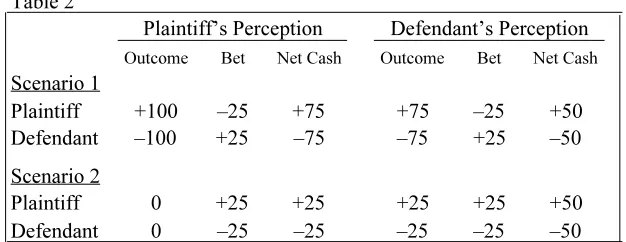
a concession in expected value. The plaintiff would offer a bet of 50, which would fix her return at 50. But this bet would have no effect on the defendant’s position. From the defendant’s perspective, the potential outcomes are [25, 75]. If the court awards 25, he must pay the plaintiff 50, resulting in a net cash outflow of 75. If the court awards 75, the plaintiff would pay him 50, resulting in a net cash outflow of 25. The two possibilities result in payouts of [25, 75], the same expected result if no bet had been placed at all. To hedge his risk completely, the defendant must bet 25.
The defendant’s position is the constraint. At his maximum betting amount of 25, he eliminates risk and fixes his return at 50. But at this bet the plaintiff’s returns from her perspective remain variable [25, 75].90
Table 2 shows this residual risk.
This analysis simply restates the obvious starting point: the plaintiff views her case to be higher variance. The plaintiff has two choices: litigate further or “sell” the residual risk at settlement. A “sale” constitutes a91
trading of expected return for risk. Keeping with the betting heuristic, the plaintiff would offer the defendant superior betting odds. In essence, the defendant would be paid to assume the plaintiff’s residual risk and thus would become a compensated risk-bearer. Here, the net risk differential92
93. Scholars have equated the calculation of expected value to asset valuation. See Bradford Cornell, The Incentive to Sue: An Option-Pricing Approach, 19 J.LEGAL STUD. 173, 178 (1990) (equating expected value to a discounted cashflow analysis); Joseph A. Grundfest & Peter H. Huang, The Unexpected Value of Litigation: A Real Options Perspective, 58 STAN.L.REV. 1267, 1273 (2006) (equating expected value to a net present value calculation). This understanding is incomplete. Asset valuation requires a two-step process: (1) project the expected cashflow, (2) discount it to calculate a true economic value. The first step considers the quantity of the return (what is the expected value of this project?), and the second step assesses its quality (what is the riskiness of this expectation?). See Rhee, Effect of Risk, supra note 8, at 202–04.
expected value. After the hedges are executed, rational settlement is predicted to be struck somewhere in the range of 25 to 50, with an equitable midpoint of 37.5.
B. Risk-Adjusted Pricing
Expected value states the quantity of expectation but not its quality.93
Various facets of risk influence the value assigned to the lawsuit as an asset or a liability. These concepts are represented in Figure 1.
The y-axis represents the variance (ó) associated with one’s expectation of outcome. The x-axis represents the ratio of the probability difference between the parties multiplied by the expected judgment
Ä
94. See Steinman v. Hicks, 352 F.3d 1101, 1104 (7th Cir. 2003) (Posner, J.) (“That discounted loss would be the actuarial value of the policy, and a risk-neutral person would pay no more. In fact he would never buy insurance, because there is always a loading charge.”).
value is determined. Based on an assessment of risk and expected value, if the assessment point lies to the left of the selection horizon, meaning the person prefers settlement based on the assessment of risk and expected value, then she would offer a discount measured as the distance between the assessment point and the selection horizon.
Under the standard model, the slope of the selection horizon H is vertical, meaning that risk has no influence on the choice between settlement and trial. The sole determinant of the choice of trial or settlement is the difference in the expected value weighed against
Ä
transaction cost. If the selection ratio (P L)/B is greater than 1.0, the parties’ difference on valuation is greater than the potential cost savings and thus trial would result. Conversely, if the selection ratio is less than 1.0, rational parties would settle because their difference is smaller than the transaction cost.
This standard model is unrealistic and thus irrelevant. If risk influences the value of a lawsuit, the slope of the selection horizon must be positive to some degree (H* in Figure 1). The most likely scenario for settlement
Ä
is when P is low and ó is high—the upper left quadrant represents the point that is furthest from the indifference points along the selection horizon. This is intuitively obvious. If the parties agree on expected outcome and risk is very high, then they would opt out of the judicial process because it could produce a result that may significantly (possibly arbitrarily) deviate from the mutual expectation. Conversely, if the disagreement is high and each party views the risk as low (i.e., the lower right quadrant of the matrix), then they would be confident in their assessments and would opt for a public valuation. In between these extremes, there are varying degrees of probability and variance and preferences for trial and settlement. The continuum of indifference that points along this matrix governs choice and value.
Based on this simple framework, there are three questions that must be asked to determine each person’s discount or premium. Where on the x-axis does the selection horizon cross (the x-intercept)? What is the slope of the selection horizon? Where is the case assessment point? These
p
questions relate to three variables: (1) the cost of risk preference C; (2) the
v r
cost of variance C; and (3) the cost of risk differential C.
1. Cost of Risk Preference
95. See infra note 159 and accompanying text. 96. See infra note 159.
97. See infra note 159 (10% to 50% loading charge for insurance).
98. Another way to think about this cost is to consider the price of liability transfer to a third-party buyer. If a defendant seeks to bundle its lawsuits into a pool of potential liabilities, the price the defendant must pay to a buyer of the pool is the expected value of the liabilities plus profit. The profit to a third party reflects the defendant’s cost to transfer the liabilities. Similarly, by holding the liability, one expects that the firm also incurs a cost.
99. The cost of variance is driven by exogenous circumstances vis-à-vis endogenous predispositions. An example serves the point. Consider the case of an insurer with $100 million in capital. The insurer approaches business in a neutral manner (indeed, a averse or risk-seeking insurer would find itself quickly out of business). Although the insurer has a risk-neutral outlook, it would never underwrite $500 million of Florida hurricane risk even if the actuarial risk has been properly assessed (and even if regulations allow it). The insurer would act as if it was risk averse because the cost of capital would increase such that the premiums charged, to achieve the return necessitated by the increased capital cost, would be infeasible in a competitive market. The amount of investment in Florida hurricane risk has nothing to do with a predisposition toward risk; rather, it is governed by economic limitations of the valuational construct at work. The risk, if undertaken, would result in a significant increase in the cost of capital, which would reduce the value of the firm. Similarly, in the case of an individual, a person may be risk averse by, say, 30%, given the stake. If, however, the circumstances were that the funds are needed to receive medical care, the opportunity cost is great and would lead to behavior that resembles greater risk aversion. Thus, given a particular risk preference, the cost of variance measures the rate of discount per
due to the diminishing marginal utility of money. For example, as I write this Article, my indifference point between a certain dollar sum and an equal chance lottery for $2,000 is probably in the range of $700, suggesting a cost of risk aversion of 30%, which coincidentally enough is approximately the cost of insurance. Across a broad range of stakes, most95
people are probably risk averse in the range of 10% to 50%. In litigation,96
individuals are generally risk averse to some degree. 97
2. Cost of Variance
The cost of variance is an exogenous measure of how a quantum of risk discounts value given the opportunity cost. In the litigation context, both the asset and liability of the ambiguous right in question are funded by capital, and the cost of variance measures its opportunity cost. For firms, a legal liability imparts a capital cost because it must be funded. The cost98
quantum of risk.
100. See Note, supra note 10, at 449.
101. Indirect evidence of this increased capital cost is seen by observing a victim’s borrowing costs before the accident and after. One can reasonably surmise that this capital cost would increase if underwriting were individually tailored.
102. See FISHBACK &KANTOR, supra note 5, at 11 (“The largest cost to injured workers probably was the cost of court delays, which could last up to five years.”).
103. A number of scholars have noted the advantage of repeat play. See ROSS, supra note 13, at 214; Marc Galanter, Planet of the APs: Reflections on the Scale of Law and Its Users, 53 BUFF. L.REV. 1369, 1396 (2006); Issacharoff & Witt, supra note 2, at 1581–83, 1599–1602.
104. See Samuel R. Gross & Kent D. Syverud, Don’t Try: Civil Jury Verdicts in a System Geared to Settlement, 44 UCLAL.REV. 1, 63 (1996) (noting that individual cases are “high-risk, . . . unpredictable, and sometimes bizarre”).
105. This theory of litigation risk is empirically seen. I find Laurence Ross’s observation, in Settled Out of Court, of the differences between insurance companies and claimants particularly insightful:
The claimant contemplating settlement or litigation is faced with a calculus of probabilities. Settlement offers a known award with certainty whereas litigation offers an unknown award with an unknown probability, although both the award and probability may be estimated by the experienced attorney. In other words, litigation involves not only additional processing costs from the claimant’s viewpoint; it also involves a gamble that may be totally lost. By taking many such
victims often confront capital-scarce situations. One can easily envision a plaintiff’s inability to work, pay bills, or obtain care or services, which could lead to a steady march into the vicinity of insolvency.100 These circumstances create the possibility of lost opportunity of capital, which imposes a real cost on the value of the case. This cost, reflected in a rate101
of discount per quantum of risk, is difficult to quantify, but one should not be blind to the fact that it exists and affects value in practice. 102
3. Cost of Risk Differential
Thus far, the discussion has assumed that the quantum of risk would be perceived similarly between the parties. In most cases, however, one expects that the parties would differ. In the typical tort action, for example, the parties value different transactions even as they are tied together in a common dispute and view the facts and laws similarly. Defendants are typically repeat players. They reduce the unique risk of variance of each103
case by holding a portfolio of cases. The portfolio produces a smooth104
gambles in litigating large numbers of cases, the insurance company is able to regard the choice between the certainty and the gamble with indifference. In the words of another analyst:
Generally speaking there will often be asymmetry between the parties, insofar as the suit is a regular, calculable element in business operations for one of them, and a unique event for the other. It means that the former will be . . . much less deterred by the likelihood of losing individual cases, providing he can transfer the loss to a group of customers or clients.
ROSS, supra note 13, at 214–15 (emphasis added) (alteration in original) (quoting Vilhelm Aubert, Courts and Conflict Resolution, 11 J.CONFLICT RESOL.40, 45 (1967)). Ross goes on to observe: “Ordinarily, the parties prefer negotiation partly because of its certain recovery, and the claimant usually prefers the certain recovery even more than the insurance company, thus yielding a discount from the expected value in litigation.” Id. at 218 (emphasis added). These empirical observations have sound basis in financial economic theory. The differences in the costs of resolution have a significant impact on the parties’ bargaining positions. Marc Galanter observed that in accessing the justice system corporations enjoy significant advantages over individual parties. Marc Galanter, Why the “Haves” Come Out Ahead: Speculations on the Limits of Legal Change, 9 LAW &SOC’Y REV. 95, 97–103, 106 (1974) (discussing the various advantages of repeat players, who are likely to be organizations such as insurance and finance companies); Galanter, supra note 103, at 1388 (“[R]ecurrent organizational litigants . . . can adopt strategies calculated to maximize gain over a long series of cases, even where this involves the risk of maximum loss in some cases.”).
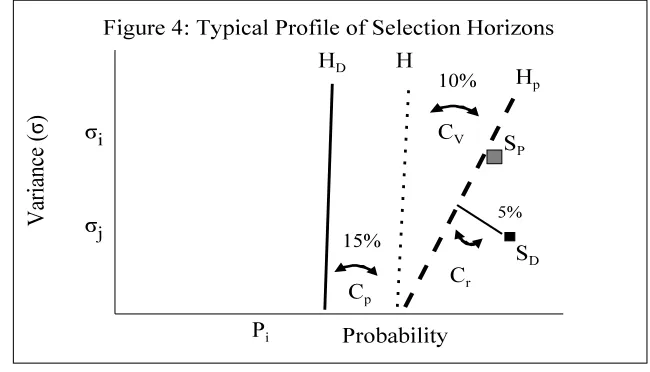
With these concepts in mind, Figure 2 illustrates the effects of risk preference and case assessment on value. It shows a situation where the
i
parties share the same probability P, but they have different selection
P D P D
horizons (H and H ) and assessment points (S and S ) resulting from
i j
106. See supra Figure 2. 107. See supra Figure 2.
P
Because the plaintiff’s assessment S lies to the left of her selection
P
horizon H , she prefers settlement. She is willing to pay a discount, measured as the line (á + a) and noted as â(á, a), to satisfy her preference.
D The defendant is less risk averse as indicated by his selection horizon H ,
P D D
which is to the left of H . His assessment S lies on H , so he is indifferent between trial and settlement. In his independent valuation (i.e., without regard to the plaintiff’s valuation), he neither pays a discount nor seeks a premium. Obviously, with transparent information and relative valuation, he would seek a discount from the plaintiff because she would settle at a discount. With expected value and transaction cost being the same for both parties, settlement is possible only if this condition holds: P x L – â(á, a) – T # P x L + T. This inequality reduces to 0 # â(á, a) + B. Thus, the contract zone is the aggregate transaction cost plus the risk-adjusted discount.
The discount â(á, a) has two components: a discount â(a) based on the difference between the relative cost of risk aversion, and a discount â(á) based on the different perceptions of risk even when the parties share the same view of probability. Consider first the cost of risk aversion. The location of the selection horizon (the x-intercept) represents the party’s risk preference given the stake. While risk aversion suggests a diminishing marginal-utility curve, and it is typically so presented, risk aversion here is presented as a fixed point given the stake. More risk aversion shifts the selection horizon to the right, decreasing the zone of preference for trial. Less risk aversion shifts it to the left. The relative cost of risk aversion is measured by the distance between the x-intercepts of the selection horizons, which is line a. Assume that the plaintiff shares the same risk
P D
preference as the defendant such that H 6 H . The line a reduces to106
zero, and the discount â(a) becomes nil, but the discount â(á) remains. Consider next the cost of risk differential. The plaintiff views the case
i j
as riskier than the defendant (compare ó and ó). The discount â(á) measures this risk differential. Assume that the parties retain their original
D P
selection horizons H and H but that the plaintiff’s assessment merges
P D
into the defendant’s such that S 6 S . They now share the same view of107
probability and variance. In this case, the line á reduces to zero, and the discount â(á) become nil, but the discount â(a) remains.
If a party has the selection horizon H with assessment S, she prefers trial because S lies to the right of the indifference point. Accordingly, she would seek a premium p to settle. Assume that the case assessment and risk preference does not change but that the slope of the selection horizon changes. If the cost of variance becomes higher, the slope of the selection horizon is lowered to H*. Because S now lies to the left of H*, this precipitates a change in preference from trial to settlement. She now would offer a discount d to settle. Probability, variance, and risk preference have remained the same, except that the cost of variance increased, resulting in a lower valuation.
C. Cost of Resolution
The above examples assume that both parties hold the same view of probability and expected value. Yet three factors of one’s risk profile—cost of risk aversion, cost of variance, and cost of risk differential—dramatically affect dispute resolution. The sum of these factors constitutes the “cost of resolution.” While transaction cost in litigation is understood to be the cash cost of dispute processing, the cost of resolution is a noncash item. Like the cost of capital for firms, it is realized through the valuation assigned by each party. It is difficult to model and conveniently ignored by assuming a risk-neutral, rational person. To be clear, the cost of resolution is a transaction cost, but given the general lack of recognition as a substantial cost in its own right, it is given a different name and analyzed separately to keep the cash and noncash costs distinct. With this cost in mind, a more robust model of
p valuation is possible. The trial inequality can be written as follows: P x L
p d d
108. Because the costs of variance and risk differential always result in a discount, a person would seek a premium only if he had a risk-seeking preference that outweighs the other factors.
109. 51 F.3d 1293 (7th Cir. 1995). 110. Id. at 1296.
111. Id. at 1294. 112. Id. at 1297–98.
113. Id. at 1298. Judge Posner offered a guess that liability could increase from about $125 million to $25 billion. Id.
a premium. 108
The settlement process is one in which parties seek information transparency regarding one’s independent value as well as the opponent’s assessment. During this discovery process, each party rationally nets out its respective costs of resolution. What remains is a net cost that is assigned to one party. Therefore, all else being equal, the net cost of resolution creates a valuational divergence, yielding a bargaining advantage for the party with the lower cost of resolution. A numeric example illustrates the point. Assume that the parties share the same expected value of 100 and each would incur a transaction cost of 40 in a trial. The plaintiff’s cost of resolution is 30, while the defendant’s is 10, and thus the net cost of resolution in favor of the defendant is 20. The plaintiff’s minimum settlement value is thus 30, and the defendant’s maximum settlement value is 150. With equitable bargaining, the parties would settle at 90. This divergence from the expected value stems from the defendant’s lower cost of resolution, resulting in a lower value of the liability as compared to the plaintiff’s assessment of the value of her asset. Thus, the net cost of resolution must be a transaction cost to one party only, and it determines, in part, which party has the bargaining advantage.
D. Settlement Pressure
The above theory of how risk affects tort law is not simply an academic inquiry. Rather, the effect is empirically seen. The most prominent example is in Judge Posner’s opinion for the Seventh Circuit in In re Rhone-Poulenc Rorer Inc. There, the plaintiffs contended that they were109
infected with HIV from blood solids manufactured by the defendants and brought a class action, which the district court certified. The defendants110
filed a petition for mandamus, asking for a rescission of the order. In111
reversing the district court, Judge Posner observed that because a class action would substantially increase “the sheer magnitude of the risk,” the defendants would be “under intense pressure to settle.”112
The magnitude of risk had several facets. A class action would increase the number of plaintiffs from several hundred without a class to thousands with a class, thus greatly increasing the potential liability. But of course,113
114. The Second Circuit has rejected the Seventh Circuit’s settlement pressure argument, reasoning that the “effect of certification on parties’ leverage in settlement negotiations is a fact of life for class action litigants. While the sheer size of the class in this case may enhance this effect, this alone cannot defeat an otherwise proper certification.” In re Visa Check/Mastermoney Antitrust Litig., 280 F.3d 124, 145 (2d Cir. 2001).
115. In re Rhone-Poulenc, 51 F.3d at 1299. 116. Id.
117. The court noted that “the result will be robust if these further trials are permitted to go forward, because the pattern that results will reflect a consensus, or at least a pooling of judgment, of many different tribunals.” Id. at 1299–1300.
118. See id. at 1299. 119. Id. at 1298. 120. Id. 121. Id. 122. Id.
irrelevant. Class actions always increase the number of plaintiffs and thereby the potential liability. Unless corporate wealth protection is the policy, a potential increase in liability is an illegitimate basis to reverse class certification. More interestingly, the court observed that the total114
liability would depend on “the outcome of a single jury trial.”115 The determination of liability, the court reasoned, should instead “emerge from a decentralized process of multiple trials, involving different juries, and different standards of liability, in different jurisdictions.” The116
defendants, as repeat players, cannot smooth out the risk through a diversified pool of lawsuits; instead, they are subject to the variance of a single outcome. Under these circumstances, even large corporations may117
face substantial “settlement pressures.” 118
The reasoning in Rhone-Poulenc illustrates how the district court’s procedural ruling fundamentally altered the risk profile and thus the value of the tort litigation. Based on probability and expected value alone, the defendants should have been confident in the outcome of the lawsuits irrespective of class designation; in individual actions, the defendants had won twelve out of thirteen cases. But the court observed that the119
defendants could not be so confident.120
Class certification has two adverse effects on presumably risk-neutral corporate defendants. First, because the risk cannot be reduced through a pooling of cases, corporate defendants do not enjoy a net risk differential as would ordinarily be the case. A class certification reverses the diversification effect, and thus the parties are put on the same footing in terms of outcome risk. Second, such a one-shot bet can put a corporation in danger of insolvency, and thus corporate defendants “may not wish to roll these dice.”121
123. See generally Rhee, Price Theory, supra note 7 (applying principles of financial economics to construct a pricing theory of legal disputes); Rhee, Effect of Risk, supra note 8 (analyzing how parties account for different perceptions of risk in valuation). Insurance companies, for example, routinely provide a “danger value,” an amount in excess of the expected value of a trial, to eliminate the exposure to a low probability, high severity claim. ROSS, supra note 13, at 202. In the front end of underwriting, a premium is based on the sum of expected value of loss, administrative expense, and risk premium. ERIC BRIYS &FRANÇOISE DE VARENNE,INSURANCE: FROM UNDERWRITING TO DERIVATIVES 6 (2001).
124. For an explanation of cost of capital, see supra notes 86–88 and accompanying text. 125. Judge Posner calls such induced settlements “‘blackmail settlements.’” In re Rhone-Poulenc, 51 F.3d at 1298 (quoting HENRY J.FRIENDLY,FEDERAL JURISDICTION:AGENERAL VIEW 120 (1973)). Commentators have differed on the legitimacy of settlement pressure as a reason to reject class certification. Compare George Priest, Procedural Versus Substantive Controls of Mass Tort Class Actions, 26 J.LEGAL STUD. 521 (1997) (arguing that contrary to the substantive goals of tort law, the procedural system creates mass tort claims that routinely settle), with Bruce Hay & David Rosenberg, “Sweetheart” and “Blackmail” Settlements in Class Actions: Reality and Remedy, 75 NOTRE DAME L.REV. 1377 (2000) (concluding that the risks of settlements caused by mass tort classification have been broadly overstated).
126. J.B. Heaton, Settlement Pressure, 25 INT’L REV.L.&ECON. 264, 270 (2005). 127. Id. at 272.
128. See generally MICHAEL C.JENSEN,ATHEORY OF THE FIRM:GOVERNANCE,RESIDUAL CLAIMS, AND ORGANIZATIONAL FORMS (2000) (applying agency theory to various organizational forms); Michael C. Jensen & William H. Meckling, Theory of the Firm: Managerial Behavior, Agency Costs and Ownership Structure, 3 J.FIN.ECON. 305 (1976) (developing a theory of the ownership structure of the firm by analyzing agency costs).
129. See Jensen & Meckling, supra note 128, at 308–09.
consistent with financial economic principles. A class certification has123
the potential of increasing the firm’s cost of capital, and this potential124
decline in market value would be fair game in the course of settlement.125
Thus, the effect of class certification was to diminish the net cost-of-resolution advantage held by the defendants and perhaps even turn the advantage to the class plaintiffs.
Despite a premise based on economic realities of the dispute resolution process, the reasoning in Rhone-Poulenc is flawed in at least two key respects. First, one can be influenced by “settlement pressure” only if one is risk averse. Risk aversion is an attribute of individual preference.126 127
For example, a corporation, as an economic entity, is typically considered risk neutral. It is true that the agents acting within a corporation may be risk averse, and this preference may manifest in corporate decisions. However, the theory of agency cost suggests that agents do not have the same personal stake in the outcome of a corporate decision as would a shareholder. Indeed, shareholders are better off when agents make128