R E V I E W
Open Access
Automated closed-loop control of diabetes:
the artificial pancreas
Boris Kovatchev
Abstract
The incidence of Diabetes Mellitus is on the rise worldwide, which exerts enormous health toll on the population
and enormous pressure on the healthcare systems. Now, almost hundred years after the discovery of insulin in
1921, the optimization problem of diabetes is well formulated as maintenance of strict glycemic control without
increasing the risk for hypoglycemia. External insulin administration is mandatory for people with type 1 diabetes;
various medications, as well as basal and prandial insulin, are included in the daily treatment of type 2 diabetes.
This review follows the development of the Diabetes Technology field which, since the 1970s, progressed remarkably
through continuous subcutaneous insulin infusion (CSII), mathematical models and computer simulation of the human
metabolic system, real-time continuous glucose monitoring (CGM), and control algorithms driving closed-loop control
systems known as the
“
artificial pancreas
”
(AP). All of these developments included significant engineering advances
and substantial bioelectronics progress in the sensing of blood glucose levels, insulin delivery, and control design. The
key technologies that enabled contemporary AP systems are CSII and CGM, both of which became available and
sufficiently portable in the beginning of this century. This powered the quest for wearable home-use AP, which is now
under way with prototypes tested in outpatient studies during the past 6 years. Pivotal trials of new AP technologies
are ongoing, and the first hybrid loop system has been approved by the FDA for clinical use. Thus, the
closed-loop AP is well on its way to become the digital-age treatment of diabetes.
Keywords:
Diabetes, Hypoglycemia, Hyperglycemia, Continuous glucose monitoring (CGM), Insulin pumps, Continuous
subcutaneous insulin infusion (CSII), Artificial pancreas (AP), Closed-loop control
Background
On March 6, 2013, the American Diabetes Association
(ADA) published research showing that the total costs of
diagnosed diabetes in the U.S. have risen to $245 billion in
2012 from $174 billion in 2007, a 41% increase over 5
years (American Diabetes Association
2013
). Thus,
dia-betes is a prime example of an enormous health care
problem the only solution of which is integration of
be-havioral change, advanced bioengineering aiming
func-tional replacement of the failing beta cell, and synergistic
drug-device integration. Given that diabetes is common
and affecting millions of people around the world, major
efforts target the optimization of diabetes control and
large international organizations are dedicated to the
treatment and, ultimately, the cure of diabetes and its
complications,
including:
ADA
(American
Diabetes
Association [Internet]
n.d.
), the European Association for
the Study of Diabetes (EASD, (
n.d.
)), the International
Diabetes Federation (IDF, (
2014
)), and the Diabetes
Tech-nology Society (Diabetes TechTech-nology
n.d.
). These efforts
are picking up speed and new diabetes treatment
tech-nologies are being introduced daily. To put this progress
in perspective, for the 1,900 years following the clinical
introduction of the term
diabetes
(Aretaeus the
Cappado-cian, first Century AD) diet was the only treatment (albeit
unsuccessful in type 1 diabetes). In the nineteenth century,
the nature of diabetes was generally understood, and with
the discovery of insulin in 1921 by Frederick Banting at
the University of Toronto type 1 diabetes was no longer a
death sentence. For this breakthrough, Banting and John
Macleod were awarded the Nobel Prize in Physiology or
Medicine in 1923. To recognize the contributions of their
colleagues, Banting shared his prize with Charles Best and
Macleod shared his with J.B. Collip.
Correspondence:[email protected]
Center for Diabetes Technology, University of Virginia, P.O. Box 400888, Charlottesville, VA 22908, USA
Several subtypes of diabetes are identified, most
preva-lent of which are referred to as type 2 diabetes (over
90% of the people with diabetes) and type 1 diabetes
–
an auto-immune disorder in which the immune system
targets its own
β
–
cells in the islets of Langerhans of the
pancreas
–
the site of insulin secretion and synthesis.
Type 1 diabetes is characterized by absolute deficiency
of insulin secretion, which necessitates daily (or
continu-ous) external insulin injections to maintain carbohydrate
metabolism and sustain life. Most often, type 1 diabetes
occurs in childhood and adolescence (although it can
occur at any age) and, until recently, was also known as
“
Insulin-Dependent Diabetes Mellitus (IDDM)
”
or
“
Ju-venile Diabetes.
”
Type 2 diabetes results from a
combin-ation of impaired insulin action and insufficient
β
–
cell
function. In health, the
β
–
cell secretes insulin in
re-sponse to increase in blood glucose (BG) levels (e.g. after
meals) or to elevated ambient BG. When insulin secretion
is inadequate and cannot overcome the insulin resistance
occurring as a result from obesity or other factors,
hyper-glycemia (elevated blood sugar levels) would occur. The
progression of type 2 diabetes is typically gradual,
begin-ning with pre-diabetes, i.e. impaired fasting glucose (IFG)
and impaired glucose tolerance (IGT). People with type 2
diabetes are also more likely to have comorbidities,
in-cluding as cardiovascular risks such as dyslipidemia and
hypertension. Overall, both type 1 and type 2 diabetes
re-quire daily treatment to match insulin availability to
carbohydrate intake. In type 1 diabetes this is exclusively
achieved by exogenous insulin injection; in type 2
dia-betes, a variety of medications are available to lower
insu-lin resistance or amplify any residual insuinsu-lin secretion;
basal and prandial insulin injections are increasingly used
as well.
Understanding and quantifying the dynamics of the
human glucose-insulin control network is critical for the
technological treatment of diabetes. BG levels are raised
by food containing carbohydrates, and glucose is also
produced by the body (mainly by the liver), after which
it is distributed and utilized through both
insulin-inde-pendent (e.g. central nervous system and red blood cells)
and insulin-dependent (muscle and adipose tissues)
pathways. Insulin secreted by the pancreatic
β
–
cell is the
primary regulator of glucose homeostasis. If a BG
per-turbation occurs (e.g. after a meal containing
carbohy-drates), beta-cells secrete insulin in a direct response to
the increase in BG concentration, or as an indirect
re-sponse to hormonal release from the gut (GIP and
GLP-1, known as the
“
incretin effect
”
(Nauck et al.
1986a
)). In turn, insulin signaling promotes glucose
utilization and inhibits glucose production to bring
rapidly and effectively plasma glucose to its
pre-per-turbation level (Cobelli et al.
2009
). In pathophysiology,
this feedback control is degraded. In type 2 diabetes, the
glucose control network is largely preserved, but insulin
secretion is deficient relative to hepatic and peripheral
in-sulin resistance. In particular, the incretin response is
defi-cient (Nauck et al.
1986b
), and this finding triggered the
introduction of new classes of medications known as
GLP-1 receptor agonists (incretin mimetics), and DPP-4
inhibitors (incretin enhancers) (Drucker and Nauck
2006
).
In type 1 diabetes, insulin secretion is virtually absent,
while glucagon secretion from the
α
–
cell is still preserved,
which removes the insulin-dependent pathways lowering
BG levels and therefore BG can only go up, leading to
hyperglycemia. Thus, insulin replacement is mandatory.
In both type 1 and type 2 diabetes, a battery of
counterre-gulatory hormones are also at work, including glucagon,
epinephrine, cortisol and growth hormone, which defend
the body against life-threatening low blood sugar events
(i.e. severe hypoglycemia).
The optimization problem of diabetes
Classic large-scale studies have shown that intensive
treatment to maintain optimal average glycemia (as
mea-sured by Hemoglobin A1c) markedly reduces the
chronic complications in both type 1 (Reichard and Phil
1994
; The Diabetes Control and Complications Trial
Re-search Group
1993
) and type 2 diabetes (UK Prospective
Diabetes Study Group (UKPDS)
1998
). External insulin
replacement through multiple daily injections (MDI) or
continuous subcutaneous insulin delivery (CSII) using
insulin pumps, is mandatory in type 1 diabetes and is
in-creasingly used in type 2 diabetes. However, MDI and
CSII are not nearly as efficient as the endogenous insulin
secretion; as a result, acute events do occur, exposing
patients to severe hypoglycemia or diabetic ketoacidosis.
Imperfect intensive insulin treatment may also reduce
the warning symptoms and hormonal defenses against
hypoglycemia leading to defective counterregulation and
hypoglycemia unawareness (White et al.
1983
; Cryer and
Gerich
1985
; Amiel et al.
1987
; Amiel et al.
1988
); thus,
intensive treatment may trigger severe hypoglycemia
(Gold et al.
1993
; Henderson et al.
2003
; Lincoln et al.
result of this optimization and the principal feedback
signal to the patient for his/her control of diabetes. This
understanding of the diabetes optimization objectives
led to quantitative description of the glucose-insulin
control network, modeling, simulation and, ultimately,
to bioengineering control of diabetes (Cobelli et al.
2009
). It should be noted, however, that undesirable
gly-cemic variation is triggered at multiple biosystem levels
and is driven by self-treatment behavior. Translated to
the context of contemporary diabetes technologies, such
as Continuous Glucose Monitoring (CGM), Advisory
Systems, or Artificial Pancreas (AP), this concept helps
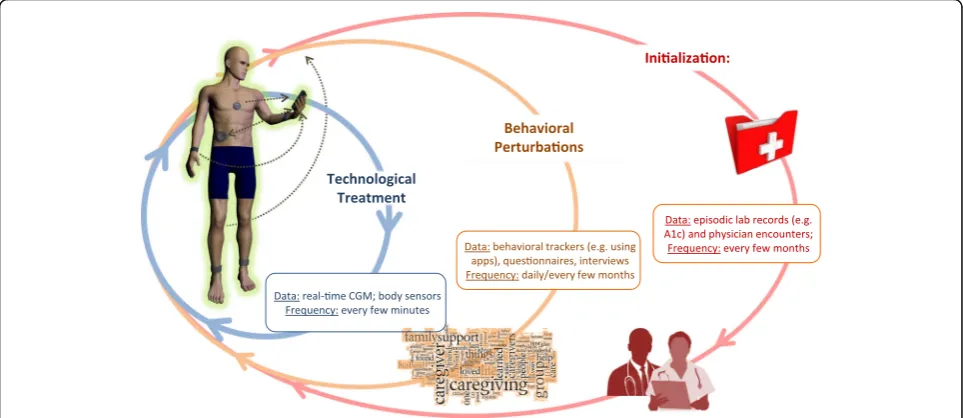
define a treatment ecosystem that includes several
inter-acting processes developing at different time scales
(Fig.
1
). As presented in Fig.
1
, with technology
advance-ment, the focus of daily maintenance of diabetes shifts
from episodic physician encounters (slowest cycle) and
lab assessments (e.g. A1c measured every few months)
to daily fine tuning assisted by advisory systems or
auto-mated by the AP. Each person
’
s behavior introduces
routine (e.g. meals exercise) or abrupt (e.g. illness)
per-turbations. While the data at the slowest and fastest
cy-cles are well defined (e.g. A1c and CGM), the tracking of
behavioral perturbations is less common, even with
con-temporary applications that attempt to track human
be-havior. At this intermediate behavioral cycle, analytics
are virtually absent; thus, the field is open for innovation
and development.
The initialization of the ecosystem for a person begins
with the diagnosis of diabetes, followed by choice of
treatment (e.g. medication, technology) that is based on
the person
’
s physiology as reflected by the medical
rec-ord and corresponds to education, skills, or social
choices. This is done infrequently. A person
’
s
self-treatment routine (e.g. meals, exercise) is a dynamical
process introducing daily behavioral perturbations to the
metabolic system. These perturbations challenge the
technological treatment of diabetes, which includes
real-time warning, alarms, advisory systems, or
auto-mated insulin delivery. Thus, the key to optimal diabetes
treatment is a multi-layer holistic approach, which must
use advanced bioelectronics and technology to account
for individual factors of human physiology and behavior.
The optimization of diabetes must rely on an entire
bio-behavioral treatment ecosystem of signals, models,
and control methods that act at several levels of
biosys-tem organization
–
from metabolic to human behavior
and social interaction.
A century of diabetes technology
In the early 60
’
s, an intravenous (i.v.) insulin pump
deliv-ering insulin and glucagon to counteract hypoglycemia
was reported by Kadish (
1964
). In 1969, the first
port-able blood glucose meter
–
the Ames Reflectance meter
- was manufactured. The first commercial subcutaneous
insulin pump
–
the Auto Syringe - was introduced by
Kamen in the 1970s, and by the end of the 70
’
s the first
trials of continuous subcutaneous insulin infusion (CSII)
were reported by Pickup et al. in the U.K. (Pickup et al.
1978
) and Tamborlane et al. in the U.S. (Tamborlane et
al.
1979
). These devices demonstrated the feasibility of
ambulatory glucose measurement and external,
includ-ing subcutaneous, insulin delivery. The next step was to
automate the process of insulin replacement in type 1
diabetes
–
from BG monitoring to insulin delivery
con-trolled by a mathematical algorithm. This approach
be-came known as closed-loop control of diabetes, or the
“
artificial pancreas (AP).
”
The AP idea can be traced
back to the 1970
’
s when the possibility for external blood
glucose regulation was established by studies using i.v.
glucose measurement and i.v. infusion of glucose and
in-sulin (Albisser et al. (
1974
), Pfeiffer et al. (
1974
),
Mir-ouze et al. (
1977
), Kraegen et al. (
1977
), and Shichiri et
al. (
1978
)). In 1977, one of these designs (Pfeiffer et al.
1974
) resulted in the first commercial device - the
Bios-tator (Clemens et al.
1977
) - a large (refrigerator-sized)
device that has been used extensively for glucose-control
research (Marliss et al.
1977
; Santiago et al.
1979
; Fischer
et al.
1978
). A review of the methods for i.v. glucose
control developed in the 70
’
s can be found in (Parker et
al.
2001
). In 1979, another key element
–
the Minimal
Model of Glucose Kinetics
–
was introduced by
Berg-man and Cobelli (BergBerg-man et al.
1979
). This, and
subse-quent mathematical models, serve as the
“
brain
”
behind
the majority of control algorithms used in contemporary
artificial pancreas systems. Detailed description of the
major early algorithm designs can be found in
(Broe-khuyse et al.
1981
; Clemens
1979
; Cobelli and Ruggeri
1983
; Salzsieder et al.
1985
). More work followed,
spanning a range of control techniques powered by
physiologic modeling and computer simulation
(Bru-netti et al.
1993
; Fischer et al.
1987
; Sorensen
1985
;
Parker et al.
1999
). Between 1980 and 2000 the insulin
pumps became smaller and portable, while the models
of the glucose-insulin system became larger and more
elaborate, allowing first computer simulation and then
automated model-predictive glucose control of
dia-betes. In 1997
–
1998, the first elements of the risk
ana-lysis of BG data were introduced (Kovatchev et al.
1997
; Kovatchev et al.
1998
), which later became the
base for closed-loop safety systems embedded in the
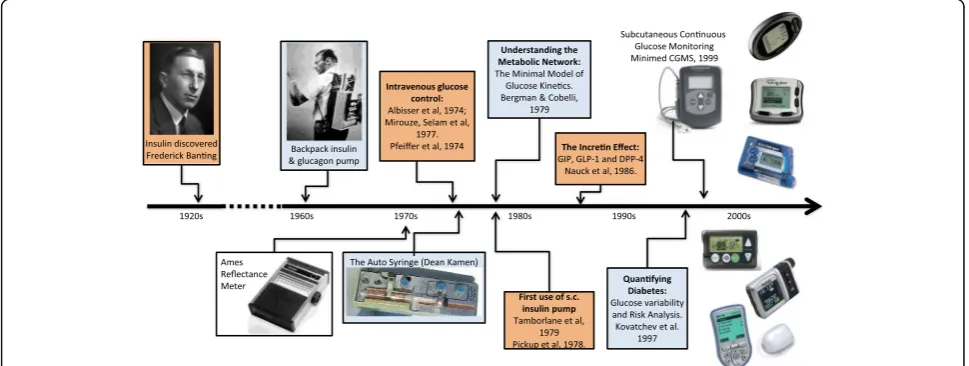
AP design. Figure
2
, which was first published in
(Kovatchev
2018a
), presents the timeline of these
developments:
Continuous glucose monitoring
The final critical technological leap enabling
minimally-invasive closed-loop was made at the turn of the
twenty-first century with the introduction of CGM
de-vices by Medtronic, Abbott, Dexcom, Cygnus, and
others (Mastrototaro
2000
; Bode
2000
; Feldman et al.
2003
). It is important to know, however, that CGM
devices measure glucose concentration in a different
compartment
–
the interstitium
–
which introduces an
additional (presumably diffusion) process between blood
and interstitial glucose (IG) (Rebrin et al.
1999
; Rebrin
and Steil
2000
; Steil et al.
2005
). To account for the
gra-dient between BG and IG, CGM devices are typically
calibrated with capillary BG readings. Successful
calibra-tion would adjust the amplitude of IG fluctuacalibra-tions with
respect to BG, but would only partially mitigate the time
lag due to BG-to-IG glucose transport. Because such a
time lag could greatly influence the accuracy of CGM, a
number of studies were dedicated to its investigation
(Boyne et al.
2003
; Kulcu et al.
2003
; Stout et al.
2004
;
Wentholt et al.
2004
). It was hypothesized that if a
glu-cose fall is due to peripheral gluglu-cose consumption, the
physiologic time lag would be negative, i.e. fall in IG
would precede fall in BG (Rebrin et al.
1999
; Wientjes
and Schoonen
2001
). But, in most studies, IG lagged
be-hind BG by 4
–
10 min, regardless of the direction of BG
change (Steil et al.
2005
; Boyne et al.
2003
). In an
at-tempt to reconcile these results, the formulation of the
push-pull phenomenon offered arguments for a more
complex BG-IG relationship than a simple constant or
directional time lag (Wentholt et al.
2004
; Aussedat et
al.
2000
; Basu et al.
2013
; Basu et al.
2015
). In addition,
errors from calibration, loss of sensitivity, and random
noise confound CGM data (Kovatchev and Clarke
2008
).
Nevertheless, the accuracy of CGM is increasing (Clarke
and Kovatchev
2007
; The Diabetes Research in Children
Network (DirecNet) Study Group
2008
; Kovatchev et al.
2008
; Garg et al.
2009
; Christiansen et al.
2013
) and has
reached a point where CGM could be used as a
replace-ment to traditional BG measurereplace-ment without calibration
with capillary blood several times a day (Kovatchev et al.
2015
). For example, a few years ago the Dexcom G4
Platinum and G5 CGMs used algorithmic signal
process-ing to improve its accuracy and obtain replacement
clearance from the Food and Drug Administration
(FDA) (Facchinetti et al.
2013
; Peyser et al.
2015
;
Kovatchev
2015
). Most recently, the new version of
these devices
–
Dexcom G6
–
was approved by the FDA
for use without fingerstick calibration.
Closed-loop control
In addition to presenting frequent data (e.g. every 5
–
10 min), real-time CGM devices typically display trends,
BG rate of change, and alerts for upcoming hypo- or
hyperglycemia (Heise et al.
2003
; Bode et al.
2004
;
McGar-raugh and Bergenstal
2009
). As a result, a number of
stud-ies have documented the benefits of CGM technology
(Deiss et al.
2006
; Garg et al.
2006
; Kovatchev and Clarke
2007
; The Juvenile Diabetes Research Foundation
Con-tinuous Glucose Monitoring Study Group
2008
) and
envi-sioned its use in closed-loop control systems (Klonoff
2005
; Hovorka
2006
; Klonoff
2007
). The first step in this
direction was the introduction of a system attempting to
prevent hypoglycemia via automated shutoff of the insulin
pump when CGM readings crossed a predetermined low
glucose threshold (Buckingham et al.
2009
)
–
a feature
that became known as Low Glucose Suspend (LGS) - or
Predictive Low Glucose Suspend (PLGS) in
implementa-tions which used forecast of glucose values. First steps
to-wards fully automateing the glucose control in diabetes
using CGM and CSII linked via a closed-loop control
al-gorithm, were taken by the early work of Hovorka et al.
(
2004a
) and Steil et al. (
2006
). The launch of the JDRF AP
Consortium in 2006, which sponsored several centers in
the U.S. and Europe to carry closed-loop control research,
institutionalized this trend. In 2009
JAMA
wrote:
“
Artifi-cial pancreas may soon be a reality
”
(Friedrich
2009
). In
May 2012, a Diabetes Outlook was published in
Nature
(Dolgin
2012
) which highlighted the AP, and 18 months
later
Science
featured the same topic (Clery
2014
). In 2008
the National Institutes of Health (NIH) launched an AP
initiative and in 2010 the European AP@Home
Consor-tium was established. A roadmap towards a viable AP was
accepted, which included several sequential steps,
be-ginning with automated mitigation of hypoglycemia
and progressing through to-range and
control-to-target towards fully automated, possibly
multi-hor-monal AP (Kowalski
2009
). By 2010 the AP became a
global research topic engaging physicians and engineers
in an unprecedented collaboration. In 2014,
JAMA
revisited the AP and suggested:
“
Fully automated
artifi-cial pancreas finally within reach
”
(Hampton
2014
).
Key milestones of this development are described in
our reviews (Cobelli et al.
2011
; Kovatchev
2011
;
Renard et al.
2013a
; Renard et al.
2013b
).
The control algorithm
A key element of the AP system is the control algorithm,
which monitors BG fluctuations and the actions of the
in-sulin pump, and computes inin-sulin delivery rate every few
minutes (Bellazzi et al.
2001
). The first studies of Hovorka
et al. (
2004a
;
2004b
) and Steil et al. (
2006
) outlined the
two major types of closed-loop control algorithms now in
use
–
model-predictive control (MPC, (Hovorka et al.
2004b
)) and proportional-integral-derivative (PID, (Steil et
al.
2006
)). By 2007, the blueprints of the contemporary
controllers were in place, including run-to-run control
(Zisser et al.
2005
; Owens et al.
2006
; Palerm et al.
2007
)
and linear MPC (Magni et al.
2007
). MPC became the
ap-proach of choice targeted by recent research, for two main
reasons: (i) PID is purely reactive, responding to changes
in glucose level, while a properly tuned MPC allows for
prediction of glucose dynamics and, as a result, for
mitiga-tion of the time delays inherent with subcutaneous
glu-cose monitoring and subcutaneous insulin infusion; (ii)
MPC allows for relatively straightforward personalizing of
the control using patient-specific model parameters. In
addition, MPC could have
“
learning
”
capabilities - it has
been shown that a class of algorithms (known as
run-to-run control) can
“
learn
”
specifics of patients
’
daily
rou-tine and then optimize the response using this
informa-tion. A combination of MPC and PID was used to drive a
dual-hormone AP system that added glucagon to combat
hypoglycemia (El-Khatib et al.
2010a
). A new step towards
adaptive AP was recently taken by a12-week multi-center
trial of 24/7 personalized closed-loop control (Dassau et
al.
2017
). In this trial, each participant
’
s insulin
require-ments (e.g. basal rate settings, carbohydrate ratio) were
al-gorithmically adapted every week.
Inpatient AP studies
During 2008
–
2012, promising results were reported by
several groups (Weinzimer et al.
2008
; Clarke et al.
2009
; Bruttomesso et al.
2009
; Hovorka et al.
2010
;
El-Khatib et al.
2010b
; Renard et al.
2010
; Hovorka et al.
2011
; Zisser et al.
2011
; Russell et al.
2012
; Breton et al.
2012
; Luijf et al.
2013
; Zisser et al.
2014
; Sherr et al.
2013
). Most of these studies pointed out the superiority
of closed-loop control over CSII therapy in terms of: (i)
increased time within target range (typically 70
–
180 mg/
dl); (ii) reduced incidence of hypoglycemia, and (iii)
bet-ter overnight control. Inpatient studies linked AP to
re-duction of hypoglycemia following exercise (Breton et al.
auxiliary heart rate signal was shown to contribute to
better AP adaptation to exercise (Breton et al.
2014
).
An algorithm mimicking
β
-cell physiology was
embed-ded in a low-power microchip (Reddy et al.
2014
), and
an MPC control algorithm running on a smart phone
was tested in the hospital (O
’
Grady et al.
2012
). A
dir-ect comparison between single- vs. dual-hormone AP
found
“
little evidence of glucagon benefits in reducing
the number of hypoglycemic events requiring treatment
”
(Haidar et al.
2015
)
–
an important finding that helped
settle the debate whether dual-hormone AP using
glu-cagon is justified, given the added complexity, possible
risks, and expenses.
AP system integration
LGS, which is now commercially available and is already
a part of the clinical practice, is considered a precursor
to AP because of the automated data transfer from
CGM to the insulin pump
–
a system integration that
was a critical step in the AP development. The ASPIRE
trial showed a 38% reduction in nocturnal hypoglycemia
compared to CGM alone without increasing HbA1c
(Bergenstal et al.
2013
); a subsequent study achieved
similar results (Ly et al.
2013
). PLGS algorithms were
in-troduced (Beck et al.
2014
), which brought this type of
system to a higher level of computational sophistication.
However, LGS and PLGS systems are still binary on-off
insulin
“
switches;
”
they lack the defining property of a
closed-loop algorithm
–
feedback estimation of the
pa-tient state using CGM and insulin delivery data to
deter-mine the degree or insulin modulation in real time.
Outpatient (but not portable) AP
The first steps towards outpatient AP were taken by a
laptop-based system installed at the bedside of children
at a diabetes camp (Phillip et al.
2013
), and then taken
to patients
’
homes (Nimri et al.
2013
). Similarly, another
bedside AP trial deployed small personal computers at
patients
’
homes, and confirmed their feasibility outside
of the hospital (Hovorka et al.
2014
). The progress of the
outpatient AP was presented in a symposium
“
Advances
in Artificial Pancreas Development
”
(
Diabetes Care
, May
2014), which contained an editorial (Cefalu and
Tambor-lane
2014
) and 7 papers on topics ranging from
physi-ology and engineering (Kudva et al.
2014
; Schiavon et al.
2014
) to reports on predictive LGS (Beck et al.
2014
),
overnight AP at home (Hovorka et al.
2014
), feasibility
of the AP in type 2 diabetes (Kumareswaran et al.
2014
),
and around-the-clock outpatient AP with a portable AP
system (Del Favero et al.
2014
). Subsequent studies
firmly took the AP to outpatient setting (Russell et al.
2014
; Leelarathna et al.
2014
; Thabit et al.
2014
).
Wearable artificial pancreas
In the
Nature
(Dolgin
2012
) and
Science
(Clery
2014
)
re-views cited above, a common photo appeared of a smart
phone presenting a dual traffic-light display
–
the face of
the first portable AP platform
–
the
Diabetes Assistant
(DiAs
) developed at the University of Virginia (UVA) in
2011. DiAs was built using an Android smart phone as a
computational hub and, for the first time, included two
features now employed by virtually all outpatient AP
sys-tems: (i) graphical user interface designed for the patient
(Keith-Hynes et al.
2013
), and (ii) a Web-based remote
monitoring system (Place et al.
2013
). The defining
char-acteristic of DiAs was its capability to switch between
different modes of operation, depending on patient
pref-erence and signal availability. For example, if CGM
sig-nal were not available or if the patient does not wear a
sensor for a certain period of time, DiAs could switch
into
“
pump mode
”
running this patient
’
s normal basal/
bolus insulin routine and adding extended GUI and
re-mote monitoring. Similarly, if the pump were
unavail-able, DiAs could switch to
“
sensor mode
”
running
trends, alerts, and Cloud services. Thus, by design, DiAs
was a platform for AP technology deployment, used in
20 clinical trials, by over 300 patients at clinical centers
in the U.S. (Virginia, California, Minnesota, and New
York), as well as in France, Italy, Holland, Israel, and
Argentina. Some examples: Following initial 2-day
pilot-feasibility trials (Cobelli et al.
2012
), in 2012
–
2013
two international multi-site studies were completed,
which confirmed the feasibility of DiAs and its efficacy to
reduce hypoglycemia in the outpatient setting (Kovatchev
et al.
2013
; Kovatchev et al.
2014
). Three summer camp
trials of remote monitoring (DeSalvo et al.
2013
), overnight
AP (Ly et al.
2014
), and AP during the day (Chernavvsky
et al.
2016
) confirmed the efficacy of DiAs in children with
type 1 diabetes. With several completed multi-center trials,
smart-phone based closed-loop control is now considered
an established and effective approach to portable AP
(Brown et al.
2015a
; Del Favero et al.
2015
; Brown et al.
2015b
; Anderson et al.
2015
; Renard et al.
2015
).
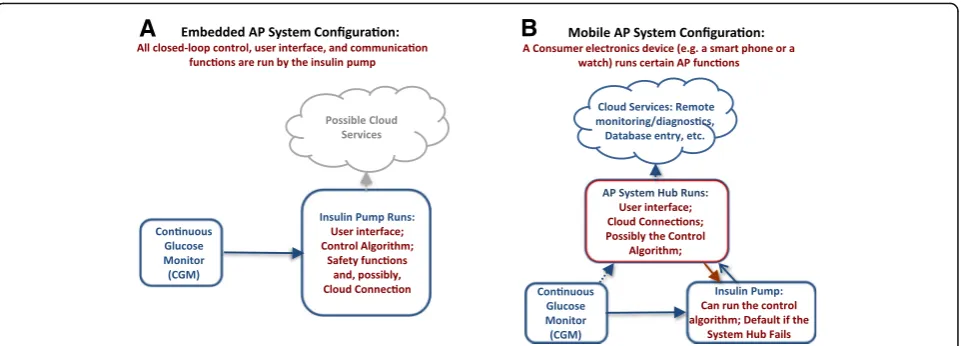
The studies done in the past few years ascertained the
two principal implementations of a wearable AP
–
a
sys-tem
embedded
in the insulin pump and a
mobile
system
based on a smart phone. These system configurations
are presented in Fig.
3
, which was first published in
Na-ture Reviews Endocrinology
in a visually different, but
conceptually similar form (Kovatchev
2018b
).
computationally able to run even complicated control
al-gorithms, and wirelessly connectable to various devices
and data networks
–
no current insulin pump offers
simi-lar capabilities; (ii) the life cycle of a smart phone is
months, as opposed to years for insulin pumps; thus,
smart phones allow easier updates of user interface and
device form factor; (iii) psychologists share that patients,
particularly youth, miss boluses because of reluctance to
use their insulin pump in public; but, no one is reluctant
to use a phone and that may be a key to AP success and
widespread adoption. Thus, the last remaining question
is whether an AP system based on consumer electronics
could receive regulatory clearance from the FDA, and
this subject is intensively discussed now.
The progress of the artificial pancreas was presented
in a symposium published by
Diabetes Care
in July 2016
(Kovatchev et al.
2016
), which was exclusively dedicated
to outpatient closed-loop control studies done with
port-able AP systems (Anderson et al.
2016
; Renard et al.
2016
; Tauschmann et al.
2016
; Del Favero et al.
2016
),
including trials at patient
’
s homes lasting a month or
more (Anderson et al.
2016
; Renard et al.
2016
;
Tausch-mann et al.
2016
) and studies in young children (Del
Favero et al.
2016
). Recently, I summarized the progress
made in 2017
–
the year of transition of the AP to
every-day clinical use (Kovatchev
2018b
)
–
as follows:
(1) A pivotal trial of the first commercial hybrid CLC
system was completed
–
the Medtronic 670G
which modulates automatically basal rate but
does not automate insulin boluses. Following the
initial summary published in
JAMA (Bergenstal
et
al.
2016
)
, Garg et al. (
2017
) reported detailed
glycemic control outcomes from the use of this
system in adolescents (ages 14
–
21 years) and
adults. This study allowed the comprehensive
testing the safety of in-home use of hybrid CLC
and the subsequent regulatory approval of the
system by the U.S. Food and Drug Administration
(FDA), thereby opening the AP field to routine
clinical use;
(2) A six-month pilot-feasibility study of long-term
closed-loop control was reported showing
improvements in glycemic control and
simultaneous reduction of hypoglycemia with
long-term AP use (Kovatchev et al.
2017
);
(3) Long-term (up to 10 months) studies were initiated
using a successor of the DiAs system
–
inControl
AP (TypeZero Technologies), which runs on android
smart phone and connects wirelessly to a CGM
sensor and an insulin pump;
(4) The National Institutes of Health invested over
$35 M in four pivotal trials of closed-loop control
technologies intended to bring these systems to
market
–
a press release can be found at
https://
www.nih.gov/news-events/news-releases/four-pivotal-nih-funded-artificial-pancreas-research-efforts-begin
,,
and
(5) The first AP Ski Camp and was successfully
completed indicating that the use of closed-loop
control in the conditions of winter sports (5 h of
skiing per day for 5 days) is safe and effective for
children and adolescents with type 1 diabetes
(Breton et al.
2017
).
Conclusions
The Artificial Pancreas technology is indeed within
reach, and
is
the ultimate bioelectronics approach to
im-prove glucose control in diabetes. In the process of AP
development, new technologies were developed, together
A
B
with sophisticated models of the human metabolic system.
Continuous glucose monitoring and insulin pumps are
now mainstream. The 2008 FDA acceptance of the UVA/
University of Padova computer simulator as a substitute
to animal trials in the design and safety pre-clinical testing
of AP controllers opened the field for rapid and
cost-ef-fective in silico experiments (Kovatchev et al.
2009a
).
Since then, no animal experiments have been conducted
for the purpose of designing AP algorithms. It can be
envi-sioned that virtual environments will increasingly allow
thorough testing of myriad control cycles in extreme
physiological situations, or during low-probability system
failures, that cannot be reproduced in real life (Viceconti
et al.
2017
). Modular architecture allows AP systems to be
assembled from independent (but compatible) modules,
each performing a specific function, e.g. prevention of
hypoglycemia, post-meal insulin corrections, fine tuning
of basal rate, or administration of ancillary compounds
such as amylin or glucagon (Kovatchev et al.
2009b
).
Modularity is essential for the
“
graceful degradation
”
of
the system in the event of component failure and permits
critical functions to be redundant, residing in more than
one module, and redirected to avoid system meltdown
(Patek et al.
2012
).
Two main AP system configurations have emerged:
embedded, running a control algorithm in the insulin
pump and mobile, using a smart phone as a data
pro-cessing and communication device. Traditionally, it was
assumed that the AP control system would reside in a
patient
’
s insulin pump, which is the case with most
com-mercial developments. An alternative solution was
suggested by DiAs, which was based on appropriately
configured consumer electronic devices (smart phone).
This approach offered certain advantages to the initial
research phase of AP development, and may be
poten-tially viable for commercial systems as well.
In conclusion, to be ultimately established and accepted
as a viable treatment of diabetes, AP systems need to prove
their safety and efficacy in large-scale clinical trials with
outcomes tied to the key components of glycemic control
in diabetes
–
hemoglobin A1c and risk for hypoglycemia.
These validations are ongoing now; thus, the optimism is
high for the closed-loop artificial pancreas becoming soon
the digital-age bioelectronics approach to the treatment of
diabetes.
Abbreviations
ADA:American Diabetes Association; AP: Artificial Pancreas; BG: Blood Glucose; CGM: Continuous Glucose Monitoring; CSII: Continuous Subcutaneous Insulin Infusion; DiAs: Diabetes Assistant; EASD: European Association for the Study of Diabetes; FDA: Food and Drug Administration; GIP: Glucose-dependent Insulinotropic Peptide; GLP-1: Glucagon-like Peptide-1; IDDM: Insulin-Dependent Diabetes Mellitus; IDF: International Diabetes Federation; IFG: Impaired Fasting Glucose; IG: Interstitial Glucose; IGT: Impaired Glucose Tolerance; LGS: Low Glucose Suspend; MDI: Multiple Daily Injections; MPC: Model-Predictive Control; NIH: National Institutes of Health; PID: Proportional-Integral-Derivative; PLGS: Predictive Low Glucose Suspend; UVA: University of Virginia
Funding
The University of Virginia’s Precision Individualized Medicine for Diabetes (PrIMeD) Project supported in part the writing of this review.
Authors’contributions
BK wrote this review. The author read and approved the final manuscript.
Ethics approval and consent to participate
Not Applicable.
Consent for publication
Not Applicable.
Competing interests
The author reports patents and patent applications related to diabetes technology managed by the University of Virginia Licensing and Ventures group; Research support managed by the University of Virginia from: Dexcom, Roche Diagnostics, Tandem Diabetes Care; Speaking Engagement/ Advisory panel/Consultant: Dexcom, Sanofi Aventis; Formerly: Board member and shareholder, TypeZero Technologies.
Publisher
’
s Note
Springer Nature remains neutral with regard to jurisdictional claims in published maps and institutional affiliations.
Received: 27 August 2018 Accepted: 8 October 2018
References
Albisser AM, Leibel BS, Ewart TG, Davidovac Z, Botz CK, Zingg W. An artificial endocrine pancreas. Diabetes. 1974;23:389–96.
American Diabetes Association. Economic costs of Diabetes in the U.S. in 2012. Diabetes Care. 2013;36:1033–46.
American Diabetes Association [Internet]. Alexandria (VA): c1995–2015. (n.d.) Available from: http://www.diabetes.org.
Amiel SA, Sherwin RS, Simonson DC, Tamborlane WV. Effect of intensive insulin therapy on glycemic thresholds for counterregulatory hormone release. Diabetes. 1988;37:901–7.3290007.
Amiel SA, Tamborlane WV, Simonson DC, Sherwin RS. Defective glucose counterregulation after strict glycemic control of insulin-dependent diabetes mellitus. N Engl J Med. 1987;316:1376–83.3553949.
Anderson S, et al. First new year’s night on closed-loop control (CLC) at home: Case reports from a multi-center international trial of long-term 24/7 CLC. American Diabetes Association 75thScientific Sessions; 2015. p. 4763.
Anderson SM, Raghinaru D, Pinsker JE, Boscari F, Renard E, Buckingham BA, Nimri R, Doyle FJ 3rd, Brown SA, Keith-Hynes P, Breton MD, Chernavvsky D, Bevier WC, Bradley PK, Bruttomesso D, Del Favero S, Calore R, Cobelli C, Avogaro A, Farret A, Place J, Ly TT, Shanmugham S, Phillip M, Dassau E, Dasanayake IS, Kollman C, Lum JW, Beck RW, Kovatchev BP. Multinational home use of closed-loop control is safe and effective. Diabetes Care. 2016;39:1143–50. Aussedat B, Dupire-Angel M, Gifford R, Klein JC, Wilson GS, Reach G. Interstitial
glucose concentration and glycemia: implications for continuous subcutaneous glucose monitoring. Am J Physiol Endocrinol Metab. 2000; 278:E716–28.
Basu A, Dube S, Slama M, Errazuriz I, Amezcua JC, Kudva YC, Peyser T, Carter RE, Cobelli C, Basu R. Time lag of glucose from intravascular to interstitial compartment in humans. Diabetes. 2013;62:4083–7.
Basu A, Dube S, Veettil S, Slama M, Kudva YC, Peyser T, Carter RE, Cobelli C, Basu R. Time lag of glucose from intravascular to interstitial
compartment in type 1 diabetes. J Diabetes Sci Technol. 2015;9(1):63–68. Beck RW, Raghinaru D, Wadwa RP, Chase HP, Maahs DM, Buckingham BA. For the
in home closed loop study group. Frequency of morning ketosis after overnight insulin suspension using an automated nocturnal predictive low glucose suspend system. Diabetes Care. 2014;37:1224–9.
Bellazzi R, Nucci G, Cobelli C. The subcutaneous route to insulin-dependent diabetes therapy: closed-loop and partially closed-loop control strategies for insulin delivery and measuring glucose concentration. IEEE Eng Med Biol. 2001;20:54–64.
Threshold-based insulin-pump interruption for reduction of hypoglycemia. N Engl J Med. 2013;369:224–32.
Bergenstal RM, et al. Safety of a hybrid closed-loop insulin delivery system in patients with type 1 diabetes. JAMA Published online September 15. 2016; 316(13):1407–8.
Bergman RN, Ider YZ, Bowden CR, Cobelli C. Quantitative estimation of insulin sensitivity. Am J Phys. 1979;236:E667–77.
Bode B, Gross K, Rikalo N, Schwartz S, Wahl T, Page C, Gross T, Mastrototaro J. Alarms based on real-time sensor glucose values alert patients to hypo- and hyperglycemia: the Guardian continuous monitoring system. Diabetes Technol Ther. 2004;6:105–13.
Bode BW. Clinical utility of the Continuous Glucose Monitoring System. Diabetes Technol Ther. 2000;2(Sup 1):S-35–42.
Boyne M, Silver D, Kaplan J, Saudek C. Timing of changes in interstitial and venous blood glucose measured with a continuous subcutaneous glucose sensor. Diabetes. 2003;52:2790–4.
Breton MD, Brown SA, Karvetski CH, Kollar L, Topchyan KA, Anderson SM, Kovatchev BP. Adding heart rate signal to a control-to-range artificial pancreas system improves the protection against hypoglycemia during exercise in type 1 diabetes. Diabetes Technol Ther. 2014;16:506–11. Breton MD, Cherñavvsky DR, Forlenza GP, DeBoer MD, Robic J, Wadwa RP,
Messer LH, Kovatchev BP, Maahs DM. Closed Loop Control During Intense Prolonged Outdoor Exercise in Adolescents With Type 1 Diabetes: The Artificial Pancreas Ski Study. Diabetes Care. 2017;40(12):1644–50https://doi. org/10.2337/dc17-0883.
Breton MD, Farret A, Bruttomesso D, Anderson SM, Magni L, Patek S, Dalla Man C, Place J, Demartini S, Del Favero S, Toffanin C, Karvetski CH, Dassau E, Zisser H, Doyle FJ 3rd, De Nicolao G, Avogaro A, Cobelli C, Renard E, Kovatchev BP, on behalf of The International Artificial Pancreas (iAP) Study Group. Fully-integrated artificial pancreas in Type 1 Diabetes: Modular closed-loop glucose control maintains near-normoglycemia. Diabetes. 2012;61:2230–7.
Broekhuyse HM, Nelson JD, Zinman B, Albisser AM. Comparison of algorithms for the closed-loop control of blood glucose using the artificial beta cell. IEEE Trans Biomed Eng. 1981;28:678–87.
Brown S, et al. Artificial pancreas improves glycemic control in a multi-night multicenter outpatient/home study of patients with T1D. ADA 75thScientific
Sessions; 2015b. p. 4197.
Brown SA, Kovatchev BP, Breton MD, Anderson SM, Keith-Hynes P, Patek SD, Jiang B, Ben Brahim N, Vereshchetin P, Bruttomesso D, Avogaro A, Del Favero S, Boscari F, Galasso S, Visentin R, Monaro M, Cobelli C. Multinight
“bedside”closed-loop control for patients with Type 1 Diabetes. Diabetes Technol Ther. 2015a;17(3):203–9.https://doi.org/10.1089/dia.2014.0259. Brunetti P, Cobelli C, Cruciani P, Fabietti PG, Filippucci F, Santeusanio F. A
simulation study on a self-tuning portable controller of blood glucose. Int J Artificial Organs. 1993;16:51–7.
Bruttomesso D, Farret A, Costa S, Marescotti MC, Vettore M, Avogaro A, Tiengo A, Dalla Man C, Place J, Facchinetti A, Guerra S, Magni L, De Nicolao G, Cobelli C, Renard E, Maran A. Closed-loop artificial pancreas using subcutaneous glucose sensing & insulin delivery, and a model predictive control algorithm: preliminary studies in Padova and Montpellier. J Diabetes Sci Technol. 2009;3:1014–21.
Buckingham B, Cobry E, Clinton P, Gage V, Caswell K, Kunselman E, Cameron F, Chase HP. Preventing hypoglycemia using predictive alarm algorithms and insulin pump suspension. Diabetes Technol Ther. 2009;11:93–7.
Cefalu WT, Tamborlane WV. The artificial pancreas: are we there yet? Diabetes Care. 2014;37:1182–3.
Chernavvsky DR, DeBoer MD, Keith-Hynes P, Mize B, McElwee M, Demartini S, Dunsmore SF, Wakeman C, Kovatchev BP, Breton MD. Use of an artificial pancreas among adolescents for a missed snack bolus and an underestimated meal bolus. Pediatr Diabetes. 2016;17(1):28–35. Christiansen M, Bailey T, Watkins E, Liljenquist D, Price D, Nakamura K, Boock R,
Peyser T. A new-generation continuous glucose monitoring system: improved accuracy and reliability compared with a previous-generation system. Diabetes Technol Ther. 2013;15:881–8.
Clarke WL, Anderson SM, Breton MD, Patek SD, Kashmer L, Kovatchev BP. Closed-loop artificial pancreas using subcutaneous glucose sensing and insulin delivery and a model predictive control algorithm: the Virginia experience. J Diabetes Sci Technol. 2009;3:1031–8.
Clarke WL, Kovatchev BP. Continuous glucose sensors–continuing questions about clinical accuracy. J Diabetes Sci Technol. 2007;1:164–70.
Clemens AH. Feedback control dynamics for glucose controlled insulin infusion system. MedProg Technol. 1979;6:91–8.
Clemens AH, Chang PH, Myers RW. The development of biostator, a glucose-controlled insulin infusion system (GCIIS). Horm Metab Res Supplement. 1977:23–33.
Clery D. A pancreas in a box. Science. 2014;343:133–15.
Cobelli C, Dalla Man C, Sparacino G, Magni L, De Nicolao G, Kovatchev BP. Diabetes: models, signals, and control. IEEE Rev Biomed Eng. 2009;2: 54–96.
Cobelli C, Renard E, Kovatchev BP. Artificial pancreas: past, present, future. Diabetes. 2011;60:2672–82.
Cobelli C, Renard E, Kovatchev BP, Keith-Hynes P, Ben Brahim N, Place J, Del Favero S, Breton MD, Farret A, Bruttomesso D, Dassau E, Zisser H, Doyle FJ III, Patek S, Avogaro A. Pilot studies of wearable artificial pancreas in type 1 diabetes. Diabetes Care. 2012;35:e65–7.
Cobelli C, Ruggeri A. Evaluation of portal/peripheral route and of algorithms for insulin delivery in the closed-loop control of glucose in diabetes. A modeling study. IEEE Trans Biomed Eng. 1983;30:93–103.
Cryer PE. Hypoglycemia: the limiting factor in the management of IDDM. Diabetes. 1994;43:1378–89.7926315.
Cryer PE. Glycemic goals in diabetes: trade-off between glycemic control and iatrogenic hypoglycemia. Diabetes. 2014;63:2188–95.24962915.
Cryer PE, Davis SN, Shamoon H. Hypoglycemia in diabetes. Diabetes Care. 2003; 26:1902–12.12766131.
Cryer PE, Gerich JE. Glucose counterregulation, hypoglycemia, and intensive therapy of diabetes mellitus. N Engl J Med. 1985;313:232–41. Dassau E,. et al. 12-week 24/7 ambulatory artificial pancreas with weekly
adaptation of insulin delivery settings: effect on hemoglobin A1c and hypoglycemia. Diabetes Care doi:https://doi.org/10.2337/dc17-1188. [Epub ahead of print] (2017).
Deiss D, Bolinder J, Riveline J, Battelino T, Bosi E, Tubiana-Rufi N, Kerr D, Phillip M. Improved glycemic control in poorly controlled patients with type 1 diabetes using real-time continuous glucose monitoring. Diabetes Care. 2006;29:2730–2.
Del Favero S, Boscari F, Messori M, Rabbone I, Bonfanti R, Sabbion A, IaFusco D, Schiaffini R, Visentin R, Calore R, Moncada YL, Galasso S, Galderisi A, Vallone V, Di Palma F, Losiouk E, Lanzola G, Tinti D, Rigamonti A, Marigliano M, Zanfardino A, Rapini N, Avogaro A, Chernavvsky D, Magni L, Cobelli C, Bruttomesso D. Randomized Summer Camp Crossover Trial in 5- to 9-Year-Old Children: Outpatient Wearable Artificial Pancreas Is Feasible and Safe. Diabetes Care. 2016;39:1180–5.27208335.
Del Favero S, Bruttomesso D, Di Palma F, Lanzola G, Visentin R, Filippi A, Scotton R, Toffanin C, Messori M, Scarpellini S, Hynes PK, Kovatchev BP, DeVries JH, Renard E, Magni L, Avogaro A, Cobelli C on behalf of the AP@home Consortium. First use of model predictive control in outpatient wearable artificial pancreas. Diabetes Care. 2014;37:1212–5.
Del Favero S, Place J, Kropff J, Messori M, Keith-Hynes P, Visentin R, Monaro M, Galasso S, Boscari F, Toffanin C, Di Palma F, Lanzola G, Scarpellini S, Farret A, Kovatchev BP, Avogaro A, Bruttomesso D, Magni L, JH DV, Cobelli C, Renard E, on behalf of AP@home. Multicenter outpatient dinner/overnight reduction of hypoglycemia and increased time of glucose in target with a wearable artificial pancreas using modular model predictive control in adults with Type 1 Diabetes. Diabetes Obes Metabolism. 2015;17:468–76.
DeSalvo D, Keith-Hynes P, Peyser T, Place J, Caswell K, Wilson D, Harris B, Clinton P, Kovatchev BP, Buckingham BA. Remote glucose monitoring in camp setting reduces the risk of prolonged nocturnal hypoglycemia. Diabetes Technol Ther. 2013;16(1):1–7.https://doi.org/10.1089/dia.2013.0139. Diabetes Technology. Burlingame (CA). (n.d.) Available from: http://www.
diabetestechnology.org
Dolgin E. Managed by machine. Nature. 2012;485:S6–8.
Drucker DJ, Nauck MA. The incretin system: glucagon-like peptide-1 receptor agonists and dipeptidyl peptidase-4 inhibitors in type 2 diabetes. Lancet. 2006;368:1696–705.
El-Khatib FH, Russell SJ, Nathan DM, Sutherlin RG, Damiano ER. A bihormonal closed-loop artificial pancreas for Type 1 Diabetes. Science Transl. Med. 2010a;2:27ra27.
European Association for the Study of Diabetes [Internet]. Dusseldorf (Germany). (n.d.) Available from: http://www.easd.org.
Facchinetti A, Sparacino G, Guerra S, et al. Real-time improvement of continuous glucose monitoring accuracy: the smart sensor concept. Diabetes Care. 2013; 36:793–800.
Feldman B, Brazg R, Schwartz S, Weinstein R. A continuous glucose sensor based on wired enzyme technology–results from a 3-day trial in patients with type 1 diabetes. Diabetes Technol Ther. 2003;5:769–78.
Fischer U, Jutzi E, Freyse E-J, Salzsieder E. Derivation and experimental proof of a new algorithm for the artificial beta-cell based on the individual analysis of the physiological insulin- glucose relationship. Endokrinologie. 1978;71:65–75.
Fischer U, Schenk W, Salzsieder E, Albrecht G, Abel P, Freyse E-J. Does physiological blood glucose control require an adaptive strategy? IEEE Trans Biomed Eng. 1987;34:575–82.
Friedrich MJ. Artificial pancreas may soon be a reality. JAMA. 2009;301:1525–7. Garg K, Zisser H, Schwartz S, Bailey T, Kaplan R, Ellis S, Jovanovic L. Improvement
in glycemic excursions with a transcutaneous, real-time continuous glucose sensor. Diabetes Care. 2006;29:44–50.
Garg SK, et al. Glucose outcomes with the in-home use of a hybrid closed-loop insulin delivery system in adolescents and adults with type 1 diabetes. Diabetes Technol Ther. 2017;19:155–63.
Garg SK, Smith J, Beatson C, Lopez-Baca B, Voelmle M, Gottlieb PA. Comparison of accuracy and safety of the SEVEN and the navigator continuous glucose monitoring systems. Diabetes Tech Ther. 2009;11:65–72.
Gold AE, Deary IJ, Frier BM. Recurrent severe hypoglycaemia and cognitive function in type I diabetes. Diabet Med. 1993;10:503–8.8365084. Haidar A, Legault L, Messier V, Mitre TM, Leroux C, Rabasa-Lhoret R. Comparison
of dual-hormone artificial pancreas, single hormone artificial pancreas, and conventional insulin pump therapy for glycaemic control in patients with type 1 diabetes: an open-label randomised controlled crossover trial. Lancet Diabetes Endocrinol. 2015;3:17–26.
Hampton T. Fully automated artificial pancreas finally within reach. JAMA. 2014; 311:2260–1.
Heise T, Koschinsky T, Heinemann L, Lodwig V, Glucose Monitoring Study Group. Hypoglycemia warning signal and glucose sensors: requirements and concepts. Diabetes Technol Ther. 2003;5:563–71.
Henderson JN, Allen KV, Deary IJ, Frier BM. Hypoglycemia in insulin-treated type 2 diabetes: frequency, symptoms and impaired awareness. Diabet Med. 2003; 20:1016–21.14632703.
Hovorka R. Continuous glucose monitoring and closed-loop systems. Diabet Med. 2006;23:1–12.
Hovorka R, Allen JM, Elleri D, Chassin LJ, Harris J, Xing D, Kollman C, Hovorka T, Larsen AMF, Nodale M, De Palma A, Wilinska ME, Acerini CL, Dunger DB. Manual closed-loop insulin delivery in children and adolescents with type 1 diabetes: a phase 2 randomised crossover trial. Lancet. 2010;375:743–51. Hovorka R, Canonico V, Chassin LJ, et al. Nonlinear model predictive control of
glucose concentration in subjects with type 1 diabetes. Physiol Meas. 2004b; 25:905–20.
Hovorka R, Chassin LJ, Wilinska ME, Canonico V, Akwi JA, Federici MO, Massi-Benedetti M, Hutzli I, Zaugg C, Kaufmann H, Both M, Vering T, Schaller HC, Schaupp L, Bodenlenz M, Pieber TR. Closing the loop: the ADICOL experience. Diabetes Technol Ther. 2004a;6:307–18.
Hovorka R, Elleri D, Thabit H, Allen JM, Leelarathna L, El-Khairi R, Kumareswaran K, Caldwell K, Calhoun P, Kollman C, Murphy HR, Acerini CL, Wilinska ME, Nodale M, Dunger DB. Overnight closed-loop insulin delivery in young people with type 1 diabetes: a free-living, randomized clinical trial. Diabetes Care. 2014;37:1204–11.
Hovorka R, Kumareswaran K, Harris J, Allen JM, Elleri D, Xing D, Kollman C, Nodale M, Murphy HR, Dunger DB, Amiel SA, Heller SR, Wilinska ME, Evans ML. Overnight closed loop insulin delivery in adults with type 1 diabetes: crossover randomised controlled studies. BMJ. 2011;342:d1855.
International Diabetes Federation. Brussels (Belgium). c2014 Available from: http://www.idf.org
Kadish AH. Automation control of blood sugar. A servomechanism for glucose monitoring and control. Am J Med Electron. 1964;39:82–6.
Keith-Hynes P, Guerlain S, Mize LB, Hughes-Karvetski C, Khan M, McElwee-Malloy M, Kovatchev BP. DiAs user Interface: a patient-centric interface for mobile artificial pancreas systems. J Diabetes Sci Technol. 2013;7:1416–26. Klonoff DC. Continuous glucose monitoring: roadmap for 21stcentury diabetes
therapy. Diabetes Care. 2005;28:1231–9.
Klonoff DC. The artificial pancreas: how sweet engineering will solve bitter problems. J Diabetes Sci Technol. 2007;1:72–81.
Kovatchev BP. Closed loop control for type 1 diabetes [editorial]. Br Med J. 2011; 342:1–2.
Kovatchev BP. Hypoglycemia reduction and accuracy of continuous glucose monitoring. Diabetes Technol Ther. 2015;17:530–3.https://doi.org/10.1089/ dia.2015.0144.
Kovatchev BP. Diabetes technology: monitoring, analytics, and optimal control. Cold Spring Harb Perspect Med. 2018a.https://doi.org/10.1101/ cshperspect.a034389.
Kovatchev BP. The artificial pancreas in 2017: the year of transition from research to clinical practice. Nat Rev Endocrinol. 2018b;14:74–6.29286043. Kovatchev BP, Anderson SM, Heinemann L, Clarke WL. Comparison of the
numerical and clinical accuracy of four continuous glucose monitors. Diabetes Care. 2008;31:1160–4.
Kovatchev BP, Breton MD, Dalla Man C, Cobelli C. In silico preclinical trials: a proof of concept in closed-loop control of type 1 diabetes. J Diabetes Sci Technol. 2009a;3:44–55.
Kovatchev BP, Cheng P, Anderson SM, Pinsker JE, Boscari F, Buckingham BA, Doyle FJ. III, Hood KK, Brown SA. Breton MD, Chernavvsky DR, Bevier WC, Bradley PK, Bruttomesso D, Del Favero S, Calore R, Cobelli C, Avogaro A, Ly TT, Shanmugham S, Dassau E, Kollman C, Lum JW, Beck RW, for the control to range study group. Diabetes Technol Ther 2017; 19: 18–24. doi:https://doi. org/10.1089/dia.2016.0333.
Kovatchev BP, Clarke WL. Continuous glucose monitoring reduces risks for hypo- and hyperglycemia and glucose variability in diabetes. Diabetes. 2007;56(Suppl 1):0086OR.
Kovatchev BP, Clarke WL. Peculiarities of the continuous glucose monitoring data stream and their impact on developing closed-loop control technology. J Diabetes Sci Technol. 2008;2:158–63.
Kovatchev BP, Cox DJ, Gonder-Frederick LA, Clarke WL. Symmetrization of the blood glucose measurement scale and its applications. Diabetes Care. 1997; 20:1655–8.
Kovatchev BP, Cox DJ, Gonder-Frederick LA, Young-Hyman D, Schlundt D, Clarke WL. Assessment of risk for severe hypoglycemia among adults with IDDM: validation of the low blood glucose index. Diabetes Care. 1998;21:1870–5. Kovatchev BP, Patek SD, Dassau E, Doyle FJ III, Magni L, De Nicolao G, Cobelli C.
Control-to-range for diabetes: functionality and modular architecture. J Diabetes Sci Technol. 2009b;3:1058–65.
Kovatchev BP, Patek SD, Ortiz EA, et al. Assessing sensor accuracy for non-adjunct use of continuous glucose monitoring. Diabetes Technol Ther. 2015;17:177–86.
Kovatchev BP, Renard E, Cobelli C, Zisser H, Keith-Hynes P, Anderson SM, Brown SA, Chernavvsky DR, Breton MD, Farret A, Pelletier MJ, Place J, Bruttomesso D, Del Favero S, Visentin R, Filippi A, Scotton R, Avogaro A, Doyle FJ III. Feasibility of outpatient fully integrated closed-loop control: first studies of wearable artificial pancreas. Diabetes Care. 2013;36:1851–8.
Kovatchev BP, Renard E, Cobelli C, Zisser H, Keith-Hynes P, Anderson SM, Brown SA, Chernavvsky DR, Breton MD, Mize LB, Farret A, Place J, Bruttomesso D, Del Favero S, Boscari F, Galasso S, Avogaro A, Magni L, Di Palma F, Toffanin C, Messori M, Dassay E, Doyle F III. Safety of outpatient closed-loop control: first randomized crossover trials of a wearable artificial pancreas. Diabetes Care. 2014;37:1789–96.
Kovatchev BP, Tamborlane WV, Cefalu WT, Cobelli C. The artificial pancreas in 2016: a digital treatment ecosystem for diabetes. Diabetes Care. 2016; 39:1123–7.
Kowalski AJ. Can we really close the loop and how soon? Accelerating the availability of an artificial pancreas: a roadmap to better diabetes outcomes. Diabetes Technol Ther. 2009;11:S113–9.
Kraegen EW, Campbell LV, Chia YO, Meler H, Lazarus L. Control of blood glucose in diabetics using an artificial pancreas. Aust NZ J Med. 1977;7:280–6. Kudva YC, Carter RE, Cobelli C, Basu R, Basu A. Closed-loop artificial pancreas
systems: physiological input to enhance next-generation devices. Diabetes Care. 2014;37:1184–90.
Kulcu E, Tamada JA, Reach G, Potts RO, Lesho MJ. Physiological differences between interstitial glucose and blood glucose measured in human subjects. Diabetes Care. 2003;26:2405–9.
Leelarathna L, Dellweg S, Mader JK, Allen JM, Benesch C, Doll W, Ellmerer M, Hartnell S, Heinemann L, Kojzar H, Michalewski L, Nodale M, Thabit H, Wilinska ME, Pieber TR, Arnolds S, Evans ML, Hovorka R, AP@home Consortium. Day and night home closed-loop insulin delivery in adults with type 1 diabetes: three-center randomized crossover study. Diabetes Care. 2014;37:1931–7.
Lincoln NB, Faleiro RM, Kelly C, Kirk BA, Jeffcoate WJ. Effect of long-term glycemic control on cognitive function. Diabetes Care. 1996;19:656–8.8725868. Luijf YM, JH DV, Zwinderman K, Leelarathna L, Nodale M, Caldwell K,
Kumareswaran K, Elleri D, Allen JM, Wilinska ME, Evans ML, Hovorka R, Doll W, Ellmerer M, Mader JK, Renard E, Place J, Farret A, Cobelli C, Del Favero S, Dalla Man C, Avogaro A, Bruttomesso D, Filippi A, Scotton R, Magni L, Lanzola G, Di Palma F, Soru P, Toffanin C, De Nicolao G, Arnolds S, Benesch C, Heinemann L. AP@home Consortium. Day and night closed-loop control in adults with Type 1 Diabetes: A comparison of two closed-loop algorithms driving continuous subcutaneous insulin infusion versus patient self-management. Diabetes Care. 2013;36:3882–7.
Ly TT, Breton MD, Keith-Hynes P, De Salvo D, Clinton P, Benassi K, Mize LB, Chernavvsky DR, Place J, Wilson DM, Kovatchev BP, Buckingham BA. Overnight glucose control with an automated, unified safety system in children and adolescents with type 1 diabetes at diabetes camp. Diabetes Care. 2014;37:2310–6.https://doi.org/10.2337/dc14-0147.
Ly TT, Nicholas JA, Retterath A, Lim EM, Davis EA, Jones TW. Effect of sensor-augmented insulin pump therapy and automated insulin suspension vs. standard insulin pump therapy on hypoglycemia in patients with type 1 diabetes: a randomized clinical trial. JAMA. 2013;310:1240–7.
Magni L, Raimondo F, Bossi L, Dalla Man C, De Nicolao G, Kovatchev BP, Cobelli C. Model predictive control of type 1 diabetes: an in silico trial. J Diabetes Sci Technol. 2007;1:804–12.
Marliss EB, Murray FT, Stokes EF, Zinman B, Nakhooda AF, Denoga A, Leibel BS, Albisser AM. Normalization of glycemia in diabetics during meals with insulin and glucagon delivery by the artificial pancreas. Diabetes. 1977;26:663–72. Mastrototaro JJ. The MiniMed Continuous Glucose Monitoring System. Diabetes
Technol Ther. 2000;2(Sup 1):S-13–8.
McGarraugh G, Bergenstal R. Detection of hypoglycemia with continuous interstitial and traditional blood glucose monitoring using the FreeStyle navigator continuous glucose monitoring system. Diabetes Technol Ther. 2009;11:145–50.
Mirouze J, Selam JL, Pham TC, Cavadore D. Evaluation of exogenous insulin homeostasis by the artificial pancreas in insulin-dependent diabetes. Diabetologia. 1977;13:273–8.
Nauck M, Stöckmann F, Ebert R, Creutzfeldt W. Reduced incretin effect in type 2 (non-insulin-dependent) diabetes. Diabetologia. 1986b;29(1):46–52. Nauck MA, Homberger E, Siegel EG, Allen RC, Eaton RP, Ebert R, Creutzfeldt W.
Incretin effects of increasing glucose loads in man calculated from venous insulin and C-peptide responses. J Clin Endocrinol Metab. 1986a;63(2):492–8. Nimri R, Danne T, Kordonouri O, Atlas E, Bratina N, Biester T, Avbelj M, Miller S,
Muller I, Phillip M, Battelino T. The“glucositter”overnight automated closed loop system for type 1 diabetes: a randomized crossover trial. Pediatr Diabetes. 2013;14:159–67.
O’Grady MJ, Retterath AJ, Keenan DB, Kurtz N, Cantwell M, Spital G, Kremliovsky MN, Roy A, Davis EA, Jones TW, Ly TT. The use of an automated, portable, glucose control system for overnight glucose control in adolescents and young adults with type 1 diabetes. Diabetes Care. 2012;35(11):2182–7.
https://doi.org/10.2337/dc12-0761.
Owens C, Zisser H, Jovanovic L, Srinivasan B, Bonvin D, Doyle FJ 3rd. Run-to-run control of glucose concentrations for people with type 1 diabetes mellitus. IEEE Trans Biomed Eng. 2006;53:996–1005.
Palerm CC, Zisser H, Bevier WC, Jovanovic L, Doyle FJ 3rd. Prandial insulin dosing using run-to-run control: application of clinical data and medical expertise to define a suitable performance metric. Diabetes Care. 2007;30:1131–6. Parker RS, Doyle FJ 3rd, Peppas NA. A model-based algorithm for blood glucose
control in type I diabetic patients. IEEE Trans Biomed Eng. 1999;48:148–57. Parker RS, Doyle FJ 3rd, Peppas NA. The intravenous route to blood glucose
control. IEEE Eng Med Biol. 2001;20:65–73.
Patek SD, Magni L, Dassau E, Karvetski CH, Toffanin C, DeNicolao G, DelFaverokS BM, Dalla Man C, Renard E, Zisser H, Doyle FJ III, Cobelli C, Kovatchev BP. Modular closed-loop control of diabetes. Transactions on Biomedical Engineering. 2012;59:2986–99.
Peyser TA, Nakamura K, Price D, et al. Hypoglycemia accuracy and improved low glucose alerts of the latest Dexcom G4 platinum continuous glucose
monitoring system. Diabetes Technol Ther. 2015;17:548–54.https://doi.org/ 10.1089/dia.2014.0415.
Pfeiffer EF, Thum C, Clemens AH. The artificial beta cell—a continuous control of blood sugar by external regulation of insulin infusion (glucose controlled insulin infusion system). Horm Metab Res. 1974;6:339–42.
Phillip M, Battelino T, Atlas E, Kordonouri O, Bratina N, Miller S, Biester T, Stefanija MA, Muller I, Nimri R, Danne T. Nocturnal glucose control with an artificial pancreas at a diabetes camp. N Engl J Med. 2013;368:824–33.
Pickup JC, Keen H, Parsons JA, Alberti KG. Continuous subcutaneous insulin infusion: an approach to achieving normoglycaemia. Br Med J. 1978;1:204–7. Place J, Robert A, Ben Brahim N, Keith-Hynes P, Farret A, Pelletier MJ, Buckingham
B, Breton M, Kovatchev BP, Renard E. DiAs web monitoring: a real-time remote monitoring system designed for artificial pancreas outpatient trials. J Diabetes Sci Technol. 2013;7:1427–35.
Rebrin K, Steil GM. Can interstitial glucose assessment replace blood glucose measurements? Diabetes Technol Ther. 2000;2:461–72.
Rebrin K, Steil GM, van Antwerp WP, Mastrototaro JJ. Subcutaneous glucose predicts plasma glucose independent of insulin: implications for continuous monitoring. Am J Physiol Endocrinol Metab. 1999;277:E561–71.
Reddy M, Herrero P, El Sharkawy M, Pesl P, Jugnee N, Thomson H, Pavitt D, Toumazou C, Johnston D, Georgiou P, Oliver N. Feasibility study of a bio-inspired artificial pancreas in adults with type 1 diabetes. Diabetes Technol Ther. 2014;16(9):550–7.https://doi.org/10.1089/dia.2014.0009.
Reichard P, Phil M. Mortality and treatment side effects during long-term intensified conventional insulin treatment in the Stockholm diabetes intervention study. Diabetes. 1994;43:313–7.8288056.
Renard E, Cobelli C, Kovatchev BP. Closed loop developments to improve glucose control at home. Diabetes Res Clin Pract. 2013a;102:79–85. Renard E, Cobelli C, Zisser H, Kovatchev BP. Artificial pancreas goes outpatient: a
new diabetes ecosystem. J Diabetes Sci Technol. 2013b;7:1411–5. Renard E, Farret A, Kropff J, Bruttomesso D, Messori M, Place J, Visentin R, Calore
R, Toffanin C, Di Palma F, Lanzola G, Galasso S, Avogaro A, Keith-Hynes P, Kovatchev BP, Del Favero S, Cobelli C, Magni L, HJ DV, AP@home Consortium. Day and night closed loop glucose control in patients with type 1 diabetes under free-living conditions: comparison of a single-arm, 1-month experience to results of a previously reported feasibility study of evening and night at home. Diabetes Care. 2016;39:1151–60.
Renard E et al. Reduction of hyper- and hypoglycemia during two months with a wearable artificial pancreas from dinner to breakfast in patients with Type 1 Diabetes. American Diabetes Association 75thScientific Sessions 2015. Renard EM, Farret A, Place J, Cobelli C, Kovatchev BP, Breton MD. Closed-loop
insulin delivery using subcutaneous infusion and glucose sensing, and equipped with a dedicated safety supervision algorithm, improves safety of glucose control in Type 1 Diabetes. Diabetologia. 2010;53(Suppl 1):S25. Russell SJ, El-Khatib FH, Nathan DM, Magyar KL, Jiang J, Damiano ER. Blood glucose control in type 1 diabetes with a bihormonal bionic endocrine pancreas. Diabetes Care. 2012;33:2148–55.
Russell SJ, El-Khatib FH, Sinha M, Magyar KL, McKeon K, Goergen LG, Balliro C, Hillard MA, Nathan DM, Damiano ER. Outpatient glycemic control with a bionic pancreas in type 1 diabetes. N Engl J Med. 2014;371(4):313–25.
24931572.https://doi.org/10.1056/NEJMoa1314474.
Salzsieder E, Albrecht G, Fischer U, Freyse EJ. Kinetic modeling of the gluco-regulatory system to improve insulin therapy. IEEE Trans Biomed Eng. 1985; 32:846–55.
Santiago JV, Clemens AH, Clarke WL, Kipnis DM. Closed-loop and open-loop devices for blood glucose control in normal and diabetic subjects. Diabetes. 1979;28:71–84.
Schiavon M, Dalla Man C, Kudva YC, Basu A, Cobelli C. Quantitative estimation of insulin sensitivity in type 1 diabetic subjects wearing a sensor-augmented insulin pump. Diabetes Care. 2014;37:1216–23.
Sherr JL, Cengiz E, Palerm CC, Clark B, Kurtz N, Roy A, Carria L, Cantwell M, Tamborlane WV, Weinzimer SA. Reduced hypoglycemia and increased time in target using closed-loop insulin delivery during nights with or without antecedent afternoon exercise in type 1 diabetes. Diabetes Care. 2013;36:2909–14.
Shichiri M, Kawamori R, Yamasaki Y, Inoue M, Shigeta Y, Abe H. Computer algorithm for the artificial pancreatic beta cell. Artif Organs. 1978; 2(Suppl):247–50.