World Maritime University
The Maritime Commons: Digital Repository of the World
Maritime University
World Maritime University Dissertations
Dissertations
2000
Maritime safety and pollution prevention in Ghana
: a review of implementation and enforcement of
international conventions
Moses Kwadzo Beick-Baffour
World Maritime UniversityFollow this and additional works at:
http://commons.wmu.se/all_dissertations
Part of the
Environmental Studies Commons
Recommended Citation
Beick-Baffour, Moses Kwadzo, "Maritime safety and pollution prevention in Ghana : a review of implementation and enforcement of international conventions" (2000).World Maritime University Dissertations. 299.
WORLD MARITIME UNIVERSITY
Malmö, Sweden
MARITIME SAFETY AND POLLUTION PREVENTION
IN GHANA:
A Review of Implementation and Enforcement of International Conventions
By
MOSES KWADZO BEICK-BAFFOUR
Ghana
A dissertation submitted to the World Maritime University in partial fulfilment of the
requirements for the award of the degree of
MASTER OF SCIENCE
in
MARITIME SAFETY AND ENVIRONMENTAL PROTECTION
(Nautical)
Declaration
I certify that all the material in this dissertation that is not my work has been identified, and that no material is included for which a degree has previously been conferred on me.
The contents of this dissertation reflect my own personal views, and are not necessarily endorsed by the University.
………..(Signature)
………...(Date)
Supervised by:
Dr. Proshanto K. Mukherjee LL.B, Ph.D
Course Professor, Maritime Safety Administration and Environmental Protection World Maritime University
Assessor:
Lt. Cdr. Max Mejia, PCG
Lecturer, Maritime Safety Administration and Environmental Protection World Maritime University
Co-assessor:
Ms. Gunnel Gyllensvaan-Erichs Head of Section
DEDICATION
Acknowledgement
“I can do all things through Christ who strengthened me. Philippians 3:13 (Holy Bible, king James Version)”
I wish to preface this work with many thanks to God Almighty, the author and perfector of my faith and whose light shines on my path always. For, it is by the grace of God that the entire family was kept safe and sound throughout the 17 months absence. I also wish to thank the members of the International Church, Europa Porten, Malmö for offering Patience and me a spiritual refuge. I want to give a special credit to my wife Patience; without her patience, humour, understanding and strength throughout the course, I have no doubt that this work could not have been accomplished. A similar sentiment goes to my mother Madam Elwine Fio Baffour, our children and my family.
I would like to thank Mr. Cabot James Afari, Shipping Commissioner, Shipping and Navigation Division and his Deputy Mr. Peter Azumah for nominating me for this course. I wish to record my gratitude to Mr. M T Addico, Secretary General of Maritime Organisations of West and Central Africa for his endeavours in seeking my sponsorship. To my sponsors, the International Maritime Organisation I would like to express my thanks to you for giving me this great opportunity. I am especially indebted to Vice Admiral E O Owusu-Ansah, Chief of the Naval Staff, Ghana Navy, for granting me the permission and support to pursue this course. My special thanks also goes to Commander E B Komeng for his intuition, guidance and motivation in attaining this ´tour de force´.
I wish particularly to express my appreciation to my course Professor and supervisor, Professor P K Mukherjee of the University, for his extensive and helpful critiques of earlier outline and drafts of this work, which compelled clarification of some key issues. I wish to record my thanks to the staff of WMU Library as well as all Staff of the University for their assistance throughout the course.
Abstract
The cardinal point of this study is the review of implementation and enforcement of maritime safety and anti-pollution conventions in Ghana. The contemporary maritime interests, national and international obligations and the potential risk to safety and marine environment likely to emerge from the Gateway Programme under Ghana Vision 2020 Plan constituted the basis for the study
A general view on International maritime safety, pollution prevention, response, preparedness and co-operation Conventions precedes an analysis of the processes of ratification, implementation and formulation of national legislation. On the average, it is noted that Ghana has ratified relevant Conventions pertaining to safety and anti-pollution but not search and rescue and pollution response and preparedness. The pace of implementation and enforcement however, does not reflect realism in shipping and marine environment due partly to finance and low prioritisation of maritime issues.
The study also examines the role of a number of maritime agencies and sub-regional co-operation. Inter-agency co-ordination, lack of facilities and lack of proper legal framework accounts for the inactivities of the agencies in complementing the efforts of the Shipping and Navigation Division. Sub-regional co-operation is acknowledged as essential to implementation of Conventions. An appraisal highlights gleaming prospects in the role of other national agencies and sub-regional bodies.
Guidelines on effective implementation and enforcement of safety and anti-pollution measures is underscored against national efforts at formulation and refinement of the Bills on a Maritime Authority and a National Shipping Law. It is noted that Ghana does not enjoy the same political and economic leverage as its industrialised counterparts in the maritime industry. Nevertheless, realistic recommendations towards the enhancement of safety and anti-pollution preparedness, response and co-operation against a backdrop of on-going privatisation of the maritime services under Vision 2020 Programme is made.
KEY WORDS:IMPLEMENTATION OF CONVENTIONS, NATIONAL LEGISLATION,
TABLE OF CONTENTS
Declaration ii
Dedication iii
Acknowledgement iv
Abstract v
Table of Contents vi
List of Tables ix
List of Figures x
List of Abbreviation xi
1 Introduction 1
2 Marine Environment and the Gateway Programme
2.1 Coastal and Seaward Limits 5 2.2 Contemporary maritime Interests
2.2.1 Seaborne Trade 5
2.2.2 Marine Resources 5 2.3 Coastal Sensitive Areas 6 2.4 Major Threats of Pollution and Safety 7 2.5 Shipping/Shipping Register 9 2.6 Challenges of a Gateway Programme 10
2.6.1 Administrative objectives and Activities in Vision 2020 11 2.7 A Strategic Perception 12
3 Safety and Pollution Prevention Convention, Implementation
And Enforcement
3.1 Conventions Relating to Safety and Pollution Prevention 14
3.1.1 1982 UNCLOS 16
3.1.5 Response And Co-operation 24 3.1.6 Search And Rescue 24 3.1.7 Related ILO Conventions 25 3.1.8 Future Developments 26 3.1.9 Other Conventions 27 3.2 Objectives And Requirements Imposed By Conventions 27 3.3 Ratification and Implementation of Conventions 27 3.3.1 The Process of Implementation 28 3.3.2 Situation in Ghana 29 3.4 Formulation of National Legislation 31 3.5 Regulation and Control 32
3.5.1 Flag State 33
3.5.2 Port State 33
3.5.3 Coastal State 34
3.6 Enforcement of Conventions 34 3.7 National legislation on Maritime Safety and Pollution prevention 35 3.7.1 The Constitution of Ghana 36 3.7.2 Merchant Shipping Act 1963 36 3.7.3 Oil in Navigable Water Act 1964 (Act 235) 37 3.7.4 The Petroleum (Exploration and Production) Law, 1984 38 3.7.5 Maritime Zone (Delimitation) Law, 1986 38
4 Institutional Arrangements and Sub-Regional Prospects
4.1 Flag State Implementation 39 4.1.1 Functions of a Maritime Administration 40 4.1.1.1 Operational Functions 40 4.1.1.2 Policy Related Matters 41 4.1.2 Execution of Functions 42 4.2 Other Institutions Responsible for Safety and Pollution Prevention 48
4.2.1 The Ghana Navy 48
4.2.4.1 Maritime Search And Rescue Plan 54 4.2.4.2 Oil Spill Contingency Plan 56 4.3 Sub-Regional Co-operation 58 4.3.1 The Maritime Organisation of West and Central Africa 58 4.3.2 The Abidjan Convention 60 4.3.3 Sub-Regional Co-operation on Port State Control 61 4.3.4 IMO Regional Office 62
5 Guidelines Towards Implementation and Enforcement
5.1 Legal Framework 64
5.2 Policies and Support Infrastructure 65 5.3 Human Resources Development 65 5.4 Delegation of Authority 66
5.5 Enforcement 67
5.6 Self-Assessment 68
5.7 Casualty Investigation/Formal Safety Assessment 69 5.8 Reception and Treatment facilities 69 5.9 Regional Co-operation 71
5.10 Contingency Plans 72
5.10.1 Tiered Response 72 5.10.2 Government Arrangements 73
5.11 Financing 74
6 Conclusion and Recommendations
6.1 Conclusion 75
6.2 Recommendations 78
6.2.1 Ratification and Implementation 79
6.2.2 Legislation 80
6.2.3 Administration 81
6.2.4 Pollution Prevention 81 6.2.5 Contingency Planning 82 6.2.6 Regional Co-operation 82
Bibliography 84
Appendices 89
Appendix I - An extract from the status of IMO Conventions 89 Appendix II - Impact of STCW 1995 90 Appendix III - Possible Administrative Functions derived from
international conventions 92 Appendix IV - An Outline of the Ghana Shipping Bill 1999 94 Appendix V - An Outline of the Ghana Maritime Authority
Bill 1999 97
Appendix VI - A condensed version of the Operational Plan, Copenhagen Agreement 1971, which are most often used in the direct practical co-operation
List of Tables
Table 2-1 Statistical Summary of sea-going merchant ships of more than 100GT on the Ghanaian Registry as at 31 December 1998 9
Table 2-2 Port calls (Tema and Takoradi) – Number and Types of
Vessels 10
Table 3-1 Status of Ghana on Safety, Pollution Prevention and Liability
and Compensation Conventions 15
Table 3-2 The Process of Implementation of Any International Maritime Convention Pertaining to Safety or Marine Environment
Protection 28
List of Figures
Figure 4- 1 Structure of the Shipping and Navigation Division 40
List of Abbreviations
ANSL Association of National African Shipping Lines BIMCO Baltic and International Maritime Council CEN Compliance and Enforcement Network
CLC International Convention on Civil Liability for Oil Pollution Damage DMA Danish Maritime Authority
DNOP Director of Naval Operations and Plans DOSP Dalhousie Ocean Studies Programme EEZ Exclusive Economic Zone
EPA Environmental Protection Agency EPC Environmental Protection Council EPZ Export Processing Zone
ERP Economic Recovery Programme FCBP Fisheries Capacity Building Project FSA Formal Safety Assessment
GMDSS Global Maritime Distress and Safety System GN Ghana Navy
GNPC Ghana National Petroleum Corporation GPHA Ghana Ports and Harbours Authority
IACS International Association of Classification Societies
IAMSAR International Aeronautical and Maritime Search and Rescue ICAO International Civil Aviation Organisation
ITCP Integrated Technical Co-operation Programme IMCO International Maritime Consultative Organisation IMO International Maritime Organisation
ILO International Labour Organisation ISM International Safety Management
ITCP Integrated Technical Co-operation Programme ITU International Telecommunication Union
LLMC International Convention on Limitation of Liability and Maritime Cliams MCS Monitoring Control and Surveillance
MINCONMAR Ministerial Conference of West and Central Africa on Maritime Transport MIS Management Information System
MORT Ministry of Roads and Transport MOU Memorandum of Understanding
MOWCA Maritime Organisation of West and Central Africa NADMO National Disaster Management Organisation NDPC National Development Planning Committee NGO Non- Governmental Organisation
NMP National Mobilisation Programme OAU Organisation of African Unity
OPRC International Convention on Oil pollution Preparedness, Response and Co-operation
OILPOL Oil Pollution
PNDC Provisional National Defence Council PSC Port State Control
PSCO Port State Control Officers RCC Regional Co-ordiantion Centre SAF Self Assessment Form
SAR Search And Rescue TBT Tributyltin
UASC The Union of African Shippers Council UN United Nations
UNCLOS United Nations Convention on the Law of the Sea UNDP United Nations Development Programme
CHAPTER ONE
INTRODUCTION
“It is irresponsible to wait for an incident to happen with an ensuing loss of life or degradation of the environment before taking some corrective action”.
(William, A. O´Neil, 1999).
The beginning of the 20th century witnessed a dramatic increase in the international
use of the sea. It was characterised by an era when traditional law maintained that freedom of the sea included the freedom to navigate the sea as an inherent right possessed by all who could build and sail ships. However, vessels and their equipment, and the shipping scenario they operate in, have changed disproportionately bringing into sharp focus both the advantages of faster and larger ships and the associated risks to people and their environment.
The spate of maritime accidents by the middle of the last century prompted the United Nations to establish the Intergovernmental Maritime Consultative Organisation (IMCO) in 1948, which was later renamed the International Maritime Organisation (IMO) in 1959. (UN, 1998, pp. 150). The chief mandate of the IMO is to improve the safety of international shipping and to prevent marine pollution from ships by providing the international forum for deliberations. In the half century that followed, IMO developed more than 40 conventions and codes and its membership grew from 32 in 1959 to 157 in 1999. (O´Neil, 1999, p.17).
to global and national efforts to safeguard the environment. In its wake, people and nations all over the world began to break out of their old insularity to the realisation that environment and development issues are inextricably inter linked.
Ghana, a littoral State, with a substantial size of sea room has diverse maritime interests in the ocean. This has influenced post-independent successive Governments to take steps to ensure sustainable use of the sea and its resources. In this regard, a number of maritime institutions like the Ghana Navy, Shipping and Navigation Division, Black Star Line, Ports and Harbours Authority, Tema Shipyard, a Maritime Academy and the Ghana Shippers Council among others were established. Unfortunately, some of the institutions set up to administer maritime related issues are defunct while others have not received the desired attention.
Ghana has ratified a number of international maritime conventions but over the years, their implementation as in most developing States, have not seen any substantial progress with the desired impact. But as the IMO Secretary – General, Dr William A. O´Neil noted in his 1999 World Maritime Day Address, “the shipping industry’s priority must continue to be the implementation of existing safety and environmental regulations. Though implementation remains the responsibility of the industry and of Government, the evidence is that it has not always been given its proper importance” (O`Neil, 1999, p. 29).
increase its trade substantially within a relatively short period. Subsequently, shipping activities in Ghanaian waters will also increase in equal proportion.
Additionally, Ghana not being an oil-producing nation has had to import crude oil and petroleum products for domestic use. With the attainment of a middle income status, the standard of lives will undoubtedly improve and energy demands will grow. On this matter, Jan Thomasen (Navigare 1999, pp13) had this to say:
oil and gas as energy for consumption are synonymous with good living standards, likely to be secured by exploitation projects that will last well into this century.
This will generate vigorous attempts to either intensify the search for offshore oil and gas or increase importation of crude oil. Furthermore, the adjacent seas of Ghana is a home to some of the world busiest shipping routes, particularly heavy oil tanker traffic from the Arabian Gulf, Nigeria or Gabon to the north and south America and to northern Europe (MINCONMAR, 1999). Any oil spills on the high seas could therefore impact negatively on the maritime interests.
The above benefits and threats underscore the dependency of the Ghanaian economy and the success of future development plans such as Vision 2020 on the sea and its resources. Irresponsible exploitation of the marine resources including fisheries or any major pollution from an accident would not only destabilise the growth of the economy but also cause irreversible or long term damages to the marine environment and the ecosystem. Fortunately, there is a global consensus with regard to these threats and the need to combat them.
But as the IMO Secretary – General, Dr William A. O´Neil observed during the 1999 Lloyd’s Register Lectures:
it is irresponsible to wait for an incident to happen with an ensuing loss of life or degradation of the environment before taking some corrective action.
The main objective of this dissertation is to bring into focus the importance of adopting a prudent approach to the implementation and enforcement of maritime safety and pollution prevention conventions in Ghana. Against this background, an analysis of the potential dangers posed by shipping to the ship, people and the environment is undertaken. The implementation of international maritime safety and pollution prevention conventions in Ghana is reviewed. Deficiencies and problems associated with the mechanisms for implementing and enforcing these conventions and the prospects of sub-regional co-operation are identified with the view to constituting recommendations towards ensuring a formidable maritime environment in support of present and future national development plans. To effectively protect lives and the marine environment, it is submitted the following factors must be maintained:
(a) Participation in developing and ratification of relevant international conventions.
(b) Prompt introduction of the conventions into domestic legislation or up-dating existing instruments where necessary.
(c) Provision of enforcement mechanisms supported by the appropriate human resource base.
CHAPTER TWO
GHANA MARINE ENVIRONMENT AND THE “GATEWAY” PROGRAMME
2.1 Legislative Framework
Ghana ratified the 1982 UN Law of the Sea Convention (UNCLOS) on 20 March 1983 and to bring the domestic laws into conformity with the Convention, the Maritime Zone (Delimitation) Law, 1986 was enacted and came into force 22 August 1986 (PNDCL, 159, 1986). The law established a territorial sea of 12 nautical miles (nm), contiguous zone of 24nm and an exclusive economic zone (EEZ) of 200nm from the baselines from which the breadth of the territorial sea is measured.
2.2 Contemporary Maritime Interest 2.2.1 Sea-borne Trade
Shipping plays a vital role in Ghana’s economic development with over ninety percent of both export and import goods being shipped. Ghana ranked fourteenth in the world on Maritime Dependence in 1995 and the sea-borne trade in US Dollars as a percentage of the Gross Domestic Product for 1995 stood at 47 percent 1.
2.2.2 Marine Resources
(a) Living
Resources:-Ghana has a long tradition of fishing in both the marine and lagoon environments. Fishing is the most important activity in the entire coastal zone in terms of the
number of people involved directly as well as dependent on it (Armah & Amlalo, 1998, p.39). Sixty percent of the national protein requirements are obtained from the sea while thirty percent of the labour force is engaged in maritime related activities. At the end of December 1999 there were 74 registered fishing vessels between 200 and 1000 gross registered tons and over 5000 smaller trawlers and canoes in Ghana (FCBP, 1999).
(b) Oil and Gas
Exploration:-Geological studies have indicated that Ghana has oil and gas deposits in the Tano basins (Akintoba, 1996, p.63). Prospecting companies have been exploiting the possibilities of drilling the oil and gas with Petro – Canada International Assistance Corporation, drilling appraisal wells in the Tano field in 1984. Plans are well underway to develop the fields and use the gas in thermal power generation from plants being built at Aboadzi near Takoradi. It was therefore not surprising, when during the Fourth Oil and Gas Africa 2000 Conference, held in Accra, March 2000, the British Company Dana Petroleum and GNPC announced the discovery of oil
with a flow rate of up to 1000 barrels a day (
http://www.ghanaweb.com/
GhanaHomepage/News
April 2000).2.3 Coastal Sensitive Areas
(a) Mangrove occurrence is sparse with stands limited to three main areas; around Elmina, near Iture, west of Cape Coast and at the Volta Delta, which are associated with tidal flushing. The mangroves constitute fish breeding grounds for the adjacent lagoons.
(c) Salt production is extensively carried out within or on the edges of several coastal lagoons, notably along the eastern dry savannah belt of the coastline, of Songaw and Panbros wetlands. (Armah & Amlalo, 1998, p.38). The pan method of production uses seawater collected from the lagoon or tidal channels at high tide when more saline water is available.
(d) Sandy Beaches can be described as one area in the entire country that offers rich and varied opportunities for tourism. Long stretches of sandy beaches occur from the Côte d’Ivoire border to Axim and from Prampram to the border town of Aflao. In all, they constitute about seventy percent of the 550km of the Ghanaian coastline. Tourism has emerged in recent times as an important foreign exchange earner for the country.
2.4 Major Threats of Pollution
Even though Ghana is not yet an oil producing country and the risk from terminal operations could be considered a potential threat, its geographical location, and the heavy dependence on importation of petroleum products puts the above mentioned maritime interests at risk from pollution resulting from accidental, operational and deliberate discharges. For example in 1998 alone, 95 very large oil tankers carrying petroleum products called at both the Tema and Takoradi port oil terminals (GPHA, MIS, 1999) with the potential of further growth judging from the following comments. During a sod cutting ceremony for a new treatment plant for residual oil at the Tema Oil Refinery, President J J Rawlings (http://www.joy-online.com, 29 May 2000) said:
it will also make finished products more available on the local markets and even provide significant surplus for export to neighbouring countries. With this project, Ghana will join the rank of countries, numbering less than 50 world-wide, which have the technological capacity to process residual fuel oil.
(a) Deliberate tank washing residues or similar discharges from tankers passing offshore. As a policy of the Shipyard and Drydock Corporation (PSC Tema Shipyard) ships wishing to dock are required to arrive at the yard with tanks free from oil residue and gas. Such requirement makes it necessary for an oil tanker to clean and gas free its cargo tanks and subsequently discharge the residue into the sea before arrival at the yard. These discharges if not carried out according to prescribed standards could constitute pollution of the sea and result in tar balls on beaches.
(b) Spills resulting from collisions, grounding, explosions or structural failures.
(c) Potential local impact from loading and unloading accidents in harbours, at buoys and lightening operations. Fishing vessels operating in Ghanaian waters prefer, for economic reasons, to illegally bunker their vessels at sea.
(d) Potential impact of an oil spill in a neighbouring country from collision, grounding or operational discharges. Ivory Coast is exploiting oil in the Tano Basin on the western border. That means any operational or accidental discharges on-site should be of grave concern to Ghana.
(e) Incidences of developing countries experiencing dumping of toxic wastes both on land and in the marine environment have been recorded and the West Coast of Africa is no exception.
(g) Unsafe practices associated with the transport or trafficking of migrants by sea.
(h) SAR requirements etc
2.5 Shipping/Shipping Registry
At present, Ghana operates a closed registry of ships. A national Shipping Company (Black Star Line) was established in 1957 to foster national aspirations in the maritime industry. By the mid 1970´s the company had 14 ships under the Ghanaian flag but by 1998 all the ships have either been sold or scrapped without replacement due to poor management, among other reasons. Since then, the register has had to depend solely on a few ships that are jointly owned. By 31st December 1998 there were 205 registered ships as depicted in Table 2-1.
Table 2-1 Statistical Summary of sea-going merchant ships of more than 100GT on the Ghanaian Registry as at 31 December 1998
TYPE OF VESSEL NUMBER GROSS TONNAGE AVERAGE AGE
OIL PRODUCTS 3 5971 34
OTHER BULK DRY 1 199 80¤
GENERAL CARGO 5 1865 26
REF CARGO 5 7511 32
FISH CATCHING 167 93408 26
OTHER FISHING 4 2006 29
OFFSHORE SUPPLY 1 476 24
TOWING/PUSHING 16 3071 27
DREDGING 1 450 27
OTHER 2 508 9
TOTAL 205 115 465 27
Source: World Fleet Statistics, 1998.
Table 2-2 Port calls (Tema and Takoradi) - Number and Types of Vessels
TEMA TYPE OF VESSEL TAKORADI
`94 ´95 ´96 ´97 ´98 ´94 ´95 ´96 ´97 ´98
292 221 226 287 372 General Cargo (GC) 108 90 64 95 96
107 94 110 124 155 Ro-Ro (RO) 89 67 98 108 116
80 97 134 122 89 Multipurpose Container 26 41 52 60 67
184 263 105 284 276 Cellular Container (CO) 66 88 99 84 90
94 106 115 108 78 Bulk Carriers (BU) 109 94 83 91 83
96 110 100 106 72 Tankers (TK) 40 17 10 19 23
81 102 137 79 53 Others (OT) 70 73 94 70 5
934 993 1127 1110 1095 Total 508 470 500 527 480
Source: GPHA, MIS, 1999.
Flowing from Table 2-1 and Table 2-2 it can be deduced that the average age of ships in the Ghanaian registry is 27 years. In 1998, 1575 ships called at both ports. It is logical to conclude that the need to maintain a credible system to exercise flag State and port State jurisdiction will be on the ascendancy.
2.6 Challenges of a “Gateway” Country
The primary objectives of Ghana Vision 2020 is to build the requisite capacity for effective performance to ensure that Ghana becomes the Gateway of Shipping for West Africa (NDPC, 1996). From the maritime administrative perspective, the success of the gateway programme will be dependent on the following, among other factors:
(a) Adequate institutional and regulatory arrangements to ensure the efficient functioning of the maritime industry. This includes ratification, acceptance or accession and implementation of relevant international maritime conventions.
(b) Adequate qualified staff to manage the Maritime Administration.
2.6.1 Administrative Objectives and Activities in Vision 2020
(a) Programme Objectives:- Specific programme objectives stated in paragraph 578 of Ghana Vision 2020 document are as follows:
(1) Ensuring institutional strengthening and capacity building for effective planning and formulation of maritime policies in the country.
(2) Ensuring maximum safety of boats and vessels operations in the Volta Lake and in the territorial sea of Ghana through intensified ships/boats surveys, inspection, registration and certification of ships and boats.
(3) Creating an open registry system in Ghana in order to increase the national tonnage capacity for the carriage of Ghanaian foreign trade, and to provide employment opportunities for Ghanaian seafarers.
(b). Programmed Activities:- The programmed activities to achieve the set objectives will focus on the following:
(1) Establishment of a National Maritime Authority with the requisite legal framework and encompassing powers to plan, formulate and co-ordinate all maritime policies, plans and programmes in the country for harmonisation.
(2) Revision of the Merchant Shipping Act, 1963(Act 183)2 as well as
other relevant laws in order to make such laws reflect modern international shipping. Other shipping Acts which have become obsolete for modern shipping will also be revised, whilst new Acts will be introduced in line with world-wide trends of shipping.
(3) Open the ship registry to enable foreign ships to register as Ghanaian ships and fly the flag of Ghana. This will not only increase the tonnage capacity of Ghana for the carriage of its export cargo and maximise the annual revenue of the Division on Ship Registration but will also significantly increase employment opportunities for Ghanaian seafarer. Furthermore, it will help make Ghana the shipping Gateway in West Africa in support of the Gateway programme.
(4) Establish new and attractive conditions of service, and employ qualified administrative and technical staff for the effective functioning of the National Maritime Authority.
(5) Provide adequate logistic support for ship surveys, inspections, registration and certification both locally and externally.
(6) Train the staff of the Authority, to enhance their efficiency.
(7) Implementation of a lake safety project on the Volta Lake, for Lake Transportation, to consist of the introduction of proto-type boats, the removal of tree stumps and the training of boat operators on the lake.
2.7 A Strategic Perception
The issues discussed in this chapter provide the basis for the development of a clear strategic perception on safety and pollution prevention. The benefits to be derived from the sea and shipping are substantial, and so are the dangers posed and responsibilities imposed especially when viewed through Vision 2020 prism. Implementation of programme of activities need to overcome budgetary constraint and bureaucratic impediments since all sectors will be competing for priority and funding from the same central source.
and pollution issues. Lately, control by national administrations over ships flying their flags has tended to become tenuous with the growth of open registry and the delegation of survey work to classification societies. However, flag States remain ultimately responsible to ensure that they establish and maintain measures for implementation and enforcement of IMO instruments. Provision of employment opportunities for Ghanaian seafarers has its economic benefits but as it will be seen, demands of STCW 95 and ILO Convention 147, for example, have also tended to put some countries out of the crew-market.
All the above difficulties impact directly on the programme of activities of the Vision 2020 plan. A schematic view ought to be taken on Flag State Implementation bringing into focus the role of the Division responsible for Shipping and Navigation pending the setting up of a proper Maritime Authority. This has necessitated further studies into the following:
(a) Identification of international safety and pollution prevention conventions relevant to Ghana;
(b) Process of implementation and enforcement of international conventions and national legislation;
(c) Identification of the existing safety and pollution prevention regulations that require revision or replacement;
CHAPTER THREE
SAFETY AND POLLUTION PREVENTION CONVENTIONS, IMPLEMENTATION AND ENFORCEMENT
Safety and pollution prevention conventions set out general principles and obligations regarding the protection of the marine environment and the implementation strategies aimed at minimising accidental pollution are usually carried out within the general framework of maritime safety. Modern legislation has tried to define a convention but the most consistent of these definitions is the one given within the context of a treaty “ an international agreement in writing between two states or a number of states with provisions which become binding for those states which have ratified when the instrument enters into force” (Martin, A.(Ed), 1994, p. 406). Such instruments must be made mandatory for ship owners, masters, shipyards etc by national legislation. This chapter will cover international and IMO Conventions dealing with safety and pollution prevention and their relative status to Ghana followed by a brief definition of obligation and requirements imposed on State Parties. Methods of implementation of conventions and formulation of national legislation in Ghana will be reviewed. Finally existing safety and pollution prevention legislation will also be reviewed.
3.1 Conventions Relating to Maritime Safety and Pollution Prevention
Table 3-1 Status of Ghana on Safety, Pollution Prevention and Liability and Compensation Conventions
MARITIME SAFETY RATIFIED REMARKS
International Convention for the Safety of Life at Sea (SOLAS), 1960 and 1974
Yes incl 78 Protocol
1988 Protocol not ratified
International conventions on Load Lines, 1966 Yes 1988 Protocol not
ratified
Special Trade Passenger Ships Agreement (STP), 1971 No
International Regulation for the Prevention of Collision at Sea (COLREG), 1972
Yes
International Convention for Safe Containers (CSC), 1972 No Convention on the International Maritime Satellite Organisation (INMARSAT), 1976
Yes
The Torrimolinos International Convention for the Safety of Fishing Vessels (SFV), 1977
No
International Convention on Standards of Training, Certification and
Watchkeeping for Seafarers (STCW), 1978 Yes 1995 AmendmentRatified
International Convention on Maritime Search and Rescue (SAR), 1979 No International Convention on Standards of Training, Certification and
Watchkeeping for Fishing Vessel Personnel (STCW-F), 1995 No
MARINE POLLUTION
International Convention for the Prevention of Pollution of the Sea by Oil (OILPOL), 1954
Yes
International Convention Relating to Intervention on the High Seas in Cases of
Oil Pollution Casualties (INTERVENTION), 1969 Yes 73 Protocol notratified
Convention on the Prevention of Marine Pollution by Dumping of Wastes and other Matter (LDC), 1972
No
International Convention for the Prevention of Pollution from Ships, 19973, as
modified by the Protocol of 1978 relating thereto (MARPOL 73/78) Yes : Annex 1 &2 Annexes III to VInot ratified International Convention on Oil Pollution Preparedness, Response and
Co-operation (OPRC), 1990
No
LIABILITY AND COMPENSATION
International Convention on Liability for Oil Pollution Damage (CLC), 1969 Yes International Convention on Liability for Oil Pollution Damage (CLC), 1992
Protocol
No
International Convention on the Establishment of an International Fund for
Compensation for Oil Pollution Damage (FUND), 1971 Yes
International Convention on the Establishment of an International Fund for Compensation for Oil Pollution Damage (FUND), 1992 Protocol
No
Convention relating to Civil Liability in the Field of Maritime Carriage of Nuclear Material (NUCLEAR), 1971
No
Athens Convention Relating to the Carriage of Passengers and their Luggage
by Sea (PAL), 1974 No
Convention on Limitation of Liability for Maritime Claims (LLMC), 1976 No International Convention on Liability and Compensation for Damage in
connection with the Carriage of Hazardous and Noxious Substances by Sea (HNS), 1996
No
OTHER SUBJECTS
Convention on Facilitation of International Traffic (FAL), 1965 Yes International Convention on Tonnage Measurement of Ships (TONNAGE),
1969
Yes
Convention for the Suppression of Unlawful Acts Against the Safety of Maritime Navigation (SUA), 1988
No
Protocol for the Suppression of Unlawful Acts Against the Safety of Fixed Platforms Located on the Continental Shelf (SUAPROT), 1988
No
International Convention on Salvage, 1989 No
The main objectives and features of major conventions relating to maritime safety and pollution prevention that are of interests to Ghana are briefly described below:
3.1.1 The International Convention on the Law of the Sea, 1982 (UNCLOS)
The 1982 Convention on the Law of the Sea sets out general principles and obligations regarding flag, port and coastal state rights and responsibilities in the protection and preservation of the marine environment, maritime safety including search and rescue, and other related issues to be implemented by participating states. It provides the legal framework and prescribes the enforcement mechanism, for action at national, regional and global level to ensure a successful implementation. It is generally acknowledged that the obligations contained in UNCLOS regarding implementation of widely accepted international anti-pollution and safety rules and standards refer to the operative rules and standards contained in IMO technical conventions. For example article 94 of UNCLOS could be considered as the basic jurisdictional framework of conventions such as SOLAS, MARPOL and STCW. Ghana ratified UNCLOS in March 1983 and the Convention entered into force in 1996.
3.1.2 Maritime Safety Conventions
(a) The International Convention for the Safety of Life at Sea, 1974 (SOLAS 1974) and the 1978 Protocol
The SOLAS Convention including its protocols and amendments serve as the universal convention for the safety of life at sea. The convention applies to cargo ships of 500 gross tons or more and to all passenger ships engaged on international voyages. It does not apply to warships, troopships, and cargo ships of less than 500 gross tons, pleasure craft not engaged in trade and fishing vessels 3. It prescribes a
wide range of standards and regulatory measures designed to ensure adequate safety provisions for ships and their passengers and crew. The convention contains standards relating to stability, subdivision, machinery electrical installations, fire protection, detection and extinction, construction of structure and machinery; life-saving appliances; radio-communications (including GMDSS); safety of navigation
3 It should be noted that there are the Torremolinos International Convention on the Safety of Fishing
and the carriage of cargoes. It also includes provisions on survey and certification that will enable governments to ensure standards are complied with and maintained.
(b) International Safety Management
(
ISM) CODEInvestigations into the flooding incident of the Herald of Free Enterprise and other incidents highlighted the lapses in shipboard operational procedures sadly attributable to the operators. As a result, on 17 November 1993 the IMO adopted Resolution A.741 (18) in the form of the International Management Code for Safe Operation of Ships and for Pollution Prevention or the International Safety Management Code (ISM Code) that was made mandatory as an amendment to SOLAS 1974 in 1994 through chapter 9 of SOLAS.
On 1 July 1998, the Code became mandatory for passenger ships, oil and chemical tankers, bulk carriers, gas carriers and cargo high-speed craft of 500 gross tons and above. For cargo ships and mobile offshore drilling units of similar category, the date of entering into force is 1 July 2002. Flag States are to implement and enforce these standards by approval of the safety management systems, certification as to meeting the requirements, verification of compliance and auditing for conformity with all measures put in place by the shipping company both ashore and on board. Ghana, considering the code to be a prudent approach to management of safety issues, ratified the amendment and is taking steps to fully implement its requirements.
(c) International Convention on Standards of Training, Certification and Watch-keeping for Seafarers, 1978 as amended in 1995 (STCW, 95)
The STCW Convention has created an awareness of differences in education and training systems – thus reflecting national policies and practices that are required to give the full force of law through the acts or decrees of national legislation and subsidiary regulations, orders and instructions. As a binding convention, parties have to give full support by necessary administrative arrangements to ensure observance of the requirements. The obligations of the STCW 95 on member States include the responsibility for certification, approval of training programmes for Maritime Training Institutions as well as monitoring their quality standards, and communicating information to the IMO. These requirements embrace a series of activities involving MET institutions and ship owners that ought to be co-ordinated by the Maritime Administration. These activities are attached as Appendix II.
3.1.3 Marine Pollution Prevention Conventions
(a) International Convention Relating to the Intervention on the High Seas in Cases of Oil Pollution Casualties 1969 and Related Protocols
One of the legacies of the Torrey Canyon disaster, was the development of the 1969 Intervention Convention aimed at providing the legal basis for States faced with a threat of imminent pollution to take early action. It is a public international law convention that was developed along with the CLC 69 as a reaction to the Torrey Canyon disaster. The interaction between flag and coastal state rights and obligations on the high seas is the essence of the convention. In article 1, States are required to take action to prevent, mitigate or eliminate grave and imminent danger to their coastline or related interests from pollution or threat of pollution of the sea by oil, following upon a maritime casualty. On the contrary, article 6 restricts the above right in order to safeguard other legitimate interests by requiring any Party which has taken measures according to article 1 to pay compensation for measures which exceed those reasonably necessary to achieve the end stated in article 1.
operational discharges of oil and other substances from ships but the Intervention Convention deals with accidental pollution.
(b) International Convention on the Prevention of Marine Pollution by Dumping of Wastes and Other Matter 1972 as amended in 1987 and the 1996 Protocol (London Convention)
The convention is global in character and represents a further step towards international control and prevention of marine pollution (Focus on IMO, 1998, pp26). It prohibits the dumping of certain hazardous materials, requires a prior special permit for the dumping of a number of other identified materials and a prior general permit for other waste or matter.
Ghana has not ratified this Convention but since its inception, the Convention has been amended and a major protocol was adopted in November 1996. While the amendments have all entered into force, the protocol has so far received only one acceptance. The slow acceptance of the protocol is probably because it is intended to replace the 1972 Convention and therefore calls for a careful study by potential State parties. The growing concern on the incidence of illegal dumping of wastes provides the basis for Ghana to participate in this convention. This will enable the country to legislate effective control measures regarding the dumping of wastes.
(c) International Convention for the Prevention of Pollution of the Sea by Oil, 1954, as amended. (OILPOL 1954)
In 1954, the international Convention for the Prevention of Pollution of the Sea by Oil primarily aimed at the prevention of deliberate discharge of oil or oily mixtures from sea going vessels in specific areas called ´prohibited zones´ was adopted. It entered into force on 26 July 1958 and later in 1969 and 1971 two amendments were adopted.
new convention became inevitable. MARPOL 73 was developed to take into account the substances of later amendments to OILPOL 54 that had not yet entered into force. The above difficulties shifted international focus on control of ship-source pollution to the more dynamic text in MARPOL 73/78 and rendered the OILPOL 54 ineffective and dormant. In this vein, it is inexpedient to further elucidate on this convention but to uphold the call for State parties to accede to the MARPOL Convention.
(d) The International convention for the Prevention of Pollution from ships, 1973, as modified by the Protocol of 1978 (MARPOL 1973/78)
The MARPOL 73/78 Convention is a combination of two treaties adopted in 1973 and 1978 respectively. The convention sets up international standards to control and prevent operational discharges of oil and other hazardous substances into the sea. It covers all the technical aspects of pollution from ships, except the disposal of wastes into the sea by dumping and applies to ships of all types. It, however, excludes pollution arising out of the exploration and exploitation of seabed mineral resources.
The 1973 Convention has two protocols dealing with Reports on Incidents involving Harmful Substances and Arbitration and five Annexes. A sixth Annex on air pollution has been added but not yet in force. Annex 1 picked up the requirements of OILPOL 54 as well as incorporating additional oil pollution measures while the other annexes dealt with a range of “new” pollution threats to the marine environment as follows:
Annex I Oil
II Noxious Liquid Substances in Bulk
III Harmful Substances Carried in Packaged forms IV Sewage from Ships
V Garbage from ships
the Annexes until the problems were resolved in the Protocol of 1978 4, to ensure
expeditious acceptance. The Protocol of 1978 to MARPOL 73 was developed at the International Conference on Tanker Safety and Pollution Prevention held in 1978. A number of measures and changes were introduced and the 1978 Protocol reflected stricter regulations and literally absorbed the parent convention and allowed extra time for the technical complex Annex II to enter into force later. It was also agreed that States, which ratify the Protocol, must also give effect to the provisions of the 1973 Convention without separate ratification, hence the adoption of the name MARPOL 1973/78. The compulsory Annexes I and II entered into force in 1983 and 1987 respectively. The optional Annexes III and V have entered into force leaving only Annex IV that is not yet in force.
Ghana has recognised the convention as fulfilling its national interests in preventing pollution and has therefore ratified Annexes I and II. Membership of the Convention ensures that Ghanaian vessels that meet the Convention requirements will be issued internationally accepted certificates by the Ghanaian authorities. Punitive measures can be taken against foreign vessels that enter Ghanaian waters and discharge pollutants. Unfortunately, there is so far no domestic legislation to implement the Convention.
Annex VI on Prevention of Air Pollution from ships was added to MARPOL in 1997 with the view to setting limits on sulphur oxide and nitrogen oxides emissions from ship exhausts and prohibits deliberate emissions of ozone depleting substances. At the same time of its adoption, a Technical Code on control of emission of nitrogen oxides from Marine Diesel Engines (NOx Technical Code) was adopted. The Annex is not optional and applies to specific ships. Ghana has not ratified the Annex and it has not yet entered into force.
3.1.4 Liability and Compensation
(a) International Convention on Civil Liability for Oil Pollution Damage 1969 and 1992 Protocol and International Convention on the Establishment of an International Fund for Compensation for Oil Pollution Damage 1971 and 1992 Protocol (The Fund Convention)
The CLC Convention entered into force on 19 June 1975 and seeks to address the financial compensation in case of pollution damage by specifying the basis and extent of liability of a ship owner (strict liability). Though Ghana has ratified the 1969 Convention, it is yet to ratify the 1992 Protocol, which inter alia enhances its coverage.
The Fund convention is supplementary to CLC 1969/92 and is aimed at:
(a) Providing compensation for pollution damage to the extent that the protection from pollution offered by CLC 1969/92 is inadequate.
(b) Give relief to ship owners in respect of the additional financial burden imposed on them by CLC.
It is generally acknowledged that both conventions have inherent limitations like definitional problems on pollution damage, preventive measures and environmental damage. Albeit, they offer the only remedial options for now and it is expedient that Ghana considers its membership while participating in international efforts to develop yet another effective system. Contributions to the Fund are payable by importers of quantities of crude and heavy oil in excess of 150, 000 metric tonnes per annum in a fund member State. In 1998, a total of 1.66 million metric tonnes of bulk oil was received through the port of Tema (GPHA, MIS, 1999). That the total quantity of 1.66 million includes heavy or crude oil and the quantity is in excess of the 150,000 metric tonnes to qualify Ghana to apply for membership of the 1992 Fund is explicit.
The Conventions will obviously serve the interest of Ghana by according domestic oil traders the avenue to contribute up-front towards any pollution damage. Furthermore, the obligation of the Fund to pay compensation is not dependent on whether the ship causing the damage is registered in a member State or not. On the contrary, it is only member States and their residents who can benefit from the Fund for the damage suffered in the territorial waters up to the EEZ.
(c) International Convention on Liability and Compensation for damage in Connection with the Carriage of Hazardous and Noxious Substances (HNS) by Sea.
3.1.5 Response and Co-operation
International Convention on Oil Pollution Preparedness, Response and Co-operation 1990 (OPRC, 1990)
The OPRC Convention was adopted in 1990 and provides a global framework for international co-operation in combating major incidents or threats of marine pollution. State parties to the Convention will be required to establish measures for dealing with pollution incidents, either nationally or in co-operation with other countries, and this include shipboard oil pollution emergency plans; reporting of pollution incidents to coastal authorities; establishment of stockpile of oil spill combating equipment. Other requirements are, development of detailed plans for dealing with pollution incidents; holding of oil spill combating exercises; provision of assistance to others in the event of a pollution emergency; and reimbursement for any assistance rendered to a third party State. An important aspects of the convention is the possibility of receiving assistance and support from shipping and oil industries, as these sectors are the principal origins of marine pollution and also they have the necessary monitoring resources. Another interesting element the convention offers both industrialised and developing countries, is the possibility of prompt and effective action with the appropriate combating means to minimise the damage that can result from pollution. The Convention entered into force in May 1995 but the absence in Ghana of prerequisites laid down by the Convention partly accounts for why Ghana has not ratified the Convention.
3.1.6 Search and Rescue
(a) The International Convention on Maritime Search and Rescue (SAR), 1979 as amended in 1998
1 January 2000 (IMO News, No.1 2000 pp3). The world oceans have also been divided into 13 SAR areas to facilitate global SAR operations. The SAR convention is supported by the following two technical manuals: the International Aeronautical and Maritime SAR Manual (IAMSAR) and the IMO Requirements and Guidelines for Ship Reporting System Resolution A.648 (16).
(b) Global Maritime Distress and Safety System (GMDSS)
The requirements of the GMDSS are laid down in Chapter IV of SOLAS 74. Its concept being that, SAR authorities ashore and ships in the immediate vicinity of a ship in distress will be rapidly alerted to a distress incident, with the view to assisting in a co-ordinated SAR operation with minimum delay. It entered into force in January 2000. The system also provides for urgency and safety communications and the promulgation of maritime safety information (MSI) – navigational and meteorological warnings and forecasts and other urgent safety information to ships. In other words, every ship is able, irrespective of the area in which it operates, to perform those communication functions, which are essential for the safety of the ship itself and of other ships operating in the same area.
3.1.7 Related International Labour Organisation (ILO) Conventions
regulations “substantially equivalent” to the articles of the convention and also to have effective jurisdiction or control of their own ships regarding safety, competency, manning, social security and shipboard conditions of employment.
3.1.8 Future Developments
(a) Anti-fouling Systems used on Ships
Anti-fouling paints are used to coat the bottom of ships to prevent sea life such as algae and molluscs attaching themselves to the hull. The compounds slowly leach into the seawater, killing barnacles and other marine life that have attached to the bottom of the ship. But studies have shown that these compounds persist in the water killing sea life, harming the environment and possibly entering the food chain. (http://www.imo.org/imo/ briefing/20007fax4, 16 March 2000). In 1990, the IMO recognised organotin tributyltin (TBT), as one of the harmful compounds and since then, the Marine Environment Protection Committee (MEPC) was mandated to develop a legal instrument to regulate the use of shipboard anti-fouling systems, with the view to phasing out those containing TBT. In the meantime, an Assembly resolution, A. 895 (21) on Anti-fouling Systems on ships has been adopted. It is envisaged that the first prohibition of organotin compounds, acting as biocides in anti-fouling systems will take effect by 1 June 2003. Ghana will have to monitor developments at the IMO regarding regulations on anti-fouling systems and to ratify it when it is adopted.
(b) Harmful Aquatic Organisms in Ballast Water
new regulation will be a new Annex to MARPOL 73/78 or an entirely new convention on Ballast Water Management. Ghana has to monitor these developments and take advantage of any pending new regulations to safeguard the marine ecosystem.
3.1.9 Other conventions
In addition to previously mentioned conventions, instruments and requirements, there are other requirements, related to the marine environment, which ship owners have to comply with. The Conventions are:
(a) International Conventions on Load Lines 1966 (LL);
(b) Convention on the International Regulation for the Prevention of Collision at Sea, 1972 (COLREG) as amended.
(c) International Convention on Tonnage Measurement of ships, 1969.
3.2 Obligations and Requirements Imposed by Conventions
The summation of obligations and requirements relating to safety and pollution prevention conventions are, regulation and control, reception and treatment facilities, monitoring/observation/surveillance, casualty investigation, communication and reporting. Others are contingency planning, provision of stockpile of equipment, international and regional co-operation and economic cost. The functions prescribed by the Conventions include prevention, control and mitigation through several stages of reaction such as prohibition, intervention, inspection and enforcement, response and co-operation, detention and sanctions, dispute settlements and liability and compensation. Appendix III is a tabular representation of a brief prescription of the Conventions.
3.3 Ratification and Implementation of Conventions
convention becomes a part of the law of that land (Mukherjee, 1999b). The legal process by which a convention is given effect in the national law is dependent on whether the monistic or dualistic system of implementation is applicable in the State in question; and this in turn depends on the constitutional law.
(a) Monistic System: - The monistic method of implementation is the process where the national constitution provides for adoption of a convention after it has been ratified or acceded by the State. Although there is virtually no requirement for any legislative action, the jurisdiction may require some form of approval for some kinds of treaties as pertains in Belgium, Netherlands and The United State of America (Mukherjee, 1999a). The effectiveness of such a method is however dependent on the “self-executing” nature of the convention. For example, the Salvage Convention of 1910 has been held to be self-executing. Regulatory conventions such as MARPOL 1973/78 are not considered self-executing due to the numerous obligations placed on the governments of State parties.
(b) Dualistic System: - The dualistic system prevails in jurisdictions where all treaty obligations that have no counterparts in respective national law must be transformed into national laws through implementing legislation (Kriangsak, 1992). Even though this system is prevalent in common law jurisdictions such as the United Kingdom and other states that follow the English legal System, there are several civil law states, for example Italy and Sweden that have adopted the dualistic method.
3.3.1 The Process of Implementation
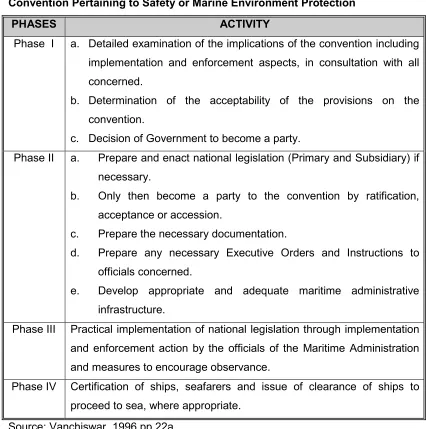
implementation should follow a step-by-step approach as illustrated in phases in Table 3-2.
Table 3-2 The Process of Implementation of Any International Maritime Convention Pertaining to Safety or Marine Environment Protection
PHASES ACTIVITY
Phase I a. Detailed examination of the implications of the convention including implementation and enforcement aspects, in consultation with all concerned.
b. Determination of the acceptability of the provisions on the convention.
c. Decision of Government to become a party.
Phase II a. Prepare and enact national legislation (Primary and Subsidiary) if necessary.
b. Only then become a party to the convention by ratification, acceptance or accession.
c. Prepare the necessary documentation.
d. Prepare any necessary Executive Orders and Instructions to officials concerned.
e. Develop appropriate and adequate maritime administrative infrastructure.
Phase III Practical implementation of national legislation through implementation and enforcement action by the officials of the Maritime Administration and measures to encourage observance.
Phase IV Certification of ships, seafarers and issue of clearance of ships to proceed to sea, where appropriate.
Source: Vanchiswar, 1996 pp 22a.
3.3.2 Situation in Ghana
(a) The IMO sends out agenda to contracting Parties,
(b) The Shipping Commissioner (Head of the Division) in consultation with the Sector Minister (in this case Roads and Transports) appoints delegates for the Conference 5;
(c) Delegates attend the conference and usually sign convention/amendments as pre-agreed.
(d) On returning to Ghana, Head of the Delegation or the Shipping Commissioner prepares a paper highlighting the relevance of the signed instrument to the Minister;
(e) Minister comments and sends the document back to the Commissioner; (f) The document is then sent to the Attorney General´s Department (Ministry of
Justice) for vetting to make sure it does not conflict with other National legislation or International treaty;
(g) The document is sent back to the Commissioner with any comments or recommendations.
(h) Necessary changes are made before it is sent back to the Minister who then requests the Speaker of Parliament for a hearing on the issue at the same time the document is being scrutinised by the Parliamentary Select-Committee on Transport;
(i) The document is then defended and if approved by the Parliament, the Minister then informs the Ministry of Foreign affairs who prepares an instrument of Ratification for deposition at the IMO or equivalent organisation;
(j) Ghana then becomes a party to the convention;
(k) A draft Bill or act goes through a similar procedure before it is passed into law (and this is where the problem usually arise);
(l) Thereafter, implementation action is supposed to be undertaken before the convention enters into force. But this is usually the end of the matter.
In comparison with Vanchiswar´s proposals, it can be deduced that Ghana does not adhere to a phased approach for adoption, ratification and implementation of
5 Although not an ideal arrangement, personnel from the Ghana High Commission in London
conventions. Thus the essential stage of drafting the respective domestic legislation before ratifying a convention is clearly ignored. This anomaly and the following problems partly account for the delays in ratification and implementation of conventions:
(a) Maritime affairs are not ranked as high priority issues at the legislature and most people are uncomfortable with maritime issues;
(b) Lack of legal experts (delegates are usually not legal experts);
(c) Not all Members of Parliament dealing with maritime issues are or care to know what goes into translating national conventions into domestic laws. As such maritime related documents do not get the deserved attention;
(d) The bureaucratic process is complex and does not lend itself to quick reactions.
There are also benefits derived from active participation in all IMO deliberations and many countries such as Denmark and Sweden have aptly demonstrated this. Although the two countries are civil law States, they often participate, contribute and make proposals for amendments to existing conventions. In most cases, they start drafting their domestic legislation before the final conference for adoption of a proposal and are therefore able to ratify conventions or amendments and to pass their domestic laws almost simultaneously.
3.4 Formulation of National Legislation
Legislation consists of laws enacted by a legislature to give full effect to international conventions. They are the necessary domestic instruments required to give legal effect to the treaties usually preceding ratification and before implementation. If necessary, this is done in two forms as follows:
(a) Primary legislation is for example Merchant Shipping Act.
certificate rules, life saving appliances regulations and regulation for the prevention of pollution by oil.
3.5 Regulation and Control
The essential elements of regulation and control are:
(a) Registration and Manning:- Flag states have prerogative to register and ensure safe manning of ships under UNCLOS;
(b) Specification, Survey and Certification: - Flag states or designated organisation are obliged to approve specification for construction in accordance with relevant conventions and to approve or endorse certificates for ships, crew, equipment and appliances after the initial survey.
(c)
The Harmonised System of Ship Survey and Certification (HSSC): - In 1988, the IMO adopted a Protocol to the SOLAS and Load Line Conventions for the introduction of the HSSC which entered into force on 3 February 2000 along with a 1990 amendment to the MARPOL 73/78 Convention regarding HSSC 6 (IMO News No.1, 2000). The main changes to the SOLAS and LoadLines Conventions are that annual inspections have been made mandatory for cargo ships and unscheduled inspections have been discontinued. The Harmonised system provides for a one-year standard interval between surveys, based on initial, annual, intermediate, periodical and renewal surveys as appropriate. In 1999, the IMO further adopted a resolution, A.883 (21), Global and Uniform Implementation of the HSSC. The types of surveys required under this new resolution are, the initial, periodical, renewal, intermediate, annual and additional surveys
.
(d) Inspections: - Inspections can be conducted by port states to verify the authenticity and validity of certificates in respect of foreign ships and the certificates may be accepted as prima facie evidence that the ship complies with the provisions of a particular convention.
6 MARPOL allowed for amendments to the certification and survey requirements to be accepted by
3.5.1 Flag State
The Flag State is the state whose flag a vessel is entitled to fly. Usually, before any state allows a sea going vessel to fly its flag, the vessel must be registered. This enables the State to exercise jurisdiction and control in administrative, technical and social matters. These functions span across construction; maintenance and manning of ships usually enforced through approval, surveys, certification and monitoring. In addition, the flag State is responsible for promulgating laws and regulations and for taking all other steps which may be necessary to give the applicable conventions full and complete effect. The state also ensures that, from the point of view of safety of life and pollution prevention, a ship is fit for the service, for which it is intended and seafarers are fit and qualified for their duties. All these constitute flag state implementation. The requirements are found in the following conventions (Mukherjee, 1999):
(a) Registration, manning and other matters UNCLOS, Article 91, 94, 97; (b) Ship surveys– SOLAS, Load Line and MARPOL;
(c) Regulation of certification regime under MARPOL, Load Lines including mandatory ISM Code;
(d) Regulation of construction, equipment and seaworthiness under SOLAS, MARPOL, Load Lines, COLREGS;
(e) Manning, training, certification and watchkeeping regime under STCW and relevant ILO convention;
(f) Maritime labour related issues – ILO and SOLAS;
3.5.2 Port State
(a) UNCLOS Part XII: Main provisions: Articles 218, 266 and other provisions: Articles 217, 222 to 226 and 228;
(b) MARPOL 73/78: Articles: 5(2) and (3), 6(2) to (5); Annex I Regulation 8A; annex II, Regulation 15; Annex III, Regulation, Annex V, Regulation 8; (c) SOLAS chapter 1, Regulation 19;
(d) LOADLINE Article 21;
(e) STCW Article X, Regulation 1/4; STCW Code Section A-1/4, Section B-1/4 (f) ILO 147, Article 4.
(g) Procedures for PSC set out in IMO Resolution A.787 (19).
3.5.3 Coastal State
The notion of the freedom of the high seas that accorded little or no authority over adjacent waters to the Coastal State, has been superseded by UNCLOS, permitting approximately forty percent of former `high seas` to be brought under varying degrees of coastal State jurisdiction (DOSP, 1985, pp1). A coastal States´ power to control activities of foreign ships in territorial waters, internal waters, EEZ and adjacent zones in respect of safety and marine pollution is called coastal state jurisdiction under UNCLOS article 73 and it is only limited by flag state jurisdiction and safeguards provided under UNCLOS. Other jurisdictions are dictated by the intervention on the high seas on pollution issues permitted under 1969 Intervention Convention and routeing measures under UNCLOS Article 211, SOLAS chapter V, COLREGS rule 10 and Resolution A. 572(14) on ships routeing (Mukherjee, 1999a).
3.6 Enforcement of Conventions
infringements depending on the applicable jurisdiction. This calls for national penal legislation for the maritime sector since general penal sanctions within the existing national laws are unlikely to offer adequate provisions for maritime offences. In broad terms, regulatory enforcement of conventions relating to maritime safety and pollution prevention by contracting Parties are divided into two categories (Sasamura, 1984) as follows:
(a) Enforcement conducted by Administrations or recognised organisations working on behalf of contracting Governments. This includes surveys, inspection and certification of ship in respect of design, construction and equipment.
(b) Enforcement carried out by port and coastal States, which include port state control of ships and certificates and the surveillance and detection of discharges in breach of a convention.
Effective judicial enforcement requires that separate penal laws are drafted for the maritime sector or that sanctions should be prescribed in maritime legislation. It is imperative that special courts are designated for handling maritime cases.
3.7 National Legislation on Maritime Safety and Pollution Prevention
Ghana does not have any umbrella type environmental legislation such as an Environmental Protection Act. Matters relating to the protection of the marine environment are dealt with in a sectoral manner. On this matter, Kwakye (1999, pp2) a Director of Planning at the Ministry of Roads and Transport, noted during the National Forum on the Ghana Maritime Authority and Shipping Bills that:
there are a number of disjointed and uncoordinated maritime laws and regulations in the country resulting in functional overlaps and conflict situations which impact negatively on the rational allocation and optimum use of resources in the maritime sector.