Proceedings of the 55th Annual Meeting of the Association for Computational Linguistics (Short Papers), pages 672–678 Proceedings of the 55th Annual Meeting of the Association for Computational Linguistics (Short Papers), pages 672–678
Character Composition Model with Convolutional Neural Networks for
Dependency Parsing on Morphologically Rich Languages
Xiang Yu and Ngoc Thang Vu Institut für Maschinelle Sprachverarbeitung
Universität Stuttgart
{xiangyu,thangvu}@ims.uni-stuttgart.de
Abstract
We present a transition-based dependency parser that uses a convolutional neural network to compose word representations from characters. The character compo-sition model shows great improvement over the word-lookup model, especially for parsing agglutinative languages. These improvements are even better than using pre-trained word embeddings from extra data. On the SPMRL data sets, our sys-tem outperforms the previous best greedy parser (Ballesteros et al.,2015) by a mar-gin of 3% on average.1
1 Introduction
As with many other NLP tasks, dependency pars-ing also suffers from the out-of-vocabulary (OOV) problem, and probably more than others since training data with syntactical annotation is usually scarce. This problem is particularly severe when the target is a morphologically rich language. For example, in the SPMRL shared task data sets ( Sed-dah et al.,2013,2014), 4 out of 9 treebanks contain more than 40% word types in the development set that are never seen in the training set.
One way to tackle the OOV problem is to pre-train the word embeddings, e.g., with word2vec (Mikolov et al.,2013), from a large set of unlabeled data. This comes with two main advantages: (1) more word types, which means that the vocabulary is extended by the unlabeled data, so that some of the OOV words now have a learned representation; (2) more word tokens per type, which means that the syntactic and semantic similarities of the words are better modeled than only using the parser train-ing data.
1The parser is available at http://www.ims.
uni-stuttgart.de/institut/mitarbeiter/ xiangyu/index.en.html
Pre-trained word embeddings can alleviate the OOV problem by expanding the vocabulary, but it does not model the morphological information. Instead of looking up word embeddings, many researchers propose to compose the word repre-sentation from characters for various tasks, e.g., part-of-speech tagging (dos Santos and Zadrozny,
2014;Plank et al., 2016), named entity recogni-tion (dos Santos and Guimarães,2015), language modeling (Ling et al.,2015), machine translation (Costa-jussà and Fonollosa, 2016). In particular,
Ballesteros et al. (2015) use a bidirectional long short-term memory (LSTM) character model for dependency parsing. Kim et al. (2016) present a convolutional neural network (CNN) character model for language modeling, but make no com-parison among the character models, and state that “it remains open as to which character composition model (i.e., LSTM or CNN) performs better”.
We propose to apply the CNN model by Kim et al. (2016) in a greedy transition-based depen-dency parser with feed-forward neural networks (Chen and Manning, 2014; Weiss et al., 2015). This model requires no extra unlabeled data but performs better than using pre-trained word em-beddings. Furthermore, it can be combined with word embeddings from the lookup table since they capture different aspects of word similarities.
Experimental results show that the CNN model works especially well on agglutinative languages, where the OOV rates are high. On other morpho-logically rich languages, the CNN model also per-forms at least as good as the word-lookup model.
Furthermore, our CNN model outperforms both the original and our re-implementation of the bidi-rectional LSTM model byBallesteros et al.(2015) by a large margin. It provides empirical evidence to the aforementioned open question, suggesting that the CNN is the better character composition model for dependency parsing.
2 Parsing Models
2.1 Baseline Parsing Model
As the baseline parsing model, we re-implement the greedy parser inWeiss et al.(2015) with some modifications, which brings about 0.5% improve-ment, outlined below.2
Since most treebanks contain non-projective trees, we use an approximate non-projective tran-sition system similar toAttardi(2006). It has two additional transitions (LEFT-2 and RIGHT-2) to the Arc-Standard system (Nivre,2004) that attach the top of the stack to the third token on the stack, or
vice versa. We also extend the feature templates in
Weiss et al.(2015) by extracting the children of the third token in the stack. The complete transitions and feature templates are listed in AppendixA.
The feature templates consist of 24 tokens in the configuration, we look up the embeddings of the word forms, POS tags and dependency labels of each token.3 We then concatenate the embeddings 𝐄𝑤𝑜𝑟𝑑(𝑡𝑖),𝐄𝑡𝑎𝑔(𝑡𝑖),𝐄𝑙𝑎𝑏𝑒𝑙(𝑡𝑖)for each token𝑡𝑖, and
use a dense layer with ReLU non-linearity to ob-tain a compact representation𝐟(𝑡𝑖)of the token:
𝐱(𝑡𝑖) = [𝐄𝑤𝑜𝑟𝑑(𝑡𝑖);𝐄𝑡𝑎𝑔(𝑡𝑖);𝐄𝑙𝑎𝑏𝑒𝑙(𝑡𝑖)] (1)
𝐟(𝑡𝑖) = max{𝟎,𝐖𝑓𝐱(𝑡𝑖) +𝐛𝑓}
We concatenate the representations of the to-kens and feed them through two hidden layers with ReLU non-linearity, and finally into the softmax layer to compute the probability of each transition:
𝐡0= [𝐟(𝑡1);𝐟(𝑡2);...;𝐟(𝑡24)]
𝐡1= max{𝟎,𝐖1𝐡0+𝐛1}
𝐡2= max{𝟎,𝐖2𝐡1+𝐛2}
𝑝(⋅|𝑡1, ..., 𝑡24) = softmax(𝐖3𝐡2+𝐛3)
𝐄𝑤𝑜𝑟𝑑,𝐄𝑡𝑎𝑔,𝐄𝑙𝑎𝑏𝑒𝑙, 𝐖𝑓,𝐖1, 𝐖2,𝐖3,𝐛𝑓,𝐛1,
𝐛2, 𝐛3 are all the parameters that will be learned through back propagation with averaged stochastic gradient descent in mini-batches.
Note that Weiss et al.(2015) directly concate-nate the embeddings of the words, tags, and labels of all the tokens together as input to the hidden layer. Instead, we first group the embeddings of the word, tag, and label of each token and compute 2We only experiment with the greedy parser, since this pa-per focuses on the character-level input features and is inde-pendent of the global training and inference as inWeiss et al.
(2015);Andor et al.(2016).
3The tokens in the stack and buffer do not have labels yet, we use a special label<NOLABEL>instead.
an intermediate representation with shared param-eters, then concatenate all the representations as in-put to the hidden layer.
2.2 LSTM Character Composition Model
To tackle the OOV problem, we want to replace the word-lookup table with a function that composes the word representation from characters.
As a baseline character model, we re-implement the bidirectional LSTM character composition model followingBallesteros et al.(2015). We re-place the lookup table𝐄𝑤𝑜𝑟𝑑 in the baseline parser with the final outputs of the forward and backward LSTMs ⃖⃖⃖⃖⃖⃖⃖⃖𝐥𝐬𝐭𝐦 and𝐥𝐬𝐭𝐦⃖⃖⃖⃖⃖⃖⃖⃗. Equation (1) is then
re-placed with
𝐱(𝑡𝑖) = [⃖⃖⃖⃖⃖⃖⃖⃖𝐥𝐬𝐭𝐦(𝑡𝑖);𝐥𝐬𝐭𝐦⃖⃖⃖⃖⃖⃖⃖⃗(𝑡𝑖);𝐄𝑡𝑎𝑔(𝑡𝑖);𝐄𝑙𝑎𝑏𝑒𝑙(𝑡𝑖)].
We refer the readers toLing et al. (2015) for the details of the bidirectional LSTM.
2.3 CNN Character Composition Model
In contrast to the LSTM model, we propose to use a “flat” CNN as the character composition model, similar toKim et al.(2016).4
Equation (1) is thus replaced with
𝐱(𝑡𝑖) =[𝐜𝐧𝐧𝑙1(𝑡
𝑖);𝐜𝐧𝐧𝑙2(𝑡𝑖);...;𝐜𝐧𝐧𝑙𝑘(𝑡𝑖);
𝐄𝑡𝑎𝑔(𝑡𝑖);𝐄𝑙𝑎𝑏𝑒𝑙(𝑡𝑖)]. (2)
Concretely, the input of the model is a concate-nated matrix of character embeddings𝐂∈ℝ𝑑𝑖×𝑤, where 𝑑𝑖 is the dimensionality of character
em-beddings (number of input channels) and𝑤is the
length of the padded word.5 We apply 𝑘
convo-lutional kernels ∈ ℝ𝑑𝑜×𝑑𝑖×𝑙𝑘 with ReLU non-linearity on the input, where𝑑𝑜 is the number of output channels and 𝑙𝑘 is the length of the
ker-nel. The output of the convolution operation is
𝐎𝑐𝑜𝑛𝑣 ∈ ℝ𝑑𝑜×(𝑙−𝑘+1), and we apply a max-over-time pooling that takes the maximum activations of the kernel along each channel, obtaining the fi-nal output 𝐎𝑓𝑖𝑛𝑎𝑙 ∈ ℝ𝑑𝑜, which corresponds to the most salient n-gram representation of the word, denoted𝐜𝐧𝐧𝑙𝑘 in Equation (2). We then concate-nate the outputs of several such CNNs with differ-ent lengths, so that the information from differdiffer-ent n-grams are extracted and can interact with each other.
4We do not use the highway networks since it did not im-prove the performance in preliminary experiments.
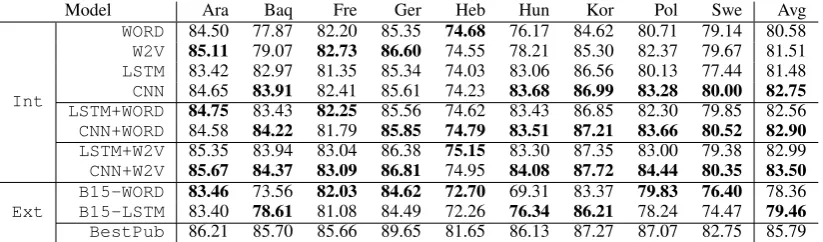
Model Ara Baq Fre Ger Heb Hun Kor Pol Swe Avg
Int
WORD 84.50 77.87 82.20 85.35 74.68 76.17 84.62 80.71 79.14 80.58 W2V 85.11 79.07 82.73 86.60 74.55 78.21 85.30 82.37 79.67 81.51 LSTM 83.42 82.97 81.35 85.34 74.03 83.06 86.56 80.13 77.44 81.48 CNN 84.65 83.91 82.41 85.61 74.23 83.68 86.99 83.28 80.00 82.75 LSTM+WORD 84.75 83.43 82.25 85.56 74.62 83.43 86.85 82.30 79.85 82.56 CNN+WORD 84.58 84.22 81.79 85.85 74.79 83.51 87.21 83.66 80.52 82.90 LSTM+W2V 85.35 83.94 83.04 86.38 75.15 83.30 87.35 83.00 79.38 82.99 CNN+W2V 85.67 84.37 83.09 86.81 74.95 84.08 87.72 84.44 80.35 83.50
Ext
[image:3.595.94.506.62.183.2]B15-WORD 83.46 73.56 82.03 84.62 72.70 69.31 83.37 79.83 76.40 78.36 B15-LSTM 83.40 78.61 81.08 84.49 72.26 76.34 86.21 78.24 74.47 79.46 BestPub 86.21 85.70 85.66 89.65 81.65 86.13 87.27 87.07 82.75 85.79
Table 1: LAS on the test sets, the best LAS in each group is marked in bold face.
3 Experiments
3.1 Experimental Setup
We conduct our experiments on the treebanks from the SPMRL 2014 shared task (Seddah et al.,2013,
2014), which includes 9 morphologically rich lan-guages: Arabic, Basque, French, German, He-brew, Hungarian, Korean, Polish, and Swedish. All the treebanks are split into training, develop-ment, and test sets by the shared task organizers. We use the fine-grained predicted POS tags pro-vided by the organizers, and evaluate the labeled attachment scores (LAS) including punctuation.
We experiment with the CNN-based character composition model (CNN) along with several
base-lines. The first baseline (WORD) uses the
word-lookup model described in Section 2.1 with ran-domly initialized word embeddings. The sec-ond baseline (W2V) uses pre-trained word
embed-dings by word2vec (Mikolov et al., 2013) with the CBOW model and default parameters on the unlabeled texts from the shared task organizers. The third baseline (LSTM) uses a bidirectional
LSTM as the character composition model follow-ingBallesteros et al.(2015). AppendixClists the hyper-parameters of all the models.
Further analysis suggests that combining the character composition models with word-lookup models could be beneficial since they capture dif-ferent aspects of word similarities (orthographic vs. syntactic/semantic). We therefore experiment with four combined models in two groups: (1) ran-domly initialized word embeddings (LSTM+WORD
vs. CNN+WORD), and (2) pre-trained word
embed-dings (LSTM+W2Vvs. CNN+W2V).
The experimental results are shown in Table1, with Int denoting internal comparisons (with
three groups) andExtdenoting external
compar-isons, the highest LAS in each group is marked in bold face.
3.2 Internal Comparisons
In the first group, we compare the LAS of the four single modelsWORD,W2V,LSTM, andCNN.
In macro average of all languages, theCNNmodel
performs 2.17% higher than theWORDmodel, and
1.24% higher than the W2V model. The LSTM
model, however, performs only 0.9% higher than the WORD model and 1.27% lower than the CNN
model.
The CNN model shows large improvement in four languages: three agglutinative languages (Basque, Hungarian, Korean), and one highly in-flected fusional language (Polish). They all have high OOV rate, thus difficult for the baseline parser that does not model morphological information. Also, morphemes in agglutinative languages tend to have unique, unambiguous meanings, thus eas-ier for the convolutional kernels to capture.
In the second group, we observe that the addi-tional word-lookup model does not significantly improve the CNN moodel (from 82.75% in CNN
to 82.90% in CNN+WORD on average) while the
LSTM model is improved by a much larger margin (from 81.48% inLSTMto 82.56% inLSTM+WORD
on average). This suggests that the CNN model has already learned the most important informa-tion from the the word forms, while the LSTM model has not. Also, the combined CNN+WORD
model is still better than theLSTM+WORDmodel,
despite the large improvement in the latter. In the third group where pre-trained word em-beddings are used, combining CNN with W2V
brings an extra 0.75% LAS over theCNN model.
Combining LSTM with W2V shows similar trend
but with much larger improvement, yet again,
CNN+W2VoutperformsLSTM+W2Vboth on
Model Case Ara Baq Fre Ger Heb Hun Kor Pol Swe Avg CNN ΔΔOOVIV 0.12 2.72 -0.440.03 5.78 0.33 0.13 -0.35 1.48 1.300.10 -1.04 5.04 2.17 0.98 1.39 0.812.34 0.95 1.74
[image:4.595.123.482.63.114.2]LSTM ΔOOVΔIV -0.58 1.98 -0.55 -0.08 -1.23 1.62 1.12 -0.49 0.21 0.22 -0.32 5.09 0.12 -0.21 -1.99 4.74 1.51 0.10 0.38 1.05
Table 2: LAS improvements byCNNandLSTMin the IV and OOV cases on the development sets.
Mod Ara Baq Fre Ger Heb Hun Kor Pol Swe Avg
♣bc -1.23 -1.94 -1.35 -1.57 -0.79 -3.23 -1.22 -2.53 -1.54 -1.71 a♣c -3.47 -3.96 -2.39 -2.54 -1.24 -4.52 -3.21 -4.47 -4.19 -3.33 ab♣ -1.52 -15.31 -0.72 -1.23 -0.26 -13.97 -10.22 -3.52 -2.61 -5.48 a♣♣ -3.73 -19.29 -3.30 -3.49 -1.21 -17.89 -12.95 -6.22 -6.01 -8.23
♣b♣ -3.02 -18.06 -2.60 -3.54 -1.42 -18.43 -11.69 -6.22 -3.85 -7.65
♣♣c -5.11 -7.90 -4.05 -4.86 -2.50 -9.75 -4.56 -6.71 -6.74 -5.80 Table 3: Degradation of LAS of theCNNmodel on the masked development sets.
3.3 External Comparisons
We also report the results of the two mod-els from Ballesteros et al. (2015): B15-WORD
with randomly initialized word embeddings and
B15-LSTMas their proposed model. Finally, we
report the best published results (BestPub) on
this data set (Björkelund et al.,2013,2014). On average, the B15-LSTM model improves
their own baseline by 1.1%, similar to the 0.9% improvement of ourLSTMmodel, which is much
smaller than the 2.17% improvement of the CNN
model. Furthermore, theCNNmodel is improved
from a strong baseline: ourWORDmodel performs
already 2.22% higher than theB15-WORDmodel.
Comparing the individual performances on each language, we observe that theCNN model almost
always outperforms the WORD model except for
Hebrew. However, both LSTM and B15-LSTM
perform higher than baseline only on the three agglutinative languages (Basque, Hungarian, and Korean), and lower than baseline on the other six.
Ballesteros et al.(2015) do not compare the ef-fect of adding a word-lookup model to the LSTM model as in our second group of internal com-parisons. However,Plank et al.(2016) show that combining the same LSTM character composition model with word-lookup model improves the per-formance of POS tagging by a very large mar-gin. This partially confirms our hypothesis that the LSTM model does not learn sufficient information from the word forms.
Considering both internal and external compar-isons in both average and individual performances, we argue that CNN is more suitable than LSTM as character composition model for parsing.
While comparing to the best published results
(Björkelund et al., 2013, 2014), we have to note that their approach uses explicit morphological features, ensemble, ranking, etc., which all can boost parsing performance. We only use a greedy parser with much fewer features, but bridge the 6 points gap between the previous best greedy parser and the best published result by more than one half.
3.4 Discussion on CNN and LSTM
We conjecture that the main reason for the bet-ter performance of CNN over LSTM is its flex-ibility in processing sub-word information. The CNN model uses different kernels to capture n-grams of different lengths. In our setting, a kernel with a minimum length of 3 can capture short mor-phemes; and with a maximum length of 9, it can practically capture a normal word. With the flexi-bility of capturing patterns from morphemes up to words, the CNN model almost always outperforms the word-lookup model.
In theory, LSTM has the ability to model much longer sequences, however, it is composed step by step with recurrence. For such deep network ar-chitectures, more data would be required to learn the same sequence, in comparison to CNN which can directly use a large kernel to match the pat-tern. For dependency parsing, training data is usu-ally scarce, this could be the reason that the LSTM has not utilized its full potential.
3.5 Analyses on OOV and Morphology
The motivation for using character composition models is based on the hypothesis that it can ad-dress the OOV problem. To verify the hypothesis, we analyze the LAS improvements of theCNNand LSTMmodel on the development sets in two cases:
[image:4.595.125.472.147.221.2]vocabu-lary or (2) at least one of them is out of vocabuvocabu-lary. Table2shows the results, where the two cases are denoted asΔIVandΔOOV. The general trend in
the results is that the improvements of both mod-els in the OOV case are larger than in the IV case, which means that the character composition mod-els indeed alleviates the OOV problem. Also,CNN
improves on seven languages in the IV case and eight languages in the OOV case, and it performs consistently better thanLSTMin both cases.
To analyze the informativeness of the mor-phemes at different positions, we conduct an ab-lation experiment. We split each word equally into three thirds, approximating the prefix, stem, and suffix. Based on that, we construct six modi-fied versions of the development sets, in which we mask one or two third(s) of the characters in each word. Then we parse them with the CNNmodels
trained on normal data. Table3shows the degra-dations of LAS on the six modified data sets com-pared to parsing the original data, where the posi-tion of♣signifies the location of the masks. The three agglutinative languages Basque, Hungarian, and Korean suffer the most with masked words. In particular, the suffixes are the most informa-tive for parsing in these three languages, since they cause the most loss while masked, and the least loss while unmasked. The pattern is quite differ-ent on the other languages, in which the distinction of informativeness among the three parts is much smaller.
4 Conclusion
In this paper, we propose to use a CNN to compose word representations from characters for depen-dency parsing. Experiments show that the CNN model consistently improves the parsing accuracy, especially for agglutinative languages. In an exter-nal comparison on the SPMRL data sets, our sys-tem outperforms the previous best greedy parser.
We also provide empirical evidence and analy-sis, showing that the CNN model indeed alleviates the OOV problem and that it is better suited than the LSTM in dependency parsing.
Acknowledgements
This work was supported by the German Research Foundation (DFG) in project D8 of SFB 732. We also thank our collegues in the IMS, especially An-ders Björkelund, for valuable discussions, and the anonymous reviewers for the suggestions.
References
Daniel Andor, Chris Alberti, David Weiss, Aliaksei Severyn, Alessandro Presta, Kuzman Ganchev, Slav Petrov, and Michael Collins. 2016. Globally nor-malized transition-based neural networks. In Pro-ceedings of the 54th Annual Meeting of the Associa-tion for ComputaAssocia-tional Linguistics (Volume 1: Long Papers). Association for Computational Linguistics, pages 2442–2452. https://doi.org/10.18653/v1/P16-1231.
Giuseppe Attardi. 2006. Experiments with a multilan-guage non-projective dependency parser. In Pro-ceedings of the Tenth Conference on Computational Natural Language Learning (CoNLL-X). Associa-tion for ComputaAssocia-tional Linguistics, pages 166–170. http://aclweb.org/anthology/W06-2922.
Miguel Ballesteros, Chris Dyer, and A. Noah Smith. 2015. Improved transition-based parsing by mod-eling characters instead of words with lstms. In Proceedings of the 2015 Conference on Empirical Methods in Natural Language Processing. Associa-tion for ComputaAssocia-tional Linguistics, pages 349–359. https://doi.org/10.18653/v1/D15-1041.
Anders Björkelund, Özlem Çetinoğlu, Agnieszka Faleńska, Richárd Farkas, Thomas Müller, Wolf-gang Seeker, and Zsolt Szántó. 2014. The ims-wrocław-szeged-cis entry at the spmrl 2014 shared task: Reranking and morphosyntax meet unlabeled data.Notes of the SPMRL.
Anders Björkelund, Özlem Çetinoğlu, Richárd Farkas, Thomas Mueller, and Wolfgang Seeker. 2013. (re)ranking meets morphosyntax: State-of-the-art results from the spmrl 2013 shared task. In Pro-ceedings of the Fourth Workshop on Statistical Pars-ing of Morphologically-Rich Languages. Associa-tion for ComputaAssocia-tional Linguistics, pages 135–145. http://aclweb.org/anthology/W13-4916.
Danqi Chen and Christopher Manning. 2014. A fast and accurate dependency parser using
neu-ral networks. In Proceedings of the 2014
Conference on Empirical Methods in Natural Language Processing (EMNLP). Association for Computational Linguistics, pages 740–750. https://doi.org/10.3115/v1/D14-1082.
R. Marta Costa-jussà and R. José A. Fonollosa. 2016. Character-based neural machine translation. In Pro-ceedings of the 54th Annual Meeting of the Associa-tion for ComputaAssocia-tional Linguistics (Volume 2: Short Papers). Association for Computational Linguistics, pages 357–361. https://doi.org/10.18653/v1/P16-2058.
Cicero dos Santos and Bianca Zadrozny. 2014. Learn-ing character-level representations for part-of-speech tagging. In Proceedings of the 31st International Conference on Machine Learning (ICML-14). pages 1818–1826.
Kaiming He, Xiangyu Zhang, Shaoqing Ren, and Jian Sun. 2015. Delving deep into rectifiers: Surpassing human-level performance on imagenet classification. InProceedings of the IEEE international conference on computer vision. pages 1026–1034.
Yoon Kim, Yacine Jernite, David Sontag, and Alexan-der M. Rush. 2016. Character-aware neural language models. InProceedings of the Thirtieth AAAI Con-ference on Artificial Intelligence, February 12-17, 2016, Phoenix, Arizona, USA.. AAAI Press, pages 2741–2749.
Wang Ling, Chris Dyer, W. Alan Black, Isabel Trancoso, Ramon Fermandez, Silvio Amir, Luis Marujo, and Tiago Luis. 2015. Finding func-tion in form: Composifunc-tional character models for open vocabulary word representation. In Proceed-ings of the 2015 Conference on Empirical Meth-ods in Natural Language Processing. Association for Computational Linguistics, pages 1520–1530. https://doi.org/10.18653/v1/D15-1176.
Tomas Mikolov, Ilya Sutskever, Kai Chen, Greg S Cor-rado, and Jeff Dean. 2013. Distributed representa-tions of words and phrases and their composition-ality. In C. J. C. Burges, L. Bottou, M. Welling, Z. Ghahramani, and K. Q. Weinberger, editors, Ad-vances in Neural Information Processing Systems 26, Curran Associates, Inc., pages 3111–3119. Joakim Nivre. 2004. Incrementality in
deter-ministic dependency parsing. In
Proceed-ings of the Workshop on Incremental Parsing: Bringing Engineering and Cognition Together. http://aclweb.org/anthology/W04-0308.
Barbara Plank, Anders Søgaard, and Yoav Goldberg. 2016. Multilingual part-of-speech tagging with bidirectional long short-term memory models and auxiliary loss. In Proceedings of the 54th An-nual Meeting of the Association for Computational Linguistics (Volume 2: Short Papers). Associa-tion for ComputaAssocia-tional Linguistics, pages 412–418. https://doi.org/10.18653/v1/P16-2067.
Djamé Seddah, Sandra Kübler, and Reut Tsarfaty. 2014. Introducing the spmrl 2014 shared task on parsing morphologically-rich languages. In Pro-ceedings of the First Joint Workshop on Statis-tical Parsing of Morphologically Rich Languages and Syntactic Analysis of Non-Canonical Lan-guages. Dublin City University, pages 103–109. http://aclweb.org/anthology/W14-6111.
Djamé Seddah, Reut Tsarfaty, Sandra Kübler, Marie Candito, D. Jinho Choi, Richárd Farkas, Jen-nifer Foster, Iakes Goenaga, Koldo Gojenola Gal-letebeitia, Yoav Goldberg, Spence Green, Nizar
Habash, Marco Kuhlmann, Wolfgang Maier, Joakim Nivre, Adam Przepiórkowski, Ryan Roth, Wolfgang Seeker, Yannick Versley, Veronika Vincze, Marcin Woliński, Alina Wróblewska, and Villemonte Eric de la Clergerie. 2013. Overview of the spmrl 2013 shared task: A cross-framework evaluation of pars-ing morphologically rich languages. In Proceed-ings of the Fourth Workshop on Statistical Pars-ing of Morphologically-Rich Languages. Associa-tion for ComputaAssocia-tional Linguistics, pages 146–182. http://aclweb.org/anthology/W13-4917.
A Transitions and Feature Templates
Transition Configurations (Before⇒After)
SHIFT (𝜎,[𝑤𝑖|𝛽], 𝐴)⇒([𝜎|𝑤𝑖], 𝛽, 𝐴)
LEFT ([𝜎|𝑤𝑖, 𝑤𝑗], 𝛽, 𝐴)
⇒([𝜎|𝑤𝑗], 𝛽, 𝐴∪ (𝑤𝑗 →𝑤𝑖))
RIGHT ([𝜎|𝑤𝑖, 𝑤𝑗], 𝛽, 𝐴)
⇒([𝜎|𝑤𝑖], 𝛽, 𝐴∪ (𝑤𝑖→𝑤𝑗))
LEFT-2 ([𝜎|𝑤𝑖, 𝑤𝑗, 𝑤𝑘], 𝛽, 𝐴)
⇒([𝜎|𝑤𝑗, 𝑤𝑘], 𝛽, 𝐴∪ (𝑤𝑘 →𝑤𝑖))
RIGHT-2 ([𝜎|𝑤𝑖, 𝑤𝑗, 𝑤𝑘], 𝛽, 𝐴)
⇒([𝜎|𝑤𝑖, 𝑤𝑗], 𝛽, 𝐴∪ (𝑤𝑖→𝑤𝑘))
Table 4: The transition system in our experiments, where the configuration is a tuple of (stack, buffer, arcs).
𝑠1,𝑠2,𝑠3,𝑠4,𝑏1,𝑏2,𝑏3,𝑏4,
𝑠1.𝑙𝑐1,𝑠1.𝑙𝑐2,𝑠1.𝑟𝑐1,𝑠1.𝑟𝑐2,
𝑠2.𝑙𝑐1,𝑠2.𝑙𝑐2,𝑠2.𝑟𝑐1,𝑠2.𝑟𝑐2,
𝑠3.𝑙𝑐1,𝑠3.𝑙𝑐2,𝑠3.𝑟𝑐1,𝑠3.𝑟𝑐2,
𝑠1.𝑙𝑐1.𝑙𝑐1,𝑠1.𝑙𝑐1.𝑟𝑐1,𝑠1.𝑟𝑐1.𝑙𝑐1,𝑠1.𝑟𝑐1.𝑟𝑐1 Table 5: The list of tokens to extract feature tem-plates, where𝑠𝑖denotes the𝑖-th token in the stack,
𝑏𝑖the𝑖-th token in the buffer,𝑙𝑐𝑖denotes the𝑖-th
leftmost child,𝑟𝑐𝑖the𝑖-th rightmost child.
B Character Input Preprocessing
For the CNN input, we use a list of characters with fixed length to for batch processing. We add some special symbols apart from the normal al-phabets, digits, and punctuations: <SOW> as the
start of the word,<EOW>as the end of the word,
<MUL> as multiple characters in the middle of
the word squeezed into one symbol, <PAD> as
padding equally on both sides, and<UNK>as
char-acters unseen in the training data.
For example, if we limit the input length to 9, a short word ein will be converted into <PAD> -<PAD>-<SOW>-e-i-n-<EOW>-<PAD>-<PAD>;
a long word prächtiger will be <SOW> -p-r-ä-<MUL>-g-e-r-<EOW>. In practice, we set the
length as 32, which is long enough for almost all the words.
C Hyper-Parameters
The common hyper-parameters of all the models are tuned on the development set in favor of the
WORDmodel:
• 100,000 training steps with random sampling of mini-batches of size 100;
• test on the development set every 2,000 steps; • early stop if the LAS on the development does
not improve for 3 times in a row;
• learning rate of 0.1, with exponential decay rate of 0.95 for every 2,000 steps;
• L2-regularization rate of10−4;
• averaged SGD with momentum of 0.9;
• parameters are initialized following He et al.
(2015);
• dimensionality of the embeddings of each word, tag, and label are 256, 32, 32, respectively; • dimensionality of the hidden layers are 512, 256; • dropout on both hidden layers with rate of 0.1; • total norm constraint of the gradients is 10.
The hyper-parameters for theCNNmodel are:
• dimensionality of the character embedding is 32;
• 4 convolutional kernels of lengths 3, 5, 7, 9; • number of output channels of each kernel is 64; • fixed length for the character input is 32.
The hyper-parameters for theLSTMmodel are:
• 128 hidden units for both LSTMs; • all the gates use orthogonal initialization; • gradient clipping of 10;