Silene sunhangii
(Caryophyllaceae),
a new species from China
Nan Lin1,2,3,*, Dai-Gui Zhang4,*, Xian-Han Huang1,3, Jian-Wen Zhang1, Jing-Yuan Yang5, Komiljon Tojibaev6, Heng-Chang Wang2, Tao Deng1
1 CAS Key Laboratory for Plant Diversity and Biogeography of East Asia, Kunming Institute of Botany, Chinese Academy of Sciences, Kunming, Yunnan 650201, China 2 CAS Key Laboratory of Plant Germplasm Enhan-cement and Specialty Agriculture, Wuhan Botanical Garden, Chinese Academy of Sciences, Wuhan, Hubei 430074, China 3 University of Chinese Academy of Sciences, Beijing 100049, China 4 Key Laboratory of Plant Resources Conservation and Utilization, Jishou University, Jishou, Hunan 416000, China 5 Admini-stration of Shennongjia National Park, Shennongjia, Hubei 44241, China 6 Central Herbarium of Uzbeki-stan, Institute of Botany, Academy Sciences of UzbekiUzbeki-stan, Tashkent 100025, Uzbekistan
Corresponding author:Heng-Chang Wang ([email protected]); Tao Deng ([email protected])
Academic editor:G.G. del Galdo | Received 23 May 2019 | Accepted 10 September 2019 | Published 5 December 2019
Citation: Lin N, Zhang D-G, Huang X-H, Zhang J-W, Yang J-Y, Tojibaev K, Wang H-C, Deng T (2019)
Silene sunhangii (Caryophyllaceae), a new species from China. PhytoKeys 135: 59–69. https://doi.org/10.3897/ phytokeys.135.36426
Abstract
Silene sunhangii, a new species of Caryophyllaceae known from only three populations in Hubei and Hunan provinces of central China, is described. Both morphological and molecular data were used to as-sess the taxonomic status and relationships of this species. Morphologically, S. sunhangii is most similar to S. platyphylla Franch. from which it differs most readily in having 3-veined elliptical leaves without pubes-cence, tasseled catacorolla, pale purple to red petals without a linear lobe or narrow tooth and lanceolate, bifid to one third. A phylogenetic analysis based on nuclear ITS region identified the new species as a well-supported, independent lineage. Our new species is nested within a grade that encompasses species representing a polyphyletic Silene sect. Physolychnis (Benth.) Bocquet. Both the genetic and morphologi-cal data support the recognition of Silene sunhangii as a distinct species, although there is inconsistency between these two datasets as to the relationships of the new species.
* The authors contributed equally to this study
Keywords
Silene, new species, morphology, phylogeny, China
Introduction
Silene L. (Sileneae, Caryophyllaceae) is the largest genus of Caryophyllaceae Juss.,
con-taining over 700 species (Melzheimer 1988; Rautenberg et al. 2010; Oxelman et al. 2011). It is distributed mainly in the Northern Hemisphere, but some species also occur in Africa and South America (Oxelman et al. 2011). Morphologically, Silene is characterized by having a synsepalous calyx, 3–5 carpels and a campanulate, clavate or ovate calyx tube. de Candolle (1824) had recognized just eight sections, using several morphological features, including those of habit, inflorescences and stems. Using life form as the primary character, Boissier (1867) recognized 31 sections for the genus, 11 containing annual species and 20 containing perennial species. Previously, the sec-tional classification within Silene was subsequently revised by Chowdhuri (1957) who recognized 44 sections, and it is this scheme that remains in place today. That study was based on a comprehensive sampling of species and a re-assessment of morpho-logical characters. Uncertainties exist as to the number of subgenera that should be recognized for the genus. Rohrbach (1868) recognized two subgenera (subg. Silene and subg. Behenantha (Otth) Endl., based on seed characters) while Williams (1896) rec-ognized three subgenera (subg. Gastrosilene Williams, subg. Conosilene Williams and subg. Eusilene Williams, based on calyx characters). Recent molecular studies (Oxel-man et al. 1997; Petri and Oxel(Oxel-man 2011) support the subdivision of Silene into two major clades which correspond to subg. Silene and subg. Behenantha. Notwithstanding the above, deficiencies still exist within current classifications involving the genus and a comprehensive phylogenetic study is needed, especially as there is a suggestion in the results of both Oxelman et al. (1997) and Petri and Oxelman (2011) that Silene may be polyphyletic.
The treatment of Silene by Zhou et al. (2001) in the Flora of China recognized 110 species, of which 67 are endemic and geographically restricted within the coun-try. Within China, species of Silene are widely distributed and show a large range of morphological variation. Historically, these species have been accommodated in 22 sections that were defined mostly by characters of the stems, petals, calyx and seeds (Zhou et al. 2001).
Material and methods
Morphology
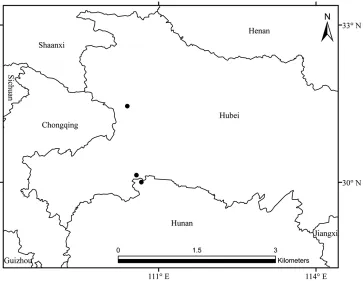
Natural populations of the new species were collected from three populations in Hubei and Hunan province (Fig. 1, these data were submitted to PANGAEA, accession num-ber 10.1594/PANGAEA.906581). Morphological characters recorded for the new species were based on fresh flowering and fruiting material collected from those popu-lations. S. platyphylla were from herbarium material (KUN). A comparison of the new species with similar species is provided in Table 1.
Molecular analyses
Fresh leaves of the new species were dried in silica gel and total genomic DNA was extracted from 10–20 mg dried leaf tissue. Molecular material of S. platyphylla was collected from herbarium specimens (Appendix 1). The nuclear ITS locus was used for phylogeny. The PCR protocol used the following conditions: 5 min at 94, fol-lowed by 35 cycles of 1 min at 94 °C, 1 min at 53 °C, 2 min at 72 °C and then ending with a final extension of 5 min at 72 °C. The ITS primers used were ITS1 and ITS4, as described by White et al. (1990) and Urbatsch et al. (2000). Voucher specimen and GenBank accession information for taxa are listed in Appendix 1. DNA sequences were aligned using MAFFT software and then manually checked (Katoh et al. 2002). A total of 301-taxon data sets, including two newly published
Table 1. Comparison of Silene sunhangii with similar species detected by morphology (S. platyphylla).
Species Characters
S. sunhangii S. platyphylla
Roots tuberous cylindric
Stems diffuse, 30–80 cm tall, long pubescent diffuse, 60–100 cm tall, pubescent
Leaves elliptic, 4–10 × 1–5 cm, glabrous,
conspicuously 3-veined ovate, 6–8 × 3–5 cm, margin ciliate, 3 or 5-veined
Flower diameter 35–40 mm 20 mm
Pedicel length &indumentum 20–30 mm, pubescent 10–30 mm, hairy
Calyx tubular-clavate, teeth triangular, glabrous tubular-clavate, teeth triangular-lanceolate with margin ciliate
Petals pale purple to red, 2.5 cm, catacorolla
tasseled, bifid to one third, lobes lanceolate, without a linear lobe or
narrow tooth on each side
white or pale red, 2 cm, catacorolla elliptical or linear, bifid to middle, lobes elliptic, with a linear lobe or narrow tooth
on each side Stamens and filaments stamens and filaments slightly exserted;
filaments pubescent stamens slightly exserted; filaments glabrous
Distribution China: Western Hubei
sequences, were obtained. Bayesian inference (BI) and Maximum likelihood (ML) analyses were conducted using MrBayes 3.1.2 and RAxML v.6 (Huelsenbeck and Ronquist 2001; Stamatakis 2006), respectively. The best-fitting substitution models GTR for Bayesian inference were selected using ModelTest v.3.8, and branch sup-port was computed with 1, 000 bootstrap replicates (Posada and Crandall 1998). ML analyses were conducted using the GTRGAMMA model with 1, 000 nonpara-metric bootstrapping replicates.
Results and discussion
Taxonomic treatment
Silene sunhangii D.G.Zhang, T.Deng & N.Lin, sp. nov.
urn:lsid:ipni.org:names:77203328-1 Figs 1–3
Type. China. Hubei Province: Shennongjia National Nature Reserve (SNNR) region, Guanmen Mountain, Alt. 1,319 m, 30°08'16.80"N, 110°34'33.59"E, 1 July 2010, Dai-Gui Zhang, et al. 0622 (holotype: KUN!).
Diagnosis. Silene sunhangii is morphologically similar to S. platyphylla, from which it differs through the root tuberous (not cylindric as S. platyphylla), stems 30– 80 cm tall (100 cm tall in S. platyphylla), leaves elliptic (not obovate in S. platyphylla), 3-veined (not 3/5 veined in S. platyphylla) and glabrous (not margin ciliate as S.
platy-phylla), flowers 35–40 mm diam. (not 20 mm in S. platyphylla), petals purple to red
(not white or pale red in S. platyphylla), catacorolla tasseled (not elliptic or linear in S.
platyphylla), lobe limbs divided to 1/3 (more than 1/3 in S. platyphylla).
Description. Herbs perennial. Plant with densely ciliate, tuberous roots and dichasial cymose inflorescences containing many flowers. Stems diffuse, 30–80 cm tall, much-branched, pubescent. Leaves elliptic, 4–10 × 1–5 cm, glabrous, conspicu-ously 3-veined. Pedicel 20–30 mm long, pubescent. Calyx tubular-clavate, ca. 1.5–2 cm long, densely hairy on veins; teeth triangulate, ciliate. Petals pale purple to red, ca. 2.5 cm long; claws exserted beyond calyx; catacorolla tasseled, limbs obovate, bifid to 1/3; lobes lanceolate, without a linear lobe or narrow tooth on each side. Stamens slightly exserted; filaments pubescent. Capsule ovoid, 10–20 mm long. Seeds dark brown, reniform, ca. 1 mm long, with lateral auricular pits (Fig. 2, 3).
Phenology. Flowering occurs from February to April, and fruiting from April to June.
Etymology. The new species is named in honor of Chinese botanist, Prof. Hang Sun, who has made significant contributions to the flora of China.
Figure 1. Distribution map of Silene sunhangii. The black dots represent locations of S. sunhangii.
humid and evergreen or deciduous mixed forest, from 1214–2227 m (Fig. 1). A total of three natural populations have been located, each comprising less than 100 indi-viduals distributed over an area not exceeding 100 m2. These populations are located
within the Shennongjia National Nature Reserve (Hubei province), Houhe Nature Reserve (Hubei Province) and Huping Mountains (Hunan Province), and are therefore well-protected; there are no known threats to these populations. Further field studies are needed to more authoritatively determine the geographic range and frequency of this species. In the meantime, current evidence indicates that Silene sunhangii should be assigned the conservation status of “Data Deficient (DD)”, following the IUCN Red List Criteria and Categories (IUCN 2017).
Taxonomic notes. Silene sunhangii is a perennial with densely ciliate, tuberous roots and dichasial cymose inflorescences containing many flowers. These characters indicate that the new species should be assigned to Silene sect. Cucubaloideae subsect.
Silene Chowdhuri. It can be distinguished from all other species of Silene that possess
lilac to red petals through its root, stem, leaf and corolla characters as described above. Morphologically, Silene sunhangii shows greatest similarities with S. platyphylla. The diagnosis above enables the two species to be reliably distinguished. Silene platyphylla
Molecular phylogenetic analysis
The results of our initial phylogenetic analysis, which included over 300 species, are not shown here but they did confirm the position of the new species within Silene. In Fig. 4, we present only those clades (38 species from that original matrix) which are relatively close to the new species. Due to the vagueness of outgroup, we constructed unrooted phylogenetic tree based on 38-taxon of Silene (Fig. 4). Clades associated with
Silene platyphylla are also included because morphological criteria indicate that this
species has similarities with S. sunhangii.
The aligned matrix consisted of 676 characters from 38 species, of which 165 were variable and 82 were parsimony-informative. Our results based on ITS produced trees with identical topology between BI and ML, and only the tree with bootstrap sup-port values from ML analyses was presented (Fig. 4). According to these results, Silene
sunhangii is nested within a grade that incorporates a polyphyletic Sect. Physolychnis
Figure 2.Silene sunhangii (from the holotype plant). A plant habit B plant C leaf D flower E calyx
Figure 3.1–5Silene platyphylla Franchet (modified from illustration in flora of China), 6–10Silene sunhangii, 1, 6 flowering branch 2, 7 sterile branch 3, 8 petal and stamen 4, 9 pistil 5, 10 root.
(Benth.) Bocquet. S. sunhangii is shown to be separated from associated taxa with very high support (BS = 97, PP = 1), and is well-removed from S. platyphylla. These results differ from those of the morphological study which placed S. sunhangii in sect.
al-Figure 4. Phylogeny of Silene species studied based on ITS region and only bootstrap values >50% are shown. The colored taxa with identical color represent which are from same sect.
ready noted, Sect. Physolychnis was resolved as polyphyletic. This section was shown to include the ‘S. ajanensis group’, an Asian clade, an American clade, and miscellaneous other species. These results are consistent with those of a previous study by Petri and Oxelman (2011). An unexplainable result was that S. platyphylla was well-separated from S. sunhangii, and included within a clade containing species of Sect.
Cucuba-loideae Edgew. et Hook. f.. These genetic results do clearly support the morphological
data in recognizing Silene sunhangii as a distinct species. However, relationships of the new species do require further investigation.
Acknowledgements
We are grateful to the herbarium curators who helped us in our study.
Special thanks to Ling Wang for her excellent illustrations of S. sunhangii. The authors are grateful to B.R. Maslin for revising manuscript. Thanks are also due to the reviewers for their useful suggestions.
and Research (STEP) program (2019QZKK0502), the Major Program of the National Natural Science Foundation of China (31590823), the National Key R & D Program of China (2017YFC0505200), the Strategic Priority Research Program of Chinese Acad-emy of Sciences (XDA20050203), the National Natural Science Foundation of China (31700165), Youth Innovation Promotion Association CAS (2019382), Young Aca-demic and Technical Leader Raising Foundation of Yunnan Province (2019HB039).
References
Boissier E (1867) Flora Orientalis (Vol. 1). Georg H., Basel, Geneva, 567–656.
Chowdhuri PK (1957) Studies in the Genus Silene, 22. Notes from the Royal Bot.,Garden
Edinburgh 22: 221–278.
de Candolle AP (1824) Prodromus systematis naturalis regni vegetabilis, sive,enumeratio contracta ordinum generum specierumque plantarum huc usquecognitarium, jux-ta methodi naturalis, normas digesjux-ta. Treuttel et Wurtz, Paris, 745 pp. https://doi. org/10.5962/bhl.title.286
Huelsenbeck JP, Ronquist F (2001) MRBAYES: Bayesian inference of phylogeny. Bioinformat-ics (Oxford, England) 17(8): 754–755. https://doi.org/10.1093/bioinformatBioinformat-ics/17.8.754 IUCN (2017) Guidelines for using the IUCN Red List Categories and Criteria, Version 13.
Prepared by the Standards and Petitions Subcommittee, 108 pp. http://www.iucnredlist. org/documents/RedListGuidelines.pdf
Katoh K, Kei KM, Kuma KI, Miyata T (2002) MAFFT: A novel method for rapid multi-ple sequence alignment based on fast Fourier transform. Nucleic Acids Research 30(14): 3059–3066. https://doi.org/10.1093/nar/gkf436
Melzheimer V (1988) Caryophyllaceae: Silene L. In: Rechinger KH (Ed.) Flora Iranica,163,
Akad. Druck- und Verlagsanstalt., Graz, Austria, 341–508.
Oxelman B, Lidén M, Berglund D (1997) Chloroplast rps16 intron phylogeny of the tribe
Sileneae (Caryophyllaceae). Plant Systematics and Evolution 206: 393–410. https://doi. org/10.1007/BF00987959
Oxelman B, Rautenberg A, Thollesson M, Larsson A, Frajman B, Eggens F (2011) Sileneae taxonomy and systematics. http://www.sileneae.info
Petri A, Oxelman B (2011) Phylogenetic relationships within Silene (Caryophyllaceae) section
Physolychnis. Taxon 60(4): 953–968. https://doi.org/10.1002/tax.604002
Posada D, Crandall KA (1998) MODELTEST: Testing the model of DNA substitution.
Bio-informatics (Oxford, England) 14(9): 817–818.
https://doi.org/10.1093/bioinformat-ics/14.9.817
Rautenberg A, Hathaway L, Oxelman B, Prentice HC (2010) Geographic and phylogenetic
patterns in Silene section Melandrium (Caryophyllaceae) as inferred from chloroplast and
nuclear DNA sequences. Molecular Phylogenetics and Evolution 57: 978–991. https:// doi.org/10.1016/j.ympev.2010.08.003
Rohrbach P (1868) Monographie Der Gattung Silene. W. Engelmann, Leipzig, Germany.
Stamatakis A (2006) RAxML-VI-HPC: Maximum likelihood-based phylogenetic analyses with thousands of taxa and mixed models. Bioinformatics (Oxford, England) 22(21): 2688– 2690. https://doi.org/10.1093/bioinformatics/btl446
Urbatsch LE, Baldwin BG, Donoghue MJ (2000) Phylogeny of the coneflowers and relatives (Heliantheae: Asteraceae) based on nuclear rDNA internal transcribed spacer (ITS) se-quences and chlorplast DNA restriction site data. Systematic Botany 25: 539–565. White TJ, Bruns T, Lee S, Taylor J (1990) Amplification and direct sequencing of fungal
ri-bosomal RNA genes for phylogenetics. In: Innis MA, Gelfand DH, Sninsky JJ, White TJ (Eds) PCR Protocols: a Guide to Methods and Applications. Academic Press, New York, 315–322. https://doi.org/10.1016/B978-0-12-372180-8.50042-1
Williams FN (1896) A revision of the genus Silene L. Botanical Journal of the Linnean Society
32(220–227): 1–196. https://doi.org/10.1111/j.1095-8339.1896.tb00695.x
Zhou LH, Wu ZY, Magnus L, Oxelman B (2001) Silene Linnaeus. Flora of China. Science
Press, Beijing, 66–100. https://doi.org/10.2478/dna-2013-0004
Appendix 1
Vouchers information and GenBank accession of species used in our study.
Species GenBank
accessions Herbarium voucher specimens
Silene ajanensis Vorosch. KX757376 Anja Rautenberg 68 UPS
Silene samojedorum (Sambuk) Oxelman JX274522 –
Silene villosula (Trautv.) V.V.Petrovsky & Elven KX757382 Afonina et al. 1983. Vii. 23 S
Silene linnaeana Vorosch. KX757383 H. Wilh. Arnell S
Silene involucrata (Cham. & Schltdl.) Bocquet KX757387 Greve Alsosreas Tribsch O
Silene sachalinensis F. Schmidt KX757394 Popov 1949.Vii.8 LE
Silene tolmatchevii Bocquet KX757396 M.Karavaev 1945.Vii.6 LE
Silene caespitella F.N. Williams KX757337 KGB 113 GB
Silene andicola Gillies ex Hook. & Arn. KX757338 –
Silene violascens (Tolm.) V.V.Petrovsky & Elven KX757343 H. Solstad, R. Elven 04/1353 O
Silene chilensis (Naudin) Bocquet KX757359 B. Frajman, P. Schonswetter 12153
Silene echegarayi (Hieron.) Bocquet KX757360 B. Frajman, P. Schonswetter 12176
Silene zawadzkii Herbich KX757363 Cernoch F 47354 M
Silene davidii (Franch.) Oxelman & Lidén KX757367 Frida Eggens 86 UPS
Silene salicifolia C.L. Tang KX757372 Tang 1225 KUN
Silene nepalensis Majumdar JF978562 KIB-D389
Silene keiskei Miq. DQ908643 –
Silene suksdorfii B.L. Rob. DQ908670 –
Silene uralensis subsp. apetala JX274519 –
Silene aprica Turcz. (L.) Bocquet JF978553 A519
Silene campanulata subsp. glulosa DQ908635 clone 2459
Silene adenocalyx F.N. Williams KX757269 Poelt J. M
Silene khasiana Rohrb. KX757270 Einarsson et.al 3025 UPS
Silene waltoni F.N. Williams KX757272 G. S. Miehe 03-048-12 Miehe
Silene kumaonensis F.N.Williams KX757273 G. S. Miehe 01-109-08 Miehe
Silene rosiflora Kingdon-Ward KX757277 G. Miehe SonamCo L.Opgenoorth 04-086-01 Miehe
Species GenBank
accessions Herbarium voucher specimens
Silene asclepiadea Franch. KX757283 Boufford D. E. et al. 35267 M
Silene cardiopetala Franch. KX757284 Liden 4-17
Silene grandiflora Franch. KX757286 KGB 275 GB
Silene batangensis H. Limpr. KX757288 Miehe 07-26-07 Miehe
Silene williamsii (Britton) Hultén KX757298 C. Brochmann H. H Grundt
Silene acutifolia Link ex Rohrb. KX757318 Bengt Oxelman 2554 GB
Silene almolae J.Gay KX757424 Merxmueller H. & Lippert W. 25372 M
Silene menziesii Hook. DQ908651 –
Silene seelyi C.V. Morton & J.W. Thomps. DQ908666 –
Silene sunhangsii – KUN060722