Vol. 6, Issue 7, October 2016
Page 1
Vol. 6, Issue 7, October 2016
Page 2
Modern Journal of Language Teaching Methods (MJLTM)
ISSN: 2251 - 6204
www.mjltm.com
Editor – in – Chief
Hamed Ghaemi, Assistant Professor in TEFL, Islamic Azad University (IAU)
Editorial Board:
1.
Abednia Arman, PhD in TEFL, Allameh Tabataba’i University, Tehran, Iran
2.
Afraz Shahram, PhD in TEFL, Islamic Azad University, Qeshm Branch, Iran
3.
Amiri Mehrdad, PhD in TEFL, Islamic Azad University, Science and research
Branch, Iran
4.
Azizi Masoud, PhD in Applied Linguistics, University of Tehran, Iran
5.
Basiroo Reza, PhD in TEFL, Islamic Azad University, Bushehr Branch, Iran
6.
Dlayedwa Ntombizodwa, Lecturer, University of the Western Cape, South Africa
7.
Doro Katalin, PhD in Applied Linguistics, Department of English Language
Teacher Education and Applied Linguistics, University of Szeged, Hungary
8.
Dutta Hemanga, Assistant Professor of Linguistics, The English and Foreign
Languages University (EFLU), India
9.
Elahi Shirvan Majid, PhD in TEFL, Ferdowsi University of Mashhad, Iran
10.
Fernández Miguel, PhD, Chicago State University, USA
11.
Ghaemi Hamide, PhD in Speech and Language Pathology, Mashhad University
of Medical Sciences, Iran
12.
Ghafournia Narjes, PhD in TEFL, Islamic Azad University, Neyshabur Branch,
Iran
13.
Grim Frédérique M. A., Associate Professor of French, Colorado State University,
USA
14.
Izadi Dariush, PhD in Applied Linguistics, Macquarie University, Sydney,
Australia
15.
Kargozari Hamid Reza, PhD in TEFL, Payame Noor University of Tehran, Iran
16.
Kaviani Amir, Assistant Professor at Zayed University, UAE
Vol. 6, Issue 7, October 2016
Page 3
17.
Kirkpatrick Robert, Assistant Professor of Applied Linguistics, Shinawatra
International University, Thailand
18.
Mehrani Mehdi, PhD in TEFL, University of Neyshabur, Neyshabur, Iran
19.
Morady Moghaddam Mostafa, PhD in TEFL, University of Tabriz, Iran
20.
Mouton Nelda, PhD in Education Management, North-West University
(NWU), South Africa
21.
Najafi Sarem Saeid, PhD Candidate in TEFL, Islamic Azad University, Science
and Research Branch, Tehran, Iran
22.
Naicker Suren, Department of Linguistics and Translation, University of South
Africa
23.
Ndhlovu Finex, PhD, Linguistics Programme, University of New England,
Australia
24.
Raddaoui Ali Hechemi, PhD, Associate Professor of Applied Linguistics,
University of Wyoming in Laramie, USA
25.
Rezaei Saeed, PhD in TEFL, Sharif University of Technology, Tehran, Iran
26.
Rolstad Kellie, PhD, Associate Professor of Education, University of Maryland,
USA
27.
Roohbakhshfar Hamid, PhD in TESOL, Islamic Azad University, Neyshabur
Branch, Iran
28.
Sanatifar Mohammad Saleh, PhD in Translation Studies, Tabaran Institute of
Higher Education, Mashhad, Iran.
29.
Shafiee Sajad, Department of English, Shahrekord Branch, Islamic Azad
University, Shahrekord, Iran
30.
Stobart Simon, PhD, Dean of Computing, Teesside University, UK
31.
Suszczynska Malgorzata, Senior Assistant Professor, University of Szeged,
Hungary
32.
Tabeifard Sayed Javad, PhD in ELT, University of Tehran, Kish International
Campus, Iran
33.
Weir George R. S., PhD in Philosophy of Psychology, University of Strathclyde,
Glasgow, UK
34.
Zabihi Reza, PhD in TEFL, University of Neyshabur, Neyshabur, Iran
35.
Zegarac Vladimir, PhD, University of Bedfordshire, UK
Vol. 6, Issue 7, October 2016
Page 4
Abstracting/Indexing
Index
Copernicus 2011
Vol. 6, Issue 7, October 2016
Page 5
Linguistics Abstract
EBSCO Publication
Lulu Publication
Vol. 6, Issue 7, October 2016
Page 6
Directory of Open Access Journals
ProQuest
Modern Language Association
Cabell's Directories
Vol. 6, Issue 7, October 2016
Page 7
COPE
Directory of Research Journal Indexing (DRJI)
Indian Citation Index
Vol. 6, Issue 7, October 2016
Page 8
International Society of Universal Research in Sciences
Ulrich's
Vol. 6, Issue 7, October 2016
Page 9
THE EFFECT OF SHORT STORY READING ON TERTIARY
LEVEL EFL STUDENTS' CREATIVE WRITING ABILITY
Neda Beyhaghi ([email protected]) MA Student in TEFL, Hakim Sabzevari University
Moslem Zolfagharkhani (Corresponding author)
Assistant Professor of English Language and Literature, Faculty of Humanitis, Hakim Sabzevari University, Sabzevar, Iran.
Gholamreza Zareian ([email protected])
Assistant Professor of English Language and Literature, Faculty of Humanitis, Hakim Sabzevari University, Sabzevar, Iran.
ABSTRACT
THIS STUDY WAS CONDUCTED TO DETERMINE THE EFFECT OF SHORT STORY READING ON IRANIAN TERTIARY LEVEL EFL STUDENTS' CREATIVE WRITING ABILITY. PARTICIPANTS WERE 68 JUNIOR STUDENTS (58 FEMALES AND 10 MALES) OF LITERATURE AT A UNIVERSITY IN KHORASAN RAZAVI, IRAN. A MIXED METHOD DESIGN WAS USED FOR DATA COLLECTION. THE QUANTITATIVE PHASE INCLUDED A PRE-TEST/POST-TEST ONE-GROUP EXPERIMENTAL DESIGN IN WHICH THE PARTICIPANTS WERE PRETESTED BY A CREATIVE WRITING TASK, RECEIVED TREATMENT ON SHORT STORY READINGS FOR 12 SESSIONS DURING FOUR MONTHS, AND WERE POST-TESTED ON CREATIVE WRITING ABILITY AT THE END OF THE EXPERIMENT. IN THE QUALITATIVE PHASE OF THE STUDY, THE PARTICIPANTS WERE INTERVIEWED ON THEIR VIEWS ABOUT THE USE OF SHORT STORIES IN TEACHING CREATIVE WRITING. THE RESULTS INDICATED THAT SHORT STORY READING HAD A SIGNIFICANTLY POSITIVE EFFECT ON ONLY ONE ASPECT OF CREATIVE WRITING; THAT IS, THE USE OF LANGUAGE AND LANGUAGE DEVICES WITH NO SIGNIFICANT EFFECT ON THE OTHER COMPONENTS OF CREATIVE WRITING ABILITY: (A) THE USE OF GENRE AND GENERIC CONVENTIONS, (B) CULTURAL, HISTORICAL, AND SOCIAL CONTEXT UNDERSTANDING, (C) THE AWARENESS OF AUDIENCE AND THE READER’S CONTEXT, (D) QUALITY OF IDEAS, AND (E) BALANCED JUDGMENT. THE QUALITATIVE DATA REVEALED THAT THE QUALITY OF CREATIVE WRITING ABILITY IS DEPENDENT ON THE PARTICIPANTS’ WRITING BACKGROUND, THE NATURE OF THEIR WRITTEN ASSIGNMENTS, THE AMOUNT OF FEEDBACK THEY RECEIVE, THEIR SELF- PERCEIVED QUALITY OF IMPROVEMENT, AND THE COMPLEXITY OF THE CREATIVE WRITING SKILL THAT REQUIRES MORE TIME FOR PRACTICE. IT WAS ALSO FOUND THAT SOME OF LEARNERS LIKED THE CREATIVE WRITING EXPERIENCE AND BELIEVED THAT IT GAVE THEM A PURPOSE FOR WRITING AND ALLOWED THEM TO REFLECT ON THEIR PERSONAL FEELINGS AND IDEAS. NEVERTHELESS, THEY EMPHASIZED ON THE NECESSITY OF SOME PRE-REQUISITE COURSES ON CREATIVE WRITING.
KEYWORDS: CREATIVE WRITING, SHORT STORY READING, COMPONENTS OF CREATIVE WRITING, MIXED-METHOD DESIGN.
Vol. 6, Issue 7, October 2016
Page 10
1. Introduction
Research has shown that learning to write requires control over cognitive skills such as planning, outlining, thinking, generating and developing ideas, and drafting and redrafting, as well as a command of the linguistic, rhetorical and sociocultural conventions of a particular language. Writing also requires a number of "transitions" such as the transition from oral to graphic expression, which is regarded as a major developmental step by Vygotsky (1978), and the transition from personal communication to "communication with a remote audience" (Bereiter & Scardamalia, 1982, p.1). Writing is believed to have a major role in the conveying of knowledge from generation to generation. That is why philosophers, scholars, knowledge providers and educationalists, ages past and ages yet to come have always paid enormous attention to writing.
Candlin (1996) surmised the "plural roles of writing; as a means of measuring cognitive abilities, as a central skill area in the design of educational curricula and in the patterns of their delivery in teaching and assessment, a way of understanding some of the occupational and social demands of daily communication in living and working, in revealing its key gate-keeping role in enabling or disabling the sheer accessibility of life chances for all in contemporary industrial and postindustrial societies, and in its ethnographic significance in exploring and explaining cultural variation and relativeness" (p. xiii). In academic settings in particular, writing is viewed as the primary channel for the communication of knowledge. And students learn to write because writing enables them to take part in the academic community (Bazerman, 1982).
1.1 Statement of the Problem
According to Williamson (1988), the influence of written language is pertinent to both academics' discipline and "their lives in a specific institution" (p. 91). However, concerns about the standards of writing continue to be expressed and addressed. Writing is a complicated task and many students experience difficulty and frustration when writing (Schultz & Fecho, 2000). Schools, colleges, and parents argue that students fail to learn and practice writing reasonable texts. They believe that such failure may result in both declining literacy levels and a weak generation that cannot "think critically about intellectual ideas and academic materials" Hamp-Lyons (1990, p. 69). Cooper et. al. (1984), for example, have addressed this issue of writing weaknesses and irregularities among students both at secondary and tertiary levels. Cooper et.al. agree with school teachers, university professors and "guardians of the language in the media" (p. 19) that there is a "writing crisis "and a "literacy crisis" (p. 19), which it appears has been the cry of every culture and every generation. Consequently, increasing attention has been paid to this vital question and there is a rapidly growing body of research in various areas of the field of writing.
Educators have recognized this fact and have looked for ways to assist students in this area for many years. To start with, it was important to acknowledge that students need to have a good grasp of the nature of writing. With this notion, the focus was placed, by theorists and educators alike, on the process of writing rather than the product. This notion was born from research into writing composition which yielded the following conclusion: writing is a non-linear, recursive process composed of prewriting, drafting, revising, editing, and publishing experiences (Chiste & O’Shea, 1990). Therefore, the focus of this mixed method study is to determine if creative writing can be improved by learners’ short story reading and what the learners think of the effectiveness of such an approach to developing creative writing.
1.2 Study Objectives
The main objective in this study is to investigate the effect of short story reading on Iranian tertiary level EFL students' creative writing ability.
1.3 Research Questions
The study is guided by the following research questions:
1. To what extent does short story reading improve Iranian Tertiary level EFL learners' creative writing?
Vol. 6, Issue 7, October 2016
Page 11
2. What factors are involved in the quality of creative writing by Iranian Tertiary level EFL learners?
3. What are Iranian Tertiary Level EFL learners’ attitudes towards short story reading in improving their creative writing?
1.4 Research Hypothesis
Short story reading has no significant effect on Iranian Tertiary level EFL learners' creative writing.
1.5 Significance of the Study
The results of the present study can be beneficial to EFL students of literature at the tertiary level and the related instructors as well as the material developers. EFL students of literature will get familiar with this expressive writing discourse that is usually ignored in both undergraduate and postgraduate programs of English literature. It will also give them insights on the practical and productive aspect of short story reading that can be considered as a prerequisite for producing similar texts. English ligature instructors will also learn about the nature of creative writing, the uses of short stories, and the learners’ strengths and weakness in the process of creative writing. And finally, material developers will learn about what content with what methodology can be beneficial for the learners at this level to learn creative writing.
1.6 Limitations of the Study
The main limitation in this study is the limited number of participants from one university in Iran. This point was considered as an important factor in the interpretation of the results and the generalization was done cautiously. The second limitation was the presentation of only short story as an example of creative writing excluding, poems, plays, personal essays, and the like.
2. Review of the Related Literature 2.1 Literature and Language Teaching
Lately, there has been an upsurge of many foreign language teaching researchers’ interest in the effectiveness of the literature implementation in teaching a second or foreign language as well as EFL and ESL students’ learning experiences.
Whereas some teachers may still believe that teach EFL include stress on linguistic benefits only, others assert that language and literature are the two sides of a coin and closely connected. Brumfit and Carter (1986) put emphasis on the role of literature as “an ally of language” (p.1). The use of literature in EFL classes was related to the earlier in the 20th century, when the Grammar- Translation Method was developed to appreciate foreign language literature. Students were asked to read and translated target language literary texts to their native language. Larsen- Freeman and Anderson (2011) elucidated “Literary language is considered superior to spoken language and is therefore the language the students study. Culture is viewed as consisting of literature and fine arts” (p. 20).
Although literature was a precious source that would add a different dimension to the teaching of EFL, it was forgotten after the GTM. The advocators of the Audio-Lingual Method paid no attention to literature because of its non-realistic nature. In other words, after it, none of the language methods have given a due attention to literature.
More recently, the goal of EFL teaching has changed and shifted to help learners to use a foreign language for real communicative purposes, and literature as an authentic example of target language use with communicative functions were revived. Consequently, language trainers and teachers have started making tireless attempts to find new efficient ways of interconnectivity of literature and language across the principles for the learners’ benefits.
2.2 Creative Writing
According to Sharples (1999), creative writing is an open-ended design process, without a fixed goal and without clearly specified and ordered stages leading to one single solution. Similarly, Maley (2012) considered creative writing as an aesthetically motivated, highly disciplined and a personal
Vol. 6, Issue 7, October 2016
Page 12
activity that deals less in facts than in the imaginative representation of emotions, events, characters and experiences. This is in contrast to the classic three-stage conception of writing that includes “planning (the generation and organization of information for goal-setting), translation (the turning of the plans and thoughts into text appropriate), and reviewing (the editing and evaluation of the text or the goals)” (Flower & Hayes, 1980, as cited in Vass, Littleton, Miell, & Jones, 2008, p. 149). Sharples (1999) believed that writing incorporates two interlinking and interdependent processes, engagement – the generation of creative ideas; the emotional engagement with the material – and reflection – the conscious break of the chain of association; reviewing, contemplation and planning.
3. Methodology 3.1 Participants
Participants were 68 junior students (58 females and 10 males) of literature at a university in Khorasan Razavi, Iran, selected through convenient sampling. The average age of the participants for this study was between 20 and 25 years. They were the junior students of English literature who were taking essay writing. They were all Iranian students with similar educational backgrounds as to writing in general with no experience of creative writing practice and no earlier residence in an English speaking country.
3.2 Research Design
The research is a mixed method study using both qualitative and quantitative data. A mixed – method design is a procedure for collecting, analyzing, and mixing both quantitative and qualitative data to understand a research problem more completely (Creswell, 2012; Creswell & Plano Clark, 2011). When used in combination, quantitative and qualitative methods complement each other and allow for a more complete analysis (Tashakkori & Teddlie, 2010).
The quantitative component of the study is a pre- test to post- test comparison measuring the change in students’ creative writing ability. For a better understanding of learners’ composing behaviors, as posited by Manchon (2011), the qualitative portion of the study focused on gathering information through semi- structured interviews. The participants in the experimental group were interviewed to determine their perception of using short stories for teaching creative writing. All interviews were transcribed, checked for accuracy, and coded (Marshall & Rossman, 2011).
3.3 Instruments
Two main instruments were used in this study: two writing tasks and semi- structured interviews. Interviews were used to allow for probing deeply into students’ comments about the quality of using short stories in learning to write creatively. Student volunteers for interviews were requested on four occasions during the semester.
3.4 Materials
This section consists of three short stories used for the study. They were written by the American short story writer, O. Henry. They are The Gift of The Magi, The Last Leaf, and Two Thanksgiving Day Gentlemen.
3.5 Data Collection Procedure
The data was collected during the spring semester 2014 and was comprised of both quantitative and qualitative data. Participants were required to write two creative essays on a general topic: “The Best Gift” (similar to the short story topics they had during the treatment) twice. Once initially before starting their writing instruction mid-February (Time 1) and then four months later in early July (Time 2). A common narrowed-down specific topic was not given to all students because a basic principle of expressive writing is that students write on their preferred topics. This general topic was treated differently by different students. Specific varieties of the same general topic were: “The Best Gift for my Dad”, the Best gift I have Ever Received”, The Best Gift from a Friend, the Best God-Given Gift, and so on.
Vol. 6, Issue 7, October 2016
Page 13
The repetition of the same task at both times of data collection was for avoiding possible problems in measuring the development of writing given that different task topics could affect the quality of the written texts( Storch & Tapper, 2009). Moreover, the use of the same topic is frequently used in pre and posttest research designs (e.g. Storch & Tapper, 2009; Elder & O’Loughlin, 2003; Shaw & Liu, 1998; Storch &Wigglesworth, 2007) to avoid the possible effect of different topics on the quality of writing. The essays were written in the classroom and students were given one hour to complete the task without the help of external sources such as dictionaries.
In addition, in order to determine the learners’ perceptions of using short stories in teaching and learning to write creatively, four volunteers were interviewed three times during the treatment and once immediately after Time 2. The interview questions were developed on the basis of the researcher’s reading of the literature (e.g., Storch & Hill, 2008; Knoch, Rouhshad, Oon, & Storch, 2015).
During the experiment that lasted for 12 sessions, the three short stories were presented to the experimental group through a short story based language teaching model proposed by Khatib & Seyyedrezaei (2013). There are three stages in this method and the following procedure was followed for instruction:
1. Pre-reading activities:
a. The teacher explained the procedures to the students in their own language. Besides, he set linguistic objectives, grammatical points, and key vocabulary items used in the short story text.
b. The teacher familiarized students with the genre features of each story. He presented the main characters and clarified cultural information that could cause comprehension difficulties. The teacher posed a variety of questions concerning the short story context in order to activate their schemata. Consequently, the students would link their prior knowledge with text experiences.
c. The teacher showed the students the short story cover and wanted them to make predictions about title and illustrations by asking some question such as what do you see in the picture? What do you think the story will be about? Do you know anything about the writer of this work? These kinds of activities could stimulate the students’ interest in the topics of the short story texts and would motivate them to pursue them to see what would finally happen.
2. While-reading activities: In this step, learners learned how to interact with, and appreciate short story text as well as negotiate meaning.
a. At this phase, the teacher read the short story, made use of facial expressions, gestures, mime and intonations so that the learners would follow the short story.
b. The teacher involved the learners in the short story text by asking a number of questions about the three basic short story elements (character, setting, and plot). For instance, who is the main character? What are the important events of the story? When and where have they happened? Of course, for more proficient short story readers, the teacher asked questions to challenge the learners’ imagination. For example: How are these characters related? What is the main character’s motivation?
c. New vocabularies and grammatical items were explained in the short story text. While the learners were reading it, they underlined the unknown words that might hinder them from grasping meaning. Of course, they could infer the vocabulary meaning in the text.
3. Post reading activities
a. Students worked together and answered the questions orally. Referential, factual, inferential, and evaluative questions were used at this phase. Could students, for example, name the main characters or record the events? Also, what was the narrative view point?
b. Students wrote a conversation between two characters. c. Students would paraphrase some paragraphs of a chapter. d. Students wrote the theme of the story.
e. Students wrote a paragraph about the characters motivations or the plot development. f. Summary had to cover the characters, resolution, climax, setting, and conflict and had to be written in a few sentences.
g. Students discussed the short story themes and if they were in protagonist’s shoes, what they would do.
Vol. 6, Issue 7, October 2016
Page 14
h. Lastly, students expressed their own personal views, criticized, and rendered a judgment about the story based on how successful it was in fulfilling its aims.
For homework, students were required to summarize the short story using new vocabulary and discussion done in the classroom. In addition, students were asked to form a new coherent work by synthesizing what they had learnt about the characters and events in the short story.
3.6 Data Analysis Procedure
The data were analyzed both quantitatively and qualitatively. For analyzing the quantitative data, statistical analyses were carried out using SPSS (Statistical Package for Social Sciences), and because the data were not normally distributed, Wilcoxon signed-rank test, a non- parametric equivalent to the paired sample t-test, was applied to examine changes in students’ performance over time from Time 1 to Time 2. The test converts the continuous scores to ranks and compares the differences between the two time periods (Pallant, 2010). The Wilcoxon Signed Rank assumptions are that the data to be used should be either continuous or ordinal in level, and that it is obtained from independent samples, such that each participant represents one score for either variable (Brace, Kemp, & Sneglar, 2006). Effect size was calculated and absolute effect sizes of 0.1- 0.29 were taken as indicating a small effect, from 0.3 to 0.49 a medium effect, and greater than 0.5 a large effect ( Cohen, 1969).
As to the analytical measures, two raters (the researcher and a Ph.D. student of TEFL) assessed the participants’ essays based on the six creative writing components suggested by Morris & Sharplin (2013). These components were (a) the use of language and language devices, (b) the use of genre and generic conventions, (c) contextual understandings (cultural, historical, and social contexts), (d) the awareness of audience and the reader’s context, (e) ideas explored, issues raised, themes developed, meanings that can be made ( quality of ideas), and (f) on balance judgment. Any disagreement when coding were solved by consensus. The inter-rater agreement was therefore always 100%.
4. Results and Discussion
4.1 Research Question 1: To what extent does short story reading improve Iranian Tertiary level EFL learners’ creative writing?
To answer this question, first of all, the Kolmogorov-Smirnov (K-S) Test (as displayed in table 4.1) was conducted to determine whether the data represented a normal distribution for both control and experimental groups
Table 4.1
The Test of Normality for Post-Test Results
Kolmogorov-Smirnovª
Statistic df Sig.
Post-test .104 33 .00
As it can be seen, the significant results obtained for Kolmogorov- Smirnov tests showed that the data was not normal and therefore, in order to answer research question 1, a Wilcoxon signed- rank test (displayed in table 4.2) as the non-parametric version of paired t-test was conducted to determine if there was a significant difference between time 1 and time 2 of creative writing test as a result of short story reading.
Table 4.2
Comparing Creative Writing Performance at Time 1& Time 2
Creative Writing Assessment Criteria Time 1 Time 2 Wilcoxon signed rank test
Mdn M SD Mdn M SD Z P
1. The use of language and language devices 4.00 4.0 .87 6.0 6.3 .83 -1.7 .00
2. The use of genre and generic conventions 4.00 4.4 .85 4.0 4.5 1.0 -1.8 .06 3. Contextual understandings: cultural, 4.00 4.1 .73 4.0 4.2 .87 -2.6 .11
Vol. 6, Issue 7, October 2016
Page 15
historical, and social contexts
4. The awareness of audience and the reader’s context 4.33 4.3 .75 4.0 4.5 .82 -2.5 .10
5. Ideas explored, issues raised, themes developed, meanings that can be made( quality of ideas)
4.25 4.4 .70 4.0 4.3 .76 -1.4 .14
6. On balance judgment 4.00 4.2 .75 4.0 4.2 .80 1.5 .10
As shown in this table, the overall findings indicate that the participants did not improve in almost all of creative writing components over time and their improvement was significant only in use of language and language devices with no significant change in other elements of creative writing ability: (a) the use of genre and generic conventions, (b) contextual understandings: cultural, historical, and social contexts, (c) the awareness of audience and the reader ’s context, (d quality of ideas, and (e) balanced judgment.
4.2 Research Question 2: What factors are involved in the quality of creative writing by Iranian Tertiary level EFL learners?
The transcription of interview results led to the emergence of six themes pertaining the factors involved in the quality of creative writing: the participants’ writing background, the nature of their written assignments, the amount of feedback they received, their self- perceived quality of improvement, the complexity of the creative writing skill that requires more time for practice, and their suggestions for curriculum change. It should be noted that not all participants were asked the same questions due to the semi- structured nature of the interviews.
The results of the interview show that most participants did not write much throughout their language learning experience. For example, one of them said:
“During the seven years of high school, I didn’t have any experience in writing and during my university level studies in English literature, I don’t have sufficient writing assignments. Just in exams, we are tested by writing in English that is different from creative writing.”
Likewise, another student complained about this lack of background in writing in general, and creative writing in particular, as a reason for her lack of success in creative writing:
“I expected to develop in proficiency after entering university and studying English literature, but I do not see much difference between the methodology used in high school and that here in the way of teaching. Here, again we have a lot of grammar, vocabulary, and reading. The only differences is the inclusion of some conversation courses and some skills-based writing. Therefore, development in creative writing is almost impossible in this short period of time.” Moreover, and as a result of focus on grammar, vocabulary, and reading, the majority of respondents believed that they had improved over two or three years of their study in paragraph structure, vocabulary, and grammatical accuracy. For example, one respondent stated:
“I feel relatively confident of my knowledge in use of formal and to some extent literary vocabulary in my writing and have many ideas in my mind but do not know how to organize them to be easily understandable for the readers.”
This statement confirms the quantitative findings that indicate improvement in only one of the six components of creative writing, that is, the use of language and language devices.
Another important point mentioned by most participants was the limited amount of feedback on their writing. When asked whether instructors commented on their written assignments, almost all respondents were not satisfied with the quantity of experts’ comments on the quality of their writing. For example, one student stated:
“During my limited writing practice, I needed a lot of help from my professors, but because of the large number of students, they couldn’t give enough feedback to all of us. Therefore, my writing skill deteriorated over time.”
Likewise, another student commented that:
Vol. 6, Issue 7, October 2016
Page 16
“For all writing assignments, we only get feedback on whether the assignment is good or bad with few direct guidelines on how to write well.”
The statement by this student shows that what the professors do in writing classes is mostly assessment not feedback.
With regard to the learners’ perceptions of the quality of their creative writing ability as a result of reading short stories, all the respondents believed in the necessity more time for practice. For example, on respondent commented:
“I didn’t learn how to write creatively. I just enjoyed reading the short stories. When it comes to writing, I think I need more time to feel ready for it.”
Finally, most participants had some suggestions for adapting the curriculum in their discipline for a more emphasis on creative writing. For instance, one of them stated:
I believe that the existing curriculum emphasizing on the structural and lexical aspects of language should be changed and that the English literature students should be trained to write creatively.
The same learners believed that they needed more training, assistance and feedback in learning how to write creatively and that the mere reading of short stories may not suffice due to the complexity of the writing process in this genre. For instance, one of them said:
“This course was an introduction to the challenging process of creative writing that requires more time and effort to learn well.”
4.3 Research Question 3: What are Iranian Tertiary level EFL learners’ attitudes towards short story reading in improving their creative writing?
In spite of all these problems (attributed to methodology, lack of background in writing, skills-based nature of learners’ written assignments, amount of feedback they receive, and their self-perceived quality of improvements), some of learners liked the creative writing experience and believed that it gave them a purpose for writing and allowed them to reflect on their personal feelings and ideas. For example, a participant stated:
“So far, I have only learned about the formal aspects of writing that focus on mechanics of writing as well as the rhetorical rules. In creative writing, I tried to express myself without worrying too much about text-based rules and this gave me a better feeling”
Similarly, another respondent reported his satisfaction with creative writing experience, even though not high in quality,
“I’m happy that I had the chance to get familiar with the nature of creative writing that is more personal and gives freedom to the writer rather than sticking to the some rules of what to write” However, few students seemed to dislike writing in general or preferred different themes or texts for creative writing. As an example, one student stated:
“I like speaking more than writing because I think I’m more successful in expressing myself through speaking. I don’t have any idea for writing because there is no interaction in it”
Another learner reported her inclination for personal anecdotes rather than short stories:
“I don’t like difficult texts written by others. I think all students should write their own personal stories or ideas either in prose or poetry. Then, we can share ideas.”
This statement shows individual differences in students’ preferences and inclinations in writing creatively. It also necessitates more systematic presentation of different sample texts by teachers to make learners reasonably familiar with what creative writing is.
4.4 Discussion
The inconclusive results of this study concur with findings by Storch and Hill (2008) who found that even in an immersion program in an L2 university environment, lack of opportunity to produce extended writing and limited feedback on writing during the course of study could be possible reasons for lack of improvement in L2 writing. Similarly, Wang (2011) found that those who dedicated more time and effort in reading and writing could be more creative in their writings. In general, and irrespective of
Vol. 6, Issue 7, October 2016
Page 17
any specific area of language, the important role of time and methodology in the effectiveness of any intervention is also underscored by Ellis (2007).
The results pertaining to learners’ success in skills-based aspects of writing or proficiency related parts as one of the six components of creative writing are in line with the findings by Meraji and Sadighi (2013) on the positively significant effects of short story reading on Iranian EFL learners’ writing proficiency. The present study results confirm the importance of different activities, as suggested by Hyland (2016) in order to take individual differences into account and to add systematicity to teaching or learning creative writing that was considered as a complex skill by many learners. These activities are: (a) students’ crucial role in deciding to focus on either fiction, poetry, screenwriting or playwriting, (b) critical appraisal of writing samples and the development of writing techniques such as editing, idea generation and overcoming writer’s block, (c) workshops to develop skills of drafting and rewriting and submitting their original work for peer critique, (d) out-of-class practice by participating in writing-based activities such as publishing clubs, university literary magazines or newspapers, and writing contests.
5. Conclusion
5.1 General Conclusions
This study highlighted the fact that creative writing is a complex skill with a multi-faceted nature that requires different types of knowledge (linguistic, genre-based, and socio-cultural), an awareness of the audience, and a reasonably high level of idea as well as judgment quality. Therefore, the learners need more time in longitudinal studies and practice in different writing assignments as well as feedback from academic staff to develop the required knowledge and skill in creative writing. The cross-sectional studies such as this study that was limited to only short story reading in only 12 sessions cannot have positive effects on the creative writing ability of learners.
More specifically and in line with the above suggestion in terms of time and practice, the curriculum in the discipline of English language literature should be modified for a more stress on creative writing. First, students should develop some creative writing background through the incorporation of some pre- requisite courses on creative writing in addition to linguistically-based grammar and paragraph or essay writing courses.
Second, student assignments should include some out of class practice in creative writing by encouraging the learners to use web-based materials in this area, to read more on the Web by introducing the related websites to them, and to use social networks to communicate with the experts all over the world. In this way, they will develop the socio-cultural as well as genre-based knowledge and an awareness of the audience. Moreover, through interaction with the texts, different available contexts, peers, and experts, the learners will develop knowledge and experience in idea generation and balanced judgment.
Third, in addition to different types of assignments to help learners explore knowledge and develop experience independently, some workshops and seminars should be offered to the learners for the close face to face interaction and real-time feedback by the literature instructors. In such workshops, all the learners will share their knowledge and experience in order to help each other overcome possible problems.
REFERENCES
Bazerman, C. (1982, December). The discourse paths of different disciplines. Paper presented at the annual meeting of Modem Language Association, Los Angeles.
Bereiter, C., & Scardamalia, M. (1982). From conversation to composition: The role of instruction in a developmental process. In R. Glaser (Ed.), Advances in instructional psychology (pp. 1-64). Hillsdale, NJ: Erlbaum.
Brace, N., Kemp, R., & Snelgar, R. (2006). SPSS for psychologists (3rd ed.). Mahwah, NJ: Lawrence Erlbaum
Associates.
Brumfit, C., & Carter, R. A. (1986). Literature and language teaching. Oxford: Oxford University Press. Candlin, C. (1996). General editor’s preface. In W. Grabe & R. Kaplan (Eds.), Theory and practice of writing
(pp. 270-298). London: Longman.
Vol. 6, Issue 7, October 2016
Page 18
Chiste, K. B., & O’Shea, J. (1990). The prewriting of unsuccessful writers on timed writing. English Quarterly, 22 (1), 45-54.
Cohen, J. (1969). Statistical power analysis for the behavioral sciences. New York: Academic Press.
Cooper, C., Cherry, R., Fleischer, S., Pollard, R., & Sartisky, M. (1984). Studying the writing abilities of a university freshman class: Strategies from a case study. In R. Beach & L. Bridwell (Eds.), New directions in composition research (pp. 19-52). New York: Guilford Press.
Creswell, J. W. (2012). Educational research: Planning, conducting, and evaluating quantitative and qualitative research (4th ed.). Boston, MA: Pearson.
Creswell, J. W., & Plano Clark, V. L. (2011). Designing and conducting mixed methods research (2nd ed.).
Thousand Oaks, CA: Sage.
Elder, C., & O’Loughlin, K. (2003). Investigating the relationship between intensive EAP training and band score gains on IELTS. IELTS Research Reports, 4, 207-254. Canberra: IELTS Australia. Hamp-Lyons, L. (1990). Second language writing: Assessment issues. In B. Kroll (Ed.), Second language
writing: Research insights for the classroom (pp. 69-87). Cambridge: Cambridge University Press. Hyland, K. (2016). Teaching and researching writing (3rd ed.). New York: Routledge.
Khatib, M., & Seyyedrezaie, S. H. (2013). Short story based language teaching (SSBLT): A literature-based language teaching method. International Journal of Basic Sciences and AppliedResearch, 2(2), 155-159. Knoch, U., Rouhshad, A., Oon, S. P., & Storch, N. (2015). What happens to ESL students ’writing after
three years of study at an English medium university? Journal of Second Language Writing, 28, 39-52.
Larsen-Freeman, D., & Anderson, M. (2011).Techniques and principles in language teaching (3rd ed.). New
York: Oxford University Press.
Maley, A. (2012). Creative writing for students and teachers. Humanizing Language Teaching,14, 1-18. Manchon, R. M. (2011). Learning- to- write and writing- to- learn in additional language. Amsterdam: John
Benjamins.
Marshall, C., & Rossman, G. B. (2011). Designing qualitative research (5th ed.). Thousand Oaks, CA: Sage.
Meraji, S. M., & Sadighi, F. (2013). Relationship between reading short stories and the writing proficiency of Iranian EFL learners. International Journal of Language Learning and Applied Linguistics World, 3(4), 178-191.
Morris, G., & Sharplin, E.D. (2013). The Assessment of creative writing in senior secondary English: A colloquy concerning criteria. English in Education, 47 (1), 49-65.
Pallant, J. (2010). SPSS survival manual (4th ed.). New York, NY: McGraw- Hill.
Schultz, K., & Fecho, B. (2000). Society’s child: Social context and development. Educational Psychologist, 55
(1), 51-70.
Sharples, M. (1999). How we write—writing as creative design. London: Routledge.
Shaw, P., & Liu, E. T.-K. (1998). What develops in the development of second language writing. Applied Linguistics, 19, 225-254.
Storch, N., & Hill, K. (2008). What happens to international students' English after one semester at university? Australian Review of Applied Linguistics, 31(4), 1-17.
Storch, N., & Tapper, J. (2009). The impact of an EAP course on postgraduate writing. Journal of English for Academic Purposes, 8(3), 207-223.
Storch, N., & Wigglesworth, G. (2007, April). Students’ engagement with feedback on writing. Paper presented at the meeting of Social and Cognitive Aspects of Second Language Learning and Teaching, University of Auckland, New Zealand.
Tashakkori, A., & Teddlie, C. (2010). Sage handbook of mixed methods in social and behavioral research.
Thousand Oaks, CA: Sage.
Vass, E., Littleton, K., Miell, D., & Jones, A. (2008). The discourse of collaborative creative writing: Peer collaboration as a context for mutual inspiration. Thinking Skills and Creativity, 3, 192–202.
Vygotsky, L. (1978). Mind in society. Cambridge, MA: Harvard University Press.
Wang, A. Y. (2011). Exploring the relationship of creative thinking to reading and writing. Thinking Skills and Creativity, 7, 38-47.
Vol. 6, Issue 7, October 2016
Page 19
Williamson, M. (1988). A model for investigating the functions of written language in different disciplines. In D. Jolliffe (Ed.), Advances in writing research: Writing in academic disciplines (pp.89-132). Norwood, NJ: Ablex Publishing Corporation.
Vol. 6, Issue 7, October 2016
Page 20
INVESTIGATING IRANIAN UNDERGRADUATE
EFL LEARNERS' KNOWLEDGE OF ENGLISH
GRAMMAR
Ali Panah Dehghani [email protected]
* Mohammad Sadegh Bagheri (Corresponding author) [email protected]
Firooz Sadighi [email protected]
Department of English, Shiraz Branch, Islamic Azad University, Shiraz, Iran
Ghasem Tayyebi [email protected]
Department of English, Kazerun Branch, Islamic Azad University, Kazerun, Iran
ABSTRACT
THE NEEDS OF LANGUAGE LEARNERS TO LEARN GRAMMAR IS WELL-KNOWN, BUT THE MATTER OF HOW TO TEACH IT THAT BENEFITS SECOND LANGUAGE (L2) LEARNERS IS CONTROVERSIAL. KNOWLEDGE OF A LANGUAGE IS NOT COMPLETE WITHOUT MASTERY OF ITS GRAMMAR. IN ORDER TO BE ABLE TO CONVEY THE INTENDED MEANING, AND TO COMMUNICATE EFFICIENTLY AND EFFECTIVELY, KNOWLEDGE OF GRAMMAR IS SUBSTANTIAL. GENDER, AS AN INDIVIDUAL DIFFERENCE, MAY PROVE TO HAVE AN EFFECT ON GRAMMAR LEANING. TO INVESTIGATE IRANIAN MALE AND FEMALE UNDERGRADUATE EFL LEARNERS' KNOWLEDGE OF ENGLISH GRAMMAR, THE CURRENT STUDY WAS CONDUCTED. 125 IRANIAN EFL LEARNERS, MALES AND FEMALES, TOOK PART IN THIS STUDY. A RESEARCHER-DEVELOPED TEST OF GRAMMAR BASED ON THE PREVIOUSLY COVERED SOURCES WAS USED. THE RESULTS WERE COLLECTED AND ANALYZED, USING AN INDEPENDENT SAMPLES T-TEST, WHICH INDICATED THAT ALTHOUGH THE MALE PARTICIPANTS HAD A BETTER PERFORMANCE THAN FEMALES ON THE GRAMMAR TEST, THE DIFFERENCES BETWEEN THE GROUPS WERE NOT STATISTICALLY SIGNIFICANT.
KEYWORDS: GRAMMAR, UNDERGRADUATE EFL LEARNERS, GENDER 1. Introduction
Knowing a language means at least mastery of vocabulary, grammar and syntax of that language. The term syntax is mostly about the study of sentence structure, and how they go together to make correct sentences, and the term grammar is concerned with the rules that are used to produce grammatical
Vol. 6, Issue 7, October 2016
Page 21
sentences. Radford (2009, p. 1) views syntax as "the study of the way in which phrases and sentences are structured out of the words". Hawkins's view (2001) is somehow close to that of Radford:
"An important part of learning a second language is learning how words fit together to form phrases, and how phrases fit together to form sentences. The combinatorial properties of words and phrases are known as syntax of a language" (p. 1).
For Hawkins (2001) syntax of a language is a set of properties which makes it possible to form and construct sentences in that language. So, it is these properties that determine if a sentence is grammatical or not. Hawkins, furthermore, distinguishes syntax from grammar by arguing that syntax deals with properties of language like agreement, adjacency, movement, and the same, and grammar as "a set of instructions for generating all the grammatical sentences of a particular language (p 4). These instructions, as Hawkins (2001) argues, specify the pronunciation of sentences, their syntax, and the meanings that are given to these sentences.
Due to the importance of grammar in language learning, and the necessity of grammar to be the focus of attention by both teachers and learners, Foppoli (2015, p. 1) argues that
Grammar is the backbone of a language and without it any single thing you know may be flux, in a sort of jelly without much consistency. In a nutshell, grammar provides you with the structure you need in order to organize and put your messages and ideas across. It is the railway through which your messages will be transported. Without it, in the same way as a train cannot move without railways, you won’t be able to convey your ideas to their full extension without a good command of the underlying grammar patterns and structures of the language.
The needs of language learners to learn grammar are known to all, but the matter of how to teach it that most benefits L2 learners is controversial (Abbasian Boroujeni, 2012). Rama and Agullo (2012) demonstrate on how grammar has evolved during the past fifty years, they also focus on how to teach grammar and whether grammar is worth teaching in the classroom. They indicate that a great amount of the class time is devoted to explanation of grammatical rules by the instructors. Seemingly, learning English as a foreign language is equal to knowledge of structure and grammar for many instructors in EFL contexts.
Although great attention is paid to grammar by instructors in EFL settings, L 2 learners are, yet, unable to use grammar correctly in their performances, or even in grammar tests. According to Borova and Murphy (1997), passive grammar is a part of the problem and may not change to active grammar: "Passive grammar may be a necessary step toward active use, but it (is) by no means a sufficient one". They define passive grammar as "the grammatical awareness that the learner has but cannot - yet - put into productive use correctly and consistently" (p. 1).
Feike (2011) believes in presenting grammar features from easy to difficult-something which may be violated in some textbooks. The difficulty of an item in language learning, in SLA settings, can be an inter-lingual problem. That is when two items are identical in the first and target languages, it is easier for the learners to master it; otherwise, it will become difficult. Lado (1957) cited in Sadighi (2014) argues that difference equals difficulty. For instance, in a language like Chinese EFL learners have more problems with learning a feature like articles. "Mismanagement of the article system is the most frequent cause of grammatical error in the Chinese foundation corpus" (Chuang 2005, P. 31). "There is no lexical equivalent of the definite article (“the”) in Chinese" (González, Chen and Sanchez 2001, p. 433).
Vol. 6, Issue 7, October 2016
Page 22
According to Azad (2013, p. 111) "Grammar is now rehabilitated in language teaching and learning after years of debate, and research on how best to teach grammar has produced a variety of options for the teachers to follow in their classrooms." Ellis (2005) believes that explicit knowledge is a matter of learnability, it is learnable, regardless of the age of language learners, while it is not so for implicit knowledge. He points to those languages in which a particular grammar feature (e.g., article) is absent and argues that it is difficult to acquire such (absent) features implicitly.
According to Widodo (2006, p. 125) "Explicit instruction is conscious knowledge of grammatical rules learned through formal classroom instruction." Practically, explicit instruction of grammar (conscious knowledge of the style, form and meaning) is emphasized in many situations. In addition, to some extent the view that learning/ acquisition of L1 and L2 may be two distinct phenomena can affect implicit/ explicit grammar instruction: The acquisition of L1 is implicit, but L2 learning especially in a foreign context is different from L1 acquisition. L2 learners already possess the knowledge of the real world, and at the same time attempt to acquire/learn the L2 knowledge consciously while child L1 acquisition is different and it is not a matter of mimicry. In some situations, the emphasis may be on fluency, such as natural environments, while in other situations accuracy may be emphasized. The purposes of the course and the aims, interests, and needs, of EFL learners may be important in this regard. Moreover, other factors such as personality, attitude, learning style, individual differences, as well as teachers' experiences and the choice of theory and material selection along with motivation of the language learners are very crucial.
Widodo (2006) argues that although explicit grammar instruction leads to declarative knowledge of grammar, production of language is achieved through implicit knowledge of grammar, without any direct or conscious effort on the rules of the language; "Implicit knowledge is automatic and easily accessed and provides a great contribution to building communicative skills" (Widodo, p. 125).
Although grammar teaching implicitly provides procedural knowledge of grammar and while implicit instruction of grammar is somehow identical to L1 acquisition (Tütüniş, 2012), explicit instruction of grammar involves conscious, deliberate and awareness learning; both students and instructors focus on the appropriate forms of the target language. Noonan (2004) believes that "teachers can draw students' attention to certain language features of input through explicit instruction, increasing the frequency and perceptual salience of the structure, and/or designing tasks that require the students to notice a structure to complete it" (p. 3).
Some other researchers in the field have come up with the idea that for some language learners, explicit grammar instruction has a positive impact on achieving fluency and accuracy in L2 learning/ acquisition (Nazari, 2013). It is not determined if communicative classes produce a better learning opportunity for the learners to master grammar. "While we await a more satisfactory conclusion to this debate regarding when and how to teach grammar, it is clear that no one should dismiss grammar instruction altogether" (Celce-Murcia 1991, p. 462). Wang (2010) states that explicit awareness of grammar may increase the competence of learners. Even teaching grammar explicitly before and after meaning-based activities is helpful, whether in L1 or L2 (Nassaji and Fotos, 2012). They argue that grammar is essential in language learning, and language does not make sense if grammar is ignored.
Noonan (2004) argues that through noticing, explicit grammar knowledge can result in implicit knowledge. Through explicit instruction, teachers can draw learners' attention to certain features of language. As Celce-Murcia (1991) argues age is a focal factor in determining implicit or explicit teaching of grammar:
Young children, for example, are by necessity more holistic in their approach to learning than adults. This suggests that age is an important learner variable in helping ESL/EFL teachers decide the
Vol. 6, Issue 7, October 2016
Page 23
extent to which they should focus on form. If the ESL learners concerned are young children, it is most likely that little explicit grammar instruction is needed. If the students are adolescents or adults, however, their learning may well be facilitated by some explicit focus on form (p. 463).
Communicative Language Teaching approach has affected grammar instruction. It focuses mainly on the use of grammar as a means of accurate communication. Within communicative competence framework, Brown (2007) states that for Canale and Swain (1980) the first component of communicative competence, in relation to second language, is "grammatical competence"; including lexical, structural, and morphological knowledge. For Bachman (1990), as cited in Brown (2007), grammatical competence entails knowledge of vocabulary, syntax, morphology, and phonology.
In sum, knowledge of different aspects of language, including grammar, is fundamental in learning a particular language successfully and communicatively. The problems of language learners in using the correct form of grammar deserve more attention. Gender may affect the process of language learning. The current study, however, aims at investigating the grammatical knowledge of Iranian undergraduate EFL learners and the role of gender in this regard. Therefore, this study relies on the following research question and hypothesis:
RQ: Is there any significant difference between the males and females' performances on English grammar test?
H0: There is no significant difference between males and females' performances on the grammar test.
2. Literature Review
Uysal & Bardakci (2014) conducted a study concerning teachers' beliefs and practices of grammar teaching, and found that traditional approaches to teaching grammar explicitly followed by a series of controlled drills and repetitions were welcomed by teachers. As they state, after the traditional activities, communicative activities were reported to be important. In this study, it was revealed that teachers used deductive and explicit instruction of grammar. They used first language and translation in teaching materials, too. Furthermore, they argue that the results of interviews with teachers in Turkey revealed that they were highly concerned with the textbooks and the meaning-oriented communication. They report that teachers themselves determined the types of practices, which were explicit in nature, and they rejected to apply new innovations in their classes because of time limitations, low motivation, crowded classes, and other problems related to classroom management.
In a recent study Koksal, Cekic and Beyhan,(2014) found that game is very beneficial for elementary language learners to acquire grammar. They believe that learning grammar through fun (game here) motivates and encourages learning. As they report, language learners remember the taught materials for a longer period of time through the use of game, and it leads them to an increased self- confidence and self-esteem. They argue that learning with games is more effective than the traditional ways of learning and teaching grammar.
Amirian and Abbasi (2014) in a study concerning grammatical conscious-raising task (GRT) found that GRT is very crucial in encouraging explicit grammatical knowledge, and it could lead to autonomy. They concluded that consciousness-raising activities promote greater motivation and involvement of learners in the task. They considered the principles of task based instruction with the focus on communication in grammar instruction, rather than mechanical drills.
Nazari (2013) conducted a study on sixty elementary female adult L2 learners to determine the effect of implicit and explicit grammar instruction on learners' achievements in receptive and productive modes.
Vol. 6, Issue 7, October 2016
Page 24
The group received explicit instruction on grammar structure outperformed the other group taught implicitly. The results indicated that the first group was more successful in noticing and correcting ungrammatical utterances. As the researcher reports, the familiarity of the participants with the traditional methods of explicit instruction along with the type of the test (production type) used in this study had a meaningful contribution in achieving such a result.
Chalipa (2013) carried out a research study to investigate the impact of deductive and inductive teaching of grammar to ESL/ EFL learners and found that teaching grammar deductively was more effective than inductive instruction in short term for EFL learners and that for long term deductive and guided inductive were identical.
Wong and Marlys (2012) on a qualitative case study investigated the perception of teaching grammar of six college teachers teaching Spanish as an L2, and reported that having and utilizing a broad knowledge of teaching methodology was crucial for some teachers. The results indicated that two teachers, among those who expressed their beliefs, confessed that explicit grammar instruction is just conducive to getting high scores on tests and it does not lead to facilitation of communication. For learning an L2, as they argue, communicative activities without any explanation of grammar are helpful. They found that despite the fact that all participants announced the significance of grammar in communication, their views for the effectiveness of teaching grammar varied. That is, some supported explicit explanation of grammar, while some others were opposed to explicit instruction of grammar. The findings revealed that L2 learning experiences highly affect teachers' perception of teaching grammar. They concluded that there is a link between instructors' beliefs, perceptions and earlier experiences.
In another study, Mottaghi Pisheh and Bagheri (2012) conducted a study to determine the impact of games on learning vocabulary and grammar among Iranian EFL elementary learners, and concluded that game has a direct and significant effect on vocabulary and grammar learning.
Ismail (2010) carried out a study on "ESP students’ views of ESL grammar learning" and found that many of the participants were interested in the model of grammar learning that allowed cooperative activities. It was reported that explicit grammar instruction has a significant effect on learning a foreign language. For many students explicit instruction of grammar was essential to help them understand the convention of utterances. Some students, however, argued that they could communicate with others without explicit instruction of grammar.
In a study, Gurata (2008) found that Turkish EFL learners take a variety of strategies for learning and using grammar. The researcher reported that age, motivation and proficiency level affect the use of strategy. Furthermore, a positive correlation between grammar learning and strategy use was reported. That is, those students who used different strategies were more successful in grammar. Gurata states that learners should become aware of the strategies to help them learn structure and grammar more successfully.
3. Method
In this section the participants of the study, the instruments and the procedure used in the current study are discussed.
3. 1. Participants
The participants of the study were 125 Iranian senior undergraduate EFL learners majoring in English (94 females and 31 males) at some universities and higher education institutes in Fars Province.
3. 2. Instruments
Vol. 6, Issue 7, October 2016
Page 25
Two tests were applied in the current study; Oxford Placement Test (2007) to ensure that the participants of the study were the same level of proficiency, and a grammar test developed to determine the grammatical/structural knowledge of the participants.
3. 3. Procedure
The participants took part in this study willingly without knowing the aims of the study. Through Oxford Placement Test the homogeneity of the participants was determined and those with very high or low proficiency were put aside from the current study. They had already been taught the grammar courses. Since the current study attempted to investigate the degree to which the participants have consolidated the taught grammatical materials during their undergraduate education, the researcher made use of the covered books to develop the grammar test. It was a sixty-item test, in multiple choice form. The participants were not allowed to consult any resources or books, but to rely just on their own grammatical knowledge. Piloting study was used to determine the reliability of the test. The results were analyzed for internal consistency through Cronbach's alpha, the reliability of the test was shown to be (r = .71). Some subject matter experts checked and approved the validity of the test, too.
4. Data Analysis and Results
To determine the performances of the participants on the grammar test and to investigate the possible similarities and differences between the males and the females' performances in the English grammar test, the collected data were analyzed, using an independent samples t-test. The results are given in this section.
Table 1.
Descriptive statistics
N Mean Std. Deviation 125 35.97 7.811
Table 1. represents the number of participants, the obtained mean score, and the standard deviation of the grammar test.
Vol. 6, Issue 7, October 2016
Page 26
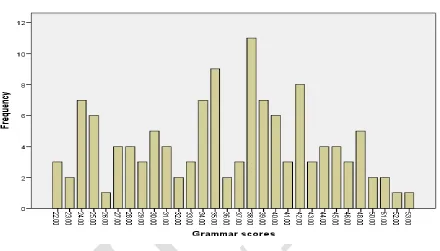
Graph 1. The obtained scores on the grammar test
The graph represents the frequency of the scores obtained by the participants on the grammar test, ranging from 22 to 53. The highest frequency of the obtained score was shown to be belonged to score 38. To determine whether there was any significant difference between the females and males' performances on the grammar test, an independent sample t-tests was run.
Table 2.
Group Statistics for females and males
Sex N Mean Std. Deviation
Female 94 35.4362 7.47261
Male 31 37.5806 8.69013
As shown, the number of the female participants exceeded that of the males. The mean score of females (M= 35.4) was shown to be lower than that of the males (M= 37.5). Therefore, there were differences between the mean scores of the female and the male participants on the English grammar test. That is, the male participants had a better performance than the females on the grammar test.
Vol. 6, Issue 7, October 2016
Page 27
Graph 2. The performance of the females on the grammar test
The graph represents the frequency of the obtained scores on the grammar test by the females. It was shown that the scores ranged from 22 to 52. The most frequent score was shown to be 35.
Graph 3. Performances of the males on the grammar test
Vol. 6, Issue 7, October 2016
Page 28
The distribution of the scores for the male participants is represented in the given graph. As shown, the scores ranged from 22 to 53. The most frequent score was shown to be 42.
Table 3.
Independent Samples t-test for the mean scores of the females and the males
Levene's Test for Equality of Variances
t-test for Equality of Means
F Sig. T df Sig. (2-tailed)
Mean Difference
Std. Error Difference
95% Confidence Interval of the
Difference Lower Upper Equal variances
assumed
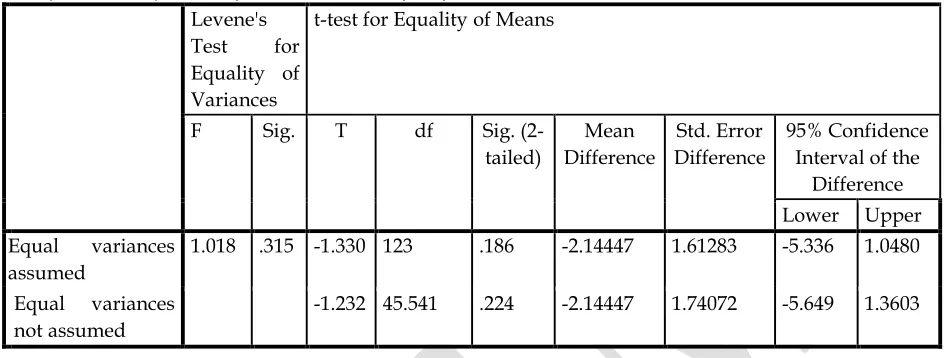
1.018 .315 -1.330 123 .186 -2.14447 1.61283 -5.336 1.0480
Equal variances not assumed
-1.232 45.541 .224 -2.14447 1.74072 -5.649 1.3603
Through an independent samples t-test the mean scores of the female and the male participants on English grammar features were compared. Despite the differences between the mean scores of the groups, that was shown in table 2, the differences were not statistically significant. Therefore, there was no significant difference in the mean scores of females (M= 35.43, SD=7.47) and males (M= 37.58, SD= 8.69); t (123) = -133, p= .186, two-tailed. The differences between the groups in terms of SD, also, revealed that this difference was very small (1.21, which is less than 2), which indicates that the differences between the groups were not significant.
5. Discussion
Males and females' performances on a grammar test were compared to determine which group had a better mastery of the English grammar. An independent samples t-test was run to determine whether males or females' performances on the English grammar test were better. The results indicated that the males with the mean score of 37.5 out-performed the females with the mean of 35.4. That is, the males had a better performance on the grammar test. It was, however, revealed that the differences between the groups were not statistically significant, despite the initial differences in their mean scores. Therefore, it was found that gender did not have a significant effect on the participants' total performances on the grammar test, and the null hypothesis was, then, confirmed. Despite individual differences, such as sex, that may affect learning, the results indicated that Iranian males and females did not significantly differ in mastering the English grammar.
Seemingly, language learning, grammar here, is not affected by gender despite the fact that gender is believed to be an influencing factor (Brown 2007, p. 234). Both males and females might have had the same understanding of the grammatical points. A rational explanation may be that both groups used the strategies that best fit them in learning grammar. Another is that since the number of female participants exceeded that of males, partially due to the nature of this field of study, females had a better control on problem-solving sessions, and group discussions concerning problematic grammatical points. Males might ask female classmates for clarifications and more explanations on some materials and, as a result, females may explain the materials based on their preferred learning styles, and learning strategies.
Vol. 6, Issue 7, October 2016
Page 29
The findings of the study support the results obtained by Tabatabaei and Shakerin (2013) who found that gender does not have a significant effect on the performances of the participants (Iranian intermediate EFL learners) on Multiple- choice (MC) cloze test and C-test. The results are, also, in line with the findings of Daif-Allah (2012) who found that males and females did not differ in beliefs about difficulties in the areas of foreign language learning. The results also confirm the findings of Zokaee, Zaferanieh and Naseri (2012) who found that gender does not have any significant impact on vocabulary learning strategies and learning styles of the participants. Tabanlıoğlu (2003) found no significant differences between the preferred language learning strategies by males and females.
6. Conclusions
It was found that males out-performed the females on the grammar test, but the differences between the groups were not statistically significant. The obtained mean scores by the groups signify the fact that there is a slight difference in the observed scores. Based on the findings of the study, it is concluded that the participants had some problems in using proper forms of the English grammar regardless of their gender. The participants were assumed to have a better consolidation of grammatical knowledge, since they were on the verge of graduation. Knowledge of grammar affects all language skills, particularly writing. Therefore, teaching and learning grammar demand more attention; Instructors and language learners should spend more time on