Applied Research on English Language
V. 6 N. 2 2017 pp: 237-266
http://are.ui.ac.ir/
___________________________________________
The Effect of Explicit and Implicit Corrective Feedback on
Segmental Word-Level Pronunciation Errors: Immediate and
Delayed Effects
Mohammad Zohrabi
1*, Nahal Behboudnia
21
Assistant Professor, University of Tabriz, Department of English Language, Faculty of Persian Literature and Foreign Languages, Tabriz, Iran
2
Instructor, University of Tabriz, Department of English Language, Faculty of Persian Literature and Foreign Languages, Tabriz, Iran
Received: 18/12/2016 Accepted: 13/01/2017
Abstract: Over the last few years, the realm of foreign language learning has witnessed an abundance of research concerning the effectiveness of corrective feedback on the acquisition of grammatical features, with the study of other target language subsystems, such as pronunciation, being few and far between. In order to bridge this gap, the present study intended to investigate and compare the immediate and delayed effect of explicit (overt) and implicit (covert) corrective feedback (CF) on treating segmental word-level pronunciation errors committed by adult EFL learners of an institute in Tabriz named ALC. To this end, through a quasi-experimental study and random sampling, three groups were formed, an explicit, an implicit and a control group, each consisting of 20 low proficient EFL learners. Besides, considering the levels that learners were assigned to, based on the institute‟s criteria, a Preliminary English Test (PET) was administered in order to determine the proficiency level of learners. Having administered the pretest before treatment, to measure the longer-term effect of explicit vs. implicit CF on segmental word-level pronunciation errors, the study included delayed posttests in addition to immediate posttests all of which included reading passages containing 40 problematic words. The collected data were analyzed by ANCOVA and the obtained findings revealed that both explicit and implicit corrective feedback are effective in reducing pronunciation errors showing significant differences between experimental and control groups. Additionally, the outcomes showed that immediate implicit and immediate explicit corrective feedback have similar effects on reduction of pronunciation errors. The same result comes up regarding the delayed effect of explicit feedback in comparison with delayed effect of implicit feedback. However, the delayed effect of explicit and implicit CF lowered comparing to their immediate effect due to time effect. Pedagogically, this study could enhance teachers‟ effort, knowledge, and beliefs in teaching pronunciation and providing corrective feedback to pronunciation errors.
238 Applied Research on English Language,V. 6 N. 2 2017
ARE
L
Introduction
Corrective feedback has recently attracted many researchers in Second Language
Acquisition. Several studies have addressed the role of correcting errors in SLA, and most of
these studies have focused on providing support for or against error correction in general. On
the theoretical ground, there are different views on the role of corrective feedback in SLA.
For example, White (1991) affirms that Error Correction (henceforth, EC) serves no purpose
in SLA. Krashen (1982, 1985) is one of those researchers who believe that corrective
feedback is not only useless but also harmful because it disrupts the flow of discourse. On the
other hand, there are many studies that show the effectiveness of corrective feedback.
Schmidt (1990), Swain (1998), and Long (1996) are among those researchers who assign a
facilitative role to feedback. They argue that corrective feedback draws learners‟ attention to
form, and this noticing to form helps them to recognize the gap between their interlanguage
and target language. Likewise, many other researchers argue that correcting errors in
language classrooms helps learners improve their proficiency in the target language
(Allwright & Bailey, 1991). The most comprehensive classification of corrective feedback is
the one proposed by Lyster and Ranta (1997) who classified corrective feedback into six
categories including explicit correction, recast, metalinguistic feedback,elicitation, repetition,
and clarification request. Among these, explicit correction and metalinguistic feedback are
considered as the explicit ones while recast and clarification request are among the implicit
types of corrective feedback. Carroll (2001) found that those learners who received explicit
error correction were more successful thanthose who received implicit corrective feedback.
However, there is a paucity of research focusing on the value of corrective feedback in
teaching pronunciation. Some insights in this area can be gleaned from descriptive studies of
error correction, such as those conducted by Lyster and Ranta (1997), Lyster (1998) or
Panova and Lyster (2002), in which pronunciation problems constituted one of the categories
of errors considered in terms of uptake and repair. In view of the fact that no studies
conducted to date have compared the effects of explicit and implicit correction on the
acquisition of pronunciation features, it seems warranted to briefly consider the findings of
research that has considered the effectiveness of these CF options in teaching other language
subsystems. Most of these empirical investigations provide rather clear-cut evidence for the
greater value of corrective techniques that are explicit and therefore can unambiguously be
The Effect of Explicit and Implicit Corrective Feedback on Segmental Word-Level Pronunciation Errors: ... 239
comes from the studies conducted by Carroll and Swain (1993), Rosa and Leow (2004), Ellis
et al. (2009), Ellis (2007).
Review of the Related Literature
Nature of Pronunciation
The term phonology refers to “the establishment and description of the distinctive sound units
of a language (phonemes) by means of distinctive features” (Richards & Schmidt 2010, p.
435). As Burgress and Spencer (2000) maintained, the phonology of a target language (TL)
consists of theory and knowledge about how the sound system of the target language works,
including segmental and suprasegmental features.
Segmental features are minimal units of sound defined in phonetic terms. These
features including vowels and consonants can be thought of as the segments of which speech
is composed (Ladefoged & Johnson, 2011). Traditionally, the fundamental components of
pronunciation are phonemes, and acquisition of the target language phonological system is
viewed as mastery of the phonemic distinctions embodied in its phonological inventory and
of the phonetic variants of phonemes which occur in particular environments within syllables
and words (Pennington & Richards, 1986).
Superimposed on the syllables are other features known as suprasegmentals. In other
words, suprasegmental features transcend the level of individual sound production and relate
to sounds at the macro level. These features are independent of the categories required for
describing segmental features (vowels and consonants). Linking, intonation, and stress are
important features for effective pronunciation at the suprasegmental level (Burns & Claire,
2003). Length is also usually considered to be a suprasegmental feature, although it can affect
single segments as well as whole syllables.
Corrective Feedback
The topic of error correction in its oral and written sense tends to spark controversy among
both language teachers and researchers. Depending on different researchers, error correction
is described on a continuum ranging from ineffective and possibly harmful (e.g., Krashen,
1994) to beneficial (e.g., Russell & Spada, 2006) and possibly even essential for some
grammatical structures (White, 1991). Furthermore, teachers may be confronted with
240 Applied Research on English Language,V. 6 N. 2 2017
ARE
L
Before going further, it is important to have brief review of definitions made for the
term “corrective feedback”. Lightbown and Spada (1993 p. 171) stated that corrective feedback is “any indication to the learners that their use of the target language is incorrect”.
Chaudron (1988) also pointed out the fact that the term corrective feedback incorporates
different layers of meaning. In his view, the term “treatment of error” may simply refer to “any teacher behavior following an error that minimally attempts to inform the learner of the fact of error”. The treatment may not be evident to the student in terms of the response it elicits, or it may make a significant effort “to elicit a revised student response” (p. 150). Finally, there is “the true” correction which succeeds in modifying the learner‟s interlanguage
rule so that the error is eliminated from further production (p. 150).
Long (1996) offered a more comprehensive view of feedback in general. He suggests
that environmental input can be thought of in terms of two categories that are provided to the
learners about the target language (TL): positive evidence and negative evidence. Long
defines positive evidence as providing the learners with models of what is grammatical and
acceptable in the TL; and negative evidence as providing the learners with direct or indirect
information about what is unacceptable. Likewise, as Ellis (2009) proposed, positive
feedback affirms that a learner response is correct. It may signal the veracity of the content of
a learner utterance or the linguistic correctness of the utterance. Negative feedback signals, in
one way or another, that the learner‟s utterance lacks veracity or is linguistically deviant. It is
for decades that error treatment is one of the main concerns of teachers to help learners
overcome their weaknesses.
Corrective feedback has recently attracted many researchers in SLA. On theoretical
ground, there are different views on the role of corrective feedback in SLA. Krashen (1982,
1985) is one of those researchers who believe that corrective feedback is not only useless but
also harmful because it disrupts the flow of discourse. On the other hand, there are many
studies that show the effectiveness of corrective feedback. Schmidt (1990), Swain (1998),
and Long (1996) are among those researchers who assign a facilitative role to feedback. They
argue that corrective feedback draws learners‟ attention to form, and this noticing to form
helps them to recognize the gap between their interlanguage and target language. Van Patten
(2003) suggested that corrective feedback in the form of negotiating for meaning can help
learners notice their errors and create form-meaning connections, and this facilitates
The Effect of Explicit and Implicit Corrective Feedback on Segmental Word-Level Pronunciation Errors: ... 241
In a broad sense, the present study was designed to focus on the effectiveness of
corrective feedback on pronunciation. In particular, the present study aimed to answer the
following questions:
RQ1: Does explicit corrective feedback have any significant immediate effect on
reduction of segmental word-level pronunciation errors committed by low proficient
EFL learners?
RQ2: Does explicit corrective feedback have any significant delayed effect on
reduction of segmental word-level pronunciation errors committed by low proficient
EFL learners?
RQ3: Does implicit corrective feedback have any significant immediate effect on
reduction of segmental word-level pronunciation errors committed by low proficient
EFL learners?
RQ4 Does implicit corrective feedback have any significant delayed effect on reduction
of segmental word-level pronunciation errors committed by low proficient EFL
learners?
RQ5: Is there any significant difference in the immediate effect of explicit and implicit
corrective feedback on segmental word-level pronunciation errors committed by low
proficient EFL learners?
RQ6: Is there any significant difference in the delayed effect of explicit and implicit
corrective feedback on segmental word-level pronunciation errors committed by low
proficient EFL learners?
The Study
Site of the Study
This study was carried out in an institutional context named ALC (Atashian Language
College) located in Tabriz, Iran. In this institute, each term is held for 20 sessions and the
classes meet three times a week for a one-and-a-half-hour class time. The main course books
covered in this institute are New Total English series for different levels of proficiency, by
Clare and Wilson (2009). Each pack consists of a students‟ book, a workbook, a portfolio and
audio CDs. The theme of the course books is English language communication. English is the
242 Applied Research on English Language,V. 6 N. 2 2017
ARE
L
Method
Design of the Study
This quasi-experimental research was based on a pretest-posttest method. Having
administered the pretest before treatment, to measure the longer-term effect of explicit vs.
implicit CF (corrective Feedback) on segmental word-level pronunciation errors, the study
included delayed posttests in addition to immediate posttests. Prior to the initiation of the
study, three groups were formed including two treatments and one control group. An explicit
and an implicit group formed the treatment groups. The sixty subjects of this study were
randomly assigned to one of the three groups. The independent variable in this study was
explicit and implicit corrective feedback which was tested against the dependent variable
being segmental word-level pronunciation errors. The researchers themselves acted as the
instructor of all the groups under study. Having reached the intermediate-low level of English
proficiency, all the subjects, over the period of the investigation, studied in
lower-intermediate (LI). The participants‟ ability to pronounce the targeted words were measured
on a pretest, a posttest, and a delayed posttest all of which included reading aloud a passage
containing 40 problematic words. While the students in the CG followed their regular
activities, those in the two experimental groups (Explicit G. and Implicit G.) had the benefit
of an instructional treatment in which they were asked to perform tasks calling for the use of
the 90 problematic words. The difference between the IG and EG was that in the former, the
corrective feedback was implicit and took the form of recasts and clarification requests, and
in the latter the correction was explicit and involved the use of direct error correction or
elicitation, sometimes accompanied by metalinguistic cues. As can be seen from Table 1,
which diagrammatically presents the design of the research project, it spanned a period of 7
weeks (the whole 20 sessions of the term).
Table 1. The design of the study
Week 1 Week 2 Week 3 Week 7
Experimental Groups
Explicit G. pretest Explicit correction Posttest Delayed
posttest
Implicit G. pretest Implicit correction Posttest Delayed
posttest
Control Group Pretest Regular activities Posttest Delayed
The Effect of Explicit and Implicit Corrective Feedback on Segmental Word-Level Pronunciation Errors: ... 243
Participants
In order to investigate the research questions, a sample of 60 female lower-intermediate EFL
learners was selected from Atashian Language College in Tabriz, Iran. The age of
participants under investigation ranged from 16 to 31 years old; the native language of the
participants was Azerbaijani, their second language being Persian, and they were in the
process of learning English as a foreign language. None of the participants had any
background of residence in an English-speaking country. They were also asked if they
suffered from any hearing deficiency. In this respect, none of them reported any background
of hearing problems.
Besides, considering the levels that learners were assigned to (lower intermediate),
based on institute‟s criteria, a Preliminary English Test (PET) was administered in order to
determine the proficiency level of the learners. The reason why elementary and advanced
levels were not considered as an intelligent choice for the current study is that elementary
levels are behind the needed competence. On the other hand, advanced level learners also
have already developed high competence in language and the number of errors is not
considerable; therefore, teachers do not provide sufficient amount of feedback types. As a
result, it would be fair to say that the intermediate, specifically lower-intermediate, levels
were the most appropriate targets for the present study.
After that, through stratified random sampling, two treatment groups and one control
group were formed, each including 20 subjects. One of the experimental groups received
explicit CF (corrective feedback) and the other one was exposed to implicit CF while the
control group received no feedback. All the learners were taught by the same teacher. It is
also worth mentioning that all the participants expressed their willingness to take part in the
study.
Instruments
Prior to the initiation of the study, a paper-based Preliminary English Test (PET), a second
level Cambridge ESOL exam for the intermediate level learners was given to all the subjects
as to ensure their homogeneity in terms of language proficiency. The test consisted of 85
items and included four sections of Reading, Writing, Listening, and Speaking. As assigned
by the instructions given in the test itself, the participants were given about 120 minutes to
244 Applied Research on English Language,V. 6 N. 2 2017
ARE
L
The mastery of the pronunciation of the instructional targets was measured on a pretest,
a posttest, and a delayed posttest. Being identical, these three tests included extracts of ten
reading passages containing 40 targeted mispronounced words. These passages were selected
from the students‟ course book named New Total English: Pre-intermediate. These
problematic words were identified on the basis of observations of English classes as well as
suggestions made by the teacher of the students taking part in the experiment. It must be
mentioned that all ten passages were used repetitively in pretest, posttest, and delayed
posttest. However, as the time interval between tests was four weeks, the memory factor
influencing the test results had been removed.
The other material used to record the students‟ voice while reading aloud in pretest,
posttest, and delayed posttest was a digital portable minidisc recorder Sony MZ-R37, with a
stereo microphone to ensure high quality sound for the rater. In order to transcribe and score
each student‟s performance on each item, a checklist of 40 problematic words was prepared.
Findings and Data Analysis
Statistical Analysis
In this regard, inferential statistical methods were used to test research hypotheses; the
collected data were examined and analyzed by ANCOVA.
Testing the First Hypothesis
Research Question 1 (RQ1): Does explicit corrective feedback have any significant
immediate effect on reduction of segmental word-level pronunciation errors committed by
low proficient EFL learners?
Null Hypothesis 1 (H01): Explicit corrective feedback has no significant immediate
effect on reduction of segmental word-level pronunciation errors committed by low proficient
EFL learners.
Alternative Hypothesis 1 (H1): Explicit corrective feedback has significant immediate
effect on reduction of segmental word-level pronunciation errors committed by low proficient
EFL learners.
Considering the use of pretest and posttest in conducting this study and for analyzing
the data related to this hypothesis, covariance analysis was used in order to control the effect
of pretest. In this study, Smirnov-Kolmogorov test was administered for ensuring normal
distribution of data. And Levene‟s test was used in order to ensure the homogeneity of the
The Effect of Explicit and Implicit Corrective Feedback on Segmental Word-Level Pronunciation Errors: ... 245
Normal distribution of data
Table 2. Results of Smirnov-Kolmogorov test for normal distribution of variables
Variables Group Test Significance level
Pretest
Explicit 0.55 0.91
Posttest 0.72 0.67
Pretest
Posttest Control
0.39 0.49
0.99 0.96
Table 2 indicates the results obtained from Smirnov-Kolmogorov test for the explicit
and control groups. Since the significance level for all the groups in pretest and posttest is
more than 0.05, it can be stated that the data of this study is distributed normally.
Equality of variances
Table 3. Results of Levene‟s test for comparing variances of immediate effect in explicit and control groups
Significance level Degree of freedom 2
Degree of freedom 1 F
0.11 38
1 16.95
The results revealed in Table 3 confirmed the assumption related to equality of
variances of groups based on Levene‟s test. Accordingly, F=16.95 and P<0.01 and the
variances of the population are equal; i.e. the distribution of scores related to immediate
effect of explicit corrective feedback in both explicit and control groups are equal.
Considering the assumptions mentioned earlier, the covariance analysis is presented in the
following part:
Table 4. Results of covariance analysis of immediate effect in explicit and control groups
Sum of squares
Degree of freedom
Mean of
squares F
Significance
level 2ƞ
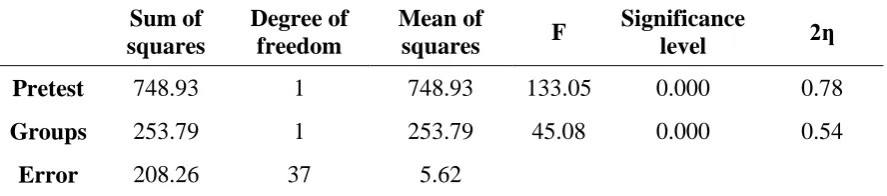
Pretest 748.93 1 748.93 133.05 0.000 0.78
Groups 253.79 1 253.79 45.08 0.000 0.54
Error 208.26 37 5.62
Table 4 illustrates the results of covariance analysis in explicit and control groups
246 Applied Research on English Language,V. 6 N. 2 2017
ARE
L
to pretest have been controlled statistically. That is, the effects of scores related to a similar
variable are removed from the scores of posttest of explicit group and then two groups are
compared based on the remained variance. As the results of covariance analysis show, there
is a significant difference between the scores of the explicit group and control group
(F=45.08, P<0.05); 2ƞ is 0.54, that is, the immediate effectiveness of explicit corrective
feedback over segmental word level pronunciation errors is 54%.
Table 5. Mean and standard deviation of scores of immediate effect in explicit and control groups after controlling pretest
Group Mean Standard deviation Confidence level
Low High
Experimental 31.91 0.53 30.84 32.99
Control 26.88 0.53 25.8 27.95
Table 5 illustrates the mean and standard deviation of immediate effect of explicit
corrective feedback on the control group and explicit group after controlling the similar
variable. The mean score for the explicit group is 31.91 and for the control group is 26.88
which are significantly different. In other words, explicit corrective feedback is effective in
reducing segmental word-level pronunciation errors of learners in immediate posttest. Thus,
it can be argued that the first alternative hypothesis is confirmed and the null hypothesis is
rejected.
Figure 1. Comparing pretest and posttest of explicit and control groups
immediate effect of explicit CF
FACT OR1
2 1
E
s
ti
m
a
te
d
M
a
rg
in
a
l
M
e
a
n
s
33
32
31
30
29
28
27
26
25
GROUP
Explicit
The Effect of Explicit and Implicit Corrective Feedback on Segmental Word-Level Pronunciation Errors: ... 247
Testing the Second Hypothesis
Research Question 2 (RQ2): Does explicit corrective feedback have any significant delayed
effect on reduction of segmental word-level pronunciation errors committed by low proficient
EFL learners?
Null Hypothesis 2 (H02): Explicit corrective feedback has no significant delayed effect
on reduction of segmental word-level pronunciation errors committed by low proficient EFL
learners.
Alternative Hypothesis 2 (H2): Explicit corrective feedback has significant delayed
effect on reduction of segmental word-level pronunciation errors committed by low proficient
EFL learners.
Considering the use of pretest and posttest in conducing this study and for analyzing the
data related to these hypotheses, covariance analysis was used in order to control the effect of
pretest. In this study, Smirnov-Kolmogorov test was administered for ensuring normal
distribution of data. And Levene‟s test was used in order to ensure the homogeneity of the
data.
Normal distribution of data
Table 6. Results of Smirnov-Kolmogorov test for normal distribution of variables
Variables Group Test Significance level
Pretest
Explicit 0.55 0.91
Delayed Posttest 0.97 0.29
Pretest
Control 0.39 0.99
Delayed Posttest 0.48 0.97
Table 6 indicates the results obtained from Smirnov-Kolmogorov test for the explicit
and control groups. Since the significance level for all the groups in pretest and delayed
posttest is more than 0.05, it can be stated that the data of this study is distributed normally.
Equality of variances
Table 7. Results of Levene‟s test for comparing variances of delayed effect in explicit and control groups
Significance level Degree of freedom 2
Degree of freedom 1 F
0.11 38
248 Applied Research on English Language,V. 6 N. 2 2017
ARE
L
The results revealed in Table 4-6 confirmed the assumption related to equality of
variances of groups based on Levene‟s test. Accordingly, F=23.86 and P<0.11 and the
variances of the population are equal. That is, the distribution of scores related to delayed
effect of explicit corrective feedback in both explicit and control groups are equal.
Considering the assumptions mentioned earlier, the covariance analysis is presented in the
following part:
Table 8. Results of covariance analysis of delayed effect on explicit and control groups
Sum of squares
Degree of freedom
Mean of
squares F
Significance
level 2ƞ
Pretest 734.59 1 734.59 125.16 0.000 0.77
Groups 159.16 1 159.16 27.11 0.000 0.42
Error 217.15 37 5.86
Table 8 illustrates the results of covariance analysis in the explicit and control groups
concerning the delayed effect of explicit corrective feedback. In this analysis the scores
related to pretest have been controlled statistically. That is, the effects of scores related to a
similar variable are removed from the scores of delayed explicit corrective feedback and then
the two groups are compared based on the remained variance. As the results of covariance
analysis show, there is a significant difference in delayed posttests of explicit and control
group (F=27.11, P<0.05); 2ƞ is 0.42, that is, 42% of the reduction of segmental word-level
pronunciation errors in delayed posttest is due to explicit corrective feedback.
Table 9. Mean and standard deviation of scores of delayed effect in explicit and control groups after controlling pretest
Group Mean Standard deviation
Confidence level
Low High
Experimental 30.72 0.54 29.62 31.81
Control 26.73 0.54 25.63 27.82
Table 9 illustrates the mean and standard deviation of delayed effect of explicit
corrective feedback on the control and explicit groups after controlling the similar variable.
The mean score for the explicit group is 30.72 and for the control group is 26.73 which are
significantly different. In other words, explicit corrective feedback is effective in reduction of
The Effect of Explicit and Implicit Corrective Feedback on Segmental Word-Level Pronunciation Errors: ... 249
argued that the second alternative hypothesis is confirmed and the second null hypothesis is
rejected.
Figure 2. Comparing pretest and delayed posttest of explicit and control group
Testing the Third Hypothesis
Research Question 3 (RQ3): Does implicit corrective feedback have any significant
immediate effect on reduction of segmental word-level pronunciation errors committed by
low proficient EFL learners?
Null Hypothesis 3 (H03): Implicit corrective feedback has no significant immediate
effect on reduction of segmental word-level pronunciation errors committed by low proficient
EFL learners.
Alternative Hypothesis 3 (H3): Implicit corrective feedback has significant immediate
effect on reduction of segmental word-level pronunciation errors committed by low proficient
EFL learners.
Considering the use of pretest and posttest in conducing this study and for analyzing the
data related to these hypotheses, covariance analysis was used in order to control the effect of
pretest. In this study, Smirnov-Kolmogorov test was administered for ensuring normal
distribution of data. And Levene‟s test was used in order to ensure the homogeneity of the
data.
delayed effect of explicit CF
FACT OR1
2 1
E
s
ti
m
a
te
d
M
a
rg
in
a
l
M
e
a
n
s
32
31
30
29
28
27
26
25
GROUP
Explicit
250 Applied Research on English Language,V. 6 N. 2 2017
ARE
L
Normal distribution of data
Table 10. Results of Smirnov-Kolmogorov test for normal distribution of variables
Variables Group Test Significance level
Pretest
Implicit 0.49 0.96
Posttest 0.74 0.63
Pretest
Control 0.39 0.99
Posttest 0.49 0.96
Table 10 indicates the results obtained from Smirnov-Kolmogorov test for the implicit
and control groups. Since the significance level for all the groups in pretest and posttest is
more than 0.05, it can be stated that the data of this study is distributed normally.
Equality of variances
Table 11. Results of Levene‟s test for comparing variances of immediate effect in implicit and control groups
Significance level Degree of freedom 2
Degree of freedom 1 F
0.011 38
1 7.27
The results revealed in Table 11 confirmed the assumption related to equality of
variances of the groups based on Levene‟s test. Accordingly, F=7.27 and P<0.011 and the
variances of the population are equal; that is, the distribution of scores related to immediate
effect of implicit corrective feedback in both implicit and control groups are equal.
Considering the assumptions mentioned earlier, the covariance analysis is presented in the
following part:
Table 12. Results of covariance analysis of immediate effect on implicit and control groups
Sum of squares
Degree of freedom
Mean of
squares F
Significance
level 2ƞ
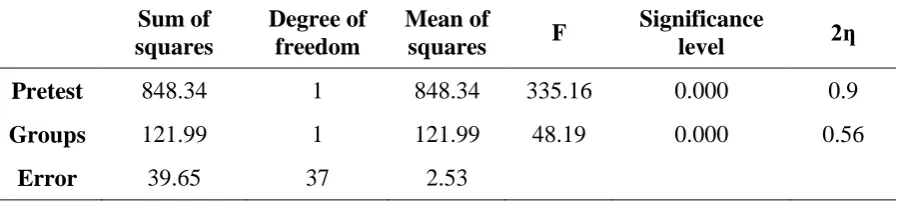
Pretest 848.34 1 848.34 335.16 0.000 0.9
Groups 121.99 1 121.99 48.19 0.000 0.56
Error 39.65 37 2.53
Table 12 illustrates the results of covariance analysis in the implicit and control groups
concerning the immediate effect of implicit CF. In this analysis the scores of pretest have
The Effect of Explicit and Implicit Corrective Feedback on Segmental Word-Level Pronunciation Errors: ... 251
removed from the scores of immediate implicit corrective feedback and then the two groups
are compared based on the remained variance. As the results of covariance analysis show,
there is a significant difference between the posttests of implicit and control groups (F=48.19,
P<0.05); 2ƞ is 0.56, that is, 56% of the reduction of segmental word-level pronunciation
errors in posttest is due to implicit corrective feedback.
Table 13. Mean and standard deviation of scores of immediate effect on implicit and control groups after controlling pretest
Group Mean Standard deviation Confidence level
Low High
Experimental 29.85 0.35 29.13 30.57
Control 26.34 0.35 25.62 27.06
Table 13 illustrates the mean and standard deviation of implicit corrective feedback in
the control and implicit groups after controlling the similar variable. The mean score for the
implicit group is 29.85 and for control group is 26.34 which are significantly different. In
other words, implicit CF is effective in reduction of segmental word-level pronunciation
errors of learners in immediate posttest. Thus, it can be argued that the third alternative
hypothesis is confirmed and the third null hypothesis is rejected.
Figure 3. Comparing pretest and posttest of implicit and control group immediate effect of implicit CF
FACT OR1
2 1
E
s
ti
m
a
te
d
M
a
rg
in
a
l
M
e
a
n
s
30
29
28
27
26
25
GROUP
Implicit
252 Applied Research on English Language,V. 6 N. 2 2017
ARE
L
Testing the Fourth Hypothesis
Research Question 4 (RQ4): Does implicit corrective feedback have any significant delayed
effect on reduction of segmental word-level pronunciation errors committed by low proficient
EFL learners?
Null Hypothesis 4 (H04): Implicit corrective feedback has no significant delayed effect
on reduction of segmental word-level pronunciation errors committed by low proficient EFL
learners.
Alternative Hypothesis 4 (H4): Implicit corrective feedback has significant delayed
effect on reduction of segmental word-level pronunciation errors committed by low proficient
EFL learners.
Considering the use of pretest and posttest in conducting this study and for analyzing
the data related to this hypothesis, covariance analysis was used in order to control the effect
of pretest. In this study, Smirnov-Kolmogorov test was administered for ensuring normal
distribution of data. And Levene‟s test was used in order to ensure the homogeneity of the
data.
Normal distribution of data
Table 14. Results of Smirnov-Kolmogorov test for normal distribution of variables
Variables Group Test Significance level
Pretest
Implicit
0.49 0.96
Delayed Posttest 0.81 0.52
Pretest
Control
0.39 0.99
Delayed Posttest 0.48 0.97
Table 14 indicates the results obtained from Smirnov-Kolmogorov test for the implicit
and control groups. Since the significance level for all the groups in pretest and delayed
posttest is more than 0.05, it can be stated that the data of this study is distributed normally.
Equality of variances
Table 15. Results of Levene‟s test for comparing variances of delayed effect on implicit and control groups
Significance level Degree of freedom 2
Degree of freedom 1 F
0.035 38
The Effect of Explicit and Implicit Corrective Feedback on Segmental Word-Level Pronunciation Errors: ... 253
The results revealed in Table 15 confirmed the assumption related to equality of
variances of groups based on Levene‟s test. Accordingly, F=9.67 and P<0.01 and the
variances of the population are equal. That is, the distribution of scores related to delayed
effect of implicit corrective feedback in both implicit and control groups are equal.
Considering the assumptions mentioned earlier, the covariance analysis is presented in the
following part:
Table 16. Results of covariance analysis of delayed effect on implicit and control groups
Sum of squares
Degree of freedom
Mean of
squares F
Significance
level 2ƞ
Pretest 837.69 1 837.69 301.92 0.000 0.89
Groups 98.51 1 98.51 35.5 0.000 0.49
Error 102.65 37 2.77
Table 16 illustrates the results of covariance analysis in the implicit and control groups
concerning the delayed effect of implicit CF. In this analysis the scores related to pretest have
been controlled statistically. That is, the effects of scores related to a similar variable are
removed from the scores of delayed implicit CF and then the two groups are compared based
on the remained variance. As the results of covariance analysis show, there is a significant
difference between the scores of delayed posttest in the implicit and control groups (F=35.5,
P<0.05); 2ƞ is 0.49, that is, 49% of the reduction of segmental word-level pronunciation
errors in delayed posttest is due to implicit CF.
Table 17. Mean and standard deviation of scores of delayed effect on implicit and control groups after controlling pretest
Group Mean Standard deviation Confidence level
Low High
Experimental 29.35 0.37 28.59 30.1
Control 26.19 0.37 25.44 26.95
Table 17 illustrates the mean and standard deviation of delayed effect of implicit CF in
the control and implicit groups after controlling the similar variable. The mean score for the
implicit group is 29.35 and for the control group is 26.19 which are significantly different. In
254 Applied Research on English Language,V. 6 N. 2 2017
ARE
L
errors of learners in delayed posttest. Thus, it can be argued that the fourth alternative
hypothesis is confirmed and the fourth null hypothesis is rejected.
Figure 4. Comparing pretest and delayed posttest of implicit and control group
Testing the Fifth Hypothesis
Research Question 5 (RQ5): Is there any significant difference in the immediate effect of
explicit and implicit corrective feedback on segmental word-level pronunciation errors
committed by low proficient EFL learners?
Null Hypothesis 5 (H05): There is no significant difference in the immediate effect of
explicit and implicit CF on reduction of segmental word-level pronunciation errors
committed by low proficient EFL learners.
Alternative Hypothesis 5 (H5): There is significant difference in the immediate effect of
explicit and implicit CF on reduction of segmental word-level pronunciation errors
committed by low proficient EFL learners.
Considering the use of pretest and posttest in conducting this study and for analyzing
the data related to this hypothesis, covariance analysis was used in order to control the effect
of pretest. In this study, Smirnov-Kolmogorov test was administered for ensuring normal
distribution of data. And Levene‟s test was used in order to ensure the homogeneity of the
data.
delayed effect of implicit CF
FACT OR1
2 1
E
s
ti
m
a
te
d
M
a
rg
in
a
l
M
e
a
n
s
30
29
28
27
26
25
GROUP
Implicit
The Effect of Explicit and Implicit Corrective Feedback on Segmental Word-Level Pronunciation Errors: ... 255
Normal distribution of data
Table 18. Results of Smirnov-Kolmogorov test for normal distribution of variables
Variables Group Test Significance level
Pretest
Explicit 0.55 0.91
Posttest 0.72 0.67
Pretest
Implicit 0.49 0.96
Posttest 0.74 0.63
Table 18 indicates the results obtained from Smirnov-Kolmogorov test for the explicit
and implicit groups. Since the significance level for all groups in pretest and posttest is more
than 0.05, it can be stated that the data of this study is distributed normally.
Equality of variances
Table 19. Results of Levene‟s test for comparing variances of immediate effect on explicit and implicit groups
Significance level Degree of freedom 2
Degree of freedom 1 F
0.054 38
1 3.95
The results revealed in Table 19 confirmed the assumption related to equality of
variances of groups based on Levene‟s test. Accordingly, F=3.95 and P<0.05 and the
variances of the population are equal. That is, the distribution of scores of posttests in explicit
and implicit corrective feedback is equal. Considering the assumptions mentioned earlier, the
covariance analysis is presented in the following part:
Table 20. Results of covariance analysis of immediate effect on explicit and implicit groups
Sum of squares
Degree of freedom
Mean of
squares F
Significance
level 2ƞ
Pretest 929.35 1 929.35 128.57 0.000 0.77
Groups 20.98 1 20.98 2.9 0.000 0.07
Error 267.44 37 7.22
Table 20 illustrates the results of covariance analysis related to immediate effect of
explicit and implicit corrective feedback. In this analysis, the scores of pretest have been
256 Applied Research on English Language,V. 6 N. 2 2017
ARE
L
from the scores of immediate effect of explicit and implicit corrective feedback and then the
two groups are compared based on the remained variance. As the results of covariance
analysis show, there is no significant difference between the scores of explicit and implicit
corrective feedback in posttests (F=2.9, P>0.09). In other words, both explicit and implicit
CF have equal immediate effect.
Table 21. Mean and standard deviation of scores of immediate effect on explicit and implicit groups after controlling pretest
Group Mean Standard deviation
Confidence level
Low High
Experimental 29.97 0.6 28.74 31.19
Control 31.42 0.6 30.2 32.65
Table 21 illustrates the mean and standard deviation of posttests in explicit and implicit
CF after controlling the similar variable. The mean score for immediate effect of explicit CF
is 29.97 and for immediate effect of implicit CF is 31.42 which are not significantly different.
In other words, the effectiveness of explicit CF is similar to implicit CF in immediate
posttests. Thus, it can be argued that the fifth alternative hypothesis is rejected and the fifth
null hypothesis is confirmed.
Testing the Sixth Hypothesis
Research Question 6 (RQ6): Is there any significant difference in the delayed effect of
explicit and implicit corrective feedback on segmental word-level pronunciation errors
committed by low proficient EFL learners?
Null Hypothesis 6 (H0 6): There is no significant difference in the delayed effect of
explicit and implicit CF on reduction of segmental word-level pronunciation errors
committed by low proficient EFL learners.
Alternative Hypothesis 6 (H6): There is significant difference in the delayed effect of
explicit and implicit CF on reduction of segmental word-level pronunciation errors
committed by low proficient EFL learners.
Considering the use of pretest and posttest in conducting this study and for analyzing
the data related to this hypothesis, covariance analysis was used in order to control the effect
of pretest. In this study, Smirnov-Kolmogorov test was administered for ensuring normal
distribution of data. And Levene‟s test was used in order to ensure the homogeneity of the
The Effect of Explicit and Implicit Corrective Feedback on Segmental Word-Level Pronunciation Errors: ... 257
Normal distribution of data
Table 22. Results of Smirnov-Kolmogorov test for normal distribution of variables
Variables Group Test Significance level
Pretest
Explicit
0.55 0.91
Delayed Posttest 0.97 0.29
Pretest
Implicit 0.49 0.96
Delayed Posttest 0.81 0.52
Table 22 indicates the results obtained from Smirnov-Kolmogorov test for explicit and
implicit groups. Since the significance level for all the groups in pretest and delayed posttest
is more than 0.05, it can be stated that the data of this study is distributed normally.
Equality of variances
Table 23. Results of Levene‟s test for comparing variances of delayed effect on explicit and implicit groups
Significance level Degree of freedom 2
Degree of freedom 1 F
0.057 38
1 3.85
The results revealed in Table 23 confirmed the assumption related to equality of
variances of groups based on Levene‟s test. Accordingly, F=3.85 and P<0.05 and the
variances of the population are equal. That is, the distribution of scores regarding the delayed
effect of explicit and implicit corrective feedback is equal. Considering the assumptions
mentioned earlier, the covariance analysis is presented in the following part:
Table 24. Results of covariance analysis of delayed effect in explicit and implicit groups
Sum of squares
Degree of freedom
Mean of
squares F
Significance
level 2ƞ
Pretest 938.98 1 938.98 120.62 0.000 0.76
Groups 5.58 1 5.58 0.71 0.4 0.01
Error 288.01 37 7.78
Table 24 illustrates the results of covariance analysis related to delayed effect of
explicit and implicit CF. In this analysis the scores of pretest have been controlled
258 Applied Research on English Language,V. 6 N. 2 2017
ARE
L
scores of delayed effect of explicit and implicit CF and then the two groups are compared
based on the remaining variance. As the results of covariance analysis show, there is no
significant difference between the scores of delayed effect of explicit and implicit corrective
feedback (F=0.71, P>0.4).
Table 25. Mean and standard deviation of scores of delayed effect in explicit and implicit corrective groups after controlling pretest
Group Mean Standard deviation
Confidence level
Low High
Experimental 29.49 0.62 28.2 30.74
Control 30.22 0.62 28.95 31.49
Table 25 illustrates the mean and standard deviation of the delayed effect of explicit
and implicit CF after controlling the similar variable. The mean score for delayed effect of
explicit corrective feedback is 29.47 and for delayed effect of implicit corrective feedback is
30.22 which are not significantly different. In other words, the explicit corrective feedback is
similar to implicit corrective feedback in delayed posttest. Finally, it can be argued that the
last alternative hypothesis fails to be confirmed.
Discussion
The form of feedback that should be used has been a point of contention in ESL and EFL
teaching in recent years. In a classroom setting where students receive feedback, they can
usually expect to receive explicit feedback in the form of metalinguistic correction, or they
can receive implicit feedback, often given in the form of recasts.
Research Questions One to Four
The obtained results related to the first four research questions showed the effectiveness of
corrective feedback on reduction of pronunciation errors. There are several studies that
revealed the general effectiveness of corrective feedback. Hence, the general results of these
four hypotheses are in line with the following studies: Ferris (1999) has disputed this claim,
arguing that it was not possible to dismiss correction in general as it depended on the quality
of the correction – in other words, if the correction was clear and consistent it would work.
Schmidt (1990), Swain (1998), and Long (1996) are also among those researchers who assign
The Effect of Explicit and Implicit Corrective Feedback on Segmental Word-Level Pronunciation Errors: ... 259
to form, and this noticing to form helps them to recognize the gap between their
interlanguage and target language.
The first research question investigated whether explicit corrective feedback has any
significant immediate effect on reduction of segmental word-level pronunciation errors
committed by low proficient EFL learners. As the results of covariance analysis exposed,
there is significant difference between the scores of explicit group and control group in
immediate posttest. Therefore, it can be concluded that explicit corrective feedback is
effective in reduction of segmental word-level pronunciation errors in short term.
The second research question investigated whether explicit corrective feedback has any
significant delayed effect on reduction of segmental word-level pronunciation errors
committed by low proficient EFL learners. As the results of covariance analysis showed,
there is significant difference between the scores of explicit group and control group in
delayed posttest. That is, explicit corrective feedback is effective in reduction of segmental
word-level pronunciation errors in long term.
The third research question investigated whether implicit corrective feedback has any
significant immediate effect on reduction of segmental word-level pronunciation errors
committed by low proficient EFL learners. According to the results obtained from covariance
analysis, there is significant difference between the scores of implicit group and control
group in immediate posttest. Thus, it can be concluded that implicit corrective feedback is
effective in reduction of segmental word-level pronunciation errors in short term.
The fourth research question investigated whether implicit corrective feedback has any
significant delayed effect on reduction of segmental word-level pronunciation errors
committed by low proficient EFL learners. As the results of covariance analysis showed,
there is significant difference between the scores of implicit group and control group in
delayed posttest. Therefore, it can be concluded that implicit corrective feedback is effective
in reduction of segmental word-level pronunciation errors in long term.
Studies Related to Research Questions One to Four
The results obtained from the following research projects are in line with the present study.
Considering explicit feedback Van Patten (2003) advocated that explicit corrective feedback
in the form of negotiating for meaning can help learners notice their errors and create
260 Applied Research on English Language,V. 6 N. 2 2017
ARE
L
Support for the greater benefits of more explicit feedback types comes, among others,
from the studies conducted by Carroll and Swain (1993), Rosa and Leow (2004), Lyster
(2004), Ellis et al. (2009), and Ellis (2007).
Carroll and Swain (1993) investigated different types of corrective feedback in
acquisition of English dative verbs by adult native speakers of Spanish and found that all
groups receiving feedback, explicit or implicit, performed significantly better at the end of
the study than the control group. Any kind of feedback was hence found to be beneficial, but
the group receiving explicit feedback outperformed the other groups.
The computer-based study undertaken by Rosa and Leow (2004) proved that the group
which was provided with explicit feedback on accurate and inaccurate utterances as well as
the opportunity to self-correct scored significantly higher on multiple-choice recognition tests
and written controlled production tests than the one in which implicit correction was
employed, although the students in this group still did better than the controls.
Ellis, et al. (2009) conducted a classroom-based study which investigated the impact of
explicit and implicit CF on the acquisition of the regular past tense „-ed‟ ending by
lower-intermediate adult ESL learners in New Zealand. Also here the feedback groups did better
than the controls, and prompts involving the use of metalinguistic information proved to be
more effective than recasts in the long run, particularly with respect to the development of
implicit knowledge as well as the occurrence of system-learning.
Similar in design was the study undertaken by Ellis (2007), which focused on the
acquisition of the „-ed‟ ending and the comparative, and also corroborated the superiority of
more overt corrective feedback options.
Corresponding results have been reported by Sheen (2007), who compared the effects
of direct correction coupled with metalinguistic explanation and recasts on the acquisition of
English articles by intermediate-level students, as well as Varnosfadrani and Basturkmen
(2009), who found that explicit correction resulted in better scores on individualized
posttests, with the caveat that its contribution was mediated by the participants‟
developmental readiness (i.e. it benefitted developmentally early features more than
developmentally late features).
Finally, in a study conducted by Lyster (2004), he used corrective feedback with
participants and divided them into three groups: 1) implicit feedback in the form of recasts, 2)
explicit feedback, and 3) a control group. In his study, the explicit feedback group
The Effect of Explicit and Implicit Corrective Feedback on Segmental Word-Level Pronunciation Errors: ... 261
group. In addition to the laboratory studies, some classroom research studies, conducted by
Doughty (1991) have also shown that explicit correction is more beneficial than implicit
correction.
This overview would surely be incomplete without mentioning the researches which
have failed to provide clear evidence for the greater effectiveness of explicit CF options, such
as those conducted by Kim and Mathes (2001), Sanz (2003), and Loewen and Nabei (2007).
The first of these was a replication of the study carried out by Carroll and Swain (1993),
which was considered above, but it failed to identify statistically significant differences
between any of the feedback conditions.
Some insights in this area can be gleaned from descriptive studies of error correction,
such as those conducted by Lyster and Ranta (1997), Lyster (1998) or Panova and Lyster
(2002), in which pronunciation problems constituted one of the categories of errors
considered in terms of uptake and repair. All of these studies demonstrated that although
recasts, which are input-providing and relatively implicit, were the most frequent, they were
the least likely to generate output modifications or prompts. They proved to be effective in
the case of pronunciation errors, but only because these were corrected during reading-aloud
activities, in which their corrective function was transparent to the learner, and it is doubtful
that they would have been responded to in the same way during fluency-oriented activities.
Research Questions Five and Six
The fifth research question investigated whether there is any significant difference in the
immediate effect of explicit and implicit corrective feedback on segmental word-level
pronunciation errors committed by low proficient EFL learners. As the results of covariance
analysis revealed, there is no significant difference between the scores of explicit and implicit
corrective feedback in immediate posttest. Thus, it can be concluded that the effectiveness of
explicit corrective feedback is similar to implicit corrective feedback in short term and there
is no difference between explicit and implicit feedback related to immediate posttest.
The sixth research question investigated whether there is any significant difference in
the delayed effect of explicit and implicit corrective feedback on segmental word-level
pronunciation errors committed by low proficient EFL learners. As the results of covariance
analysis revealed, there is no significant difference between the scores of explicit and implicit
corrective feedback in delayed posttest. Thus, it can be concluded that the effectiveness of
262 Applied Research on English Language,V. 6 N. 2 2017
ARE
L
long term and there is no difference between explicit and implicit feedback related to delayed
posttest.
Studies Related to Research Questions Five and Six
The last two research questions revealed that explicit and implicit CFs in immediate and
delayed forms have similar degree of effectiveness in correcting students‟ pronunciation
errors. This revealed that both explicit and implicit feedbacks are effective in error correction,
still the use of a certain method in correcting learners‟ errors is based on the preference of the
teacher and the contextual and academic factors which are existent during providing
feedback.
There are several studies conducted in this field which are generally in line with the
findings of the present study. However, due to the novelty of this study there are no specified
studies related to immediate and delayed effect of explicit and implicit CFs on pronunciation
errors.
Saito and Lyster (2011) compared the effects of form-focused instruction with and
without corrective feedback in the form of recasts on the acquisition of the English /r/ by 65
Japanese learners. They conducted acoustic analysis of the frequency values of the third
formant in controlled and spontaneous speech production on a pretest and a posttest, and
found that FFI with CF was more effective than FFI alone or a sheer focus on meaning.
The influence of corrective feedback on the occurrence of item-learning was also
explored by Pawlak and Pospieszyn´ska (2003), who investigated the contribution of implicit
correction in the form of recasts provided in communicative activities on 32 secondary school
learners‟ ability to pronounce 36 problematic words. Even though the scores on the pretest,
immediate and delayed posttest demonstrated a dramatic improvement, these findings have to
be regarded with circumspection in view of the fact that there was no control group or a
comparison group that would have received more explicit correction.
Jelska-Cydzik (2006), in turn, looked into the role of explicit instruction, which
included a phase involving self-correction and peer-correction, in helping Polish learners of
English gain greater control over word stress, thus focusing on item-learning rather than
system-learning. The intervention proved to be effective in raising the learners‟ awareness of
the stress patterns of particular words, but the weakness of the study is that the participants
were requested to mark the primary stress in 40 instructional targets rather than to produce
The Effect of Explicit and Implicit Corrective Feedback on Segmental Word-Level Pronunciation Errors: ... 263
Pedagogical Implications
Commonly, the field of foreign language teaching is focused on the teaching of grammar,
writing, reading, and vocabulary. In this regard the spoken aspect of language learning and
having the accurate and proper pronunciation have received inadequate attention and,
therefore, the research conducted in this ground is limited. As can be seen from the foregoing
discussion, error correction proved to be an effective way of helping learners eliminate
persistent errors in the pronunciation of problematic words. Having precise and correct
pronunciation requires teachers to present the related information properly, correct the
occurred errors and provide students with adequate form of feedback. While it is much more
difficult to draw definitive conclusions about the contribution of explicit and implicit
corrective feedback options, the outcomes obtained from this study can help and guide EFL
teachers in instructing learners in dealing with pronunciation problems.
According to the findings, there is no difference between explicit and implicit
corrective feedbacks and teachers can make use of these two methods in correcting learners‟
errors considering the context of error occurrence and their own preferences, which is linked
to different matters like the proficiency level and individual differences of learners, expertise
of teachers and type of errors. Pedagogically, this will enhance teachers‟ effort in providing
corrective feedback since the results also showed that both explicit and implicit feedback in
immediate and delayed forms are effective in reducing learners‟ pronunciation errors.
In addition, the findings can better illuminate experienced EFL teachers‟ reasoning,
knowledge, and beliefs about the teaching of pronunciation. This information should
represent valuable source material for teacher education programs. On the other hand,
learners‟ scores in delayed posttest were lower than their scores in immediate posttest; this
requires teachers to review the taught materials related to pronunciation issues frequently so
that learners may not forget the learnt and corrected errors within time.
References
Allwright, D. & Bailey, K. (1991). Focus on the language classroom. Cambridge, UK: CUP.
Burgess, J. & Spencer, S. (2000). Phonology and pronunciation in integrated language
teaching and teacher education. System, 28(2), 191-215
Burns, A. & Claire, S. (2003). Clearly speaking: Pronunciation in action for teachers.
264 Applied Research on English Language,V. 6 N. 2 2017
ARE
L
Carroll, S. (2001). Input and evidence: The raw material of SLA. Amsterdam: John
Benjamins.
Carroll, S. & Swain, M. (1993). Explicit and implicit negative feedback: An empirical study
of the learning of linguistic generalizations. Studies in Second Language Acquisition,
15, 357-366
Chaudron, C. (1988). Second language classrooms: Research on teaching and learning.
Cambridge, UK: CUP.
Clare, A. & Wilson, J. J. (2009). New total English. Pearson Education.
Doughty, C. (1991). Second language instruction does make a difference: Evidence from an
empirical study of ESL relativization. Studies in Second Language Acquisition, 13,
431- 469
Ellis, R. (2007). The differential effects of corrective feedback on two grammatical
structures. In A. Mackey (Ed.), Conversational interaction in second language
acquisition: A collection of empirical studies (pp. 339-360). Oxford: OUP.
Ellis, R. (2009). Corrective feedback and teacher development. L2 Journal, 1(1), 3-18.
Ellis, R., Loewen, S., Elder, C., Erlam, R., Jenefer, P., & Reinders, H. (2009). Implicit and
explicit knowledge in second language learning, testing and teaching. North York: Short Run Press Ltd.
Ferris, D. R. (1999). The case for grammar correction in L2 writing classes: A response to
Truscott. Journal of Second Language Writing, 8, 1–10.
Jelska-Cydzik, A. (2006). Does explicit treatment help students eradicate word stress errors.
In W. Sobkowiak & E. Waniek-Klimczak (Eds.), Dydaktyka fonetyki je˛zyka obcego
(pp.93-105). Płock: Wydawnictwo Pan´stwowej Wy zszej Szkoły Zawodowej w
Płocku.
Kim, H. R. & Mathes, G. (2001). Explicit vs. implicit corrective feedback. The Korea TESOL
Journal, 4(1), 57-72.
Krashen, S. D. (1982). Principles and practice in second language acquisition. New York:
Pergamon Institute of English.
Krashen, S. D. (1985). The input hypothesis: issues and implications. New York: Longman.
Krashen, S. D. (1994). Bilingual education and second language acquisition theory. In C.
Leyba (Ed.), Schooling and language minority students: A theoretical framework. Los
Angeles: California State University.