http://www.sciencepublishinggroup.com/j/ajset doi: 10.11648/j.ajset.20170204.12
IoT Based Stepper Motor Position Control for Industrial
Automation
Lakshmi Narayana Roshanna, Nagabhushan Raju Konduru
Department of Instrumentation, Sri Krishnadevaraya University, Anantapuramu, Andhra Pradesh, India
Email address:
[email protected] (L. N. Roshanna), [email protected] (N. R. Konduru)
To cite this article:
Lakshmi Narayana Roshanna, Nagabhushan Raju Konduru. IoT Based Stepper Motor Position Control for Industrial Automation. American Journal of Science, Engineering and Technology. Vol. 2, No. 4, 2017, pp. 106-111. doi: 10.11648/j.ajset.20170204.12
Received: October 18, 2017; Accepted: October 30, 2017; Published: November 25, 2017
Abstract:
This paper describes the design and implementation of stepper motor control system based on Internet of Things (IoT). Due to the development of digital control systems, hybrid stepper motors became more attractive to be used in robotics and computer numerical control machines, where they have to perform high-precision positioning operations without any feedback sensor. The objective of the present paper is to use NodeMcu aWiFi integrated microcontroller to control actuators like stepper motor through IoT.Keywords:
IoT, NodeMcu, I2C, Hybrid Stepper Motor1. Introduction
Every system is automated in order to face new challenges in present situation. Automated systems have less manual operations, so that the flexibility, reliabilities are high and accurate. Hence every field prefers automated control systems. Especially in the field of electronics automated systems are doing better performance. Nowadays, there are lots of good-quality motor speed controls on the market. However, their costs are relatively high. A speed control with both low cost and good performance will be highly marketable, especially for small mobility applications. On the other hand, the wireless connectivity has a nature of low cost and less environmental limitations. The present trend IoT technology is better suitable for automation systems. The IoT refers to the ability of everyday objects to connect to the Internet and to send and receive data. It includes, for example, home automation systems that turn on your front porch light when you leave work; Internet-connected cameras that allow you to post pictures online with a single click; and bracelets that share with your friends how far you have biked or run during the day. IoT described it as including “embedded intelligence” in individual items that can detect changes in their physical state. IoT have in common is that focus on how computers, sensors, and objects interact with one another and process data [1].
Internet of Things (IoT) becomes utility with increased
sophistication in sensing, actuation, communication, control and in creating knowledge from vast amounts of data. It is rapidly increasing technology, the network of physical objects or things are interconnected with electronics. IoT has given us a promising way to build powerful industrial applications by using wireless devices, Android, and sensors. The physical objects that are being connected will possess one or more sensors. Each sensor will monitor a specific condition such as location, vibration, motion and temperature. In IoT, these sensors will connect to each other and to systems that can understand or present information from the sensor’s data feeds. The IoT concept was simple but powerful. If all objects in daily life were equipped with identifiers and wireless connectivity, these objects could be communicating with each other and be managed by computers.
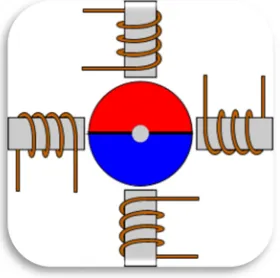
motors that move in discrete steps. They have multiple coils that are organized in groups called "phases". By energizing each phase in sequence, the motor will rotate one step at a time. With a computer controlled stepping you can achieve very precise positioning and/or speed control. For this reason, stepper motors are the motor of choice for many precision motion control applications [2]. The main usage of stepper motor is positioning of stepper motor rotor rotates with required precision. Stepper motor is suitable for primarily tasks where the precision is very important factor [3]. Application areas are automobile industry, computer hard disks, printers, tool machines, actuators of industry robots and manipulators etc. For stepper motor control it is necessary control unit, which generates steps of motor. Stepper motor is a special type of synchronous motor. The difference between the synchronous and stepper motor is stepper motor can reaches certain amount of defined positions. The step of motor is reached by suitable activity of control unit. The basic principle of the motion is electric current flowing through the coil generates magnetic field. This magnetic field pulls opposite pole of rotor magnet, see Figure 1. By suitable generating of pulses to coils, the rotor starts to rotate [4].
Figure 1. Internal structure of stepper motor.
One of the first advantages of stepper motor is effective positioning. For precise positioning of stepper motor can be determined by specific step and motor rotates to required position without encoder. The basic relations of stepper motor are following:
α=2π/spr (1)
θ=nα (2)
ω=α/dt (3)
where ‘α’ motor step angle, ‘spr’ is number of steps per round, ‘θ’ is position, ‘n’ is number of steps, ‘ ’ is angular velocity. The difference of stepper motor in comparison with DC motor is that it doesn´t need encoder, because it operates with open loop, while DC motor operates with closed loop. On the other side, stepper motor positioning is limited to step size of rotor. The disadvantage of stepper motor is for example lower torque in comparison with DC motor [5].
2. Literature Survey
[6] MIN CHIT KO and KYAW SOE LWIN presents Wireless Two Stepper Motors Control System Based PIC Microcontroller using RF Module, has been used to position the shaft of the stepper motor at a desired angle which in turn may be used in deferent application areas. Okan BINGOL and Omer AYDOGAN proposed a web-based remote-controlled motor educational tool for electrical, electronic and computer education was formed. It is composed of a server computer with an National Instruments PCI 6221 M data acquisition card, where the experiments are formed, a direct current motor, stepper motor, a servo motor, the driver circuits of the motors and a camera displaying these. Users can interact with the educational tool by using PC connected to the Internet, and can conduct the experiments in a real-time manner [7].
Parthsarthi1, M. B. Patel et al., presents a wireless based dc motor speed control unit using Zigbee. The user will be able to perform the operation like acceleration and deceleration of the DC motor by pushing button or switch from distance. The main advancement of this paper is wireless based speed control and direction control using Zigbee technique [8]. Sirsanth N. S, Dhole P. S et all., proposes a Home automation system that employs the integration of multi-touch mobile devices, cloud networking, wireless communication, and power-line communication to provide the user with remote control of various lights and appliances within their home [9]. [10] Sagarika Pal1, Niladri S. Tripathy presents the DTMF technology has been used to position the shaft of the stepper motor at a desired angle which in turn may be used in deferent application areas. As a conventional RF wireless system has distance limitation. Angular position between 0° and 360° can be obtained and achieved angular position, can be varied only in integral multiple of one step angle 1.8°. [11] Reenu George 1, Manoj G2, S. Kanthalakshmi proposed a microstepping technique, which consists of sine/cosine wave, is used to drive the stepper motor instead of discrete pulses. The microstepper driver based on LM3S6965 is suitable for small and medium microstepper motors as it can achieve high microstepper resolution. Motor controls for specific number of rotations in required direction and speed are achieved by varying the number of pulses and pulse frequency.
GSM based stepper motor controller is aautomatic control system which is capable of receiving a set of command instructions from any place where GSM signals are available in the form of Short Message Service and perform the necessary action like start, stop and speed control. Shailesh J. Parmar, Mital S. Zala et al., presents design of Arduino controller based Stepper Motor controller for position control that will smoothly control the rotation of a stepper motor taking into account the physical constraints [15]. Pratiksha N. Balai and Jimit A. Talati proposed to control the motion of the camera using PIC16F877A Microcontroller, used two hybrid stepper motors in which one for left side motion and
for right side motion and another stepper motor is for upper motion and lower motion with higher accuracy [16]. B. PrasannaSai, S. BhagyaSree et al., purposed to control the speed and direction of a stepper motor using Zigbee module using wireless controlling method. The aim of the system is to control the turn of stepper motor rotor direction clockwise or anti-clockwise and also decrease or increase the speed. Instead of using in industrialapplications such as remote control device, valve operation or any other electrical device operation; the device also can be apply for home application such as camera monitoring [17].
3. Proposed System
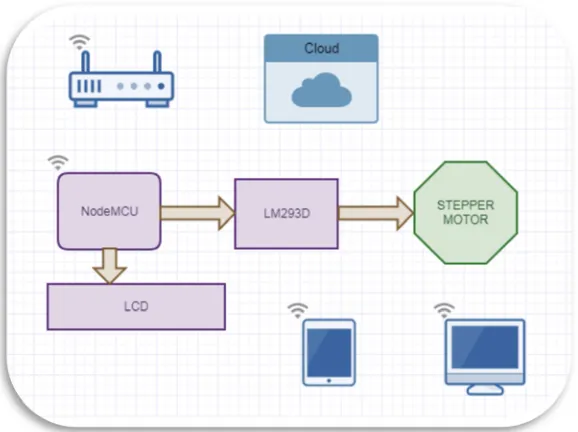
Figure 2. Proposed model of IoT based stepper motor control.
The proposed system is implemented with NodeMcu an open-source firmware and development board that helps to prototype IOT product within a few Lua script lines [18]. The features of NodeMcu are Interactive, Programmable, Low cost, Simple, Smart and WI-FI enabled. The development board has integates GPIO, PWM, IIC, 1-Wire and ADC. NodeMcu module is a main processor to entire system to receive commands from user and control the appropriate actions. NodeMcu is an open source IoT platform. It includes hardware which is based on the ESP-12E module, firmware which runs on the ESP8266 Wi-Fi SoC from Espressif Systems. This firmware used the Lua scripting language it is based on eLua project and built on the Espressif Non-OS SDK for ESP8266. It uses many open source projects, such as lua-cjson and spiffs. The microcontroller reads the data and after processing, performs the corresponding action i.e., to rotate the stepper motor clockwise and anticlockwise. The 16x2 Liquid Crystal display (LCD) display is provided to display the status of the stepper motor, the complete system setup shown in Figure 2.
H-bridges can be tricky to build from scratch. But there are
free software that enables you to program in the language that the Arduino understands. In the case of the Arduino the language is C. The ArduinoIDE enables you to write a computer program, which is a set of step-bystep instructions that you then upload to the Arduino. In the Arduino world, programs are known as ʻSketchesʼ. The Arduino hardware and software are both Open Source, which means the code, the schematics, design, etc. are all open for anyone to take freely and do what they like with it. The following steps are software algorithm.
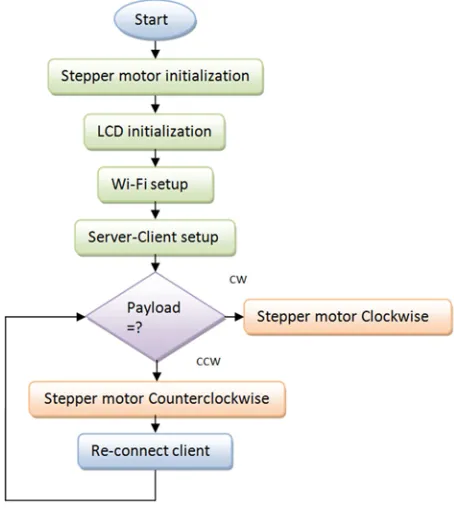
Figure 3. Software flow chart.
4. Results and Discussions
A simple control algorithm is as shown in Figure 3. It shows that the stepper motor is used to rotate in two directions clockwise and counter clockwise mode, depending on command received from MQTT client. The motor is
operated in full step drive where two windings of motor are energized at any given time. For a specific application the torque vs speed characteristics are the key for selecting correct motor and corresponding drive method. The sequence of phase energizing, the motor will rotate one step at a time is shown in table 1.
One step angle = 1.8° No. of Steps= 1
Rotation of revolution of Stepper Motor / Step Angle = 360° / 1.8° = 200
The design of stepper motor controller is very important for high precision positioning and smooth rotation operation.
Table 1. Stepper motor drive sequence.
Yellow Red Blue White
1 HIGH LOW LOW LOW
2 LOW HIGH LOW LOW
3 LOW LOW HIGH LOW
4 LOW LOW LOW HIGH
The Figure 4 shows the hardware interface of NodeMcu microcontroller, LCD and Stepper motor. NodeMcu of GPIO14, GPIO12, GPIO13 and GPIO15 are configured as outputs it is connected to 5-wire stepper motor coils through LM293D driver. REES52 LCD display IIC I2C serial interface module is a 2 line by 16 character display interfaced to an I2C, interface requires only 2 data connections SCL to NodeMcu GPIO5 and SDA to NodeMcu GPIO4.
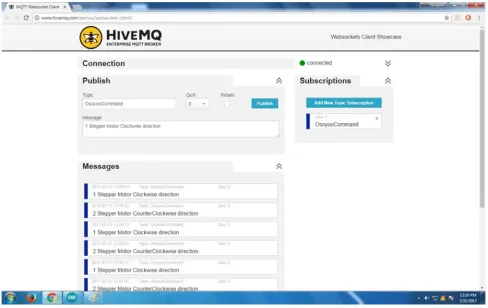
HiveMQ is the MQTT broker for the connected enterprises, puzzle piece between constrained devices and enterprise systems. It is best-in-class performance and scalability to connect your devices. Enterprise Integrations enable you to handle huge throughput at lowest latency and further process your data. Our MQTT server is scalable, secure and simple with state-of-the-art technology [20]. To connect the HiveMQ broker we required the Host, Port number and Topic, username and password optional is shown in Figure 5. After successful connection type the message in messagebox then click Publish. The NodeMcu receives this message and control the stepper motor depending on the message CW or CCW is shown in Figure 5.
Figure 5. HiveMQTTWebclient Screenshot.
5. Conclusion
The developed system is user friendly, used to wireless precision control of stepper motor with help of personal computer or smartphone or tablet etc. It is very important to keeps the privacy and it restricts the access to the unauthorized user. Stepper motor plays highest role in most of the scientific and manufacturing industries. The proposed paper mainly focused on wireless control and status monitoring stepper motor by using advanced wireless IoT technology. The minimal modification of this methodology is useful for actuators like dc motors, servo motors (robotic control system) control in industry is made easy.
Acknowledgements
The authors would like to thanks to University Grant Commission PDF no: PDFSS-201415-SC-AND-9024, entitled “Wireless Industrial Monitor and Controller using Embedded Linux (RTOS)”.
References
[1] Internet of Things privacy & Security in a Connected World, January 2015, FTC Staff Report
[2] Adafruit learning system Stepper Motor page http://adafru.it/aOF.
[3] M. Kelemen, I. Virgala, Ľ. Mikova, P. Frankovsky, 2015,
Experimental Identification of Linear Actuator Properties, ActaMechanicaSlovaca, Vol. 19, No. 1, pp. 42-47.
[4] M. Dababneh, W. Emar, I. TTrad, 2013, Chopper Control of a Bipolar Stepper Motor, International Journal of Engineering, Vol. 7, No. 2, pp. 61-73.
[5] A. Morar, 2015, “The modeling and simulation of bipolar hybrid stepping motor by Matlab/Simulink”, Procedia Technology, 8th International Conference Interdisciplinarity in Engineering, pp. 576-583.
[6] MIN CHIT KO and KYAW SOE LWIN, 2014, “Wireless Two Stepper Motors Control System Based PIC Microcontroller using RF Module”, International Journal of Scientific Engineering and Technology Research Volume. 03, Issue No.24, Pages: 4737-4743.
[7] Okan BINGOL1, Omer AYDOGAN2, 2012, “Web Based Remote Controlled Electrical Motor Laboratory used as Educational Tool”, PRZEGLĄD ELEKTROTECHNICZNY (Electrical Review), ISSN 0033-2097, R. 88.
[8] Parthsarthi1, M. B. Patel 2, S. J. Bora3, B. U. Parihar, 2016, “Wireless based DC motor speed control using Zigbee”, IOSR Journal of Computer Engineering (IOSR-JCE) e-ISSN: 2278-0661, p-ISSN: 2278-8727, PP 32-35.
[9] Sirsanth N. S, Dhole P. S, Mohire N. P, Naik S. C &Ratnaparkhi N. S, “Home Automation using Cloud Network and Mobile Devices”, Department of computer engineering, 44, Vidyanagari, Parvathi, Pune-411009, India University of Pune.
[11] Reenu George1, Manoj G2, S. Kanthalakshmi, 2014, “Design and Implementation of PWM Stepper Motor Control Based On 32 Bit Arm Cortex Processor”, International Journal of Advanced Research in Electrical, Electronics and Instrumentation Engineering, Vol. 3, Issue 7.
[12] Shahera S. Patel, 2015, “Stepper Motor Precise Position Control System Using DTMF Technology”, International Journal on Recent and Innovation Trends in Computing and Communication, ISSN: 2321-8169, Volume: 3, Issue: 5.
[13] Ivan Virgala, Michal Kelemen, Alexander Gmiterko, and Tomas Liptak, 2015, “Control of Stepper Motor by Microcontroller.” Journal of Automation and Control, vol. 3, pp. 131-134.
[14] SrushtiChafle and Swati Bhandarkar, 2017, “USE OF GSM TECHNILOGY TO CONTROL THE SPEED OFSTEPPER MOTOR”, International Journal of Engineering Development and Research, IJEDR, Volume 5, Issue 2, ISSN: 2321-9939.
[15] Shailesh J. Parmar, Mital S. Zala et al., 2017, “Design and Development of Stepper Motor Position Control using Arduino Mega 2560”, IJSTE - International Journal of Science Technology & Engineering, Volume 3, Issue 09, ISSN (online): 2349-784X.
[16] Pratiksha N. Balai, Jimit A. Talati, 2013, “Position Control of Hybrid Stepper Motor Using PIC16F877A Microcontroller”, International Journal of Science and Research (IJSR) ISSN (Online): 2319-7064.
[17] B. PrasannaSai, S. BhagyaSree and G. Manikantha, 2016, “Speed and Position Controlling ofStepper Motor Using ZIGBEE”, Imperial Journal of Interdisciplinary Research (IJIR) Vol-2, Issue-11, ISSN: 2454-1362.
[18] http://espressif.com/products/hardware/esp8266ex/overview/
[19] http://www.ti.com/lit/ds/symlink/l293.pdf