Inzinerine Ekonomika-Engineering Economics, 2013, 24(5), 478-487
Creation of Knowledge and Reverse Logistics. Empirical Analysis from Perspective
of the Resource Based View Theory
Antonio Mihi Ramirez, Lina Girdauskiene
Granada University
Avda. del Hospicio, s/n C.P. 18071 Granada, Spain e-mail: [email protected]
Kaunas University of Technology
K. Donelaicio st. 73, LT-44029, Kaunas, Lithuania e-mail: [email protected]
http://dx.doi.org/10.5755/j01.ee.24.5.2689
Reverse logistics activities require the ability to generate new knowledge to reduce high uncertainty and to solve problems resulting of these activities. In this sense the purpose of this research is to understand how the modes of knowledge conversion (Nonaka & Takeuchi, 1995) affect reverse logistics and examine the joint influence of these variables on the flexibility of distribution of information (because information has a key role for these variables) and performance of the organization. Our results provide empirical evidence confirming 1) the more necessary is the knowledge creation processes in the organization the greater are the importance and the ability to anticipation of reverse logistics systems for the organization, 2) also we found the importance of reverse logistics enhances the effects of flexibility of distribution of information and reinforces the belief that it is a fundamental capacity that increases the value of the company's products obtained by reverse logistics processes, 3) the findings have provided empirical evidence of the existence of positive relationship between reverse logistics, flexibility and business performance. In short, the results have shown the importance for the organization of knowledge management systems and reverse logistics systems that give your company a greater ability to anticipate and flexibly to the increasing changes taking place in a competitive environment of high uncertainty. A number of implications and contributions stem from the discussion and conclusions of the study.
Keywords: reverse logistics, knowledge creation, flexibility of distribution of information, organizational performance.
Introduction
Knowledge has become one of the most important intangible assets for the company in this new economic scenery (Kess & Haapasalo, 2002; Li et al., 2009; Nonaka, 1994), being of particular importance in the process of creating knowledge within the organization (Nonaka, 1994; Nonaka & Konno, 1998). Similarly, consideration of a reverse flow in the Logistics function amplifies competitive capabilities of the company (Kenne et al., 2012). The study of this whole product flow in the opposite way and how to deal with all the consequences that entail for the organization is what has been called in recent years reverse logistics (Dowlatshahi, 2000; Rogers & Tibben-Lembke, 1999, 2001; Tibben-Lembke & Rogers, 2002).
Reverse logistics activities require adequate knowledge management in all phases of returning the product to help solve the problems it faces in these processes (Wadhwa & Madaan, 2007). In this sense it will be essential for the organization to have the ability to generate new knowledge to reduce the high uncertainty of reverse logistics activities (Arrow, 1962; Galbraith & Kazanjian, 1986) giving it greater flexibility to expand its capacity to respond to the continuous changes that occur in these activities.
We propose an empirical model to analyze how the modes of knowledge conversion (Nonaka & Takeuchi, 1995) affect reverse logistics. We also examine the
influence of these interactions on flexibility of distribution of information and on the performance of the company, and finally analyze results and possible implications to be derived from them.
Literature review and hypotheses
Hypotheses related to creation of knowledge
Various studies have revealed the crucial role of knowledge creation to achieve organizational success (Kylaheiko et al., 2011; Kogut & Zander, 2003; Li et al., 2009; Matusik & Hill, 1998; Nonaka & Takeuchi, 1995; Zack, 1999). The knowledge creation model of (Nonaka & Takeuchi, 1995) is the most cited so far to explain the process of knowledge creation. This model considers four possible modes of knowledge conversion: socialization,
externalization, combination and internalization where explicit and tacit knowledge interact (Nonaka & Takeuchi, 1995).
Thus, we propose four groups of hypothesis related to: creation of knowledge,
knowledge creation and reverse logistics,
reverse logistics and flexibility of distribution of information,
reverse logistics, flexibility of distribution of information and organizational performance.
These hypotheses are presented in Table 1.
Table 1
The research hypothesis
No Content interconnections Hypothesis
1.
Creation of knowledge
The combination of knowledge is positively related to the externalization of knowledge.
2. The combination of knowledge is positively related to the socialization of knowledge.
3. The combination of knowledge is positively related to internalization of knowledge.
4. The externalization of knowledge is positively related to socialization of knowledge.
5. The externalization of knowledge is positively related to internalization of knowledge.
6. Knowledge creation and reverse
logistics
The internalization is positively related to the importance of reverse logistics processes.
7. Socialization is positively related to proactivity towards reverse logistics of the organization.
8.
Reverse logistics and flexibility of distribution of information
The importance of reverse logistics is positively related to the flexibility of distribution of information.
9. Proactivity towards reverse logistics is positively related to the flexibility of distribution of
information. 10. Reverse logistics, flexibility of
distribution of information and organizational performance
The importance of reverse logistics is positively related to organizational performance.
11. Proactivity towards reverse logistics is positively related to organizational performance.
12. Flexibility of distribution of information relates positively with the results of the company.
Methodology
Sample and procedure
To perform this task a research questionnaire was sent to managers and operations managers of companies representative of Spanish economic sectors where it can technically be considered as the use of reverse logistics processes (in Table 1 the characteristics of the research can be observed with more details). The companies registered in the database DB (Dun & Bradstreet Spain, 2008) were considered. This database includes organizations whose area of operations is in Spain and includes more than 50.000 organizations with higher number of sales in Spanish territory. The total population of the selected sectors includes 28.000 companies. The number of companies selected in each of the sectors was directly related to the overall proportion of institutions in this sector in the database that met the requirements requested. The sample included 1.200 finally selected organizations representing Spanish industrial sectors, which was done in order to have broad representation of the various activities of the Spanish economy. Spanish market is relatively well developed and wholly integrated in the European Union. However, Spain is in a geographical area that has received relatively little attention from organizational researchers.
We summarize technical details of the sample used in our research in Table 2.
Measures
The use of constructs has played an important role in designing a survey instrument in management research. Constructs used in this research are:
Table 2
Combination: We selected four items from the previous scale of Nonaka et al. (1994). We then performed a confirmatory factor analysis to validate our Likert-type 7-point scale (1-“total disagreement”, 7-“total agreement”) of four items ( 2=48.78, RMSEA=.01, CFI=.99, GFI=.99, NFI=.99, NNFI=.99), which required deletion of Item 3. This procedure allowed us to choose three items (Appendix) with high validity and reliability (α=.724).
Socialization: We selected four items from the previous scales of Nonaka et al. (1994). We developed a confirmatory factor analysis to validate our Likert-type 7-point scale (1-“total disagreement”, 7-“total agreement”) of four items ( 25=21.36, RMSEA=.08, CFI=.96, GFI=.99,
NFI=.99, NNFI=.92), which required deletion of Item 3. This procedure allowed us to choose three items (Appendix) with high validity and reliability (α=.766).
Externalization: We drew from the scale designed by Nonaka et al. (1994) to establish a Likert-type 7-point scale (1-“total disagreement”, 7-“total agreement”) of three items (Appendix). Using a confirmatory factor analysis ( 23=16.24, RMSEA=.07, CFI=.98, GFI=.99, NFI=.98,
Technical details of the research
Metodology Structured survey
Geographic scope National (Spain)
Sectorial scope All sectors
Sampling procedure Random
Universe of population 1200 firms
Sample responder size 284 firms
Responders CEOs
Response rate 23,67 %
Confidence level 95 % (p-q)=0,5; Z=1,96
Sample error -5,8 %
NNFI=.97), we validated our scale and verified the scale’s unidimensionality, high validity and reliability (α=.702).
Internalization: We selected five items from the scale designed by (Nonaka et al., 1994) to establish a Likert-type 7-point scale (1-“total disagreement”, 7-“total agreement”). Individual reliability had an approximate value of 0.5 recommended level, with the exception of items KINT1, KINT2, KINT3, which have a lower reliability (R2 = 0.17, R2 = 0.35, R 2 = 0.24), indicating that the percentage of shared variance of these variables is low, so initially it is decided to eliminate the scale. Eliminating KINT1 loads become significant and appropriate reliabilities above the recommended level, except for the indicator KINT2, KINT3 (R2 = 0.36, R2 = 0.25). We did this process for these items one by one until the items KINT5 and KINT2 are finally obtained, and finally individual reliabilities are close to 0.5 (Munoz & Gordon, 2002).
Thus, the number of estimable parameters exceeds the available equations, so we would have a problem of identification and we would be obliged to set an arbitrary parameter (the error variance of an item) for a perfectly identified model that yielded a trivial solution already discussed on the implications for the previous scale. The above reasoning led to evaluation of the appropriateness of this scale using traditional methods, based on the value of Cronbach's Alpha indicator and the inter-item correlations and item-total (Munoz & Cordon, 2002). Thus, the multivariate normality test performed on these indicators provided by the processor PRELIS showed for a significance level of 5 % the existence of significant differences in asymmetry (p = 0.00), as kurtosis (p = 0.00). In addition, the normality condition requires the joint assessment of the level of skewness and kurtosis; we obtain 5 indicators that are not distributed as a normal ( = 70,640, for p = 0.00). For this reason WLS method was used to estimate the measurement model, which requires the calculation procedure, through the processor PRELIS, the polychoric correlation matrix and the asymptotic variance matrix, as discussed previously. We then revalidated the scale and verified scale’s unidimensionality, high validity and reliability (α=.792).
Importance of reverse logistics: reverse logistics is a process of planning, implementing and efficient control of the flow of raw materials, current inventory, finished goods and related information, from the point of consumption to the point of origin in order to recapture, create value or disposal (Rogers & Tibben-Lembke, 2001). Measure is based on the work presented by Rogers & Tibben-Lembke (1999) that included 6 items. Thus we developed a Likert scale of seven points in which managers had to indicate their level of agreement or disagreement (using a Likert scale where 1 means "strongly disagree“ and 7 is "strongly agree"). Using a confirmatory factor analysis we validate it ( 29=45.24,
RMSEA=.12, NFI=.94, NNFI=.92, CFI=.95, GFI=.98); we validated our scales and verified the scale’s unidimensionality, high validity and reliability (α=.865).
Proactivity towards reverse logistics:
We have adapted the scale by Antoncic and Hisrich (2001) regarding the measure of the degree of proactivity, and the scale by Rogers and Tibben-Lembke (1999) which
among other aspects of reverse logistics measures proactivity towards reverse logistics. Thus we developed a Likert scale of five points in which managers had to indicate their level of agreement or disagreement (using a Likert scale of seven points, 1 being "strongly disagree" and 7 is "strongly agree"). The multivariate normality test performed on these indicators provided by the processor PRELIS, showed for a significance level of 5 % the existence of significant differences in asymmetry (p = 0.00), as kurtosis (p = 0.00). In addition, the normality condition requires the joint assessment of the level of skewness and kurtosis, obtaining 6 indicators are not distributed as a normal ( = 70,640, for p = 0.00). For this reason WLS method was used to estimate the measurement model, which requires the calculation procedure, through the processor PRELIS, the polychoric correlation matrix and the asymptotic variance matrix (Munoz & Cordon, 2002). We report the full survey of his research as a final appendix.
Flexibility of distribution of information: Our measure is based on the research by Arias (2003) and drawn from the model for studying flexibility proposed by Gupta and Somers (1992). Within this measurement scale, we focus on operational flexibility (Bernardo & Mohamed, 1992), which indicates the ability to distribute and process information and the ease of sharing it. After obtaining a Likert-type point scale (1-"totally disagreement", 7-"totally agreement") of four items, we performed a confirmatory factor analysis ( 22=26, RMSEA=.47,
CFI=.97, GFI=.99, NFI=.97, NNFI=.91), validated our scale and verified its unidimensionality, high validity and reliability (α=.824).
Organizational performance: The literature has established widely that there are high correlation and concurrent validity between objective and subjective data on performance, which implies that both are valid when calculating firm’s performance (Venkatraman & Ramanujan, 1986). We selected five items from the previous scales of (Garcia et al., 2007) to measure organizational performance (1-“total disagreement”, 7-“total agreement”). We used a confirmatory factor analysis ( 25= 15.74, RMSEA=.12, CFI=.98 GFI=.99, NFI=.94,
NNFI=.93) to validate our scale and verify the scale’s unidimensionality, high validity and reliability (α=.821), which required deletion of Item 5. The validation of scales usually requires removal of some items, which enhances the scales’ validity and reliability and the results of the research (Hair et al., 2004; Garcia et al., 2007).
Model and analysis
The procedure followed was to develop a model based on set theory and structural equations, incorporating the coefficients used for the investigation of the set of hypotheses, The LISREL 8.70 program was used to test the theoretical model. Then once measuring instruments were estimated and adjusted, we propose a
exogenous latent variables Combination ( 1). Also at first
grade the externalization is used as endogenous latent variable, and at second grade the rest of variables were used: socialization ( 2), internalization ( 3), importance of
reverse logistics ( 4), proactivity towards reverse logistics
( 5), flexibility of distribution of information ( 6) and
organizational performance ( 7) (Figure 1). Through
flexible interplay between theory and data, this structural equation model approach bridges theoretical and empirical
knowledge for a better understanding of the real world. Such analysis allows for modelling based on both latent and manifest variables, a property well suited to the hypothesized model, where most of the represented constructs are abstractions of unobservable phenomena. Further, structural equation modelling takes into account errors in measurement, variables with multiple indicators and multiple-group comparisons (Koufteros et al., 2009).
Figure 1. Hypothesized model
Results and Discussions
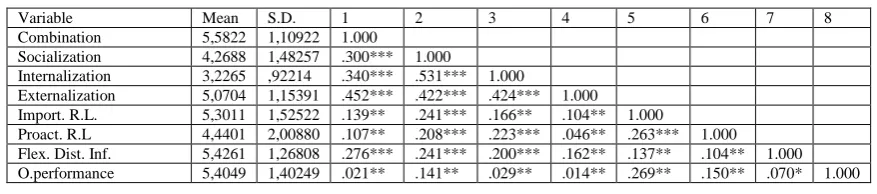
Table 3 shows the means and standard deviations as well as the inter-factor correlation matrix for the study variables. There are significant and positive correlations
among the study variables. A series of tests (e.g. tolerance, variance inflation factor) shows the non-presence of multicolinearity (Hair et al., 2004).
Table 3
Means, standard deviations and correlations
Variable Mean S.D. 1 2 3 4 5 6 7 8
Combination 5,5822 1,10922 1.000
Socialization 4,2688 1,48257 .300*** 1.000
Internalization 3,2265 ,92214 .340*** .531*** 1.000
Externalization 5,0704 1,15391 .452*** .422*** .424*** 1.000
Import. R.L. 5,3011 1,52522 .139** .241*** .166** .104** 1.000
Proact. R.L 4,4401 2,00880 .107** .208*** .223*** .046** .263*** 1.000
Flex. Dist. Inf. 5,4261 1,26808 .276*** .241*** .200*** .162** .137** .104** 1.000
O.performance 5,4049 1,40249 .021** .141** .029** .014** .269** .150** .070* 1.000
Note. *p <.05;**p<.01;*** p<0.001 (two tailed) n=284
Regarding the quality of the measurement model for the sample, the constructs display satisfactory levels of reliability, as indicated by composite reliabilities ranging from 0.70 to 0.96 and shared variance coefficients ranging from 0.54 to 0.86. The amount of variance shared or captured by a construct should be greater than the amount of measurement error (shared variance>0.50). All of the multi-item constructs meet this consistency criterion, each loading ( ) being significantly related to its underlying factor (t-values greater than 2,31) in support of convergent validity. Likewise, a series of chi-square difference tests on the factor correlations showed significant differences in chi-square indicating that the constructs are not perfectly correlated and that discriminant validity is achieved.
A structural equation modelling was performed to estimate direct and indirect effects using LISREL with the correlation matrix and asymptotic covariance matrix as input (Bollen, 1989). This type of analysis has the advantage of correcting for unreliability of measures and
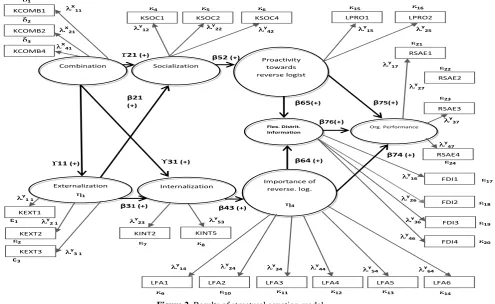
also gives information on the direct and indirect paths between multiple constructs after controlling for potentially confounding variables. Figure 2 shows the standardized structural coefficients. The relative importance of the variables is reflected by the magnitude of the coefficients.
Thus we propose that positive relationship between four modes of knowledge conversion are combination (H1, H2, H3), externalization (H1, H4, H5), socialization (H2, H4), and internalization (H3, H5) and that, in turn, internalization is positively related to the importance of reverse logistics (H6) and socialization is positively related to proactivity towards reverse logistics (H7), the importance of reverse logistics (H8 ) and proactivity towards reverse logistics (H9) are positively related to the flexibility of distribution of information, and finally, the importance of reverse logistics (10), proactivity towards reverse logistics (11) and the flexibility of distribution of information are positively correlated with the results.
β65(+)
β64 (+)
β75(+)
β76(+)
β74 (+) Flexibility of
distribution of information 6
β52 (+)
β31 (+)
11
(+)
β43 (+)
β21 (+)
31
(+)
21 (+)
Externalization
1
Internalization 3
Importance of reverse logistics 4
Organizational Performance 7
Combination
1
Socialization
2
Figure 2. Results of structural equation model
So if we examine the set of hypotheses that have found significant statistical support (Table 4), the findings show that four modes of conversion of knowledge are related significantly. Thus the first hypothesis (H1) we proposed is positive relationship between combination and externalization. In this sense, both variables have a very significant (t = 10.44), with a standardized structural coefficient of 0.60, which brings us to assert that the combination is important to explain externalization, verifying the hypothesis 1 (H1). Furthermore, both combination and externalization have very high compound reliability, 0.81 and 0.84 respectively, and variance extracted of 0.59 and 0.63, therefore, scales are very reliably to measure these two variables. It adds empirical
evidence to the theoretical arguments raised in the model of the creative organization of knowledge by (Nonaka & Takeuchi, 1995). In this sense, for example, the research by (Kylaheiko et al., 2011) of different technology strategies in different knowledge regimes showed that firms favour the creation of knowledge by integrating and sharing between partners’ tacit and explicit knowledge, and also by their capability to combine and share codified knowledge of competitors. Thus, as shown in the case of Taiwan motherboard industry (Chang et al., 2005) these capabilities can also be achieved through specialized departments that work closely with other functions to plan, coordinate and integrate activities and information.
Table 4
Final structural model standardized parameters
Parameters and relations(1) Hypothesis
Standardized structural coefficient
t value
γ11 Combination Externalization H1 (+) 0.60 10.44
γ21 Combination Socialization H2 (+) 0.52 7.20
γ31 Combination Internalization H3 (+) 0.33 4.96
β21 Externalization Socialization H4 (+) 0.52 7.33
β31 Externalization Internalization H5 (+) 0.77 11.76
β43 Internalization Importance of reverse logistics H6(+) 0.64 13.59
β52 Socialization Proactivity towards reverse
logistics H7(+) 0.44 8.32
β64 Importance of reverse logistics Flexibility of
distribution of information H8(+) 0.50 11.81
β 65 Proactivity towards reverse logistics
Flexibility of distribution of information H9 (+) 0.14 2.89
β74 Importance of reverse logistics Organizational
performance H10 (+) 0.35 5.95
β75 Proactivity towards reverse logistics
Organizational performance H11 (+) 0.14 2.90
β76 Flexibility of distribution of information
Organizational performance H12 (+) 0.14 2.31
(1) It shows those indirect effects that are significant at 5% (t 1.96).
β43 (+) 11 (+)
y47 y17
y27 β52 (+)
β31 (+)
β64 (+) β65(+)
y12 y
42
y22 y
15 y25
y 37 y16 y26 y 36 y46 y64 y54 y44 y34 y24 y 14 y 53 y23
y3 1 y
2 1 y1 1
24 23 22 21 20 19 17 18 16 15 14 13 12 10
9 11
8 7 6 5 4 3 2 1 X11 X41 X21 3 2 1 β75(+) β76(+)
β74 (+) Flex. Distrit.
Information
6
β21 (+)
31 (+) 21 (+)
Importance of reverse. log. 4 Org. Performance 7 Combination 1 Socialization 2 Proactivity towards reverse logist 5 KCOMB1 KCOMB2 KCOMB4
KSOC1 KSOC2 KSOC4 LPRO1 LPRO2
RSAE1 RSAE2 RSAE3 RSAE4 KEXT1 KEXT2 KEXT3
KINT2 KINT5
LFA2
LFA1 LFA3 LFA4 LFA6
Also there is a strong relationship between combination and socialization. Thus, proposed hypothesis 2 (H2) indicates the existence of positive effect of the combination on socialization. In the final model there was obtained a coefficient of 0.52, statistically significant and representative of this relationship (t = 7.20), being contrasted to this hypothesis. Thus, we have verified empirically that the merging process promotes socialization. This result supports the empirical results of previous studies that show this positive relationship (e.g. Nonaka et al., 1994; Nonaka & Konno, 1998). Thus, for instance, the research by (Kylaheiko et al., 2011) has pointed the importance of knowledge created by partners by means of cooperation. Similarly according to (Nonaka´s, 1994) observation of successful project teams in Japanese firms, combination and socialization are facilitated through cooperation among the firm’s members.
Taking into account the results obtained, we can accept the hypothesis 3 (H3) as we get a significant relationship (t = 4.96) for a standardized structural coefficient of 0.33, meaning that we confirmed that the combination positively affects internalization. And also we accept hypothesis 4 (H4) as we get a very significant (t = 7.33) for a standardized structural coefficient of 0.52, which means that we confirm that externalization positively affects socialization. These results are also consistent with previous empirical work (Nonaka et al., 1994; Nonaka & Konno, 1998; Nonaka & Toyama, 2003). Thus, according to Nonaka (1994), socialization enables a clear feedback to assistance of the workers in the decision-making.
The relationship between externalization and internalization obyained a very significant (t = 11.76) for a standardized structural coefficient of 0.77. Therefore, the results confirm that we accept the hypothesis 5 (H5), which means that we confirm that externalization positively affects the internalization. Thus, for the case of software production in the telecommunications industry (Kess & Haapasalo, 2002) have found that sharing knowledge and good practices in all phases of projects is vital in creating a knowledge base of the organization.
The importance of reverse logistics is increasing (Dowlatshahi, 2000; Wadhwa & Madaan, 2007). In addition, the creation of knowledge is essential in reverse logistics activities (Wadhwa & Madaan, 2004) since by four conversion modes there is stored and retrieved the information logistics, which is essential to minimize the uncertainty of these activities, generated by this conversion of the knowledge needed for the various activities of reverse logistics, which is very important in the generation of value to the organization (Nonaka & Konno, 1998). In this sense, through internalization, explicit knowledge of how the product is returned to the organization is shared and understood by people who are not directly leading the process, improving decision-making (Nonaka & Konno, 1998).
Therefore, we proposed the hypothesis 6 (H6) that there is a positive relationship between internalization and the importance of reverse logistics. In this sense, both variables have a very significant (t = 13.59), with a standardized structural coefficient of 0.75, which brings us to assertion that the Internalization positively affects the
importance of reverse logistics, verifying the hypothesis 6 (H6). This adds empirical evidence to the theoretical arguments of the researches on the topic (Nonaka & Konno, 1998; Stentoft & Halldorsson, 2002), and reinforces the belief that intangibles are important in dynamic environments with high uncertainty. Moreover, the importance of reverse logistics has a high compound reliability and shared variance 0.94 and 0.72, therefore, there is a scale that measures very reliable for this variable. We have also discussed that the improvement of the management of returns can be produced by socialization, by providing a high feedback on logistical processes promoting a new and better knowledge that adds value to the organization (Nonaka & Konno, 1998) which increases continuously through coordination between the various parties (Blumberg, 1999).
Thus, assuming 7 (H7) we proposed that there is a positive relationship between proactivity towards reverse logistics and socialization. In this sense, both variables have a very significant (t = 8.32), with a standardized structural coefficient of 0.61, which brings us to claim that socialization affects positively proactivity towards reverse logistics, verifying the hypothesis 7 (H7).
Again, this result provides empirical evidence to the theoretical arguments of the few works on the subject (Nonaka & Konno, 1998; Stentoft & Halldorsson, 2002), and reinforces the belief that intangibles are important in dynamic environments and high uncertainty.
In this paper we have chosen the flexibility of distribution of information to analyze the relationships that may exist with reverse logistics because flexibility of distribution of information means the ability to manage information flow in manufacturing processes and return of the products (Arias, 2003; Sethi & Sethi, 1990; Swafford, 2003), and because of the very important role of information on reverse logistics processes (Arrow, 1962; Galbraith & Kazanjian, 1986; Murdick & Munson, 1988; Stentoft & Halldorsson, 2002) and of course also for knowledge creation (Nonaka & Takeuchi, 1995; Rivero, 2002). Our results provide empirical evidence supporting the theoretical arguments about the importance of reverse logistics to enhance the effects of the flexibility of information, verifying the hypothesis 8 (H8). (Banomyong et al., 2008; Rogers & Tibben-Lembke, 1999), and reinforces the belief that there is a fundamental capability (Stalk et al., 1992) that increases the value of the company's products obtained by reverse logistics processes.
In addition, the flexibility of distribution of information has higher reliability of the model compound 0.96 and variance extracted also higher, 0.86, therefore, there is a scale that measured very reliably this variable. Following the research by Chang et al., (2005), the flexibility of distribution of information has the greater effect the higher the degree of involvement of the organization to reverse logistics, it means more proactivity that led us to hypothesize 9 (H9) that there is a positive relationship between proactivity towards reverse logistics and flexibility of distribution of information (Rivero, 2002).
affect flexibility of distribution of information, verifying the hypothesis 9 (H9).
This result provides empirical evidence supporting the theoretical arguments of (Chang et al., 2005) on the importance of a proactive approach to reverse logistics, which enhances the effects of the flexibility of distribution of information.
It is also necessary to analyze how these variables affect the results of the organization. Therefore, we propose first to examine the relationship between the importance of reverse logistics and performance, hypothesis 10 (H10) that the variable importance of reverse logistics is positively related to organizational performance. Both variables have a very significant (t = 5.95), with a standardized structural coefficient of 0.35. So the importance of reverse logistics positively affects organizational results, verifying the hypothesis 10 (H10). This result provides empirical evidence supporting the theoretical arguments that the company improves its performance through reverse logistics (Rogers & Tibben-Lembke, 1999).
Also, we proposed the hypothesis 11 (H11), where proactivity towards reverse logistics is positively related to the results. The relationship between these two variables is highly significant (t = 2.90), with a standardized structural coefficient of 0.15. Reverse logistics proactiveness positively affects organizational results, verifying the hypothesis 11 (H11). This result provides empirical evidence supporting the theoretical arguments that the company performs better the higher the degree of proactivity towards reverse logistics (Kim, 1998; Rogers & Tibben-Lembke, 1999).
Finally, we proposed the hypothesis 12 (H12), where the flexibility of the information relates positively with the results. The relationship between these two variables is highly significant (t = 2.31), with a standardized structural coefficient of 0.13. As it is shown the flexibility of information positively affects organizational results, verifying the hypothesis 12 (H12).
This result provides empirical evidence that supports the work by arguing that the company improves its performance with the flexibility of the data from the perspective of reverse logistics (Daugherty et al., 2002).
Conclusions
As for the set of hypotheses about the creation of knowledge, the results are very significant, which confirms the close relationship between different forms of knowledge conversion proposed by the model of knowledge creation of Nonaka and Takeuchi (1995), which posed the creation of knowledge through the interaction of tacit and explicit knowledge between four forms of knowledge conversion. In addition, we established a series of hypotheses to test the relationship between knowledge creations with reverse logistics. The results obtained confirm the existence of positive relationship between knowledge creation and reverse logistics for the organization, so the importance of this increases the more you need the knowledge creation processes in the organization. Specifically, the internalization positively affects the importance of reverse logistics; this relationship is significant and intense. So we
can say that by internalizing explicit knowledge of returning the product is shared, so it can be understood by people who not bear directly the return process, generating a new tacit knowledge that will bring participants to the activities reverse logistics to take better decisions and better understand the decisions that were made by others in the management of the product once the product has already returned.
As confirmed by the results obtained, there is a positive relationship between socialization and proactive to reverse logistics. Socialization improved a management of returned products providing high feedback on logistics processes, prompting a new and better knowledge that adds value to the organization, as argued in the work of (Nonaka & Konno, 1998). This value will be greater the greater the capacity to anticipate reverse logistics systems. Also, the results provide empirical evidence supporting the theoretical arguments about the importance of reverse logistics to enhance the effects of the flexibility of distribution of information and reinforce the belief that it is a fundamental capability (Stalk et al., 1992) that increases the value of the company's products obtained by reverse logistics processes, their effects being greater the higher the degree of involvement of the organization to reverse logistics, that means it is more proactive. In terms of organizational performance, the results obtained allow us to establish a positive relationship between the constructs and proactivity importance of reverse logistics, distribution flexibility of information and organizational performance.
At this point, from the empirical results we confirm that creation of knowledge positively affects the reverse logistics, and it positively affects the flexibility of distribution of information and positively influences the results of the organization; then we can deduce that knowledge creation also indirectly affects the flexibility of distribution of information and results. So with these results we can say that there is the case of knowledge of reverse logistics activities and the flexibility of the information, elements of which constitute strategic business direction. Our results have shown the importance of having organizational knowledge management systems with reverse logistics systems, that give your company a greater ability to anticipate and flexibly to the increasing changes taking place in an environment of high competitive uncertainty.
recovered materials, which minimizes waste generation and use of non-renewable raw materials. Furthermore, these aspects are particularly important when it comes to dangerous products, contaminants, high value or a high number of returns. Finally, given the complexity of reverse logistics activities, achievement of flexibility in these activities should be a key objective for organizations, since it leads the organization to limit its competitiveness, supporting a variety of delivery requirements, reducing uncertainty and anticipation to the continuous changes characteristic of these activities.
Limitations and future research
First, survey data based on self-reports may be subject to social desirability bias (Podsakoff & Organ, 1986). However, an assurance of anonymity can reduce such bias even when responses are related to sensitive topics (Konrad & Linnehan, 1995). Second, absence of objective measures is a limitation. However, external validation of these variables from the archival data of a subset of respondents increased confidence in self-reports and reduced the risk of common method variance. Further, the possibility of common method bias was tested using Harman’s one-factor test and other methods. We also used objective data and randomized the order of presentation of the survey items across the subjects. Common method bias does not appear to be present (Podsakoff & Organ, 1986; Konrad & Linnehan, 1995).
Third, the cross-sectional nature of the research into a series of dynamic concepts allows us to analyze only a specific situation in time of the organizations studied, not their overall conduct through time. Our approach has reduced the magnitude of this problem, since dynamic characteristics and causal affirmations can be made if the relationships are based on theoretical rationales (Hair et al., 2004). For this reason, we began with a theoretical effort that would allow us to identify and check for the formal existence of the different cause-effect relationships. Nonetheless, future research should focus on longitudinal study. Fourth, the use of a single respondent may have influenced the accuracy of some measurements. Although measures were taken to reduce data inaccuracies, the use of multiple respondents would have been preferable. However, difficulties in obtaining sponsorship for research based on a multiple views for each firm, the value of CEOs’ knowledge of their firms, and common practice in organizational research all supported the use of CEOs as respondents. Finally, our model only analyzes direct and indirect relationships between creation of knowledge, reverse logistics flexibility of distribution of information and organizational performance. Other factors could be analyzed, such as knowledge transfer, organizational learning or information systems. However, it should be noted that the strategic variables we chose explain a significant amount of the variance in organizational performance.
References
Antoncic, B., & Hisrich, R. D. (2001). Intrapreneurship: Construct Refinement and Cross-Cultural Validation. Journal of Business Venturing, 16 (5), 495-527. http://dx.doi.org/10.1016/S0883-9026(99)00054-3
Arias, D. (2003). Service Operations Strategy, Flexibility and Performance in Engineering Consulting Firms. International Journal of Operations & Production Management, 23 (11), 1401-1423. http://dx.doi.org/10.1108/01443570310501907 Arrow, K. J. (1962). The Economic Implications of Learning by Doing. Review of Economic Studies, 29, 155-73.
http://dx.doi.org/10.2307/2295952
Banomyong, R., Veerakachen, V., & Supatn N. (2008). Implementing Leagility in Reverse Logistics channels. International Journal of Logistics: Research and Applications, 11 (1), 31-47. http://dx.doi.org/10.1080/136755 60701403651
Bernardo, J. J., & Mohamed, A. (1992). The Measurement and use of Operational Flexibility in the Loading of Flexible Manufacturing Systems. European Journal of Operational Research, 60, 144-155. http://dx.doi.org/10.1016/0377-2217(92)90089-R
Blumberg, D.F. (1999). Strategic Examination of Reverse Logistics and Repair Service Requirements, Needs, Market Size, and Opportunities. Journal of Business Logistics, 20 (2), 141-159.
Bollen, K. A. (1989). Structural Equations with Latent Variables. Wiley-Interscience Publication, USA.
Brancheau, J. C., Janz, B. D., & Wetherbe, J. C. (1996). Key Issues in Information Systems Management: 1994-95 SIM Delphi results’. MIS Quarterly, 20 (2), 225-42. http://dx.doi.org/10.2307/249479
Byrd, T. A., & Turner, D. E. (2000). Measuring the Flexibility of Information Technology Infrastructure: Exploratory Analysis of a Construct. Journal of Management Information Systems, 17 (1), 167-208.
Chang, S. C., Ru-Jen Lin, R. J., Chen, J. H., & Huang L. H. (2005). Manufacturing Flexibility and Manufacturing Proactiveness: Empirical Evidence from the Motherboard Industry”. Industrial Management & Data Systems, 105 (8), 1115-1132. http://dx.doi.org/10.1108/02635570510624482
Chanopas, A., Donyaprueth, K., & Khang. D. B. (2006). Managing Information Technology Infrastructure: a New Flexibility Framework. Management Research News, 29 (10), 632-651. http://dx.doi.org/10.1108/01409170610712335 Daugherty, P., Matthew B. M., & Richey, R. G. (2002). Information Support for Reverse Logistics: The Influence of
Dowlatshahi, S., (2000). Developing a Theory of Reverse Logistics. Interfaces, 30 (3), 143-155. http://dx.doi.org/10.1287/ inte.30.3.143.11670
Dun & Bradstreet (2008). Database [online] http://www.dnb.com/us/
Galbraith, J. R., & Kazanjian, R. J. (1986). Strategy Implementation; Structure, Systems and Process. California: West Publishing.
Garcia, V. J., Ruiz-Moreno, A., & Llorens-Montes, F. J. (2007). Effects of Technology Absorptive Capacity and Technology Proactivity on Organizational Learning, Innovation and Performance: An Empirical Examination. Technology Analysis & Strategic Management, 19 (4), 527-558. http://dx.doi.org/10.1080/09537320701403540 Griffis, S. E., Goldsby, T. J., Cooper, M., & Closs, D. J. (2007). Aligning Logistics Performance Measures to the
Information Needs of the Firm. Journal of Business Logistic, 28 (2), 35-53. http://dx.doi.org/10.1002/j.2158-1592.2007.tb00057.x
Gupta, Y. P., & Somers, T. M. (1992). The Measurement of Manufacturing Flexibility. European Journal of Operational Research, 60, 166–182. http://dx.doi.org/10.1016/0377-2217(92)90091-M
Hair, J. F., Anderson, R. E., Tatham, R. L., & Black, W. (2001). Multivariate Data Analysis (5th ed). London: Prentice Hall Pearson Education.
Henderson, R. M., & Clark, K. B. (1990). Architectural Innovation: The Reconfiguration of Existing Product Technologies and the Failure of Established Firms. Administrative Science Quarterly, 35, 9-30. http://dx.doi.org/10.2307/2393549 Kess, P., & Haapasalo, H. (2002). Knowledge Creation Through a Project Review Process in Software Production.
International Journal of Production Economics, 80, 49–55. http://dx.doi.org/10.1016/S0925-5273(02)00242-6
Kim, L. (1998). Crisis Construction and Organizational Learning: Capability Building in Catching-up at Hyundai Motor. Organization Science, 9 (4), 506-521. http://dx.doi.org/10.1287/orsc.9.4.506
Kogut, B., & Zander, U. (2003). Knowledge of the Firm and the Evolutionary Theory of the Multinational Corporation. Journal of International Business Studies, 34 (6), 516−529. http://dx.doi.org/10.1057/palgrave.jibs.8400058
Konrad, A. M., & Linnehan, F. (1995). Formalized HRM Structures: Coordinating Equal Employment Opportunity or Concealing Organizational Practice? Academy of Management Journal, 38, 787-820. http://dx.doi.org/10.2307/256746 Koufteros, X., Babbar, S., & Kaighobadi, M (2009). A Paradigm for Examining Second-order Factor Models Employing
Structural Equation Modeling. International Journal of Production Economics, 120 (2), 633-652. http://dx.doi.org/10.1016/j.ijpe.2009.04.010
Matusik, S. F., & Hill, C. W. L (1998). The Utilization of Contingent Work, Knowledge Creation, and Competitive Advantage. Academy of Management Review, 23 (4), 680−697. http://dx.doi.org/10.2307/259057
Munoz, A., & Cordon E., (2002). Tamano, Estructura e Innovacion Organizacional. Revista Europea de Direccion y Economia de la Empresa, 11 (3), 103-120.
Murdick, R. G., & Munson, J. C. (1988). Sistemas de Informacion Administrativa. Mexico. Prentice Hall hispano Americana. Nonaka, I., (1994). A Dynamic Theory of Organizational Knowledge Creation. Organization Science, 5 (1), 14-37.
http://dx.doi.org/10.1287/orsc.5.1.14
Nonaka, I., & Konno, N. (1998). The Concept of Ba: Building a Foundation for Knowledge Creation. California Management Review, 40 (3), 40-54. http://dx.doi.org/10.2307/41165942
Nonaka, I., & Takeuchi, H. (1995). The Knowledge-Creating Company: How Japanese Companies Create the Dynamics of Innovation. Oxford: Oxford University Press.
Nonaka I., & Toyama R. (2003). The Knowledge-Creating Theory Revisited: Knowledge Creation as a Synthesizing Process. Knowledge Management Research & Practice, 1(1), 2-10. http://dx.doi.org/10.1057/palgrave.kmrp.8500001 Nonaka, I., Toyama, R., & Konno, N. (2000). SECI, Ba and Leadership: A Unified Model of Dynamic Knowledge
Creation. Long Range Planning, 33 (1), 5-34. http://dx.doi.org/10.1016/S0024-6301(99)00115-6
Nonaka, I., Byosiere, P., Borucki, C., & Konno, N. (1994). Organizational Knowledge Creation Theory: A first comprehensive test. International Business Review, 3 (4), 337-351. http://dx.doi.org/10.1016/0969-5931(94)90027-2 Podsakoff, P. M., & Organ, D. W. (1986). Self-Reports in Organization Research: Problems and Prospects. Journal of
Management, 12, 531-544. http://dx.doi.org/10.1177/014920638601200408
Rivero, S. (2002). Claves y Pautas para Comprender e Implantar la Gestion del Conocimiento: un Modelo de Referencia. Las Arenas. SOCINTEC.
Robertson, B., & Sribar, V. (2002). The Adaptive Enterprise: IT Infrastructure Strategies to Manage Change and Enable Growth. Oregon, Intel Press.
Rogers, D. S., & Tibben-Lembke, R. S (1999). Going Backwards: Reverse Logistics Trends and Practices. Pittsburgh, PA. RLEC Press.
Rogers, D. S., Tibben-Lembke, R.S., (2001). An Overview of Reverse Logistics Practices. Journal of Business Logistics, 22 (2), 129-149. http://dx.doi.org/10.1002/j.2158-1592.2001.tb00007.x
Sethi, A. K., & Sethi, S. P. (1990). Flexibility in Manufacturing. International Journal of Flexible manufacturing Systems, 2 (4), 289-328. http://dx.doi.org/10.1007/BF00186471
Stalk, G., Evans, P., & Shulman, L. E. (1992). Competing on Capabilities: the New Rules of Corporate Strategy. Harvard Business Review, 70 (2), 57-69.
Swafford, P. (2003). Theoretical Development and Empirical Investigation of Supply Chain Agility. Georgia Institute of Technology.
Takeuchi, H., & Nonaka, I. (1986). The New Product Development Game. Harvard Business Review, 64 (1), 137-146. Venkatraman, N., & Ramanujam, V. (1986). Measurement of Business Performance in Strategy Research: A Comparison
of Approaches. Academy of Management Review, 11(4), 801-814.
Wadhwa, S., & Madaan, J. (2004). Role of Quality Management Self-Assessment Model to Promote Reverse Logistics Ooperations. Bangkok: International Conventions on Quality Control Circles.
Wadhwa, S., & Madaan J. (2007). Conceptual Framework for Knowledge Management in Reverse Enterprise System. Journal of Knowledge Management Practice, 8 (2), 1-22.
Zack, M. (1999). Developing a Knowledge Strategy. California Management Review, 41 (3), 125-146. http://dx.doi.org/ 10.2307/41166000
Antonio Mihi Ramirez, Lina Girdauskienė
Žinių kūrimas ir reverso logistika. Empirinė prieiga, paremta ištekliais grįstu požiūriu
Santrauka
Šiuolaikinės ekonomikos sąlygomis, žinios tapo vienu iš svarbiausių, nematerialiųjų organizacijos išteklių (Kess, Haapasalo, 2002; Li ir kt., 2009; Nonaka, 1994). Organizacijos sėkmingai veiklai ypač svarbu žinių kūrimo procesas (Nonaka, 1994; Nonaka, Konno, 1998). Taip pat organizacijos konkurencingumą didina ir reverso logistikos procesas (Kenne ir kt., 2012). Reverso logistika analizuoja grįžtamąjį prekių ir produktų judėjimą ir siekia suteikti žinių, kaip suvaldyti galimas to proceso neigiamas pasekmes, su kuriomis susiduria organizacija (Dowlatshahi, 2000; Rogers, Tibben-Lembke, 1999, 2001; Tibben-Lembke, Rogers, 2002).
Reverso logistikos veiklai įgyvendinti (prekės grąžinimo metu) yra būtina valdyti žinias, nes reikia išnagrinėti įvairias iškylančias problemas (Wadhwa, Madaan, 2007). Taigi, organizacijoms yra svarbu gebėti generuoti naujas žinias, mažinant reverso logistikos veiklų neapibrėžtumą (Arrow, 1962; Galbraith, Kazanjian, 1986), tampant lankstesnėmis ir didinant savo galimybes, kai reikia, reaguoti į nuolatinius pokyčius, kurie atsiranda tų veiklų metu. Mes pateikiame empirinį tyrimą, kuris parodo, kaip žinių virsmo fazės (Nonaka, Takeuchi, 1995, veikia reverso logistiką. Mes taip pat tiriame šių sąveikų įtaką informacijos perdavimo lankstumui ir organizacijos veiklai. O išanalizavus rezultatus, pateikiamos išvados ir galimos jų taikymo galimybės. Siekiant išanalizuoti žinių kūrimo procesą, remiamasi Nonaka ir Takeuchi (1995) žinių kūrimo modeliu, susidedančiu iš keturių etapų: socializacijos, eksternalizacijos, internalizacijos ir kombinavimo, ir yra tiriamas ryšys tarp šių etapų. Vėliau mes analizuojame žinių kūrimo etapus ir jų ryšį su reverso logistika. Taip pat analizuojame žinių kūrimo proceso ir reverso logistikos įtaką operacijų lankstumui (Bernardo, Mohamed, 1992), kai pagrindinis dėmesys skiriamas informacijos perdavimo lankstumui, kuris apibūdinamas kaip galimybė perduoti ir pasidalinti informacija bei galimybė tai padaryti lengvai (Brancheau ir kt., 1996; Byrd, Turner, 2000; Chanopas ir kt., 2006; Henderson, Clark, 1990; Robertson, Sribar, 2002; Sanchez, Mahoney, 1996; Takeuchi, Nonaka, 1986). Taip pat analizuojama, kaip reverso logistikos procesai ir informacijos perdavimo lankstumas veikia organizacijos veiklą ir jos efektyvumą (Griffis ir kt., 2007). Gauti empirinio tyrimo rezultatai yra reikšmingi ir patvirtina teorinėje dalyje suformuluotas hipotezes. Nustatyta, kad Nonaka ir Takeuchi (1995) pasiūlytas žinių kūrimo modelis, kuriame dviejų tipų žinioms (slypinčioms ir išreikštoms) sąveikaujant tarpusavyje, jos virsta tokiomis pačiomis, todėl reverso logistika yra artimai susijusi. Taip pat buvo suformuluotos hipotezės, susijusios su reverso logistika ir žinių kūrimu. Empirinio tyrimo metu gautas teigiamas ryšys tarp reverso logistikos ir žinių kūrimo. Tai parodo, kaip yra svarbu skatinti žinių kūrimo procesus organizacijoje. Ypač internalizacija teigiamai veikia reverso logistiką. Šis ryšys yra svarbus ir intensyvus. Mes galime teigti, kad grąžinant bendrai dalijamą produktą, yra internalizuojamos išreikštos žinios. Tai gali būti paaiškinta, kad tiesiogiai nedalyvaujantys grąžinimo procese veikėjai sukuria naujas, slypinčias žinias, kurios grąžinimo proceso dalyviams leis priimti geresnius sprendimus ir geriau suprasti sprendimus, kurie yra priimti kitų dalyvių produkto valdymo metu. Teorinės prielaidos pasitvirtino. Nustatytas teigiamas ryšys tarp socializacijos ir reverso logistikos, kai poveikis yra proaktyvus. Socializacija pagerino grąžinamų produktų valdymą, nes suteikė grįžtamąjį ryšį. Socializacija pasiūlė naujesnės ir geresnės informacijos, kuri suteikia pridėtinę vertę organizacijai (kaip ir teigiama Nonaka ir Konno (1998) teorijoje). Ši vertė tuo reikšmingesnė, kuo didesnė galimybė dalyvauti reverso logistikos sistemoje. Taip pat gauti rezultatai patvirtina teorinius teiginius apie reverso logistikos svarbą skatinant informacijos perdavimo lankstumą ir nuostatas. Taip pat, kad tai yra svarbu visos organizacijos gebėjimams ir potencialui (Stalk ir kt., 1992), nes tai didina organizacijos gaminamų produktų vertę, įgyjamą reverso logistikos procesų metu. Taigi veikla yra proaktyvi. Vertinant organizacijos veiklos efektyvumą, gauti rezultatai leidžia mums teigti, kad egzistuoja teigiamas ryšys tarp taikomų konstruktų ir proaktyvios reverso logistikos svarbos, informacijos perdavimo lankstumo ir organizacijos veiklos. Remiantis empirinio tyrimo rezultatais, mes patvirtiname, kad žinių kūrimas teigiamai veikia reverso logistiką ir informacijos perdavimo lankstumą organizacijoje. Nustatyta, kad egzistuoja reverso logistikos veiklų ir informacijos lankstumo dedamosios, kurios sudaro strateginę verslo kryptį. Mūsų tyrimo rezultatai rodo organizacijos žinių valdymo ir reverso logistikos sistemų svarbą, nes jos suteikia organizacijoms daugiau galimybių numatyti ir lanksčiai reaguoti į vis didėjantį išorinės aplinkos konkurencinį neaiškumą ir neapibrėžtumą.
Taigi, žinių kūrimo procesas organizacijoje skatina naujų žinių, kurios suteikia konkurencinį pranašumą, kūrimą. Šios žinios gerina reverso logistikos veiklas, kartu sumažindamas vykdomų operacijų neapibrėžtumą. Organizacijų, taikančių reverso logistikos sistemas ir žinių vadybos veikla labai pagerėja. Šios naudos yra kaip grįžtamoji grąža (Rogers, Tibben-Lembke, 1999): sumažėja gamybos kaštai (naudojant grąžintų prekių dalis); gaunama geresnė produkcija mažesniais kaštais; optimizuojamas pakuočių ir pakavimo detalių utilizavimas; mažinamas neigiamas poveikis aplinkai, kuris taip pat panaudojamas, kaip marketinginė priemonė naujoms verslo galimybėms ir potencialioms naudoms, (t. y pristatant save rinkoje kaip socialiai atsakingą įmonę, kuri gamina perdirbamus produktus iš grąžintų medžiagų ir kurie sumažina neperdirbamų ir retų medžiagų švaistymą bei nepanaudojimą). Šie aspektai yra ypač svarbūs, kai yra kalbama apie pavojingus produktus, teršalus, didelės vertės ar didelių apimčių grąžinamus produktus. Galiausiai, kompleksiškai išanalizavus ir pateikus reverso logistikos veiklas, galima teigti, kad lankstumo siekimas būtų reikšmingesnis ir leistų organizacijoms išlikti konkurencingomis, jei tenkintų įvairius, grąžinamų produktų reikalavimus, taip mažindamas reverso veiklų neapibrėžtumą ir gebėjimą prisitaikyti nuolat besikeičiančioje aplinkoje.
Raktažodžiai: reverso logistika, žinių kūrimas, informacijos perdavimo lankstumas, organizacijos veikla.