4815
The Arithmetical Edifices of Strength of
Connectedness in Intuitionistic Fuzzy Soft Graphs
Dr.N.Sarala R.Deepa R.Deepa
Abstract : Fuzzy graphs and soft graphs are two different mathematical frameworks for modeling ambiguous and imprecise data in real-time applications. The concept of a fuzzy soft graph is more generalized as compared with fuzzy graphs and soft graphs. Hence, the fuzzification of soft graph theory has attracted the interest of several researchers, and investigations in this domain have exaggerated over the last few years. The analysis of links (i.e., edges) plays a significant role in Intuitionistic fuzzy soft graphs (IFSG) to understand the nature of the entire real-world problems. In this paper, we present various arithmetical edifices related to types of links such as sturdy, feeble and δ∗ a weak edge to analyze the strength of
connectedness of IFSG. Also, we implement these concepts to solve a real-time decision-making problem.
Keywords: decision making; edges; intuitionistic fuzzy soft graphs; strength of connectedness;
————————————————————
1
INTRODUCTION
Imprecision, uncertainty, and fuzziness are ubiquitous in current real-time applications, and these issues cannot be resolved successfully by conventional mathematical frameworks. Some of the innovative concepts exploited to handle these restrictions include fuzzy set theory [1], soft set theory [2] and intuitionistic fuzzy set theory [3]. Over the past fifty years, the concept of fuzzy set proposed by Zadeh, have paved the way to handle vagueness, ambiguous, and fuzziness of information in real-life problems. Based on the fundamental description of the fuzzy set theory introduced by Zadeh, Kauffman developed the preliminary concept of fuzzy graphs [4]. Fuzzy graphs are now used as an innovative technique for handling perceptions related to an imprecise and uncertain situation. They are hastily entering into the mainstream of science and technology fields including computer science, electrical and electronics engineering, data mining approaches, communication system, information coding, and image processing where the rate of required data of the system changes with multiple levels of precision. Consequently, Bhattacharya [5] proposed some essential insights into fuzzy graphs. Mordeson and Nair performed some basic operations on fuzzy graphs [6].
Recently, fuzzy graphs having gained more attention from several researchers. Akram et al. extended the notion of fuzzy graphs to the interval-valued fuzzy graph [7], intuitionistic fuzzy graphs [8], intuitionistic fuzzy hyper graphs structures [9], and bipolar fuzzy graphs [10]. Samanta et al. suggested some important concepts on irregular bipolar fuzzy graphs, fuzzy planar graphs, regularity and completeness of the generalized fuzzy graph, and vague graphs [11-13]. However, the main issue in implementing a fuzzy graph is that a membership degree in [0, 1] is fixed for each element in the set for a specific application. Then, it was ratified that a single membership function might not replicate the uncertainty of a real-time environment completely. To overcome this limitation, Molodtsov proposed soft sets as an effective mathematical tool for handling uncertainty problems. The concept of soft set delivers a parameterized view for handling and evaluating uncertainties [14]. The utilization of the soft set is rising rapidly and a number of researchers are aiming at real-world problems with imperfect and vague data. Molodtsov‘s approach revealed the applicability of soft sets in various domains and realized some noteworthy results continuously improved by other researchers like Maji et al. [15] and Aktas and Cagman [16], and others. Ali et al. discussed some interesting features of soft sets [17]. Sezgin and Atagun studied the theoretical characteristics of the soft sets by performing some elementary operations on soft sets [18]. At present, soft sets are finding several applications in several fields to handle data with uncertainties. In order to evade the uncertainty issues that are integral in each of these notions, some investigators have preferred to integrate the above-mentioned notions in order to implement novel fuzzy-based hybrid frameworks. The most popular among these include fuzzy soft sets [19], [20] interval-valued fuzzy soft sets [21], intuitionistic fuzzy set [22], vague soft sets [23]. But all of these notions have their intrinsic difficulties to assign the membership function in each case. This led to the evolution of the Intuitionistic fuzzy soft graphs model [20], and, successively, the progress and extension of this concept [24]. At present, the theory of IFSG is used to handle vague data in the domain of engineering, environmental science, social science, medical science, and economics. This article explores various kinds of links in IFSG and categorizes the links as sturdy, feeble and ∗ weak. Furthermore, we also exploit the concept of IFSG to find appropriate solutions for a decision-making problem.
________________________________
Dr.N.Sarala1 Research Supervisor, Associate Professor, Department of Mathematics, A.D.M College for Women (Autonomous), Nagapattinam, Affiliated to Bharathidasan University, Thiruchirupalli, Tamilnadu, India [email protected]
R.Deepa Associate Professor,
Department of Mathematics, E.G.S Pillay Engineering College (Autonomous), Nagapattinam,
Tamilnadu, India R.Deepa Research Scholar (Part Time),
Department of Mathematics, A.D.M College for Women (Autonomous), Nagapattinam, Affiliated to Bharathidasan
University, Thiruchirupalli, Tamilnadu,
4816
2
PRELIMINARIES
AND
NOTATIONS
We start this section by reviewing some fundamental concepts related to IFSG.
Definition 2.1: A fuzzy set of a non-empty base set { } is defined by its degree of membership function ; where [ ] assigning to all , the degree to which .
Definition 2.2: A fuzzy graph is defined as a pair of function [ ] and [ ], where ( ) ( ) ( ) Here and are known as node and link of correspondingly.
Definition 2.3: Consider and are fuzzy graphs over the given set . The union operation of and is provides a fuzzy graph
over the set
Here { } ,
and . Similarly
( ) { ( ) ( )} ( ) , where .
Definition 2.4: Consider a non-empty set . An intuitionistic fuzzy set in is denoted as { } which is pigeonholed by a membership degree (m-deg) given by [ ] and the non-membership degree (nm-deg) [ ] and satisfying the following constraints
(i) (ii) (iii)
Here is known as the intuitionistic fuzzy index of the element ; the defines the degree of non-determinacy. If for all , then the intuitionistic fuzzy set is just Zadeh‘s fuzzy set.
Definition 2.5: An intuitionistic fuzzy graph is denoted as where
1. The non-empty set is defined as { } such that [ ] and [ ] define the m-deg and nm-deg of the element
correspondingly and and .
2. where [ ] and [ ] are such that
a) ( ) { ( )} b) ( ) { ( )} and c) ( ) ( )
( ) ( ) ( )
where ( ) ( ) ( ) ( ) and .
Definition 2.6: Consider be a universe of discourse, be a set of attributes, be the power set of and
. A pair is known as a soft set over if and only if is a mapping of into the set of all subsets of the set . Definition 2.7: A pair ̂ is known as a fuzzy soft set over , where ̂ is a mapping defined by ̂ ; the represents the group of all fuzzy subsets of ; and .
Definition 2.8: A pair ̂ is known as an intuitionistic fuzzy soft set over , where ̂ is a mapping defined by ̂ ; represents the group of all intuitionistic fuzzy subsets of ; and .
3
STRENGTH
OF
CONNECTEDNESS
IN
INTUITIONISTIC FUZZY SOFT GRAPHS
Definition 3.1: Let be a simple graph, is a non-empty set and it is defined as { }, , (set of attributes) and . Also consider
1) is a m-deg given by and
[ ]
denotes an intuitionistic fuzzy soft node (I-node) of m-deg
and [ ]
denotes an I-node of the nm-deg such that and
2) is a m-deg given on and given by
and [ ] ( ) ( )
is a nm-deg and defined on by
and
[ ] ( ) ( )
where and are IFSG-links (I-links) of m-deg and nm-m-deg satisfying
a) ( ) { ( )} b) ( ) { ( )} and c) ( ) ( ) ( ) ( ) ( ) ( ) The graph is known as the IFSG.
Example 3.1: Let be a simple graph, where { } and { }. Let { } be the set of attributes. Then the IFSG
is defined as below
4817 { }
{ } { }
{ }
{ } { }
{ }
{ } { }
Figure 1(a):IFSG corresponding to a1
Figure 1(b):IFSG corresponding to a2
Figure 1(c):IFSG corresponding to a3
Definition 3.2: An IFSG
is known as strong-IFSG if ( )
{ ( )} and
( ) { ( )} ( ) and
Definition 3.3: The I-path of length in an IFSG is defined as a sequence of distinct nodes such that any one of the following constraint met for each attribute
a) ( ) and ( ) for some i, j
b) ( ) and ( ) for some i, j c) ( ) and ( ) for some i, j
Definition 3.4: An I-path of length with vertices for the attribute is called I-cycle of length if .
Definition 3.5: The strength of m-deg of the I-path for the attribute is denoted as the minimum m-deg of all links in the I-path and it is symbolized by .
Definition 3.6: In an IFSG, the strength of nm-deg of the I-path for the attribute is denoted as the highest nm-deg of all links in the I-path and it is symbolized by .
The strength of an I-path for the attribute is and it is symbolized by .
Definition 3.7: In an IFSG, the strength of connectedness ( among vertices and for the attribute is measured as the maximum strength of m-deg of all I-path connecting and excluding the link connecting and
which is symbolized by ( ).
Definition 3.8: In an IFSG, the strength of connectedness among vertices and for the attribute is measured as the minimum strength of nm-deg of all I-path connecting and excluding the link connecting and
which is symbolized by ( ).
Definition 3.9: In an IFSG, the strength of connectedness among vertices and for the attribute is defined as the least strength of node m-deg of all I-path connecting and including the link connecting and is called total strength of connectedness and it is symbolized by ( ).
Definition 3.10: In an IFSG, the strength of connectedness among vertices and for the attribute is measured as the least strength of node nm-deg of all I-path connecting and including the link connecting and is called Total strength of connectedness and symbolized by ( ).
Definition 3.11: In an IFSG , a node is called partially weakest vertex for the attribute if it has minimum m-deg as compared to other vertexes for in
.
Definition 3.12: In an IFSG , a node is called partially weakest vertex for the attribute if it has maximum node nm-deg as compared to other vertexes for in .
Definition 3.13: In an IFSG , a node for the attribute is called weakest vertex, if it is partially -weakest and partially weakest vertex for . That is the node for has the minimum node m-deg and
Figure 1(a): IFSG corresponding to
Figure 1(b): IFSG corresponding to
4818 the highest node nm-deg as compared to other vertexes
for the attribute in .
Definition 3.14: In an IFSG , a node for the attribute is called partially weakest vertex for , if it is partially weakest or partially weakest vertex for in .
Definition 3.15: Let ( ) is an I-link of and it is called partially weakest link for the attribute if it has minimum link m-deg as compared to other vertexes for in .
Definition 3.16: Let ( ) is an I-link of and it is called partially weakest link for the attribute if it has least link nm-deg as compared to other vertexes for in .
Definition 3.17: Let ( ) is an I-link of and it is called the weakest link for the attribute if it is partially - weakest and partially weakest link for in . That is if ( ) has minimum link m-deg and maximum link nm-m-deg as compared to other vertexes in .
Definition 3.18: Let ( ) is an I-link of and it is called partially weakest link for the attribute if it has minimum link m-deg or maximum link nm-deg as compared to other vertexes for in .
Example 3.18: Consider the same problem given in Example 1. In that example, is the weakest vertex for the attribute , is the weakest vertex for the attribute and is the weakest one for . Similarly the link is the weakest link for , is partially weakest link for and is partially weakest link for the attribute .
Definition 3.19: Let ( ) is an I-link of IFSG { } is said to be
a) strong if ( ) ( ) for some b) strong if ( ) ( ) for some c) strong if ( ) ( ) for some d) strong if ( ) ( ) for some e) weak if ( ) ( ) for some f) weak if ( ) ( ) for some
Example 3.19: Consider an IFSG,
{ } described as below: { } { } { } { } { } { } { } { } { } { } { } { }
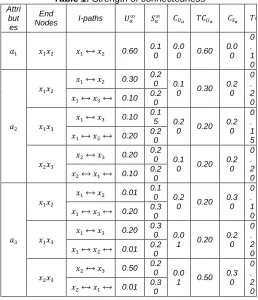
Using regular calculation, the value of the strength of m-deg and nm-deg of I-path, strength and strength of connectedness among each pair of nodes and the total strength and strength of connectedness among each pair of nodes for the attributes a1, a2 and a3 are estimated and
tabulated in Table 1.
Table 1: Strength of connectedness
Attri but
es
End
Nodes I-paths
0.60 0.1
0 0.0
0 0.60 0.0 0 0 . 1 0
0.30 0.2
0 0.1 0 0.30
0.2 0 0 . 2 0
0.10 0.2 0
0.10 0.15 0.2
0 0.20 0.2 0 0 . 1 5
0.20 0.2 0
0.20 0.2
0 0.1 0 0.20
0.2 0 0 . 2 0
0.10 0.20
0.01 0.1
0 0.2 0 0.20
0.3 0 0 . 1 0
0.20 0.30
0.20 0.3
0 0.0 1 0.20
0.2 0 0 . 2 0
0.01 0.2 0
0.50 0.2
0 0.0 1 0.50
0.3 0 0 . 2 0
0.01 0.3 0
From the above table, it is noticed that the link is strong as well as strong for the attribute a2
and weak and strong for a3. Also the link
is weak and strong for the attribute a2 and strong and weak for the attribute a3 and the link is strong and strong for a2 and strong and strong for a3. Therefore it can be observed that a link which is
strong or strong for an attribute and does not mean that it is strong and strong for the attribute . Furthermore an I-link which is
strong or strong for some attribute need not means that it is strong or strong for some other attribute .
4819
Definition 3.21: Let ( ) is an I-link and it is named as a strong link if it is strong or strong for some .
Definition 3.22: Let ( ) is an I-link and it is named as a strong link if it is strong or strong for some .
Definition 3.23: Let ( ) is an I-link and it is named as a sturdy link if it is both strong and strong for some .
Definition 3.24: Let ( ) is an I-link and it is named as a feeble link if it is either weak or weak link for some .
Definition 3.25: Let ( ) is an I-link and it is named as a ∗ weak link for the attribute if it is weak and
weak link.
Definition 3.26: In an IFSG, an I-path for the attribute is called firm I-path if it comprises of only the sturdy links.
Definition 3.27: In an IFSG, an I-path is infirm I-path if it consists of only ∗ weak links.
Consider the problem given in Example 3. In this example, the links and are sturdy for the attribute and is a sturdy link for . The link is feeble for the attributes and .
Definition 3.28: In an IFSG, an I-path from to is said to be the strongest I-path for the attribute if its strength of m-deg and nm-deg equals ( ) and ( ). That is ( ) and
( ), for , .
In Example 3.19, the I-paths , are the strongest I-paths for the attribute .
4
APPLICATION
OF
IFSG
IN
DECISION-MAKING
PROBLEM
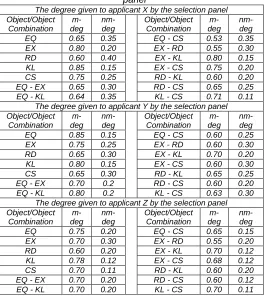
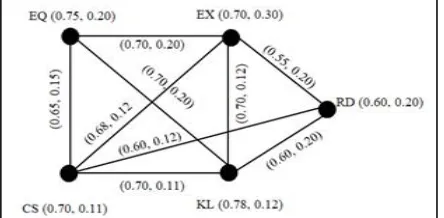
Most of the problems in Engineering, Medical science, Economics, Environments, etc., have several uncertain information to handle. These uncertainties arise from different sources and cannot be captured within a single mathematical model. The concept of the fuzzy graph is used in many applications for modeling real-time systems. As IFSG provides more accuracy, compatibility, and flexibility to the system than other the fuzzy-based frameworks, this paper demonstrates an application of link analysis in a real-time decision-making problem. An educational institution desires to fill the position of Professor for a single post from the three shortlisted applicants after a discussion and interview over. The selection panel gave positive grade (m-deg) and negative grade (nm-deg) to each applicant according to their performance by considering "Educational qualification, Experience, Research and development activities, Knowledge level, and Communication skill". Let us model this problem with an IFSG. Consider the set of three
applicants as the attributes and denoted as X, Y, Z. The kinds of stuff EQ, EX, RD, KL, and CS are considered as nodes of IFSG where ‗EQ‘ denotes educational qualification, ‗EX‘ denotes experience, ‗RD‘ denotes Research and development activities, ‗KL‘ denotes Knowledge level, and ‗CS‘ denotes Communication skill. The selection panel also assign m-deg and nm-deg to combination of stuff like {(EQ, EX), (EQ, KL), (EQ, CS), (EX, RD), (EX, KL), (EX, CS), (RD, CS), (RD, KL), (KL, CS)} by considering combination. For instance, the m-deg or nm-deg of the I-link EQ−EX for attribute X denotes how the applicant X good or not good both in ‗Educational qualification and Experience‘. The path relating the nodes EQ−KL−CS−RD−EX for the attribute X denotes the grade given to the applicant X by considering all those kinds of stuff. Table 2 and Figure 2 denote the IFSG analogous to the scenario. It is very difficult to relate these three applicants here to provide the right recruitment since all the three applicants have a close degree in various kinds of stuff and their combination. Once we denote the information in the form of an IFSG, we can select a suitable applicant for the post by examining the I-links. Using regular calculation and definitions given in section 2, we observed that the IFSG in Figure 2(b) has more sturdy links and strong paths as compared to IFSGs in Figure 2(a) and Figure 2(c) and moreover it comprises of only one ∗ weak link. The applicant X has two sturdy links (EX−CS) and (EX−KL) and it has firm I-paths (EX−KL), (EX – CS) and (KL−EX−CS). Also, it contains a ∗ weak link (EX–RD). So (EX–RD) is an infirm I-path for the attribute X.
Table 2: The degree given to the applicants by the selection panel
The degree given to applicant X by the selection panel Object/Object
Combination m-deg
nm-deg
Object/Object Combination
m-deg
nm-deg
EQ 0.65 0.35 EQ - CS 0.53 0.35
EX 0.80 0.20 EX - RD 0.55 0.30
RD 0.60 0.40 EX - KL 0.80 0.15
KL 0.85 0.15 EX - CS 0.75 0.20
CS 0.75 0.25 RD - KL 0.60 0.20
EQ - EX 0.65 0.30 RD - CS 0.65 0.25
EQ - KL 0.64 0.35 KL - CS 0.71 0.11
The degree given to applicant Y by the selection panel Object/Object
Combination m-deg
nm-deg
Object/Object Combination
m-deg
nm-deg
EQ 0.85 0.15 EQ - CS 0.60 0.25
EX 0.75 0.25 EX - RD 0.60 0.30
RD 0.65 0.30 EX - KL 0.70 0.20
KL 0.80 0.15 EX - CS 0.60 0.30
CS 0.65 0.30 RD - KL 0.65 0.25
EQ - EX 0.70 0.2 RD - CS 0.60 0.20
EQ - KL 0.80 0.2 KL - CS 0.63 0.30
The degree given to applicant Z by the selection panel Object/Object
Combination m-deg
nm-deg
Object/Object Combination
m-deg
nm-deg
EQ 0.75 0.20 EQ - CS 0.65 0.15
EX 0.70 0.30 EX - RD 0.55 0.20
RD 0.60 0.20 EX - KL 0.70 0.12
KL 0.78 0.12 EX - CS 0.68 0.12
CS 0.70 0.11 RD - KL 0.60 0.20
EQ - EX 0.70 0.20 RD - CS 0.60 0.12
4820
Figure 2 (a) : IFSG corresponding to X
Figure 2(b): IFSG corresponding to Y
Figure 2(c): IFSG corresponding to Z
When we consider the case of applicant Y, it has four sturdy links (EQ−EX), (EQ−CS), (EX–KL), (RD−KL) and has firm I-paths (EX−EQ–CS), (CS−EQ−EX−KL), (RD−KL−EX), (RD−KL−EX−EQ–CS), (RD−KL−EX–EQ) and has single infirm I-path (EQ−KL). When we consider the case of applicant Z, the sturdy links are (RD–KL) and (KL–CS) and the firm paths are (RD−KL−CS), (RD−KL), (KL−CS). But it has two ∗ weak links (EX−RD) and (EX−KL). The candidate M has more sturdy links and firm I-paths. Therefore when we relate and examine the complete information, applicant Y is appropriate for recruitment. This simple example indicates that the concept of IFSG can be applied to solve decision-making problems effectively. Similarly, IFSG can be exploited in many more domains with uncertainties like machine learning applications, medical diagnosis, and so on.
5
CONCLUSION
Fuzzy graphs and soft graphs are two different mathematical frameworks for modeling ambiguous and imprecise data in real-time applications. The concept of the fuzzy soft graph is more generalized as compared with
fuzzy graphs and soft graphs. Hence, the fuzzification of soft graph theory has attracted the interest of several researchers, and investigations in this domain have exaggerated over the last few years. The analysis of links (i.e., edges) plays a significant role in Intuitionistic fuzzy soft graphs (IFSG) to understand the nature of the entire real-world problems. In this paper, we present various arithmetical edifices related to types of links such as sturdy, feeble and δ∗ a weak edge to analyze the strength of connectedness of IFSG. Also, we implement these concepts to solve a real-time decision-making problem.
6
REFERENCES
[1] Akram.M and , Dudek W.A, ―Interval-valued fuzzy graphs,‖ Computers & Mathematics with Applications, vol. 61, no. 2, pp. 289–299, 2011. [2] Akram.M and Akmal .R, ―Intuitionistic fuzzy graph
structures,‖ Kragujevac Journal of Mathematics, vol. 41, pp. 219–237, 2017.
[3] Akram.M and Dudek W.A, ―Intuitionistic fuzzy hypergraphs with applications,‖ Information Sciences, vol. 218, pp. 182–193, 2013.
[4] Akram M, ―Bipolar fuzzy graphs with applications,‖ Knowledge-Based Systems, vol. 39, pp. 1–8, 2013. [5] Atanassov, K.T. "Intuitionistic fuzzy sets", Fuzzy
Sets and Systems, 20(1), pp. 87-96 (1986)
[6] Aktas .H and Cagman. N, ―Soft sets and soft groups,‖ Information Sciences, vol. 177, no. 13, pp. 2726–2735, 2007.
[7] Ali M.I, Feng. F,. Liu .X, Min .W.K, and Shabir .M, ―On some new operations in soft set theory,‖ Computers & Mathematics with Applications, vol. 57, no. 9, pp. 1547–1553, 2009
[8] Atanassov, K.T.: "Intuitionistic fuzzy sets", VII ITKR‘s Session, Deposed in Central for Science Technical Library of Bulgarian Academy of Sciences, 1697/84, Sofia, Bulgaria (Bulgarian) (1983)
[9] Bhattacharya.P, ―Some remarks on fuzzy graphs,‖ Pattern Recognition Letters, vol. 6, no. 5, pp. 297– 302, 1987.
[10]Dinda.B, Samanta T.K, Relations on intuitionistic fuzzy soft sets, General Mathematics Notes 1(2) (2010), 74−83.
[11]Kauffman .A, ―Introduction a la Theorie des Sous-emsembles Flous, Masson et Cie,‖ vol. 1, 1973 [12]Maji. M, Biswas.R, and A. R. Roy, ―Soft set
theory,‖ Computers & Mathematics with Applications, vol. 45, no. 4-5, pp. 555–562, 2003. [13]Maji.P.K, Roy.A.R,Biswas.R, "Fuzzy soft sets", The
Journal of fuzzy mathematics 9(3) (2001), 589−602.
[14]Maji.P.K, Roy .A.R, Biswas.R, "An application of soft sets in a decision making problem", Computers and Mathematics with applications 44(8−9) (2002), 1077−1083.
[15]Molodtsov, D.A., "Soft set theory-first results", Compu. Math. Appl. 37, 19–31 (1999)
4821 [17]Samanta .S, Pal.M, Rashmanlou .H, and
Borzooei R.A, ―Vague graphs and strengths,‖ Journal of Intelligent and Fuzzy Systems, vol. 30, no. 6, pp. 3675–3680, 2016. [18]Samanta .S and Pal .M, ―Fuzzy Planar Graphs,‖
IEEE Transactions on Fuzzy Systems, vol. 23, no. 6, pp. 1936–1942, 2015.
[19]Samanta.S and Pal .M, ―Irregular bipolar fuzzy graphs,‖ International Journal of Fuzzy Systems, vol. 2, pp. 91–102, 2012.
[20]Sezgin.A and Atagun A.O, ―On operations of soft sets,‖ Computers & Mathematics with Applications, vol. 61, no. 5, pp. 1457–1467, 2011
[21]Xu,W., Ma,J.,Wang,S., and Hao,G. "Vague soft sets and their properties", Computers and Mathematics with Applications, 59, pp. 787-794 (2010).
[22]Yang, X., Lin, T.Y., Yang, J., Li, Y., and Yu, D. "Combination of interval-valued fuzzy set and soft set", Computers and Mathematics with Applications, 58, pp. 521-527 (2009)