management: implications for conservation and
human health in southern Nepal
Pandey
et al.
Pandeyet al. Journal of Ethnobiology and Ethnomedicine (2016) 12:22
R E S E A R C H
Open Access
Public perceptions of snakes and snakebite
management: implications for conservation
and human health in southern Nepal
Deb Prasad Pandey
1*, Gita Subedi Pandey
2, Kamal Devkota
3and Matt Goode
4Abstract
Background:Venomous snakebite and its effects are a source of fear for people living in southern Nepal. As a result, people have developed a negative attitude towards snakes, which can lead to human-snake conflicts that result in killing of snakes. Attempting to kill snakes increases the risk of snakebite, and actual killing of snakes contributes to loss of biodiversity. Currently, snake populations in southern Nepal are thought to be declining, but more research is needed to evaluate the conservation status of snakes. Therefore, we assessed attitudes, knowledge, and awareness of snakes and snakebite by Chitwan National Park’s (CNP) buffer zone (BZ) inhabitants in an effort to better understand challenges to snake conservation and snakebite management. The results of this study have the potential to promote biodiversity conservation and increase human health in southern Nepal and beyond.
Methods:We carried out face-to-face interviews of 150 randomly selected CNP BZ inhabitants, adopting a cross-sectional mixed research design and structured and semi-structured questionnaires from January–February 2013. Results:Results indicated that 43 % of respondents disliked snakes, 49 % would exterminate all venomous snakes, and 86 % feared snakes. Farmers were the most negative and teachers were the most ambivalent towards snakes. Respondents were generally unable to identify different snake species, and were almost completely unaware of the need of conserve snakes and how to prevent snakebites. Belief in a snake god, and the ability of snakes to absorb poisonous gases from the atmosphere were among many superstitions that appeared to predispose negativity towards snakes of BZ residents.
Conclusion:People with predisposed negativity towards snakes were not proponents of snake conservation. Fear, negativity, ambivalence towards, and ignorance about, snakes and the need for snake conservation were strong indicators of the propensity to harm or kill snakes. It seems that if wanton killing of snakes continues, local snake populations will decline, and rare and endangered snake species may even become locally extirpated. Moreover, inappropriate perception and knowledge about snakes and snakebites may put BZ people at increased risk of venomous snakebite. Therefore, intensive, pragmatic educational efforts focused on natural history and ecology of snakes and prevention of snakebite should be undertaken in communities and at schools and universities.
Keywords:Snake species diversity, Snake identification, Conservation, Snake worship, Snakebite, Ethno-ophiology, Ecosystem health, Key stone species
* Correspondence:[email protected]
1Department of Herpetology, Senckenberg Research Institute and Natural
History Museum, Senckenberg Biodiversity and Climate Research Centre, JW Goethe University, Frankfurt am Main, Germany
Full list of author information is available at the end of the article
© 2016 Pandey et al.Open AccessThis article is distributed under the terms of the Creative Commons Attribution 4.0 International License (http://creativecommons.org/licenses/by/4.0/), which permits unrestricted use, distribution, and reproduction in any medium, provided you give appropriate credit to the original author(s) and the source, provide a link to the Creative Commons license, and indicate if changes were made. The Creative Commons Public Domain Dedication waiver (http://creativecommons.org/publicdomain/zero/1.0/) applies to the data made available in this article, unless otherwise stated. Pandeyet al. Journal of Ethnobiology and Ethnomedicine (2016) 12:22
Background
Human attitudes towards snakes can be both positive and negative [1, 2]. In some places, people possess a deep respect for snakes due to spiritual traditions [3], while in other places people value snakes for utilitarian reasons [2, 4, 5]. However, snakes are typically misunder-stood, mistreated, feared or killed, even when humans consider snakes to be symbols of power and worthy of worship worldwide [3, 6–8]. The consequences of negativ-ity, ambivalence, fear, and killing of snakes for biodiversity conservation and human welfare have rarely been studied. Because snakes and snake parts are used in many different ways by different cultures, human activities can influence snake populations and communities both directly and indirectly. Therefore, snake-human interactions and the importance of ethnoherpetology [9] must be considered when planning conservation actions [10, 11].
A lack of knowledge and misguided perception of snakes threaten snake populations worldwide. An-thropogenic habitat fragmentation or destruction [12] and intentional killing of snakes [13, 14] contribute to snake population decline. If wanton killing of snakes goes unchecked, it will likely add to the risk of popula-tion decline, and even local extirpapopula-tion of rare and endangered snake species, which may have cascading community- and ecosystem-level effects. In Nepal, the conservation status of snakes is either unknown or poorly defined based on minimal survey efforts carried out in the distant past, or simply confined to expert opinion [15]. Human activity, including intentional kill-ing of snakes, likely contributes to population declines in many species, some of which play an important role in agricultural and grassland ecosystems of southern Nepal, which in turn may lead to negative impacts to biodiversity and human health. In addition to increas-ing our knowledge of snake ecology and natural history, it is important to assess public perception and know-ledge of snakes. From a human health perspective, it is vitally important to better understand snakebite care and prevention among people inhabiting snakebite prone regions, which in turn represents a key compo-nent of snake diversity conservation, snakebite preven-tion, and prehospital care of snakebites.
Human and snake conflicts are commonplace through-out the world. People engaged in agricultural practices that utilize local resources from protected or non-protected areas for their living and sociocultural re-quirements, such as those living in the buffer zone of Chitwan National Park (BZCNP) in southern Nepal, suffer from life threatening snakebite envenoming. The threat of potentially fatal snakebite results in often ruthless killing of snakes. Therefore, it is important to understand the perceptions of rural villagers towards snakes, including assessing general knowledge about
snakes, frequency and care of snakebites, and prevent-ive measures taken. Armed with this knowledge, it is imperative to engage inhabitants in educational efforts that will lead to more appropriate responses towards snakes, which is expected to reduce snakebites and minimize life threatening interactions with snakes resulting in enhanced conservation of snake popula-tions [16]. Although assessing attitudes and percep-tions towards charismatic megafauna has been the subject of recent research [17] similar attention has not been given to assess attitudes, knowledge, and awareness of snakes and snakebite among people inhabiting BZCNP.
Snakes may be keystone predators [18, 19], especially in agricultural and grassland ecosystems, because snakes are effective predators of rodents. Indeed, snakes likely help to regulate food webs in important ways that other predators cannot. Snakes are also excellent ecological indicators due to their sensitivity to temperature and climate change [20]. Therefore, massive killing of snakes likely influences trophic interactions in ecosystems and may alter predator–prey population dynamics in multifa-ceted ways.
It seems reasonable to assume that high levels of human-caused mortality of snakes will result in an in-crease in rodent populations that will lead to a reduction in pre- and post-harvest cereal grains, other agricultural products, and household goods [21–25]. Increased rodent populations may also increase the risk of epidemic plague [26, 27] and diseases caused bySalmonellaand Campylo-bacter [28]. Subsequently, snakes contribute directly to maintain natural trophic interactions, and indirectly to public health by reducing disease and famine. Although seemingly counterintuitive, unsustainable killing of snakes may also lead to increased snakebite [29], because individ-uals attempting to kill snakes are more likely to be bitten. Therefore, understanding causes of snake-human conflicts is essential.
Use of snakes for food, medicine, goods (e.g., snakeskin belts, purses, bags) and recreation (e.g., keeping snakes as pets, at zoos and for display by charmers) also threatens snakes. Worldwide, people use about 165 reptilian species, including snakes, for traditional medicine [10] and several ethnoherpetological studies indicate that traditional knowledge is important to herpetological conservation and human health [10, 30–33]. But similar studies are rare worldwide [34, 35], including in Nepal [36]. This study also highlights the human exploitation of snakes in BZCNP.
snakebite envenoming, which can lead to death if not properly treated. It is not yet known how rural people react to snakes encountered in their homes compared to human-snake interactions that take place outdoors (e.g., roads, agricultural fields).
To the best of our knowledge, this is the first study to investigate perceptions, knowledge, and awareness (AKA) of snakes and snakebite in Nepal. Our goal is to provide baseline data useful for conservation of local snake populations and for enhancing snakebite preven-tion. To achieve this goal, we assess AKA by occupa-tion, gender, and literacy of people living in BZCNP. We also determine challenges to snake conservation and snakebite management and provide insights and measures to improve AKA to address these challenges. This study informs major questions associated with anthropogenic threats to snakes and broad challenges to snakebite management [37]. Because teachers, stu-dents, and farmers are important for dissemination of conservation and public health education, quantifying their AKA may be of heightened importance for effect-ive snake conservation and public health policy making.
Methods
Study area
A total of 35 BZ communities (15 from Chitwan, 16 from Nawalparasi, two from Makawanpur, and two from Parsa Districts [38]) surround CNP. Approximately 364,000 people inhabit these communities [39]. These people
depend, both directly and indirectly, on resources found in the park and buffer zone areas. A rapidly increasing population in the Chitwan Valley has resulted in increased impacts on biodiversity and other natural resources in the vicinity. There is nearly an equal proportion of agricultural (46 %) and forested lands (50 %) in the BZ of CNP [38]. Agricultural lands are comprised of rice paddies, maize, and wheat fields, and forested lands consist ofShorea ro-busta (Sal) (30 %), tropical mixed hardwood (19 %) and
Accaciaspecies (Khair) andDalbergia sissoo(Sissoo) (1 %) [38]. Both agricultural and forested lands appear to provide suitable habitat for snakes and their prey (e.g., ro-dents, birds, reptiles, amphibians and fishes) and predators (e.g., raptors, carnivores, other snakes).
The study area is characterized by a tropical climate, with temperatures up to 38 °C in summer, dropping to a minimum of 6 °C in winter, and receiving approximately 240 cm of rainfall annually, with the bulk occurring during the monsoon season [40].
We purposely selected three distantly distributed Vil-lage Development Committees (VDCs) adjoining CNP to represent a diverse array of BZ communities (Fig. 1). We selected three institutions of higher education and randomly selected three wards (i.e., the smallest admin-istrative unit of Nepal). From these study units, we ran-domly sampled 75 household heads from a current household list of respective wards, and 45 teachers and 30 students from the daily attendance-register of each institution (Table 1).
Fig. 1Map showing study sites in the southcentral lowlands of Nepal. Yellow highlighted area represents buffer zones of Chitwan National Park
Data collection
We conducted a cross-sectional survey using semi-structured and pre-tested questionnaires, qualitative and quantitative research methods [41, 42] from January-February 2013. We performed personal, formal, and face-to-face interviews of 150 randomly selected respondents with a mean age of 37 years (range = 15–79) using a voice recording device and visual stimuli (i.e., A4-sized color photographs of adult snakes known to be distributed in the vicinity of CNP; Fig. 2, Table 2) [43]. We also included photographs of neonate and juvenile snakes for species with ontogenetic variation in color patterns.
Of the total number of people surveyed, 33 % were farmers1(n= 50), 30 % were teachers (n= 45), 23 % were students (n= 34) and 14 % were classified as “other” (n= 21). Respondents were illiterate (20 %) to highly literate (32 %). Three respondents refused to share their education status. The literate respondents (80 %,n= 120) attained up to class 10 (21 %,n= 31), class 11–12 or equivalent intermediate degree (21 %,n= 31), and Bache-lor’s and Master’s degree (32 %, n= 48). We surveyed
68 % males (n= 102, males and females ratio = 213) and 98 % Hindus.
Written informed consent was obtained from the par-ticipants for publication of this study and any accom-panying images. For the informed consent, we clearly explained the main objectives of our research at the be-ginning of the interview and asked them if they would participate in the survey research. As for institutional re-spondents, we interviewed them after a formal request for permission to the principals of the respective institu-tions. We did not obligate any respondents to participate in this study.
Attitudes
We asked 15 questions designed to understand positive attitudes and 14 questions designed to examine negative attitudes towards snakes and snake conservation. We de-termined ambivalent attitudes if participants responded
“yes”to both types of questions. To scrutinize and meas-ure attitudes, we asked participants questions related to like, dislike or fear of snakes, intention of killing snakes, responses to snakes encountered in defined and undefined places, worship of snakes, realizing the need of snake con-servation, and snakes as a “farmers’ friend.” We phrased the first type of question as, Do you…? Why?; we coded responses as 1 = Yes, 2 = No, 3 = Unknown, and we noted three types of logic for Yes or No responses. We phrased the second type of question as,What do you do when…?; we coded responses as 1 = I ignore it, 2 = I kill it, 3 = I call others to kill it, 4 = I kill it only if I know it a venomous snake, 5 = I just keep it out using sticks (snake hooks, tong, etc.). We phrased the third type of question as,
Which of the following do you consider to be…?; we coded responses as 1 = All snakes around us should be killed, 2 = Only venomous snakes around us should be killed, 3 = All Table 1Study sites and study samples
Study sites Sampling units (classes of listed educational institutions below, wards of Village Development Committee (VDCa))
Sampling unit population Sample size
(i.e. number of respondents)
Sample size (%)
Bachhayauli Class 12, Jhuwani Higher Secondary School, Bachhayauli 09, Chitwan
33 (10 students, 23
teachers)b 25 (10 students, 15 teachers) 76
Ward number 3, Bachhayauli VDCa, Chitwan 148 household headsc 25 (household heads) 17
Baghauda Bachelor’s degree of Business Studies, 1st year, Madi Multiple Campus, Tribhuvan University, Baghauda 03, Chitwan
44 (24 students, 20 teachers)b
25 (10 students, 15 teachers) 57
Ward number 5, Baghauda VDCa, Chitwan 87 household headsc 25 (household heads) 29
Meghauli Class 11 and 12, Janaki Higher Secondary School, Telauli, Meghauli 05, Chitwan
60 (28 students, 32 teachers)b
25 (10 students, 15 teachers) 42
Ward number 6, Meghauli VDCa, Chitwan 43 household headsc 25 (household heads) 58
Total 415 150 (30 students, 45 teachers, 75
villagers)
36
Symbols:a
each VDC consists of nine wards which are the smallest administrative units of Nepal,b
obtained from daily attendance register,c
obtained from community forest register and social workers of respective wards,%(percent) = sample size / unit sample population x 100
Table 2Checklist of snake photographs used while interview
PN Scientific name Common name Vernacular name Toxicity
Typhlopidae
1 Indotyphlops braminus
Brahminy Worm Snake/ Common Blind Snake/ Brahminy Blind Snake
Andha Sarpa or Sanp/ Ganeule Sanp/ Teliya Sarpa/ Nelia Sarp/ Matti Sanp/ Dhudh Sanp/ Andhara Sanp
Nv
2 Argyrophis diardii
Diard’s Worm/ Diard’s Blind Snake/ Large Worm/ Western Large Worm Snake/ Indochinese Blind Snake
Phusre Telia/ Andha Sap/ Matti Sanp/ Dhudh Sanp/ Andhara Sanp/ Ganeule Sanp/ Teliya Sanp or Sarpa
Nv
Erycidae (Boidae)
3 Eryx johnii Red Sand Boa/ Brown Earth Boa/ John’s Sand Boa
Domukhe or Lide or Laxmi or Mate Sanp/ Lal Dhusar/ Duitauke Sarpa/ Jhataha
Nv
Pythonidae
4 Python bivittatus
Burmese Rock Python Ajingar/ Ajgar/ Thulo Pate Ajinger/ Sonakatar Nv
Colubridae
5 Coelognathus helena
Common Trinket Snake Singare Sarpa (long-striped snake)/ Gahane Sap/ Male Sap Nva
6 Coelognathus radiatus
Copper-headed Trinket Snake/ Copperhead Trinket Snake/ Copperhead Racer
Singare Sarpa/ Ratothauke Gahane Sap Nva
7 Dendrelaphis tristis
Common Bronzeback Tree Snake Sirish or Sirise (tree living)/ Siris Rukh Sanp/ Shipu/ Laudanga Nv
8 Lycodon aulicus
Common Wolf Snake Chichinde (gourd-shaped snake)/ Dhamiloo Sanp/ Buwase Sarp/ Sikhaphyancha/ Sikham Phyancha/ Sikhphyancha
Nv
9 Lycodon jara Yellow-speckled Wolf Snake/ Twin-spotted Wolf Snake
Jor Thople Sikhaphyancha Nv
10 Oligodon arnensis
Common/Banded Kukri Snake/ Russet Kukri Snake
Pate Khukuri Sap/ Gurbay/ Pate Sikhan Pyancha/ Sankhad Sanp Nv
11 Oligodon kheriensis
Coral Red Kukri Snake/ Coral Kukri Snake Puwale Khukuri Sap/ Harrama (Rai community) Nv
12 Ptyas mucosa Asiatic Rat Snake/ Indian Rat Snake/ Indian Wolf Snake
Dhamin or Dhaman (big garlands), Dhamila or Dhamala/ Muse Sarpa/ Lambaiya (lanky snake)/ Bichhar (nipple sucking snake)
Nv
14 Xenochrophis piscator
Checkered Keelback Pani Sarpa or Pani Sanp or Pani Syap (water snake)/ Kothe Dhodiya Sap/ Dhodiya Sanp/ Pankhadar/ Gareha Sarpa/ Dom
Mv, Vs
15 Ahaetulla nasuta
Common Vine Snake/ Common Green Whip Snake/ Green Vine Snake
Sugia or Suga Sarpa (parrot like or parrot snake)/ Hario Chabuke Sarpa/ Udne Hareu/ Harahara
Mv, Bf
16 Amphiesma stolatum
Striped Keelback/ Buff-striped Keelback Bagale/ Nauri/ Nauria/ Ashare/ Harara/ Harihara/ Bahune Sarpa/ Harhare Sarpa/ Hurra/ Chyarra/ Dirisarp/ Deri/ Dondaha
Mv, Bf
17 Boiga trigonata Common Cat Snake/ Indian Cat Snake/ Indian Gamma Snake
Sanbe or Sabhe (cylindrical snake, in Kirat or Limbu)/ Adhoo Sarpa/ Tirish/ Batashe Sarpa (windy or gliding snake)/ Bharati Birale Sap/ Basara (nesting snake)/ Lohagin (irony)/ Birale Sarpa (catlike snake)/ Batyoudesyaap (gliding snake)/ Chittar (cupid)/ Chudeu (crested)/ Katakhor (cutter of pen)
Mv, Bf
18 Rhabdophis subminiatus
Red-necked Keelback Lal Kanthe Daline Sap V, Vs
Homalopsidae
13 Ferania sieboldi Siebold’s Smooth-scale Water Snake/ Siebold’s Smooth Water Snake
Dhod or Dhodia Sarpa/ Machhagidhi/ Chile Pani Sap/ Pani Sarpa Mv, Bf
Elapidae
19 Bungarus caeruleus
Common Krait/ Common Indian Krait Bairi Karet/ Kret Sarpa (file snake)/ Chure Karet/ Seto-kalo-chure Krait/ Ganaich/ Gadainch/ Ghod Gadainch (horse like krait)/ Kalaich (killing monster)/ Karkat nag (cancer snake)
V
snakes around us should be conserved. Again, we coded responses as 1 = Yes, 2 = No, 3 = Unknown.
Knowledge
The knowledge test questions included three types of questions: the first type tested whether or not people could identify the snake as venomous or non-venomous, and if they knew the local/English/scientific names of the snake; second, we tested their understanding of the need for snake conservation; and third, we asked about measures of snakebite prevention. We presented the first type of question as,Which one of the following snakes do you think were venomous or non-venomous? (we consid-ered both rear- and front-fanged snakes as venomous)
and which snake species do you know by their local/ English/scientific names?
To measure knowledge of the need to conserve snakes, we phrased questions such as, Do you think snakes should be conserved? and If you do/don’t think so, why?
We asked respondents to give five reasons. To measure knowledge about snakebite prevention, we phrased ques-tions such as,Do you know how to prevent snakebite? If yes, we asked them to give 10 preventive measures that they practice. We encircled the corresponding assigned snake photo numbers (i.e., 1–28) following their re-sponses and noted names of respective snakes if they were able to identify the species. We crosschecked their replies with a corresponding list of snakes (Table 2) and published sources [44] during data entry.
Table 2Checklist of snake photographs used while interview(Continued)
20 Bungarus fasciatus
Banded Krait Panhelo-kalo-chure Sarpa/ Kanthmala Sap (snake with necklace or
garland)/ Laxmi Sarpa (money making snake)/ Ganguwali or Pate Ganguwali Sarpa/ Gangwari (cowshed living)/ Gun Gawari/ Gangwar/ Ganguri Sarpa/ Maher/ Gwala Sarpa (cow-herd snake)/ Rajasarp (king snake)/ Ahiriniyasarp (not looking snake)
V
21 Bungarus lividus
Lesser Black Krait Kalo Krait (black krait) V
22 Sinumicrurus m. univirgatus
MaClelland’s Coral Snake Setofetawal Nag/ Muga Sanp/ Rato Sarpa/ Karkat Nag (cancer cobra)/ Nag/ Naag (semi-divine serpent)
V
23 Naja kaouthia Monocled Cobra/ Monocellate Cobra Goman/ Nag/ Ek Thople Goman/ Seto Goman/ Paniadarad (water burning pain)/ Supailyasyaap/ Tilakdom (with black hood marking)/ Dom/ Dumini
V
24 Naja naja Spectacled/ Common Cobra Goman (cobra, aggresive snake)/ Nag/ Dui Thople Goman/ Kalo Goman/ Dudhiya Goman (milky cobra)/ Dumini (female sweeper)/ Supailyasyap/ Supailesyap/ Supya Sarpa/ Phetara (expanded hood)/ Kopre (hooded or bent ahead)
V
25 Ophiophagus hannah
King Cobra Queta or Kenwata/ Raj Goman/ Darad (much poisonous or paining)/
Nagraja (snake king)/ Alhaad (Sanskrit: fireband)/ Kalinag (black cobra)/ Bhainsedom (buffalo sweeper)
V
Viperidae
26 Trimeresurus albolabris
White-lipped Green Pit-viper/ White-lipped Bamboo Viper
Harau/ Harau Sanp/ Haryousarpa/ Setojibre Hareu Sap/ Pattar V
27 Daboia russelii Russel’s Viper Baghe Sarpa, Suskar V
28 Echis carinatus Saw-scaled Viper Karaute Sarpa V
Abbreviations:PNphoto number (PN 27 and 28 are presumed to be distributed in Chitwan valley and lowlands of Nepal (Shah and Tiwari 2004, Shrestha 2001). So, we included them despite these were not reported from Chitwan valley (Pandey 2012)),NvNon-venomous,MvMildly venomous,BfBack-fanged,VsVenomous secretion,VVenomous; this checklist was adopted from: Pandey 2012, Shah and Tiwari 2004, Schleich and Kästle 2002, Shrestha 2001, Zug and Mitschel 1995). AlthoughCoelognathus radiatuspossesses postsynaptic neurotoxin in its Duvernoy’s gland (Fry et al. 2003), Harris et al. (2010) reported fourCoelognathus radiatusbites on the feet causing pain and bleeding at the bite site. Therefore, I considered both nonvenomous snakes while analysing knowledge of locals on surrounding venomous snakes
Table 3Chitwan National Park buffer zone population with positive, negative and ambivalent attitudes to snakes
Hypothesis tests (for all respondents with different responses to attitude test questions, please, see questions in Table6)
Median, range
Mean ± SEM sd W (res) p-value 95 % CI
a. With positive attitudes (n= 15, see Table6.a); H0: M = M0 (70), Ha: M > M0 (70) 99, 12–148 91.6 ± 11.08 42.92 90 0.047 70.5–Inf
b. With negative attitudes (n= 14, Table6.b); H0: M = M0 (9), Ha: M > M0 (9) 13, 0–129 28.86 ± 9.84 36.82 81.5 0.037 8.5–Inf
c. With ambivalent attitudes (n= 9, see Table6.c); H0: M = M0 (14), Ha: M > M0 (14) 22, 7–62 28.11 ± 6.78 20.33 31 0.040 14.5–Inf
Table 4Scores for attitudes of Chitwan National Park buffer zone people to snakes and their conservation
Demographics a. Score for positive attitudes (n= 15, see Table6.a) (null hypothesis (H0): population median scores (M) = hypothesized median scores (M0 = 8 of 15); alternative hypothesis (Ha): M > M0)
b. Scores for negative attitudes (n= 14, see Table6.b) (null hypothesis (H0): population median scores (M) = hypothesized median scores (M0 = 2 of 14), alternative hypothesis (Ha): M > M0)
c. Scores for ambivalent attitudes (n= 9, see Table6.c) (null hypothesis (H0): population median scores (M) = hypothesized median scores (M0 = 1 of 9); alternative hypothesis (Ha): M > M0)
Median, range W (pos) p-value Median, range W (neg) p-value Median, range W (amb) p-value All respondents (150) 9,4–14 67885.5 <0.001 2,0–7 5058 <0.001 2,0–7 4618 <0.001
Age (years) 15–24 (42) 10,4–14 639.5 <0.001 2,0–6 332.5 0.044 2,0–5 337 0.001
25–34 (22) 9,4–14 115 0.102 2,0–6 125 0.226 1,0–4 60 0.048
35–44 (40) 9,5–13 478.5 0.001 2.5,0–7 336 0.037 2,0–7 357 0.004
45–54 (21) 10,5–13 156 0.007 2,0–7 80 0.442 1,0–6 92.5 0.030
55–64 (17) 9,6–13 107.5 0.021 3,1–6 104 0.006 2,1–5 120 <0.001
65+above (8) 6,5–12 7 0.901 3,1–7 25.5 0.029 1,0–5 12 0.412
Gender Male (102) 9,4–14 3317.5 <0.001 2,0–7 2130 0.055 2,0–7 2475.5 <0.001
Female (48) 9,4–13 620 0.017 3,1–7 604 <0.001 1,0–5 335 0.012
Occupation Farmer (50) 8,4–13 538.5 0.214 3,1–7 736 <0.001 1.5,0–6 490 0.001
Teacher (45) 9,6–13 718.5 <0.001 2,0–6 401.5 0.321 2,0–7 451 <0.001
Student (34) 10,4–14 414.5 0.001 2,0–6 185 0.269 1.5,0–5 197 0.002
Othera(21) 10,6–14 158 0.001 2,0–6 91 0.411 2,0–4 129 0.025
Educational status Illiterate (27) 8,5–13 143.5 0.439 3,1–7 211 0.003 1,0–5 115.5 0.026 Literate (120) 9,4–14 4671 <0.001 2,0–7 3055.5 0.006 2,0–7 3212 <0.001
≤Class 10 (31) 8,4–14 195 0.193 3,0–7 329 <0.001 2,0–6 275 0.001
Class 11–12 (31) 11,5–14 465.5 <0.001 1,0–6 136 0.918 2,0–4 190 0.012
Master’s D (22) 9,6–13 238.5 0.006 2.5,0–6 153 0.186 2,0–7 170 0.001
Bachelor’s D (26) 9.5,4–13 117 0.028 2,1–6 67 0.067 2,0–5 95 0.003
Lit. inf.b(10) 11,5–13 49 0.015 1.5,0–6 17 0.584 0.5,0–3 18.5 0.5
Symbols andabbreviations:ahotel owner (3), miller (3), fisherman (2), boat-man (1), mason (1), labourer (1), housewife (7), nature guide (3);brespondents able to read and write by informal education but never attained school, < less than, > greater than,nsample size i.e. total number of attitude test questions,Ddegree,Wvalue for one-tailed one-sample Wilcoxon signed rank test,pospositive,negnegative,ambambivalent; parentheses in column demographics show number of respondents involved in statistical analysis
Pandey
et
al.
Journal
of
Ethnobiolog
y
and
Ethnome
dicine
(2016) 12:22
Page
7
of
Awareness
To examine the snake awareness level among BZCNP res-idents, we asked 33 “yes-no” questions, which included both useful and useless, deleterious, and fictitious aspects of snakes and snakebite management [45]. Of the 33 questions, 26 were designed to test belief in popular, deep-rooted, and widely-held traditional beliefs or misconcep-tions regarding snakes (n= 13) and pre-hospital care of snakebites (n= 13). Two questions tested belief in doubtful benefits of pre-hospital care in the context of Nepal [45, 46], and five questions were related to first aid measures (i.e., pressure immobilization bandaging (PIB) and local compression pad immobilization (LCPI)) recommended by the World Health Organization and the Government of Nepal [44, 47–49].
To better understand ethno-ophiological issues, we asked respondents whether or not they or their neighbor killed snakes for food or ethno-medicine during the 1-year period of this study.
Data analysis
We analysed composite AKA scores using the non-parametric Wilcoxon test with median scores as the dependent measure [50]. We used the one-sample Wilcoxon signed rank test to understand median scores for each demographic group for attitudes and know-ledge, a two-tailed unpaired Wilcoxon rank sum tests to compare differences of scores among demographic groups, and a one-tailed unpaired Wilcoxon rank sum
test to compare maximum scores among demographic groups. We did not conduct demographic-group ana-lyses for sample sizes lower than six to minimize prob-lems associated with measurement error.
We analysed awareness based on the percentage of me-dian scores of respondents after conducting the Wilcoxon test. We classified BZCNP residents as “highly aware” (HA), if they scored ≥75 %, indicating rejection of trad-itional beliefs of snakes and snakebite care, doubt about refusing to seek medical attention for snakebites, and acceptance of suggested measures of pre-hospital care. Similarly, we considered respondents as “aware” (A) if they scored 50–74 %,“mildly aware”(MA) if they scored 25–49 %, and“unaware”(UA) if they scored 0–24 %.
We considered all tests to be significant atα= 0.05. We roundedp-values (p) to significant digits (values less than three significant digits were represented as p= < 0.001). We performed all analyses using the R statistical package (R version 2.15.1).
Results
Attitudes
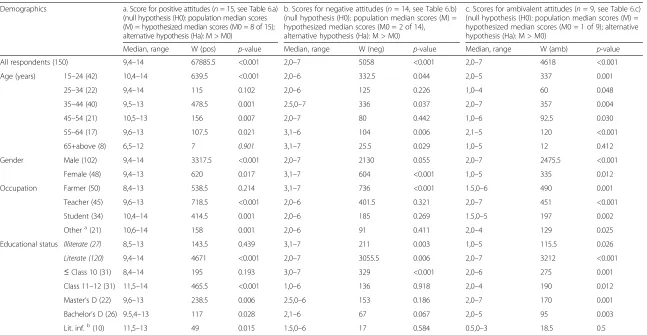
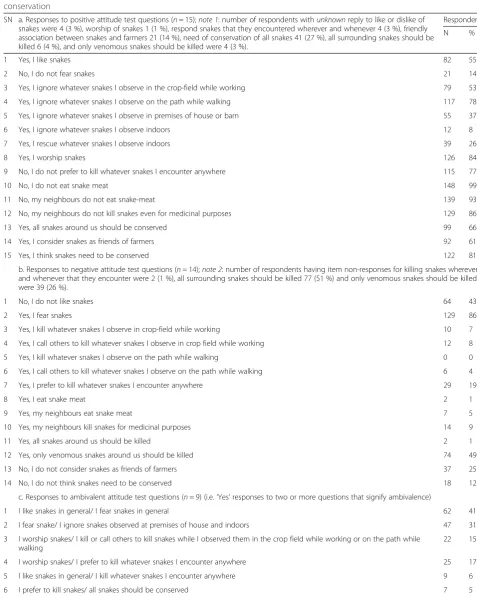
Residents of CNPBZ had higher scores for positive atti-tudes than for negative and ambivalent attiatti-tudes towards snakes and snake conservation issues. More than 47 % of respondents (n= 70) had positive attitude scores (median = 99,p= 0.047, Table 3) based on answering >8/15 questions (median = 9, p= <0.001, Table 4.a). Students, Table 5Attitudes to and awareness of native snakes in Chitwan National Park buffer zone people
Demographics a. Scores gained for attitude test b. Scores gained for awareness test
i. Positive attitude ii. Negative attitude iii. Ambivalent attitude i. Awareness ii. Unawareness
W p-value W p-value W p-value W p-value W p-value
Younger & oldera(Ha.1) 1168.5 0.743 1137.5 0.581 954.5 0.061 948 0.064 1390 0.229
Male & female (Ha.1) 2755 0.213 1836.5 0.012 2929 0.045 3447 <0.001 1876.5 0.021
Female > male (Ha.2) x x 3059.5 0.006 x x x x 3019.5 0.011
Male > female (Ha.2) x x x x 2929 0.022 3447 <0.001 x x
Farmer & student (Ha.1) 582.5 0.014 1182 0.002 824 0.808 623.5 0.039 795 0.618
Student > farmer (Ha.2) 1117.5 0.007 518 0.002 x x 1076.5 0.020 x x
Farmer & teacher (Ha.1) 793.5 0.013 1557.5 0.001 1019.5 0.418 412 <0.001 1410 0.033
Teacher > farmer (Ha.2) 1456.5 0.006 x x x x 1838 <0.001 x x
Farmer > teacher (Ha.2) x x 1557.5 0.001 x x x x 1410 0.017
Teacher & student (Ha.1) 711.5 0.595 777.5 0.902 711.5 0.585 289.5 <0.001 1098.5 0.001
Teacher > student (Ha.2) x x x x x x 1240.5 <0.001 x x
Student > teacher (Ha.2) x x x x x x x x 1098.5 <0.001
Literate & illiterate (Ha.1) 2128 0.011 1244 0.055 1798.5 0.356 2550 <0.001 1276 0.085
Literate > illiterate (Ha.2) 2128 0.005 x x x x 2550 <0.001 x x
Illiterate > literate (Ha.2) x x 1996 0.028 x x x x x x
Symbols andabbreviations:a
15–34 years old people are considered young and 45–64 year respondents as older;null hypothesis (H0): population median score (M)
Table 6Responses of Chitwan National Park buffer zone people to attitude test questions (n= 38) about snakes and their conservation
SN a. Responses to positive attitude test questions (n= 15);note 1: number of respondents withunknownreply to like or dislike of snakes were 4 (3 %), worship of snakes 1 (1 %), respond snakes that they encountered wherever and whenever 4 (3 %), friendly association between snakes and farmers 21 (14 %), need of conservation of all snakes 41 (27 %), all surrounding snakes should be killed 6 (4 %), and only venomous snakes should be killed were 4 (3 %).
Respondents
N %
1 Yes, I like snakes 82 55
2 No, I do not fear snakes 21 14
3 Yes, I ignore whatever snakes I observe in the crop-field while working 79 53
4 Yes, I ignore whatever snakes I observe on the path while walking 117 78
5 Yes, I ignore whatever snakes I observe in premises of house or barn 55 37
6 Yes, I ignore whatever snakes I observe indoors 12 8
7 Yes, I rescue whatever snakes I observe indoors 39 26
8 Yes, I worship snakes 126 84
9 No, I do not prefer to kill whatever snakes I encounter anywhere 115 77
10 No, I do not eat snake meat 148 99
11 No, my neighbours do not eat snake-meat 139 93
12 No, my neighbours do not kill snakes even for medicinal purposes 129 86
13 Yes, all snakes around us should be conserved 99 66
14 Yes, I consider snakes as friends of farmers 92 61
15 Yes, I think snakes need to be conserved 122 81
b. Responses to negative attitude test questions (n= 14);note 2: number of respondents having item non-responses for killing snakes wherever and whenever that they encounter were 2 (1 %), all surrounding snakes should be killed 77 (51 %) and only venomous snakes should be killed were 39 (26 %).
1 No, I do not like snakes 64 43
2 Yes, I fear snakes 129 86
3 Yes, I kill whatever snakes I observe in crop-field while working 10 7
4 Yes, I call others to kill whatever snakes I observe in crop field while working 12 8
5 Yes, I kill whatever snakes I observe on the path while walking 0 0
6 Yes, I call others to kill whatever snakes I observe on the path while walking 6 4
7 Yes, I prefer to kill whatever snakes I encounter anywhere 29 19
8 Yes, I eat snake meat 2 1
9 Yes, my neighbours eat snake meat 7 5
10 Yes, my neighbours kill snakes for medicinal purposes 14 9
11 Yes, all snakes around us should be killed 2 1
12 Yes, only venomous snakes around us should be killed 74 49
13 No, I do not consider snakes as friends of farmers 37 25
14 No, I do not think snakes need to be conserved 18 12
c. Responses to ambivalent attitude test questions (n= 9) (i.e.‘Yes’responses to two or more questions that signify ambivalence)
1 I like snakes in general/ I fear snakes in general 62 41
2 I fear snake/ I ignore snakes observed at premises of house and indoors 47 31
3 I worship snakes/ I kill or call others to kill snakes while I observed them in the crop field while working or on the path while walking
22 15
4 I worship snakes/ I prefer to kill whatever snakes I encounter anywhere 25 17
5 I like snakes in general/ I kill whatever snakes I encounter anywhere 9 6
6 I prefer to kill snakes/ all snakes should be conserved 7 5
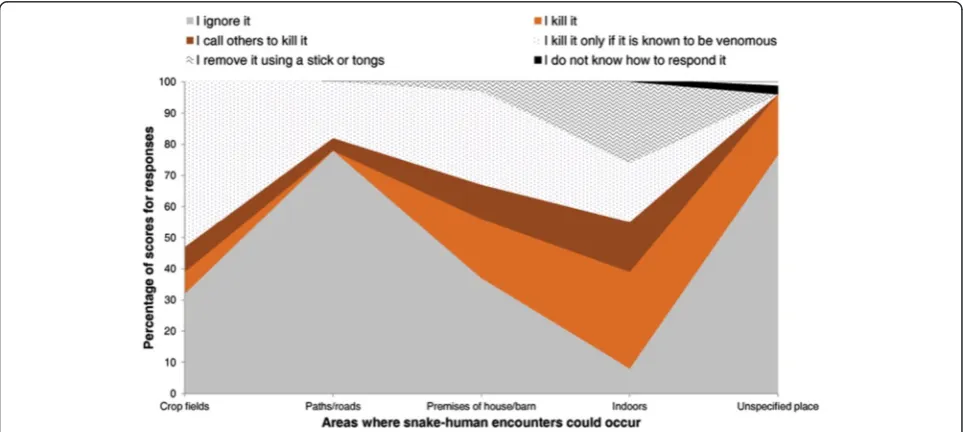
teachers, and literate respondents were more positive (Table 5.i). Positivity was not significantly different between males and females (p= 0.213, Table 5). Respondents had a positive temperament towards snakes in unspecified areas and areas with less human activity. Respondents generally ignored snakes encountered while walking on paths and 77 % remained tolerant to snakes at unspecified localities (Table 6.a, b, Fig. 3).
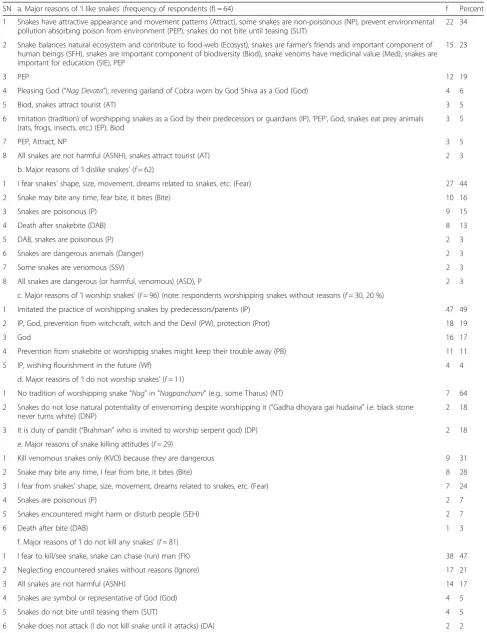
Although 55 % of respondents (n= 82) were generally positive towards snakes (Table 6.a), 86 % (n= 129) feared snakes and 43 % (n= 64) were repulsed by snakes, primar-ily due to preconceptions about shape, size, and move-ments and related nightmares (44 %, n= 27, Table 7.b). Proportionately, males, literate persons, farmers, and teachers feared snakes more than their counterparts did (Fig. 4). We found a greater degree of negative attitudes towards snakes encountered indoors or in areas with increased human activity, such as homes, and agricultural fields. Thirty-eight percent (n= 57) of respondents would kill a snake if encountered, but this attitude varied by locality (Fig. 3). Only 1 % (n= 2) of respondents intended to kill all snake species encountered, but 49 % (n= 74) would kill all venomous snakes observed (Table 6.b). Approxi-mately 6 % of respondents (n= 9) were negative towards snakes (median = 13, p= 0.037, Table 3.b), as indicated by
answering two or more out of 14 questions on the negativ-ity test (median = 2, p= <0.001, Table 4.b). Farmers, females, students, and illiterate people were the most negative towards snakes (Table 5.a.ii).
Greater than 9 % of respondents (n= 14) were ambivalent towards snakes (median = 22, p= 0.04, Table 3.c) based on answering >1 of 9 questions on the ambivalence test (median = 2, p= <0.001, Table 4.c). In particular, males were more ambivalent towards snakes than females (Table 5.a.iii). Despite no difference in ambivalence towards snakes between teachers and farmers and teachers and students (Table 5.a.iii), teachers had the highest scores for ambivalence (median = 2,
p= <0.001, Table 4.c).
Knowledge
Although inhabitants of CNPBZ were able to identify venomous (Table 8.a) more often than non-venomous snake species (Table 9.a), there remained substantial confusion in correct identification of snakes in gen-eral (Fig. 5, Table 8.b, 9.b, Table 10.b,d). Specifically, inhabitants correctly identified approximately 63 % (approximately 10 of 16 species) of venomous (me-dian = 11, p= <0.001, Table 8.a) species, but only approximately 25 % (>3/12) of non-venomous snake Table 6Responses of Chitwan National Park buffer zone people to attitude test questions (n= 38) about snakes and their conservation (Continued)
7 All snakes should be killed/ only all venomous snakes should be killed/ all snakes should be conserved/ I think snakes should be conserved
52 35
8 I prefer to kill whatever snakes I encounter anywhere/ I consider snakes as farmers’friends 15 10
9 I kill or call others to kill snakes I observe in the crop fields/ I consider snakes as farmers’friends 14 9
Abbreviationand symbol:Nnumber of respondents,%percent of respondents
Table 7Reasons for certain attitudes to snakes
SN a. Major reasons of‘I like snakes’(frequency of respondents (f) = 64) f Percent
1 Snakes have attractive appearance and movement patterns (Attract), some snakes are non-poisonous (NP), prevent environmental pollution absorbing poison from environment (PEP), snakes do not bite until teasing (SUT)
22 34
2 Snake balances natural ecosystem and contribute to food-web (Ecosyst), snakes are farmer’s friends and important component of human beings (SFH), snakes are important component of biodiversity (Biod), snake venoms have medicinal value (Med), snakes are important for education (SIE), PEP
15 23
3 PEP 12 19
4 Pleasing God (“Nag Devata”), revering garland of Cobra worn by God Shiva as a God (God) 4 6
5 Biod, snakes attract tourist (AT) 3 5
6 Imitation (tradition) of worshipping snakes as a God by their predecessors or guardians (IP),‘PEP’, God, snakes eat prey animals (rats, frogs, insects, etc.) (EP), Biod
3 5
7 PEP, Attract, NP 3 5
8 All snakes are not harmful (ASNH), snakes attract tourist (AT) 2 3
b. Major reasons of‘I dislike snakes’(f= 62)
1 I fear snakes’shape, size, movement, dreams related to snakes, etc. (Fear) 27 44
2 Snake may bite any time, fear bite, it bites (Bite) 10 16
3 Snakes are poisonous (P) 9 15
4 Death after snakebite (DAB) 8 13
5 DAB, snakes are poisonous (P) 2 3
6 Snakes are dangerous animals (Danger) 2 3
7 Some snakes are venomous (SSV) 2 3
8 All snakes are dangerous (or harmful, venomous) (ASD), P 2 3
c. Major reasons of‘I worship snakes’(f= 96) (note: respondents worshipping snakes without reasons (f= 30, 20 %)
1 Imitated the practice of worshipping snakes by predecessors/parents (IP) 47 49
2 IP, God, prevention from witchcraft, witch and the Devil (PW), protection (Prot) 18 19
3 God 16 17
4 Prevention from snakebite or worshippig snakes might keep their trouble away (PB) 11 11
5 IP, wishing flourishment in the future (Wf) 4 4
d. Major reasons of‘I do not worship snakes’(f= 11)
1 No tradition of worshipping snake“Nag”in“Nagpanchami”(e.g., some Tharus) (NT) 7 64
2 Snakes do not lose natural potentiality of envenoming despite worshipping it (“Gadha dhoyara gai hudaina”i.e. black stone never turns white) (DNP)
2 18
3 It is duty of pandit (“Brahman”who is invited to worship serpent god) (DP) 2 18
e. Major reasons of snake killing attitudes (f= 29)
1 Kill venomous snakes only (KVO) because they are dangerous 9 31
2 Snake may bite any time, I fear from bite, it bites (Bite) 8 28
3 I fear from snakes’shape, size, movement, dreams related to snakes, etc. (Fear) 7 24
4 Snakes are poisonous (P) 2 7
5 Snakes encountered might harm or disturb people (SEH) 2 7
6 Death after bite (DAB) 1 3
f. Major reasons of‘I do not kill any snakes’(f= 81)
1 I fear to kill/see snake, snake can chase (run) man (FK) 38 47
2 Neglecting encountered snakes without reasons (Ignore) 17 21
3 All snakes are not harmful (ASNH) 14 17
4 Snakes are symbol or representative of God (God) 4 5
5 Snakes do not bite until teasing them (SUT) 4 5
6 Snake does not attack (I do not kill snake until it attacks) (DA) 2 2
species (median = 3, p= 0.001, Table 9.a). Inhabitants misidentified >50 % (>6/12) of non-venomous species as venomous (median = 7, p= <0.001, Table 8.b) and 19 % (>3/16) of venomous species to be non-venomous (median = 4, p= <0.001, Table 9.b). Only one (0.67 %) respondent thought all snakes were deadly venomous, and 5 % (n= 7) could not identify any non-venomous snakes.
Females correctly identified more venomous snakes than males (median = 12, p= <0.001, Table 8.a), but males identified more non-venomous snakes than females (Table 9.a). Farmers identified more venomous snakes (median = 12, p= <0.001) than teachers (me-dian = 9,p= 0.812, Table 8.a, Table 10.a). Students had the best aptitude for identifying venomous snakes Table 7Reasons for certain attitudes to snakes(Continued)
7 Snakes balance natural ecosystem and contribute to food-webs (Ecosyst) 2 2
g. Major reasons of regarding snakes as friends of farmers (f= 60)
1 Eats prey animals (e.g., rodents, insects, etc.) (EP) 50 83
2 EP, prevent environmental pollution absorbing poisonous gases (PEP) 6 10
3 EP, Snakes balance natural ecosystem and contribute to food-webs (Ecosyst) 4 7
Note: Respondents’responses for why questions are grouped, coded and quantified in this table
among all occupational groups (Table 10.a). Illiterate people correctly identified more venomous snakes, but literate respondents correctly identified more non-venomous snakes (Table 10.a,c).
Respondents incorrectly identified Common Kraits
(Bungarus caeruleus, 24 %), Common Cobras (Naja
naja, 5 %) and Green Pit Vipers (Trimeresurus albolab-ris, 12 %) as non-venomous species. Ninety-one percent of respondents wrongly thought that Common Wolf Snakes (Lycodon aulicus) were venomous, with 66 % identifying the species as kraits (Bungarus spp.); 33 % thought Rat Snakes (Ptyas mucosa) were venomous and 2 % identified them as Cobras (Naja spp.); 59 % of respondents correctly identified Pythons (Python bivitta-tus) as non-venomous, and 37 % thought they were venomous (Fig. 5). Almost no respondents were able to identify snakes by their scientific and English names, and they were only slightly familiar with local names (Fig. 6). Older people, students, teachers, and literate people knew the English names of snakes more often than other groups (Table 10.e, Table 11.a). Conversely, farmers knew local names of snakes more often
(Table 10.f, Table 11.b). No respondents knew the name of the Saw-scaled Viper (Echis carinatus) and only 1 % of respondents knew the local and English names for
D. russelii. In total, 83 % of respondents knew the local name for the Monocellate Cobra (Naja kaouthia), 72 % for the Common Cobra (N. naja), 23 % for the Green Pit Viper (T. albolabris), 73 % for the Striped Keelback (Amphiesma stolatum), and 60 % for the Python (P. bivittatus) (Fig. 6).
A total of 81 % (n= 122) of CNPBZ inhabitants con-sidered there to be a need for snake conservation (Table 7.a), but respondents below 35 years of age, teachers, students, and literate people only gave one reason to justify the need for snake conservation (Table 12.a). Although 85 % (n= 127) of respondents replied that they were aware of preventive measures for snakebite, their reasoning was poor. Respondents aged 15–24 years, teachers, students, and literate people men-tioned slightly more than two appropriate preventive measures (Table 12.b), although their score for“yes” re-sponses was higher. Snake conservation knowledge was greater among males (Table 10.g), and knowledge about Table 8Familiarity of Chitwan National Park buffer zone people with native venomous snakes
Demographics a. Correct scores for knowing venomous snakes
(CSV,n= 16); null hypothesis (H0): population median scores (M) = hypothesized median scores (M0 = 10); alternative hypothesis (Ha): M > M0)
b. Incorrect scores for claiming non-venomous (ISV,n= 12) snakes to be venomous; null hypothesis (H0): population median scores (M) = hypothesized median scores (M0 = 6), alternative hypothesis (Ha): M > M0)
Median, range W (CSV) p-value Median, range W (ISV) p-value
All respondents 11,4–16 6237.5 <0.001 7,1–12 5756.5 <0.001
Age (years) 15–24 11,7–15 612.5 <0.001 7,2–12 449.5 0.013
25–34 10,4–16 86 0.181 5,2–11 121 0.431
35–44 10.5,4–16 422.5 0.142 7,2–11 386.5 0.011
45–54 12,6–14 136.5 0.048 7,1–10 115 0.214
55–64 12,4–15 95 0.084 7,1–10 80 0.132
65+above 11.5 22.5 0.285 9,3–11 30.5 0.045
Gender Male 11,4–16 2567.5 0.070 6,1–11 2134.5 0.174
Female 12,4–16 754.5 <0.001 8,3–12 843.5 <0.001
Occupation Farmer 12,6–16 878.5 <0.001 8,1–11 815.5 <0.001
Teacher 9,4–16 310.5 0.812 6,2–11 370.5 0.611
Student 7,7–15 349 0.008 6,2–11 231.5 0.259
Othera 12, 7–14 172 0.001 8,1–12 143 0.027
Educational status Illiterate 12,6–16 256 0.006 9,3–11 369 <0.001
Literate 11,4–16 3667.5 0.004 6,1–12 3144 0.062
Class 10 12,4–15 301.5 0.012 7,1–12 245 0.039
Class 11–12 11,7–16 253.5 0.059 5,2–11 169.5 0.687
Master’s degree 10,4–16 98.5 0.730 6.5,2–11 157.5 0.280
Bachelor’s degree 10.5,7–15 137 0.117 6.5,3–10 106.5 0.177
Literate informallyb 12,7–14 42 0.074 7,1–11 28 0.276
Symbols andabbreviation:ahotel owner, miller, fisherman, boat-man, mason, labourer, housewife, nature guide;brespondents able to read and write by informal education and never attained school;nnumber of snake species displayed,Wvalue of one-tailed one-sample Wilcoxon signed rank test
Table 9Familiarity of Chitwan National Park buffer zone people with native non-venomous snakes
Demographics a. Correct scores for knowing non-venomous
snakes (CSN,n= 12); null hypothesis (H0): median scores (M) = hypothesized median scores (M0 = 3), alternative hypothesis (Ha): M > M0
b. Incorrect scores of claiming venomous snakes (n= 16) to be non-venomous (ISN); null hypothesis (H0): population median scores (M) = hypothesized median scores (M0 = 3); alternative hypothesis (Ha):
M > M0
Median, range W (CSN) p-value Median, range W (ISN) p-value
All respondents 3,0–11 5303.5 0.001 4,0–11 5354 0.001
Age 15–24 2,1–7 172 0.998 4,1–9 580 0.001
25–34 3.5,0–10 132 0.022 4,0–9 121 0.018
35–44 2.5,0–10 314 0.510 3,0–10 318.5 0.038
45–54 4,1–11 130 0.006 4,2–8 128 0.001
55–64 4,1–9 76.5 0.177 3,1–11 52.5 0.151
65+above 1.5,0–5 8 0.932 2,1–3 0 0.994
Gender Male 4,0–11 3148 <0.001 4,0–11 3045 <0.001
Female 2,0–7 172 0.998 3,0–9 284.5 0.698
Occupation Farmer 2,0–7 230 0.996 2.5,0–7 235.5 0.964
Teacher 5,1–10 773 <0.001 5,0–11 679 <0.001
Student 4,1–9 300 <0.001 4,1–9 469 <0.001
Othera 2,0–11 80 0.604 3,2–8 62 0.036
Educational status Illiterate 2,0–5 26 1.000 2,0–6 78.5 0.946
Literate 4,0–11 4071.5 <0.001 4,0–11 3817.5 <0.001
Class 10 3,0–9 170 0.424 3,1–11 131 0.296
Class 11–12 4,1–9 250.5 <0.001 4,0–8 344.5 0.001
Master’s degree 5,1–10 237 0.006 5,0–10 449.5 <0.001
Bachelor’s degree 5,1–7 188 0.001 4,1–9 159.5 0.005
Literate informallyb 4,1–11 35 0.234 3,2–5 55 0.003
Symbols andabbreviation:a
hotel owner, miller, fisherman, boat-man, mason, labourer, housewife, nature guide;b
respondents able to read and write by informal education and never attained school;nnumber of snake species displayed,Wvalue of one-tailed one-sample Wilcoxon signed rank test
Table 10Familiarity of Chitwan National Park buffer zone people with native snakes, their knowledge about snake conservation and prevention of their bites
Group of people a. Knowing VS b. Claim of NVSasVS
c. Knowing NVS
d. Claim of VSasNVS
e. Knowing English name
f. Knowing local name
g. Snake conservation
h. Snakebite prevention W p-value W p-value W p-value W p-value W p-value W p-value W p-value W p-value Younger and oldera(two tailed) 1214.5 0.994 1200 0.914 428.5 0.877 1199.5 0.911 1284.5 0.035 1107 0.450 1461 0.076 1533 0.026
Oldera> younger (one-tailed) x x x x x x x x 1831.5 0.018 x x x x x x
Younger > oldera(one-tailed) x x x x x x x x x x x x x x 1533 0.013
Male and female (two tailed) 1620 0.001 1568 <0.001 3679 <0.001 3343.5 <0.001 1152 1 2358 0.716 3171.5 0.002 2861 0.091
Female > male (one-tailed) 3276 <0.001 3328 <0.001 x x x x x x x x x x x x
Male > female (one-tailed) x x x x 3679 <0.001 3343.5 <0.001 x x x x 3171.5 0.001 x x Farmer and student (two tailed) 1022.5 0.114 1145 0.007 328 <0.001 412 <0.001 720 0.014 1086.5 0.030 346 <0.001 324 <0.001
Farmer > student (one-tailed) x x 1145 0.003 x x x x x x 1086.5 0.015 x x x x
Student > farmer (one-tailed) x x x x 1372 <0.001 1288 <0.001 980 0.007 x x 1354 <0.001 1376 <0.001 Farmer and teacher (two tailed) 1543.5 0.002 1551.5 0.001 483.5 <0.001 457 <0.001 649.5 <0.001 1632.5 <0.001 380 <0.001 483.5 <0.001 Farmer > teacher (one-tailed) 1543.5 0.001 1551.5 0.001 x x x x x x 1632.5 <0.001 x x x x Teacher > farmer (one-tailed) x x x x 1766.5 <0.001 1793 <0.001 1600.5 <0.001 x x 1870 <0.001 1766.5 <0.001 Teacher and student (two tailed) 1000.5 0.019 836 0.482 696.5 0.496 641 0.217 520 0.004 912.5 0.143 787 0.819 673 0.353
Students > teacher (one-tailed) 1000.5 0.009 x x x x x x x x x x x x x x
Teacher > student (one-tailed) x x x x x x x x 1010 0.002 x x x x x x
Literate and illiterate (two tailed) 2039.5 0.035 2420 <0.001 660 <0.001 887.5 <0.001 1118 0.003 1883.5 0.185 610.5 <0.001 750.5 <0.001
Illiterate > literate (one-tailed) 2039.5 0.017 2420 <0.001 x x x x x x x x x x x x
Literate > illiterate (one-tailed) x x x x 2580 <0.001 2352.5 <0.001 2052 0.001 x x 2629.5 <0.001 2489.5 <0.001
Symbols andabbreviation:a
15–34 years old people are considered younger and 45–64 years as older people;VSvenomous snakes (including mildly and highly venomous ones),NVSnon-venomous snakes,null hypothesis (H0): population median score (M)hypothesised population score (M0 = 0) (i.e. H0: M = M0),alternative hypothesis.1 (Ha.1)population median score (M)≠hypothesised population score (M0),alternative hypothesis.2 (Ha.2) popu-lation median score (M) > hypothesised popupopu-lation score (M0),Wvalue for two-tailed and one-tailed unpaired Wilcoxon rank sum test
Pandey
et
al.
Journal
of
Ethnobiolog
y
and
Ethnome
dicine
(2016) 12:22
Page
15
of
snakebite prevention was greater among younger re-spondents (Table 10.h).
Awareness
Awareness of recommended pre-hospital care of snake-bite was below 50 % on average. We found that >48 % of respondents aware of proper snakebite care (n= 72,
p= 0.045, Table 13) based on rejecting traditional be-liefs and medical care of doubtful use, and accepting modern measures of pre-hospital care of snakebite (median = 19, p= 0.001, Table 14.a). In contrast, >21 % (n= >32) of respondents were unaware of recommended pre-hospital care of snakebite (p= 0.033, Table 13) as indi-cated by accepting traditional beliefs and medical help of doubtful use, and rejecting modern measures of pre-hospital care (median = 9, p= <0.001, Table 14.b). More than 11 % (n= >17) respondents were unfamiliar (p= 0.034) with awareness test questions (i.e., they did not know the correct answer for >3 awareness test questions; median = 3.5,p= <0.001, Table 14. Note 1.).
Respondents were highly aware of particular practices of snakebite care and belief. Out of 33 awareness test questions (Table 15), 95 % of respondents were aware of the need to visit a treatment center equipped with anti-venom (95 %) to treat snakebite from anti-venomous species (88 %, n= 132), and they also knew where the nearest snakebite treatment center was located (83 %, n= 125). Similarly, 95 % of respondents rejected the belief that all snakes are venomous and 85 % refused to seek treatment from traditional healers (Table 15). More than half of
respondents accepted widely recommended first aid mea-sures for venomous snakebite. However, a total of 61 % of respondents would apply PIB and 51 % would apply LCPI (Table 15). Overall, only >51 % of respondents (n= >76) agreed to apply suggested first aid measures (median = 125, p= 0.031, Table 13.b). The level of awareness of proper snakebite treatment was greater among males than females, among student and teachers than farmers, among teachers than students, and among literate than illiterate people (Table 5.b.i).
Ethno-ophiology
Ninety-nine percent of respondents replied that they made no use of snakes and snake products, and only 2/ 150 (1 %) respondents consumedPythonmeat. Five per-cent of respondents knew neighbors from native ethnic groups (i.e., Tharu, Mushahar, Kusunda, and Newar) that consumed snake meat, and 9 % (n= 14) of respondents knew about the killing ofPythonsfor gallbladder and fat, and Cobras for fat and intestines used to purportedly cure backache, burn or other infected wounds, hemor-hoids, mastitis, and rheumatism (Table 6).
Discussion
Ignorance of the need for snake conservation, extreme disgust and fear of snakes (Fig. 4), a strong desire to kill snakes, confusion in differentiating venomous from non-venomous species (Fig. 5), a willingness to exterminate all venomous snakes by nearly 50 % of respondents, and susceptible positivity to snakes appear to be challenges
to snake conservation in the lowlands of Nepal. Killing and harassing snakes is common in CNPBZ [51] and elsewhere in Nepal [36]. General belief that most snakes are venomous and the desire to kill snakes is also known to occur in neighboring areas, such as Sikkim state in India [52]. Similar challenges were apparent in Brazil [53], Kenya [54], and Australia [14]. Indeed, wanton killing of snakes appears to be a worldwide phenomenon, which likely amplifies wide-ranging declines in snake population [13, 55], and only serves to heighten the importance of snake conservation. Continued killing of snakes may negatively impact snake population dynamics, potentially resulting in a trophic cascade that leads to deterioration of ecosystems, which may ultimately impact human health. Extinction of species due to factors, such as climate change [56] may add to the global biodiversity crisis [57]. Therefore, authorities should consider human-snake conflicts as an important driver of human-snake population declines.
Killing of snakes appears to be the result of extreme negativity that originates due to fear. A lack of awareness about essential ecological services that snakes provide
facilitates the killing of snakes. Although 95 % of the respondents in the current study were aware that all snakes are not venomous, more than two-thirds of respondents feared snakes. Furthermore, a lack of aware-ness of the need for snake conservation, and extreme fear of snakes (especially among farmers) has apparently led to large-scale killing of snakes in Nepal [58]. In-creased tolerance of snakes in areas with less human activity further suggests that fear of snakes leads to human-caused mortality of snakes in Nepal. The fear of snakes may have originated since time immemorial [59], and was introduced into the scientific community by Linnaeus [60]. Irrational belief in snake mythologies propagates fear and negativity towards snakes [61, 62]. Revulsion, accompanied by a lack of awareness about snakebite prevention, and inappropriate care of snake-bites due to superstition likely induce fear of snakes in humans, which is compounded by the possible fear of snakes that was evolutionarily ingrained in the human brain [63, 64]. Further, poor transportation, ill-equipped and inaccessible snakebite care facilities, and greater snakebite mortality as a consequence [65, 66]), likely Table 11Familiarity of Chitwan National Park buffer zone people with names of native snakes (n= 28)
Demographics a. Knowing snakes by their English name (KEN); null hypothesis (H0): population median scores (M) = hypothesized median scores (M0 = 1); alternative hypothesis (Ha): M > M0
b. Knowing snakes by their local name (KLN); null hypothesis (H0): population median scores (M) = hypothesized median scores (M0 = 5), alternative hypothesis (Ha): M > M0
Median, range W (KEN) p-value Median, range W (KLN) p-value
All respondents 0,0–12 2888 1 6,0–14 5625 0.004
Age (years) 15–24 0,0–2 82 1 5,1–11 414.5 0.171
25–34 0,0–7 91.5 0.891 5,0–11 91.5 0.405
35–44 0,0–8 236 0.990 6,2–11 508.5 0.009
45–54 0,0–12 93 0.376 7,1–14 150 0.003
55–64 0,0–4 42.5 0.965 5,1–7 39 0.892
65+ above 0 0 0 5,3–7 16 0.641
Gender Male 0,0–12 1780.5 0.985 7,5–11 2582 0.026
Female 0,0–3 0 0 6,0–11 597.5 0.033
Occupation Farmer 0,0–3 0 0 6,0–11 824 <0.001
Teacher 0,0–6 558.5 0.142 4,1–9 253.5 0.974
Student 0,0–2 66 1 5,1–11 239.5 0.319
Othera 0,0–12 0 0 7,1–14 203 0.001
Educational status Illiterate 0 0 0 6,0–11 257.5 0.005
Literate 0,0–12 2243 0.999 5,1–14 3277.5 0.056
Up to class 10 0,0–12 0 0 6,1–14 298.5 0.001
Class 11 to 12 0,0–2 56 1 4,1–9 174 0.751
Master’s degree 1,0–6 240.5 0.046 4,1–9 90.5 0.930
Bachelor’s degree 0,0–3 83 0.939 5,1–11 116 0.203
Literate informallyb 0,0–8 0 0 7.5,3–10 42 0.012
Symbols andabbreviation:ahotel owner, miller, fisherman, boat-man, mason labourer, housewife, nature guide;brespondents able to read and write by informal education but never attained school;nnumber of snake species displayed,Wvalue of one-tailed one-sample Wilcoxon signed rank test. I zeroed W andpvalues for confidence interval (CI) below 95%
intensifies fear of snakes. Moreover, a famous Nepali proverb “Bish nabhyako sarpa ra ekh nabhyako manis hudaina (i.e., “there are no snakes without venom and no humans without jealousy”) likely fortifies fear, leading to increased negativity towards snakes. And finally, a lack of understanding of ecological services provided by snakes appears to cultivate negativity, which predisposes people to kill snakes.
Similar to teachers in Kenyan communities [54] and stu-dents in Brazilian communities [53], a fear of snakes is common in Nepal. Coupling fear and negativity with a poor aptitude for distinguishing venomous and nonvenomous snakes likely results in wanton killing of all snakes, includ-ing non-venomous species, in order to feel safe. In Nepal, killing snakes is common, even in and around biodiversity conservation hotspots [36, 51]. Similar ruthless killing of snakes reported from other parts of Nepal [67], and intentional killing of snakes encountered elsewhere in our study, suggests a lack of education about snake ecology and effective practices of snakebite prevention and treatment.
Due to the relatively high rate of respondents that believed pythons are venomous places this species at risk from human-caused mortality. Less familiarity of snakes by teachers and students suggests the need for intensive educational efforts designed to minimize wanton killing of snakes. The fact that teachers and students, who are the backbone of the community, fail to recognize the difference between venomous and non-venomous snakes may impact snake conservation and public health in Nepal and elsewhere with similar circumstances.
In contrast to China, Vietnam, Brazil [4, 68, 69], and other parts of Nepal [51, 70], the use of snakes for food and medicinal products does not appear to be a signifi-cant threat to snake conservation in the Chitwan Valley. Killing snakes for human use was rare in Nepal com-pared to past reports [67]. Similar to some areas in India [71], only people from sparsely populated ethnic com-munities used pythons and cobras as food and/or medicine. The majority of Tharu respondents in our study denied the eating of snake meat, although Zug and Table 12Knowledge of Chitwan National Park buffer zone people about the need of snake conservation and preventive measures against snakebites
Demographics a. Scores for logics explaining the need of snake conservation (cons.,n= 5); null hypothesis (H0): population median scores (M) = hypothesized median scores (M0 = 1), alternative hypothesis (Ha): M > M0
b. Scores for appropriate preventive measures mentioned (prev.,n= 10); null hypothesis (H0): population median scores (M) = hypothesized median scores (M0 = 2), alternative hypothesis (Ha): M > M0
Median, range W (cons.) p-value Median, range W (prev.) p-value
All respondents 1,0–4 2064 0.626 2,0–9 3678.5 0.210
Age (years) 15–24 1,0–4 251.5 0.055 2.5,0–7 398 0.005
25–34 1.5,0–4 103.5 0.028 2.5,0–6 107.5 0.170
35–44 1,0–3 66.5 0.904 2,0–9 225 0.568
45–54 1,0–3 24 0.909 1,0–7 51 0.824
55–64 1,0–4 27.5 0.720 2,0–4 49 0.602
65+above 0,0–2 3.5 0.960 0,0–2 0 0
Gender Male 1,0–4 1042 0.099 2,0–9 1935 0.062
Female 0,0–3 158 0.992 2,0–4 264 0.872
Occupation Farmer 0,0–2 80 1 1,0–6 169 1
Teacher 1,0–4 199 0.001 2,0–9 338.5 0.004
Student 1,0–4 162 0.013 3,0–7 317.5 0.001
Othera 1,0–2 0 0 2,0–7 78 0.481
Education status Illiterate 0,0–2 0 0 0,0–6 55 0.999
Literate 1,0–4 1423 0.028 2,0–9 2675 0.002
Class 10 0,0–4 0 0 1,0–5 144.5 0.797
Class 11 or 12 1,0–4 150.5 0.037 3,1–7 295 <0.001
Master’s degree 1,0–4 69 0.008 2,0–9 89.5 0.009
Bachelor’s degree 1,0–4 57 0.015 2,0–6 77.5 0.317
Literate informallyb 1,0–2 0 0 1,0–7 14.5 0.717
Mitchell mentioned that the Tharus of Chitwan were known to consume snakes [51]. However, there is need for intensive research on the ethno-medicinal use of snake products nationwide.
Humans have long been suffering from the conse-quences of our attitudes towards snakes [61]. Fear, bias, negativity, disregard, and superstition are behavioral risk factors for snakebite in Nepal and elsewhere with similar geosocioeconomic and cultural circumstances. Ignorant, negative, and fearful people who tend to encourage the killing of snakes put themselves at the risk of envenom-ation. Pronounced confusion in differentiating venomous and non-venomous snakes, even among teachers and students in Nepal, teachers in Kenya [54] and medical service providers in Sri Lanka [72] disclose the need for
more effective education in southern Nepal and elsewhere with similar circumstances.
Like in this study, the inability to correctly identify snakes, or the illogical claim of being able to identify snakes [66], also occurs in developed countries [73]. People commonly identify non-venomous snakes as venomous [74]. This increases the risk of and vulnerabil-ity of rural inhabitants to snakebite envenomation. Therefore, finding out which of the snakes in residential or visiting area are venomous and which are not is essential. Accurate identification of snake species not only enhances snakebite prevention, may minimize the chance of multiple bites to a victim or a bite to the first aid provider. Correctly identifying snakes can also minimize snakebites for people who attempt to kill the Table 13Chitwan National Park buffer zone people responding to misbeliefs on snakes, traditional and modern care of snakebites
General responses Median,
range W (resp)
p -value
Median
a Median% LA
b
a. All respondents’responses (n= 33, see Table15)
Aware (not believing on misbelief but believing on recommended care), H0 (A): M = M0 (72), Ha (A): M > M0 (72)
82,4–142 335 0.045 72 48 MA
Unaware (believing on misbelief but not believing on recommended care), H0 (UA): M = M0 (32), Ha (UA): M > M0 (32)
40,2–141 362.5 0.033 32 21
Unknown to both traditional and modern information, H0 (Uk):
M = M0 (17), Ha (Uk): M > M0 (17)
24,1–61 362 0.034 17 11
Not answered to both traditional and modern information (i.e. item nonresponses), H0 (NA): M = M0 (1), Ha (NA): M > M0 (1)
2,0–11 417.5 0.002 1 1
b. Categorical responses
n= 28, see Table15.a–c
Aware (not believing misbelief on snakes and snakebite care), H0 (A28): M = M0 (67), Ha (A28): M > M0 (67)
75,4–142 280.5 0.040 67 45 MA
Unaware (believing on misbelief on snakes and snakebite care), H0 (UA28): M = M0 (35), Ha (UA28): M > M0 (35)
43,2–141 278 0.045 35 23
n= 13, see Table15.a
Aware (not believing misbelief on snakes), H0 (A13): M = M0 (62), Ha (A13): M > M0 (62)
72,39–142 62.5 0.036 62 41 MA
Unaware (believing misbelief on snakes), H0 (UA13): M = M0 (28), Ha (UA13): M > M0 (28);
43,2–82 71.5 0.037 28 19
n= 15, see Table 15. b,c
Aware (not believing on traditional and doubtful pre–hospital care of snakebite), H0 (A15): M = M0 (60), Ha (A15): M > M0 (60)
76,4–128 90.5 0.044 60 40 MA
Unaware (believing on traditional and doubtful pre–hospital care of snakebite), H0 (UA15): M = M0 (33), Ha (UA15): M > M0 (33)
43,18–141 91.5 0.039 33 22
pre–hospital care (n= 5, see Table15.d)
Aware (believing the recommended pre–hospital care of snakebite), H0 (A5): M = M0 (76), Ha (A5): M > M0 (76)
125,77–142 15 0.031 76 51 A
Unaware (not believing on recommended pre– hospital care of snakebite), H0 (UA5): M = M0 (1), Ha (UA5): M > M0 (1)
22,2–47 15 0.031 1 1
Symbols andabbreviations:a
median significantly greater than (after hypothesis test),b
level of awareness,%percent,W(resp)one-tailed one-sampled Wilcoxon value of respondents who responded particular belief on snakes and/or care of snakebites,H0null hypothesis,Haalternative hypothesis,Mpopulation median,
M0hypothesized median (parenthesis contains figure of hypothesized median),UAunaware (0–24 %),MAslightly aware (25–49 %),Aaware (50–74 %),
UkUnknown,NANot answered,resprespondents
snake. If snakes are mishandled, envenoming by recently killed, decapitated or inadequately killed [75], preserved [76], and even frozen specimens [77] is possible. A lack of identification skills and knowledge about preventive measures against snakebite undoubtedly places inhabi-tants of agrarian lowlands in Nepal at increased risk of snakebite. Our findings that a large majority of people who claimed to be familiar with recommended snakebite preventive measures actually had very little idea of how to prevent snakebites. Although farmers and illiterate people may be expected to be at higher risk of snakebite, the fact that people with higher education were also at greater risk indicates that ignorance about snakes and snakebite are widespread among all sectors of the com-munity, leading us to conclude that education about snakes and snakebite prevention at schools, universities [46] and within the community is inadequate.
The relatively greater degree of negativity towards snakes among farmers, females, students, and illiterate people (Table 5.a.ii) may be associated with a lack of
knowledge about the role that snakes play in ecosystems, the risk of snakebite, and proper preventative measures. The high degree of ambivalence towards snakes among teachers is especially troubling, because it indicates that educators are likely not utilizing factual information on snakes and snakebite issues to develop effective educa-tional approaches.
On a positive note, 85 % of respondents rejected trad-itional healers as a legitimate alternative treatment for snakebite, which is supported by a decreasing trend of dependency on traditional healers for snakebite treat-ment in the Chitwan Valley [66, 78, 79]. Therefore, we conclude that traditional healing is not a challenge to snakebite management in this part of Nepal. However, the situation is different in other countries. For ex-ample, 86 % of snakebite victims in Bangladesh [80], 75 % in Pakistan [81], and 61 % in India [82] still visit traditional healers. Belief in traditional snakebite treat-ment methods may be a challenge to snakebite manage-ment in other regions of Nepal. Although CNPBZ Table 14Awareness of Chitwan National Park buffer zone people concerning belief on snakes and snakebite care
Demographics a. Scores for awareness (rejecting traditional belief and medical help of doubtful use and accepting modern measures of pre-hospital care,n= 33); null hypothesis (H0): population median scores (M) = hypothesized median scores (M0 = 16), alternative hypothesis (Ha): M > M0(16)
b. Scores for unawareness (accepting traditional belief and medical help of doubtful use and rejecting modern measures of pre-hospital care,n= 33); null hypothesis (H0): population median scores (M) = hypothesized median scores (M0 = 8), alternative hypothesis (Ha): M > M0(8)
Median, range W (Aware) p-value Median, range W (Unaware) p-value
All respondents 19,3–31 6564.5 0.001 9,0–24 6628 <0.001
Age (years) 15–24 16,7–28 433.5 0.182 11,2–18 628 <0.001
25–34 20.5,3–31 178 0.049 8,2–23 98.5 0.452
35–44 19,4–30 394.5 0.260 8.5,2–12 470.5 0.132
45–54 21,6–29 193.5 0.004 8,2–14 94 0.667
55–64 21,9–27 111 0.014 10,3–24 114.5 0.037
65 and above 9,3–25 8 0.930 9,0–17 19 0.223
Gender Male 20,3–31 3769.5 <0.001 8,0–24 2698.5 0.039
Female 13.5,3–27 335.5 0.952 10,2–23 855.5 <0.001
Occupation Farmer 12,3–28 435.5 0.975 9.5,0–24 873.5 0.005
Teacher 22,14–30 898 <0.001 8,2–17 382 0.650
Student 16,7–28 271 0.329 11,2–18 426.5 <0.001
Othera 21,5–31 142.5 0.029 9,2–22 126.5 0.216
Educational status Illiterate 10,3–28 75 0.997 10,0–23 227.5 0.005
Literate 20,5–31 4954 <0.001 9,2–24 3982 0.005
Up to class 10 22,5–31 388 0.001 7,2–21 165.5 0.918
Class 11 or 12 17,7–29 734 0.068 12,3–18 376.5 <0.001
Master’s degree 22,16–30 325 <0.001 7,3–17 123 0.682
Bachelor’s degree 21,13–28 220 <0.001 9,2–15 135.5 0.129
Literate informallyb 12.5,7–26 25 0.620 12.5,4–24 48.5 0.018