Bio-Soft Computational and Tabu Search
Methods for Solving a Multi-Task Project
Scheduling Problem
Ikno Kim and Junzo Watada
Graduate School of Information, Production and Systems, Waseda University, Kitakyushu, Japan Email: [email protected], [email protected]
Abstract—This article presents a novel integrated method in which bio-soft computational and tabu search methods are both used to solve a multi-task project scheduling problem. In this scheduling problem, the main challenge is to deter-mine the most reliable completion time. To solve this prob-lem, we first use our proposed bio-soft computational method. Next, a tabu search method is used to verify the final results of the soft computational method. The bio-soft computational method includes molecular techniques, and the tabu search method is an intelligent optimization technique. Based upon this integrated method’s success solving a multi-task project scheduling problem, this article proposes that this method can help decision makers in their computational project scheduling.
Index Terms—adjacency matrix, bio-soft computational method, molecular encoding, tabu search method, multi-task project scheduling
I. INTRODUCTION
Many different kinds of multiple tasks or temporary multiple tasks, including the time spent in their processes, increase significantly and must be immediately processed by project workers who have different scheduling tasks. This type of project scheduling, which is commonly called multi-task project scheduling, deals with hired pro-ject workers who must perform their given tasks during the course of a project’s completion. There are many dif-ferent types of multi-task project scheduling, but our fo-cus here is only upon the process scheduling type of multi-task project.
The novel integrated method proposed in this article uses both bio-soft computational and tabu search methods, and is based on several previously reported algorithms and methods [1-5]. This method is basically employed to solve a multi-task project scheduling problem. The prob-lem to resolve is how all project workers can complete their given tasks in the shortest time. In other words, how we can determine the most reliable completion time by organizing and analyzing the given information about project workers, their tasks, and the time they each need for their individual tasks.
When dealing with a large number of tasks, the prob-lem of multi-task project scheduling is a computation-intensive endeavor. It is extremely difficult to schedule a
great many task and determine optimal organized task-completion times that correspond to a highly reliable completion time in this scheduling. Thus, multi-task pro-ject scheduling involves an intractable scheduling prob-lem, which means that it is an NP (non-deterministic polynomial-time) -hard problem. Moreover, in the case that a number of unpredictable tasks emerge that involve large numbers, it is even harder to arrive at an optimal solution.
A model of such a multi-task project scheduling prob-lem is presented in this article. The model probprob-lem in-cludes project workers and their given tasks, along with project worker sequences and the time spent on their tasks. A bio-soft computational method is employed to classify the possible schedules into feasible schedules and unfeasible schedules, and to also determine the most reli-able completion time. The tabu search method is em-ployed to confirm the results of the bio-soft computa-tional method.
Regarding the multi-task project scheduling problem, we need to consider the project worker sequences, mean-ing that each given task has its own project worker se-quence. For this reason, the bio-soft computational method is first applied to project worker sequences in multi-task project scheduling. Moreover, the method in-cludes molecular techniques in its molecular encoding process, which controls the directional relations of project workers and their tasks.
This article is basically organized into eight different sections. Section II describes multi-task project schedul-ing; Section III briefly describes a bio-soft computational method; Section IV presents a molecular encoding proc-ess with our novel encoding concepts; Section V reviews simulation-based experimental studies and their results; Section VI presents the tabu search method for this prob-lem; Section VII shows our approximated computational running time comparisons; and Section VIII offers our conclusions.
II. MULTI-TASK PROJECT SCHEDULING
multi-task project scheduling and present one model of this kind of scheduling.
A. One Project Scheduling with Tasks
When creating project process strategies, precise pro-ject scheduling needs to be considered for each of the different features of specific task process strategies. In the field of scheduling, several different types of process strategies related to scheduling are commonly used. One process strategy, called process focus scheduling [6, 7], is mainly applied to projects and job shops. In this article, we focus mainly on the process focus scheduling type of multi-task project scheduling, which is similar to job-shop production scheduling.
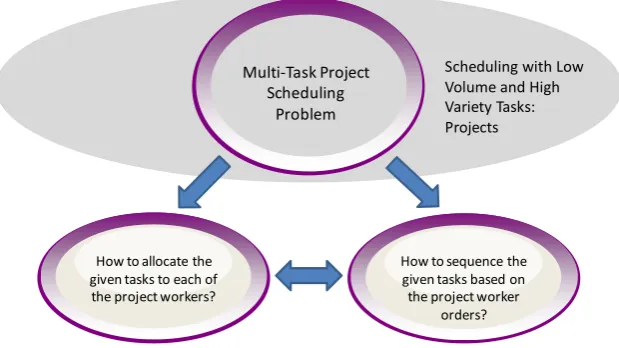
This multi-task project scheduling is devoted to the completion of a small number of tasks and many different types of tasks at the same time. The settings in which small numbers of tasks and large numbers of task-types are controlled are referred to as projects in process focus scheduling. Scheduling in the project management of small numbers and large numbers of task-types is referred to as project scheduling. The systems that use this project scheduling are called project systems. Figure 1 shows the two main problems of multi-task project scheduling.
A common trend in project management is to fulfill a given project that must be punctually completed in order
for the next project to proceed with fewer risks. The most important point here is the need to build a realistic and precise schedule, which means that we must determine the most proper and most reliable completion time. Man-aging such scheme is a complex challenge, however, and it becomes even more complex if the number of tasks with their individual time requirements increases. When dealing with a large number of task types, the main issue is the complexity of the computational time.
B. Model Scheduling
Multi-task project scheduling can be represented as a cell table, which describes it in a mathematical way [8, 9]; the similar is true for job-shop production scheduling. In a cell table, a cell corresponds to a pair consisting of one project worker and one task, and an arc corresponds to a process direction between two different cells. The pair cell is denoted as (Pi, Tj), where Pi, i = 1, 2,…, m is the process step of the project worker and Tj, j = 1, 2,…,
n is the process step of the task. The arc of the two arbi-trary pair cells is represented as (Pα, Tα)→(Pβ, Tβ) when
the arbitrary pair cell (Pα, Tα) precedes the arbitrary pair
cell (Pβ, Tβ).
To demonstrate our proposed methods, we selected a simple scheduling problem that is readily understandable. Table I shows a model table of a multi-task project
Multi‐Task Project Scheduling
Problem
How to sequence the
given tasks based on
the project worker
orders? How to allocate the
given tasks to each of
the project workers?
Scheduling with Low Volume and High Variety Tasks: Projects
Figure 1. Two main problems when dealing with multi-task project scheduling included in common scheduling issues with low volume and high variety tasks.
TABLE I.
MODEL TABLE OF A MULTI-TASK PROJECT SCHEDULING EXAMPLE (DAYS)
Project Worker-1 Project Worker-2 Project Worker-3
1 320 350 400
2 250 450 350
3 250 320 100
P. Worker-1 → P. Worker-3 → P. Worker-2
P. Worker-2 → P. Worker-1 → P. Worker-3 Process Spending Times
Task Project Worker Process Sequence
scheduling example that is composed of three project workers and three tasks, with project worker process se-quences.
III. BIO-SOFT COMPUTATIONAL METHOD
A bio-soft computational method is a new type of a computational method that involves new massively paral-lel computation, unlike silicon-based computation. In this section, a bio-soft computational method and its molecu-lar techniques are briefly described to provide an under-standing of this integrated method.
A. Bio-Soft Computational Method
This mode of computation basically uses the biologi-cal molecules that constitute deoxyribonucleic acid (DNA), which is composed of polymer chains, and these molecules are also composed of the nucleotides that cor-respond to adenine, guanine, cytosine, and thymine. Ade-nine is attached to thymine, and guaAde-nine is attached to cytosine.
A bio-soft form of computation is commonly called molecular computation [10] because it employs biologi-cal molecules. However, because it also performs mas-sively parallel computation, bio-soft computation could be considered a better term. Bio-soft computation is based on the phenomenon of molecular recognitions, which are executed by biological molecular reactions.
A molecular polymerase has a potential enzymatic function of copying bio-molecules, which is similar to the core function of a Turing machine. A molecular poly-merase consists of its complementary molecules, using a strand of the single helix. With this feature, if a large number of bio-molecules are mixed for biochemical mo-lecular reactions, then the bio-molecules occur in parallel. B. Molecular Techniques for Computation
The execution of the bio-soft computational method can involve many different types of molecular techniques [11-13]. Here, we briefly explain four major and impor-tant techniques, which correspond to a restriction enzyme technique, a polymerase chain reaction technique, a gel electrophoresis technique, and an extraction technique that employs magnetic beads.
First, the restriction enzyme technique plays various roles in a recombinant molecular experiment. Bio-molecules have different lengths which are obtained from the amplification of molecular base sequences, and which are broken by employing restriction enzymes. This is the selected enzyme that seeks out specific molecular se-quences and breaks them into separate pieces.
Second, the polymerase chain reaction technique is used in order to amplify molecules into thousands and even greater numbers of molecules. This technique is intended for use with two different types of molecular primers, which are attached to denatured single-stranded molecules and repeat template-specific synthesis reac-tions. A molecular primer is used for a polymerase chain reaction with short lengths.
Third, the gel electrophoresis technique is used for measuring the proper lengths of molecules and proteins
by transforming electrically charged molecules as well as the proteins that constitute the gel. This technique is also employed to analyze molecules when studying the mass, degree of purity, electric charge, and presence of their proteins.
Finally, the extraction technique, which mainly em-ploys magnetic beads, is a popular method used for col-lecting and extracting specific desired molecules, and for separating certain specific molecules from other mole-cules. One recently developed extraction technique uses fluorescent lights to classify molecules into different lev-els.
IV. MOLECULAR ENCODING PROCESS
This section presents our molecular encoding process, which is a part of the bio-soft computational method. This encoding process is an important step that must be taken prior to execution of the molecular techniques de-scribed in the previous section.
A. Matrices for Pair Cells
The model multi-task project scheduling table shown in Table I can be transformed into an adjacency matrix. All the pair cells are connected by their arcs. If one arbi-trary pair cell (row) is directed to another arbiarbi-trary pair cell (column), then this is represented by 1. If, on the other hand, one arbitrary pair cell (row) is not directed to another arbitrary pair cell (column), this is represented as 0. Here, 1 and 0 are entries in the adjacency matrix that is used for molecular encoding. The model adjacency ma-trix is expressed as
0 1 1 0 0 0 0 0 0 1 0 1 0 1 0 0 0 0 1 1 0 0 0 0 0 0 0 0 0 0 0 1 1 1 0 0 0 0 0 1 0 1 0 0 0 0 0 1 1 1 0 0 0 0 1 0 0 0 0 0 0 1 1 0 1 0 0 0 0 1 0 1 0 0 0 0 0 1 1 1 0 ) , ( ) , ( ) , ( ) , ( ) , ( ) , ( ) , ( ) , ( ) , ( 3 3 2 3 1 3 3 2 2 2 1 2 3 1 2 1 1 1 T P T P T P T P T P T P T P T P T P
. (1)
We also present another different type of matrix of all the given pair cells among pair cell directions. Assuming that n pair cells consist of both m project workers P1, P2,…, Pm and n tasks T1, T2,…, Tn. A pair cell set is de-noted as S, which represents S = {(P1, T1), (P2, T1),…, (Pm,
Tn)}, and this directional matrix is expressed as
) , ( ) , ( ) , ( ) , ( ) , ( ) , ( ) , ( ) , ( ) , ( 2 1 2 2 2 2 1 1 1 2 1 1 n m n n m m T P T P T P T P T P T P T P T P T P
. (2)
then the empty symbol “ϕ” is employed for these entries. Moreover, in this directional matrix, each of entries can be selected and allocated based on the given multi-task project scheduling problem. Thus, the selected and allo-cated directional matrix based on the given model multi-task project scheduling table, as shown in Table I, is ex-pressed as ) , ( ) , ( ) , ( ) , ( ) , ( ) , ( ) , ( ) , ( ) , ( 3 3 3 1 3 2 2 2 2 3 2 1 1 3 1 2 1 1 T P T P T P T P T P T P T P T P T P
, (3)
which implies ) , ( ) , ( ) , ( ) , ( ) , ( ) , ( ) , ( ) , ( ) , ( 3 3 3 1 3 2 2 2 2 3 2 1 1 3 1 2 1 1 T P T P T P T P T P T P T P T P T P
, (4)
where three sets of (1) {(P1, T1), (P1, T2), and (P1, T3)};
(2) {(P2, T1), (P2, T2), and (P2, T3)}; and (3) {(P3, T1), (P3, T2), and (P3, T3)} are all duplicated and directed to each
other as directed complete graphs. Based on these two different types of directional matrices, we can encode molecules for calculations.
In the directional matrix, any two pair cell is denoted as e, which is the connected relation between these two pair cells. The disconnected relation between any two
pair cells is denoted as ē. If there are two arbitrary pair cells (Pα, Tα) and (Pβ, Tβ), then the connected one
be-comes (Pα, Tα)e(Pβ, Tβ) and the disconnected one
be-comes (Pα, Tα)ē(Pβ, Tβ).
The model adjacency matrix has row and column la-bels which are represented as tx, y, x and y = 1, 2,…, 9 for all (x, y)∈Q, where x is the label for rows, y is the label for columns, and Q is the set of all possible row and col-umn labels. If there are two arbitrary pair cells, then tx, y = 1, which corresponds to both (Wα, Jα)→(Wβ, Jβ) and (Wα,
Jα)e(Wβ, Jβ), while tx, y = 0, which corresponds to (Wα,
Jα)ē(Wβ, Jβ). We also determined that when (Wα, Jβ) = (Wβ,
Jα), then tx, y = 0.
B. Concepts of Encoding
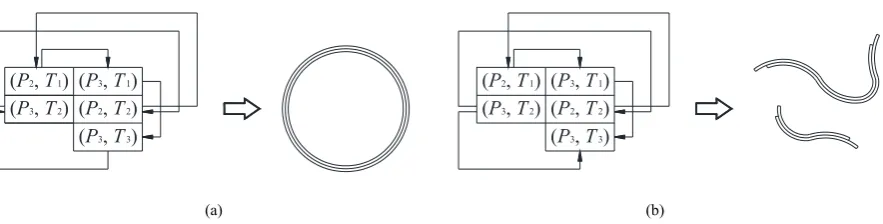
The main concept governing the use of our proposed molecular encoding is the checking of cyclic and acyclic directions among pair cells in the directional matrix. If some pair cells are cyclic, then it is impossible to create a schedule. If, however, some pair cells are acyclic, then a single schedule is possible.
Based on the two different matrices, we can encode molecular strands. All possible directions are reacted by molecular techniques, and we can only distinguish all of the acyclic directional molecules from the cyclic direc-tional molecules. As shown in Figures 2(a) and (b), a cyclic direction corresponds to a circular molecule and an acyclic direction corresponds to a linear molecule, re-spectively.
As shown in Figure 3, the other governing concept is
(P2, T1) (P3, T1)
(P3, T2) (P2, T2)
(P3, T3)
(P2, T1) (P3, T1)
(P3, T2) (P2, T2)
(P3, T3)
(a) (b)
Figure 2. Two different types of directional pair cell sets, each of which has its own molecular type: (a) a pair cell set of a cyclic direction corre-sponds to a circular molecule; (b) a pair cell set of an acyclic direction correcorre-sponds to two linear molecules.
(P1, T1) (P2, T1) (P3, T1)
(P1, T2) (P3, T2) (P2, T2)
(P2, T3) (P1, T3) (P3, T3) First Tasks Last Tasks
(P1, T1) (P2, T1) (P3, T1)
(P1, T2) (P3, T2) (P2, T2)
(P2, T3) (P1, T3) (P3, T3) First Tasks Last Tasks
(a) (b)
the focus on certain tasks that should be processed first and others that should be processed last. These tasks are determined in advance and given to schedulers before scheduling is begun. The direction from the first tasks to the last tasks can be rendered in a permanent bio-molecule direction.
V. SIMULATION-BASED EXPERIMENTAL STUDIES AND
RESULTS
In this study that seeks to solve the problem of multi-task project scheduling by searching for the most reliable completion time, a simulation-based experiment was exe-cuted to produce that solution. Molecular techniques can manipulate encoded molecules to produce reliable results. In this section, we describe the process of molecular techniques that can solve the model problem, as shown in Table I, and present the final results with the most reli-able completion time.
A. Process of Molecular Techniques
The main process in molecular techniques is to seek out circular molecules, delete these circular bio-molecules, distinguish the molecules’ directions, starting from the first tasks and ending with last tasks, and to re-solve the shortest one in the possible direction.
There are two types of molecular strands that corre-spond to an upper substring and a lower (complementary) substring. At the same time, two different pair cells are involved in one single upper substring, and the lower substring is used for concatenating two given upper sub-strings. All the substrings (upper and lower substrings) must be generated for the first step, prior to their manipu-lation in the molecular technique process. The simula-tion-based experimental protocol is composed of the fol-lowing six steps:
Step 1: A pair cell table is constructed by the process directions among the given pair cells (m project workers and n tasks) on the basis on their project worker se-quences with ordered tasks. For the DNA-digraph, the upper and lower substrings are encoded through the bio-molecular encoding process. In this step, all the sub-strings of the existing directions of the pair cells are cre-ated and encoded in a single molecular type.
Step 2: All the encoded single types of upper and lower molecules are placed into one or more test tubes,
depending on their amounts. These encoded upper and lower substrings are heated and then cooled for the two molecular techniques of hybridization and ligation. Hy-bridization is used to anneal the upper and lower sub-strings, and ligation is used to catalyze, seal, and repair them.
Step 3: Circular molecules clearly have a topology that is different from that of linear molecules. A molecu-lar measuring technique of gel electrophoresis can be used to separate the circular molecules from the linear molecules. All the extracted circular molecules are re-moved properly.
Step 4: In all the remaining molecules, specific mole-cules, starting from the first tasks of substrings and end-ing with the last tasks of substrend-ings, are only extracted from other molecules. In Table I, the first tasks corre-spond to (P1, T1), (P1, T2), and (P2, T3), and the last tasks
correspond to (P3, T1), (P2, T2), and (P3, T3). A molecular
extraction technique is used to extract only these specific molecules. After this, the other remaining molecules are all removed.
Step 5: All the extracted molecules are classified into different lengths using gel electrophoresis. The number of both possible and impossible project schedules of mole-cules subtracted from the number of impossible project schedules becomes the number of possible project sched-ules. For the gel electrophoresis, from top to bottom in order of size, the length results present the longest bio-molecule to the shortest bio-molecule. We select the specific schedule that is located in the possible project schedule number. This schedule’s base pairs (bp) correspond to the most reliable completion time.
B. Simulation-Based Results
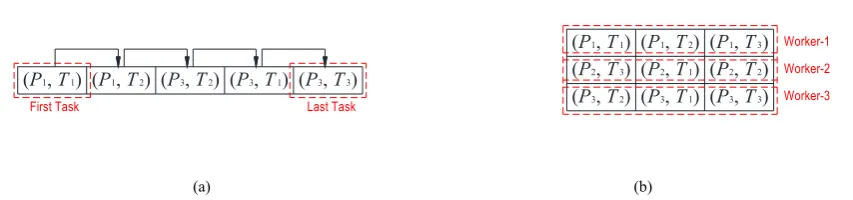
Based on the process of molecular techniques, the simulation-based gel electrophoresis results for the multi-task project scheduling table particularly contain the spe-cific schedule with the possible project schedule number. Figures 4(a) and (b) illustrate the final results of the pair cell chain strand, and the allocated and optimal model cells (arranged based on the given project worker se-quences from left to right) of multi-task project schedul-ing, respectively.
Although we presented a simple problem in this arti-cle, this bio-soft computational method could be expected to deal with a large volume of project workers and tasks
(P3, T2) (P3, T1) (P3, T3)
(P1, T2)
(P1, T1)
(P1, T1) (P1, T2) (P1, T3)
(P2, T3) (P2, T1) (P2, T2)
(P3, T2) (P3, T1) (P3, T3)
First Task Last Task
Worker-1
Worker-2
Worker-3
(a) (b)
by making use of the main advantages offered by the en-coding of various types of molecules in combinatorial numbers.
VI. TABU SEARCH METHOD
This article also employs a tabu search method to ver-ify the results of the bio-soft computational method. Tabu search [14] is a meta-heuristic intelligent optimization technique, and here, this method is applied to multi-task project scheduling. The tabu search method is widely used and is quite suitable to solving a combinatorial scheduling problem.
In this multi-task project scheduling that employs the tabu search method, when we select the present schedule, we do not return to the previous schedule. At the same time, when we transpose the specific pair cells, we memorize these pair cells and do not use them again.
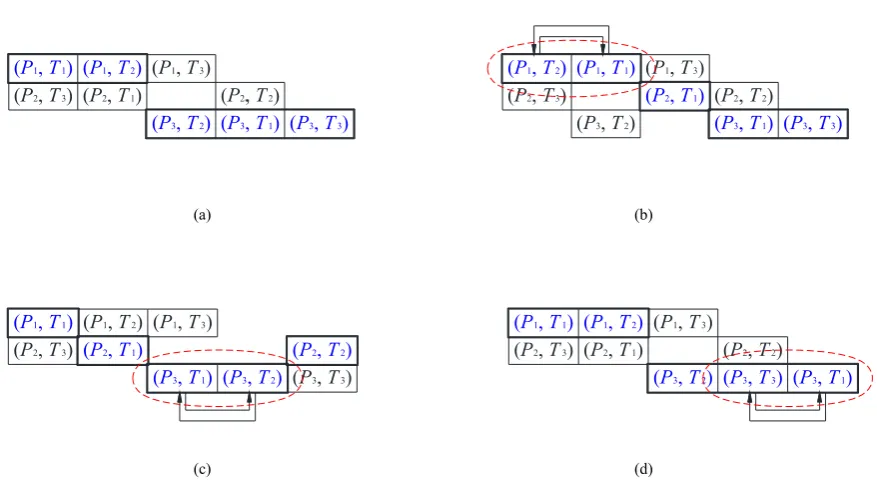
For the multi-task project scheduling in the model multi-task project scheduling table, we first seek out the critical path that exactly corresponds to the final result of the pair cell chain strand, as shown in Figure 4(a). Second, we select two or more reliable continued pair cells, trans-pose them, and check the most reliable completion time. Figure 5(a) illustrates the selected continued pair cells. The three different pair cell sets that present the trans-posed pair cells in three different ways are shown in Fig-ures 5(b), (c), and (d). From the results of the tabu search method, we can say that the final result of the most reli-able completion time, as obtained from the bio-soft
com-putational method, was verified as being the most reliable solution.
VII. APPROXIMATED COMPUTATIONAL RUNNING
TIME COMPARISONS
The same number of project workers and tasks was set in this section. Although n pair cells are composed of both m project workers P1, P2,…, Pm and n tasks T1, T2,…, Tn, the same number of both project workers and tasks was set. Thus, one project worker and one task imply one pair cell, two project workers and two tasks imply four pair cells, three project workers and three tasks imply nine pair cells, and so on. In other words, the number of project workers was continuously set to be equal to the number of tasks for our approximated computational run-ning time comparisons, although the number of project workers could be different from the number of tasks.
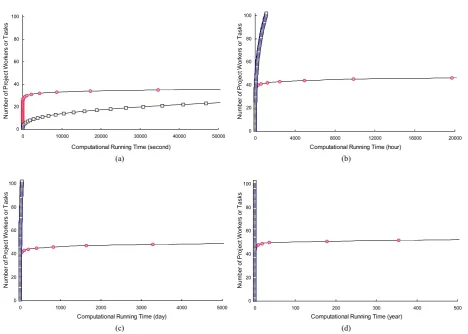
Figures 6(a), (b), (c), and (d) show four comparison representations of our approximated computational run-ning times for the exponential-time method and the pre-pared bio-soft computational method (we are ready to detect real solutions). Molecular manipulating times were not included in all of the approximated computational running times of the prepared bio-soft computational method.
A processor executes a million high levels of instruc-tions a second was supposed, and the exponential-time method uses an operation of 2n [15]. The approximated computational running times of the prepared bio-soft
(P1, T2) (P1, T1) (P1, T3)
(P2, T3) (P2, T1) (P2, T2)
(P3, T2) (P3, T1) (P3, T3)
(P1, T1) (P1, T2) (P1, T3)
(P2, T3) (P2, T1) (P2, T2)
(P3, T2) (P3, T1) (P3, T3)
(a) (b)
(P1, T1) (P1, T2) (P1, T3)
(P2, T3) (P2, T1) (P2, T2)
(P3, T2) (P3, T3) (P3, T1)
(P1, T1) (P1, T2) (P1, T3)
(P2, T3) (P2, T1) (P2, T2)
(P3, T1) (P3, T2) (P3, T3)
(c) (d)
Figure 5. Final results of the selected pair cells and the tabu search method in three different ways of transposing the specific pair cells on the pair cell chain strand: (a) the final result of the selected pair cells (the highlighted pair cells (sequenced from left to right) correspond to the pair cell chain strand or the critical path, shown in Figure 4(a)) arranged based on the given project worker sequences from left to right, and the com-pletion time of this final result was 1420 days; (b) the result of the first way of the transposed pair cells (P1, T1) and (P1, T2), and the completion time of this pair cell set was 1420 days; (c) the result of the second way of the transposed pair cells (P3, T2) and (P3, T1), and the completion time of this pair cell set was 1870 days; (d) the result of the final way of the transposed pair cells (P3, T1) and (P3, T3), and the completion time of this
computational method were calculated on the basis of previous experimental reports and genetic engineering notes [10-13, 16].
VIII. CONCLUSIONS
The efficiency of the proposed integrated method, which combines bio-soft computational and tabu search methods, has been measured using our molecular techni-cal studies in multi-task project scheduling. This inte-grated method was used to distinguish all possible sched-ules from other impossible schedsched-ules and to provide the most reliable completion time, and to show its approxi-mated computational running times.
The characteristics of the multi-task project schedul-ing table with pair cells and two different types of matri-ces related to the problem of project scheduling involved two different types of directions among pair cells, namely the cyclic and acyclic directions.
This is a novel way of dealing with the problem pre-sented by multi-task orders with project worker se-quences in project scheduling. This new concept of add-ing a tabu search method to the bio-soft computational method was first proposed in this article, thus creating an integrated method that is accompanied by a new bio-molecular encoding process.
REFERENCES
[1] J. Watada, D. J.-F. Jeng, and I. Kim, “Application of DNA computing to group control of elevators,” 2005 Anniver-sary Symposium on the Romanian Society for Fuzzy Sys-tems & A. I., Iasi, Romania, 2005, pp. 9-19.
[2] J. Watada, S. Kojima, S. Ueda, and O. Ono, “DNA com-puting approach to optimal decision problems,” Interna-tional Journal of Innovative Computing, Information and Control, ICIC International, vol. 2, no. 1, 2006, pp. 273-282.
[3] I. Kim and J. Watada, “Decision making with an interpre-tive structural modeling method using a DNA-based algo-rithm,” IEEE Transactions on NanoBioscience, IEEE Pub-lishing, vol. 8, no. 2, 2009, pp. 181-191.
[4] I. Kim, J. Watada, and W. Pedrycz, “A DNA-based algo-rithm for arranging weighted cliques,” Simulation Model-ling Practice and Theory, Elsevier B.V., vol. 16, issue 10, 2008, pp. 1561-1570.
[5] I. Kim, Y. Chu, D. J.-F. Jeng, J. Watada, and J.-Y. Wu, “Building a bio-inspired reinforcement medical network system for optimal relationships in medical communica-tions,” International Journal of Biomedical Soft Comput-ing and Human Sciences, Biomedical Fuzzy Systems Asso-ciation, vol. 15, no. 2, 2009, pp. 9-16.
[6] R. A. Gardner, “The process-focused organization,” Ame-rican Society for Quality, 2004, pp. 27-38.
0 20 40 60 80 100
0 10000 20000 30000 40000 50000 Computational Running Time (second)
N
u
m
ber
of
P
roj
ect
W
o
rk
er
s o
r T
a
sk
s
0 20 40 60 80 100
0 4000 8000 12000 16000 20000 Computational Running Time (hour)
N
u
m
ber
o
f P
roj
ect
W
o
rk
e
rs or
T
a
sk
s
(a) (b)
0 20 40 60 80 100
0 1000 2000 3000 4000 5000 Computational Running Time (day)
N
u
m
b
e
r of
P
roj
e
ct
W
o
rk
er
s o
r T
a
sk
s
0 20 40 60 80 100
0 100 200 300 400 500 Computational Running Time (year)
N
u
m
ber
of
P
roj
ect
W
o
rk
er
s o
r T
a
sk
s
(c) (d)
Figure 6. Four approximated computational running time comparisons, in which the symbol ‘□’ is used for representing the prepared bio-soft computational method and the symbol ‘○’ is used for representing the exponential-time method: (a) a comparison of approximated computational
[7] W. J. Stevenson, “Operations management: ninth edition,” McGraw-Hill, Irwin, 2007, pp. 720-759.
[8] R. W. Conway, W. L. Maxwell, and L. W. Miller, “Theory of scheduling,” Dover Publications, Inc., 2003, pp. 103-131.
[9] R. Zhang and C. Wu, “A simulated annealing algorithm based on block properties for the job shop scheduling prob-lem with total weighted tardiness objective,” Computers & Operations Research, Elsevier B.V., vol. 38, no. 5, 2011, 854-867.
[10]L. M. Adleman, “Computing with DNA: The manipulation of DNA to solve mathematical problems is redefining what is meant by computation,” Scientific American, 1998, pp. 34-41.
[11]T. Tamura, “New experimental notes in genetic engineer-ing, note 1/2,” Yodosha Co., Ltd., 2005, pp. 61-160 in Japanese.
[12]T. Tamura, “New experimental notes in genetic engineer-ing, note 2/2,” Yodosha Co., Ltd., 2005, pp. 11-86 in Japa-nese.
[13]Z. F. Burton and J. M. Kaguni, “Experiments in molecular biology: biochemical applications,” Academic Press, 1997, pp. 11-20.
[14]D. T. Pham and D. Karaboga, “Intelligent Optimisation Techniques,” Springer-Verlag London, 2000, pp.149-181. [15]J. Kleinberg and E. Tardos, “Algorithm design,” Pearson
Education, Inc., 2006, pp. 29-207.
[16]Z. F. Burton and J. M. Kaguni, “Experiments in molecular biology: Biochemical applications,” Academic Press, 1997, pp. 11-20.
Ikno Kim received the B.Sc. degree in technology management from Osaka Institute of Technology, Japan, and the M.Sc. and Ph.D. degrees in information, production and systems engineering from Waseda University, Japan.
His current research interests include industrial engineering and management, operations research and management, management information system, nano-biotechnology, and bio-soft computation.
Mr. Kim received the excellent presentation prize from the Czech-Japan Research Project, the excellent master’s thesis prize from the Japan Industrial Management Association (JIMA), Kyushu Branch, and the Hibikino award for the excel-lent master’s thesis from the Kitakyushu Foundation for the Advancement of Industry Science and Technology (FAIS), Japan.
Junzo Watada received the B.Sc. and M.Sc. degrees in electrical engineering from Osaka City University, Japan, and the Ph.D. degree from Osaka Prefecture University, Japan.