Vol. 04, Issue 03 (March. 2014), ||V1|| PP 01-09
Unit Commitment Solution Using Particle Swarm Optimisation
(PSO)
Divya Ananthan
1, Prof.S.Nishanthinivalli
2 1(P.G Student, Jayaram college of Engineering & Technology, Tiruchirapalli)
2
(Assistant Professor, Department of EEE, Jayaram College of Engineering and Technology, Tiruchirapalli)
Abstract: - Existing unit commitment methods have the problem of stopping at local optimum and slow convergence. So it is replaced by a new method known as Particle Swarm Optimisation (PSO) which is a biological method based on particle swarming. It consists of a group of particles moving towards optimal solution. Feasible solutions are obtained as particles move in feasible solution space rather than infeasible ones. Thus the method reduces computational time. In this paper PSO is applied to IEEE 30 bus test system with six generators so that fuel cost of each generator is reduced using PSO.
Keywords: - 𝐶𝑝𝐶𝑔, GA,𝐺𝑏𝑒𝑠𝑡, K, 𝑃𝑏𝑒𝑠𝑡,PSO,UC,𝑣𝑖,W,𝑥𝑖 Ui
I. INTRODUCTION
Due to the nature of changing technology, unit commitment is also undergoing a change in its solution method. This is because there must be an efficient method to commit the generators to meet the load. Many methods have been introduced to solve unit commitment. Even if the methods have advantages, most of the methods suffer from local convergence and curse of dimensionality. So a new method known as PSO is introduced to solve unit commitment.
The method was introduced by Eberhart and Kennedy in the year 1995.It is a biological based method based on the motion of particles in a hyperspace towards optimal solution. The project deals with the solution of unit commitment using PSO. Other applications of PSO are optimal placement of facts devices, reactive power dispatch, state estimation and fuzzy systems.
One such area is the commitment of thermal units. Particle swarm optimization has roots in biological simulation and behavior of birds and animals such as bird flocking, fish schooling, and swarming theory. It is also related to evolutionary computation, and has ties to both genetic algorithms and evolutionary programming.
Particle swarm optimization as developed by the authors comprises a very simple concept, and paradigms can be implemented in a few lines of computer code. It requires only primitive mathematical operators, and is computationally inexpensive in terms of both memory requirements and speed. Early testing has found the implementation to be effective with several kinds of problems.Particle swarm optimization has also been demonstrated to perform well on genetic algorithm test functions.
II. PROBLEMFORMULATION
Unit commitment can be defined as the selection of generators that must be operated to meet the forecasted load demand on the system over a period of time so that fuel cost is minimum [2,3,4,5,6,7,8]. The Unit Commitment Problem (UCP) is to determine a minimal cost turn-on and turn-off schedule of a set of electrical power generating units to meet a load demand [23] while satisfying a set of operational constraints.It is a well known problem in power industry and helps in saving fuel cost if units are committed correctly so that fuel cost is saved.
2.1 NEED FOR UNIT COMMITMENT
(i)Enough units will be committed to supply the load. (ii)To reduce loss or fuel cost.
(iii)By running the most economic unit load can be supplied by that unit operating closer to its better efficiency.
2.2 FACTORS CONSIDERED IN UNIT COMMITMENT
(i) For finding the nature of fluctuating load as well as to commit the units accordingly a graph is drawn between load demand and hours of use. This graph is known as load curve. In the solution load pattern for M period is formed using load curve.
(ii)The possible numbers of units are committed to meet the load.
Unit Commitment is considered as a complex optimization problem where the aim is to minimize the objective function in the presence of heavy constraints
The objective function is given by
MinimizeTotal cost = Fuel cost + Start up cost +Shut down cost Fuel cost: It is a quadratic function of power generated Pg. It is given by fuel cost=ai Pgi2+biPgi+ci
Where ai, bi and ci are the fuel cost coefficients of generator i and Pgi is the power generated by generator i.
Start up cost: When the unit is at rest, some energy is required to bring the unit online. This is the start up cost. It is maximum when the unit is at cold start (start up cost when cooling).The unit is given sufficient energy input to keep it at operating temperature(start up cost when banking).So it requires some energy input to the system to keep it at operating temperature.
Shut down cost: It is the cost for shutting down the unit. Sometimes during the shutdown period boiler may be allowed to cool down naturally and thus no shut down cost will be incurred.
2.3. CONSTRAINTS IN UNIT COMMITMENT
The constraints in unit commitment are [1, 2, 3, 4, 11, 15, 16,17]
(i) Load balance constraints: The real power generated must be able to meet the loads. 𝑁 𝑃𝑔𝑖
𝑖=1 =PD
(ii) Spinning reserve: It is the total power available from all units synchronised on the system minus present loads plus the losses. It is given by
(
𝑁
𝑖=1 𝑃max 𝑖-𝑃𝑔𝑖)𝑈𝑖 ≥ SR
(iii) Thermal constraints: The temperature and pressure of units increase gradually as the units are started. So they must be synchronised before bringing online.
(iv) Must run units: Some of the units must be given a must-run status in order to provide voltage support for the network. For such units 𝑈𝑖=1.
(v) Power limits: Each generator has upper power limits and lower power limits within which the generators should run. It is given by
𝑃𝑔𝑖𝑚𝑖𝑛 ≤𝑃𝑔𝑖 ≤ 𝑃𝑔𝑖𝑚𝑎𝑥
(vi) Ramp rate constraints: The ramp rate constraint ensures that sufficient ramp rate capacity is committed to accommodate required generation changes. Any generation changes beyond the required changes are due strictly to economics of the committed generators.
(vii) Fuel constraints:The constraint means limited availability of fuel or burning of some amount of fuel.
III. SOLUTIONFORTHEOPTIMISATIONPROBLEM
The electric power industry has been using many methods to solve the unit commitment for decades. Due to complexity of the problem different solution methods are necessary [8].Reduction in computation time and fuel cost makes one method better than the other. In restructured market, small change in total cost can produce big changes in annual fuel cost.
A literature survey on unit commitment reveals that several methods have been developed to solve unit commitment [1,2,3,4,5].They include
3.1. DYNAMIC PROGRAMMING METHOD
It is a stochastic search method which searches for solution from one state to the other. The feasible states are then saved [1,11,19]. Dynamic programming was the earliest optimization-based method to be applied to the UC problem. It is used extensively throughout the world. It has the advantage of being able to solve problems of a variety of sizes and to be easily modified to model characteristics of specific utilities[11].But the disadvantage of this method is curse of dimensionality. ie, the computational effort increases exponentially as problem size increases and solution is infeasible[4] and its suboptimal treatment of minimum up and downtime constraints and time-dependent startup costs[11].
3.2. MIXED INTEGER LINEAR PROGRAMMING METHOD
3. 3 LAGRANGE RELAXATION METHOD
In this method the constraints are relaxed using Lagrange multipliers. A brief description of the method is given in [11].Unit commitment is written as a cost function involving a single unit and coupling constraints. Solution is obtained by adjoining coupling constraints and cost by Lagrange multipliers [11].[17] explains the scheduling of hydrothermal units using LA method. It provides a faster solution but solution feasibility and solution quality problem when number of units increases [4]. Lagrangian Relaxation is also being used regularly by some utilities [11]. Its utilization in production UC programs is much more recent than the dynamic programming.[19,24].But the disadvantage is that unit commitment obtained from an LR dual solution, even a ―near-optimal" dual solution, usually displays over-commitment[35].
3.4. FUZZY LOGIC METHOD
Zadeh introduced the concept of fuzzy sets in 1965 as a mathematical means of describing vagueness in linguistics. It was later developed by mathematical researchers in 1970[11]. The idea may be considered as a generalization of classical set theory. UC is a complex decision-making process [1,3,5]which operates appropriate units at different hours and schedules the outputs of the committed units to meet a predicted demand, such that the operating cost is minimized. Due to the uncertainty of the demand and outages of generating units, fuzzy is used to represent the uncertainty.The method is an intelligence based technique that quantifies linguistic terms so that variables are treated as continuous. It establishes the relation between input and output according to some fuzzy control rules.eg by using ―if-then‖. The result is defuzzified to obtain numerical solution [4].But the disadvantage of this method is that it cannot handle large scale systems [5].
3.5. SIMULATED ANNEALING
SA is a recently developed optimization technique, proposed by Kirkpatrick, Gelatt, and Vecchi in 1983, which takes advantage of the analogy between the minimization of the cost function of an optimization problem and the slow procedure of gradually cooling a metal, until it reaches its ―freezing‖ point, where the energy of the system has acquired the globally minimal value [11,32]. The algorithm is based on the iterative method which simulates the transition of atoms in equilibrium at a given temperature. SA serves for solving difficult combinatorial optimization problems without specific structure. The main drawback of this method is that it requires long CPU time, due to the large number of iterations needed for the convergence of the algorithm.
3. 6. GENETIC ALGORITHM
It consists of an initial member of population. It is a matrix of number of generators and time of scheduling. The generators are given status of 0 or 1. Most highly fit members in a population are selected to pass on information to the next population of members [12]. A crossover point is then selected at random and information from one parent, up to the crossover point, exchanged with the other member thus creating two new members for the next generation. The better performing members are rewarded well [20].The benefits of using a genetic algorithm (GA) are: a robust optimization technique, easy implementation and production of multiple UC schedules.
They operate on a population of potential solutions applying the principle of survival of the fittest to produce successively better approximations to a solution [27].GA has also been applied for solving the UCP of hydro-thermal power system.
IV. EVOLUTIONOFPSO
Since all the previous methods suffer from dimensionality and computation problems, a new method has been evolved in solving the unit commitment. It is known as Particle Swarm Optimisation method.[6,15,21].The method was developed [13] by simulation of social model. The method is inspired from social behaviour such as ―bird flocking‖ or ―fish schooling‖. Concept of bird flocking was introduced by Reynolds. Later Hepner modelled group motion, disintegration and changing direction of group.
4.1 CONCEPT OF PSO
The method consists of a group of particles in a given dimension moving towards optimal solution. The particles move based on their previous best position, the position of neighbours and the best among all particles[15,33].Each particle move towards the optimal solution based on its previous best position given by
Pbest,position of other particles and the best among all the other particles given by Gbest. The search is continued until a globally best solution is obtained or specific number of iteration is reached.
4.2 SOLUTION METHODOLOGY:
Consider a system having N particles moving in D dimensional space. Let the position of ith particle be xi and its
velocity be Vi. When the particle move from one position to the other, its velocity is updated using the
rule, 𝑉𝑖𝑘 +1=W𝑉
𝑖𝑘+𝐶𝑝*rand1 (𝑃𝑏𝑒𝑠𝑡𝑖𝑘 -𝑥𝑖𝑘) + 𝐶𝑔*rand2 (𝐺𝑏𝑒𝑠𝑡𝑘 -𝑥𝑖𝑘)
Where,
W is the inertia weight.
Cp andCg are acceleration constants which accelerate the particle towards Pbest and Gbest respectively.k is the iteration number.
rand1 and rand2 are random numbers of the range 0 to 1. The equation for W is given by
W=𝑊𝑓𝑖𝑛𝑎𝑙+ 𝑘𝑚𝑎𝑥−𝑘
𝐾𝑚𝑎𝑥 (𝑊𝑖𝑛𝑖𝑡𝑖𝑎𝑙-𝑊𝑓𝑖𝑛𝑎𝑙) Where,
𝑊𝑖𝑛𝑖𝑡𝑖𝑎𝑙=initial inertia weight.
𝑊𝑓𝑖𝑛𝑎𝑙=final inertia weight.
Kmax=final inertia weight.
Value of W is varied between 0.9 and 0.4 to find optimal solution. Later the position of the particle is updated using the rule,
𝑥𝑖𝑘 +1 =𝑥𝑖𝑘 +𝑉𝑖𝑘 +1
4.3. PSO ALGORITHM
According to the formulation above, the following procedure can be used for implementing the PSO algorithm.
1) Initialize the swarm by assigning a random position in the problem hyperspace to each particle. 2) Evaluate the fitness function for each particle
3) For each individual particle, compare the particle’s fitness value with its Pbest. If the current value is better than the Pbest value, then set this value as the Pbest and the currentparticle’s position, xi as Pi .
4) Identify the particle that has the best fitness value. The value of its fitness function is identified as Gbest and its position as Pg .
5) Update the velocities and positions of all the particles using (1) and (2).
6) Repeat steps 2–5 until a stopping criterion is met (e.g., maximum number of iterations or a sufficiently good fitness value)
4.4. ADVANTAGES OF PSO COMPARED TO CONVENTIONAL METHODS:
1. Easy to implement and potential to achieve a high quality solution with stable convergence characteristics. 2. The particles are treated as volume less and each particle update position and velocity according to its own experience and partners experience. [8]
3. PSO is more capable of maintaining diversity of the swarm.
4. One of reasons that PSO is attractive is that there are very few parameters to adjust [21]
4.5. PSO CONCEPTS:
The basic concepts of PSO are classified as
1. Social concepts: Human intelligence is based on social interaction, evolution, comparison and imitation from others.
2. Swarm Intelligence Principle: It has five fundamental principles
(i)Proximity principle: Particle should carry simple space and time computation. (ii)Quality principle: Particle should respond to quality factors in environment.
(iii)Diverse response principle: Particle should not commit its activity in extensively narrow channel. (iv)Stability principle: Particle should not commit its activity in extensively narrow channels. (v)Adaptability principle: Particle should change its behaviour when worth computational.
4.6. APPLICATIONS OF PSO
The pumped storage unit generates at peak load and pumps at light load. It uses a PSO method and a mutation operation to find solution. The electromagnetic problem uses a robust PSO where particles are arranged in ascending order according to feasibility and energy is reduced.
V. RESULT
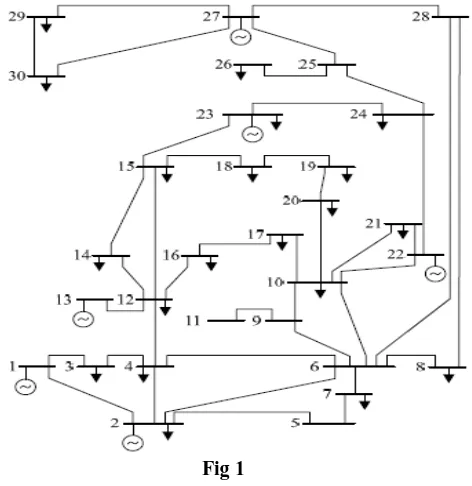
In this paper PSO is applied on IEEE 30 bus system. It consists of 6 generators as shown in figure.
Fig 1
.
The generator data is given in table below Generator data of IEEE 30 bys system
UNIT BUS
COST COEFFICIENT
PMAX PMIN MIN UP
TIME
MIN DOWN
TIME
A B C
1 1 0.02 15 0 80 15 2 2
2 2 0.0175 14.75 0 80 15 2 2
3 13 0.025 16 0 50 10 3 3
4 22 0.0625 14 0 50 10 4 4
5 23 0.025 16 0 30 5 3 3
6 27 0.0083 15.25 0 55 10 4 4
The PSO algorithm is applied to IEEE 30 bus system considering three random particles. Each particle undergoes 10 iterations. The minimum value of fuel cost as well as the power generated at minimum fuel cost is calculated and tabulated below.
A Priority list of Units are created according to the input data and the units are turned on as shown in table below.
Ranking Order Unit L (Mw) U (Mw)
1 6 10 55
2 6+2 25 135
3 6+2+1 40 215
4 6+2+1+5 45 245
5 6+2+1+4+5 55 295
6 6+2+1+5+4+3 65 345
The table shows the turn on and turn off status of units.
Time Unit Status
1 2 3 4 5 6
1. 1 1 0 0 0 1
2. 1 1 0 0 1 1
3. 1 1 1 1 1 1
4. 1 1 1 1 1 1
5. 1 1 1 1 1 1
6. 1 1 1 1 1 1
7. 1 1 0 1 1 1
8. 1 1 0 1 1 1
9. 1 1 0 0 1 1
10. 1 1 0 0 0 1
11. 1 1 0 0 0 1
12. 1 1 0 0 0 1
13. 1 1 0 0 0 1
14. 1 1 0 0 1 1
15. 1 1 0 1 1 1
16. 1 1 0 1 1 1
17. 1 1 0 1 1 1
18. 1 1 0 1 1 1
19. 1 1 0 1 1 1
20. 1 1 0 1 1 1
21. 1 1 0 0 1 1
22. 1 1 0 0 0 1
23. 1 1 0 0 0 1
24. 1 1 0 0 0 1
The PSO algorithm is applied to above system considering three random particles. Each particle undergoes 10 iterations. The Spinning Reserve is taken as 10% of maximum demand. The minimum value of fuel cost as well as the power generated at minimum fuel cost is calculated and tabulated below.
Load Demand G1 G2 G3 G4 G5 G6
166 66.0251 72.6845 - - - 54.6221
196 66.0251 72.6845 - - 29.8964 54.6221
229 61.55 70.406 38.93 36.716 29.8945 54.577 267 61.55 70.406 38.93 36.716 29.8945 54.577
283.4 68 73.7 42.8 41.36 29.8985 54.6899
272 61.55 70.406 38.93 36.716 29.8945 54.577
246 68 73.7 - 41.36 29.8985 54.6899
213 55.2768 67.1397 - 32.1156 29.8926 54.4719
192 61.55 70.406 - - 29.8945 54.577
161 61.55 70.406 - - - 54.577
147 53.5938 66.2687 - - - 54.4630
160 61.55 70.406 - - - 54.577
170 68 73.7 - - - 54.6899
185 75 77.4 - - - 54.8
208 74.0605 76.8352 - - 29.9081 54.7259
232 61.55 70.406 - 36.716 29.8945 54.577
246 68 73.7 - 41.36 29.8985 54.6899
241 68 73.7 - 41.36 29.8985 54.6899
236 66.0251 72.6845 - 39.8867 29.8964 54.6221
225 61.55 70.406 - 36.716 29.8945 54.577
204 68 73.7 - - 29.8985 54.6899
182 75 71.4 - - - 54.8
161 61.55 70.406 - - - 54.577
The total fuel cost obtained using this method is Rs. 91281/- The results are compared with Lambda Iteration Method and following schedule is obtained.
Load
Demand 𝜆 Value G1 G2 G3 G4 G5 G6
166 17.4613 61.5239 77.4662 - - - 55
196 17.4718 61.7961 77.767 - - 29.4369 55
229 17.5476 63.6891 79.9304 - 28.3805 30 55
267 17.6792 66.9811 80 33.5849 29.434 30 55
283.4 17.9887 74.7170 80 39.7736 31.9094 30 55
272 17.7736 69.3396 80 35.4717 30.1887 30 55
246 18.0606 76.5151 80 - 32.4848 30 55
213 17.3398 58.4939 73.993 - 26.7180 26.7951 55
192 17.3335 60.4369 76.2136 - - 28.3495 55
161 17.368 59.2 74.8 - - - 55
147 17.1067 52.6667 67.3333 - - - 55
160 17.3493 58.7333 74.2667 - - - 55
170 17.5360 63.4 79.6 - - - 55
185 18.12 80 80 - - - 55
208 17.84 71 80 - - 30 55
232 17.6364 65.9091 80 - 29 30 55
246 18.0606 76.5151 80 - 32.4848 30 55
241 17.9091 72.7273 80 - 31.2727 30 55
236 17.7576 68.9394 80 - 30.0606 30 55
225 17.4869 62.1716 78.1961 - 27.8949 29.7373 55
204 17.68 67 80 - - 30 55
182 18 75 80 - - - 55
161 17.368 59.2 74.8 - - - 55
131 16.9096 50 64.2857 - - - 55
The fuel cost obtained using this method is Rs.91923/- it shows that PSO method is more efficient than Lambda Iteration Method because it reduces the fuel cost.
Simulations are performed in mat lab software and a graph is drawn between number of iterations and fuel cost. The graph obtained is exponentially decreasing showing convergence. The graph is shown below.
VI. CONCLUSION
PSO method is applied to IEEE 30 bus system and the fuel cost is reduced. The result is compared with Lambda Iteration Method showing the efficiency of PSO Method. The method can also be extended to above 30 bus system. The graph obtained also shows convergence.
REFERENCES
[1] Alam M.S, El-Sharkh M.Y,Rahman A and, Sisworahardjo.N. S ―An Improved Ant Colony Search
Algorithm for Unit Commitment Application‖IEEE transactions on Power Systems Vol6,No.2 February
2006.
[2] Alice E Smith and Jorge Valenzuela ―A seeded Memetic algorithm for large unit commitment
problem‖Journal of Heuristics October 2000.
[3] Alva J. Svoboda (Member, IEEE ),Chao-an Li,Chung-Li Tseng , Eric Hsu and Raymond B. Johnson ―A
robust unit commitment algorithm for hydro-thermal optimization‖ IEEE Transactions on Power Systems, Vol. 13, No. 3, August 1998.
[4] Amit Jain,Lingamurthy Belede, and Ravikanth Reddy Gaddam ―Unit Commitment with Nature and
Biologically Inspired Computing‖ Power Systems Research Center IIIT Hyderabad, India, 2009 World Congress on Nature & Biologically Inspired Computing (NaBIC 2009).
[5] Angelina Jane Reyes-Medina, Gregorio Toscano-Pulido, Jos´e Gabriel and Ram´ırez-Torres ―A
Statistical Study of the Effects of Neighborhood Topologies in Particle Swarm Optimization‖ Computational Intelligence,Springer 2011.
[6] Arthur I Cohen and Gregory Ostrowski ―Scheduling units with multiple operating modes in unit
commitment‖IEEE Transactions on Power Systems, Vol 11,No.1,February 1996.
[7] Beltran.C and Heredia.F.J ―Unit Commitment by Augmented Lagrangian Relaxation: Testing Two
Decomposition Approaches‖ Journal of Optimization Theory and Applications: vol. 112, No. 2, February 2002
[8] Carlos Murillo and Robert J Thomas ―Thermal unit commitment with non linear power flow
constraints‖1998 IEEE.
[9] Chung Li an Raymond B Johnson ―A transmission constrained unit commitment method‖1998 IEEE.
[10] Chenthur Pandian.S, and Dr. Duraiswamy.K ―Fuzzy Logic Implementation for Solving the Unit Commitment Problem‖IEEE 2004 International Conference on Power System Technology - POWERCON 2004 Singapore, 21-24 November 2004.
[11] Claus c. caroe and Rudiger Schultz ―A Two-Stage Stochastic Program for Unit Commitment Under Uncertainty in a Hydro-Thermal Power System‖ University of Copenhagen,February 1998
[12] Costas D. Vournas, Dimitris N. Simopoulos and Stavroula D. Kavatza ―Unit Commitment by an
Enhanced Simulated Annealing Algorithm‖ PSCE 2006.
[14] Dipti Srinivasan and Logentiran T ―Particle Swarm Optimization for Unit Commitment Problem‖IEEE Transactions on Power Systems, Vo16, No. 2, May 2010
[15] Emmanuel S. KARAPIDAKIS and Yiannis A. KATSIGIANNIS ―Comparing different approaches to
solve the unit commitment problem considering hydropumped storage stations‖Dogus
University,DEMSEE 2007.
[16] Erik.J, John R Birge and Samer Takriti ―Intelligent unified control of unit commitment‖University of
Michigan.technical report,September 1994
[17] Erlich.I , Senior Member, IEEE and Pappala V.S, Student Member, IEEE, ―A New Approach for Solving the Unit Commitment Problem by Adaptive Particle Swarm Optimization‖ 2008 IEEE
[18] Feng Luan, Jong-Ho Choi and Hyun-kyo-Jung―A Particle Swarm Optimisation Algorithm with Novel
Expected Fitness Evaluation for Robust Optimisation Problems‖. IEEE transactions on Magnetics Volume 48, No.2 February 2012
[19] Ganesh Kumar Venayagamoorthy, Jean-Carlos Hernandez, Ronald G. Harley,Salman Mohagheghi and
Yamille del Valle ―Particle Swarm Optimization: Basic Concepts, Variants and Applications in Power Systems‖ IEEE Transactions on Evolutionary Computation, Vo1.12, No. 2, April 2008
[20] Gerald B. Sheble and Tim T. Maifeld ―Genetic-based unit commitment algorithm‖ IEEE Transactions
on Power Systems, Vol.11, No. 3, August 1996.
[21] Joon-Hyung Park,Sun-Kyo Kim, Geun-Pyo Park, Sang-Seung Le and Yong-Tae Yoon and Modified
Dynamic Programming Based Unit Commitment Technique‖ IEEE Transactions on Power Systems, Vol. 10, No. 2, March 2010
[22] Houzong Yan and Peter M Rogan ―Scheduling of Hydrothermal Power Systems‖IEEE transactions on
Power System, Vol.8, No.3, August 1993
[23] Huseyin hakan balci and Jorge F. Valenzuela ―Scheduling electric power generators using particle swarm
optimization combined with the lagrangian relaxation method ―International Journal for Applied Mathematics and Computer Science Vol.14,No.3,May 2004.
[24] Irissari.K,Mokhtari.S and Wang.S.J ―Short term generation scheduling with transmission and
environmental constraints with an augmented lagrange relaxation‖IEEE Transactions on Power Systems,Vol.10,N0.3,August 1995
[25] James Kennedy' and Russell Eberhart ―Particle Swarm Optimization‖1995 IEEE
[26] João Catalão, Sílvio Mariano and Victor Mendes ―Unit commitment with environmental considerations: a
practical approach‖ 15th PSCC, Liege, 22-26 August 2005
[27] Jonathan F Bard ―Short term scheduling of thermal electric generators via Lagrange Relaxation ―Operations Research Vol.36, No.5,September 1988
[28] José M. Arroy and Miguel Carrion ―A Computationally Efficient Mixed-Integer Linear Formulation for
the Thermal Unit Commitment Problem‖ IEEE Transactions on Power Systems, Vol. 21, No. 3, August 2006.
[29] Narayana Prasad Padhy ―Unit Commitment—A Bibliographical Survey‖ IEEE transactions on power
systems, vol. 19, No. 2, May 2004
[30] Po Hung Chen ―Pumped-Storage Scheduling Using Evolutionary Particle Swarm Optimization‖ IEEE
Transactions on Energy Conversion, Vol. 23, No. 1, March 2008
[31] Qiaozhu Zhai, Wei Fan and Xiaohong Guan and ―A new method for unit commitment with ramping constraints‖ Electric Power Systems Research(ELSIVIER) February 2002.
[32] Russel Eberheart and Yuhui Shi ―Particle Swarm Optimisation-development,application and
resources‖2001 IEEE
[33] Russell Eberhart and Yuhui Shi ―A Modified Particle Swarm Optimizer‖1998 IEEE
[34] Steven R. Braymer and William L Peterson ―A Capacity Based Lagrangian Relaxation Unit Commitment
with Ramp Rate Constraints‖ IEEE Transactions on Power Systems, Vol. 10, No. 2, May 1995
[35] Wen-Jun Zhang ,Xiao-Feng Xie and Zhi-Lian Yang ―A Dissipative Particle Swarm