ISSN (e): 2250-3021, ISSN (p): 2278-8719
Vol. 08, Issue 12 (December. 2018), ||V (I) || PP 57-63
A Survey on Performance Improvement of Cluster-Based
Routing Protocol in Vanet
Jisha. K
1Guest Lecturer, Department of Computer Science, Providence Women’s College, Kozhikode, Kerala, India1 Corresponding Author:Jisha. K
Abstract:
VANET is one of the networks most used for a vehicle. wVANET means Vehicular Ad-hoc Networks. It has received the considerable attention in recent years, a reason to its characteristics, which are different from MANET (Mobile Ad-hoc Networks) such as (i) rapid topology change, (ii) frequent link failure, (iii) high vehicle mobility. The VANETs network considers one drawback is network instability, it reduces the network efficiency. So the concept has overcome the drawback by using three algorithms namely, (a) Cluster-Based Life-Time Routing (CBLTR) protocol, (b) Intersection Dynamic VANET Routing (IDVR) protocol, (c) Control Overhead Reduction Algorithm (CORA). The first algorithm CBLTR protocols main goal is to increase the route stability and increase average throughput in a bidirectional segment scenario. The CH means Cluster Heads it is selected based on the maximum lifetime among all vehicles that are located within each cluster. Then, the second algorithm IDVR protocols main goal is to increase the route stability and increase average throughput and reduce the end-to-end delay in a grid topology. The CH is elected intersection because it classifies the cluster. The CH receives a Set of Candidate Shortest Routes (SCSR). In this SCSR is covers the desired destination from Software Defined Network (SDN). Then, the IDVR protocol selects the optimal route. The optimal route means the correct way and it is based on (i) its current location, (ii) destination location, (iii) the maximum of the minimum average throughput of SCSR. The third algorithm CORA protocols main aim is to reduce the controls the overhead messages in the clusters by developing a new mechanism to evaluate the optimal numbers of control overhead messages between the cluster members and the CH. It used the SUMO traffic generator simulators. SUMO means Simulation of Urban Mobility. The MATLAB (MATrix LABoratory) is to evaluate the performance of three protocols. The three protocols (CBLTR, IDVR, CORA)significantly outperform many protocols mentioned in the term and these protocols use many parameters. Key Terms: VANET, MANET, ICH, CH, IDVR, grid topology, AODV, lifetime, CBLTR, CBR, SCSR,
CORA, CMHELLO message, CHADS message, control overhead, CM, SDN.
--- Date of Submission: 29-11-2018 Date of acceptance: 13-12-2018 ---
I.
INTRODUCTION
The term VANET is developing the network and it is very useful for vehicle routing. The Intelligent Transportation System (ITS) holds all types of communications between vehicles is an important next-generation transportation system. It gives more facilities to passengers like, (i) safety applications, (ii) assistant to the drivers, (iii) emergency warning, etc. VANET is a derived form of self-organized MANET because it follows the MANET principles. The vehicles are equipped with an On-Board Units (OBUs) which can communicate with each other the communication is established with V2V or the V2V communication with stationary road infrastructure units (V2I) that are installed along the roads. The V2V means Vehicle-To-Vehicle communication. The VANET holds several characteristics so that it makes different from MANETs that is differs from the following characteristics, (i) high node mobility, (ii) predictable, (iii) restricted mobility patterns, (iv) rapid network topology change, (v) frequent battery charging, so these characteristics are varied in the VANET, for this reason, is protected the VANET, which means the energy consumption is not a big issue in this term.
networks like the VANET. But it requires the response time and high transmission rate. The VANET is dealing with two wireless access standards are, (i) IEEE 802.11p, (ii) IEEE 1609. The VANETs dealt with this two standards is relates to physical, MAC layers and higher-layer protocols, that is first is physical and MAC layers and the second one is higher-layer protocol. MAC means Media Access Control. IEEE 802.11p according to the vehicles is capable to share their GPS related position together with velocity and acceleration.
Key Terms:
ROUTING PROTOCOL:
The routing protocol maps the pathway from source to destination. It specifies how routers are communicating with each other and distributing pieces of information that enables and to choose the routes between any two computer system or a node or a network. The routing protocol finds the routes to the help of some basic routing algorithms. There are ten types of effective routing algorithms are available in this networking environment. MANET:
The MANET means Mobile Ad-hoc NETwork. It is also known as „Wireless Ad-hoc NETwork (WANET)' or „ad-hoc wireless network'. It has usually routable the networking environment on the top of a link layer in the ad-hoc network. The MANETs consists the peer-to-peer networks but this form of the network is called self-forming, self-healing networks.
VANET:
The VANETs is following the MANETs principles. In this network is mostly used for Vehicle to Vehicle (V2V) data exchanging and it by using the domain of the vehicles. But this network is another way to use, which means in this network-based creates the application namely, „car-to-car ad-hoc mobile communication and the networking'. The VANETs is a part of Intelligent Transportation Systems (ITS) frameworks and sometimes it refers. The VANET based creates the widest range of applications are, electronic brake lights, platooning, traffic information systems, road transportation emergency services, on-the-road services.
Data Mining Cluster:
A cluster is a group of objects, it similar to a class. The cluster is only grouped the similar objects or grouped the dissimilar objects. The term cluster is an important part of the graph processing system. So, this concept is discussed in this term.
What is clustering?
It is the process of making the group of objects into classes of similar objects, but its grouping object is an abstract type. The abstract means without background details or explanations. The clustered data are also treated as a group of data. The cluster analysis means the group of data is partitioned, and then similar data is assigned to the labels. The main advantage of the clustering is easily grouping the data and gives more benefits.
CLUSTERING CONCEPT:
(a) Supervised clustering: The supervised clustering is to identify the clusters easily with includes high-probability densities. The supervised clustering gives the best performance, because it uses the target variable and training sets, so that includes the variable to the cluster.
(b) Unsupervised learning: In this term mostly used to measures the dissimilarity and similarity. It reduces the increased similarity between intercluster and intracluster. It uses the very specific objective function. It uses the most popular clustering algorithms like, (i) hierarchical, (ii) k-means.
(c) Semi-supervised clustering: These types of clustering are formed by using the adjusting information or guiding domain information in the sequential form improving cluster. This information is a combination of supervised and unsupervised and it combines with the target variable. In the concept using some basic technical algorithm is,
(i) Support vector machines (binary classifiers), (ii) Decision trees (to classify data dependency).
II.
LITERATURE REVIEW
performance is combined called the VANETs performance. The parameters are, (i) throughput, (ii) propagation delay, (iii) average cluster changes per vehicle. Then, the simulated value it gives the results that are finally, increase their throughput, decrease the propagation delay, average cluster change per vehicle so the performance is increased. But it only improves the stable network topology it does not supports the dynamic network topology.
In paper [2] author has delivered the message is "improving the performance of cluster-based routing protocol using cross-layer design". The aim of the routing protocol is to efficiency delivers the data from source to destination. Generally, all types of protocols are same this task, but the way they adapt to achieves differently, the routing strategy has an egregious role on the ad hoc network performance. Many routing protocols basically follow the Ad-Hoc networks, because it has a flat structure. These types of protocols are expanded the control overhead packets to discover or maintains a route. Then the other words of this concept, that is a number of hierarchical based routing protocols have been developed but it mostly based on layer design. Each protocol includes the layer, each layer performs any task. So the layer is an important part of the protocol, like routing protocol. The layers are improves the network performance particularly when the network size developing up since the details about the remote portion of the network can be handled in an aggregate manner. Then another hand of the approach is to design a protocol called cross-layer design. In this layer can exchange between different layers of the protocol stack the final result is giving the optimizing performances of the network. In this concept is used as the protocol namely, “Cluster Based Routing Protocol (CBRP)”, so it is called, Cross-CBRP. The cross-layer is designed by using the optimized CBRP. It using the NS-2 network simulator that is NS means Network Simulator. So it evaluates the (i) rate of cluster head changes, (ii) throughput, (iii) packet delivery ratio. Finally, it provides the better performance and decrease the traffic congestion, but increases the number packets so increase the bytes, that increases the memory size.
In paper [3] author has presented the concept namely, "performance evaluation of a cluster based routing protocol for VANETs". The VANET has exposed to the safety of the roadway. The term VANET holds dynamically moving vehicles that communicate for a certain purpose. All protocols include the procedure, so same as the VANET protocol follows this step, it includes the routing procedures and it requires to delivers the requested data packets to the vehicles in a short period of time. As usual, the routing algorithm like to involves (i) Ad-hoc On-Demand Vector (AODV) routing, (ii) the Greedy Perimeter Stateless Routing (GPSR), (iii) the Direct-Sequenced Distance-Vector (DSDV) routing, (iv) the Dynamic Source Routing (DSR) have been utilized in most of the ad-hoc networks. But the conventional algorithms have met some problems in utilizing for the VANET. It describes the problems are first in DSR, that is the DSR does not restore the link breakages. Then the DSDV routing protocol not requires a higher bandwidth for the message exchanges and increase the excessive cost. So the paper verifies the Cluster Based Routing (CBR) protocol then overcome the problems obviously. The performance evaluation concept according to gives the evaluation results achieved by the computer simulations are implemented with the OMNeT++, the CBR routing protocol outperforms the AODV, GPSR, and DSR protocols in the sense of the packet delivery ratio and the message excessive. But increase the elapsed time.
In paper [4] author has presented the "A clustering-based fast and stable routing protocol for Vehicular Ad Hoc Networks". The concepts main goal is to improve the network performances, that is the avoids the breaches reasons are, (i) end-to-end delay, (ii) Packet Drop Ratio (PDR) in VANET. The term uses the protocol to improve the network performance, so the protocol namely, “Clustering-based Fast and Stable Routing (CFSR) protocol”. The protocol introducing a link quality assessment mechanism which calculates and analysis the link quality on the road segments between intersections and it adopts the end-to-end delay as an evaluation metrics to assigns a weight to the link relating to each road segment. Then the delay-sensitive applications can directly use the assigned weight as the link quality indicator to establish directly the path of routing in the sub-zone by using a Dijkstra algorithm. The concept of Local Coordinator (LC) is introduced into the routing protocol. It helps to constructs the routing path flexible and quick. Additionally, it gives the benefits, it can also avoid the local optimum problem that caused by single-step decision and it reduces the network transmission delay. It simulates the protocols are namely, (i) Simulation of Urban MObility (SUMO), (ii) Network Simulation 3 (NS3). Then the results are provided that the CFSR protocol can obtain the lower end-to-end delay and PDR than those of the AODV and DSDV protocols. The CFSR does not require to maintain each and every node.
(LLT-based) neighbor sampling strategy is put forward to filtered outs the repeated and redundant unstable neighbors. The clustering scheme is mainly classified three parts are, (i) cluster head selection, (ii) cluster formation, (iii) cluster maintenance. The LRCA routing protocol is to serve the infotainment applications in the term, VANET. Then, to makes the routing decisions appropriate nominate special nodes at the intersections to calculate or evaluate the condition of the network by assigning the weights to the road segments. Routes with assigning lowest weights are selected as the optimal and correct data are forwarding the path. Then, next evaluate the clustering stability and routing performance. The experimental result shows that the methods and approach outperform in both cluster stability and data transmission. It does not work on the non-clustering area.
In paper [6] author has presented the concept namely, “VANET clustering based routing protocol suitable for deserts”. The VANET is mostly covered the traffic congestion increasing place, but it is applied in all area because the traffic congestion increases every place, so for this implementation. The VANET is provided security, safety, rescue, exploration, military and communication redundancy systems in the non-populated areas. Usually, the VANET is used in urban environments as an essential part of organizing a cluster structure and the Cluster Head Election (CHE) suitable for the VANETs. Then it presents a robust clustering-based routing protocol, that is appropriate for the deserts and it can achieve high communication efficiency, then ensuring reliable information delivery and optimal exploitation of the equipment on each vehicle. The simulation evaluates the performance of CHE and the routing algorithms. The CBRP and DSR using but increasing the routing cost so it follows the flooding approach. More approaches are used and apply many methods some small effects are coming in the concept based system.
Author has presented the paper [7] concept is, "An optimal and stable route selection in the cluster based routing in VANET with reduced overhead". The MANET holds some network related principles but it differs the rapid and basic topology change then occurs the frequent link failures, so it will be moved into the next concept VANET. In the concepts, the main challenges of the two areas considered are, (i) high vehicle mobility, (ii) spontaneous transmission. The system based on the VANET so it focuses the VANET drawbacks take the problem network stability and solved it by using different algorithms because making the network stable. The previous protocols CBLTR, IDVR is to reduce the control overhead messages and it is to optimize the available bandwidth resources but these control overhead messages are not effectively reduced these messages. So next follows the Optimized Link State Routing protocol (OLSR), which means IP (Internet Protocol) routing protocol optimized for MANET but it is used for other Ad-Hoc based networks, like VANET. The OLSR has reduced the overhead by using a new multi-metric election method, it is used and determines the cluster nodes. It provides the security for the clustering approaches on the basis of the density and moves the ability, neighbor selections happen on the basis distance for secured transmission. Apply the AES (Advanced Encryption Standard) technique for both encryption and decryption in data transmission, thus finally the security of the VANET clustering approach is enhanced. The concept is working correctly but average speed so sometimes expiry the time.
Presented by the author has delivered the paper [8] concept is "Spatial distribution and channel quality adaptive protocol". It uses the DADCQ (Distribution And Distribution Channel Quality adaptive protocol) protocol. These protocols utilize the distance method and to selects the forwarding nodes. This method of performance depends heavily on the value of the decision threshold. But it is difficult to select a value that results in good performance across all scenarios. The optimal value is affected by node density, spatial distribution pattern, and wireless channel quality. The main goal of this concept gives the better VANETs routing mechanism, so it clears the vehicle to vehicle (V2V) communication and the protocols. The broadcast protocols adapted to vehicular networking must be adaptive to variation in these factors. The concept gives some facilitates the impact analysis of the distance-dependent DSRC (Dedicated Short Range Communication) is fading the channel and analysis the application-level. It only accepts the variation factors.
The author kindly presents the paper [9] concept that delivers, "ACR: A cluster-based routing protocol for VANET". The clustering is a technique that was used in the network routing or routing schemes to enhances the performance and organizes the network resources. It only uses a cluster-based routing protocol for the VANET and utilizing a new addressing scheme in that each node receives an address according to its mobility pattern. Then the technique hamming distance is used to partitions the network reachability, at the same time reduces the routing the end-to-end delay and the traffic received and comparing with the two terms are, AODV and DSDV. But it needs a lower number of nodes.
considered the interesting and increase the characteristics day by day. The VANET applied in another concept then they get the benefits like special new features, so understands this beneficial that move to the mobility based environment because it is trending technology. It provides the efficient routing and saving the resource in the VANET protocol. It provides information like the classification of VANET routing protocols with two forms of classifications and its summarization. But it does not automatically make the arrival time, so before fit the arrival time then the randomly performs the changing.
The paper [11] author has presented the concept of "Improving energy and efficiency in cluster-based VANETs through AODV protocol". Network Ad-hoc is used for vehicles on a road it is called, „VANET‟. The VANET and MANET are not the same, but similar differences have occurred. Then the concept is to overcome the main difference of MANET and VANET, that is big modification term like AODV. The MANET including AODV is modified for the VANET. Then the concept is to make the AODV, but it adaptive for VANET. So enhancing to minimizing the energy consumption and improves their efficiency. Generally, any node can have three mobility parameters are, (i) position, (ii) direction, (iii) speed. In the term specially selects the speed parameter for selects the next route discovery phase in the based approach. It uses a novel location-based routing solution over the VANETs and to forms the pathway which is able to address the vehicle passenger preferences and delivers the contents of their interests basis. To improve energy consumption by placing the roadside unit between the two pathways. But, the packet delivery ratio increases the node density.
In the paper [12] has presented the concept, “Junction-based geographic routing algorithm for vehicular Ad-hoc networks”. The VANETs is one of the growing terms so it takes the interests in the scientific community. The concept introduces the position-based routing algorithm namely, "Junction-Based Routing (JBR)”. This algorithm makes the use of selective greedy forwarding up to node which is located at a junction and it covers the destination. If, suppose the local optimum is reached then the recovery strategy is applied and use the minimum angle method but the key point of views it is used. It evaluates the performance of this VANETs topology. It can use the obstacle modeling and various different physical layer settings are by the simulation scenarios. The final result shows that the theme concept then it follows the well-defined Greedy Perimeter Coordinator Routing (GPCR) algorithm. But the concept is considered the main issue is to drop the packets. When the data transmission qualifies the neighbors so selects the next hop, in this time sometimes but rare drops the packets.
This paper [13] author has presented the concept namely, "clustering based routing protocols in vehicular ad-hoc networks". The VANET follow MANET, so it is a subclass of MANET. So these areas are for moving into the various researches, standardization, and various different development, thus this holds very big potentials so to improve vehicle and road safety and traffic efficiency. The VANETs beat more challenges in mobility environments. The VANET is to routes the packet destination and it involves the high mobility in the network area. It keeps and views the mobility constraints. The VANET with clustering is a control scheme and it is to manage the media access and make the VANET global topology. The issue is overcome by using the MANETs because most of the algorithms and protocols are derived from the MANET.
In this paper [14] authors have presented the concept, "Cluster-based data dissemination protocol in VANET". The concept main aim is to minimize the end-to-end delay and side by side increase the overall network performance. So it follows the NS2, which is used to conducts the simulation process. The clustering based routing protocol is new cross layered data that gathering, aggregating and disseminating protocols that use the synchronization between the vehicles to efficiently and effectively operate over a wide range of traffic loads. So the model takes the open scenario model and characterizing the VANETs, then vehicles can move freely. The mobility is affecting the cluster size and lower mobility increases the cluster size but it compares with the higher mobility so that problem is solved by increasing the number of clusters. The network performance is improved, so evaluates the average end-to-end delay, packet delivery ratio, average throughput calculated. It requires a number of clusters.
III.
CONCLUSION
VDLA, IRTIV, and the GPCR in terms of the delay and throughput. The concept finally achieves the goal which means to reduce the CH messages in the clusters by growing a new mechanism for calculating the optimal period for updating or exchanging the control messages between the CMs and CHs. The CORA expose the messages in three scenarios are, first one is, CMs has entered the cluster zone and the CH is announced itself. In the simulation results of CORA significantly minimized the number of messages in each cluster and in the segment with multiple clusters.
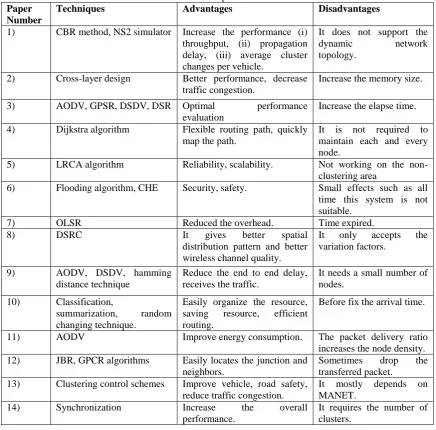
Table 1.0. Comparison Table Paper
Number
Techniques Advantages Disadvantages
1) CBR method, NS2 simulator Increase the performance (i) throughput, (ii) propagation delay, (iii) average cluster changes per vehicle.
It does not support the dynamic network topology.
2) Cross-layer design Better performance, decrease traffic congestion.
Increase the memory size.
3) AODV, GPSR, DSDV, DSR Optimal performance evaluation
Increase the elapse time.
4) Dijkstra algorithm Flexible routing path, quickly map the path.
It is not required to maintain each and every node.
5) LRCA algorithm Reliability, scalability. Not working on the non-clustering area
6) Flooding algorithm, CHE Security, safety. Small effects such as all time this system is not suitable.
7) OLSR Reduced the overhead. Time expired.
8) DSRC It gives better spatial
distribution pattern and better wireless channel quality.
It only accepts the variation factors.
9) AODV, DSDV, hamming distance technique
Reduce the end to end delay, receives the traffic.
It needs a small number of nodes.
10) Classification,
summarization, random changing technique.
Easily organize the resource, saving resource, efficient routing.
Before fix the arrival time.
11) AODV Improve energy consumption. The packet delivery ratio increases the node density. 12) JBR, GPCR algorithms Easily locates the junction and
neighbors.
Sometimes drop the transferred packet.
13) Clustering control schemes Improve vehicle, road safety, reduce traffic congestion.
It mostly depends on MANET.
14) Synchronization Increase the overall performance.
It requires the number of clusters.
Above table 1.0. Depicts the working methodologies of various techniques which can be used in the VANETs and it applies to different terms to get the different result. Finally, the system gives better performance.
REFERENCES
[1]. M. Hari Prasad, P. Kowsalya. “Performance Enhancement of VANETs Using Cluster-Based Routing”. Vol. 3, Issue 5, May 2014.
[2]. Seyed Kazem Jahanbakhsh, Marzieh Hajhosseini. “Improving Performance of Cluster-Based Routing Protocol using Cross-Layer Design”.
[3]. Mazen Alowish, Yasuhiro Takano, Yoshiaki Shiraishi, Masakatu Morii. “Performance Evaluation of a Cluster-Based Routing Protocol for VANETs”. Vol.12, No. 2, February 2017.
[4]. P F Zhao, K Liu, Y Zhang, T Zhang, F Liu. “A Clustering-Based Fast and Stable Routing Protocol for Vehicular Ad Hoc Networks”. [2018]
[6]. Mohammed Mohsen Mohammed Nasr, Abdeldime Mohamed Salih Abdelgader, Zhi-Gong Wang, Lian-Feng Shen. “VANET Clustering Based Routing Protocol Suitable for Deserts”. April, 2016.
[7]. M. Sowmya, K. Ramachandran, R. Senthilkumaran. “An Optimal and Stable Route Selection in Cluster-based Routing in VANET with reduced overhead”. Vol. 119 No. 14, 2018.
[8]. Lokesh Raj K, Dr. Shashikumar D.R. “Spatial Distribution and Channel Quality Adaptive Protocol”. Vol.4, Issue 6, June 2016.
[9]. Saeid Pourroostaei Ardakani. “ACR: A Cluster-Based Routing Protocol for VANET”. Vol. 10, No. 2, April 2018.
[10]. Mr. Vaibhav D. Patil, Atul R. Deshmukh. “Performance Improvement of Routing Protocol Using Two Different Mobility Models in Vehicular Ad-Hoc Vehicular Network”. Vol. 3, Issue. 4, April 2014. [11]. Prerana Deshmukh, Shrikant Sonekar. “Improving Energy and Efficiency in Cluster-Based VANETs
through AODV Protocol”. Vol. 5 (3), 2014.
[12]. Sotirios Tsiachris, Georgios Koltsidas, Fotini-Niovi Pavlidou. “Junction-Based Geographic Routing Algorithm for Vehicular Ad-Hoc Networks”.
[13]. Sanjeev Punia, Rajeev Kumar Patial. “Clustering Based Routing Protocols in Vehicular Ad-Hoc Networks: A Review”. Vol. 9(47), December 2016.
[14]. Garima Dhawan, Shilpa Nagpal. “Cluster-Based Data Dissemination Protocol in VANET”. Vol. 5 Issue 9, September 2016.