Improving QoS Performance of radio
Multi-channel WMNs by Adopting a Novel Channel
Assignment Scheme
1
Potti Balamuralikrishna, 2 M V Subramanyam, 3 K Satya Prasad
1, 3
Department of ECE, University College of Engineering, JNTUK Kakinada, Andhra Pradesh, India
2
Department of ECE, Santhiram Engineering College Nandyal, Kurnool, India
Abstract - The CSMA/CA based random channel access mechanisms in Wireless Mesh Networks(WMNs), IEEE 802.11 DCF and EDCA, are inefficient to eliminate effectively hidden terminal and exposed terminal problems in multi-hop scenarios. In this paper, we propose efficient channel assignment and routing protocols for multi-radio multi-channel (MRMC) wireless mesh networks. These set of protocols are based on Latin squares and have MRMC communication capabilities i.e., the multiple access scheduling in multi-radio multi-channel mesh networking. A novel efficient channel assignment and routing scheme is also developed taking into account the interference constraints, the number of channels in the network and the number of radios available at each mesh router for multi-radio multi-channel wireless mesh networks. MRMC communication using the two types of channel assignment schemes and routing methods is compared.
Keywords -Wireless Mesh Networks, IEEE 802.11 DCF and EDCA, Multi-radio multi-channel, Latin squares, Novel channel.
1. Introduction
The IEEE 802.11 MAC protocols that include DCF (distributed coordination function), PCF (point coordination function) and EDCA[1] (enhanced distributed channel access) are unable to guarantee basic data services due to overwhelming network congestion and severe hidden terminal interference in multi-hop wireless mesh networks. The scheduled and traffic-adaptive channel access mechanisms are required than the simplistic CSMA/CA [2] mechanisms in current IEEE 802.11 MAC protocols. Multiple non-overlapping channels are available in each of the IEEE 802.11
communication standards a/b/g—around three at 2.4 GHz band, and thirty at 5 GHz band [1]. Nodes equipped with multiple radios can communicate with multiple neighbors simultaneously over non-overlapping channels. Therefore, MRMC could reduce interference and increase network capacity. WMNs with single-radio multi-channel (SRMC) capabilities were addressed in [3], and WMNs with multi-radio multi-channels (MRMC) were addressed in [4].
As nodes in a WMN are increasingly equipped with multiple radio interface cards to harvest the full capacity of the channels, practical and efficient channel allocation and switching mechanisms are highly desirable to continue the success of IEEE 802.11 networks. Clustering in WMNs with MRMC capabilities could handle the network partition for dynamic radio/channel assignments, and facilitate radio/channel negotiation for data communications. In [5], the connectivity-based k-hop clustering problems have been addressed.
applications, MRMC routing cannot simply choose the path with the minimal hop count without considering the link quality.
In this paper, based on Latin squares [10] , we propose M4 (Multiple access scheduling in radio Multi-channel wireless Mesh networking), that is a joint MRMC assignment, scheduling and routing protocol from a holistic perspective in order for WMNs to achieve their full potentials at two scales. In the macro-time scale, we design radio and channel resource allocation algorithms to provide dynamic and adaptive conflict-free radio and channel assignments to active clusters in WMNs; in the micro-time scale, we specify multiple channel access control protocols to provide collision-free packet transmissions within each cluster. MRMC routing specification has been designed based on the MRMC link quality. Our MRMC routing exploits and integrates physical propagation models, location information and radio utilization efficiency to provide near optimal routing paths to guarantee the quality of service (QoS) in M4 applications.
A novel optimal efficient channel assignment and routing scheme is also developed taking into account the interference constraints, the number of channels in the network and the number of radios available at each mesh router for multi-radio multi-channel wireless mesh networks. This algorithm can effectively exploit the increased number of channels and radios, and it performs much better than the worst case theoretical bounds.
2. Related Work
The work that is most closely related to this paper is that of [11, 12, 13, and 14]. Like ours, the work in [11, 12] assumes that there is no system or hardware support to allow a radio interface to switch channels on a per-packet basis. Raniwala et al. propose a centralized joint channel assignment and multi-path routing algorithm. The channel assignment algorithm considers high load edges first. The routing algorithm uses both shortest path routing and randomized multi-path routing (a set of paths is used between any pair of communicating node pair). The joint channel assignment and multi-path routing algorithm proceeds in an iterative fashion. However, their algorithm is based on heuristics and a worst performance bound on its performance is not known. In addition, in their scheme no guarantees on fair allocation of bandwidth are provided. In [12], Raniwala and Chiueh propose a distributed heuristic algorithm. The algorithm also is not known to have any worst case performance bound. Unlike ours, the work in [13, 14] assume a radio
interface that is capable of switching channels rapidly and is supported by system software. In [13], Kodialam and Nandagopal present channel assignment and routing algorithms to characterize the capacity regions among a given set of source and destination pairs. In [14], Kyasanur and Vaidya study how the capacity of multi-channel wireless networks scale with respect to the number of radio interfaces and the number of channels as the number of nodes increases.
Jain et al. [15] consider throughput optimization using a general interference model. Their algorithm can be computationally intensive to achieve close to optimal performance. In addition, their algorithm does not exploit the properties of interference using 802.11 MAC for better performance. Kumar et al. [16] consider the throughput capacity of wireless networks between given source destination pairs for various interference models. However, they do not take channel allocation into account as they consider a single-channel network. Kodialam and Nandagopal [17] investigate the same problem using a simple interference model where a node cannot send and receive at the same time. Objectives other than throughput have also been considered, e.g. power optimization [18]. There have also been approaches that consider routing and channel assignment separately. In [19], Draves et al. propose a routing metric that exploits multi-channel diversity. In particular, paths with more channel diversity and fewer hops are preferred.
In [20], Bahl et al. present a MAC protocol that exploits the availability of multiple channels. However, they change channel assignment in a fast time scale on a per-packet basis which may not work with existing commodity hardware. The problem of how to design a multi-hop mesh network has been studied in [21, 22]. Their goal is to place a minimal set of gateways to meet certain performance requirements. They do not consider multi-radio and multi-channel mesh networks and their algorithms do not apply in our setting. Finally, fair bandwidth allocation and load balancing has been considered in single-radio wireless LAN context [23]. Channel assignment has been extensively studied in cellular networks. However, there is no multi-hop routing in that context.
3. Methodology
scheduling, Latin squares based MRMC assignment, and MRMC scheduling oriented routing.
3.1 Clustering
It is well-known that CSMA/CA mechanism cannot fully guarantee collision-freedom due to hidden terminal problems in multi-hop wireless networks. Instead, a hierarchically organized, cluster based spatial division multiple access scheme has to be applied so as to resolve the hidden terminal problem at macro-time scale, while the CSMA scheme is limited to micro-time scale channel access control amongst nodes within individual clusters. For clustering purpose, we use the concept of interference graph, where two nodes have a link between them if they can carrier-sense each other’s transmissions. In addition, we define a collision domain of a node as the set of adjacent nodes that can interfere and damage the packet receptions of the node. Nodes within each collision domain are fully connected with each other in the two-hop range, and form a clique in the corresponding interference graph.
Assuming that the nodes of a large-scale WMN are grouped into non-overlapping collision domains, it is easy to see each collision domain forms a clique of the network graph. For collision avoidance and communication purposes, we structure the WMN according to types of clusters, namely the interference cluster (IC) and the bridge cluster (BC). Nodes in the same interference cluster form a collision domain of each other, and share a common channel. Nodes in the same bridge cluster form a collision domain as well, except that they are chosen among adjacent interference clusters so as to facilitate communications between interference clusters that use different channels.
3.2 On Demand Multiple Access Scheduling
In the previous section, we have constructed the interference clusters and bridge clusters for a WMN. To provide a collision-free environment in the network, we allocate different channels for neighboring interference clusters, and only one node in each interference cluster is allowed to transmit at any time. We utilize the basic schemes in MALS for inter-cluster transmission by assigning Latin square indices to the nodes in each cluster. Because it is usually the case that only a subset of the network nodes require channel access for data forwarding purposes, instead of assigning a Latin square row to each and every node in the wireless networks, we map the Latin square row indices to different colors, and in turn assign colors to nodes with traffic forwarding demands
using graph coloring schemes. There are two types of graph coloring schemes in our MRMC mesh networks for channel access scheduling, node coloring and cluster coloring. Node coloring schedules channel access time for the nodes in the same collision domain. Cluster coloring is used to allocate channels for different interference clusters.
3.3 MRMC Assignment and Scheduling
In the previous section, we have colored the network such that neighboring clusters will obtain different colors. Using the color information, we can now set up a collision-free multiple access schedules for different radios and channels in the network. In this section, we will first explain the schedules between clusters and channels. Because each neighboring cluster uses different channels to avoid collisions, we will then talk about how to utilize multiple radio interfaces to connect neighboring clusters.
3.3.1 Scheduling between Clusters and Channels
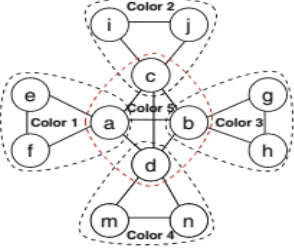
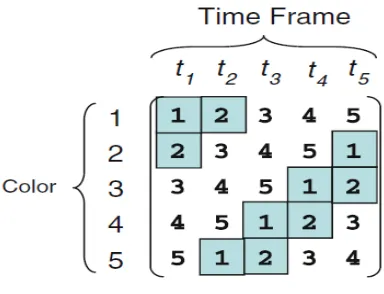
Once the color assignment of the clustered network is finished, M4 distributes the color information to the clusters, including the color of every cluster and the total number of colors required in the network. Using the color information and the number of available channels in the large-scale WMN, each cluster can independently generate its channel access schedules. We use a Latin squares based method to assign channels. Once a cluster in the clustered graph is assigned a channel, the WMN nodes inside the cluster can communicate using the specified medium access protocol.WMN nodes without any channel allocation have to remain silent during the corresponding time slots.Fig.1 shows our Latin Squares based channel assignment scheme.
Fig. 1 (b) MRMC assignment using Latin squares.
Fig. 1 MRMC scheduling in a clustered graph.
3.3.2 Scheduling between Clusters and Channels
As shown in Fig. 1, nodes in the bridge cluster can be connected with multiple neighboring interference clusters. If we have multiple radios on each node, inter-cluster and intra-cluster communications may be activated at the same time. Thus increase the network throughput and reduce the end-to-end delay. According to the number of interference clusters which are overlapped by the bridge cluster, we can assign different radio interfaces to support intra-cluster communication. Using the coloring information of each interference cluster, the maximum number of colors, and the number of available radios, each node in the bridge cluster can independently generate its radio access schedules.
3.4 MRMC Routing
Since a WMN is organized into interference clusters and interference clusters are connected by bridge clusters with different radio interfaces on nodes, we group the cluster ID and corresponding radio interface ID for each node, and specify this information in the routing packets for MRMC communications.
Fig. 2 MRMC routing in a clustered graph.
3.4.1 Location Aware Route Discovery
In M4, a route is established when the source node sends a RREQ message in search of a path to a certain destination, and receives an RREP message in return. To find a near optimal route, we define a new metric, called
forwarding speed, for a RREQ receiver to evaluate the
quality of the potential path through itself. The forwarding speed Sforward is a vector, defined by
(1)
RREQ forward
Queue MAC
D
S
T
T
=
−
+
It is worth noting that equation (1) eventually combines several path evaluation criterion into a single metric for route selection. The criterion combines information from several layers, like the MAC layer latency, DLL layer queuing delay, PHY layer transmission rate, and WMN node location information, thereby providing a comprehensive cross-layer perspective to the routing protocol designs. In general, equation (1) enables a route selection mechanism to choose faster routing path with less forwarding hops, higher data rates and lower queuing delays. Accordingly, intra-cluster next-hop node that is located in an interference cluster and a bridge cluster at the same time will be preferred to forward the data in WMNs.Fig. 2 shows MRMC routing in a clustered graph.
4. Novel Channel Assignment Scheme
One of the major problems facing wireless networks is the capacity reduction due to interference among multiple simultaneous transmissions. In wireless mesh networks providing mesh routers with multiple-radios can greatly alleviate this problem. With multiple-radios, nodes can transmit and receive simultaneously or can transmit on multiple channels simultaneously. However, due to the limited number of channels available the interference cannot be completely eliminated and in addition careful channel assignment must be done to mitigate the effects of interference.
because channel assignments have an impact on link bandwidths and the extent to which link transmissions interfere. This clearly impacts the routing used to satisfy traffic demands. In the same way traffic routing determines the traffic flows for each link which certainly affects channel assignments. Channel assignments need to be done in a way such that the communication requirements for the links can be met.
Heuristic approaches on channel assignments and load aware routing are proposed to improve the aggregate throughput of WMNs and balance load among gateways. These heuristic approaches can still be far from the optimal performance the network can offer. Because aggregate traffic demands and network topology do not change frequently in WMNs optimizations using measured traffic demands are feasible. The system management software can compute the optimal channel assignment and routing and configure each element periodically. Routing protocols will still need to be run to handle topology changes. In this paper, we also develop a novel channel assignment and routing scheme in multi-radio WMNs which is different from Latin-squares based MRMC discussed in section III. Our method works as follows.
• We present a formulation for the joint channel assignment, routing and scheduling problem that can model the interference and fairness constraints and is also able to account for the number of radios at each of the wireless nodes.
• We establish matching necessary and sufficient conditions under which interference free link communication schedule can be obtained and we design an efficient algorithm to compute such a schedule.
• We use a novel flow transformation technique to design an efficient channel assignment algorithm that can assign channels to node radios while ensuring that maximum data can be transmitted on specified traffic routes.
• We establish that our algorithm for the joint channel assignment, routing and scheduling problem is a constant factor approximation algorithm. To the best of our knowledge, this is the first constant factor approximation algorithm for the problem.
5. Results Analysis
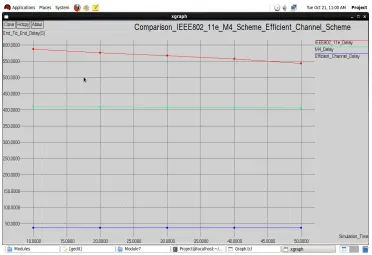
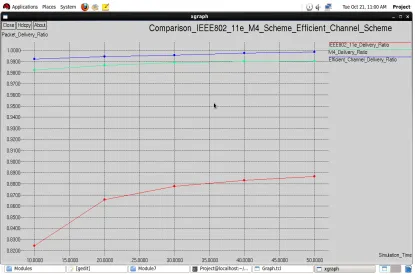
We implemented the proposed Latin Squares based channel assignment and routing and also the optimized efficient channel assignment and routing in Multi-radio Multi-channel Mesh networking using the network simulator 2.33 (ns-2.33), and evaluated its performance in terms of overall network throughput, average packet delay, and packet delivery ratio. We compared the performance of our proposed methods with IEEE 802.11e standard. End simulation was carried out for duration of 50s, with 35 nodes.
The throughput comparison is shown in Fig. 3. The throughput of the proposed Latin squares based M4 was about 1.08 times the throughput of IEEE 802.11e. It is because that there are two types of nodes operated in different number of channels in M4. One type is the inter-cluster nodes and the other type is the intra-inter-cluster nodes. The nodes for inter-cluster communication operate on one shared channel, and the bridge nodes for intra-cluster communication operate on two channels simultaneously to connect different clusters. The proposed optimized efficient channel assignment scheme has shown very good throughput performance i.e., 1.2 times that of the IEEE 802.11e.
Fig. 3 Throughput comparison.
Fig. 5 Packet delivery ratio comparison.
4. Conclusions
We have presented the two types of channel assignment schemes and routing methods: Latin squares based M4 approach and Novel channel assignment approach, for MRMC communication. The novel optimal efficient channel assignment scheme can greatly relieve the interference effect of close-by transmissions; effective routing schemes can alleviate potential congestion on any gateway to the Internet, thereby improving per-client throughput.The channel assignment in multi-interface WMN consists of a task to assign channels to the radio interfaces by such away to achieve efficient channel utilization and minimize the interference. Simulation results conclude that the proposed effective channel assignment scheme will improve the Quality of Service (QoS) in wireless mesh networks by improving throughput, packet delivery ratio and by reducing end-to-end delay compared to Latin squares based M4 approach and IEEE 802.11e.
References
[1] IEEE Std 802.11e. (2003). Wireless medium access control (MAC) and physical layer (PHY) specifications: Medium access control (MAC) enhancements for quality of service (QoS). Technical report, IEEE, 2003.
[2] IEEE Std 802.11. (2007). IEEE standard for information technology telecommunications and information exchange between systems local and metropolitan area networks-specific requirements— Part 11: Wireless LAN medium access control (MAC) and physical layer (PHY) specifications, Technical report, IEEE, 2007.
[3] Aryafar, E., Gurewitz, O., & Knightly, E. W. (2008). Distance-1 constrained channel assignment in single radio wireless mesh networks. In IEEE INFOCOM’08 (pp. 762–770).
[4] Ramachandran, K. N., Belding, E. M., Almeroth, K. C., & Buddhikot, M. M. (2006), Interference-aware channel assignment in multi-radio wireless mesh networks. InIEEE INFOCOM’06(pp. 1–12).
[6] Liu, Q., Jia, X., & Zhou, Y. (2011), Topology control for multichannel multi-radio wireless mesh networks using directional antennas. Wireless Networks, 17(1), 41–51.
[7] Mao, X., Li, X., & Dai, G. (2011), Flow admission control for multi-channel multi-radio wireless networks. Wireless Networks, 17(3), 779–796. [8] Alicherry, M., Bhatia, R., & Li, L. (2005), Joint
channel assignment and routing for throughput optimization in multi radio wireless mesh networks. In ACM MobiCom’05 (pp. 1960–1971).
[9] Lim, S., Ko, Y., Kim, C., & Vaidya, N. (2011). Design and implementation of multicasting for multi-channel multi-interface wireless mesh networks. Wireless Networks, 17(4), 955–972.
[10] Denes, J. & Keedwell, A. D. (1974).Latin squares and their applications. London: Academic Press.
[11] A Raniwala, K. Gopalan, and T.-C. Chiueh. Centralized channel assignment and routing algorithms for multi-channel wireless mesh networks.ACM Mobile Computing and Communications Review (MC2R), volume 8(2), pp. 50–65, 2004.
[12] A. Raniwala and T.-C. Chiueh. Architecture and algorithms for an IEEE 802.11-based multi-channel wireless mesh network, In Proc. IEEE INFOCOM, 2005.
[13] M. Kodialam and T. Nandagopal, Characterizing the capacity region in multi-radio and multi-channel mesh network, In Proc. ACM MOBICOM, 2005.
[14] P. Kyasanur and N. Vaidya. Capacity of multi-channel wireless networks: Impact of number of channels and interfaces, In Proc. ACM MOBICOM, 2005.
[15] K Jain, J. Padhye, V. N. Padmanabhan, and L. Qiu, Impact of interference on multi-hop wireless network performance. In Proc. ACM MOBICOM, pp. 66–80, 2003.
[16] V. S. A. Kumar, M. V. Marathe, S. Parthasarathy, and A. Srinivasan, Algorithmic aspects of capacity in wireless networks, In Proc. ACM SIGMETRICS, pp.133–144, 2005.
[17] M. Kodialam and T. Nandagopal, Characterizing achievable rates in multi-hop wireless networks: the joint routing and scheduling problem, In Proc. ACM MOBICOM, pp. 42–54, 2003.
[18] R. Bhatia and M. Kodialam,On power efficient communication over multi-hop wireless networks:Joint routing, scheduling and power control, In Proc. IEEE INFOCOM, pp. 1457–1466, 2004.
[19] R. Draves, J. Padhye, and B. Zillm Routing in multi-radio, multi-hop wireless mesh networks, In Proc. ACM MOBICOM, pp. 114–128, 2004.
[20] P. Bahl, R. Chandra, and J. Dunagan SSCH: slotted seeded channel hopping for capacity improvement in ieee 802.11 ad-hoc wireless networks, In Proc. ACM MOBICOM, pp. 216–230, 2004.
[21] Y. Bejerano, Efficient integration of multi-hop wireless and wired networks with QoS constraints, In Proc.ACM MOBICOM, pp. 215–226, 2002.
[22] R. Chandra, L. Qiu, K. Jain, and M. Mahdian. Optimizing the placement of internet TAPs in wireless neighbourhood networks, In Proc. IEEE ICNP, pp. 271–282, 2004.
[23] Y. Bejerano, S.-J. Han, and L. E. Li. Fairness and load balancing in wireless lans using association control, In Proc. MOBICOM, pp. 315–329, 2004.
Balamuralikrishna Potti is a Research Scholar, JNTUK, Kakinada, India .He has 13 years of teaching and 4 years of research experience. He received B.E. degree in Electronics and Communication Engineering from Andhra University, India in 2001 and M.Tech. degree in Instrumentation and control systems from JNTU College of Engineering ,Kakinada in 2008.He has guided 5 M.Tech projects 10 B.Tech projects. He has published four research papers in International Journals. He has published two papers in International conferences. He attended 15 workshops / short-term courses. His areas of interest are Computer Networks, Communications, Image processing, Signal processing and Instrumentation. He is a life member in ISTE.
Dr. M. V. Subramanyam is Principal and Professor, at Santhi Ram Engineering College, Nandyal, India. He has 22 years of teaching and 10 years of research experience. He received B.E. degree in Electronics and Communication Engineering from Gulbarga University, Karnataka, India in 1989 and M. Tech. degree in Digital Systems and Computer Electronics from JNTU, Hyderabad, India in 1997.He received PhD from JNT University in the area of Ad hoc wireless networks in 2007.He has worked as Head of department and Chairman Board of studies. At present he is supervising 8 PhD scholars. He has published more than 50 papers in International Journals/ Conferences. His research interests include control systems, wireless networks, embedded systems and artificial intelligence. He is the life member in IE, ISTE and KDTFM.He is a member in IEEE. He is a fellow in IETE.