IJIRT 148219
INTERNATIONAL JOURNAL OF INNOVATIVE RESEARCH IN TECHNOLOGY744
IOT Based Door Unlock Using Digital Image Processing
Dnyanada Kale
1, Priti Sangle
2, Rini Dalvi
3, Sneha More
4, Prof. Shital Kakad
5 1,2,3,4,5Marathwada Mitra Mandal’s College of Engineering, Karvenagar, Pune, Maharashtra
Abstract-Utilizing the area of Internet of Things (IoT), Digital Image Processing and Android Platform, the proposed framework gives a system to secure and remotely monitor homes. The proposed framework comprises of three noteworthy modules specifically the IoT based Hardware components, the Server and the Android application. A picture of an individual is captured by the camera attached to the Raspberry Pi. The captured picture is then processed by utilizing Python. A warning is popped up on the user's phone whenever the camera detects an individual. This permits the client to acknowledge or dismiss the individual on the entryway.
Index Terms-IoT, Digital Image Processing, Raspberry Pi, Face Detection, Face Recognition
I. INTRODUCTION
The Internet of Things (IoT) could be characterized as a worldwide framework that joins wise administrations with situational mindfulness and gives intelligent correspondence access between one substance and the other, likewise among sharp and individual’s protests inside a framework [inch]. Machine to Machine (M2M) correspondence is diverse by IoT as somebody won’t specifically control the savvy or gear instruments; they truly are at risk for conveying in the interest of individuals. As of late, a wide scope of correspondence advances has been updated to get and offer insights regarding matters. IoT advances have been empowered to convey by the blend of apparatuses for the home and cell phones. Of late, electronic entryway secures have been used homes and workplaces [1]. Much of the time, by going around the bolt, a gate crasher has endeavoured to infiltrate a zone. Inside this investigation, we currently structure and utilize an entryway bolt additionally to enhance checking capacities and the different security utilizing IoT innovations and to decrease the harm of computerized entryway bolt altering. Security
concerns are expanding each day, in each field of living, be it vehicles, homes or the relatives.[13] Concentrating on the home security, this paper proposes a framework, called as HSDL System for example Savvy Door Locking and Home Security System which can give opportunity from the worry of being ransacked [11]. This framework depends on the innovation of Internet of Things for example IoT, because of its wide use in the advancement of new items.
Home security has turned into a serious issue in the general public. Anybody can be bugged in its very own home [12]. More established security frameworks can't handle a few circumstances like hacking, separate in the framework. Undesirable people like hoodlums, killers and some realized offenders will endeavour to interrupt in the home whenever they need. Likewise we realize that the devices now Manuscript got days are not unreasonably anchored and consequently can be effectively hacked. Indeed, even interlopers have discovered their approach to assume control over these devices. So to stay away from such circumstances, we need to build up the framework in such way that nobody ought to get an interruption to the framework [13]. The utilization of IoT will upgrade some security level just as it will help in getting to and controlling the framework remotely.
II. LITERATURE SURVEY
Internet of Things (Iot) is increasing enormous concentration in the area of innovation wherein vast number of gadgets is being associated with one another. These gadgets can speak with each other over a web so as to exchange information and are discovering incredible value in giving home security as well.
IJIRT 148219
INTERNATIONAL JOURNAL OF INNOVATIVE RESEARCH IN TECHNOLOGY745
prompts the catching of the individual's picture [1]. This picture is sent for handling by the face discovery and face acknowledgment sub-modules of the Server. On the off chance that the face is perceived to be the one having a place with one of the occupant of the home, the entryway gets naturally opened. Generally the facial picture of the individual is received by the possessor’s Android application from where the proprietor can take three activities for approving the individual remaining at the entryway for example the proprietor can press either the Accept, the Reject or the Buzzer option.
A remote access control framework contains the web to control the gadgets and apparatuses at home or office with the individual controlling them from anyplace around the world. In framework proposed in [2], a Raspberry Pi board is employed as the dais for observing and controlling the entryway bolt. The entryway section framework proposed here made up of a switch for visitor monitoring, camera for visitor verification, solenoid actuator for opening the entryway and a speaker set for making the framework personal the reactions to the visitor. Switch, speakers and camera for cooperation with the visitor are mounted at proper spots at the entryway
In paper [3], Aman Pathak and et al have a microcontroller board which is the centre of the plan, interfacing the cell phone with the entryway bolt to bolt or opening the equivalent. Entryway bolt is constrained by servo engines, which is initiated by the microcontroller on getting the order from the conveying gadget (here cell phone). For opening and shutting the entryway first association with the facilitating server is checked .If the association isn't discovered then it will endeavour to interface with the facilitating server. After this facial acknowledgment is done through pie camera by means of scilab if the individual is remaining before the entryway. In the event that the face matches with the picture present in database, microcontroller directions to open the entryway and advice the client. A Wi-Fi/Bluetooth module is additionally accommodated remotely controlling the entryway utilizing an android application for this: Data Sent over the application will be utilized to offer direction to microcontroller. Thus microcontroller actuates the servo to bolt/open the entryway bolt.
In [4], three modules have been incorporated to be specific: Human Detection Module, ZigBee Module
and Door bolt Module. At first the guest of the house is distinguished by the Human Detection module. At that point ZigBee module checks if the guest has a legitimate ZigBee tag (ID). On the off chance that the tag is substantial, the Door bolt module works an engine to open the entryway. In the case the tag is invalid, the entryway remains bolted. With this framework, no cabling is required as it is a remote framework. Be that as it may, ZigBee is short-extended contrasted with most different remote innovations like Wi-Fi.
The recommended technique in [5] supplies strengthened insurance purposes which may move caught pictures to a person's cell device when an invalid client attempts that an unlawful working; it might even send ready data to the cell phone at whatever point the entryway bolt has been severely destroyed. The stage engages an individual bolt to consequently build advantage and generously deal with the way to inspect the section data. Just of late, electronic entryway locks are generally used as an individual from their IoT (Web of Matters). Considering all things, the press has announced entryway locks have been presented to end clients to attack workplaces and homes. Inside this examination is proposed. It utilized and is made to build preferred standpoint and wellbeing.
IJIRT 148219
INTERNATIONAL JOURNAL OF INNOVATIVE RESEARCH IN TECHNOLOGY746
The framework proposed in [7] gives the client a chance to control his entryway bolt either by means of Bluetooth or a message over the web. The proposed security capacities enable the client to monitor who visited his home and when alongside controlling the instances of conceivable interruption. The work proposed in [8] is to send a flag to entranceway from a Tablet or android phones by utilizing remote framework. This enables the client to unlock and open an entranceway from inside or outside a house with a Wi-Fi run accessible. The perfect reason for the work is, if the entryway isn't secured First floor or in some other floor, the client from ground floor they can open the entryway or open the entryway from cell phone or Laptop, which makes an individual to diminish its vitality or spare time.
Home security is developing field. To give security to home, confront acknowledgment framework can be actualized. A standard UBS camera catches the picture to recognize the individual. It's a model that distinguishes the guest. In case of the entryway perceives the guest, it will welcome them by their respective name, and the entryway will be opened named opened. In case they aren't distinguished the entryway will be immovably bolted. The framework will play out the identification and acknowledgment quickly continuously. The undertaking [9] uses the essential web cam, and the web association with make an entryway that opens itself through facial acknowledgment. On the off chance that the guest at the entryway is recognized, the entryway will be opened.
In paper [10] a framework is being developed to associate any entryway with the web, so the entrance control framework can be controlled from anyplace on the planet. For a situation that one isn't at home and a visitor is at his entryway steps then the approved individual will be told about the guest by means of twitter and the individual can see the guest from the web through the camera from anyplace and the framework will snap a photo of the guest and keep a record by sending a connection through E-mail or tweet in twitter. In case the approved individual needs to give a message to the guest it tends to be sent effectively through the web and it will show up in a screen on the front essence of the entryway. The entryway bolt can be controlled through the web. With the assistance of this
framework a proof of the guest can be kept as a record if any crisis case or situation happens.\
III. PROPOSED ARCHITECTURE
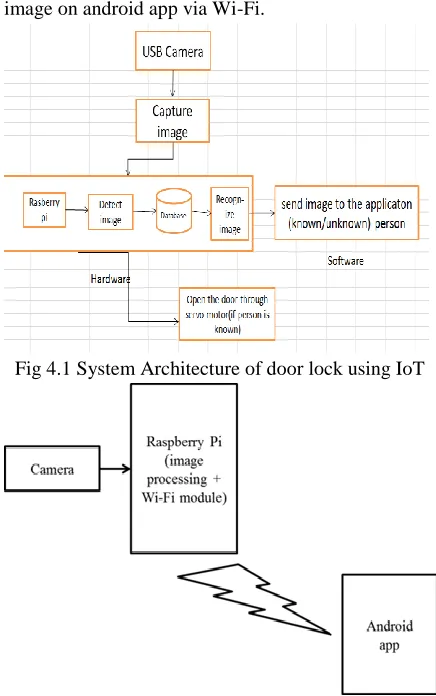
Camera is interfaced to raspberry Pi module which captures image of person stands in front of door. Raspberry pi is main controlling unit which controls all activities like processing of image captured by camera to detect face of person and send this face image on android app via Wi-Fi.
Fig 4.1 System Architecture of door lock using IoT
Fig 4.2 block diagram of Door unlock using IoT Android app is used to display image of intruder and to wirelessly control door of house from far place.
1. Face detection:
IJIRT 148219
INTERNATIONAL JOURNAL OF INNOVATIVE RESEARCH IN TECHNOLOGY747
2.
3. Android App:
The owner of the house receives a pop-up message on the smart phone. Through the Android application, the user can see the image of the face of the person standing at the door. The user can perform the following-
1. Unlock Button: The user can press the unlock button to unlock the door. The door will be unlocked only if the person is recognized or the user permits the person to enter his/her room/house.
2. Login: By entering email id and password user can get access to the next page of the android application.
IV. IMPLEMENTATION DETAILS
The implementation of this work starts with selecting the microcontroller that we prefer. As the Arduino only provides a subdivision of the functions that the Raspberry Pi provides, we have chosen to use Raspberry Pi in our project. A Raspberry Pi is a general-purpose computer, usually with a Linux operating system, and the ability to run multiple programs, unlike Arduino which cannot run multiple programs. We have selected a raspbian operating system.
We downloaded the Raspbian and wrote the disc image to a micro SD card, then booted the Raspberry
Pi to that micro SD card. The configuration settings can be done according to the user. After that, the python program is to be typed in the text editor as a .py file. The USB camera and servo motor are interfaced with the hardware.
We choose to use a USB camera instead of a Raspberry Pi camera as it gives us better and clear images. To access the USB webcam and the code written for face detection and recognition, we have used VNC. VNC i.e. Virtual Network Computing is a system which allows remote control of one computer system by another. To connect the Raspberry Pi with the VNC, we have to first activate it. After activating the VNC server, we just have to connect it to the VNC client. For this, a client is installed on the computer from which we will take control of the Raspberry Pi. Once we have installed the VNC viewer, it is launched and connected to the IP address of the Raspberry Pi.
Once the connection is established to an IP address, we can run our code. We have developed an android application through which the system can be controlled. The USB camera seizes the image and sends it to the user’s phone. The user has a login ID and password. The user has been provided with the option to unlock the door. A default directory can be maintained by the user, in which he/she stores the images of people who are allowed to enter his/her room or home. When the user clicks on the unlock button, the Raspberry Pi sends a signal to the servo motor, which in turn rotates, causing the door to open.
V. ALGORITHMS
1. Haar Cascade Classifier
IJIRT 148219
INTERNATIONAL JOURNAL OF INNOVATIVE RESEARCH IN TECHNOLOGY748
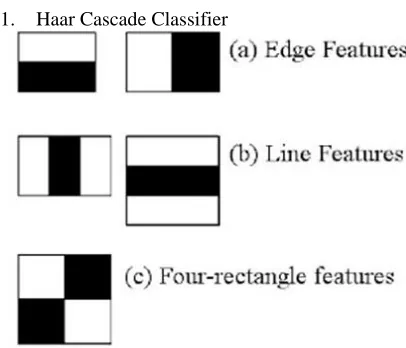
The algorithm initially requires a lot of images (with and without faces) so as to train the classifier. Then, we extricate the features from it. Each feature represents a single value. This value is obtained by performing the subtraction of the sum of pixels under the white rectangle from the sum of pixels under the black rectangle. Not all the features calculated are relevant. We select the best features by a technique called Adaboost. When a face is detected, a rectangle will be generated around the face.
Fig 5.2 Division of pixels of face
2. LBPH Algorithm
To train the algorithm, we need to use a dataset with the facial images of the people we want to recognize, providing an unique id for each person’s image. The algorithm uses this information to recognize an input image, based on which we get an output.
Fig 5.3 Creation of intermediatory image The detected face image is divided into pixels. Then a central value of the matrix to be used as the threshold. For the computation, we set 1 for values equal or higher than the threshold value and 0 for values lower than the threshold value. The matrix will now contain only binary values. This binary value is converted to a decimal value and set to the central value of the matrix, which is actually a pixel from the original image. In this way a new image is generated, from which we extract the histogram of each region.
Each histogram which is created is used to represent each image from the dataset used for training. To find if the image matches, we just have to compare two
histograms. If match is found, then the face is recognized.
Fig 5.4 Extraction of Histogram
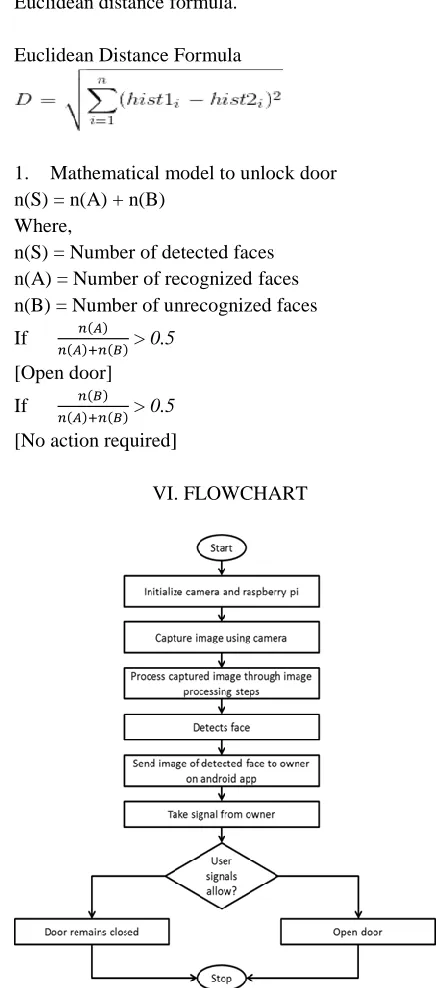
We can use different approaches to compute distance between two histograms such as Euclidean distance, Chi square, Absolute value etc. Here we can consider Euclidean distance formula.
Euclidean Distance Formula
1. Mathematical model to unlock door n(S) = n(A) + n(B)
Where,
n(S) = Number of detected faces n(A) = Number of recognized faces n(B) = Number of unrecognized faces
If ( ) ( ) ( ) > 0.5
[Open door]
If ( )
( ) ( ) > 0.5
[No action required]
IJIRT 148219
INTERNATIONAL JOURNAL OF INNOVATIVE RESEARCH IN TECHNOLOGY749
Fig 6.1 flowchart of door locks system
VII. CONCLUSION
Internet of Things is gaining vast focus in the area of technology wherein large number of devices are being connected to each other. Each devices can communicate with one another over internet in order to transfer data and are finding great usefulness in providing home security too. Image captured by camera is sent for processing by the face detection and face recognition sub-modules of the Server. Captured image of the person is sent to the owner’s Android application from where the owner can take action for authorizing the person standing at the door i.e. the owner can press the Unlock button. To provide home security the three domains namely IoT, Digital Image Processing and Android Platform have been used systematically because home is a prised possession in one’s life and it is one’s prime responsibility to protect it.
REFERENCES
[1] Hardik Asnani1, Suhaib Khan2, Suhaas Nandeesh3, Prarthana T.V, “Securing an IoT based Home using Digital Image Processing and an Android Application”, International Research Journal of Engineering and Technology (IRJET) Volume: 05 Issue: 08 | Aug 2018 Page 410 [2] Rishabh Kumar Gupta, S. Balamurugan, K.
Aroul and R.Marimuthu, “IoT Based Door Entry System”, Indian Journal of Science and Technology, Vol 9(37), 0974-5645
[3] Aman Pathak* Utkarsh Sundaram, “Smart Locking System f king System for Homes or Homes”, IJCTA, 9(21), 2016, pp. 83-86 © International Science Press
[4] K. Sri Viraja1 , K. Bharath Kumar2, C. Keerthi3, G. Sandeep, “IOT Based Smart Door System” International Journal for Research in Applied Science & Engineering Technology (IJRASET) Volume 6 Issue IV, April 2018
[5] Shahid Sohail Sajid Prawez C. K. Raina “A digital door lock system for the internet of things with improved security and usability” International Journal of Advance Research, Ideas and Innovations in Technology, Volume 4, Issue 3, 2018
[6] Pavithra.D M.E, Ranjith Balakrishnan “IoT based Monitoring and Control System for Home” Proceedings of 2015 Global Conference on Communication Technologies (GCCT 2015) Automation
[7] Anshika Agarwal1 , Nancy Hada1 , Deepali Virmani2 , Tarun Gupta, “A Novel Design Approach for Smart Door Locking and Home Security using IoT”, International Journal of Innovative Research in Science, Engineering and Technology Vol. 6, Issue 8, August 2017 Copyright to IJIRSET
[8] Anuradha. R. S, Bharathi.R, Karthika.K, Kirithika.S, S.Venkatasubramanian, “Optimized Door Locking and Unlocking Using IoT for Physically Challenged People”, International Journal of Innovative Research in Computer and Communication Engineering Vol. 4, Issue 3, March 2016.
[9] Sandesh Kulkarni, Minakshee Bagul, Akansha Dukare, Prof. Archana Gaikwad “Face Recognition System Using IoT” International Journal of Advanced Research in Computer Engineering & Technology (IJARCET) Volume 6, Issue 11, November 2017
[10]Md. Nasimuzzaman Chowdhury1 , Md. Shiblee Nooman2 , Srijon Sarker “Access Control of Door and Home Security by Raspberry Pi Through Internet” International Journal of Scientific & Engineering Research, Volume 4 [11]https://www.researchgate.net/publication/316699
790_Raspberry_Pi_Based_Security_System_On _IoT_Platform
[12] https://issuu.com/journalnx/docs/20150565-face-recognition-system