R E S E A R C H
Open Access
Analysis of sports image detection
technology based on machine learning
Wenrui Yang
Abstract
Current sports competitions are mostly broadcast in the form of live video or video files, and information detection for athletes and sports economic processes can also be carried out through image detection technology. However, from the current situation, we can see that sports image detection technology is still immature. Therefore, this study uses sports video as a material to analyze the application of sports image detection technology. In this study, image detection technology edge detection, grayscale processing, object capture, target recognition, etc. are combined with the actual needs of sports video to achieve a variety of needs for sports image detection. Simultaneously, this study has realized the recognition of athletes, motion recognition, sports behavior judgment, etc. and built a test platform to verify the effectiveness of this research method. The results show that the research method has certain practicality and can provide a theoretical reference for subsequent related research.
Keywords:Machine learning, Semantics, Image, Video content analysis, Image detection
1 Introduction
In the semantic analysis of video, how to extract the se-mantic concept of human thinking from video content is the focus of this research field. Crossing the semantic gap and achieving semantic concept level video retrieval is the most challenging research content in video con-tent research. The most common methods for solving such problems are to construct a semantic index of a specific domain through semantic analysis and semantic extraction of video content. For sports video, it generally has a relatively uniform semantic structure and shooting mode, so there is a certain convenience for the semantic analysis of sports events. Semantic analysis of video data, efficient retrieval of video, sharing of video data re-sources, and construction of video content analysis and management systems have far-reaching research signifi-cance and practical application value.
Columbia University’s Peng Xu et al. divided the struc-ture of the football game into two categories, running and stopping, and developed a detection system port. First, they calculated the grass color ratios in keyframes based on the color histogram, and based on these fea-tures, the keyframes were divided into three categories:
close-up, panorama, and close-up. Then, according to the sports video shooting and editing rules, it is judged whether the game is in progress or suspended. In the process of detection, the system is self-learning and adjusting according to the grass color and classification decision, which has the characteristics of self-adaptation, and finally gives the experimental results [1]. The same is the processing of the football game video; another article uses the hidden Markov model statistical method to estab-lish their own hidden Markov model group for the game to play and pause. Compared with the rule-based method, this method does not need to establish complex classifica-tion rules, nor does it need to determine the threshold, but directly learns through the training of the sample [2].
The production process of sports videos also has cer-tain rules that can be used to analyze video content. Ekin et al. studied the scenes of sports videos. They first divided the shots into distant shots, medium shots, close-ups shots, and off-site shots based on the main color distribution of the video images. For the semantic understanding of video content, many researchers start from the wonderful event detection of video and expand the semantic analysis of video content [3].
Correspondence:[email protected]
Department of Physical Education, Inner Mongolia University of Finance and Economics, Hohhot 010070, China
In the event detection of basketball video, Saur et al. proposed to directly use the MPEG compression domain feature to automatically analyze the basketball video content. The algorithm detects specific events by statisti-cally analyzing the magnitude and direction of motion vectors. Zhou et al. proposed a new idea based on the learning and classification of decision trees to analyze the content of basketball videos. They first extract the motion features, color features, and texture features from the video and then use the inductive learning method to learn the classification rules. The advantage of this method is that it can selectively use the under-lying features in classification identification, which im-proves the processing speed [4].
In the event detection of baseball video, the re-searchers also have different research conclusions for different aspects. For television broadcast video of base-ball games, the literature proposes a method for recog-nizing events based on video subtitles. Firstly, the subtitles in the video are extracted and analyzed and then related events in the baseball game are detected ac-cording to the changes of the subtitle information, and the start and end boundaries of the event are judged accord-ing to the color and motion characteristics of the frame image [5]. Chang et al. proposed a statistical-based method for detecting basketball video. Firstly, the video is segmented, and then the features such as color, shape, and camera motion are extracted in the lens. Finally, the hid-den Markov model is used to establish the recognition model of the event [6].
For the processing of sports videos, some scholars have proposed some general methods. Zhong et al. divided the detection of events into two steps: compression domain-based analysis and object level-domain-based verification. In the first step, according to the characteristics of the com-pressed domain, the primary selection of the event is real-ized by the method based on statistical learning. In the second step, the object segmentation is performed in the candidate scene, and the tennis game is the object of pro-cessing [7]. Nitta and Babaguchi propose a method for de-tecting events in sports videos with comprehensive text and visual features. First, the data is divided into four sets, defined as trainingset, validation setl, validationset2, and validationset3, and the classifier is trained with the first two sets, and the semantics of the third set is used to ob-tain the semantics of the classification [8].
University of Southern California’s Somboon Hongeng et al. proposed a method that uses semi-hidden Markov models to detect large events. This method allows for a semantic analysis of large events. The method first de-tects and tracks moving objects. Then, using the shape and motion characteristics of the object, the probability of occurrence of the sub-event is estimated according to the Bayesian network. Finally, the method uses
semi-hidden Markov models to combine sub-events to derive the probability of a composite event occurring, that is, to analyze the probability of occurrence of a se-mantic event [9].
Gu Xu et al. of Tsinghua University have developed a method for detecting motion events using HMM. According to this method, motion is the most important feature of the video semantic analysis, so motion can be described by a motion filter set response to a sequence of video frames. Then, the characteristics of these reac-tions are taken as parameters, the event-related key-words in the HMMs are called, and the text information is taken from the closed caption of the television signal to estimate the time period during which the event oc-curs. Finally, the characteristics of the lens in the time period are analyzed to detect the event-related lens [10]. Wh proposed a reasoning based on semantic reasoning for events in sports video. First, a semantic reasoning framework is established. The frame consists of three layers, a top layer, an intermediate layer, and a bottom layer. The middle layer uses neural networks and deci-sion trees to give semantics to video clips, and the top layer identifies events based on finite automata model inference. In the semantic analysis of video content, the detection of wonderful events is one of the most import-ant tasks. We divide the methods of wonderful event de-tection into two categories: extraction methods based on playback mode and extraction methods based on sub-jective perception [11].
The subjective feeling-based method defines the high-lights as the segments of interest in the video, which is based on the psychological principle to establish a sub-jective model, so that the highlights are detected [12]. Ma et al. propose a method for analyzing highlights based on user attention. The method integrates visual, auditory, text, and other information in the process of detection and finally extracts the wonderful segments in the video. Hanjalic uses a similar method to detect the highlights in the video based on the energy of the audio in the video, the intensity of the motion in the video, and the frequency of the camera’s switching [13]. Rui et al. proposed a method for detecting highlights based on the characteristics of the sound, and they dealt with the baseball game video. First, the voice of the commentator and the sound of the baseball hit are detected, and then the information of both is used to infer the final high-light [14].
2 Research methods
Identifying human motion requires the use of motion sen-sors to collect human motion data. Data acquisition com-ponents are often based on portable considerations and power considerations. It has no strong computing power, but it needs to have the equipment with strong computing ability to complete the functions of data pre-processing, recognition model training, and recognition. Therefore, the system needs to send data to the computing device by the data collector to realize motion recognition. Since the test environment will be selected in outdoor venues such as basketball courts, computing devices need to have some portability. This study uses support vector machine ex-pansion for the part of machine learning [15].
The sample setD= {(x1,y1), (x2,y2),…, (xm,ym)} is given.
Among them, yi∈(−1, +1). There are many hyperplanes
that can separate two types of samples. The support vector machine aims to find a hyperplane to make the generalization of the partitioning of the sample stronger. In the sample space, a divided hyperplane can be described as:
ωTxþb¼0 ð1Þ
Among them, ω= (ω1;ω2; …;ωd) represents the
nor-mal vector of the hyperplane, and b is the amount of translation, which determines the distance between the hyperplane and the origin. (ω,b) is used to represent the hyperplane, and the distance from any point in the space to the hyperplane can be obtained as [16]:
r¼ ω
Txþb
ω
j j
j j ð2Þ
We assume that the hyperplane can correctly classify the training samples, then (xi,yi)∈D. If yi= + 1, then
ωT
xi+b> 0. Ifyi= −1, thenωTxi+b< 0.
ωTx
iþb>þ1;yi¼ þ1
ωTx
iþb<−1;yi¼−1
ð3Þ
The few training sample points closest to the hyper-plane make the (2–25) equations, they are called
“support vectors.” The sum of the distances of the two heterogeneous support vectors to the hyperplane is:
γ¼j jj jω2
s:t:yi ωTxi
≥1;i¼1;2;…;m 8
<
: ð4Þ
min ω;b
1 2j jj jω
s:t:yi ωTxiþb
≥1;i¼1;2;…;m 8
<
: ð5Þ
Equation (5) is solved to obtain the optimal hyper-plane. This is the support vector machine and the basic model for studying machine learning.
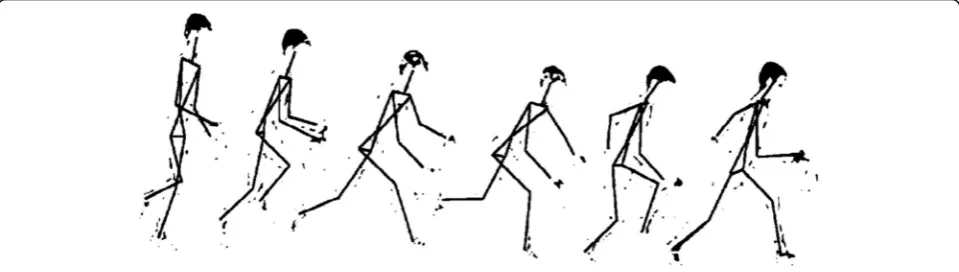
Before the plan and strategy are determined, the objec-tives of the classification need to be analyzed, and the processes and means used are determined according to the characteristics of the classification actions. Analysis of technical movements requires the creation of abstract models of the human body. Therefore, this chapter, ac-cording to the human skeleton model, needs to analyze the characteristics of technical actions by decomposing actions. Finally, according to the characteristics of tech-nical actions, the strategies and schemes most suitable for action classification are selected. Since different people have different understandings of the same action, or there are differences in details in the definition, it is first necessary to clarify the goal of the problem before analyzing and identifying the action. Therefore, a unified definition and explanation of the target actions of this study is first carried out. In the study, the shot image was identified and analyzed. Through the exploded view of the side motion of the basketball dribble, the human skeleton model can be established (Fig.1). Through the changes of the human skeleton model, it can be intuitively seen that during the completion of the technical movement, the movements and changes of the limbs are the largest, and the movement state of the trunk is less obvious. In gen-eral, during the completion of the technical action, the trunk can roughly reflect the overall movement state and the trend of the center of gravity of the entire person.
In the background processing of image detection, be-cause the background of sports video is relatively com-plicated and there are a lot of motion disturbances such as viewers and pedestrians, it is difficult to obtain a static background, and it is difficult to obtain a stable motion prospect directly through background subtrac-tion. In addition, the method of background modeling is more complicated and time-consuming. Therefore, this study uses the first frame as a background image in ac-tual research. After the background is subtracted, binari-zation is performed, a corrosion is performed, and two expansion treatments are performed to obtain a complete foreground area of motion. The results are shown in Fig.2.
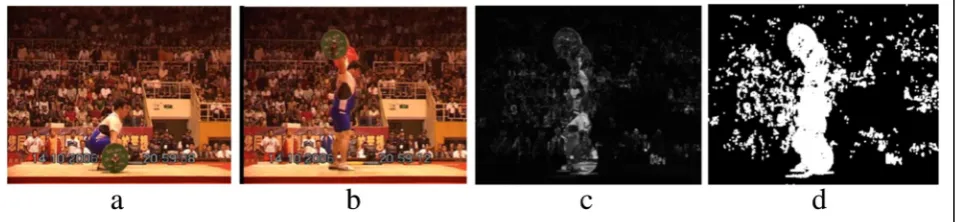
When the game environment is more complicated, the difference between the first frame and the subse-quent video frames will introduce a lot of noise, which will make the foreground detection difficult. Therefore, the method of detecting the foreground area by using the first frame picture as the background is not reli-able. This study attempts to obtain the foreground re-gion of motion through the method of inter-frame difference (Fig. 3). Firstly, through the method of inter-frame difference, the grayscale image of the dif-ference between frames is obtained, and then the bina-rization processing is performed, the corrosion is performed once again, the expansion process is per-formed twice, and the foreground is segmented to ob-tain the motion foreground.
It can be seen from the experimental results that the method of inter-frame difference can well detect the contour of the moving target. However, in the process of weightlifting, the limb movement has local charac-teristics, the gap between the frames will form a void, and the foreground area obtained by the segmentation is incomplete, making the detection area inaccurate. In the initial stage and the squatting stage, the athletes exercise too slowly, which makes the inter-frame dif-ference method detection invalid, and sometimes the motion prospect cannot be obtained at all. Therefore, we propose a foreground region detection method based on inter-frame differential accumulation.
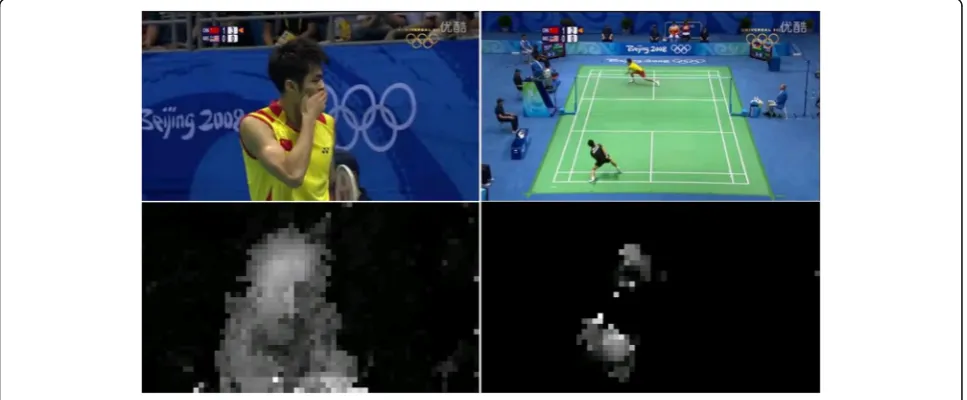
This paper uses Matlab to carry out the simulation ex-periment of background difference detection target, and through the analysis of the experimental results, the tar-get detection method based on the background differ-ence method is improved. The target detection of this study is a simulation experiment conducted under the Windows 7 operating system and the Matlab software platform. Matlab is a mathematical software developed by MathWorks for data analysis and calculation, algo-rithm development, and data visualization, which is an interactive advanced computer language. Figure4 shows the dynamic model saliency area.
Compared to statistical histograms, cumulative histo-grams increase the amount of data stored and the amount of computation. However, this increase in a small amount of complexity eliminates the zero-value regions that are common in statistical histograms and overcomes the drawbacks of the effects of quantization over thickness in statistical histograms. Its formula is as follows:
I kð Þ ¼Xk
i¼0 nk
N;k¼0;1;…;L−1 ð6Þ
Gradient is an important feature of edge extraction. In grayscale images, edges can be measured by gradi-ents. The gradient is the rate of change of the value of a point in the gray image in the horizontal direction and the vertical direction. To get the gradient in these two directions is very simple, as long as the discrete partial differential operator is used to convolute the image in these two directions. Gradient vector refers to the combination of the obtained gradients in these two directions as components. Then, we can use the size of the gradient vector to represent the edge value of the point. Here, the convolution formula is:
h xð ;yÞ ¼X
u
X
vf xð −u;y−vÞg uð ;vÞ ð7Þ
Among them,g(x,y) represents a convolution kernel and f(x, y) represents a discrete grayscale image. The convolution kernel is a square matrix template. As-suming that the image frame to be processed contains a total of m pixels, and the convolution kernel is a
square matrix of size 3, the time complexity of the above equation is O(9m). The Sobel edge algorithm and the Prewitt edge algorithm are commonly used al-gorithms for detecting image edges. Figure5a–d repre-sent the convolution kernels of the two algorithms.
Considering that the color image has three compo-nents, we can calculate the gradients of the three com-ponents separately, then superimpose the three gradients and use the gradient obtained by the super-position to represent the edge values. In addition, we can also grayscale the color image and then extract the corresponding gray image edge. Since the color con-version and convolution operations are linear, the two methods are actually equivalent. However, there is a deficiency in doing this, that is, the color information of the image is lost. In this way, it is not possible to ex-tract the edges of the color image by simply superim-posing the three components. The edge processing method of the color image is given below. This method uses the Prewitt operator to process the image. In the gray image, we first calculate the Prewitt edge
detection operator in the xdirection and then bring it into the convolution formula, then we can get:
h xð ;yÞ ¼ f xð þ1;yþ1Þ−f xð −1;y−1Þ
þf xð þ1;yÞ−f xð −1;yÞ þf xð þ1;y−1Þ−f xð −1;y−1Þ
ð8Þ
As can be seen from the above formula, in fact, as long as the sum of the grayscale differences of the three pairs of points around a point is obtained, the gradient of the point can be obtained. If this method is applied to the vector space of a color image, it is only necessary to re-place the sum of the grayscale differences with the sum of the vector modes. That is in the color image:
h xð ;yÞ ¼jjf xð þ1;yþ1Þ−f xð −1;y−1Þjj
þjjf xð þ1;yÞ−f xð −1;yÞjj þjjf xð þ1;y−1Þ−f xð −1;y−1Þjj
ð9Þ
Among them, f(x,y) is the vector point in the color image, and the polynomial ||a−b|| represents the
Fig. 3Inter-frame difference method.aGrayscale image.bBinarization image.cEdge image after split inspection
modulus of the vectors a and b. This method counts each color component information of the color image, and there is no loss of image information. Thus, for each color pixel, the entire color pixel vector is considered, and the three color components of each pixel are also considered. Of course, we can also calculate the Prewitt edge detection operator in the x direction and then bring it into the convolution formula, so that the gradi-ent in theydirection can be obtained as follows:
h xð ;yÞ ¼jjf xð þ1;yþ1Þ−f xð þ1;y−1Þjj
þjjf xð ;yþ1Þ−f xð ;y−1Þjj
þjjf xð −1;yþ1Þ−f xð −1;y−1Þjj
ð10Þ
The Color-Prewitt algorithm is an algorithm for de-tecting the edges of an image taking into account both the x and y directions. Similarly, the Color-Sobel algo-rithm in thexdirection is:
h xð ;yÞ ¼jjf xð þ1;yþ1Þ−f xð −1;yþ1Þjj
þ2jjf xð þ1;yÞ−f xð −1;yÞjj þjjf xð þ1;y−1Þ−f xð −1;y−1Þjj
ð11Þ
The Color-Sobel algorithm in theydirection is:
h xð ;yÞ ¼jjf xð þ1;yþ1Þ−f xð þ1;yþ1Þjj
þ2jjf xð ;yþ1Þ−f xð ;y−1Þjj
þjjf xð −1;yþ1Þ−f xð −1;y−1Þjj
ð12Þ
One thing to note is that the gradient value is a scalar, so the edge value represented by the gradient is also a scalar.
3 Results
In order to study the effectiveness of the proposed algo-rithm, basketball is taken as an example for the analysis. The experiment carried out in this section is to verify the effectiveness of the detection feature proposed by the algorithm that basketball video scoring event is the free throw. In order to determine the minimum time interval between the suspension of the game and the start of the free throw, the samples in the training set were counted. The results are shown in Table1.
Among them, V0 to V5 represent different basketball game videos as training samples. The goal score in the table refers to the score conversion of the score after the game is suspended (in actual situations, the change in the score corresponding to the game goal may occur after the game is suspended, such as the game is sus-pended while the ball is being played). According to the determined threshold, the detection result of whether the goal in the basketball video is the free throw is as follows.
Among them, V6 to V11 represent six different bas-ketball game videos in the test set. According to the ex-perimental results, it can be seen that the characteristics proposed by the algorithm in this paper can effectively judge whether the basketball video scor-ing event is a free throw.
Two experiments were conducted in this study. The first experiment is the comparison of the accuracy of dif-ferent models for the numerical recognition before and after the conversion, and the second experiment is the three-point detection in the algorithm. The score digital recognition experiment first compared three different chained CRF models. The first is to independently iden-tify the scores before and after the conversion (max-imum entropy model ME), the second is the general form of first-order chain CRF (LC-CRF), and the third is the domain-based recognition model, KE-CRF. The
Fig. 5Prewitt operator and Sobel operator.aPrewitt edge operator in thexdirection.bPrewitt edge operator in theydirection.cSobel edge operator in thexdirection.dSobel edge operator in theydirection
Table 1Correspondence between the time interval between the suspension of the game and the change of the score with whether the goal is a free throw (video frame rate is 25)
Video V0 V1 V2 V3 V4 V5 Total
Match score # 35 35 35 34 35 35 209
Minimum value (frame)
23 18 2 1 14 37 21 18
Maximum value (frame)
103 105 125 186 102 85 186
Free throw # 17 19 20 13 11 13 93
Minimum value (frame)
615 547 694 592 646 646 547
Maximum value (frame)
experiment tested six different basketball game videos in the data set. The experimental results are shown in Tables2and3.
The test result of whether the basketball video score based on KE-CRF is a three-pointer is as follows (Table4).
4 Discussion and analysis
The commonly used functions are summarized as fol-lows: (1) The VideoReader() function and the read() function are pre-processing functions for the video. Among them, the VideoReader() function can be used to input a video and return a sequence of images. This function is more powerful in Matlab 2014 and can read videos in multiple formats. The read() function reads the image of each frame from the video sequence returned by the VideoReader() function and returns the image for subsequent use. (2) The rgb2gray() function converts RGB images into grayscale images. Since current video capture devices generally acquire color image video, and grayscale images are often used in later processing, this function is often used. (3) The imabsdi ff() function is a mandatory function of the background difference method. (4) The im2bw() function is also a function that must be used in the background difference method. Its function is to convert grayscale images into binary im-ages. (5) imdilate() and imerode() functions and imo-pen() and imclose() functions are the four mathematical morphology functions, which represent expansion and corrosion function and open and close operations, re-spectively. Mathematical morphology processing of the binarized image can result in a better target area. This study combines the actual situation to improve the algo-rithm, combines various algorithms to achieve innovation, and applies it to sports video image processing.
There are many ways to describe image color features, where color histograms are a widely used color feature. At the same time, color histograms are mostly used in the judgment of team colors. The color histogram does not care about the spatial position of the color. It de-scribes the proportion of different colors in the whole image, which can reflect the statistical distribution and basic color of the image color, and is easy to calculate. Especially for images with significantly different back-ground and foreback-ground color distributions, a bimodal characteristic appears on the histogram, so that the fore-ground and backfore-ground can be distinguished according
to the histogram relationship. Therefore, this study uses a cumulative histogram to distinguish.
Through the observation of sports videos, it is found that in different sports teams, different players will have the same number. In this case, players with the same jersey number should be distinguished according to the team. In sports competitions, in order to distinguish be-tween the players of each team and the referees, the color of the players and referees of each team is obvi-ously different. In particular, the jersey colors of the players on both sides of the game are significantly differ-ent, and because the home and away are differdiffer-ent, one party is sometimes brighter and the other is darker. Therefore, this paper uses the detected color characteris-tics of the player or jersey area to measure the similarity, thus judging the team’s team, and laying the foundation for the subsequent player identity certification.
When all possible colors are not included in an image, some areas with an eigenvalue of zero will appear in the statistical histogram. These areas with zero eigenvalues affect the measure of similarity and do not correctly re-flect the color difference between the images. The cu-mulative histogram is proposed to solve this problem, and it can better reflect the difference in features be-tween images. In the cumulative histogram, adjacent colors are statistically related in frequency.
It can be seen from the experimental results that the ME model does not consider the constraints of the con-version mode of the score number, and the recognition rate is the lowest. In the experiment, LC-CRF misidenti-fied part of the score number into an impossible pattern, such as (2,6). This indicates that this model cannot auto-matically learn the domain knowledge of the score trans-formation mode through the training data. In comparison, the KE-CRF model proposed in this chapter can achieve higher score digital recognition accuracy. The experiment
Table 2Recognition result that whether the type of goal score in the basketball video is a free throw
Video V6 V7 V8 V9 V10 V11 Total
Yes/total 8/8 3/3 5/5 5/5 7/7 3/3 31/31
ACC (%) 100 100 100 100 100 100 100
Table 3Comparison of the accuracy of score recognition before and after conversion of different CRF models
Video V6 V7 V8 V9 V10 V11l Total
ME Yes/total 39/41 41/41 39/42 48/49 40/42 28/30 233/245
Accuracy (%) 95.1 100 92.9 98.0 95.2 93.3 95.9
LC-CRF Yes/total 40/41 41/41 40/42 48/49 41/42 28/30 238/245
Accuracy (%) 97.6 100 95.2 98.0 97.6 93.3 97.1
KE-CRF Yes/total 40/41 41/41 42/42 49/49 38/42 30/30 240/245
Accuracy (%) 97.6 100 100 100 90.5 100 98.0
Table 4Test result that whether the basketball video score is a three-point
Video V6 V7 V8 V9 V10 V11 Total
Yes/total 32/33 38/38 37/37 44/44 35/35 27/27 213/214
also compares the score recognition model proposed in this chapter with the score digital recognition model pro-posed in the existing work. According to the experimental results, the recognition accuracy of the recognition model based on Zernike Moment + template matching is less than 80%, and the accuracy of the digital recognition model based on shape features is 90%.
The experimental results show that the accuracy of KE-CRF in the accuracy of three-point detection is higher than that of digital recognition. This is because accurate free throw test results help reduce errors that the model may make when identifying (e.g., mistaking the score from 5 to 6 as a score from 5 to 8). This verifies the effective-ness of the proposed algorithm in a variety of models.
5 Conclusion
Based on the detection of sports video content, this paper deeply analyzes the construction and optimization tech-nology of depth model, and according to the characteris-tics of depth model, the migration learning technology based on the deep network is analyzed. The classifier is trained to classify and achieve the best results. It can be seen that the combination of the depth model and the traditional machine learning algorithm is a feasible solu-tion. Identifying human motion requires the use of motion sensors to collect human motion data. Data acquisition components are usually based on portable considerations and power consumption considerations. It does not have a strong computing power but requires devices with strong computing power to perform data pre-processing, recogni-tion model training, and recognirecogni-tion funcrecogni-tions. Therefore, the system needs to send data to the computing device by the data collector to realize motion recognition. At the same time, this study uses a support vector machine to carry out the machine learning process, and the corre-sponding algorithm is formulated. Meanwhile, this study combines image recognition and image processing tech-nology to realize the recognition of sports process. Finally, the research algorithm is combined with the traditional model to identify and analyze the basketball video, and the experimental analysis is carried out. The first experiment is a comparison of the accuracy of different models for the identification of scores before and after conversion. The second experiment is the three-point detection in the algo-rithm. The research results show that the sports image de-tection technology of this study has certain practicality.
Acknowledgements
The authors thank the editor and anonymous reviewers for their helpful comments and valuable suggestions.
Funding Not applicable.
Availability of data and materials Please contact author for data requests.
Author’s contributions
The author took part in the discussion of the work described in this paper. The author read and approved the final manuscript.
Competing interests
The author declares that she has no competing interests.
Publisher’s Note
Springer Nature remains neutral with regard to jurisdictional claims in published maps and institutional affiliations.
Received: 26 October 2018 Accepted: 2 January 2019
References
1. K. Yamamoto, H.W. Guo, S. Ninomiya, Node detection and internode length estimation of tomato seedlings based on image analysis and machine learning. Sensors16(7), 1044 (2016)
2. T. Toulouse, L. Rossi, T. Celik, et al., Automatic fire pixel detection using image processing: a comparative analysis of rule-based and machine learning-based methods. SIViP10(4), 647–654 (2016)
3. S. Hong-Wei, Z. Tao, T. Xin-Guang, Experiments and analysis for intrusion detection method based on machine learning. Comput. Eng. Des.27(6), 108–114 (2004)
4. G. Petropoulos, P. Partsinevelos, Z. Mitraka, Change detection of surface mining activity and reclamation based on a machine learning approach of multi-temporal Landsat TM imagery. Geocarto Int.28(4), 323–342 (2013) 5. Y. Chen, W. Xu, F. Kuang, et al., The research and application of visual
saliency and adaptive support vector machine in target tracking field. Comput. Math. Methods Med.2013(7), 925341 (2013)
6. W. Songyang, W. Pan, L. Xun, et al., Effective detection of android malware based on the usage of data flow APIs and machine learning. Inf. Softw. Technol.75(C), 17–25 (2016)
7. S. Alshareef, S. Talwar, W.G. Morsi, A new approach based on wavelet design and machine learning for islanding detection of distributed generation. IEEE Trans. Smart Grid5(4), 1575–1583 (2014)
8. B.V. Ginneken, Fifty years of computer analysis in chest imaging: rule-based, machine learning, deep learning. Radiol. Phys. Technol.10(1), 23–32 (2017) 9. A. Verma, V. Ranga, Statistical analysis of CIDDS-001 dataset for network
intrusion detection systems using distance-based machine learning. Proc. Comput. Sci.125, 709–716 (2018)
10. P. Mishra, V. Varadharajan, U. Tupakula, et al., A detailed investigation and analysis of using machine learning techniques for intrusion detection. IEEE Commun. Surv. TutorialsPP(99), 1 (2018)
11. G.A.P. Singh, P.K. Gupta, Performance analysis of various machine learning-based approaches for detection and classification of lung cancer in humans. Neural Comput. & Applic.1, 1–15 (2018)
12. F. Narudin, A. Feizollah, N. Anuar, et al., Evaluation of machine learning classifiers for mobile malware detection. Soft. Comput.20(1), 343–357 (2016) 13. D.R. Pereira, F.A.D. Silva, H. Molinasapia, et al., Intrusion detection system
based on flows using machine learning algorithms. IEEE Lat. Am. Trans. 15(10), 1988–1993 (2017)
14. A. Banharnsakun, Hybrid ABC-ANN for pavement surface distress detection and classification. Int. J. Mach. Learn. Cybern.8(2), 1–12 (2015)
15. R.R. Chhikara, P. Sharma, L. Singh, A hybrid feature selection approach based on improved PSO and filter approaches for image steganalysis. Int. J. Mach. Learn. Cybern.7(6), 1195–1206 (2016)