R E S E A R C H A R T I C L E
Open Access
Chip-based adaptive skin color detection using
trajectory constraints on hue
Ying-Hao Yu
1*, Tsu-Tian Lee
2,5, Ngai-Ming Kwok
3and Pei-Yin Chen
4Abstract
Background:In a construction site, the safety of workers can be better secured if vehicle or robot can be properly maneuvered by using image-based gesture guidance. This kind of semi-automatic motion control is based on the features extracted in colors, outlines, textures, and motion intentions. Among these features, detecting worker?s skin color on face and hands could serve as an essential method for enabling robot to determine the region of interest (ROI). However, the performance of skin detection is usually unreliable due to interferences from reflections and shadows. Although many efficient skin color detection methods had been developed in past years, those are mostly based on complicated learning and statistical processes and are unsuitable for embedded systems. The exploration of a concise and efficient skin color detector, therefore, becomes a challenge for applications in mobile robots.
Method:In this paper, we propose a novel adaptive skin detector on face and hands as a fundamental capability of a gesture tracking system. This approach enhances the detection performance of traditional HSV color space but only requires a low computing power. For the design criteria of small size, low-power, low-cost, and minimum computing resource usages on mobile robots, the entire detecting system is built on single field-programmable-gate-array (FPGA) chip. Meanwhile, besides the contributions of adaptive algorithms and FPGA chip designs, the proposed skin detector also employs a touch screen to designate expected skin color of worker as the human-robot interaction (HRI) in real-time.
Results:The chip design of the FPGA is based on hardware circuits in register-transfer-level (RTL) for real-time image processing. A reasonable amount of hardware resource usages of FPGA have consumed 8% of logic elements (LEs) and 1.4% for embedded random access memory (RAM). Demonstrations with various pictures had indicated that sufficient ROI can be efficiently identified by using the proposed adaptive skin color detector.
Conclusions:According to our experimental results, the proposed adaptive skin detection can work well for non-ideal illumination. It has demonstrated the reliability and feasibility on supporting the embedded robotic control in the future.
Keywords:Gesture tracking; Skin color detection; Color space; Field-programmable-gate-array (FPGA); Trajectory constraints on hue (TCH)
Background
In past years, skin color detection has been regarded as an essential component in human-robot interaction sys-tems for analyzing human intentions (Kim et al. 2006; Luo et al. 2011). This methodology had become popular because it requires a lower computing effort than other image processing approaches even though skin color analysis is a fundamental area of pattern recognition. Recently, we have also developed a chip-based gesture
tracking system by cooperating with motion detection to control mobile robots on construction sites (Yu et al. 2014). Our system simulated a robot to receive worker?s instructions by detecting a traffic light baton on his hand. Once our gesture tracking system confronts the situation of similar lighting sources on the same field, localizing traffic light baton involving regional infor-mation of worker?s face and hands will be an efficient and feasible scheme.
In this paper, we propose an adaptive skin color detection strategy by using single FPGA chip. We replaced image col-lection and training processes with a touch screen as the * Correspondence:[email protected]
1
Department of Electrical Engineering, National Chung Cheng University, No. 168, University Rd, Min-Hsiung Township, Chiayi County 62102, Taiwan Full list of author information is available at the end of the article
of images, a novel adaptive algorithm named trajectory constraints on hue (TCH) is proposed to dynamically adjust the thresholds of skin color detection.
The contributions of our work rest on the economic cir-cuit resource usages on chip, satisfactory real-time perform-ance, high detection rate under non-ideal illumination, and convenience in installation. Comparing with the state-of-the-art technologies either based on PC simulations and FPGA chip designs, our skin color detection system can achieve superior detecting rate under severe tests. While nowadays efficient skin color detection mostly relies on the complicated algorithms, intelligent learning, skin texture analysis, working on high-end computers or a large amount of FPGA gates count; our concise skin color detection pro-vides the answer to improve detection rates on embedded systems and miniature robots.
In the rest of this paper, the background of skin color detection will be first reviewed. Next, the relationship between HSV and RGB color spaces and the mechanism of the proposed skin color detection by using TCH will be presented. The configuration of chips, hardware re-source usages, and the performance of the proposed skin color detection will be described in fourth section. The final sections contain the discussion and the conclusion.
Background
In designing a skin color detection system, there are many color spaces that can be chosen to obtain the components of skin color. The initial idea comes from the use of thresholds to examine human skin color with the red (R), green (G), and blue (B) color space. Human skin color can be determined by the specific magnitudes of R, G, and B. This kind of RGB thresholding method has been recognized as unreliable in that the imaged skin color is highly dependent on the combination of luminance on the skin and results in poor resistance to non-ideal illumination, e.g., shadows and reflections (Yang et al. 2010). Although the design by using multi-intensity thresholds can mitigate the interferences of shadows and reflections, complicated calibrating pro-cesses for different intensity thresholds become another problem for implementation (Yu et al. 2011). Conse-quently, modern color detection systems prefer to use color attributes for detection, which are improved from the use of RGB color space for independent color com-ponents and discarding intensity, e.g., Normalized RGB, YCbCr, YUV, YIQ, and HSV (Chaves-Gonz?lez et al. 2010; Liu et al. 2009). With these kinds of color spaces,
tions usually shift skin color beyond thresholds and degrade detection performance if intensity-independent color spaces were used (Zhu and Cai, 2011). This leads to skin color detection methods developed on the basis of adaptive or learning methodologies. For example, Liu employed a variable as the learning rate of histogram to adapt to different environments and then improved skin color detection by using morphological operations (Liu and Peng 2010). Similar work can be also found on (Li et al. 2013); where authors simply adopted a ratio to evaluate the deviation distance from centroid value of skin color. This proportion played the role as a threshold to refine their skin color maps in the database. More-over, Khan et al. (2011) designed a skin detector by using RGB color space and Bayesian-based classifiers training, which contained about 5000 samples of skin samples. Chenaoua and Bouridane (2006) employed the Markov Random Field to estimate the distribution of skin pixels in images. Fotouhi et al. (2009) combined with YCbCr, texture extraction, Gaussian mixture models, multi-layer perceptron, and artificial neural networks to perform a comprehensive skin detector. In summary, adaptive skin color detection usually has higher detection rate than methodologies based on traditional color spaces. Par-ticularly for the system designed with learning capabil-ities, the regions of skin color can be reliably detected except small areas on chin, neck, and fingers.
In general, skin color detection based on high-level statis-tics and machine learning usually requires huge computing resources. In spite of the sufficient performance with static image analysis, these methodologies usually result in low frame rate and therefore are unsuitable for tracking with embedded video systems without any modification (Fotouhi et al. 2009). On the other hand, traditional skin color detec-tion working on basic color space thresholds cannot pro-vide enough quantity of detection for real-life applications. These design dilemmas had motivated our work both on computer- and embedded-based systems, which provides excellent detection rate to provide ROI of targets for further pattern recognition processes.
Methods
Relationship between RGB and HSV
Many intensity independent color spaces can be utilized for skin color detection. Here we have adopted HSV color space after considering the advantage of separating skin color in hue, saturation, and intensity. The distribu-tion of hue and saturadistribu-tion on a circular plan is conveni-ent to develop an algorithm for examining the trajectory variation of skin color.
The HSV color space is known as an improvement from traditional RBG color space. The term of H de-notes the hue (or color-depth), and S is for saturation (or color-purity). Intensity is represented as V (or bright-ness). The algorithm for converting RGB into HSV color space can be expressed as the follows (Chaves-Gonz?lez et al. 2010):
H?
Undefined; if MAX? MIN 60?G−B?
MAX−MIN; if MAX? R and G≥B 60?G−B?
MAX−MIN? 360; if MAX? R and G<B 60?B−R?
MAX−MIN? 120; if MAX? G 60?R−G?
MAX−MIN? 240; if MAX? B
8 > > > > > > > > > > > < > > > > > > > > > > > :
? 1?
and
S?
0; if MAX? 0 MAX−MIN
MAX Otherwise
(
? 2?
V? MAX ? 3?
whereMINandMAXin equations (1) to (3) denote the RGB-intensity bound in [0,1]. The distribution of hue is usually plotted as a circular plan in four quadrants, and the plan radius is equivalent to the saturation value S. Hue is composed of red, green, and blue colors changing by every 120∘. When the HSV color space is plotted as a 3D model, the part right under the H-S circular plan is the intensity V of color space, which is in an inverted conical shape.
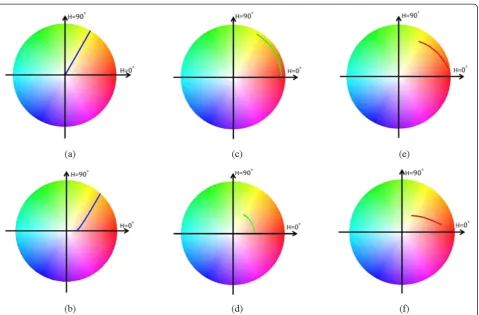
As shown in Figure 1, by changing the magnitudes of RGB from the scale of 0 to 255 with constraints forR≥ G≥B, the variation of blue are approximately the S, and adjusting green will obtain H. On the other hand, the trajectory of red color combines with the features of H and S at the same time. According to the studies of Vezhnevets et al. (2003) and Lin et al. (2011), human skin color can be roughly classified asR>G>B, and dif-ferent skin colors can be derived by adjusting R, G, or B magnitude arbitrarily within the constraints. By avoiding the use of intensity value, the variation of skin color is the same as the changes of H and S.
Based on above discussion, most colors can be simulated by altering the positions of colors in constraints. For ex-ample, the relationship ofR>B>Gresults in a pink color and the B trajectory becomes H instead. If we continually increase the magnitude of B, the output of color will be closer to vivid blue in a clockwise direction for B>R>G
towards the plan boundary. Since the behavior of color be-tween upper and lower constraints is similar to hue, here we define the color in the middle as the dominant color. Therefore, it can be seen that human skin color is domi-nated by green.
The definition of H-S plan
According to the discussion in the last sub-section, the intensity V could be neglected in skin color detection. Al-though skin color may look different under dim environ-ments, one can achieve skin color discrimination by only examining the variations on hue and saturation. When de-tecting skin color by using HSV color space, the H-S plan can be plotted as in Figure 2(a). The coordinate of cen-troidTof skin color map can be expressed as:
Tx? ScosH ? 4?
Ty ? SsinH ? 5?
thus
S?
ffiffiffiffiffiffiffiffiffiffiffiffiffiffiffiffiffi
T2x? T2y q
? 6?
where the hue H in equations (4) and (5) is equivalent to the angle suspended by vector T, and S is the radius of the circular plan. Based on the coordinate ofT, an ini-tial skin color map can be defined by four points of as:
TA? H;S? ? ? HT? EH;ST−ES? ? 7?
TB? H;S? ? ? HT−EH;ST−ES? ? 8?
TC?H;S? ? ?HT−EH;ST? ES? ? 9?
TD?H;S? ? ?HT? EH;ST? ES? ? 10?
the range of initial skin color map F, as shown in Figure 2(b). The intensity scale of H-S plan is [0, 255] for an 8-bits digital system. Thus the coordinates of initial skin color map are:
TA x? ?;y ? ?STAcosHTA;STAsinHTA? ? 11?
TB x? ?;y ? ? STBcosHTB;STBsinHTB? ? 12?
TC x? ?;y ? ? STCcosHTC;STCsinHTC? ? 13?
TD x? ?;y ? ? STDcosHTD;STDsinHTD? ? 14?
According to equations (7) to (10), various skin color can then be obtained by adjusting the range of H and S. Chen et al. (2012) had defined humans skin colors by using constraints of 0≤H≤50 and 51≤S≤173. Before
Figure 1The trajectories in HSV color space by adjusting R-G-B color individually; (a) R = 255,G = 250,B = 0 ~ 255, (b) R = 146,G = 115,
B = 0 ~ 115, (c) R = 240,G = 20 ~ 240,B = 20, (d) R = 170,G = 100 ~ 170,B = 100, (e) R = 52 ~ 255,G = 52,B = 12, (f) R = 92 ~ 255,G = 92,B = 60.
(b)
(a)
this, Yang et al. (2011) had also defined the skin color for the east Asian races by using the constraints of 14.4≤H≤46.8 and 69.615≤S≤149.55. Here we define the centroid point T by using 3≤H≤18 and leave S as undefined in that value is varied to different human races and can be dynamically determined by touch screen. Finally, the tolerance of skin hue is set forEH= ? 25 and the range of ES= ? 30 is for saturation testing based on our experiments. This arrangement leads to TCH?s adapt-ability on H which will mostly stop around yellow and only a small amount of sampled greenish color will be passed at low saturation.
Skin color detection by using TCH algorithm
After described the H-S plan characteristics, next we can determine an adaptive skin color threshold by using the TCH algorithm, which can be discussed as in the follow-ing cases.
1. |Hi−HT|≤25 and |Si−ST|≤30:
If the input of sampled image pixel color (Hi,Si) always falls into the region of initial skin color mapFas shown in Figure 2(b), this pixels is defined as corresponding to human skin.
2. |Hi−HT|≤25 and |Si−ST| > 30:
These kinds of input colors indicate that pixels in image have exceeded saturation values of the initial skin color map F but are still with acceptable hue. Since the saturation value is impossible for human skin color, the locations of these pixels in picture are defined as the non-skin areas.
3. |Hi−HT| > 25 and |Si−ST|≤30:
Skin color may vary slowly in hue by reflections and il-lumination. It makes it difficult to determine skin color without learning capability, as shown in Figure 3(a). Once any sampled image pixel color first conforms to this case, the adaptive algorithm using TCH is triggered and then proceeds in the following steps:
a. Record the pixel saturation value S as a constant, which is from the last colorT0before exceeding the initial skin color mapF, as shown in Figure3(a) and (b). This procedure ignores the effects from saturation besidesF. In other words, S will be unvalued if H is too far away from centroid T. b. If incoming image pixels colors are all outside the
region ofF, the proposed TCH will continually replace these image pixels? saturations fromT0? otherwise the system resets its operation to the initial condition. Such arrangement leads to varying trajectories of image pixels colors beyond both sides
(c)
(b)
(a)
Figure 3The operations of TCH algorithm; (a) incoming image pixels? colors exceeding out of skin regionF, (b) updating colors?
saturations with homogenous value ofT0, (c) examining slope using line
TnTn? 1.ofFand will all follow a concentric circle, as shown in Figure3(b). This results in a simple and adaptive skin color detection process which only needs to examine the variances on the pixel?s hue.
c. Examining the slope of line
TnTn? 1 after obtained the coordinates of pointsTAtoTD, as shown in Figure3(c);Tn, andTn+1are derived based onequations (4) to (14), and the corrected hue trajectory of line
TnTn? 1 will run on a circle as tangent. Once the slopemTof tangentTnTn? 1 exceeds the slopes constraints of four linesTn?1TA,Tn?1TB,Tn?1TC,and
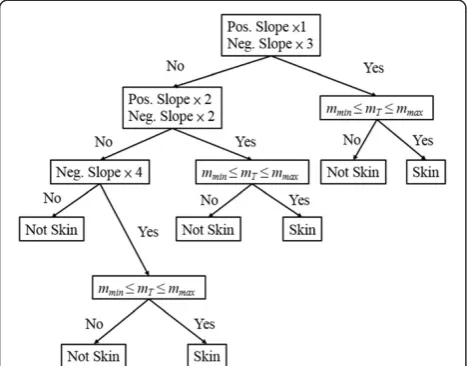
Tn?1TD, the pixel color at pointTn+ 1is defined asa non-skin color and then the system is reset to the initial condition. The examination mechanism can be represented in a decision tree shown in Figure4. The
mminandmmaxin the tree denote the upper and lower constraints of four lines?slopes respectively. The slopes of
Tn?1TA,Tn?1TB,Tn?1TC, andTn?1TD on bothsides of skin color mapFcan be summarized for three conditions atHi≥0:
State_1: One positive slope (?1) and three negative slopes (?3).
State_2: Two positive slopes (?2) and two negative slopes (?2).
State_3: The slopes of the four lines are all in negative (?4).
(b)
(a)
(c)
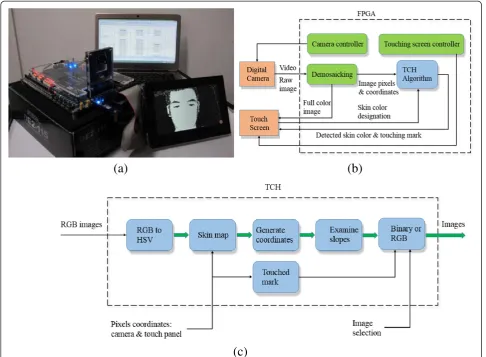
Figure 5The proposed chip-based skin detection; (a) System setup, (b) FPGA block diagram, (c) TCH block diagram.
Table 1 FPGA resource usages of proposed skin color detection
Chip family Cyclone IV E
Device EP4CE115F29C7 N
Total logic elements 9,216 LEs/114,480 (8%)
De-mosaicking and camera controller 1,275 (1.1%)
TC algorithm 7,646 (6.7%)
Touch screen control 295 (0.2%)
Embedded multiplier 9-bit elements 21/532 (3.9%)
Total embedded memory bits 57,400 bits/3,981,312 (1.4%)
The detected skin color below line T―――BTD represent lip
and blood vessel colors which can be judged as a part of the skin.
Results
Figure 5(a) shows the hardware setup of the proposed skin color detection system. A touch screen is employed
(d)
(c)
(b)
(a)
(h)
(g)
(f)
(e)
(l)
(k)
(j)
(i)
(p)
(o)
(n)
(m)
(t)
(s)
(r)
(q)
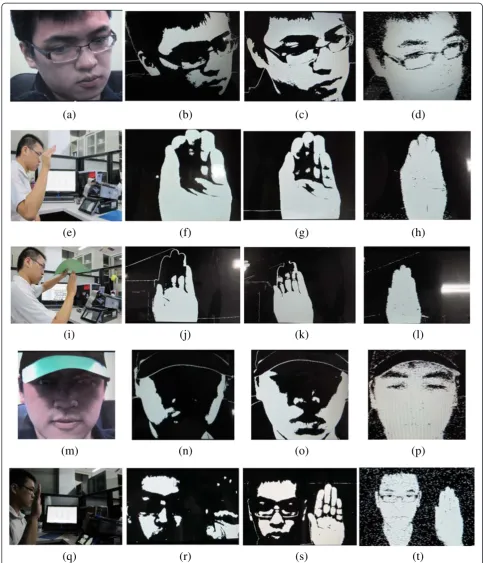
Figure 6Comparisons among traditional RGB and HSV thresholds and proposed TCH algorithm; (a)(e)(i)(m)(q) the test scenarios,
(m)
(n)
(o)
(p)
(q)
(r)
(a)
(b)
(c)
(d)
(e)
(f)
(g)
(h)
(i)
(j)
(k)
(l)
(s)
(t)
(u)
(v)
(w)
(x)
(y)
(z)
Figure 7Proposed TCH without noise filter for working on various human races and illumination conditions with imperfect reproduction of
to designate expected skin color of worker and examines detection performance. The digital camera module is vertically installed on a slot of the FPGA platform. Syn-thesis of FPGA circuits and summary of chip resources usages are based on the Quartus II from Altera software. The block diagram of FPGA chip is shown in Figure 5(b). Raw video images from the digital camera are converted into full color images by the real-time de-mosaicking of our previous works (Yu et al. 2011). Full color images from de-mosaicking are then sent to the touch screen for user to designate expected skin color. Once any skin region has been designated (touched) by the user?s finger, the informa-tion of skin color and screen coordinate of the touched point are sent to the TCH algorithm together for skin detection. As shown in Figure 5(c), output images can be controlled by the signal denoted as Image Selection. A full color was first chosen to observe the region of skin color. After the user touching screen, a touched mark is generated and shown on the screen to indicate the location of the touching point. This action also determines the initial skin color map F in HSV color space, which is transferred from RGB. Next the user switch image output to detection mode. Skin color map coordinatesTAtoTDare then derived and examined for slopes constraints as aforementioned. In the end, the skin color detected by TCH is represented in a binary image and displayed on the touch screen.
Resource usages of the proposed FPGA chip designs are shown in Table 1. Consumption of logic elements (LEs) are 9,216 (8%), which involves 7,646 LEs for TCH. The FPGA chip is the Altera Cyclone IV EP4CE115F29C7 N. The proposed TCH was designed in RTL circuits in order to achieve real-time image processing. It can be seen that
the TCH algorithm consumed the largest amount of LEs in the proposed skin color detection system that the algorithm required 21 9-bit embedded multipliers for RGB-HSV conversion and slope derivation with trig-onometric functions. The embedded memory con-sumption was 57,400 bits (1.4%). This concon-sumption was for the image buffer of touch screen and full color de-mosaicking.
The digital camera adopted in our design has a max-imum of 5 M pixels resolution, but it was set for 800 ? 480 pixels for use with the touch screen at a frame rate of 15fps and 30 MHz pixel clock. Meanwhile, the pro-posed TCH required 300 MHz clock speed and 37 clocks to run TCH during image pixel scans. Such ar-rangement leads to about four pixels delay showing on the touch screen.
Snapshots of real-life operations for proposed skin color detection are shown in Figure 6 without a video noise filter. Five severe test scenarios were designed to demonstrate the reliability of the proposed adaptive skin color detec-tion system. We focused on the resistances to shadows and reflections at forehead, chin, hands, and the part of the face under the brim of a cap. Figure 6 demonstrates excellent skin color detection of TCH, which provides satisfactory ROI area for pattern recognition, object tracking, and image processing purposes. In these test scenarios, the skin color detections by using traditional RGB and HSV thresholds were also conducted to com-pare with our TCH algorithm using constant skin color map. We could see that the skin color detection using RGB threshold in these tests exhibited the worst detec-tion rate while the proposed TCH algorithm had the best detection performance in tests.
Table 2 Comparisons of resource usages among different skin detector designs
Items (1) (2) (3) (4) (5) (6)
Resources Chenaoua and
Bouridane (2006)
Fotouhi et al. (2009) Khan et al. (2011) Liu and Shi (2011)
Zafarifar et al. (2012) Proposed TC
Platforms PC PC PC FPGA FPGA FPGA
EP2C20 Xilinx Cyclone IV E
EP4CE115F29C
7 N
Methods Markov random field Texture analysis & ANN classifier
Cascaded skin training & classifier
YCbCr& I1I2I3 Classifiers
YUV & Adaptive texture analysis
Adaptive HSV constraints
Tested images Static picture Static picture Static picture Video Video Video
Adaptability Yes Yes Yes No Yes Yes
Resource usages (LEs/LUTs)
- - - 4,091 30,720 7,646
DSPs - - - No 192 No
Embedded memory (bits)
In the first test scenario of Figure 6, see Figures 6(a) to (d), the interferences of shadows and reflections existed at the same time on tester?s face. It can be seen that the pro-posed TCH skin color detection system demonstrated ex-cellent adaptive capability to detect skin areas with shadows and reflections. For the test result using HSV
threshold, although it has been a popular method on em-bedded systems, the detection rates at testers? chin and neck were still deteriorated by shadows. The detection performances between RGB and HSV thresholds had not shown much difference in this test. In the second test sce-nario, we tested TCH algorithm with extreme interference
(k)
(f)
(a)
(l)
(g)
(b)
(m)
(h)
(c)
(n)
(i)
(d)
(o)
(j)
(e)
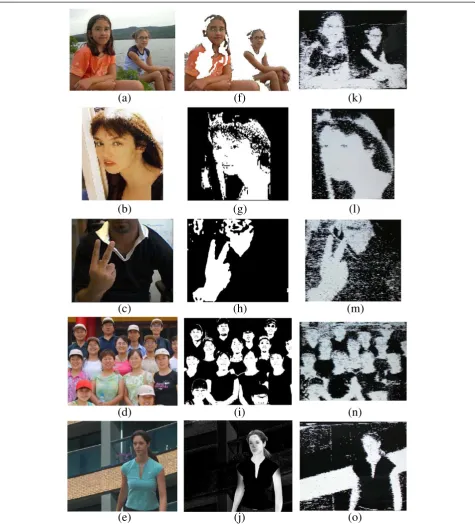
Figure 8The comparison with skin detection methodologies from references; (a)-(e) are test scenarios from Table 2, (1)-(5) with their
of shadow by huddling up a palm. The RGB and HSV thresholds both still had low detection rate in test. Com-paratively, proposed TCH algorithm in this test could de-tect the skin color reaching the inner part of palm perfectly. In the third test scenario, we tested our skin de-tector by using green color to shift skin color moderately. The tester covered his palm with a green paper to obtain some green reflection on palm, as shown in Figure 6(i). It can be seen that the proposed TCH algorithm operating in such environment could still resist to green shadow and reflection. Again, RGB and HSV constant thresholds in this test still had low detection rate at fingers, where was covered by green shadow. After illustrated the success in resistance to shadows and reflections, the fourth test sce-nario simulated the condition of wearing a cap, as shown in Figure 6(m). In this test, the tester?s face was covered by shadow and some yellow reflections from inner brim of cap. The RGB threshold with this test scenario nearly failed to detect the tester?s face, and even the HSV thresh-old could only improve little. Nevertheless, our TCH algo-rithm could still work quite well in this test except a small part right under the brim of cap. In the last test scenario of Figure 6, the capability of skin detection under a dark environment was also tested, as shown in Figure 6(q). The lights in laboratory were nearly turned off in this test sce-nario. It can be seen the RGB and HSV thresholds could surprisingly detect skin region of the subject, and the sil-houette of HSV threshold was sufficient for recognition on the face and palm. The proposed TCH skin color de-tection system under such severe environment was appar-ently superior to traditional HSV threshold for full scope detection rate of the subject?s face and palm.
For quantitative analysis, we tested TCH with different human races and illumination conditions. Tested images were all downloaded from the internet (Eastday 2013; Gamebase 2008; Gigacircle 2014; Nextmedia 2013; Sina house 2011; Sohu sport 2010; Vanity fair 2014; 10202blog 2013) and references and then printed by a color printer
so that digital camera could capture these pictures into FPGA. However, it should be noted that this test method also incurred chromatic distortions due to imperfect reproduction in paper and from the printer. Figure 7 indi-cates that TCH could detect these candidate faces effi-ciently even in outdoor environments. With the same test method, we also compared with state-of-the-art method-ologies given in Table 2, and experimental results are shown in Figure 8. The images for comparison were cop-ied from articles and enlarged so that the TCH system was fed with images of larger chromatic distortions than that given in Figure 7. It can be seen that TCH with such se-vere test condition can also provide sufficient detection accuracy for ROI.
Discussions
The salient features of the proposed skin color detection system involve simple calibration processes, moderate hardware resource usage on chips, and efficient adaptabil-ity without complicated training algorithms. Comparing with the state-of-the-art technologies listed in Table 2, the proposed TCH adaptive algorithm cooperating with a touch screen is comparable to the methodologies using statistical and training classifier for high detection rate and low implementation effort. Besides, the combination of different color thresholds may achieve sufficient detec-tion rate on embedded system by using a small amount of hardware resources (Liu and Shi, 2011), but such system can only work under adequate illumination and tedious calibration is still unavoidable because of the lack of adap-tive mechanisms. After inspecting the skin detector results in Figure 8, the best skin color detection design for em-bedded system is the texture-based skin color analysis; see the performance in Figure 8(j). This kind of system is not only applicable for skin color detection but also provides additional functionality on background elimination, where it is colored with skin color. However, a large amount of hardware resources usages is required for complicated
(b)
(a)
Figure 9Operations of TCH at upper and lower boundaries of adaptability; (a) upper saturation boundary, (b) lower
the pixel color before exceeding the initial skin color map at a high saturation value will result in a low adapt-ability to variation in skin color, and a null adaptadapt-ability will be set if the exceeded color is at the upper satur-ation boundary of the initial skin color map, as shown in the Figure 9(a). In contrast, TCH?s adaptability will be increased if the exceeded color is at a low saturation value, and it results in maximum adaptability at the lower saturation boundary of initial skin color map, as shown in the Figure 9(b). The proposed non-linear adap-tive mechanism is similar to human?s vision in that people can distinguish different colors easily between high saturation colors but not the low saturation ones.
Finally, the minor drawback of TCH arises from the delay of image processing and incurs coarse binary picture quality, as shown in Figures 6 to 8. With the pixel-based skin color detection, the image quality is sensitive to ran-dom noise in the camera, then the noise is enlarged hori-zontally due to the late update of pixels information during image acquisition. Although the coarse binary pic-ture quality seems not affecting detection rate, the authors will determine how to improve processing speed with re-fined hardware circuits in the future, and a real-time and simplified pixel-based noise filter from our previous work may be also implemented (Yu et al. 2011).
Conclusion
In this paper, we have proposed an efficient adaptive skin color detection system. The proposed algorithm can derive an initial skin color map using traditional HSV color space after captured images from touch screen. Once incoming pixel colors exceed the region of default skin color map, the non-linear adaptive algorithm of tra-jectory constraints on hue (TCH) can dynamically adjust the range of thresholds for detection. Various severe test scenarios had been arranged to verify the capability of proposed skin detection. Our experimental results indi-cate that the proposed adaptive skin color detection is efficient and applicable to various effects from illumin-ation conditions. A reasonable amount of hardware re-source usages in the FPGA chip can allow the TCH skin color detection to be implemented on single FPGA chip and suitable for miniature electronic devices. The future works involve the refinement of circuits in economical gates count and processing delay improvement.
Competing interests
The authors declare that they have no competing interests.
government of Taiwan under Grant NSC 99-2221-E-027-057-MY3, Ministry of Education Taiwan for the Top University Project to the National Cheng Kung University (NCKU), and Mr. En-Shi Lin are gratefully acknowledged.
Author details 1
Department of Electrical Engineering, National Chung Cheng University, No. 168, University Rd, Min-Hsiung Township, Chiayi County 62102, Taiwan. 2
Department of Electrical Engineering, Tamkang University, No. 151, Yingzhuan Rd, Tamsui Dist, New Taipei City 25137, Taiwan.3School of Mechanical and Manufacturing Engineering, The University of New South Wales, Sydney, NSW 2052, Australia.4Department of Computer Science and Information Engineering, National Cheng Kung University, No. 1, University Rd, Tainan City 701, Taiwan.5Department of Electrical Engineering, Chung Yuan Christian University, 200 Chung Pei Rd, Chung Li City 32023, Taiwan.
Received: 16 July 2014 Accepted: 24 October 2014
References
10202blog. (2013).Photos collection. http://swjhgrade10202.blogspot.tw/ 2013_10_01_archive.html. Accessed 10. July. 2014.
Chaves-Gonz?lez, JM, Vega-Rodr?guez, MA, G?mez-Pulido, JA, & S?nchez-P?rez, JM. (2010). Detecting skin in face recognition systems: a colour spaces study.
Digital Image Processing, 20, 806?823.
Chen, YH, Hu, KT, & Ruan, SJ. (2012). Statistical skin color detection method without color transformation for real-time surveillance systems.Engineering Application of Artificial Intelligence, 25(7), 1331? 1337.
Chenaoua, K, & Bouridane, A. (2006).Skin Detection Using a Markov Random Field and a new Color Space (IEEE international conference on image processing (ICIP 2006)). Atlanta, USA: Georgia Institute of Technology.
Eastday. (2013).Photos collection. http://big5.eastday.com:82/gate/big5/msnphoto. eastday.com/hdqxb2013/20130717_9/index.html. Accessed 10. July. 2014. Fotouhi, M, Rohban, MH, & Kasaei, S. (2009).Skin Detection Using Contourlet-Based
Texture Analysis (4th international conference on digital telecommunication (ICDT 2009)). Colmar, France: University of Haute Alsace.
Gamebase. (2008).Photos collection. http://www.gamebase.com.tw/forum/5351/ topic/83232878/1. Accessed 10. July. 2014.
Gigacircle. (2014).Photo collection. http://tw.gigacircle.com/1039866-1. Accessed 10. July. 2014.
Khan, S, Gupta, GS, & Demidenko, S. (2011).Adaptive Classifier for Robust Detection of Signing Articulators Based on Skin Colour (6th IEEE international symposium on electronic design, test and application (DELTA 2011)). Queenstown, New Zealand: Institute of Electrical and Electronics Engineers Incorporated. Kim, KK, Kwak, KC, & Chi, SU. (2006).Gesture Analysis for Human-Robot Interaction
(8th international conference on advanced communication technology (ICACT 2006)). Gangwon-Do, Korea: Institute of Electrical and Electronics Engineers Incorporated.
Kumar, A. (2014).An Empirical Study of Selection of the Appropriate Color Space for Skin Detection: a Case of Face Detection in Color Images (2nd International conference on issues and challenge in intelligent computing techniques (ICICT 2014)). Ghaziabad, India: Krishna Institute of Engineering and Technology. Li, C, Liu, YH, & Shih, HC. (2013).Adaptive Skin Color Tone Detection With
Morphology-Based Model Refinement (9th international conference on information, communication, and signal processing (ICICS 2013)). Tainan, Taiwan: National Cheng Kung University.
Lin, C, Su, CH, & Huang, HS. (2011). Colour image segmentation using relative values of RGB in various illumination circumstances.Int J Comput, 5(2), 252? 261.
Liu, Q, & Peng, GZ. (2010).A Robust Skin Color Based Face Detection Algorithm (2nd international conference on information in control, automation, and robotics (CAR 2010)). Wuhan, China: Hubei University of Education. Liu, G, & Shi, Z. (2011).Embedded Implementation of Real-Time Skin Detection
Liu, L, Sang, N, Yang, S, & Hunag, R. (2009). Real-time skin color detection under rapidly changing illumination conditions.IEEE Trans Consum Electron, 57(3), 1295? 1302.
Luo, RC, Chang, SR, & Yang, YP. (2011).Tracking With Pointing Gesture Recognition for Human-Robot Interaction (IEEE/SICE international symposium on system integration (SII-2011)). Kyoto, Japan: Kyoto University.
Nextmedia. (2013).Photos collection. http://hk.apple.nextmedia.com/realtime/ news/20130826/51675805. Accessed 10. July. 2014.
Sagheer, A, & Aly, S. (2012).An Effective Face Detection Algorithm based on Skin Color Information (8th international conference on signal image technology and internet based systems (SITIS 2012)). Naples, Italy:
Sina house. (2011).Photos collection. http://sx.bbs.house.sina.com.cn/thread-851846640456301-2.html. Accessed 10. July. 2014.
Sohu sport. (2010).Photos collection. http://sports.sohu.com/20100320/ n270968863.shtml. Accessed 10. July. 2014.
Toledo, FJ, Mart?nez, JJ, Garrig?s, J, Ferr?ndez, J, & Rodellar, V. (2006). Sink Color Detection for Real Time Mobile Applications (16th international conference on field programmable logic and applications (FPL 2006)). Madrid, Spain: Universidad Aut?noma de Madrid.
Vanity fair. (2014).Photo: The 2014 Vanity Fair Hollywood Portfolio. http://www. vanityfair.com/hollywood/photos/2014/03/chuck-close-hollywood-portfolio#6. Accessed 10. July. 2014.
Vezhnevets, V, Sazonov, V, & Andreeva, A. (2003).A Survey on Pixel-Based Skin Color Detection Techniques (13th international conference on computer graphics (GraphiCon 2003)). Moscow, Russian Federation: Moscow State University.
Yang, G, Ren, J, Huang, C, & Li, H. (2010).Research on a Skin Color Detection Algorithm Based on Hybrid Color Model (3rd international congress on image signal processing (CISP 2010)). Yantai, China: Yantai University.
Yang, L, Li, H, Wu, XY, & Zhao, D. (2011).An Algorithm of Skin Detection Based on Texture (IEEE international congress on image and signal processing (CISP 2011)). Shanghai, China: Donghua University.
Yu, YH, Kwok, NM, & Ha, QP. (2011). Color tracking for multiple robot control using a system-on-programmable-chip.Autom Constr, 20, 669?676. Yu, YH, Yeh, CH, Lee, TT, Chen, PY, & Shiau, YH. (2014).Chip-based Real-time
Gesture Tracking for Construction Robot?s Guidance (31st international symposium on automation and robotics in construction and mining (ISARC 2014)). Sydney, Australia: The University of Technology Sydney. Zafarifar, B, van den Kerkhof, T, & de With, PHN. (2012). Texture-adaptive skin
detection for TV and its real-time implementation on DSP and FPGA.IEEE Trans Consum Electron, 58(1), 161?169.
Zheng, Y, Yang, G, & Wu, L. (2010).Fast Face Detection in Field Programmable Gate Array (International conference on digital manufacturing and automation (ICDMA 2010)). ChangSha, China: Institute of Electrical and Electronics Engineers Incorporated.
Zhu, JQ, & Cai, CH. (2011).Region Growing Based High Brightness Skin Detection (10th international symposium on signals, circuits, and systems (ISSCS 2011)). Lasi, Romania: Gheorghe Asachi Technical University.
doi:10.1186/s40327-014-0011-1
Cite this article as:Yuet al.:Chip-based adaptive skin color detection
using trajectory constraints on hue.Visualization in Engineering20142:11.
Submit your manuscript to a
journal and bene? t from:
7Convenient online submission
7Rigorous peer review
7Immediate publication on acceptance
7Open access: articles freely available online
7High visibility within the ? eld
7Retaining the copyright to your article