[Diana * et al., 5(2): February, 2018]
ISSN: 234-5197
Impact Factor: 3.765
I
NTERNATIONAL
J
OURNALOF
R
ESEARCH
S
CIENCE&
M
ANAGEMENT
THE ANALYSIS ON STUDENTS’ CREATIVE THINKING SKILLS IN SOLVING
SOCIAL ARITHMETIC PROBLEMS IN REACT-BASED INSTRUCTION
(RELATING, EXPERIENCING, APPLYING, COOPERATING, AND
TRANSFERRING)
Risa Aries Diana MR
1, Hobri
2& Susanto
3The Graduate Program of Mathematics Education, The Faculty of Teacher and Training, Jember
University, East Java, Indonesia
Mathematics Education, The Faculty of Teacher and Training, Jember University, East Java,
Indonesia,
Mathematics Education, The Faculty of Teacher and Training, Jember University, East Java,
Indonesia
DOI: 10.5281/zenodo.1175215
Keywords: CreativeThinking, REACT (Relating, Experiencing, Applying, Cooperating and Transferring), Social Arithmetic.
Abstract
REACT (Relating, Experiencing, Applying, Cooperating and Transferring) is an instructional approach, which includes linking classroom learning process with daily-life concept (relating), learning to find mathematical concept (experiencing), solving problems in independent work or group work (applying), cooperating in solving problems (cooperating), and applying the concept learnt into daily-life context (transferring). The purpose of this study was to analyse students' creative thinking skills in solving SocialArithmetic problems. Delving into REACT approach in solving SocialArithmetic problems, qualitative research was operative in the study and aimed at analysing the skills to perform creative thinking using 5 components, i.e. fluency, flexibility, originality, and elaboration evaluation).
Introduction
Contextual learning has been widely introduced by the Center of Occupational Research and Development (CORD). The United States presents a five-element instructional strategy for educators grappling with contextual learning, which is abbreviated to the REACT strategy (Crawford:2001). One of the learning models which can overcome the prevalent problems in Mathematics instruction is the model involving Relating, Experiencing, Applying, Cooperating, Transferring (REACT), as what Crawford points out (in Rohati, 2011). This learning model is one of the models, which put contextual learning at work. In contextual learning, problem in an instructional context is related to that in daily life, so that students can experience and feel the concept being learnt directly in real life situation. This direct experience is then combined with students’ experience, resulting in new realistic and relevant concepts. As a result, the students will capable of applying the new concepts, which have been learnt in class, into a new context.
[Diana * et al., 5(2): February, 2018]
ISSN: 234-5197
Impact Factor: 3.765
I
NTERNATIONAL
J
OURNALOF
R
ESEARCH
S
CIENCE&
M
ANAGEMENT
through the context of interpersonal communication and sharing; and (5) Transferring, which is done by applying and transferring learnt concepts and materials.
Afterward, students are required to relate daily situation with new information being learnt or problems solved. The teacher uses strategy one, relating, when he associates a new concept with something the students already know. The learning process should begin with posing questions and presenting phenomena, which are interesting and familiar to students, instead of those which are abstract and beyond the reach of students' perceptions, understanding, and knowledge. Relating is basically linking what students already know with the new information they are about to learn. The second strategy, which is experiencing, is the stage in which exploration, discovery, and discussion serve the basis to contextual learning. However, students may become motivated and comfortable due to the results of other learning strategies such as interaction with text, stories, or videos. Learning seems to be going faster when students can manipulate tools and materials and also work on other forms of investigation. Meetings in the classroom can involve manipulating equipment, problem solving, and laboratory activities. Next, teacher initiates the applying strategy, which deals with how to put a learnt concept into use. At this juncture, students learn to apply concepts when they grapple with problem-solving activities. Teachers should be able to motivate students to understand concepts by providing more realistic exercises. Fourth, cooperating (learning together) is learning process in which responsiveness and communication among students take place in contextual teaching. The experience of working together goes beyond simply helping most students to learn the instructional materials. Working with peers in small groups will improve students' readiness in explaining conceptual understanding and suggesting problem-solving approaches for their groups. The learning process will take place very well when students are given the opportunity to express their opinions and work in tandem with their peers. The last stage includes transferring, which deals with using and extending what has been known or transferred, on the basis of what the students already know. After students understand the concepts, they apply the knowledge they have gained into a new context. Crawford (2001) defines transferring as the use of knowledge in a new context. Gaining in-depth understanding requires the skills to think and the skills to transfer knowledge.
A study focusing on the implementation of REACT strategy, conducted by Faisal (2005), shows that students' learning outcomes are better with the application of REACT (Relating, Experiencing, Applying, Cooperating, Transferring) strategies in the learning of cube and block volume at junior high school. In addition, research conducted by NurLailiAchadiyah (2009) who conducts an instruction using REACT strategy on the circumverence and width of circle indicates that the students’ understanding improves subsequent to applying the approach. One of the learning models which can overcome the problems in Mathematics instruction is the Relating, Experiencing, Applying, Cooperating, Transferring model (REACT) Crawford (in Rohati, 2011). This REACT learning model is one of the models that apply contextual learning. In contextual learning, problems are linked to the problems that exist in students’ everyday life, so that students can gain first-hand experience on the problem solving. This direct experience is then combined with previous experience, resulting in new realistic and relevant concepts. Afterwards, the students will work with the theme in applying new concepts they have learnt. The results of Pramadan’s study (2013) suggest that learning through REACT (Relating, Experiencing, Applying, Cooperating, Transferring) model with Cabri 3D can improve tenth-grade students’ learning outcomes. Experiment conducted by Yuniawatika (2011) evinces improvement of mathematical representation of students involved in an instruction applying REACT model in that they perform better than those who are involved in conventional instruction. The development of REACT model instrument will result in students-centred learning, so as to improve students’ motivation in learning activities which aim ultimately at improving students' mathematical comprehension of three-dimension figures. What sets the present study apart from the previous studies is that it investigates Mathematics learning on Social Arithmetic to improve students' creative thinking skills.
[Diana * et al., 5(2): February, 2018]
ISSN: 234-5197
Impact Factor: 3.765
I
NTERNATIONAL
J
OURNALOF
R
ESEARCH
S
CIENCE&
M
ANAGEMENT
This supports the opinion of Nuris (2016: 2) in a proceeding, which suggests that the skills to think creatively represents a person's skills to generate an idea or how to solve problems or produce a product. Given student’s level of creative thinking skill of each is different, teacher needs to know and analyse whether his students categorized into excellent critical thinker or poor one. In reality, the current study has revealed that students’ participation is still low, as they tend to be passive in following instruction, especially Mathematics learning. As a result, students are not used to creative thinking. What exacerbates the issue is the Mathematics achievements of students at grade VII-C at Public Junior High School 13 of Jember is have yet to reach maximum scores. These preliminary findings indicate that the weak creative thinking skill is evident.
This study aimed to analyse students' creative thinking skills. In the process of learning Mathematics, creative thinking skill is necessary, which is why students need to develop their creativity in solving Mathematics problems. The creative thinking skills in the learning process are representative of various aspects, such as the emergence of questions for increased expectations and anticipation; probing existing information; describing information presented carefully and systematically; physically preparing information presented; deepening the awareness of problems, difficulties, and information gaps; encouraging personal creative traits or tendencies; and heightened caring and curiosity (HeriKuswanto, 2016:2).
Resolving a problem is a general goal of learning Mathematics, which prioritizes process and strategy performed by students in solving problems. This of course has to be balanced with the students' creative skills. In this case, the researchers adopted an instructional model proposed by the Centre of Occupational Research and Development (CORD), dealing with contextual learning and involving five strategies for teachers, abbreviated into REACT (Nurhadi, et al, 2004:23). This strategy includes Relating, Experiencing, Applying, and Transferring to determine the level of creative thinking skills of the students. The five stages include linking, discovering, experiencing, cooperating, and applying.
Research Method
This research deployed qualitative descriptive approach, as it was projected to describe and analyse students' creative thinking skills in solving SocialArithmetic problem. This research was conducted at Public Junior High School 13 of Jember, by involving the students in class VII, leading to choosing class VIIC as control group and class VII A as well as VII B as the experimental classes, which possessed heterogeneous skills, that was high, medium, and fair.
The data analysis model in the study was adopted from Miles and Huberman (in Gunawan, 2013), involving three stages in analysing qualitative research data, namely data reduction, data exposure, and drawing conclusions.
The steps in this research were divided into three stages,inter alia, preparation stage, implementation stage, and final stage. The first stage was the preparation stage, at which instructional instruments were developed. The instruments consisted of lesson plan, students’ worksheet, and learning achievement test. The second stage was the implementation of learning process and running learning achievement test. In the final stage, data processing, data analysis, and drawing conclusions were performed.
In the research, the measured data were pertinent to the students’ creative thinking skills in solving the social arithmetic in instruction deploying REACT. Afterwards, then the data were analysed to know the level of students' creative thinking skills based on the indicator of creative thinking skills.
Results and Discussion
[Diana * et al., 5(2): February, 2018]
ISSN: 234-5197
Impact Factor: 3.765
I
NTERNATIONAL
J
OURNALOF
R
ESEARCH
S
CIENCE&
M
ANAGEMENT
Figure 1:The Percentage of Validation Result on Instructional Instruments
Based on the validation results, the instructional instruments received over 94% of total score, so this result indicated that the instructional instrument were ready for research implementation. After validating the instruments and getting the positive validation results concerning the instructional instruments, then the researchers conducted the study in the classes. The research was implemented in 4 meetings (4 lesson plans, 4 worksheets and 3 learning achievement tests).
During the learning activities, the teacher’s activities in managing the class and those of students in the class were assessed by the observer, which aimed to know whether or not the learning process ran well. The following chart points out the percentage of teacher and students’ activity in the learning process.
Figure 2:The Percentage of Teacher’s Activities
[Diana * et al., 5(2): February, 2018]
ISSN: 234-5197
Impact Factor: 3.765
I
NTERNATIONAL
J
OURNALOF
R
ESEARCH
S
CIENCE&
M
ANAGEMENT
In the second meeting, the percentage of teacher’s activity increased to 87%, as he still maintained the instruction according to the existing learning plan by trying to motivate the students to remain excited. In this second meeting, the first teacher gave motivation so that the students were more passionate to take part in the lesson and then carried out the instructional activities related with the previous material (relating). Afterward, he pointed out the learning objectives, motivated the students to find the material concept in the learning activity (experiencing), and asked the students to observe the learning object. He then motivated the students to ask questions about the problems presented in the worksheets by encouraging them to raise opinion (applying). The students were then asked to find a concept (experiencing) and to understand the problems in the sheets. The teacher afterward asked the students to explain the problems in the sheets. He asked the students to work together in solving the problems (cooperating), asked them to apply learnt concept into everyday-life context (transferring) by solving the problems, and asking the students to summarize the problems of the whole material.
The percentage of teacher’s activity in the third meeting rose in the second meeting to 88%, marked as good category. In this third meeting, the teacher kept giving motivation and tried to encourage the students in following the learning by giving material, which was familiar and soundly related to students’ life (relating). The teacher continued to carry out the core activity that was by describing the learning objectives, motivating the students to find the concept of material (experiencing), asking the students to observe the learning object, motivating them to ask questions about the problems in the worksheet by trying to solve them on their own so that students gained first-hand experience (applying). Afterward, the teacher asked the students to understand the problems in the worksheet, asked them to explain the problems in the worksheets, and asked the students to be able to solve the problems, as well as asking them to apply learnt concepts into daily-life context (transferring). In this case, the students learnt how to calculate the percentage of tax or any other expenditure when solving the problems in the sheets. Lastly, the teacher encouraged the students to find their own concepts and asked students to summarize the problems.
[Diana * et al., 5(2): February, 2018]
ISSN: 234-5197
Impact Factor: 3.765
I
NTERNATIONAL
J
OURNALOF
R
ESEARCH
S
CIENCE&
M
ANAGEMENT
Figure 3:The Percentage of Student’s Activities
The diagram above indicates that in the first meeting the percentages of students’ activity from the first to the third meetingare 84.65%, 86.30%, and 87.30%, respectively. In the fourth meeting, the percentage of students’ activityreaches 89.95%. In the first meeting up to the fourth meeting, the students paid attention to and listened to the teacher’s explanation of teachers, actively askedto take active role in raising their opinions and find the link between the previous materialsand their daily life (relating). Also,they were encouraged to understand the problems presented in the sheets, find the concept (experiencing), pointed out the problems present in the sheets, completing themselves in group work (applying).They were also supported to take activepart in the discussion process (cooperating) and sum up the material they learnt. They werefurther fostered to apply the concepts learnt in their daily life (transferring) and solve problems present in the worksheets.
The implementation of REACT-based instruction was aimed to introduce the concept of Social Arithmetic in a case-study context. After the introduction and explanation of SocialArithmetic through REACT-based learning were accomplished, then at the end of the learning an achievement test was carried out.The students had to solve problems germane toSocialArithmetic. The test results were then analysed to determine the level of their creative thinking skills.
The test ultimately was intended to assess the students’ creative thinking skills in solving SocialArithmetic problems, subsequent to based instruction. Here is one of the student's answers in solving REACT-based SocialArithmetic problems (Relating, Experiencing, Applying, Cooperating and Transferring).
In the case of instructional process in control class, the students 'creative thinking skills were divided into 3 levels, inter alia, (1) very creative thinking skills, (2) fairly creative thinking skills, (3) unsatisfactorily creative thinking skills, as the following.
Students,who were found to master very creative thinking skills,successfully met the 5 components of creative thinking, namely being able to think fluently (fluency), thinkflexibly, think originally (originality), provide elaboration, and evaluate his progress (evaluation). On the other hand, the students who were proven able to showcasefair creative thinking skillsmet three of the five components of creative thinking. Lastly, those classified to show unsatisfactory critical thinking skills did not meet the five components of creative thinking, namely being able to think fluently (fluency), thinkflexibly, think originally (originality), provide elaboration, and evaluate his progress (evaluation).
[Diana * et al., 5(2): February, 2018]
ISSN: 234-5197
Impact Factor: 3.765
I
NTERNATIONAL
J
OURNALOF
R
ESEARCH
S
CIENCE&
M
ANAGEMENT
a. Fluent (fluency)
From the answers of students categorized in fluent category (fluency), we can see that they perform well in the fluency respect. As in the student’s answer in Figure 4.20 below:
Figure 4.20: The Answer of Student Categorized at Very Fluent Level (Fluency)
The student can provide the answer in systematic, detailed, clear, procedural fashion when working on what was known and unknown about the problem to determine the price after discount given. Also, he can find out the goods affordable with the money he has. So, he has already given the right answer.
b. Flexibility
[Diana * et al., 5(2): February, 2018]
ISSN: 234-5197
Impact Factor: 3.765
I
NTERNATIONAL
J
OURNALOF
R
ESEARCH
S
CIENCE&
M
ANAGEMENT
Figure 4.21 The Answer of Student Categorized at Very Flexible Level (Flexibility)
The answer provided is clear, coupled with alternatives to problem solving. This is done through finding the percentage of discounted price first, rather than finding the sale price substracted with the purchase price first.
c. Original (Originality)
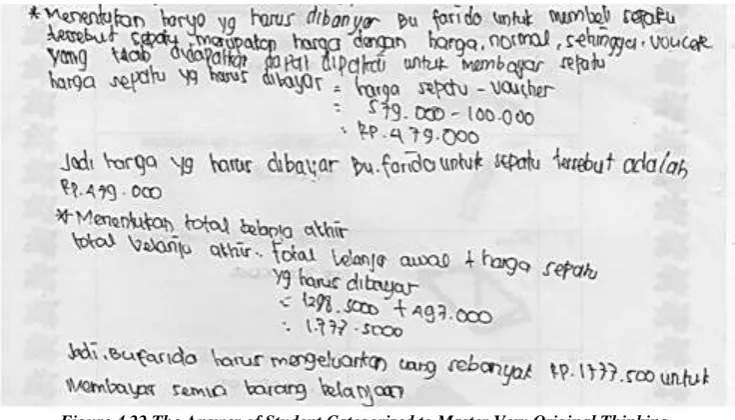
This aspect deals with how well student provides answers appropriate to a problem. The problems presented to the students were categorized as highly original as the answer given was different from other students’ and it was not created by modifying the existing samples of problem solving. This is evident of the answer presented in Figure 4.22 below.
Figure 4.22 The Answer of Student Categorized to Master Very Original Thinking
[Diana * et al., 5(2): February, 2018]
ISSN: 234-5197
Impact Factor: 3.765
I
NTERNATIONAL
J
OURNALOF
R
ESEARCH
S
CIENCE&
M
ANAGEMENT
d. Elaborating
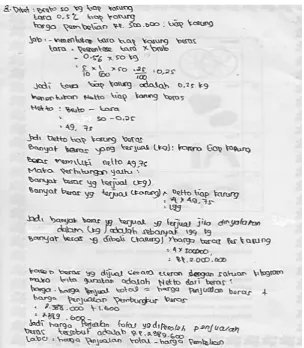
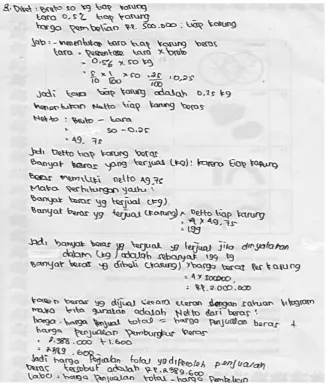
This aspect is represented by detailed answers given in an orderly, procedural, and systematic fashion. In this case, the ability was evident in searching the net, gross, and tare and providing clear answer, such as student’s answer in Figure 4.23 below.
Figure 4.23: Student's Answer Indicating Very Elaborated Response (Elaboration)
As shown in the figure, the student’s response is classified into analysis one as he performs analysis on what is known and connects it with the problem at hand by linking purchase percentage and sale percentage. The problem solving of this kind belongs to synthesis. In solving the problem, the student combines two ideas, including the idea concerning percentage and the percentage of sale profit.
e. Evaluating (evaluation)
[Diana * et al., 5(2): February, 2018]
ISSN: 234-5197
Impact Factor: 3.765
I
NTERNATIONAL
J
OURNALOF
R
ESEARCH
S
CIENCE&
M
ANAGEMENT
Figure 4.24: Student’s Answers Indicating Fine Evaluation
The analysis on students’ works indicate that their answers are given with clear judgmental components, including the capability of giving ideas, being able to carry out the ideas along with the right reasons, and being able to draw conclusions marked by the "so ..." answers. Thus, from the answers of students categorized as very creative thinker, it is clear that these students are very capable of thinking divergently, which deploys open, broad mindset, and leads to optimal development. These students can develop responses optimally and are very capable of generating new ideas or solutions to the problems experienced during the learning process problem solving, which indicated the ability to generate original ideas (originality). The students can provide systematic, detailed and, very clear answers, including what is known, questioned, and answered, in very precise and systematic elaboration. The students are proven capable of thinking flexibly and fluently as shown by the action in the form of smooth expression of his ideas, the ability to evaluate problem and progress (evaluation) during the collaboration in finding a mathematical concept (experiencing) and following the learning process.
[Diana * et al., 5(2): February, 2018]
ISSN: 234-5197
Impact Factor: 3.765
I
NTERNATIONAL
J
OURNALOF
R
ESEARCH
S
CIENCE&
M
ANAGEMENT
corroborated that 10 students were able to think at very creative level, 22 students were able to think at fairly creative level, and 4 students were proven unsatisfactorily creative. The test results in the first experimental class marked an improved creative thinking skills compared to the control class. In the second experimental class (class VII B) with 36 students, encompassing 15 female students and 21 male students, found out that 12 students were at very creative thinking level, 23 students were able to think at fairly creative level, and 1 student was found at unsatisfactory creative thinking category. Hereunder is the data signifying increase in creative thinking between the control class (VII C) and the experimental classes (VII A and VII B).
Figure 4:The T-test on The Correlation of Creative Thinking Skills between Control Class (VII C) and Experiment Classes (VII A and VII B)
[Diana * et al., 5(2): February, 2018]
ISSN: 234-5197
Impact Factor: 3.765
I
NTERNATIONAL
J
OURNALOF
R
ESEARCH
S
CIENCE&
M
ANAGEMENT
Learners were guided to deploy their creative thinking in solving problems related to daily-life problems based on REACT strategy, which has systematic and procedural stages ranging from linking, discovering, experiencing, cooperating, and transferring during learning the instructional materials. The five components of REACT strategy (Relating, Experiencing, Applying, Cooperating and Transferring) were all operative in each instructional instrument, which was meant to scaffold more improved instructional instruments so as to facilitate students in understanding Social Arithmetic material. The exercises in the worksheets that students had to do were accompanied with guidance and examples of guided steps to solve problems. In general, the students liked the worksheet as it was practical and easy to understand as well as very interesting to learn. In learning, students were taught to cooperate and share knowledge (cooperating). This was seen during group work, in which the more competent students helped the other group members who appeared to be struggling (peer tutor).
Conclusion And Suggestions
REACT-based Mathematics instruction has been proven effective to improve students' creative thinking skills. The learning process under investigation resulted in three levels of students’ critcal thinking skills, including very creative, fairly creative, and unsatisfactorily creative.
Learners are guided to active their creative thinking skills in solving problems related to mathematical problems based on REACT strategy, which stipulates systematic and procedural stages ranging from linking, discovering, experiencing, cooperating, and transferring upon working on mathematical concept. Five components of REACT strategy (fluency, flexibility, originality, elaboration and evaluation) are operationalized in every instructional instrument developed in the study, which is devoted to scaffolding students’ understanding on Social Arithmetic.
The researchers suggest future researchers to come up with better work by pondering the following details. First, research methodology has to be elaborated in greater lens. Also, novelty and advancement should lie in the core of future studies. It is also imperative that the researchers gain better results than do former ones.
References
[1] Crawford, L.M. Teaching Contextually,“Research, Rationale, and Techniques for Improving Student Motivation and Achievement in Mathematics and science”, Texas: CCI Publishing, INC. Tersediapada
http://www.cord.org/uploadedfiles/Teaching%20Contextually%20(Crawford).pdf, 2001.
[2] Rohati,“Pengembangan Bahan Ajar Materi Bangun Ruang Dengan Menggunakan Model Relating, Experiencing, Applying, Cooperating, Transferring (REACT) DiSekolah Menengah Pertama”, Universitas Jambi. JurnalEdumaticaVolume01Nomor02, Oktober2011.
[3] Komalasari, Kokom,“Pembelajaran Kontestual: KonsepdanAplikasi”, Bandung, PT RefikaAditama, 2011. [4] Pradani.M.Y,MimiepS.M,dan Anwar.L, “Pembelajaran Melalui Model REACTberbantuCabri3D untuk
Meningkatkan Hasil Belajar Materi Dimensi Tiga Siswa KelasX SMA”,jurnal-online Universitas Negeri
Malang. Tersedia
http://jurnal-online.um.ac.id/da/artikel/artikel11C591777B46683C4A004EF5CB9C8311.pdf(Diunduh14 Agustus 2015), 2013
[5] Yuniawati, “Penerapan Pembelajaran Matematika Dengan Strategi REACT Untyk Meningkatkan Kemampuan Koneksi Dan Representasi Matematik Siswa Sekolah Dasar”,Jurnal UPI edisikhusus No.2, hal 107-120 Agustus 2011. Tersediahttp://jurnal.upi.edu/719/view/639. 2011.
[6] Nuris, “ProfilKemampuanberfikirKreatifMahasiswadalammengkontruksiTeoremapadaMatematika”, Prodi Pend. Matematika, FKIP, UNIRA Pamekasan, 2016.
[7] Nurhadi, dkk,“Pembelajaran Kontekstual (contextual teachingand learning/ CTL) dan Penerapannya Dalam KBK”, Malang, UM press, 2004.
[8] Arikunto, Suharsimi,“Prosedur Penelitian Suatu Pendekatan Praktik” Jakarta,RinekaCipta, 2006. [9] Coleman, JC. Dan C. L. Hammen,“Contemporary Psychology and Effective Behavior”, Glenview, 2011. [10] Ruseffendi, E, “Pengantar Kepada Membantu Guru Mengembangakan Kompetensinva Dalam Pengajaran
MatematikaUntuk Meningkatkan Cara Belajar Siswa Aktif (CBSA)”, Bandung, Tarsito, 2006.