Comparative Analysis Of Image Segmentation
Techniques And Its Algorithm
P.Jayapriya, Dr. S.Hemalatha
ABSTRACT: Image Segmentation is one of the hopeful and emerging fields in image processing. It has applications in various fields like medical applications, astronomical, traffic controlling, Fingerprint recognition, digital forensics, self driving motor cars, locating objects in satellite images etc. It is the process of splitting an image into sub regions with respect to one or more characteristics. Image segmentation is the basic step to analyze images and extract data from them. Different Image Processing techniques are available and segmentation is one of the challenging fields in which complexity is least and implementation is effective. Image segmentation based on Region Based, Edge Detection, Thresholding, Clustering, Fuzzy Logic and Neural Network are discussed and compared. These algorithms are mainly based on two properties similarity and discontinuity. Methods based on similarity are called Region based methods and Methods based on discontinuities are called as Boundary based methods. From the comparative analysis it is found that Image segmentation can be done in effective way using Marker- Controlled Watershed Segmentation Algorithm.
Keywords: Image Segmentation, Edge Detection, Fuzzy Logic, Neural Network, Region Based, Thresholding
————————————————————
1. INTRODUCTION
The recent applications of Digital Image Processing are used in medicine, photography, remote sensing film, video production, and security monitoring [1]. Many modern technologies are emerged in the fields of Image Processing, especially in Image Segmentation domain. Generally, Segmentation is the process of segmenting or partitioning a digital image into multiple segments or partitions .These segmented partitions are analyzed and processed to get some meaning images, then cluster those image pixels into prominent image regions, i.e., regions corresponding to individual objects, surfaces or grouped parts of objects. Image segmentation algorithms are based mainly on two properties (i.e.) either discontinuity principle or similarity principle. The idea behind the discontinuity principle is to extract regions that differ in properties such as intensity, color, texture, or any other image statistics and the similarity principle is to group pixels based on common properties in Image Segmentation [2].Image Segmentation widely used in Face Recognition, Medical Field, Astromical and many other fields. Bali discussed about principle segmentation techniques, implementation, and applications based on human and machine perceptions [3].
2.
KEY
TECHNIQUES
IN
IMAGE
SEGMENTATION
Segmentation Algorithms have been developed to segment the images and it can be classified into following
Segmentation by Clustering Segmentation by Edge Detection Segmentation by Fuzzy Logic Segmentation by Neural Network Segmentation by Region Based Segmentation by Thresholding
2.1 Segmentation by Clustering
Clustering is the task of dividing the population (data points) into a number of groups, such that data points in the same groups are more similar to other data points in that same group than those in other groups. These groups are known as clusters. The most commonly used clustering algorithm is k-means. The loss of information image is often due to generation of boundary in expression of images during segmentation. The clustering method is applied to classification research of many studies [4].K-means algorithm for Image Segmentation helps to improve high performance and efficiency. This method works based on flow as shown in Figure 1. In addition, selection is based on number of clusters determined using datasets from images by using frame size and the absolute value between the means of clusters. The experimental result provides better output and increases the speed of the execution process. K-means used to estimate the number of cluster that dependent on the values of pixels. The number of iteration of process affects its computational cost routine for reaching convergence. The computational time as well as segmentation quality aspects helps to improve accuracy and implementation time by using K-means Clustering [5].The single clustering method does not give better results ,so segmentation using clustering remains a challenging problem in computer vision and Image Processing[6].
_____________________________ P.Jayapriya, Dr. S.Hemalatha
Research scholar, Department of Computer Science, Nallamuthu Goundar Mahalingam College, Pollachi, India.
Figure 1: The General Structure of K-means Clustering Based Image Segmentation
2.2 Segmentation by Edge Detection
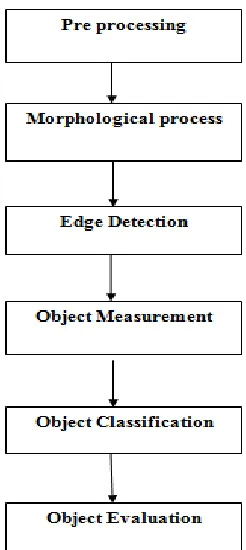
In Edge Detection, Segmentation is done from end to end by identifying the boundaries; edges are detected to identify the discontinuities in the image. In Edge based Detection, detected edges need not to be closed. By detecting edges or pixels during segmentation helps us to extract or associate to form a closed object boundaries [7]. The process of identifying and locating sharp with fine discontinuities is called Edge Detection and this technique
helps to get the desired output [8].Performance of various edge detection techniques is carried out with traditional ones as shown in Figure 2. An improved Canny Algorithm is performed and tested by comparing with various Edge Detection Algorithms and concluded that Canny is good one. Canny method helps to separate noise from image before finding edges in image. [9].Edge Detection techniques help to retain change from grey tones in image.
Figure 2: The General Structure of Edge Based Image Segmentation
2.3 Segmentation by Fuzzy Logic
Segmentation Algorithm for color images based on Fuzzy Membership Function’s masking methods are used which is
C-means strategies can improve remote sensing image using Threshold Segmentation with fewer iterations time, good stability and robustness [11]. This method mainly depends on the mean of each bunch and gathering similar information characteristics into one group. Fuzzy Cognitive
Maps (FCM) is one of the reasonable clustering techniques in Medical Image Segmentation mainly for Magnetic Resonance Imaging (MRI). Fuzzy C-mean Algorithm gives the better results in image segmentation [12].The general structure of Fuzzy logic algorithm is shown in Figure 3.
Figure 3: The General Structure of Fuzzy Based Image Segmentation
2.4 Segmentation by Neural Network
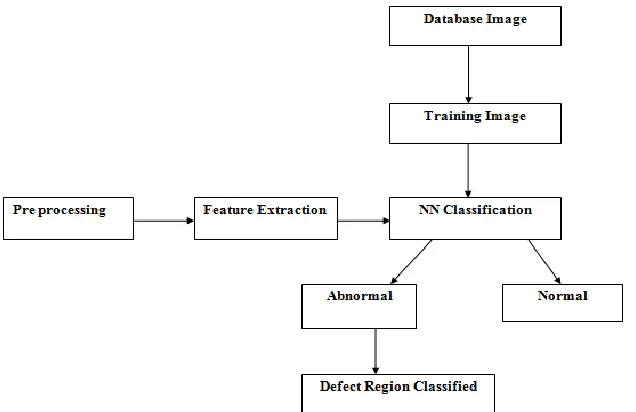
Image segmentation is performed on the raw image to detect and locate the bright spot. Research done by Kevin et al; has drawn significant attention on the Segmentation process and Neural Network used as shown in Figure 4.After segmentation process ,Artificial Neural Network
(ANN) is performed to distinguish the segmented objects called candidates with the help of Nodes. The accuracy of ANN is tested by having a labeled set of images for determination of true positive and false positive values during segmentation [13].
Figure 4: The General Structure of Neural Network Based Image Segmentation
The Deep Convolution Neural Network helps to learn the hierarchy features (low to mid to high level). Deeper means better feature extraction and need to regularize the model well and finely tuned to network that can reduce the domain mismatch [14].
2.5 Segmentation by Region Based
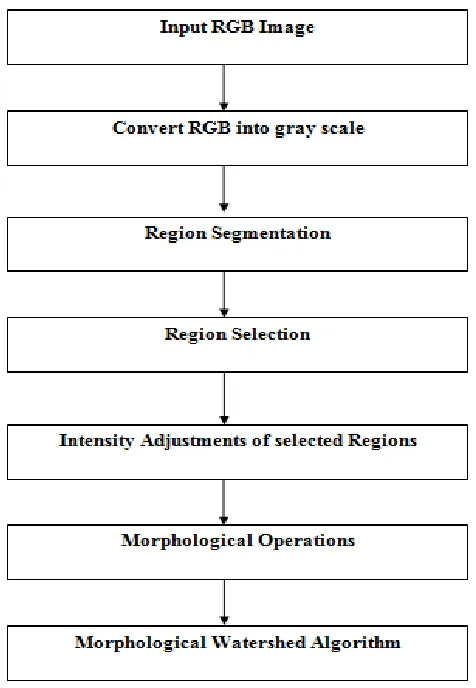
Region Based Segmentation is also called as Similarity Based Segmentation. As shown in Figure 5 an RGB image
Figure 5: The General Structure of Region Based Image Segmentation
When water from two sources (regional minima) are about to meet, a dam is constructed to prevent the merging .The flooding and dam construction process continues until only the dams are visible from above. These dams (Watershed lines or 'Watersheds') effectively segment the image into regions. Many morphological techniques are available for the segmentation of images. But the problem related to that segmentation is condensed or defeated by the better selection of Marker Controlled Algorithm. Marker can be applied directly on gradient image to control over segmentation [15]. Different Segmentation techniques are reviewed and found that instead of segmenting regions, marking is very easy [16]. Watershed Algorithm is a powerful and efficient in case of overlapping or adjacent rocks formation. By combining with the process of mark selection using Field-Programmable Gate Array (FPGA) Processor, Segmentation can be done effectively [17].
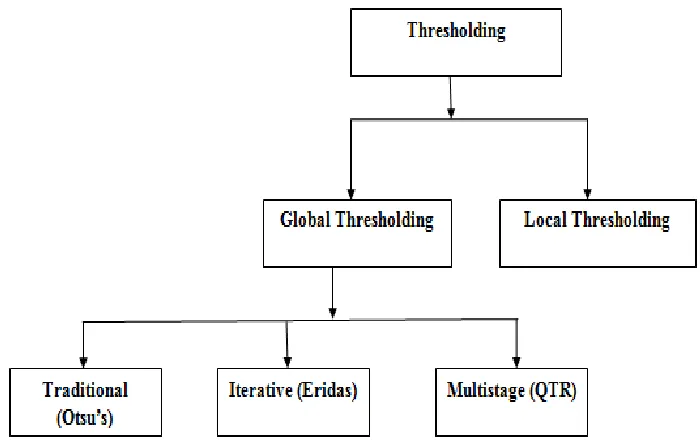
2.6 Segmentation by Thresholding
Figure 6: The General Structure of Thresholding Based Image Segmentation
3. COMPARISION OF SEGMENTATION TECHNIQUES
Comparison of Image Segmentation is made and its advantages along with limitations are discussed and tabulated.
Table 1 Comparison between Image Segmentation Techniques
Algorithm Description Advantages Limitations
Segmentation by Clustering
Grouping of pixels having similar properties and defines the cluster values based on their visible intensities.
Works actually well on tiny datasets and generates admirable clusters.
a. Computation time is excessively large and also expensive.
b.k-means is a distance-based algorithm. It is not suitable sometimes.
Segmentation by Edge Detection
Segmentation is done from end to end by identifying the boundaries.
Helps to retain gray tones in Edges and for good contrast images.
a. Difficult for low contrast images
b.It is not suitable if edges are many.
Segmentation by Fuzzy Logic Ambiguity and manipulation in datasets can be done easily with Fuzzy Logic Algorithm.
Unsupervised and Fuzzy is better than K- means. Assemble very well.
a. Fuzzy membership determination is not very easy .
b.Computational expensive Segmentation by Neural
Network Nodes of Neural Network are used.
Training data set are used to solve difficult problems and to detect errors easily.
a. Training of data set consumes more time. b. Sometimes required over training.
Segmentation by Region Based
Separates the objects into different regions based on Morphological operations
Calculations are simple and operations are fast. It works well high contrast images.
a. Sometimes overlap of the grayscale pixel values faces difficult.
b.It is good with implementation of Marker based.
Segmentation by Thresholding Depends on the histogram and Threshold of an image.
A simple approach to adopt without prior knowledge of image..
a. Computational expensive. b.Not suitable for real time applications
4. RESULTS AND DISCUSSIONS:
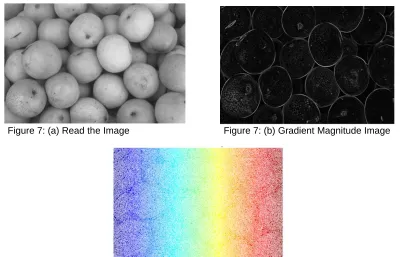
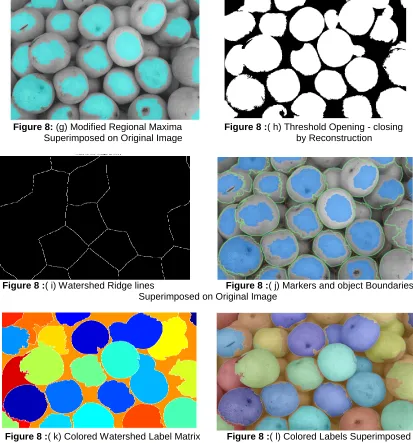
The image segmentation results using Marker-Controlled are shown in Figure 7. Figure 7(a), 7(b), 7(c) shows original, Gradient, Watershed Transformed Gradient respectively. Then it is found that over segmentation arises which can be reduced with implementation of Marker-Controlled Watershed Segmentation as shown in Figure 8. Figure 8(a) shows opening of original image,8(b) shows opening by reconstruction,8(c) shows opening –closing,8(d) shows opening-closing by reconstruction,8(e) shows Regional Maxima Opening – closing Superimposed on Original Image,8(f) shows Regional Maxima by Reconstruction,8(g) shows Modified Regional Maxima Superimposed on Original Image ,8(h) shows Threshold Opening - closing by Reconstruction, 8(i) shows Watershed Ridge lines,8(j) shows Markers and object Boundaries Superimposed on Original Image, 8(k) shows Colored Watershed Label Matrix and finally 8(l) shows Colored Labels Superimposed Transparently on Original Image.
4.1 Watershed Segmentation using the Distance Transforms
The existing edge detecting operators such as Prewitt, Robert, Canny and LoG helps to segment image by using Distance Transform in Morphological Watershed Segmentation. The traditional Watershed Segmentation using Distance Transform are applied to detect edges which are more apparent, pinpointed and sharp with abundant edge information. Moreover, Canny Edge operator filers the noise more effectively than Sobel, LoG and other traditional operators in Watershed Segmentation using Distance Transform. It is found that Canny Edge
operator is more efficient for edge detection with watershed segmentation using distance transform method [21].The steps to be followed includes
Step 1: Read the Image Step 2: Convert it to Binary
Step 3: Find complement of Binary image and apply distance transform.
4.2 Watershed Segmentation using Gradients
The preprocessing of a gray-scale image before using the Watershed transformation for segmentation can be done with the help of gradient magnitude. Dilation and erosion can be used in combination with image subtraction to obtain the Morphological Gradient image with the smoothened image. The regions in an image are thickened and shrunk by dilation and erosion. Watershed Segmentation based on Morphological Gradient are introduced in Watershed Segmentation through opening and closing by reconstruction. Then reconstruction operators are in use to restructure gradient image in which a set of gradient pixels with high value are conserved and few gradient pixels with low value are detached. Thus improved algorithm using Gradients is applied to reconstruct image which eliminates over- segmentation but not completely. Although it holds the position of region contours clearly [22]. The steps to be followed includes
Step 1: Read the Image
Step 2: Use the Gradient Magnitude as the Segmentation Function
Step 3: Watershed transform of gradient image results in over segmentation
Step 4: Smoothed Watershed transform of gradient image reduces over segmentation but not completely
Figure 7: (a) Read the Image Figure 7: (b) Gradient Magnitude Image
4.3 Watershed Segmentation using Marker-Controlled
From the above discussion it is found that Watershed Segmentation applied directly on Gradient magnitude images, it shows the problem of over segmentation. In Marker-Controlled Watershed Segmentation, the Image to be segmentated is converted in to Grayscale. Then reconstruction of image is made by opening and closing by reconstruction with selection of markers based on foreground and background objects, to found the definite boundaries. The accuracy of the Marker-based Watershed Segmentation is high compared to Sobel, Roberts, LoG, Canny, Active contour Morphological-based Segmentation, Otsu’s thresholding segmentation methods [23].It is reliable, efficient, robust, and also provides result with reduced noise .It also works fine with composite images. The steps to be followed includes
Step 1: Read the gradient image and applying Closing and Opening function by Reconstruction Step 2: Regional Maxima of gradient magnitude
Step 3: Compute Foreground Objects Step 4: Compute Background Objects
Step 5: Compute the Watershed Transform using Segmentation Function. Step 6: Visualize the Result
Figure 8 :( a) Opening of the Image Figure 8: (b) Opening by Reconstruction
Figure 8: (c) Opening- closing Figure 8: (d): Opening - closing by Reconstruction
Figure 8: (g) Modified Regional Maxima Figure 8 :( h) Threshold Opening - closing Superimposed on Original Image by Reconstruction
Figure 8 :( i) Watershed Ridge lines Figure 8 :( j) Markers and object Boundaries Superimposed on Original Image
Figure 8 :( k) Colored Watershed Label Matrix Figure 8 :( l) Colored Labels Superimposed Transparently on Original Image
4. CONLUSION
Several important techniques for Image Segmentation are reviewed and summarized. Algorithms like K-means, Canny Edge Detection, Fuzzy C-means, Neural Network, Morphological Watershed, Otsu’s Thresholding techniques are discussed and compared. Some of the recent works on Image Segmentation are analyzed. With the subsequent observation of these techniques individually, it is concluded that, Marker-Controlled Morphological Watershed Segmentation is superior. Over segmentation is major drawback in segmentation, Marker-Controlled Watershed Segmentation helps to solve and bring out segmentation with reduced over segmentation. It brings desired output when applied using distance measure and gradient magnitude operations. Since there is no unanimously accepted technique for Image Segmentation process, a good recommendation is that Marker- Controlled Watershed Segmentation Algorithm is best suitable for segmentation to attain better implementation in Medical Image Processing.
REFERENCES
[1] Anil K Jain (2014), ―Fundamentals of Digital Image Processing‖, ISBN 978-81-203-0929-6, Pearson Education.
[2] Rafael C Gonzalez and Richard E Woods (2013), ―Digital image processing‖, ISBN 978-81-317-2695-2, Pearson Education.
[3] Akanksha Bali, Dr. Shailendra Narayan Singh,‖ A Review on the Strategies and Techniques of image Segmentation‖, Fifth International Conference on Advanced Computing & Communication Technologies, IEEE 2015.
[4] Pengfei shan, ―Image segmentation method based on K-means algorithm‖, EURASIP, 3 September 2018. [5] Miki K. Patel, Mitula H. Pandya, ―Survey on Image
Segmentation Using Different K-Mean Algorithms‖, ISBN 2271-8179, volume 2, Issue 1, January 2013 [6] Sneha Pise, H. R.Turkar, A. V. Anjikar , A. Golghate, P.
Image Segmentation‖,IJIRCCE, Vol. 5, Issue 3, March 2017,PP 4026-4032
[7] Ms.R.Saranya P on Selvi, Ms. C. Lokanayaki, ―A Survey Paper on Fuzzy Image Segmentation Techniques‖, Int. Journal of Engineering Research and Applications, ISSN : 2248-9622, Vol. 4, Issue 3,( Version 1), March 2014.
[8] Rahul Basak, Surya Chakraborty, Aditya Kumar Mondal, Satarupa Bagchi Biswas,‖ Image Segmentation Techniques: A Survey‖, IRJET, Volume: 05 Issue: 04 , Apr-2018,pp51-57
[9] Pooja A and Smitha Vas P, ―Edge detection using deep learning‖,IRJET,volume 5,Issue 7,July 2018
[10] E.Boopathi kumar , V.Thiagarasu , ―Color Image edge detection based on fuzzy rule based approach‖ ICICS , December 2017,pp 42-50
[11] Deepali Aneja, T. K. Rawat, ―Fuzzy Clustering Algorithms for Effective Medical Image Segmentation‖, I. J. Intelligent Systems and Applications, pp.55-51, 2013
[12] V. Sumathi, Dr. V. Anuratha ,―Analysis and survey on Medical Image Segmentation using different Clustering Algorithms‖.IJRSET, Volume 5, Issue 2, FEB 2018, Pp: 7-15
[13] M.M Mehdy,P.Y.Ng,E.F.Shair,N.I.Mdsalch,C.Gomes, ―Artifical Neural Network’s in image processing for early detection of breast cancer‖,3 April 2017
[14] Santosh Jangid, P S Bhatnagar,‖Semantic Image Segmentation using Deep Convolutional Neural Networks and Super-Pixels‖,IJAER, ISSN 0973-4562 ,Volume 13, November 20 - 2018 ,pp.14657-14663 [15] Suvarna D.Kamble., Pawar D.D and Sharadkumar
Jagtap,‖ Morphological Image Segmentation by Morphological Watersheds‖,IJRSR, ISSN 0976-3031, Vol. 10, Issue, 01(C), January, 2019 , pp. 30370-30374.
[16] Lalitha K, Amrutha R, Stafford Michahial, Dr M Shivakumar,‖ Implementation of Watershed Segmentation‖, IJARCCE, Vol. 5, Issue 12, December 2016, pp 196-199
[17] R. Kiruthikaa,‖An Implementation of Watershed Based Image Segmentation Algorithm Using FPGA Processor‖, IJSR, Volume 2 Issue 12, December 2013, pp-399-402
[18] Bendale Dhanashri Dilip, Dinesh Kumar Sahu, ―A Brief Review of Image Segmentation Based on Thresholding Technique‖ IJRASET, Volume 5 Issue III, March 2017, pp 293-296
[19] Magdalene C. Unajan, Member, IAENG, Bobby D. Gerardo, Ruji P. Medina, ―A Modified Otsu-based Image Segmentation Algorithm (OBISA)‖ IMECS 2019, March 13-15, 2019
[20] Shakuntala Satyawana, Surendra Kumar Agarwal ,‖A Review Paper on Image Segmentation and Object Recognition Procedures‖,IJSET, Volume 4, Issue 1,2016,pp 299-303
[21] Pinaki Pratim Acharjya, Dibyendu Ghoshal ,―Watershed Segmentation based on Distance Transform and Edge Detection Techniques‖,IJCA, Volume 52– No.13, August 2012,pp 6-10
[22] Baoan Han, ―Watershed Segmentation Algorithm Based on Morphological Gradient Reconstruction‖,IJCE, IEEE 11 June 2015,pp 533-536 [23] S.Madhumitha and M. Manikandan ,‖Quantitative