517 | P a g e
ENERGY EFFICIENT CLUSTERING TECHNIQUES
FOR MOBILE DATA GATHERING IN DISTRIBUTED
WSN
Mrs. Rashmi KR.
1, Mr. Shivakumar AB.
2, Mr. Ananda Babu J.
31,2
M.Tech. (CSE) Scholar, Kalpataru Institute of Technology, (India)
3
CSE, Assistant Professor, Kalpataru Institute of Technology, (India)
ABSTRACT
Now a days the “big data” emerged as a hot topic because of the tremendous growth of the Information and
Communication Technology (ICT). The key contributors of the big data in the networks is the distributed
Wireless Sensor Networks (WSNs). The data generated by an individual sensor node may not appear to be
significant, the overall data generated across numerous sensors in the densely distributed WSNs can produce a
significant portion of the big data. The researchers introduces a data-gathering technologies for large-scale
wireless sensor networks by introducing mobility into the network. An M-collector (mobile data collector) starts
the data-gathering tour periodically from the static data sink, polls each sensor while traversing its
transmission range, then directly collects data from the sensor in single-hop communications, and finally
transports the data to the static sink. We mainly focus on the problem of minimizing the length of each
data-gathering tour and refer to this as the single-hop data-data-gathering problem (SHDGP). We have a data-data-gathering
algorithm where multiple M-collectors traverse through several shorter sub tours concurrently to satisfy the
distance/time constraints. Simulation results will try to demonstrate that the proposed data-gathering algorithm
can greatly shorten the moving distance of the collectors and significantly prolong the network lifetime.
Keywords
:
Data Gathering, Energy Harvesting, Life Time, WSN.
I.
INTRODUCTION
A wireless sensor network (WSN) consists of sensor nodes. These sensor nodes collect information from the
environment and communicate with each other via wireless transceivers. The data collected by these sensor
nodes will be delivered to one or more sinks, generally via multi-hop communication. The sensor nodes operate
with batteries. These sensor nodes are deployed to not-easily accessible or hostile environment, sometimes in
large quantities. It can be difficult or impossible to replace the batteries of the sensor nodes. On the other hand,
the sink is typically rich in energy. Since the sensor energy is the most important resource in the WSN, The
communications in the WSN has the many-to-one property in that data from a large number of sensor nodes
tend to be concentrated into a few sinks. Since multi-hop routing is generally needed for distant sensor nodes
from the sinks to save energy. The sensor nodes near a sink can be burdened with relaying a large amount of
518 | P a g e
low range communication and bandwidth. Limited battery power is used to operate the sensor nodes and is verydifficult to replace or recharge it, when the nodes die. This will affect the network performance. Energy
conservation and harvesting increase lifetime of the network. Optimize the communication range and minimize
the energy usage, we need to conserve the energy of sensor nodes .Sensor nodes are deployed to gather
information and desired that all the nodes works continuously and transmit information as long as possible.
This address the lifetime problem in wireless sensor networks. Sensor nodes spend their energy during
transmitting the data, receiving and relaying packets. Hence, designing routing algorithms that maximize the
lifetime until the first battery expires is an important consideration. Designing energy minimized algorithms
increase the lifetime of sensor nodes. In some applications the network size is larger so we need scalable
architectures. Energy conservation is the primary objective of wireless sensor networks, however for efficient
working of wireless sensor networks it includes other objectives like scalable architecture, routing and latency.
The WSN is built of nodes from a few to several hundreds or even thousands, where each node is connected to
one or more sensors. Components of sensor nodes are as follows: a radio transceiver with an internal antenna or
connection to an external antenna, a microcontroller, an electronic circuit for interfacing with the sensors and an
energy source, usually a battery or an embedded form of energy harvesting. A sensor node might vary in size
from that of a shoebox down to the size of a grain of dust, although functioning "motes" of genuine microscopic
dimensions have yet to be created. The cost of sensor nodes is similarly variable, ranging from a few to
hundreds of dollars, depending on the complexity of the individual sensor nodes. Size and cost constraints on
sensor nodes result in corresponding constraints on resources such as energy, memory, computational speed and
communications bandwidth.
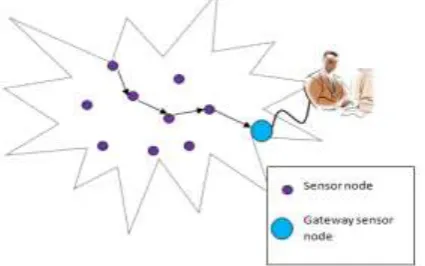
Fig 1: Multihop wireless sensor architecture
Collecting the large volume and variety of the sensed data is indeed, difficult as a number of important domains
of human endeavor are becoming increasingly reliant on these remotely sensed information. For example, in
smart-houses with densely deployed sensors, users can access temperature, humidity, health information,
electricity consumption, and so forth by using smart sensing devices. In order to gather these type of data, the
WSNs are constructed whereby the sensors relay their data to the “sink”. In case of widely and densely
distributed WSNs for e.g. in schools, urban areas, mountains, and so forth, there are two problems in gathering
the data sensed by millions of sensors. First, the network is divided in to some sub-networks because of the
limited wireless communication range. For example, sensor nodes deployed in a building may not be able to
519 | P a g e
communication range may raise a challenge for data collection from all sensor nodes. Second, the wirelesstransmission consumes the energy of the sensor nodes. Even though the volume of data generated by an
individual sensor is not significant, each sensor node requires a lot of energy to transmit the data generated by
surrounding sensor nodes. Especially in dense WSNs, the life time of sensor nodes will be very small because
each sensor node transmits a lot of data generated by tremendous number of surrounding sensors. To solve these
problems, we need an energy-efficient method to gather large volume of data from a large number of sensors in
the densely distributed WSNs. To achieve energy-efficient data collection in densely distributed WSNs, there
have been many existing approaches. For example, the data compression mechanism is capable of shrinking the
volume of the transmitted data. Although it is easy to be implemented, the data compression mechanism
requires the nodes to be equipped with a big volume of storage and high computational power. In addition, the
topology control mechanism can evaluate the best logical topology and reduce redundant wireless transmissions.
When the redundant wireless transmissions are minimized, the required energy for wireless transmissions can be
also minimized. Furthermore flow control and routing can choose the path which consists of nodes having high
remaining energy. However, these technologies are not able to deal with the divided networks problem. To deal
with both the divided sub-network problem and the energy consumption issue, the mobile sink technology have
received great attention in literature. In such schemes, the data collector, referred to as the “sink node” or simply
the sink is assumed to be mobile such as Vehicle, Unmanned Aerial Vehicle (UAV), and so on. As the sink node
moves around the sensing location, the sensors send data to the sink node when the sink node comes in their
proximity. Thus, energy consumption can be minimized by reducing the amount of transmissions in the WSN.
Since the mobile sink schemes aim to reduce wireless transmissions, the trajectory of the sink node is decided
based on the sensor nodes’ information (e.g., location and residual energy). The sink node divides the sensor
nodes into a number of clusters based on a certain condition. Then, the sink node roams around in these clusters.
II.
LITERATURE SURVEY
W. Heinzelman, A. Chandrakasan, and H. Balakrishnan proposed Energy efficient communication protocol for
wireless microsensor networks [1] in Jan. 2000. Distributed wireless sensor network will enable the reliable
monitoring of a variety of environments for both civil and military applications. In communication protocols,
which can have significant impact on the overall energy dissipation of these networks. The conventional
protocols of direct transmission, minimum-transmission-energy, multihop routing, and static clustering may not
be optimal for sensor networks, we propose LEACH (Low-Energy Adaptive Clustering Hierarchy), a
clustering-based protocol that utilizes randomized rotation of local cluster base stations to evenly distribute the energy
load among the sensor nodes in the network.
N. Li, J. Hou, and L. Sha proposed Design and analysis of an MST-based topology control algorithm[2] in May
2005, They introdused a Minimum Spanning Tree (MST) based topology control algorithm, called Local
Minimum Spanning Tree (LMST), for wireless multi-hop networks. In this algorithm, each node builds its local
minimum spanning tree independently and keeps only on-tree nodes that are one-hop away as its neighbors in
520 | P a g e
T. Khac and C. Hyunseung proposed Connectivity-based clustering scheme for mobile ad hoc networks [6] inJuly 2008. This describess several new clustering algorithms for nodes in a mobile ad hoc network. The main
contribution is to generalize the cluster definition and formation algorithm so that a cluster consists of s all
nodes that are at distance at most k hops from the cluster head. They also describe algorithms for modifying
cluster structure in the presence of topological changes. They also introduced a unified framework for most
existing and new clustering algorithm where a properly defined weight at each node is the only difference. They
studied node connectivity and node ID as two particular weights, for k = 1 and k = 2. Finally, they introduses a
framework for generating random unit graphs with obstacles.
K. Miyao, H. Nakayama, N. Ansari, and N. Kato proposed LTRT: An efficient and reliable topology control
algorithm for ad-hoc networks [7] in Dec. 2009. Transmission is a costly operation in the context of ad-hoc
networks, and thus topology control has been introdused to achieve efficient transmission with low interference
and low energy consumption. By topology control method, each node optimizes its transmission power by
maintaining network connectivity in a localized manner. Local Minimum Spanning Tree (LMST) is the
topology control algorithm, which has been proven to provide satisfactory performance.
S. He, J. Chen, D. Yau, and Y. Sun proposed Cross-Layer optimization of correlated data gathering in wireless
sensor networks [8] inJun. 2010. They consider the problem of collecting correlated sensor data by a single sink
node in a wireless sensor network. They assume that the sensor nodes are energy constrained and design
efficient distributed protocols to increase the network lifetime. Many existing approaches focus on optimizing
the routing layer only, but in fact the routing strategy is often coupled with link access in the MAC layer and
power control in the physical layer.
III.
EXISTING SYSTEM
The Existing System of this project is energy minimized clustering algorithm by using the
Expectation-Maximization (EM) algorithm for 2-dimensional Gaussian mixture distribution. This system aims to minimize
the sum of square of wireless communication distance since the energy consumption is proportional to the
square of the wireless communication distance. Moreover, we first focus on the “data request flooding
problem” to decide the optimal number of clusters.
The data request flooding problem refers to the energy inefficiency that occurs when all the nodes broadcast
data request messages to their respective neighboring nodes. This problem wastes energy, particularly in the
high density WSNs. Previous research work advocates increasing the number of clusters to reduce the data
transmission energy. However, in this method, we point out that an excessive number of clusters can result in
performance degradation, and therefore, we adopt an adequate method for deriving the optimal number of
clusters.
IV.
PROPOSED SYSTEM
The aim of this project is to achieve energy efficient Data Collection in densely distributed Wireless sensor
521 | P a g e
new data-gathering mechanisms for large-scale sensor networks when single or multiple M-collectors are used.In our data-gathering scheme with multiple M-collectors, only one M-collector needs to visit the transmission
range of the data sink. While the entire network can be divided into sub networks. In each sub network, an
M-collector is responsible for gathering data from local sensors in the subarea. Once in a while, the M-M-collector
forwards the sensing data to one of the other nearby M-collectors, when two M-collectors move close enough.
Finally, data can be forwarded to the M-collector that will visit the data sink via relays of other M-collectors. All
data are forwarded to M-collector 1 from other collectors, and then, M-collector 1 carries and uploads data to
the data sink.
Network Initialization
Cluster formation
Recieving information
using Sink node
Sending data to Base station
Simulation Results
leach.jpg
Figure 2: Architecture of proposed System
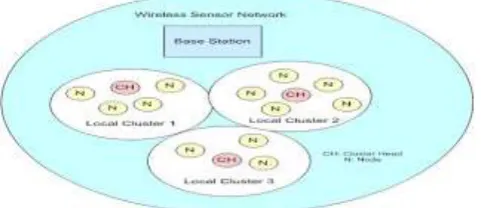
Figure 3: Cluster formation
V.
CONCLUSION
The mobile data-gathering scheme for large-scale sensor networks increases the performanse of the network .
The concept mobile data collector, called an M-collector, which works like a mobile base station in the network.
An M-collector starts the data gathering tour periodically from the static data sink, traverses the entire sensor
network, polls sensors and gathers the data from sensors one by one, and finally returns and uploads data to the
data sink. In addition, it can prolong the network life time significantly compared with the scheme that has only
522 | P a g e
REFERENCES
[1] W. Heinzelman, A. Chandrakasan, and H. Balakrishnan, “Energy efficient communication protocol for
wireless microsensor networks,” in Annual Hawaii International Conference on system Sciences, vol. 2,
Jan. 2000.
[2] N. Li, J. Hou, and L. Sha, “Design and analysis of an MST-based topology control algorithm,” INFOCOM
2003. Twenty-Second Annual Joint Conference of the IEEE Computer and Communications, vol. 4, no. 3,
pp. 1195–1206, May 2005.
[3] C.-C. Lin, M.-J. Chiu, C.-C. Hsiao, R.-G. Lee, and Y.-S. Tsai, “Wireless health care service system for
elderly with dementia,” IEEE Transactions on Information Technology in Biomedicine, vol. 10, no. 4, pp.
696–704, 2006.
[4] I. Bisio and M. Marchese, “Efficient satellite-based sensor networks for information retrieval,” IEEE
Systems Journal, vol. 2, no. 4, pp. 464–475, Dec. 2008.
[5] S. Katti, H. Rahul, W. Hu, D. Katabi, M. Medard, and J. Crowcroft,“XORs in the air: practical wireless
network coding,” IEEE/ACM Transactions on Networking, vol. 16, no. 3, pp. 497–510, Jun. 2008.
[6] T. Khac and C. Hyunseung, “Connectivity-based clustering scheme for mobile ad hoc networks,” in IEEE
International Conference on Research, Innovation and Vision for the Future, July 2008.
[7] K. Miyao, H. Nakayama, N. Ansari, and N. Kato, “LTRT: An efficient and reliable topology control
algorithm for ad-hoc networks,” IEEE Transactions on Wireless Communications, vol. 8, no. 12, pp. 6050–
6058, Dec. 2009.
[8] S. He, J. Chen, D. Yau, and Y. Sun, “Cross-Layer optimization of correlated data gathering in wireless
sensor networks,” in IEEE Communications Society Conference on Sensor Mesh and Ad Hoc
Communications and Networks (SECON), Jun. 2010, pp. 1–9.
[9] C. Jiming, X. Weiqiang, H. Shibo, S. Youxian, P. Thulasiraman, and S. Xuemin, “Utility-based
asynchronous flow control algorithm for wireless sensor networks,” IEEE Journal on Selected Areas in
Communications, vol. 28, no. 7, pp. 1116–1126, Sep. 2010.
[10] L. Ramaswamy, V. Lawson, and S. Gogineni, “Towards a qualitycentric big Data architecture for federated