33 |
P a g e
FACE DETECTION BY HAAR CASCADE CLASSIFIER WITH
SIMPLE AND COMPLEX BACKGROUNDS IMAGES USING
OPENCV IMPLEMENTATION
Vandna Singh
1, Dr. Vinod Shokeen
2, Bhupendra Singh
31 PG Student , Amity School of Engineering and Technology, Amity University, Noida, India.
2,3
Department of Electronics & Communication , Amity School of Engineering and Technology, Amity University, Noida, India.
ABSTRACT
This paper considers the problem of face detection in first attempt using haar cascade classifier from images containing
simple and complex backgrounds. It is one of the best detector in terms of reliability and speed. Experiments were
carried out on standard database i.e. Indian face database (IFD) and Caltech database. All images are frontal face
images because side face views are harder to detect with this technique. Opencv 2.4.2 is used to implement the haar
cascade classifier. We achieved 100% face detection rate on Indian database containing simple background and 93.24%
detection rate on Caltech database containing complex background. Haar cascade classifier provides high accuracy
even the images are highly affected by the illumination. The haar cascade classifier has shown superior performance
with simple background images.
Key words
- Face detection, Haar cascade classifier.I.
INTRODUCTION
Face detection is a part of face identification. When we see at the person’s face, can get the information such as the expression, gender, age and ethnicity. Face detection is useful in many applications such as surveillance system, human machine interaction, biometrics, gender classification etc. For human beings face detection is an easy task but face detection is quite a tough task for a computer.
34 |
P a g e
The remaining paper is setup as follows: Section II describes our proposed method and section III describes experimental results. Finally, conclusion and future work is discussed in last section.
II. PROPOSED METHOD
In terms of speed and reliability for face detection from an image haar cascade classifier is one of the best detector.
2.1 Face Detection
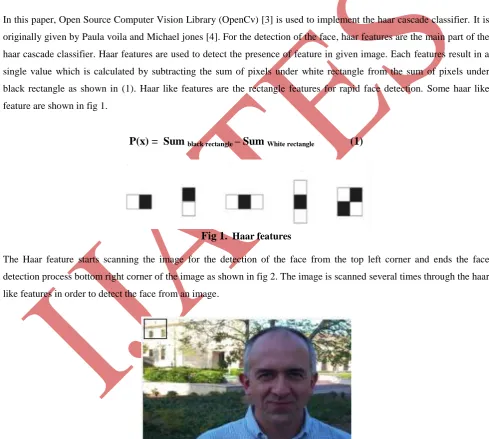
In this paper, Open Source Computer Vision Library (OpenCv) [3] is used to implement the haar cascade classifier. It is originally given by Paula voila and Michael jones [4]. For the detection of the face, haar features are the main part of the haar cascade classifier. Haar features are used to detect the presence of feature in given image. Each features result in a single value which is calculated by subtracting the sum of pixels under white rectangle from the sum of pixels under black rectangle as shown in (1). Haar like features are the rectangle features for rapid face detection. Some haar like feature are shown in fig 1.
P(x) = Sum
black rectangle– Sum
White rectangle(1)
Fig 1
. Haar featuresThe Haar feature starts scanning the image for the detection of the face from the top left corner and ends the face detection process bottom right corner of the image as shown in fig 2. The image is scanned several times through the haar like features in order to detect the face from an image.
35 |
P a g e
To compute the rectangle features rapidly integral image concept is used. It need only four values at the corners of the rectangle for the calculation of sum of all pixels inside any given rectangle. In an integral image the value at pixel (x,y) is the sum of pixels above and to the left of (x,y). Sum of all pixels value in rectangle D is shown in fig 3:
G1=A, G2=A+B, G3=A+C, G4=A+B+C+D
G1+ G4 - G2- G3=A+A+B+C+D-A-B-A-C=D
Fig 3.
Calculation of integral imageVoila jones algorithm uses a 24×24 window as the base window size to start evaluating these features in any given image. If we consider all the possible parameters of the haar features like position, type and scale then we have to calculate the 160, 000 features in this window but this is practically impossible. The solution of this problem is to use the adaboost algorithm. Adaboost is a machine learning algorithm which helps us to find the best features among the 160,000. These features are the weak classifiers. Adaboost construct a strong classifier as a linear combination of these weak classifiers as shown in (2).
F(x) =
α
1F
1(x) +
α
2F(x) +
⋯⋯⋯⋯
(2)
The face detection can be performed by cascade using haar like features as shown in fig 4. In that cascade, an image will be a human face if it passes all the stages. If it is not passed any one of the stage it means the image is not a human face [5].
Fig 4.
Cascade classifier
36 |
P a g e
OpenCv 2.4.2 is used to implement the haar cascade classifier in order to detect face from the images. To test the performance of haar cascade classifier we run experiments on a large number of datasets containing simple and complex images.
3.1 Image databases
Two type of images were used in our experiments. The type-1 images contains simple background and lightly affected by the illumination while the type -2 images highly affected by the illumination and have complex backgrounds. The type-1 images were downloaded from website [6] and type 2 images were downloaded from the website [7]. The size of type -1 images are 640× 480 and size of type-2 images are 896×592. All images are in JPEG format. Indian database belongs to type-1 images and Caltech database belongs to the type – 2 images. We used 360 type-1 images and used 370 type-2 images. All images are frontal face images because haar cascade classifier gives good result on frontal face images. Some images of Indian face Database and Caltech database are shown in fig 5. First row contain the Indian face database images and second row contain the Caltech database images.
Fig 5. Sample images from test set 1 and test set 2 databases.
3.2 Haar cascade classifier result
OpenCv [3] provides haar cascade classifier Implementation with various trained classifier cascades . Default frontal face cascade is used in our experiment. Total number of images used for both the databases for the experiment are shown in TABLE I
Table I Number of total images used for both datasets Databases Total images
Test set 1 360
Test set 2 370
TABLE II Shows the face detection results on test set 1 and test set 2 databases containing simple and complex backgrounds respectively.
37 |
P a g e
For Images
detected face Images
detected face images
rate (%)
Test set 1 360 0 100%
Test set 2 345 25 93.24%
TABLE III Shows the false detection rate for both the datasets.
Table III False detection rate Datasets False detection rate
(%)
Test set 1 0%
Test set 2 6.76%
Fig 6 shows the detected face from simple background images with 0% false detection rate. All faces are accurately detected in first attempt using haar cascade classifier.
Fig 6.
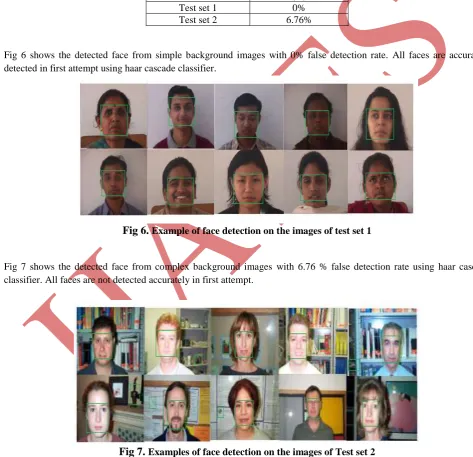
Example of face detection on the images of test set 1Fig 7 shows the detected face from complex background images with 6.76 % false detection rate using haar cascade classifier. All faces are not detected accurately in first attempt.
Fig 7.
Examples of face detection on the images of Test set 238 |
P a g e
In this paper, simple and complex backgrounds images used for the experiment of face detection. From the experimental point of view it is clear that haar cascade classifier has shown excellent performance for the images which contain the simple background. The haar cascade approach has several advantages:
1) To handle the large databases haar cascade classifier is the best detector in terms of speed and reliability. 2) Even the image is affected by illumination, face detection results are more accurate using haar cascade
classifier.
3) There is no restriction on wearing glasses.
Looking at the advantage of haar cascade classifier it is suitable to implement for real time face detection.
REFERENCES
[1] Makinen ,E., Raisamo,R.,2002 Real time face detection for Kiosk interfaces. In :Proc .APCHI 2002, Beijing, China,pp.528-539.
[2] Hjelmas, E.,Low,B.K.,2001 Face detection: A survey. Computer vision and image understanding 83, 236-274.
[3] Open source computer vision library http://sourceforge.net/projects/opencvlibrary/
[4] P. Viola and M. Jones, “Rapid object detection using a boosted cascade of simple features,” in Computer Vision and Pattern Recognition,
2001. CVPR 2001. Proceedings of the 2001 IEEE Computer Society Conference on, 2001, vol. 1, pp. I-511-518.
[5] Erno and Roope “An experimental comparision of gender classification methods,” Pattern recognition 2008,pp:1544-1556.
[6] Indian database downloaded from http://vis-www.cs.umass.edu/~vidit/AI/dbase.html