Absolute Difference Based Progressive
Switching Median Filter for Efficient Impulse
Noise Removal
Gophika ThanakumarAssistant Professor, Department of Electronics and Communication Engineering Easwari Engineering College Ramapuram Chennai
Abstract—Digital images are often corrupted by different noises. These noises can be removed by designing an efficient filter. Based upon the specified operation the pixels are classified. Absolute Difference Based Progressive Switching Median Filter (ADBPSMF) outperforms all other filter for the removal of impulse noise from corrupted images. This filter performs two basic operations for efficient noise removal. The first stage is noise detection and the second is noise filtering. For noise detection, Modified Boundary Discriminative Noise Detection (MBDND) algorithm is used. For noise filtering, Absolute Difference Based Progressive Switching Median Filter (ADBPSMF) is used. The Modified Boundary Discriminative Noise Detection (MBDND) incorporate two modifications after classifying the pixels as follows: (1) Expansion of filtering window. (2) Incorporating spatial and intensity information. By introducing these modifications into the algorithm, it is found that there is increase in the performance and the quality of image has improved. Results are compared with other median filters like Boundary Discriminative Noise Detection Filter (BDND), Tri State Median Filter (TMF), Center Weighted Median Filter (CWMF), Progressive Switching Median Filter (PSMF), Adaptive Threshold Median Filter (ATMF) and it is found that ADBPSMF performs well even at high noise density ( 95%).
Keywords—Absolute Difference Based Progressive Switching Median Filter (ADBPSMF); Adaptive Threshold Median Filter (ATMF) ;Boundary Discriminative Noise Detection Filter (BDND); Center Weighted Median Filter (CWMF; Modified Boundary Discriminative Noise Detection (MBDND); Progressive Switching Median Filter (PSMF); Tri State Median Filter (TMF);
I. INTRODUCTION
During the transmissions of images over channels, images are often corrupted by impulse noise due to faulty communication or noisy channels, faulty camera or the like. In a black and white digitized image, pixels corrupted by positive impulses appear as white dots and those corrupted by negative impulses appear as black dots. The objective is to remove impulses so that the noise-free image fully
recovered with a minimum signal distortion. To reduce the effect of noise, restoration techniques are available. Filtering is one among those techniques. Filters are of two types: linear filters and non-linear filters.
Linear filters have been the primary tool for signal processing. They are easy to design and offer excellent performance. They also provide distortionless transmission. This is particularly true for spectral separation where the desired signal spectrum is significantly different from the interference. The drawbacks of linear filters are poor performance in the presence of non-additive noise, non-Gaussian noise. In image processing applications, linear filters tend to blur the edges, but do not remove the impulse noise effectively and do not perform well in the presence of signal dependent noise. The transmission of the digital image requires communication channels which are often modeled by theory of non-linearity. So, noise in image due to communication channels must be filtered using non-linear filters.
II. MEDIAN FILTER
A Median filter is a non-linear digital filter which is able to preserve sharp signal changes and is very effective in removing impulse noise. While linear filters have no ability to remove this type of noise without affecting the distinguishing characteristics of the signal, median filters have remarkable advantages over linear filters for this particular type of noise. Therefore median filter is very widely used in digital signal and image processing applications. The SM filter can suppress noise while retaining sharp sustained changes (edges) in signal values. Median filter is the best filter for removing impulse noise.
III. EXISTING METHOD
The switching median filter is Boundary Discriminative Noise Detection (BDND) filter. The BDND filter is proven to operate efficiently when compared to other filters, even under high noise densities upto 90%. Being a switching – based median filter, the BDND algorithm filters the noisy image in two steps. The first step is essentially a noise detection step which is based on clustering the pixels in the image in a localized window into three groups, namely;
Low intensity impulse noise
High intensity impulse noise
Uncorrupted pixels
The BDND filter is proven to operate effectively under different impulse noise models. However, two main observations can be made about its filtering steps.
Expanding the window until the number of uncorrupted pixels is at least half the number of pixels in the window may impose additional blurring in the output image. The impact of this is clearly noticeable under high noise densities.
The filtering step relies on computing the median value of the uncorrupted pixels found in the window without any regard to the spatial relationship of these pixels to the noisy pixels, and the deviation of the pixels’ intensities from the median value. This also affect the quality and the sharpness of the edges in the filtered image.
IV. PROPOSED MODIFICATIONS
After introducing modifications in the filtering steps of BDND, it is named as MBDND. The performance of MBDND is high when compared with other standard median filters. The main drawback of MBDND is blurring due to expansion of filtering window. In order to overcome this drawback, we designed a new filter with improved performance.
ADBPSMF (Absolute Difference Based Progressive Switching Median Filter) is the proposed new filter. Instead of expansion of filtering window, the absolute difference calculation and sliding window mechanism is followed with BDND noise detection. In BDND noise detection, the pixel misclassification occurs. This drawback can be overcome by ADBPSMF, in which different cases are considered in the obtained window. Let us consider an example which elaborates the filtering operation of the ADBPSMF.
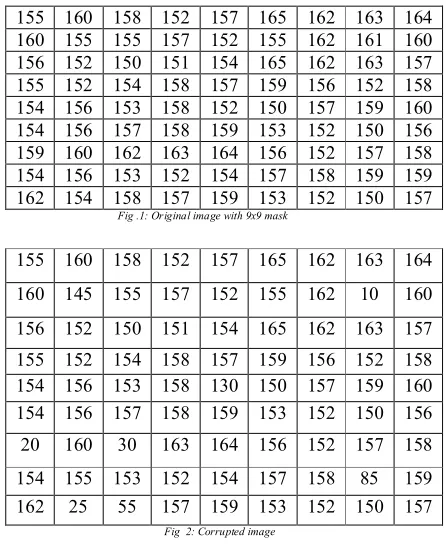
Consider the original image with following pixel values in a 9x9 window. Initially, the 3x3 window is considered for illustrating different conditions.
Centre pixel is taken as Processing Pixel (PP) and then each neighboring pixel is compared with PP to find the Absolute Difference (AD) value.
155 160 158 152 157 165 162 163 164 160 155 155 157 152 155 162 161 160 156 152 150 151 154 165 162 163 157 155 152 154 158 157 159 156 152 158 154 156 153 158 152 150 157 159 160 154 156 157 158 159 153 152 150 156 159 160 162 163 164 156 152 157 158 154 156 153 152 154 157 158 159 159 162 154 158 157 159 153 152 150 157
Fig .1: Original image with 9x9 mask
155 160 158 152 157 165 162 163 164 160 145 155 157 152 155 162 10 160 156 152 150 151 154 165 162 163 157 155 152 154 158 157 159 156 152 158 154 156 153 158 130 150 157 159 160 154 156 157 158 159 153 152 150 156 20 160 30 163 164 156 152 157 158 154 155 153 152 154 157 158 85 159 162 25 55 157 159 153 152 150 157
Fig 2: Corrupted image
Different cases are considered for illustrating the operation of the filter.
A. Case 1
If the Absolute Difference is very low value, then the Processing Pixel is considered as “noise free” and it is unaltered.
B. Case 2
If all the values in the absolute difference are high, then the processing pixel is considered as noisy and it must be eliminated by computing the median value. The median value is computed by sorting the pixels in the window without considering the PP value. After sorting the left and right extreme pixel values are eliminated one by one and then remaining two values [(162+162)/2] are summed up and average is calculated. The computed median value for the AD value is 162. So, the PP = 10 in the window is replaced by 162.
C. Case 3
Here we need to define two new variables, N1 and N2. Count of the lowest difference is N1 and Count of the highest difference is N2. Here N1>N2, so the PP is considered as noise free and unaltered.
performance of the filter and hence ADBPSMF is proved to be best when compared with other filter.
V. ALGORITHM I [NOISE DETECTION] Step 1 : Get an input image of size 512x512. Step 2 : Add impulse noise to the original image. Step 3 :Then detect the type of noise introduced on the input image by performing BDND noise detection step.
Step 4 : Classify pixels into three types as follows:
i) High intensity impulse noise pixels ii) Medium intensity impulse noise pixels iii) Uncorrupted pixels
Step 5 : Identified noisy pixels are applied for filtering and other noise free pixels are left unchanged.
VI. ALGORITHM II [NOISE FILTERING] Step 1 : Construct a 3x3 window centered on the Processing Pixel (PP).
Step 2 : Identify whether the processing pixel is noisy or noise free with the help of BDND noise detection.
Step 3 : If the processing pixel is identified as “noisy”, then calculate the Absolute Difference(AD) with the neighborhood pixels in the selected window.
Step 4 :Three different cases are considered and each
cases are explained one after other. (i) If all the obtained values in the absolute difference are less, then processing pixel is considered as noise free.
(ii) If all the obtained values are large, then PP is considered as noisy and then median is found and replaced.
(iii) When majority of the values obtained in absolute difference are high- PP is noisy, else PP is noise free and unaltered.The above steps are repeated until the processing is completed for the entire image.
VII. PERFORMANCE EVALUATION
Filtering performance can be evaluated by computing parameters like, Peak Signal to Noise Ratio (PSNR), MAE (Mean Absolute Error), MSE (Mean Square Error), IEF( Image Enhancement Factor) and FOM (Figure Of Merit). The obtained values are compared for different filters. MAE is used to focus on the detail preserving characteristics of the filter.
Smaller MAE values signify better detail preservation of restored image and high PSNR value indicates better image restoration.
MSE is defined as:
2
1
m
0
i
1
n
0
j
I(i,
j)
K(i,
j)
mn
1
MSE
The PSNR is defined as:
MSE 2 I MAX 10 log 10 PSNRHere, MAXI is the maximum possible pixel value of the image. When the pixels are represented using 8 bits per sample, this is 255.
The MAE is defined as:
x
i,
j
j
i,
r
i,
j
MN
1
MAE
Where, ri,j is the pixel values of the restored
image and
x
i,
j
is the pixel values of the original image.The IEF is defined as:
ji, η(i, j)Y(i, j) Y(i, j) 2 2 j) Y(i, j) η(i, IEF
Here, Y represents an original image ,
Y
represents the denoised image and
represents the noisy image.The FOM is defined as:
d n 1 K 2 K ad 1 1 t n , d n Max 1 FOMWhere, ‘
n
d’ and ‘n
t’ are the number of edge pixels detected in the original and output images, respectively,d
k is the distance from thek
thedge pixel in the original image.
Based on the two modifications in the filtering step of BDND algorithm are:
Expansion of filtering window
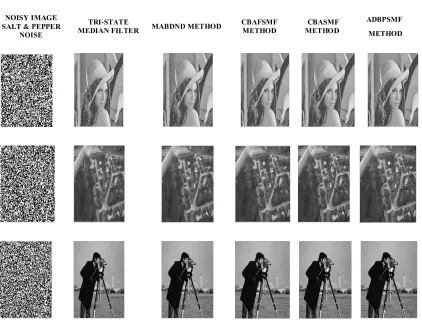
The above process is carried out for evaluating the performance of the filter used. Comparisons of various filters are analyzed by using simulation software.
NOISY IMAGE SALT & PEPPER
NOISE
TRI-STATE
MEDIAN FILTER MABDND METHOD
CBAFSMF METHOD
CBASMF METHOD
ADBPSMF
METHOD
Figure. 3: Simulation output for 95% noise density
VIII. SIMULATION RESULTS
TABLEI
COMPARISON TABLE FOR VARIOUS PARAMETERS AND FILTERING
METHODS FOR LENA IMAGE
FILTERING METHOD FOLLOWED
NOISE DENSITY=95%
PSNR IEF MAE
ADBPSMF 27 13.02 19.7
CBAFSMF 25 12.00 27.2
CBASMF 24 11.75 28.0
MABDND 23 11.52 29.4
TMF 20 11.04 30.0
TABLE II.
COMPARISON TABLE FOR VARIOUS PARAMETERS AND FILTERING METHODS FOR CAMERAMAN
IMAGE
FILTERING METHOD FOLLOWED
NOISE DENSITY=95%
PSNR IEF MAE
ADBPSMF 27.5 13.33 19.9
CBAFSMF 25.5 11.52 27.3
CBASMF 24.5 11.28 27.8
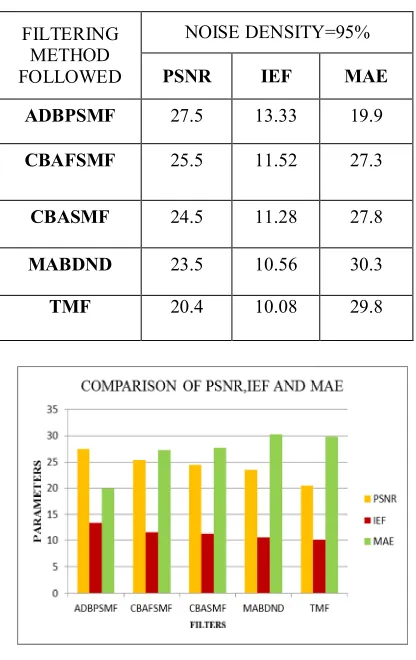
MABDND 23.5 10.56 30.3
TMF 20.4 10.08 29.8
fig .5: Plot Obtained for Table II
TABLE.III.
COMPARISON TABLE FOR VARIOUS FILTERING METHODS
TABLE IV.
COMPARISON TABLE FOR VARIOUS FILTERING METHODS
Fig 6: Plot Obtained for Table III IX. CONCLUSION
A new filtering approach named as, ADBPSMF (Absolute Difference Based Progressive Switching Median Filter) is proposed for efficient impulse noise removal from corrupted images. This filter is designed in order to overcome problems like, (i) blurring-loss of clarity in images due to expansion of filtering window (ii) increased computation time (iii) high complexity. It also helps to improve the quality of images for large window sizes and poor noise removal for smaller window sizes. Performance is evaluated by comparing various parameters like PSNR, MSE, IEF, FOM and MAE. It is analyzed with consistent and stable performance across a wide range of noise densities, varying from 10% to 95%. Thus, we can conclude that by comparing different filtering methods like CBAFSMF, CBASMF, MABDND and TMF for corrupted images, ADBPSMF (Absolute Difference Based Progressive Switching Median Filter) is best impulse noise removing filter.
X. REFERENCES
[1] Iyad F. Jafar, Rami A. AlNa’ mneh, and Khalid A. Darabkh,” Efficient Improvement on the BDND Filtering Algorithm for the Removal of High-Density Impulse Noise,” IEEE Trans. Image Process., vol.22, No. 3, MARCH 2013.
[2] T. Veerakumar, S. Esakkirajan, Ila Vennila,“An efficient approach to remove random valued impulse noise in image”, ICRTIT 2012,IEEE 2012.
[3] Kenny Kal Vin Toh, Nor Ashidi Mat Isa,” Cluster- Based Adaptive Fuzzy Switching Median Filter for Universal Impulse Noise Reduction,’’ IEEE Transactions on Consumer Electronics, Vol. 56, No. 4, November 2010.
[4] Tao Chen, Kai-Kuang Ma, and Li-Hui Chen, “Tri-state median filter for image de-noising,” IEEE Trans. Image Process., vol. 8, no. 12, pp. 1834-1838, Dec. 1999.
[5] Yanwei Huang, Binglu Qi and Shaobin Chen,”Modification
of advanced boundary discriminative noise detection
PARAMET
ERS FILTERING METHOD USED
ADBPSM F
CBAFSM
F CBSMF
MABD ND
TM F
MSE 1112.3 1203.6 1213.8 1221.9 127 5
FOM 0.88 0.87 0.86 0.85 0.8
Algorithm,” IEEE International Conference on Control and Automation (ICCA), June 12-14, IEEE 2013.
[6] Yunfan Wang, Zhu Zhu, Lei Miao, Xiaoguo Zhang, Xueyin Wan,Qing Wang,” A cluster based adaptive switching median filter,” IEEE 2013.
[7] Z. Wang and D.Zhang, “Progressive switching median filter for the removal of impulse noise from highly corrupted images,” IEEE Trans. Circuits Syst. II, Analog Digit. Signal Process., Vol. 46, no. 1,pp. 78-80,Jan. 1999.
[8] Pei-Eng Ng and Kai-Kuang. Ma,” A switching median filter with boundary discriminative noise detection for extremely corrupted images,” IEEE Trans. Image Process.,vol. 15,no. 6, pp. 1506-1516, June.2006.
[9] Wei Ping, LiJunli, Lu Dongming, Chen Gang,” A Fast and Reliable Switching Median Filter for highly corrupted images by Impulse noise,” IEEE 2007,pp . 3427-3430.
[10] Wei Wang and Peizhong Lu,”An efficient switching median filter based on local outlier factor,” IEEE Signal Processing Letters,Vol.18,No.10,October 2011.
[11] S. J. Ko and Y. H. Lee, “Center weighted median filters and their applications to image enhancement,” IEEE Trans. Circuits Syst., vol. 38, no. 9, pp. 984-993, Sep.1991.
[12] D. R. K. Brownrigg, “The weighted median filter,” ACM Commun., vol. 27, no. 8, pp. 807-818, Aug. 1984.
[13] P. S. Windyga, “Fast impulsive noise removal,” IEEE Trans. Image Process., vol. 10, no. 1, pp. 173-179, Jan. 2001.
[14] R. C. Gonzalez and R.E. Woods, Digital Image Processing. Upper Saddle River, NJ: Prentice Hall, 2002.
[15] R. H. Chan, C.-W. Ho, and M. Nikolova, “Salt-and- Pepper Noise Removal by Median-Type Noise Detectors and Detail-Preserving Regularization,” IEEE Trans. Image Process., vol. 14, no. 10, pp.1479–1485, Oct. 2005.