2017 | VOLUME 13 | 211 © ARCHIVES OF BUDO | PROPHYLACTIC AND THERAPEUTIC AGONOLOGY
Possibilities and limitations of judo (selected
martial arts) and innovative agonology in the
therapy of people with mental disorders and also
in widely understood public health prophylaxis
Dariusz Mosler
1ABCDE, Roman Maciej Kalina
2ABCDE1
Institute Physical Education, Tourism and Physiotherapy, Jan Dlugosz University of Czestochowa, Poland
2Gdansk University of Physical Education and Sport, Faculty of Physical Education, Department of Combat Sports,
Poland
Received:
11 July 2017;
Accepted:
03 August 2017;
Published online:
09 August 2017
AoBID:
11490
Abstract
Background and Aim: From the perspective of the modern language of health science, it is rightful interpretation, that multidimen
-sional judo deserves to be recognised as a specific method of public health, having a complementary impact on somatic and mental aspects of health. The aim of this review is theoretical and empirical argumentation regarding possibilities and limitations of judo and innovative agonology application in an area of broadly un
-derstood prophylactic in public health with special focus on therapy of people with mental disorders.
Material and Methods: As main criteria for reviewing published scientific papers with relations with a term of judo, by a sole presence of this term in its title (“judo”, “judoka”, “judoist”) was taken. Databases were accessed in 31.07.2017 despite
Web of Knowledge power of collecting knowledge and data is limited to papers written in English. That is why criteria of inclusion to this work are limited to all Web of Science databases (not only Core Collection) but also
Research Journal of Budo, which belongs to Japanese Academy of Budo (papers written in Japanese, abstracts in English).
The review books and articles concerning agonology include 1) the historical context of creating and publish
-ing specific theories of agonology; 2) unique value of agonology in a methodological meaning and its utilitari
-an applications; 3) subst-antive offer of innovativeagonology.
Results: Applied search method in Web of Knowledge resulted in 1,264 records found, written by scientists from 66 different countries: Brazil (140); Poland (118); Japan (86). In the ranking of general science categories, there is undisputed domination of papers classified to science technology (1,058), life science and biomedicine (1,012), social sciences papers (270). In a category of research areas, out of 100 research areas, sports sci
-ences are dominating with some 916 papers included, the area of general internal medicine (193), physiolo
-gy (183). Rehabilitation concerns 67 publications. Occasional psychiatry and people with mental disorders. Five detailed theories of agonology were published in 6 separate books (from 1938 to 2000, all in Polish). Since 2011 innovative agonology offers e.g.: mixed assessments; martial arts bibliotherapy; modern health-re
-lated training.
Conclusion: Quantitative analysis of scientific papers available in global space of science regarding judo is a proof, that 84% of works are framed into two general science categories: science technology and life science and bio
-medicine. Sports orientation is dominating over health promotion and public health medicine – which con
-firms the first hypothesis. Recommendations of innovative agonology are close to the overall concept of a jūdō
creator, Jigoro Kano. The concept of jūdō by Jigoro Kano and innovativeagonology do not exclude themselves. They are coherent, which confirms the second hypothesis.
212 | VOLUME 13 | 2017 www.archbudo.com Original Article
INTRODUCTION
Upon first recommendations, Jigoro Kano high
-lighted, that jūdō (written in this way means compliance with Jigoro Kano’s conceptions) not only modern martial art but also before anything else, it is a consistent system of physical and moral education [1-4]. At the turn of the 19th
and 20th century, he recognises, that emerging
Olympic Movement is a suitable occasion for promoting it. He presented this idea originally as a lecture given at the University of Southern California on the occasion of the 10th Olympiad
in Los Angeles 1932 [5]. He could not foresee, that judo will be officially included at summer Olympic games at 1972. At that moment, all sport was strongly commercialised, subjected to the strict rigour of mass media domination, connected with business and politics. At 1989, judo, alongside with kendo and sumo was imple
-mented in the physical education system in Japan by the name ofbudō [6].
The appearance of Archives of Budo in a global space of science in 2005 caused increased inter
-est not only in Japanese martial arts in health aspects. The necessity of redefinition of jour
-nal mission in 2013, creating branch jour-nal called Archives of Budo Science of Martial Arts and
Extreme Sports [7] was a consequence of phe
-nomena showed by Peset et al. [8]. During the period of 5 years (2005-2010), Archives of Budo became a leader regarding judo-related papers published in 1959-2010 in journals evaluated
by Web of Science. Moreover, topic analysis of
papers published in Archives of Budo from 2005 to 2010 showed total domination of judo-re
-lated issues [7]. This result is an indirect proof how strong is an intellectual influence of Jigoro Kano upon scientific environment throughout the world. None other martial art generates numer
-ous such group of researchers with highest sci
-entific qualifications.
From the perspective of the modern language of health science, it is rightful interpretation, which multidimensional judo deserves to be recognised as a specific method of public health, having a complementary impact on somatic and mental aspects of health.
Public health medicine – according to Concise Colour Medical Dictionary – is defined as „the branch of medicine concerned with assessing needs and trends in health and disease of pop
-ulations as distinct from individuals. Formerly known as community medicine or social medi-cine, it includes epidemiology, health promotion, health service planning and evaluation, commu
-nicable disease control and environmental haz
-ards” [9, p. 549]. Sticking to terms defined by this Dictionary, such as “epidemiology”, „health pro
-motion”, „health service planning”, „environment” (see glossary) there is possible to deeply analyse judo accordingly to Jigoro Kano concept and its implementation in different countries with two perspectives of applications. On the one side, with assessing needs and trends in health and disease of populations. On the other hand with the need of every single individual, where tradi
-tional medical procedures are insufficient.
For the parallel analysis and perspective of such application based on the same methodologi
-cal assumptions encourages innovative agonol-ogy [10]. The main difference is that at the most recent development stage of this deeply esoteric science about struggle [11, 12] is not separate martial arts. Oppositely, innovative agonology (or rather prophylactic and therapeutic agonology) is specific science, which formal concepts are for
-mulated on a highest general level than techni
-cal terms of judo, budo or any other martial art developed outside Asia [10].
The aim of this review is theoretical and empir
-ical argumentation regarding possibilities and
Key words: budō • combat sports • fun forms of martial arts • Jigoro Kano • martial arts •neo gladiatorship
Copyright: © 2017 the Authors. Published by Archives of Budo
Conflict of interest: Authors have declared that no competing interest exists
Ethical approval: Not required
Provenance & peer review: Not commissioned; externally peer reviewed
Source of support: Departmental sources
Author’s address: Roman Maciej Kalina, Department of Sport, Faculty of Physical Education, University of Physical Education and Sports, K. Gorskiego 1, 80-336 Gdansk, Poland; e-mail: [email protected]
Epidemiology – n. the study of epidemic disease, with a view to finding means planned on of control and future prevention. This not only applies to the study of such classical epidemics as plague, smallpox, and cholera but also includes all forms of the disease that relate to the environment and ways of life. It thus includes the study of the links between smoking and cancer, and diet and coronary disease, as well as communicable diseases [9, p. 222].
Health promotion – a programme of surveillance planned on a community basis to maintain the best possible health and quality of life of the members of the community, both collectively and individually. Programmes include a blend of such personal services as health education, immunisation, and screening tests, with environmental monitoring of the atmosphere, housing and water and food supplies as well as occupational hazards [9, p. 296].
limitations of jūdō(judo) and innovative agonol-ogy application in an area of broadly understood prophylactic in public health with special focus on therapy of people with mental disorders.
The realisation of this goal involves verification of the following hypotheses:
H1 – articles in scientific journals, dedicated to jūdō are dominated by sports aspect of judo, with mostly analysis of physiological and motor perfectionism;
H2 – innovative agonology have the universal characteristic of formulated laws, rules and prin
-ciples, as well as original methods and means of prophylactic and therapy, which are sub judged to open formula, where the only limitation is on mixed evaluation (effeciency with ethics) of every action. It does not states contrary to ethics and motor principles of jūdō or those martial arts and defence systems, which are not harmful towards health and interpersonal relations.
MATERIAL AND METHODS
Main premises and assumptions
It is not contested, that Jigoro Kano contributed greatly to the modern understanding of wide cat
-egories of martial arts as potential methods and means of enhancing every health aspects – somatic, mental and social [13, 14]. In contrary to that vision, there are promoted by electronic media contem
-porary forms of gladiatorial contest, among other names called Mixed Martial Arts – MMA [15].
As main criteria for reviewing published scientific papers with relations with a term of judo, by a sole presence of this term in its title (“judo”, “judoka”, “judoist”) was taken. Apparently, it is contrary to assumptions described above. However, it is obvi
-ous, that comprehensive review of all judo-related papers with detailed topics exceeds capabilities of an even large international team of research
-ers. There are papers regarding specific connec
-tions of judo with different aspects, but authors did not put term “judo” or any of its varieties in a title. For this group of authors, we can acknowl
-edge, that they inform the reader, that their work issue is not directly connected with a specificity of judo. Analysis of specific judo-related keywords (e.a. randori, nage-no kata, ukemi waza) also will not do a complete review, as it is hard to guess all possi
-ble combinations of words that someone may come up with.
This simplest criterion of identification for use in this review (derivative from word “judo” in a title) has an elementary methodological advantage. In a part of papers, judo athletes are considered as a material for specific issues such as biomechanical, physiological, psychological etc. Recommendations may not be associated with a specificity of judo training or its other aspect (it could be about any other universal aspect). Regardless, term “judo” in its title is justified. For example, long-term judo training is one of the possibilities to analyse results by differences between physically active and those who prefer sedentary lifestyle. No rule forbids such comparison (judo athletes – not physically active individuals). Another example is scientific paper qualified to science technology (according to gen
-eral categories of science), which puts “judo” in the title just to inform that it will be about the applica
-tion of specific technology for use in judo, or for any other application. However, the crucial part is an analysis of phenomena by specialist related to science technology etc.
Different nationalities of jūdō creator (Jigoro Kano, in 19th century model his method on tra
-ditions of samurai ju-jitsu and Japan culture) and agonology co-authors (three Polish scientist who have the same methodological school, but dif
-ferent in age and experiences of fighting prac
-tice in real world) determined to include partially works written in Japanese and Polish. Review of judo-related works is partially based on papers written in Japanese, while agonology (despite its newest implementation – innovative agonology) on papers written in Polish (books included).
First of all, Jigoro Kano, in a lecture about his con
-cept of jūdōstates that, „final aim of Judo, there
-fore, is to inculcate in the mind of man a spirit of respect for the principle of maximum efficiency and mutual welfare (…)” [5, p. 58]. Therefore, peo
-ple with mental disorders, are in a difficult situ
-ation to achieve that, because their inner state, including emotional, intellectual or any other mental limitation makes harder or impossible for achieving “judo in mind” state.
Secondly, our therapeutic achievements by work
-ing with people with a mental disorder by us-ing motor elements of jūdō connected with a cog
-nitive-behavioural offer of innovative agonology bring empirical argumentation, which among other things, the potential of jūdō is not used effectively in widely understood public health prophylaxis (in national systems and globally).
Environment – n. any or all aspects of the surroundings of an organism, both internal and external, which influence its growth, development, and behaviour [9, p. 220].
Olympic Movement – noun all the international sporting federations who abide by the rules of the Olympic Charter [91].
Summer Olympics – noun the Olympic event that takes place during the summer of an Olympic year [91].
Perfectionism – noun, rigorous rejection of any performance or level of competence that is less than perfect [91].
Public health – noun the study of illness, health and disease in the community. ð community medicine [91].
Community medicine –
noun the branch of medicine devoted to the provision of public health care [91].
Struggle – any activity that is at least a two-subject one (premising that a team can be a subject) where at least one of subjects hinders the other [6].
Budo (Budō) – originally a term denoting the “Way of the warrior”, it is now used as a collective appellation for modern martial arts of kendō, jūdō, kyūdo and so on. The primary objective of these “martial ways” is self-perfection (ningen – kesei) [6].
Nage-no kata – forms of throwing.
Randori – sparring in judo in which both participants practice attacking and defending [6].
214 | VOLUME 13 | 2017 www.archbudo.com Original Article
For the third, sport pathology, which did not omit judo (e.g. aggression, death cases and inju
-ries during training and tournaments, migration of Olympic champions to bloody fights of con
-temporary gladiators) is probably the biggest bar
-rier for promoting wide category of martial arts as substantial methods and means in many aspects of public health prophylaxis.
Specific criteria for reviewing publications, show
-ing research trends of phenomena specific for „judo” and on the edge of topics related to dif
-ferent groups and disciplines of science
Databases were accessed in 31.07.2017. Despite Web of Knowledge power of collect
-ing knowledge and data, it is limited to papers written in English. That is why criteria of inclu
-sion to this work are limited to all Web of Science databases (not only Core Collection) but also Research Journal of Budo, which belongs to Japanese Academy of Budo (papers written in Japanese, abstracts in English).
In a search engine, phrase “judo” (and all vari
-ances of the judo-related word) was typed, and set search for “title”. It was set to show results from all years. Obtained results were analysed using inbuild Web of Science tools. Records were ranked in following fields: authors, countries/ter
-ritories, general categories and research areas, journal.
However, Research Journal of Budo is not indexed in Web of Science, as there are language barri
-ers, so does not fit into criteria for inclusion. Therefore, this journal papers cannot be anal
-ysed by the automated engine of Web of Science with other papers. That is why, new categories, for showing trends of the topic, will be presented. Analyzed period concerned 2010 to 2017 (July).
All included papers put in specific categories by using smart groups in EndNote. This bibliomet
-ric analysis will only categorise papers by main subjects and what topics they are focused on. All papers were selected by following categories by words in the title:
“competition” – all papers related to competition subject understand as rules of competitions and other circumstances related to rules or conditions of winning besides this related to physiological or mental capabilities of competitors;
“injury” – all papers related to injury occurrence during judo practice or competitions;
“physiology and performance” – it is hard to dis
-tinguish between performance during competi
-tion and physiological reac-tions of judo athletes (that is why performance understand as physio
-logical conditions or physio-logical changes during judo-related activity are in that category);
“technique” – all papers related to analy
-sis of technique executions during practice or competitions;
“education & mental” – all papers related to spreading ideas of judo as well as education of judo principles of the youth, as well as mental development through judo practice.
This criterion splits all topics of judo-related papers to categories for psychosomatic aspects and competition-related environment of judo as an Olympic discipline. If some paper has aspects of both categories, the majority of paper topic determines whether the category is more suit
-able. It is decided by the main aim of this paper so that overall trends will be shown despite minor dilemmas.
Specific criteria of review of publications regard
-ing “agonology” (science about struggle) in rela
-tion to complementary health promo-tion and enchantment of survival ability
The necessity of references to books written in Polish is a consequence of an editorial way of all specific agonology theories (since 1938 to 2000). Only from 2011 [16] agonology (and its basic ter
-minology) is promoted in English-based journals as the original achievement of Polish scientists. In a global space of science (so in English, avail
-able on the Internet in a Web of Science) first work regarding the relationship of agonology with judo, budo and wide understood of martial arts was published in the year 2015 [11].
This review includes 1) the historical context of creating and publishing specific theories of agonology; 2) unique value of agonology in a meth
-odological meaning and its utilitarian applica
RESULTS
Review of trends in international journals
dealing with judo research
1Applied search method in Web of Knowledge resulted in 1,264 records found, written by sci
-entists from 66 different countries. At the first positions in this ranking, there are papers pub
-lished by authors from Brazil (140). The second place belongs to Poland (118), and the third to Japan (86). Only papers from Brazil and Poland exceeds 100 publications. From third to sixth place, authors from specific countries published several dozens of papers (86 to 72). There is a large gap between 6th and 7th place, where the
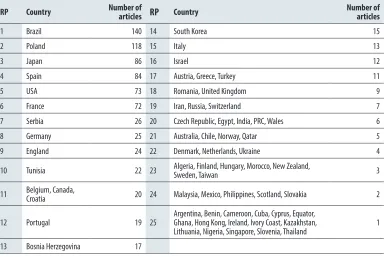
drop in some publication is 46. From this point, there is a steady decrease from several to one paper per country (25 to 1) (Table 1).
In the ranking of general science categories, there is undisputed domination of papers classified to science technology (1,058) and life science and biomedicine (1,012). On the third place, there are social sciences papers (270). Whereas 4th to 6th
place did not exceed 100 papers (Table 2).
1. Results of this part of paper is main empirical argumen
-tation of oral presen-tation RM Kalina „Trends in interna
-tional journals dealing with judo research” during: 2nd International Budo Conference (Japanese Academy of Budo 50th Anniversary Conference), September 6-8 , 2017, Osaka, Japan.
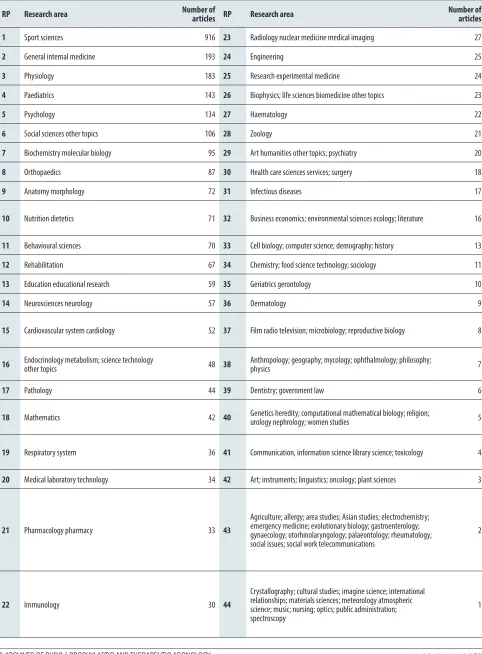
In a category of research areas, out of 100 research areas, sports sciences are dominating with some 916 papers included. Second place is occupied by area of general internal medicine (193) and the third by physiology (183), which shows the domi
-nance of papers related to performance and phys
-iology of judokas. At the rest of ranking places, there is a steady decrease in some papers in next areas. By analysing results, it showed a big
-ger interest in psychology (5th) than social and
behavioural science (6th and 11th), which repre
-sents mental aspect. After them, there is interest in orthopaedics (8th) and rehabilitation (12), neu
-roscience neurology (14th) and pathology (18th),
which corresponds with injury-related topics. In the rest part of the ranking, there is a mix of areas related to specific aspects of medicine, humanities and engineering (Table 3).
Regarding some judo-related publications in top 50, journal Archives of Budo is ranked as first (114). At the second place, there is The Journal of Korean Alliance of Martial Arts (49). On the third place, there are Korea Sports Research and Medicine and Science in Sports and Exercise (40). First, two journals are strictly related to martial arts, while the rest of journals focused on top
-ics related to sport, sports medicine and exer
-cises (Table 4).
Table 1. Ranking positions (RP) by 66 countries with most publications dedicated or related to judo (n = 1,264).
RP Country Number of articles
RP
Country Number of articles1 Brazil 140 14 South Korea 15
2 Poland 118 15 Italy 13
3 Japan 86 16 Israel 12
4 Spain 84 17 Austria, Greece, Turkey 11
5 USA 73 18 Romania, United Kingdom 9
6 France 72 19 Iran, Russia, Switzerland 7
7 Serbia 26 20 Czech Republic, Egypt, India, PRC, Wales 6
8 Germany 25 21 Australia, Chile, Norway, Qatar 5
9 England 24 22 Denmark, Netherlands, Ukraine 4
10 Tunisia 22 23 Algeria, Finland, Hungary, Morocco, New Zealand, Sweden, Taiwan 3
11 Belgium, Canada, Croatia 20 24 Malaysia, Mexico, Philippines, Scotland, Slovakia 2
12 Portugal 19 25 Argentina, Benin, Cameroon, Cuba, Cyprus, Equator, Ghana, Hong Kong, Ireland, Ivory Coast, Kazakhstan,
Lithuania, Nigeria, Singapore, Slovenia, Thailand 1
216 | VOLUME 13 | 2017 www.archbudo.com Original Article
Table 2. Ranking position (RP) by 6 general categories of 1,264 scientific publications (one article may be put in more than one category).
RP General category Number of papers included
1 Science technology 1,058
2 Life sciences biomedicine 1,021
3 Social sciences 270
4 Arts humanities 71
5 Physical sciences 59
6 Technology 42
16 Biological Rhythm Research, International Journal of Sports Physiology and Performance, Luminescence, Luminescence Chichester, Luminescence The
Journal of Biological and Chemical Luminescence 9
17 Health and Martial Arts in Interdisciplinary Approach; International Journal of Sport Nutrition and Exercise Metabolism; Korean Society for Wellness 8
18 6th International Scientific Conference on Kinesiology Integrative Power of Kinesiology; Asian Journal of Sports Medicine; Kinesiology; Medicina Dello
Sport Turin 7
19 International Journal of Sports Science Coaching; Motriz Revista De Educacao Fisica, Procedia Social and Behavioral Sciences, Revista Brasileira De
Educacao Fisica E Esporte 6
20 Doklady Akademii Nauk Sssr, Exercise Science, Isokinetics And Exercise Science, Journal Of Coaching Development, Rbne Revista Brasileira De
Nutricao Esportiva 5
21 Sportverletzung Sportschaden, Strength And Conditioning Journal, Wcpcg 2010 4
From the beginning of gathering data in 1959, there were no more than ten records per year up to the year 2000. After that, some published papers burst, exceeding 100 papers per year in 2011 (Figure 1).
Figure 1. Dynamics of increase in anumber of publications (n = 1264) published each year starting from 1959 to 2016.
In the specific analysis of papers in Web of Science (Wos) and Research Journal of Budo (RJB), there is a clear difference in the distribution of the proportion of papers included in specific categories. In WoS, physiology & performance related papers exceed 51%. In the rest of categories, distribution is relatively homogeneous in comparison with the first category (from 9% to 17%). Papers published in RJB are distributed more evenly. Scientists focus mainly in competition and technique related papers (30% and 28%), slightly less is in physiology & performance and education & mental (20% and 17%), while seemingly fewer papers than WoS is about injuries (only 6%) (Figure 2).
Figure 2. Distribution of all papers dedicated or linked to judo[%] in Web of Science (WoS) – variable order; and Research Journal of Budo (RJB) included in the analysis by specific categories.
Review of detailed theories of agonology, publications and reference to historical contexts2
Five detailed theories of agonology were published in 6 separate books (from 1938 to 2000, all in Polish) – Table 5. Tadeusz Kotarbiński in 1938 gave the commencement of general theory of struggle (agonology). On order of the Polish Army Headquarters edited a brochure From
2 Results of this part of publication is main empirical argumentation of oral presentation RM Kalina „Heritage and
the future of East Asian Martial Arts in the development of preventive and therapeutic agonology” during: Waseda
University International Conference on East Asian Martial Arts 2017; Future of the East Asian Martial Arts or Budo: The quest for the actual utility and its applicability. September 10, 2017, Tokyo Japan
0% 10% 20% 30% 40% 50% 60%
education&mental competition injury technique physiology&performance
RJB (n=54) WoS (n=257)
Figure 1. Dynamics of a number of publications (n = 1,264) published each year starting from 1959 to 2016.
Table 3. Ranking position (RP) by 100 research areas (one article among 1,264 could be put to more than one area).
RP Research area Number of articles RP Research area Number of articles
1 Sport sciences 916 23 Radiology nuclear medicine medical imaging 27
2 General internal medicine 193 24 Engineering 25
3 Physiology 183 25 Research experimental medicine 24
4 Paediatrics 143 26 Biophysics; life sciences biomedicine other topics 23
5 Psychology 134 27 Haematology 22
6 Social sciences other topics 106 28 Zoology 21
7 Biochemistry molecular biology 95 29 Art humanities other topics; psychiatry 20
8 Orthopaedics 87 30 Health care sciences services; surgery 18
9 Anatomy morphology 72 31 Infectious diseases 17
10 Nutrition dietetics 71 32 Business economics; environmental sciences ecology; literature 16
11 Behavioural sciences 70 33 Cell biology; computer science; demography; history 13
12 Rehabilitation 67 34 Chemistry; food science technology; sociology 11
13 Education educational research 59 35 Geriatrics gerontology 10
14 Neurosciences neurology 57 36 Dermatology 9
15 Cardiovascular system cardiology 52 37 Film radio television; microbiology; reproductive biology 8
16 Endocrinology metabolism; science technology other topics 48 38 Anthropology; geography; mycology; ophthalmology; philosophy; physics 7
17 Pathology 44 39 Dentistry; government law 6
18 Mathematics 42 40 Genetics heredity; computational mathematical biology; religion; urology nephrology; women studies 5
19 Respiratory system 36 41 Communication, information science library science; toxicology 4
20 Medical laboratory technology 34 42 Art; instruments; linguistics; oncology; plant sciences 3
21 Pharmacology pharmacy 33 43
Agriculture; allergy; area studies; Asian studies; electrochemistry; emergency medicine; evolutionary biology; gastroenterology; gynaecology; otorhinolaryngology; palaeontology; rheumatology; social issues; social work telecommunications
2
22 Immunology 30 44
Crystallography; cultural studies; imagine science; international relationships; materials sciences; meteorology atmospheric science; music; nursing; optics; public administration; spectroscopy
218 | VOLUME 13 | 2017 www.archbudo.com Original Article
Table 4. Ranking positions (RP) of top 50 journals by a number of publications related to judo (n = 1,264).
RP Journal name of articlesNumber
1 Archives of Budo 114
2 The Journal of Korean Alliance of Martial Arts 49
3 Korea Sport Research; Medicine and Science in Sports And Exercise 40
4 The Korean Society of Sports Science 35
5 Journal of Strength And Conditioning Research 31
6 Medicine Science in Sports Exercise 29
7 The Journal of Sports Medicine and Physical Fitness 23
8 Journal of Sport and Leisure Studies; The Korean Journal of Physical Education, The Korean Journal of Sport 22
9 Journal of Sports Medicine and Physical Fitness; Journal of Sports Sciences 20
10 Perceptual and Motor Skills 20
11 International Journal of Performance Analysis In Sport; International Journal of Sports Medicine; Korean Journal of Sport Biomechanics 16
12 Biology of Sport; Journal of Human Kinetics; Science Sports 15
13 Archives of Budo Science of Martial Arts And Extreme Sports; British Journal of Sports Medicine 14
14 Medicina Dello Sport 13
15 Journal of Sports Science and Medicine, Journal of Sports Science Medicine, Revista Brasileira De Medicina Do Esporte 11
16 Biological Rhythm Research, International Journal of Sports Physiology and Performance, Luminescence, Luminescence Chichester, Luminescence The Journal of Biological and Chemical Luminescence 9
17 Health and Martial Arts in Interdisciplinary Approach; International Journal of Sport Nutrition and Exercise Metabolism; Korean Society for Wellness 8
18 6th International Scientific Conference on Kinesiology Integrative Power of Kinesiology; Asian Journal of Sports Medicine; Kinesiology; Medicina Dello Sport Turin 7
19 International Journal of Sports Science Coaching; Motriz Revista De Educacao Fisica, Procedia Social and Behavioral Sciences, Revista Brasileira De Educacao Fisica E Esporte 6
20 Doklady Akademii Nauk Sssr, Exercise Science, Isokinetics And Exercise Science, Journal Of Coaching Development, Rbne Revista Brasileira De Nutricao Esportiva 5
From the beginning of gathering data in 1959, there were no more than ten records per year up to the year 2000. After that, some published papers burst, exceeding 100 papers per year in 2011 (Figure 1).
In the specific analysis of papers in Web of Science (Wos) and Research Journal of Budo (RJB), there is a clear difference in the distribution of the pro
-portion of papers included in specific catego
-ries. In WoS, physiology & performance related papers exceed 51%. In the rest of categories, dis
-tribution is relatively homogeneous in compar
-ison with the first category (from 9% to 17%). Papers published in RJB are distributed more evenly. Scientists focus mainly in competition and technique related papers (30% and 28%), slightly less is in physiology & performance and educa
-tion & mental (20% and 17%), while seemingly fewer papers than WoS is about injuries (only 6%) (Figure 2).
Review of detailed theories of agonology,
publications and reference to historical
contexts
2Five detailed theories of agonology were pub
-lished in 6 separate books (from 1938 to 2000, all in Polish) – Table 5. Tadeusz Kotarbiński in 1938 gave the commencement of general theory of struggle (agonology). On order of the Polish Army Headquarters edited a brochure From Problems of
General Theory of Struggle which was published
by the Psychological Section of the Military
2 Results of this part of publication is main empirical argu
-mentation of oral presentation RM Kalina „Heritage and the future of East Asian Martial Arts in the develop
-ment of preventive and therapeutic agonology” dur
-ing: Waseda University International Conference on East Asian Martial Arts 2017; Future of the East Asian Martial Arts or Budo: The quest for the actual utility and its applicability. September 10, 2017, Tokyo, Japan.
Knowledge Association [17]. Kotarbiński a mili
-tary struggle (an armed one) on “the basement”. To “an intermediate level” of the stage of gener
-alisation he qualifies struggles e.g.: in sport, in political and lawyers’ debates, business compe
-tition, partly in education. On the “highest level” a general theory of the deed (praxiology) which includes the theory of struggle [11]. Kotarbiński could not know back then, that in the future, agonology will become separate science subdis
-cipline, especially its newest form – innovative agonology.
Józef Konieczny has not developed agonol
-ogy as widely understood by science about struggle. His contribution is partly because it is based on a conceptual apparatus of mathemat
-ics and cybernet-ics. He underlines that purpo
-sive destruction takes place also in activity which is not an armed struggle [18, p. 24]. The theory of destructing (a cybernetic theory of struggle) has limited application in a field of agonology. Therefore, Józef Konieczny should not be recog
-nised as one of the creators of agonology.
On the contrary, there was Jarosław Rudniański, a student of Tadeusz Kotarbiński. Rudniański pub
-lished the general theory of struggle during the Martial Law in Poland (1983) in under disguised title Elements of Praxiological Theory of Struggle. From Problems of a Negative Co-operation [19]. Contents of these elements and problems were, in fact, precise allegations of the theory of a non-armed struggle (the impression of 2,000 cop
-ies was legally edited, practically this book was not accessible). An essential work of Rudniański A Compromise and a Struggle was published in 1989 [20]. During the Martial Law in Poland, Rudniański was a teacher of the theory of the struggle for a part of underground Solidarity Table. 5. Detailed theories of agonology were published in Polish from 1938 to 2000 in separate books.
Author Printed(year) Detailed theory
Tadeusz Kotarbinski [17] 1938 the general theory of struggle (agonology)
Józef Konieczny [18] 1972 theory of destructing (a cybernetic theory of struggle)* Jarosław Rudniański [19] 1983 theory of a non-armed struggle
Jarosław Rudniański [20] 1989 theory of a non-armed struggle and theory of compromise
220 | VOLUME 13 | 2017 www.archbudo.com Original Article
leaders. During his youth, he experienced terror and cruelty of total war. A prisoner of Soviet gulag during the Second World War, after the gulag the soldier of Anders Army participated in the Battle of Monte Cassino (1944) on the side of the Allied forces.
Roman M. Kalina (student of Jarosław Rudniański) besides two detailed theories (defensive strug
-gle [21] and empirical theory of combat sports [22]) brought to agonology specific prac
-tical qualifications. He is judo trainer on the mas
-ter class level (4th dan), specialist for teaching
“Judo for Disabled People”, instructor of kyok sul and self-defence, author of special programs of hand-to-hand fighting for Armed Forces. As an effect of this year of experiences connected with knowledge and interdisciplinary research, there are original complex methods placed in cognitive-behavioural prophylactic and therapy (Figure 3).
Innovative agonology created by RM Kalina (pro
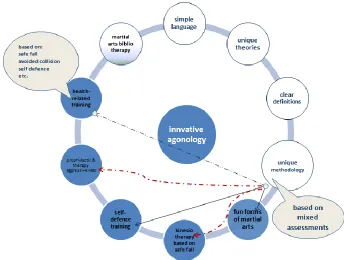
-phylactic and therapeutic agonology) offers (Figure 4):
1) in cognitive dimension: simple language, unique theories, clear definitions, unique meth
-odology (based on mixed assessments);
2) in behavioural dimension: fun forms of mar
-tial arts, kinesiotherapy based on safe fall, defence training (including innovative self-defence), prophylactic and therapy aggressive
-ness, health-related training;
3) martial arts bibliotherapy (program adapted to the intellectual abilities of the individual).
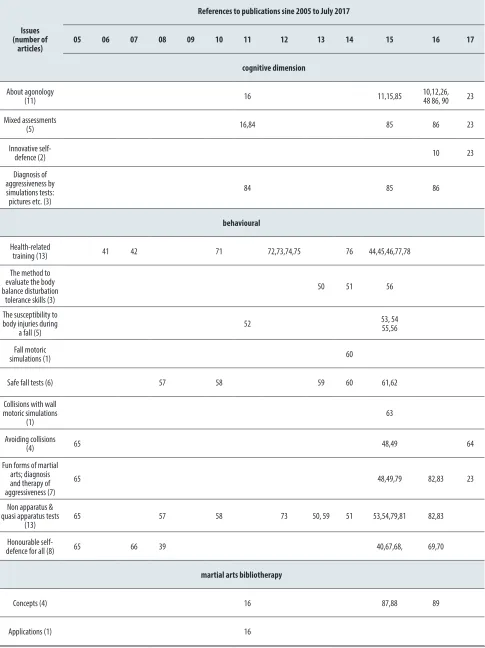
The most papers are written in English regarding knowledge about agonology and its application in innovative agonology concerns: 13 health-related training; 13 none apparatus and quasi-apparatus tests; 11 “about agonology” (Table 6). Interventions for people with mental disorders is mainly limited to therapy and prophylactic based on behavioural methods. We can formulate the metaphor (which should stay as it), that multi
-plicity of specific issues in separate dimensions of innovative agonology is symbolic (and only sym
-bolic) analogue of degrees of initiation in judo (kyu and dan). Innovative agonology did not claim rich ideas and practice of judo or any other mar
-tial art system as its own.
DISCUSSION
This review is edited in a formula of the origi
-nal paper and in the same way it is an example of breaking certain paradigms of modern science (see [23], where the innovative methodological approach of editing scientific papers in this cat
-egory is explained).
Whereas discussion is a synthesis of both reviews: 1) possibilities and limitations of jūdō and innovative agonology in the therapy of peo
-ple with mental disorders; 2) possibilities and lim
-itations of jūdō and innovative agonology in widely understood public health prophylaxis. This syn
-thesis leads to three significant generalisations:
First of all, Jigoro Kano, in a lecture about his con
-cept of jūdō states that, „final aim of Judo, there
-fore, is to inculcate in the mind of man a spirit of respect for the principle of maximum efficiency and mutual welfare (…)” [5, p. 58]. Therefore, peo
-ple with mental disorders, are in a difficult situ
-ation to achieve that, because their inner state, including emotional, intellectual or any other mental limitation makes harder or impossible for achieving “judo in mind” state.
Secondly, our therapeutic achievements by working with people with a mental disorder by using motor elements of jūdō connected with a cognitive-behavioural offer of
innova-tive agonology bring empirical argumentation,
which among other things, the potential of jūdō is not used effectively in widely understood pub
-lic health prophylaxis (in national systems and globally).
Roman M. Kalina (student of Jarosław Rudniański) besides two detailed theories (defensive struggle [21] and empirical theory of combat sports [22]) brought to agonology specific
practical qualifications. He is judo trainer on the master class level (4th dan), specialist for
teaching “Judo for Disabled People”, instructor of kyok sul and self-defence, author of special programs of hand-to-hand fighting for Armed Forces. As an effect of this year of experiences connected with knowledge and interdisciplinary research, there are original complex methods placed in cognitive-behavioural prophylactic and therapy (Figure 3).
Figure 3. Model cognitive-behavioural prophylactic and therapy innovative agonology.
Innovative agonology created by RM Kalina (prophylactic and therapeutic agonology) offers (Figure 4):
1) in cognitive dimension: simple language, unique theories, clear definitions, unique methodology (based on mixed assessments);
2) in behavioural dimension: fun forms of martial arts, kinesiotherapy based on safe fall, self-defence training (including innovative self-self-defence), prophylactic and therapy aggressiveness, health-related training;
3) martial arts bibliotherapy (program adapted to the intellectual abilities of the individual).
Table. 6. Articles dedicated directly and indirectly agonology (n = 56) published in English since 2005 to July 2017, available in Web of Knowledge (one article may be put in more than one category).
Issues (number of
articles)
References to publications sine 2005 to July 2017
05 06 07 08 09 10 11 12 13 14 15 16 17
cognitive dimension
About agonology
(11) 16 11,15,85 10,12,26, 48 86, 90 23
Mixed assessments
(5) 16,84 85 86 23
Innovative
self-defence (2) 10 23
Diagnosis of aggressiveness by simulations tests: pictures etc. (3)
84 85 86
behavioural
Health-related
training (13) 41 42 71 72,73,74,75 76 44,45,46,77,78
The method to evaluate the body balance disturbation
tolerance skills (3)
50 51 56
The susceptibility to body injuries during
a fall (5) 52
53, 54 55,56
Fall motoric
simulations (1) 60
Safe fall tests (6) 57 58 59 60 61,62
Collisions with wall motoric simulations
(1) 63
Avoiding collisions
(4) 65 48,49 64
Fun forms of martial arts; diagnosis and therapy of aggressiveness (7)
65 48,49,79 82,83 23
Non apparatus & quasi apparatus tests
(13) 65 57 58 73 50, 59 51 53,54,79,81 82,83
Honourable
self-defence for all (8) 65 66 39 40,67,68, 69,70
martial arts bibliotherapy
Concepts (4) 16 87,88 89
222 | VOLUME 13 | 2017 www.archbudo.com Original Article
For the third, sport pathology, which did not omit judo (aggression, death cases and injuries during training and tournaments, migration of Olympic champions to bloody fights of contem
-porary gladiators, synonym neo gladiatorship, etc.) is probably the biggest barrier for promot
-ing wide category of martial arts as substantial methods and means in many aspects of public health prophylaxis.
As good indicator of perception of judo in a medium scale (in a country, where this activity is popular in many aspects) there are results of the analysis performed by Osipov et al. [24] topics of doctoral (n = 58) and postdoctoral (n = 9) disser
-tations in period 2000-2016 in Russia. Among 6 topics dominates 32 dissertations (48%), includ
-ing 7 out 9 postdoctoral, problems of judo ath
-letes’ competition preparation and training; the second (16, that is 24%, including 1 postdoctoral) includes works, devoted to increasing physical, psychological and social level of Russian judo ath
-letes; the third (n = 7, that is 10%) deals with methodic of formation of basic judo throws and ways of increasing techniques effectiveness; the fourth (6, that is 9%, including 1 postdoctoral) is devoted to determination of judo role in physi
-cal education of persons – students of Russian
Federation educational establishments; the fifth included works, devoted to preparation of coaches’ and referees’ personnel; the sixth dealt with selection of children in judo schools and cir
-cles (each 3 PhD thesis, that is 4.5% each) [24].
It is clear that Russian scientists focus their researching efforts around issues connected with judo seen as a sport. However, in a global space of science, there are only 7 publications affiliated by authors from Russia (19 ranking positions in Table 1). This issue is far more complex. It con
-cerns breaking language barriers and long-term effect of Iron Curtain [25, 26].
Undoubtedly, applied simplified criteria of iden
-tification of judo-related papers makes impossi
-ble to select those, which concerns the use of specific methods (e.g. ukemi waza) and means (specific judo techniques as a throw, grappling techniques etc.) in the therapy of people with mental disorders. In a case of same works, it is simple – criteria of applied in this paper are fulfilled [27, 28]. In other papers, term “judo” appears among key words [29, 30] or only in text. That is the reason why work titled Why Prof. Jigoro Kano did not received the Nobel Prize? [31] was not included in this review, but synthetically Figure 4. The model offered by the innovative agonology specific tools to pursue the objectives of adaptation – to develop and maintain all dimensions of positive health and ability to survive (red line: also application the motoric simulation or verbal or projective tests).
The most papers are written in English regarding knowledge about agonology and its application in innovative agonology concerns: 13 health-related training; 13 none apparatus and quasi-apparatus tests; 11 “about agonology” (Table 6). Interventions for people with mental disorders is mainly limited to therapy and prophylactic based on behavioural methods. We can formulate the metaphor (which should stay as it), that multiplicity of specific issues in separate dimensions of innovative agonology is symbolic (and only symbolic) analogue of degrees of initiation in judo (kyu and dan). Innovative agonology did not claim rich ideas and practice of judo or any other martial art system as its own.
reveals qualities of judo concept as seen by the author before publications were showing the pre
-cise connection of agonology with chivalry edu
-cation (European model) and exact humanistic and ideas of martial arts [11]. Moreover, it was published before Czestochowa Declarations 2015: HMA against MMA [15] as a protest against the promotion of neo gladiatorship was formulated.
Heritage of East Asian martial arts goes beyond phenomenon of jūdō ( the coherent concept of Jigoro Kano [1, 2, 5] in a mental and behavioural sense) and budō [6, 32-36] cultivated in Japan in formula authorised by Japanese Academy of Budo in the 50th Anniversary. This budō model
is deeply rooted in culture and bushido tradi
-tion [37] and is worthy of following with pos
-sibility of adopting in many aspects in different cultures. Permeation of education and therapeu
-tic models based on martial arts in specific coun
-tries of East Asia region is eminent in practice and intellectual concepts supported by scientific argumentation [38]. On all continents, there was an adaptation (mostly in sports formula) of judo, karate, kendo, taekwondo, muay tai. Aikido is soft self-defence art [39, 40], and there are more sharp like hapkido and wushu. Among healing forms of martial arts such as tai chi, Qigong etc.
In preventive and therapeutic agonology there is a place for all martial arts and combat sports with East Asian [41-46]. Methods and means are decided by an expert of innovative agonol-ogy, which universal language does not favour any national position. Directive of „self-defence” could be based on aikido; goshin jutsu no kata (judo) [6]; hosil sun (taekwondo) [47], kung-fu, etc. Whereas „avoiding collisions” could be based on aikido; partially on karate, kendo or tae
-kwondo, unifight. Feedback is ensured by origi
-nal motor proposition innovative agonology: fun forms of martial arts [48, 49]; the methods to evaluate the body balance disturbation tolerance skills [50, 51]; the susceptibility to body injuries during a fall [52-56]; safe fall for all and disabil
-ity people [57-62];collision with a vertical obsta
-cle [63]; avoiding collisions [64], honourable self defence for all [39, 40, 65-70]; health-related training [41, 42, 44-46, 71-78]; non apparatus and quasi apparatus tests [50, 51, 53, 54, 57, 58, 65, 73, 79-83], etc. This propositions could be
added to any combat sport training. The extent of motor actions in every combat sports is limited even in the same category: for example boxing – karate – taekwondo; judo – sumo – wrestling. Specific means of innovative agonology could make combat sport training more attractive, countering routine, motivate for greater effort and regain focus on main training tasks or coun
-ter potential injuries etc.
The original cognitive proposals concern: diag
-nosis of bravery and aggressiveness [84-86] and martial arts bibliotherapy [16, 87-89]. Before innovative self-defence the perspective can be optimistic: effective defence of peace and unrestricted freedom of scientists [90]; effec
-tive counteracting each attack on any good of an individual (honour, dignity, life, health, prop
-erty, etc.) [10].
CONCLUSIONS
Quantitative analysis of scientific papers available in global space of science regarding judo is proof that 84% of works are framed into two general science categories: science technology and life science and biomedicine (with a slight advantage of the first group). More specific analysis (based on the category of research areas) revealed dom
-ination of sports sciences (72%) and mere 15% in general internal medicine and 14% for phys
-iology. There is no significant representation of papers related to therapy of people with mental disorders: rehabilitation (5%), neuroscience neu
-rology (4.5%) and pathology 3.5%). Sports orien
-tation is dominating over health promotion and public health medicine – which confirms the first hypothesis.
Recommendations of innovative agonology are close to the overall concept of a jūdō creator, Jigoro Kano. It especially gives explanations, methods and means of developing jūdō in mind (mix assessment of all actions reducing aggres
-siveness by a fun form of martial arts, honour
-able self-defence, martial arts bibliotherapy). The concept of jūdō by Jigoro Kano and innovative
agonology do not exclude themselves. They are
224 | VOLUME 13 | 2017 www.archbudo.com Original Article
REFERENCES
1. Kanō J. Seinen shūyō kun. The teaching of young man’s moral self-improvement. Tōkyō: Tōbunkan; 1911
2. Kanō J. Judo as physical and mental culture. Japan Advertiser; 1922
3. History of Judo/Histoire du Judo. Judo Kodokan Review 1962; 12(5)
4. Jigoro Kano and the Kodokan. An Innovative Response to Modernisation. Compile by the Kanō Sensei Biographic Editorial Committee. Edited and Translated by Alex Bennett. Kōdōkan Judo Institute; 2009
5. Kano J. The Contribution of Judo to Education. Journal of Health and Physical Education. 1932; 58(3): 37-40
6. Budō: The Martial Ways of Japan. Nippon Budokan Foundation; 2009
7. Kalina RM, Barczyński BJ. Archives of Budo Science of Martial Arts and Extreme Sports – A reason for this new branch journal. Arch Budo Sci Martial Art Extreme Sport. 2013; 9: 1-9
8. Peset F, Villamón M, Ferrer-Sapena A et al. Scientific literature analysis of Judo in Web of Science®. Arch Budo 2013; 9(2): 81-91
9. Martin EA, editor. Concise Colour Medical Dictionary. Oxford University Press; 1996
10. Kalina RM. Innovative agonology as a synonym for prophylactic and therapeutic agonology – the final impulse. Arch Budo 2016; 12: 329-344
11. Kalina RM. Agonology as a deeply esoteric science – an introduction to martial arts ther
-apy on a global scale. Procedia Manufacturing 2015; 3: 1195-1202
12. Kalina RM. Agonology – the unknown science. Arch Budo 2016; 12: 231-237
13. Kalina RM, Barczyński BJ. Archives of Budo – dialogue about the personal safety and action worth the man. Arch Budo 2008; 4(4): 1-3
14. Kalina RM, Barczyński BJ. Budo – a unique keyword of life sciences. Arch Budo 2009; 5 (5): 117-119
15. Kalina RM, Barczyński BJ. Long way to the Czestochowa Declarations 2015: HMA against MMA. In: Kalina RM (ed.) Proceedings of the 1st World Congress on Health and Martial Arts in Interdisciplinary Approach, HMA 2015, 17–19 September 2015, Czestochowa, Poland. Warsaw: Archives of Budo; 2015: 1-11
16. Krzemieniecki LA, Kalina RM. Agon – a term connecting the theory of struggle with belles-lettres. A perspective of inter-disciplinary research. Arch Budo 2011; 7(4): 255-265
17. Kotarbiński T. Z zagadnień ogólnej teorii walki. Warszawa: Sekcja Psychologiczna Towarzystwa Wiedzy Wojskowe (From Problems of General
Theory of Struggle. Psychological Section of the Military Knowledge Association); 1938 [in Polish]
18. Konieczny J. Cybernetyka walki. Państwowe Wydawnictwo Naukowe. Warszawa 1970 [in Polish
19. Rudniański J. Elementy prakseologicznej teorii walki. Z zagadnień kooperacji negaty
-wnej. Warszawa: Państwowe Wydawnictwo Naukowe. 1983 [in Polish]
20. Rudniański J. Kompromis i walka. Sprawność i etyka kooperacji pozytywnej i negatywnej w gęstym otoczeniu społecznym. Warszawa: Instytut Wydawniczy Pax; 1989 [in Polish]
21. Kalina RM. Przeciwdziałanie agresji. Wykorzystanie sportu do zmniejszania agresywności. Warszawa: Polskie Towarzystwo Higieny Psychicznej; 1991 [in Polish]
22. Kalina RM. Teoria sportów walki. COS. Warszawa 2000 [in Polish]
23. Kalina RM, Barczyński BJ. Mixed assessments as mental and pedagogic basis of innovative self-defence. Arch Budo 2017; 13: 211-218
24. Osipov AY, Kudryavtsev MD, Iermakov SS et al. Topics of doctoral and postdoctoral dis
-sertations devoted to judo in period 2000-2016 – the overall analysis of works of Russian experts. Arch Budo 2017; 13: 1-10
25. Barczyński BJ, Graczyński M, Kalina RM. Barriers Restricting the Free Dissemination of Scientific Achievements: Own Experiences in Crossing Walls and Bridges J Hum Kinet 2009; 22(22): 7-14
26. Kalina RM. Cognitive and application barriers to the use of “agonology in preventive and ther
-apeutic dimension”. P. Salmon, A.-C. Macquet (Eds.) Advances in Human Factors in Sports and Outdoor Recreation. Proceedings of the HFE 2016 International Conference on Human Factors in Sports and Outdoor Recreation, July 27-31, 2016, Walt Disney World®, Florida, USA Series: Advances in Intelligent Systems and Computing
27. Gleser J, Lison S. Judo as therapy for emo
-tionally disturbed adolescents: a pilot study. International Journal of Adolescent medicine and health 1986; 2(1): 63-72
28. Ion-Ene M, Roşu D, Adriana Neofit A. Judo adapted to the therapy of disabled children. Procedia – Social and Behavioral Sciences 2014; 137: 37-42
29. Matsui K, Larsson A, Yamahira Y et al. Budo practice for post-stroke patients – reflections on historical and scientific issues. In: Kalina RM (ed.) Proceedings of the 1st World Congress on Health and Martial Arts in Interdisciplinary Approach, HMA 2015, 17–19 September 2015, Czestochowa, Poland. Warsaw: Archives of Budo; 2015: 12-18
30. Nagao S. Acceptance and sublimation of aggres
-siveness and violence in Japanese martial arts: From a view-point of the history of the tech
-niques and equipment used in budo. In: Kalina RM (ed.) Proceedings of the 1st World Congress on Health and Martial Arts in Interdisciplinary Approach, HMA 2015, 17–19 September 2015, Czestochowa, Poland. Warsaw: Archives of Budo; 2015: 19–24
31. Kalina RM, Barczyński BJ. Why Prof. Jigoro Kano did not received the Nobel Prize? Arch Budo 2008; 4(4): 98-100
32. Sasaki T. Budo (the Martial Arts) as Japanese Culture – The Outlook On The Techniques and The Outlook On The Human Being. Arch Budo 2008; 4(4): 46-49
33. Ikemoto J, Liu Ch, Shishida F. Why Japanese budo enthusiast study foreign martial arts? By the case study of the Chinese martial arts pio
-neer Ryuchi Matsuda’s works and his thought based on Japanese traditional budo thought. In: Kalina RM (ed.) Proceedings of The 1st World Congress on Health and Martial Arts in Interdisciplinary Approach, HMA 2015, 17–19 September 2015, Czestochowa, Poland. Warsaw: Archives of Budo; 2015: 171–174
34. Liu Ch, Ikemoto J, Shishida F. The conflicts in modernization of wushu – By the case of Japanese Wushu Taijiquan Federation oppose the Rules for Wushu Taolu Competition. In: Kalina RM (ed.) Proceedings of the 1st World Congress on Health and Martial Arts in Interdisciplinary Approach, HMA 2015, 17–19 September 2015, Czestochowa, Poland. Warsaw: Archives of Budo; 2015: 74–78
35. Oboki T. Philosophy of kendo: Killing sword and Life living sword. Reconsider the meaning of the culture of kendo in connection with the ideas of setsunintou and katsuninken. In: Kalina RM (ed.) Proceedings of the 1st World Congress on Health and Martial Arts in Interdisciplinary Approach, HMA 2015, 17–19 September 2015, Czestochowa, Poland. Warsaw: Archives of Budo; 2015: 68–73
36. Tai K. The study on Educational Property of Japanese Budo − Based on the Formation of the Bushi Status in the Early Modern Period. In: Kalina RM (ed.) Proceedings of the 1st World Congress on Health and Martial Arts in Interdisciplinary Approach, HMA 2015, 17–19 September 2015, Czestochowa, Poland. Warsaw: Archives of Budo; 2015: 182–184
37. Nitobe I. Bushido: The Soul of Japan. Bilingual Edition. Korea: Chong-A Printing co; 2008
38. Trulston ME. Martial arts training: A novel ‘cure’ for juvenile delinquency. Hum Relat 1986; 39: 1131-1140
39. Shishida F. Counter techniques against Judo: the process of forming Aikido in 1930s. Arch Budo 2008; 4(4): 4-8
a strong man using only a finger? The mech
-anism of soft atemi-waza. In: Kalina RM (ed.) Proceedings of the 1st World Congress on Health and Martial Arts in Interdisciplinary Approach, HMA 2015, 17–19 September 2015,Czestochowa, Poland. Warsaw: Archives of Budo; 2015: 49–58
41. Mroczkowski A, Jaskólski E. Effects of aikido exercises on lateral spine curvatures in chil
-dren. Arch Budo 2006; 2: 31-26
42. Mroczkowski A, Jaskólski E. The change of pelvis placement at children under influence of aikido training. Arch Budo 2007; 3: 21-26
43. Harasymowicz J, Novikov S: Axiological, ethi
-cal and utilitarian benefits of UNIFIGHT. Arch Budo 2013; 4: 227-232
44. Matsui K. An invitation to study Budo for the disabled – Is Budo good for the disabled? Is Budo for the disabled good for Budo? In: Kalina RM (ed.) Proceedings of the 1st World Congress on Health and Martial Arts in Interdisciplinary Approach, HMA 2015, 17–19 September 2015, Czestochowa, Poland. Warsaw: Archives of Budo; 2015; 170
45. Matsui K, Larsson A, Yamahira Y et al. Budo practice for post-stroke patients – reflections on historical and scientific issues. In: Kalina RM (ed.) Proceedings of the 1st World Congress on Health and Martial Arts in Interdisciplinary Approach, HMA 2015, 17–19 September 2015, Czestochowa, Poland. Warsaw: Archives of Budo; 2015: 12-18
46. Mroczkowski A. Influence of aikido exercises on mobility of hip joints in children. In: Kalina RM (ed.) Proceedings of the 1st World Congress on Health and Martial Arts in Interdisciplinary Approach, HMA 2015, 17–19 September 2015, Czestochowa, Poland. Warsaw: Archives of Budo; 2015: 25–31
47. Choi Hong Hi. Taekwon-do. The Korean Art of Self Defence ITF. New Zealand; 1995
48. Jagiełło W, Kalina RM, Klimczak J et al. Fun forms of martial arts in positive enhancement of all dimensions of health and survival abili
-ties. In: Kalina RM (ed.) Proceedings of the 1st World Congress on Health and Martial Arts in Interdisciplinary Approach, HMA 2015, 17–19 September 2015, Czestochowa, Poland. Warsaw: Archives of Budo; 2015: 32-39
49. Klimczak J, Kalina RM, Jagiełło W. Fun forms of martial arts in diagnosing and reducing aggres
-siveness? mental effects of a one-day course for Polish animators of sport. In: Kalina RM (ed.) Proceedings of the 1st World Congress on Health and Martial Arts in Interdisciplinary Approach, HMA 2015, 17-19 September 2015, Czestochowa, Poland. Warsaw: Archives of Budo; 2015: 187-189
50. Kalina RM, Jagiełło W, Barczyński BJ. The method to evaluate the body balance dis
-turbation tolerance skills – validation pro
-cedure of the “Rotational Test”. Arch Budo 2013; 9(1): 59-69
51. Jagiełło W, Wójcicki Z, Barczyński BJ et al. Optimal body balance disturbance tolerance skills as a methodological basis for selection of the firefighters to solve difficult tasks of rescue. Ann Agric Environ Med 2014; 21(1): 148-155
52. Kalina RM, Barczyński BJ, Klukowski K et al. The method to evaluate the susceptibility to injuries during the fall – validation procedure of the specific motor test. Arch Budo 2011; 7(4) :201-215
53. Gąsienica Walczak B, Kalina A. Susceptibility of body injuries during a fall of people after amputation or with abnormalities of Lower limb. In: Kalina RM (ed.) Proceedings of the 1st World Congress on Health and Martial Arts in Interdisciplinary Approach, HMA 2015, 17–19 September 2015, Czestochowa, Poland. Warsaw: Archives of Budo; 2015: 193–195
54. Mosler D. Changes of susceptibility of body injuries during a fall of patients with mental impairment participating for several months in special cognitive-behavioural therapy. In: Kalina RM (ed.) Proceedings of the 1st World Congress on Health and Martial Arts in Interdisciplinary Approach, HMA 2015, 17–19 September 2015, Czestochowa, Poland. Warsaw: Archives of Budo; 2015; 196-198
55. Mroczkowski A, Mosler D. Rotating training simulator as an assessment tool measuring susceptibility of the body injuries during The fall caused by an external force – validation procedure. In: Kalina RM (ed.) Proceedings of the 1st World Congress on Health and Martial Artsin Interdisciplinary Approach, HMA 2015, 17–19 September 2015, Czestochowa, Poland. Warsaw: Archives of Budo; 2015: 202
56. Mroczkowski A, Sikorski MM. The susceptibil
-ity to body injuries during a fall and abilities related to motor coordination of children aged 10 to 12. Arch Budo Sci Martial Art Extreme Sport 2015; 11: 65-71
57. Kalina RM, Barczyński BJ,Jagiełło W et al. Teaching of safe falling as most effective ele
-ment of personal injury prevention in people regardless of gender, age and type of body build – the use of advanced information tech
-nologies to monitor the effects of education. Arch Budo 2008; 4(4): 82-90
58. Gąsienica-Walczak B, Barczyński BJ, Kalina RM, et al. The effectiveness of two methods of teaching safe falls to physiotherapy stu
-dents. Arch Budo 2010; 6(2): 63-71
59. Kalina RM. Non-apparatus safe falls prepara
-tions test (N-ASFPT) – validation procedure. Arch Budo 2013; 4: 255-265
60. Michnik R, JurkojćJ, Wodarski P et al. Similarities and differences of body control during professional, externally forced fall to the side performed by men aged 24 and 65 years. Arch Budo 2014; 10: 233-243
61. Mroczkowski A. Motor safety of a man during a fall. Arch Budo 2015; 11: 293-303
62. Reguli Z, Šenkýř J, Vít M. Questioning the Concept of General Falling Techniques (GFT). In: Kalina RM (ed.) Proceedings of the 1stWorld Congress on Health and Martial Arts in Interdisciplinary Approach, HMA 2015, 17–19 September 2015, Czestochowa, Poland. Warsaw: Archives of Budo; 2015: 63–67
63. Michnik R, Jurkojć J, Wodarski P et al. Similarities and differences of the body con
-trol during professional collision with a ver
-tical obstacle of men aged 24 and 65. Arch Budo 2015; 11: 27-39
64. Michnik R, Wodarski P, Bieniek A. Effectiveness of avoiding collision with an object in motion – virtual reality technology in diagnostic and training from perspective of prophylactic of body injuries. Arch Budo 2017; 13: 203-210
65. Harasymowicz J, Kalina RM. Training of psy
-chomotor adaptation – a key factor in teach
-ing self-defence. Arch Budo 2005; 1(1): 19-26
66. Kalina RM, Jagiełło W, Wiktorek P. Motor competence in self-defence of students of a detectives’ school during their course of studies. Arch Budo 2007; 3(3):1-6
67. Čihounková J, Skotáková A, Bugala M et al. Different approach analysis of self–defence for people with physical disability. In: Kalina RM (ed.) Proceedings of the 1st World Congress on Health and Martial Arts in Interdisciplinary Approach, HMA 2015, 17–19 September 2015, Czestochowa, Poland. Warsaw: Archives of Budo; 2015: 40–43
68. Bugala M, Reguli Z, Čihounková J. Educational Background of Security Bodies Identification in Self-defence: Study Programme Special Education of Security Bodies. In: Kalina RM (ed.) Proceedings of the 1st World Congress on Health and Martial Arts in Interdisciplinary Approach, HMA 2015, 17–19 September 2015, Czestochowa, Poland. Warsaw: Archives of Budo; 2015: 79–84
69. Vít M, Reguli Z, Sebera M et al. Predictors of children´s successful defence against adult attacker. Arch Budo 2016; 12: 141-150
70. Čihounková J, Skotáková A, Kohoutková J et al. Evaluation of self-defence for people with visual impairments – methodology aspects. Arch Budo 2016; 12: 275-285
71. Kalina RM, Barczyński BJ. EKO-AGRO-FITNESS© original author continuous program of health-oriented and ecological education in the family, among friends or individually imple
-mented – the premises and assumptions. Arch Budo 2010; 6(4): 179-184
72. Jagiełło W, Sawczyn S, Jagiełło M.The subjec
-tive profile of posi-tive health and survival abili
-ties in women differing as to physical activity. Arch Budo 2012; 8(4): 219-224
73. Kalina RM. Applying non-apparatus and qua
226 | VOLUME 13 | 2017 www.archbudo.com Original Article
74. Kalina RM. Methodology of measurement, documentation and programming optimal workload continuous with variable intensity – applications in sports medicine, physiother
-apy, geriatrics, health-related training, sport for all. Arch Budo 2012; 8(4): 235-249
75. Kalina RM. The profile of Sense of Positive
Health and Survival Abilities indices (subjec
-tive assessment) as a diagnostic tool used in health-related training. Arch Budo 2012; 8(3): 179-188
76. Kalina RM, Kalina A. Methods of measure
-ment of somatic health and survival abilities in the framework of the questionnaire SPHSA – methodological aspects. Arch Budo Sci Martial Art Extreme Sport 2014; 10: 15-20
77. Bergier B. The diversity of the profiles involv
-ing the sense of positive health and survival abilities of Polish students of paramedical sci
-ences. Arch Budo 2015; 11: 17-25
78. Bąk R. Combat sports and martial arts as an element of health-related training. In: Kalina RM (ed.) Proceedings of the 1st World Congress on Health and Martial Arts in Interdisciplinary Approach, HMA 2015, 17–19 September 2015, Czestochowa, Poland. Warsaw: Archives of Budo; 2015: 190–192
79. Kalina RM, Jagiełło W, Chodała A. The result of “testing fights in a vertical posture” as a criterion of talent for combat sports and self-defence – secondary validation (part I: the reliability). Arch Budo Sci Martial Art Extreme Sport 2015; 11: 229-238
80. Mosler D. Usability of non-apparatus and quasi apparatus flexibility tests based on self-per
-ception participants in health-related judo training. Arch Budo Sci Martial Art Extreme Sport 2015; 11: 189-197
81. Mosler D. Validity and reliability of non-ap
-paratus and quasi ap-paratus flexibility tests – verification dur-ing health-related train
-ing based on judo. Arch Budo Sci Martial Art Extreme Sport 2015; 11: 123-133
82. Kalina RM, Jagiełło W, Chodała A. The result of “testing fights in a vertical posture” as a criterion of talent for combat sports and self-defence – secondary validation (part II: the accuracy). Arch Budo Sci Martial Art Extreme Sport 2016; 12: 163-180
83. Niedomagała W. The result of “testing fights in a vertical posture” as a selection criterion for professional training of judo sport – prog
-nostic value TFVP. Arch Budo Sci Martial Art Extreme Sport 2016; 12: 181-190
84. Kałużny R, Płaczek A. Declared bravery” of Polish police officers (comparative studies of 1998 and 2010). Arch Budo 2011; 7(4): 247-253
85. Kałużny R, Kalina G. Change of the actions declared in simulate-ed situations involv
-ing interpersonal aggression. Arch Budo Sci Martial Art Extreme Sport 2015; 11: 221-228
86. Klimczak J, Barczyński BJ, Podstawski R et al. The level of bravery and aggressiveness of the sports activity organisers for the youth
– simulation research Arch Budo 2016; 12: 345-354
87. Klimczak J, Krzemieniecki LA, Mosler D. Martial arts bibliotherapy – the possibility of com
-pensating the negative effects of the contin
-uous education for aggression by electronic media and the aggressive interpersonal rela
-tionship of children and adults. Arch Budo 2015; 11: 395-401
88. Klimczak J, Krzemieniecki LA, Mosler D et al. Martial arts bibliotherapy – the prospect of support of Aggressiveness therapy based on cognitive-behavioural methods. In: Kalina RM (ed.) Proceedings of the 1st World Congress on Health and Martial Arts in Interdisciplinary Approach, HMA 2015, 17–19 September 2015, Czestochowa, Poland. Warsaw: Archives of Budo; 2015: 179–181
89. Krzemieniecki LA, Moska W. Combat issues in
literary works of Nobel Laureates for Literature – an interdisciplinary perspective o martial arts bibliotherapy. Arch Budo 2016; 12: 345-352
90. Kalina RM. Agonology – the prospect of an
effective defence of peace and unrestricted freedom of scientists. Arch Budo 2016; 12: 1-13
91. Dictionary of Sport and Exercise Science. Over 5,000 Terms Clearly Defined. London: A & B Black; 2006
![Figure 2. Figure 2. Distribution of all papers dedicated or linked to judo [%] in Web of Science (WoS) – variable order; and Distribution of all papers dedicated or linked to judo [%] in Web of Science (WoS) – variable order; and Research Journal of Budo (RJB) included in the analysis by specific categories.Research Journal of Budo (RJB) included in the analysis by specific](https://thumb-us.123doks.com/thumbv2/123dok_us/8591408.1721266/6.567.137.511.492.715/distribution-dedicated-distribution-dedicated-research-included-categories-research.webp)