H Y P O T H E S I S
Open Access
Amino acid fermentation at the origin of the
genetic code
Harold P de Vladar
Abstract
There is evidence that the genetic code was established prior to the existence of proteins, when metabolism was powered by ribozymes. Also, early proto-organisms had to rely on simple anaerobic bioenergetic processes. In this work I propose that amino acid fermentation powered metabolism in the RNA world, and that this was facilitated by proto-adapters, the precursors of the tRNAs. Amino acids were used as carbon sources rather than as catalytic or structural elements. In modern bacteria, amino acid fermentation is known as the Stickland reaction. This pathway involves two amino acids: the first undergoes oxidative deamination, and the second acts as an electron acceptor through reductive deamination. This redox reaction results in two keto acids that are employed to synthesise ATP via substrate-level phosphorylation. The Stickland reaction is the basic bioenergetic pathway of some bacteria of the genusClostridium. Two other facts support Stickland fermentation in the RNA world. First, several Stickland amino acid pairs are synthesised in abiotic amino acid synthesis. This suggests that amino acids that could be used as an energy substrate were freely available. Second, anticodons that have complementary sequences often correspond to amino acids that form Stickland pairs. The main hypothesis of this paper is that pairs of complementary proto-adapters were assigned to Stickland amino acids pairs. There are signatures of this hypothesis in the genetic code. Furthermore, it is argued that the proto-adapters formed double strands that brought amino acid pairs into proximity to facilitate their mutual redox reaction, structurally constraining the anticodon pairs that are assigned to these amino acid pairs. Significance tests which randomise the code are performed to study the extent of the variability of the energetic (ATP) yield. Random assignments can lead to a substantial yield of ATP and maintain enough variability, thus selection can act and refine the assignments into a proto-code that optimises the energetic yield. Monte Carlo simulations are performed to evaluate the
establishment of these simple proto-codes, based on amino acid substitutions and codon swapping. In all cases, donor amino acids are assigned to anticodons composed of U+G, and have low redundancy (1-2 codons), whereas acceptor amino acids are assigned to the the remaining codons. These bioenergetic and structural constraints allow for a metabolic role for amino acids before their co-option as catalyst cofactors. Reviewers: this article was reviewed by Prof. William Martin, Prof. Eörs Szathmáry (nominated by Dr. Gáspár Jékely) and Dr. Ádám Kun (nominated by Dr. Sandor Pongor)
Background
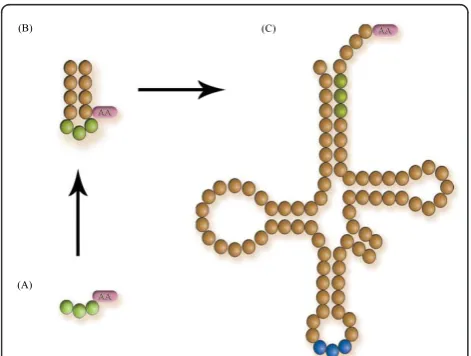
The RNA world is an ancient evolutionary period char-acterised by a ribozyme-based metabolism. It is thought that the genetic code, or at least the precursors to the modern adapters (i.e. tRNAs, Figures 1 and 2), were established at that stage [[1], Ch. 5]. There are several theories that explain the current organisation of the code in terms of selective advantages, robustness against mutation, lateral gene transfer, biochemical and
physical-chemical properties, and so forth. Most of these ideas build from the assumption that earlier, perhaps less accurate or complex codes existed, which evolved by selecting on different organisational principles, lead-ing to the modern genetic code. Whilst most theories deal with the rearrangements to the code, only few directly address the question of how this code emerged. To some extent, the specific association between some amino acids and their codons can be explained by the formation of covalent complexes of dinucleotides and precursors to amino acids [2]. Other ideas that have received more attention, are the stereochemical Correspondence: [email protected]
Am Campus 1. Klosterneuburg A3400. Austria
arguments (the structural affinity between amino acids and coding triplets) [3-6]. Furthermore, it has been pro-posed that the role of amino acids in an RNA world was to improve the catalytic activity of ribozymes [7], a func-tion that requires coding, because ribozymes needed to bind the amino acid as cofactors in a specific way.
I propose that an alternative ancient function for the amino acids in an earlier RNA world was to harvest energy. I propose a scenario in which coding is required in order to carry out the catabolic degradation of amino acids, and which may have easily arisen from initial ran-dom assignments.
My argument follows from three observations. First, amino acids are catabolised to obtain energy, and the metabolites are used as precursors for other biomole-cules, a role often overlooked due to the prominent and central position of proteins in metabolism. This suggests that the amino acids could have originally had a bioe-nergetic, rather than catalytic role, with the latter appearing later. In particular, bacteria of the genus Clos-tridium are known to directly use amino acids to har-vest metabolic energy. Some of these obligate anaerobes do not employ glucose as a carbon source, but rather ferment a pair of molecules; one amino acid acts as an electron donor and another acts as an electron acceptor. The overall reaction, termed Stickland fermentation releases energy the that powers the production of ATP (Figure 3). The substrates for the Stickland reaction are specific pairs of amino acids. That is, the reactants need to include one amino acid that can be oxidised (typically alanine, valine, leucine, serine, isoleucine or threonine), and another amino acid that can be reduced (typically glycine, proline, or aspartic acid; see Table 1) [8,9]. Figure 1Basic structure of the tRNA molecule.
Figure 2Stages of the evolution of the tRNA molecule. (A) Originally this consisted on a trinucleotide attached to an amino acid; (B) the triplet elongated to a mini-helix, probably because it conferred structural stability; (C) further elongations of the mini-helix resulted on the modern tRNA structure. This work is set in a stage as in (B). For details on the actual mechanisms of the evolution of the tRNA molecule, see [6].
Figure 3The Stickland reaction. In the genusClostridium, amino acid fermentation requires two steps. (A) Oxidative deamination of the amino acid with the higher oxidation state yields ana-keto acid, ammonium, and two protons. For example, if R1is a methyl group (-CH3), then the donor amino acid is an alanine, and the product of the oxidative deamination would be pyruvate, a central compounds of the intermediary metabolism. (B) Inorganic phosphate attaches at the carboxyl terminus. The second proton takes the place of the amino radical. The product of this reaction is an acyl-phosphate. For example when R2is a hydrogen (thus the acceptor amino acid is a glycine) this product corresponds to acetyl-phosphate. The two phosphate compounds from A and B are substrates for the synthesis of ATP from ADP. Naturally, in
Secondly, amino acids are readily produced under numerous potential scenarios for the abiotic synthesis of the building blocks of life. The famous Miller experi-ment [10] and other Miller-Urey syntheses [11-13] employ energy sources to generate amino acids from gases. The“iron-sulfur”chemo-autotrophic theory [14], which is compatible with the conditions of black-smoker hydrothermal vents (extremely hot and highly acidic), employs the reductive power of sulphides and high tem-peratures to synthesise organic molecules, including amino acids, via thio esters. In the warm but alkaline hydrothermal vents (the white smokers) a similar reduc-tion of CO2 by sulphides occurs, and the reactions that
take place are analogous to the acetogenesis (Wood-Ljungdahl) pathway, where the nitrogen-fixation branches lead to amino acids, which are, in turn, also used as precursors to synthesise nucleotides [15].
In all three scenarios several “Stickland pairs” are readily formed. In particular, the“Miller amino acids” [10] with the highest yield (principally alanine, glycine, aspartic acid and valine; Figure 4) can form four Stick-land pairs: alanine+glycine, alanine+aspartic acid, valine +glycine and valine+aspartic acid. Similarly, in the iron-sulfur world, glycine, serine and aspartic acid are readily synthesised [16], where we find that glycine+serine and glycine+aspartic acid are Stickland-reactive pairs. Finally, besides glycine and alanine, aspartic and glutamic acids are also formed in the alkaline hydrothermal vents [15], again forming the pairs alanine+glycine and alanine +aspartic acid and aspartic acid+alanine.
The third observation is the crucial one; anticodons that are complementary often code for amino acids that have conjugated Stickland pairs. This is particularly true for the “Miller” amino acids (which are the simplest ones), and also holds for complementary anticodons that involve non-canonical G-U pairs. The correlation between these two forms of complementation (the metabolic or Stickland complementation, and the
anticodon complementation) is relevant because in the evolution of the proto-adapters, RNA complementation played a role in diversifying the anticodons [6,17,18].
These three independent facts suggest that amino acid fermentation could have played a role in the establish-ment of the genetic code. The purpose of this article is to develop this idea in more detail, to state the hypoth-esis in a testable way, and to analyse the implications that it has on our current understanding about the con-text of the early metabolism and on the factors that established the translational machinery.
Abiogenesis of amino acids
In the 1920’s Oparin [19] and Haldane [20] proposed that under anoxic conditions and with suitable energy sources, organic matter would spontaneously form, which would be the basis for the first forms of life.
Table 1 Amino acids involved in Stickland fermentation inClostridium spp.
e-Donors (reductants) e-Acceptors (oxidants) Donors or acceptors (depending on partners)
Alanine*[39,70] Glycine*[39,42,70] Leucine*
Valine*[39] Aspartic acid•[9] Phenylalanine* [9]
Serine* [8,30,42] Proline•[70] Tyrosine* [9]
Isoleuine* [30] Tryptophan* [9]
Threonine•[8] Arginine•[9]
Glutamic acid•[8] Histidine* [8] Cysteine Methionine Lysine
The underlined compounds are those abiotically synthesised, and the italicised items are the ones included in the“primordial”cycle, Figure 7D. Amino acids marked with‘*’are synthesised via the glycolitic (including the pentose phosphate) pathway, and those marked with‘•’are synthesised via the citric acid cycle (either oxaloacetate ora-ketoglutarate).
Later, Miller [10] synthesised amino acids from a mix of four elementary gases: ammonia (NH3), methane (CH4),
water (H2O), and carbon dioxide (CO2). This mixture
forms a “reductive atmosphere”, which means that the compounds that are formed have a significant potential to undergo redox reactions. Some compounds are good electron donors, such as ammonia and methane. Carbon dioxide and molecular oxygen are powerful electron acceptors. The presence of electron acceptors is critical for organisms, since they allow the oxidation of carbon sources (e.g. glucose) to water and carbon dioxide, and the concomitant release of free energy is employed for vital metabolic processes. However, contemporary understanding suggests that methane and ammonia were absent from the early Hadean atmosphere (about 4 billion years ago). Instead, molecular nitrogen (N2) was
abundant [21]. In this“weakly reducing”atmosphere N2
is a poor electron donor, which limits both the diversity and the yield of the compounds that can be abiotically formed.
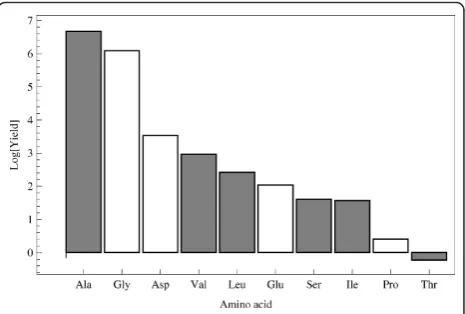
In any case, applying energy to these reducing mix-tures synthesises amino acids that are biologically signif-icant. This is true for several of the variants of Miller’s experiment [11]. Miller-like experiments usually give relatively high yields of glycine, aspartic acid, alanine and valine, amongst others, depending on the energy source and initial mix [11-13,22]. Figure 4 depicts the relative yields of the reducing atmosphere, in which some important amino acids are readily synthesised.
It is debatable however, under which atmospheric conditions the origin of the genetic code occurred, and therefore which were the amino acids that were relevant for an early metabolism. One possibility is that the genetic code was established just after the origin of life, in a pre-RNA world in a prebiotic-soup setting, under a weakly reducing atmosphere with low yields of glycine, aspartic acid and alanine [11]. This is an unlikely possi-bility because an abiotic metabolism which included nucleic acids had to exist. The geological conditions during this period were also very harsh, characterized by hostile volcanic activity and high temperatures. These conditions are thought to be too adverse for the estab-lishment of early forms of life, although it is not clear whether autotrophic metabolisms could have actually existed. Another possibility, is that the genetic code was established in a late RNA world, after the atmosphere had already changed, perhaps to include methane and ammonia produced from the metabolism of methano-genic protobionts. This, as we understand it, happened during the Archaean period, about 3.5 billion years ago. This is a more likely scenario because in an already existing metabolism, an emerging code would result from the reorganisation of established processes. In other words, the pre-adaptations that were required for
the genetic code to be established are consistent with early metabolisms.
Wächtershäuser summarised and pointed out several reasons why Miller’s“prebiotic soup” does not work as a model for prebiotic evolution [14]. Although these rea-sons are debatable, it is worth considering that a prebio-tic soup may in fact not be the most adequate scenario. One strong argument is that the composition of the pri-mitive atmosphere [21] would not consist of the gases needed to synthesise primordial amino acids with enough yield. As an alternative, Wächtershäuser pro-posed what has been called the“primitive pizza”[1, pp. 32-33]. This theory posits the prebiotic reactions occur-ring not in solution, but on the surface of pyrites, minerals rich in iron. Ferrous cations (positively charged) and sulphur anions (negatively charged) are adsorbed in the mineral surface and react to form pyrite. This reaction, i.e. Fe2+
+ 2H2S®FeS2 + 4H++ 2e-,
lib-erates two electrons and is exergonic, making energy readily available for other chemical reactions to happen. Amongst the possible chemical pathways, the surface reactions can form amino acids. Most amino acids could in principle be formed. However, the first amino acids that would be formed on pyrite surfaces, and which by tentative implication would be the first to be included in an ancient genetic code, would be serine and aspartic acid. Serine would be immediately cleaved to produce glycine [14]. In experimental syntheses of Wächtershäu-ser’s theory, some amino acids were actually obtained: glycine, alanine and serine [16], and alanine, glutamic acid, phenylalanine, and tyrosine [23,24].
Another chemo-autotrophic scenario that is worth dis-cussing actually occurs at the alkaline hydrothermal vents [15]. Arguably, this setting comprises the most comprehensive view of the origin of energy metabolism. Geosynthesis in the Earth’s crust powers serpentiniza-tion: silicates of magnesium and iron are oxidised by water and produce H2. This molecular hydrogen is later
released at the hydrothermal vents, where it reacts with CO2and iron sulphide (FeS), forming thio esters. These
compounds are the basis for the synthesis of many com-pounds and cofactors, and also couple the activation of acetate with phosphate to give acetyl-phosphate, which can be further hydrolysed to end up in acetate (CH3COOH). As in the iron-sulfur scenario, FeS can
also catalyse the oxidative amination of a-keto acids, resulting in alanine, glycine, and aspartic and glutamic acids. Notably, purines and pyrimidines can also be formed from aspartic acid and glycine (a pathway that involves acyl-phosphates) [25].
pathways forde novo amino acid synthesis, experimental assessments have shown that the yield is rather poor compared to the requirements of modern organisms. But was the relatively low abiotic yield of amino acids enough to sustain protobionts based on RNA metabo-lisms? The answer to that question strongly depends on the role of amino acids at the moment when the genetic code was established.
The Stickland reaction
The role of the amino acids is inevitably associated with the structural and catalytic nature of proteins. Given their small size, it would be absurd to consider that free amino acids could have a structural role. But because of their physical-chemical properties, free amino acids associated with RNA adaptamers could aid catalysis [7]. The theory of the coding coenzymatic handles (CCH) argues that the amino acids were covalently attached to trinucleotides, in a way that is reminiscent of metabolic cofactors, such as nicotinamide adenine dinucleotide (NADH) or ATP for example [7,26]. The trinucleotides served as “handles”through which ribozymes non-cova-lently attached to the amino acids. In this way, the amino acids could be re-used to aid catalysis [27]. Any unambiguous association between triplets and the amino acid repertoire would ensure that correct catalytic factors would be used for specific functions. This assumes that a modestly-varied repertoire of amino acids was already available. The synthesis of most cataly-tically important amino acids is very elaborate, and their abiotic yield is negligible (except for aspartic acid), a fact that necessarily postpones the catalytic functions of the amino acids to later historical stages.
Another fundamental role of protein and amino acid metabolism is nutrition. Amino acids are oxidised via the citric acid cycle and converted into urea (which is disposed of) and pyruvate and other keto acids of the citric acid cycle which are used in the anabolic synthesis of other compounds. Amino acids have a similar oxida-tion state to that of glucose, suggesting that they can undergo fermentation, and in extant organisms their breakdown fosters ATP synthesis.
There are several catabolic pathways of amino acid degradation. Amongst these, the Stickland reaction is the most efficient, by coupling the oxidation of one amino acid with the reduction of another. The amino acids that are oxidised undergo a deamination by the amino acid dehydrogenases, losing in addition two elec-trons and two protons [28-30]; the resulting keto acid then loses one carbon to CO2, and leads to ATP
synth-esis by substrate-level phosphorylation (Figure 3A) [9,29-31]. This reaction is then coupled to the“reductive branch”by transferring the electrons and the protons to the other amino acid, which undergoes a reductive
deamination, catalysed by a reductase [32-35]. The reduced keto acid has the same number of carbons as the acceptor amino acid. Normally, the reductive branch does not lead to ATP (unless both substrates are gly-cine), (Figure 3B) [36].
The overall amount of free energy varies according to the specific pair of amino acids undergoing fermenta-tion, and to the stoichiometry of the reaction. For exam-ple, fermenting four moles of glycine leads to 3 moles of ATP; fermenting glycine and alanine (in a stoichiometric ratio of 3:1 moles) leads to 1.7 moles of ATP. Both result in lower yield than the fermentation of two moles of glucose, which leads to 5 moles of ATP, but still effi-cient when compared with the yield of fermenting other carbohydrates (e.g. 3 moles of lactate gives a yield of 2.3 moles of ATP) [[36,37], Ch. 12].
The energetic yield is in fact sufficient to sustain organisms that employ exclusively amino acids as energy sources. The most compelling example is the genus Clostridiumwhich comprises chemoautotrophic, anaero-bic, bacteria [38]. Various species may or must use amino acids as a carbon source [9,30,35,39,40]. However the genus Clostridium is not a monophyletic group [40,41], which indicates that the Stickland reaction may have independent origins (an unlikely possibility because of the sequence similarity of the dehydrogenates and reductases [32]), has been lost in other genera, or was acquired by lateral transfer. Amongst the species we find thermophilic and alkaliphilic, some of which are associated with hydrothermal vents [37,38,40,42,43]. This hardly places the extant Stickland reaction path-ways in a deep ancestral branch of the tree of life, but it is conceivable that analogous, if not ancestral, versions of Stickland reaction pathways not only existed before the code was established, but could also have played a role in the establishment of the code, before the cataly-tic role was implemented and translation evolved.
Evolution of the adapters
functions. The ideas introduced in this article assume a helical stage for the proto-adapters. The mini-helices eventually evolved by successive and recursive duplications to form the modern adapters with their clo-verleaf structure, the tRNAs (Figure 2, [6]). This idea is founded in a recently proposed mechanism. It argues that the ancestor to the adapters was a primordial palin-drome gene composed of 11 nucleotides. This small hairpin would be composed of two block sequences: a coding triplet (the CCH, say, GCC), and a replication tag (something like a promoter sequence) with sequence 5’-DCCA-3’(where D is either an A or a U). If the pre-coding triplet is linked between the tag and the tag’s complementary sequence, a small hairpin of 11 nucleo-tides is formed: UGGDGCCdCCA (where d denotes the complement of D). Now, the tag plus triplet (7 nucleo-tides) is complementary to the 11 nucleotides block, and can be ligated at one of its ends and form an 18 nucleo-tides hairpin. If this pattern is iterated, then the 76 nucleotides long molecule, the tRNA, can be built [6]. Notably, in each iteration of this duplication-elongation mechanism two proto-adapter molecules are co-evolving (one in each strand), which supports the long-standing hypothesis that amino acids were included in the code in pairs [6,18,44-47].
Because a hairpin has complementary sequence at both strands, then a pair of proto-adapters with complemen-tary anticodons are fully complemencomplemen-tary. Furthermore, this RNA double helix must have been a palindrome (see Figure 5). What is striking is that modern pairs of tRNAs with complementary anticodons are also complementary at the amino acid determiner sequences at the stem [6,18,45,46]. This suggests that the sequences at the stem must have corresponded to the precursors of an antico-don. This correlation is stronger when the non-canonical pair G-U is allowed in the helices [45,48,49]. The impli-cation, as detailed below, is that the redundancy of the code can be explained in terms of the coevolution of the anticodon precursors [18,45,46]. First, it is assumed that proto-adapters with complementary anticodons when replicating, form intermediary double stranded helices. Low-fidelity RNA replicators produced unassigned antic-odons, perhaps by mutations, but mainly by employing
G-U pairing [6]. Second, these unassigned codons were assigned to new amino acids whilst their complements, being similar to the original proto-adapter, were assigned to the original amino acids [18,45]. Consider for example GCC, an anticodon assigned to glycine. This codon can produce an initially unassigned triplet by template repli-cation: GGU. The latter, through proper Watson-Crick matching, produces ACC, which is another anticodon for glycine. The intermediate anticodon GGU was then assigned to a new amino acid (in this case, threonine). This mechanism can be extended to other anticodons, and parsimoniously explain the incorporation of several amino acids in pairs, although it does not explain why specific pairs (say, glycine and threonine) were assigned to the pair of anticodons ACC and GGU.
Presentation of the hypothesis
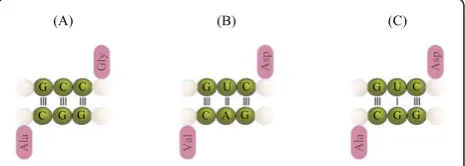
The coevolution of the anticodon precursors as described above raises the following question: which amino acids were assigned to the new anticodons? To answer this question, we need to invoke a function for the proto-adapters. A catalytic role for the amino acids cannot be excluded, given that these are compounds with versatile chemical and structural properties. How-ever, there is a gap between the stage when CCH were used as catalytic cofactors and the use of adaptors hav-ing a proto-code. What I propose is that the free antico-dons were assigned to amino acids that complemented the Stickland role of the amino acids readily assigned to the complementary anticodons. This rule should apply for both legitimate and illegitimate complements (i.e., those involving G-U pairs). For example, in Figure 6 the anticodon GCC for glycine is complementary with the
Figure 5Primordial palindrome gene. Two mini-helices that have complementary anticodons but are otherwise identical, can unfold and dimerize to form a RNA double helix. This double-helix is a palindrome.
anticodon GGC for alanine. Glycine and alanine are Stickland pairs. Another pair would be formed between GUC (for aspartic acid) and GAC (for valine) where the amino acids are Stickland pairs. However, the illegiti-mate pair between GUC and GGC can also be formed. In fact, their amino acids, aspartic acid and alanine respectively, are also Stickland pairs. Table 1 lists the Stickland roles of some amino acids, including the ones appearing in the cycle (all of which are “Milller” amino acids, Figure 4). This observation leads to the following hypothesis:
Complementary anticodons are assigned to amino acids that are conjugated Stickland pairs.
In other words, the suggestion is that the origin of the genetic code traces back to the mutual redox deamina-tion of the amino acid pairs to synthesise high-energy intermediates, such as acetyl phosphate and other related phosphate compounds.
Testing the hypothesis
The association between Stickland pairs and comple-mentary anticodons is expected to hold more strongly for the primordial amino acids. Later additions could have been affected by other factors, especially when the bioenergetic pathways had already evolved, and departed from amino acid fermentation.
When we consider the set of amino acids produced in Miller’s revisited experiment [[13], underlined in Table 1], we find that the associations between Stickland pairs and complementary anticodons still hold, and the adap-ters form a cross-catalytic cycle (Figure 7). The signifi-cance of this observation is not about the plausibility of Miller’s experiment as a model of the origins. What Miller-Urey synthesis suggests is that the amino acids are easily formed, with a yield that is somewhat inver-sely proportional to their chemical complexity. Overall, glycine and alanine are formed at a roughly 2:1 ratio, with a yield more than an order of magnitude higher than that of the rest of the amino acids [13], suggesting that alanine and glycine were the ancestral components of the genetic code, followed by valine and aspartic acid [50].
This initial amino acid composition is supported by the bias in the amino acid use of ribosomal proteins [51]. In other words, when the transition to proteins came, the simpler amino acids were used preferentially over the simpler ones; in particular glycine, alanine, and asparagine are overrepresented on the deep branches, although the case for valine, lysine and arginine remains unsolved (i.e. there seems that there was no significant increase in their usage, and that this has remained more or less constant) [51]. Here we find some evidence that
supports the hypothesis; some of the anticodons for gly-cine (NCC) are complementary to some anticodons of alanine (NGC). This pair of amino acids is Stickland reactive (in fact amongst the most efficient pairs). A sec-ond step in the extension of the code is given by includ-ing valine and aspartic acid, which allow the associations gly-ala, asp-val and asp-ala, which are Stick-land reactive, and their templates (NGC and NUC, respectively) form a small cross-catalytic system (Figure 6A-C). Thus the addition of two more adapters results not in two reactive pairs, but in three.
If an amino acid has the tendency to give a good ener-getic yield, it is expected to pair with several other amino acids of conjugate role. Strictly speaking, amino acids that tend to be good donors or good acceptors are expected to be assigned to anticodons that are flexible in pairing with other anticodons. For instance, it has been proposed that originally, glycine was encoded by the anticodon NCN, which would match the original anticodon of alanine, NGN. The latter additions valine and aspartic acid would have NAN and NUN respectively.
amino acids, namely isoleucine and threonine (electron donors in the Stickland reaction), is accompanied by the implementation of new anticodons (NAU and NGU), which are still complementary to pre-existing antico-dons of the electron acceptors (i.e. aspartic acid, NUN, and glycine, NCN; Figure 7). At this point, the “ symme-try” of the primaeval code would be broken at the third position of the anticodons. However the anticodons for the electron acceptors (which are more numerous that donors), would be left intact. In this way, the multipli-city of the reactions would be maintained. Again, the number of possible reactions is increased, in a combina-torial manner.
Notice that there are two levels of redundancy that can support this multi-reactive proto-code. The first is to allow for synonymy of the anticodons associated with an amino acid: several anticodons coding for an amino acid will allow it to potentially associate with as many other amino acids as the degree of redundancy. This redundancy would eventually result in degenerated associations as in the extant genetic codes. The second redundancy adds to this by assigning the amino acids to anticodons rich in G +U. Each of these anticodons, through non-canonically pairing, are able to associate with several other anticodons, not just the cognate one. Examples of this secondary redundancy are the anticodons for serine and arginine, which can pair with up to 15 other anticodons in total, by both kinds of redundancy. More significantly, alanine’s anticodons pair very well with anticodons of several elec-tron acceptor amino acids: glycine, proline, histidine (whose codon would originally be assigned to aspartic acid), and arginine, making it readily available to react. This is because its anticodons are rich in U, which besides pairing with A, are able to pair with G. The other extreme is achieved by tryptophan and methionine, and have high A+C content, are not degenerate, and were unlikely to be present at the initial stages of the evolution of the adapters [50,51]. As a matter of fact, there is a significant correla-tion between number of complementary anticodons of an amino acid and the free energy of the Stickland reaction (Figure 8).
Simulations
In order to explore the extent of this idea, a significance test was performed by resampling the genetic code and calculating the energetic yield of the Stickland reactions. First of all, amino acids were randomly assigned to an anticodon triplet to give a putative proto-code. Second, pairs of amino acids are allowed to react only if (a) they ended up assigned to complementary anticodons, and (b) they are Stickland pairs. These two constraints need to be considered explicitly in order to calculate the total yield of ATP. There are nr pairs of adapters that bear reactive amino acid pairs AAd and AAa, which react
according to the equation
κ(r)
d AAd+κ
(r)
a AAa
ADP
−−→ κ(r)
p ATP +αKAc(r). (1)
The stoichiometric coefficients depend on the speci-fic reactionr [37];aKAc(r)denotes thea-keto acid pro-duced in reactionr. It is assumed that there is enough ADP available to produce the necessary ATP. In order to compute the yield of ATP for the whole set of reac-tions, we first need to calculate the limiting reagent for each reaction. Then, considering the stoichiometry and that the reactions are completed, the ATP production can be obtained. First of all notice that the concentra-tion of an amino acid that is involved in the reacconcentra-tionris
[AAi](r)= nr
ρ∈Rinρ
[AAi]sol, (2)
where Ri is the set of reactions involving the amino acid AAi, and [AAi]solis the total concentration of the amino acid in the solution. Effectively, the concentration [AAi](r)is the concentration of adapters that have that amino acid AAi attached to it, and which are comple-mentary to other adapters that have the Stickland part-ner attached. Because the stoichiometry, the limiting reagent of each reaction r, say, AAlr, will be the one with the lowest value of [AAi](r)/κi(r). In that case, the
yield of ATP for that reaction is
[ATP](r)= κ
(r)
p
κ(r)
lr
[AAlr](r). (3)
L L V
V
A A
SS T T C
C
II
0 5 10 15 20
170
160
150
140
130
Number of complementary anticodons,nc
Change
in
free
energy,
G
KJ
mol
The overall yield of ATP is simply the sum of the yield of each reaction. One mol of ATP gives roughly ΔG° = -80 KJ/mol.
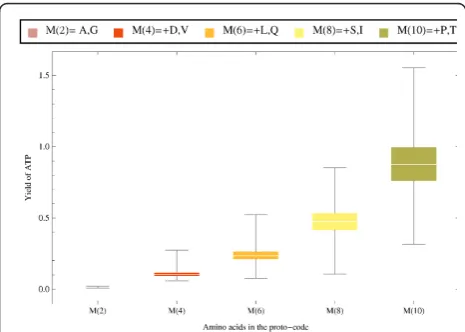
Code arrangements were bootstrapped 104 times, and the distribution of the yield of ATP was calculated under different subsets of 2,4,6,8 and 10 of the Miller amino acids (Figure 4). The mean yield of ATP, as well as its variance, significantly increases as the number of amino acids pairs included in the code increases (Figure 9). Therefore, under the assumption that the Stickland hypothesis is true, the inclusion of more amino acids could have been a driving force for the coevolution of the assignments. These distributions reflect the extent of the variability that can be available for selection to act. But in itself, these significance tests do not pose any statement about the evolutionary mechanisms that shaped the code. However, if there is any heritable mechanism capable of generating such variability in a proto-code, then the differences in the energetic yield can account for the relative selective advantage amongst types that employed different codes, or number or com-position of amino acids.
Sequential bootstrapping was also performed in order to evaluate whether there is a preferential order of addi-tion of amino acids. The different 18 combinaaddi-tion of Stickland donors and acceptors of the Miller amino acids all lead to distributions of ATP yields with means that are different from zero (p< 10-30), which is to be expected. However, further additions of individual donors or acceptors, or pairs of them, resulted in a sig-nificant increase of the mean yield of ATP, whilst
adding non-reactive amino acids significantly decreased the mean yield of ATP. This is reassuring, because it reflects the fact that the amino acids that can undergo fermentation, and can drive the expansion of the proto-code. But based only on the distribution of yield, this test does not allow us to derive any conclusions about the sequential increase of the amino acid repertoire.
In order to account for historical factors, a preliminary evaluation of the role of selection on variation was per-formed by implementing a Monte Carlo simulation. The central assumption is that there is a mutation ism that generates variants of the code, and a mechan-ism to select amongst these variants. For the mutations a swap-or-replace mechanism is assumed; two anticodon triplets are randomly selected, and if they bear different amino acids, the assignments are swapped. If they are the same, one of the amino acids is randomly substi-tuted by any other present in the code. Selection acts according a Boltzmann factor, exp [-80(Δ[ATP])/RT], where the Δ[ATP] is the difference in ATP yield amongst the code that is implemented at any given time, and a mutated one;R is the gas constant and T the temperature. Then,“evolution”is allowed to proceed as a Metropolis algorithm.
One hundred and four replicas of the process were initiated with the following amino acids drawn with equal probability: alanine, glycine, aspartic acid and valine. All processes converged in between 5,000 and 30,000 generations (Figure 10A), and the resulting codes all produced 2 mol of ATP (the maximum possible according to the stoichiometry). The codes have an overrepresentation of the acceptor amino acids over the donors (Table 2). The latter, were almost invariably assigned to four of the eight codons composed exclu-sively of U+G, confirming the reasoning above (Table 2). In another test, the code was allowed to sequentially include more amino acids; every 7000 generations each of the remaining Miller amino acids were assigned to a randomly chosen anticodon, until all of them were included into the code (Figure 10B). In 3 of the 100 runs some amino acids were lost and the codes con-verged to a sub-optimal state (with a yield of 2 moles of ATP). However, the remaining 97 converged to optimal codes, resulting in 3 moles of ATP (Figure 10B). Again, we find that the electron acceptor amino acids always are coded with high redundancy, and the donor amino acids with low redundancy, but assigned to anticodons with high U+G content (Table 3). In Table 4 some negative results are reported: the sub-optimal codes can all be explained by chance, suggesting that it is not only the composition of amino acids that matters, but also the assignment to proto-adapters.
Summarising, the principle of amino acid fermentation via adapter pairing can lead to particular structures of Figure 9 Box plots of the distribution of ATP yield as a
the code, and explain some features of redundancy. The results are statistically significant and reproducible.
Possible experimental tests
There are two feasible experimental tests that can give support to the hypothesis above. First, notice that the
“Stickland role” of any amino acid can depend on the actual partner. The classification shown in Table 1 is a compilation from the literature. In most of the experi-ments the amino acids were classified when tested against“universal” donors (usually alanine) or acceptors (usually glycine or proline). Ultimately, whether an amino acid acts as an electron donor or acceptor depends on its oxidation state relative to its partner, on their reactivity, and of the enzymes that catalyse the redox reactions. The electron-acceptor amino acids in all cases have higher oxidation states that their Stickland donors. This suggests that the roles of specific partners
could be inverted, an observation supported by experi-mental results. For example, arginine can revert the roles of proline or lysine, and act as an electron acceptor when reacting with these [31,52], which is reasonable when we consider that arginine’s oxidation state is higher than that of proline or lysine. Therefore, testing the reactivity and free energy of specific pairs of amino acids in the extant species that carry the Stickland reac-tion can convey more informareac-tion about (a) fermenta-tion pathways and reacfermenta-tion mechanisms that could have also been employed before the code was established, and (b) the energetic yield of these reactions.
The second possible test is related to the catalysis of the reactions. It is assumed that before the establish-ment of the genetic code ribozymes performed catalytic functions. The redox pathways, even when energetically Figure 10Evolution of early codes by selecting on the ATP yield. Evolution of the assignation of amino acids to adapters by selecting on the resulting ATP yield. (A) Employing only the simplest four Miller amino acids (alanine, aspartic acid, glycine and valine) 104 runs with initial random associations converged to optimise the ATP yield, in all cases reaching to the maximum of 2 moles of ATP. (B) 100 runs started from random associations to alanine and glycine and every 7000 generations a new Miller amino acid, randomly selected, was included and assigned to a random adapter. Most runs converged to optimal codes (with the maximum yield of 3 moles of ATP), but three did not.
Table 2 Evolved proto-codes using the primaeval amino acids
Amino Acid # anticodons (SE) G+U content (SE) p
Glycine 27.14 (2.8) 1.5 (0.80) 10-3
Alanine 1.96 (0.19) 2.98 (0.14) 10-62
Valine 1.93 (0.25) 2.96 (0.18) 10-61
Aspartic acid 32.96 (2.80) 1.33 (0.80) 10-21
Outcomes of selection on the fermentation yield of proto-codes randomly initiated with equal probabilities of glycine, alanine, valine and aspartic acid. For each of these amino acids (first column) the mean of the final number of anticodons that coding (second column) and the average of the G+U content of the assigned anticodons (third column). The fourth column is thep-value from a sign test centred at 1.5 (the expected mean number go G+U in a randomly constructed codon). The distribution of assignments are significantly different from 1.5. Pearson’sc2
test on a binomial distribution was also applied, and in all cases resulted inp-values between 10-15
and 10295 . These test reject the null hypothesis, i.e. the structure of the proto-codes cannot be explained by random assignments. The data consists of the end points of 104 independent runs, each evolved for 60,000 generations (MC steps).
Table 3 Evolved proto-codes, optimal solutions
Amino Acid # anticodons (SE) G+U content (SE) p* p+
Alanine 2.21(0.84) 1.98 (0.89) 10-8 10-21
Glycine 13.06 (2.96) 1.36 (0.66) 10-7 10-9
Aspartic Acid 14.24 (3.01) 1.25 (0.68) 10-17 10-23
Valine 2.19 (0.94) 2.23 (0.54) 10-25 10-37
Leucine 10.77 (4.60) 1.41 (0.61) 0.0024 10-7
Glutamic acid 2.09 (0.89) 2.18 (0.46) 10-29 10-28
Serine 2.13 (0.86) 2.15 (0.52) 10-21 10-27
Isoleucine 2.13 (1.12) 2.18 (0.54) 10-22 10-30
Proline 13.30 (3.04) 1.37 (0.69) 0.00003 10-6
Threonine 1.88 (1.16) 2.12 (0.56) 10-18 10-21
Outcomes of selection on the fermentation yield of proto-codes randomly initiated with equal probabilities of glycine and alanine. Every 7000 generations a new amino acid was added, randomly selected from the remaining Miller amino acids. Overall, the simulations ran for 100,000 generations (MC steps). The results are from 97 optimal codes (see Figure 10). * Significance p value for a sign test;+
favourable tend to be limited by very slow reactions and must be aided by cofactors and ribozymes. It would be possible to test some of the steps of the Stickland reac-tion, such as the deamination of the amino acids and the phosphorylation of the keto acids. Could ribozymes be evolvedin vitroto catalyse these functions? This is a very interesting question to be explored in the future, for which there is an enigmatic starting point: glutamate dehydrogenase (which oxidises glutamate, as in the first step of the Stickland reaction) is an enzyme that has notable sequence homology to the synthetases [47,53]. This leads to the speculation that both functions could be somewhat related. It is a feasible idea to attempt to evolve the flexizymes (but in general, any other ribo-zyme) to have the dehydrogenase function.
Implications of the hypothesis
Structural constraints
Why would the proto-adapters form complementary RNA complexes? The attachment of the amino acids to the proto-adapters can allow their spatial coordination in such a way that ribozymes and/or cofactors can cata-lyse their coupled redox deamination.
If this coordination does not include a covalent bond to the RNAs, it is hard to rationalise any structural mechanisms, due to the immense possibilities of coordi-nation for which we currently know no constraint. Furthermore a non-covalent mechanism could be limit-ing because of the slow speed of the reaction rates. But if the amino acids are covalently attached, then mechan-isms for this reaction can evolve due to steric constraints.
Amino acids attached to an RNA complex (say, a dou-ble strand) could be more easily oriented and prone to be catalysed. Current tRNAs have their amino acids attached at the 3’ end of the molecule, i.e., at position 76, whereas the encoding triplet in the stem is located
between positions 70 and 72. In a double stranded RNA of 11 nucleotides the amino acids that are attached at the 3’end of the RNA do not lie close to each other.
Because of the symmetry of the double helix, the attachment point of the amino acids to their RNA chains needs to be at equivalent positions. At the same time the amino acids need to have spatial proximity. The anti-par-allel nature of the double helix gives two alternatives that satisfy these two constraints, and are shown in Figure 11A,B. The first possibility is that amino acids are attached to the third base of the the anticodon (high-lighted in red). The second possibility is that the amino acids are attached three bases before the first nucleotide of the anticodon (shown in green). These are the only two options in an 11 nucleotides mini-helix where the amino acids lie in the same physical plane.
In the tRNAs the carboxyl group of the amino acids form an ester bond with the 3’ carbon of the ribose. However, at non-terminal nucleotides the 3’carbon is is occupied by the phosphodiester bond forming the back-bone of the RNA. A sound alternative is to attach the amino acid to the 2’ carbon of the ribose (Figure 12). Table 4 Evolved proto-codes, sub-optimal solution
Amino Acid # anticodons (SE) G+U content (SE) p* p+
Alanine 4.67 (1.15) 1.93 (0.84) 0.18 0.12
Glycine 15.0 (3.61) 1.36 (0.69) 0.55 0.65
Aspartic Acid 3.67 (6.35) 1.00 (0.60) 0.23 0.24
Valine 2.33 (0.58) 2.00 (0.33) 0.13 0.14
Leucine 14.70 (1.15) 1.36 (0.56) 0.17 0.21
Glutamic acid 2.33 (0.577) 1.71 (1.57) 0.45 0.34
Serine 3.00 (1.00) 2.11 (0.61) 0.18 0.10
Isoleucine 2.33 (0.577) 2.29 (0.24) 0.02 0.03
Proline 11.30 (9.87) 1.35 (0.72) 0.39 0.77
Threonine 4.67 (4.62) 1.57 (1.03) 1.00 0.55
Outcomes of selection on the fermentation yield of proto-codes randomly initiated with equal probabilities of glycine and alanine. The results are from the 3 sub-optimal codes (see Figure 10). * Significance p value for a sign test; +
significance p value for ac2
test. Otherwise as in Tables 2 and 3.
Figure 11Structural features of a double stranded RNA mini-helix of 11 nucleotides. Structural features of a double stranded RNA mini-helix of 11 nucleotides. The backbones of each chain are shown in blue and pink wire representations. Their anticodons are shown in tubes; showing also the bases. The putative attachment points of the amino acids are shown in red (at the third base of the anticodon position) and green (three bases before the anticodon). (A) Top view. (B) Side view. (C,D) Close-up showing the spatial proximity of the attachment nucleotides (shown in tube
The formation of the ester link has to be catalysed; in extant metabolisms, specific enzymes (the amino-acyl-tRNA-synthetases) catalyse the ester-bond formation. The flexizymes are artificially evolved ribozymes that have synthetase activity [54,55], thus this first step can be performed in the absence of proteins. Still, in order to form the covalent link with the ribose, the amino acid has to be activated (with AMP in the modern synthetase proteins as well as in the artificial ribozyme).
Figures 11C,D show a structural detail of the anchor-ing nucleotides facanchor-ing each other, and arrows indicate the 2’point of attachment.
Towards a reaction mechanism
The structural constraint posed above, although reason-able from the structural point of view, poses two pro-blems. The first is that the deaminations are less likely to happen than for free amino acids. Current dehydro-genases do not form a covalent bond with the amino acid, for which oxidative deamination is more likely [28]. Thus if the Stickland reaction were mediated by ribozyme in an analogous way as the dehydrogenases, then the structural constraints described above would complicate matters. In fact, we can understand why. Because the ester bond displaces the electron cloud, the a-carbon is less electronegative; this impedes its depro-tonation, making it unlikely that the nitrogen transiently forms a double bond with thea-carbon (the latter dou-ble bond is required for the nucleophilic attack of oxy-gen from water). Thus if covalently bonded, the amino acids are more stable than the keto acids [2]. However this does not take into account that the side chain of the partner amino acid can aid deprotonation by inter-acting with the nitrogen moiety. Naturally, there must be some cofactors (such as NAD+, or NADPH+) to
mediate the electron transfer, and ribozymes that allow the reaction to proceed.
The following step is the reductive deamination of the other amino acid. This is a complicated reaction, and how the precise mechanism proceeds remains unclear even for the extant reductases [32-34]. The central lim-itation is that this deamination requires a very strong oxidising agent, which in the reductases involves inter-mediates between selenium esters and the deaminated glycine [32] (in principle an analogous bond could be established by thioesters).
The second complication is that after the deamination, the keto acids remain attached to the ribose. This is an important factor, because ATP can be synthesised only from the remaining keto acids, which need to be detached from the ribose. The ester bond between the carboxyl group and the ribose has to be broken (to result in a deoxyribose), by direct or indirect oxidative phosphorylation of the keto acid.
Relation to the stereochemical hypothesis
The stereochemical theory suggests a physical and struc-tural relation between the coding triplets (either codons or anticodons) and their cognate amino acids [[3], Chs. 6-7]. Based on sequence and structural data of ribos-witches, it has been calculated that for some amino acids (arginine, histidine, isoleucine, leucine, phenylala-nine, tryptophan and tyrosine) the chances that the cod-ing triplets are evenly distributed in the bindcod-ing site are small. The implication is that there is a significant asso-ciation between the amino acids and some of their cod-ing triplets (either codons or anticodons). Although only a fraction of the possible coding triplets (21%) show sig-nificant associations [5], these could have been an important determinant for coding, at least for some of the assignments [4,6].
Given that the Stickland pairing is correlated to antic-odon pairing, in any random sample containing comple-mentary anticodons the chances that Stickland pairs are formed are high. Thus the appearance of the two Stick-land pairs in the stereochemical associations might just be casual. For instance, of the anticodons that are signif-icantly associated with their amino acids in the ribos-witch data, two complementary anticodon pairs appear: GUG (histidine) with AUA (leucine), and AUA with leu-cine (AUA) with GUA (tyrosine), although there is no data on whether these amino acid pairs are Stickland reactive. On the other hand, this would make the two theories compatible.
If both factors are taken into account, (Stickland pair-ing and stereochemical affinity), codpair-ing is more con-strained; whilst the choice of some anticodons might have been determined stereochemically [6], their com-plementary pairs can be assigned to an amino acid that
O P O3
A N
R O NH3
R O
n O
O P O3 A N R
is an efficient Stickland partner. If this were true, it could explain why only a fraction of the amino acids are stereochemically assigned to their anticodons. Further-more, it is also possible that the stereochemical factors bias the choice, purging the code of some naturally occurring amino acids that were not biochemically use-ful (for energy or otherwise). The analyses to support the stereochemical theory did not include the amino acids that seem to be most relevant for the initiation of the code, which are the simplest to synthesise abioti-cally, namely glycine, alanine, aspartic acid and valine, and other Miller amino acids. This does not discredit the stereochemical theory, but it does lead to some conflicts.
The stereochemical theory is an ideal precursor to the CCH hypothesis since it establishes some non-covalent associations that could become covalently linked in a later stage of evolution. In this way the non covalent associations would give birth to the catalytic cofactors. This view has its merits, but in the context of this arti-cle the sequence of events is somewhat reversed. Simple amino acids were used as energy sources (rather than for catalysis), and were initially assigned randomly. The more complex amino acids were included later in the code when biosynthetic pathways were available to synthesise them, most likely for catalysis. This is sup-ported by phylogenetic analyses that showed that most of the species that have strong stereochemical associa-tions to their coding triplets increased their representa-tion much later in evolurepresenta-tion, after the last universal common ancestor was established [51].
Other amino acids favoured in the stereochemical the-ory are underrepresented in the deep branches indicat-ing that despite havindicat-ing good catalytic properties, they were hardly used in the nascent proteins. Thus, by the time these amino acids were included in the code, a more primitive code had to exist, and therefore the covalent associations to the proto-adapters (or even ancestral versions of the modern adapters) had to be readily established. Also, if it turns that the simple amino acids do not have a significant stereochemical association with their coding triplets, it is hard to argue for the case arginine and lysine, since they cannot be formed by simple abiotic processes, and thus cannot impose constraints in the early evolution of coding.
Relation to the abiotic and early metabolisms
It has been argued that the citric-acid cycle might have originated in the opposite way [15,56,57]; instead of lib-erating CO2, it would employ it in a biosynthetic and
reductive direction (as cyanobacteria and many extremo-philes do), in accordance with the reductive atmosphere scenario [11,21]. This is similar to the scenario of the alkaline vents where CO2 is employed for the synthesis
of the organic precursors. This theory is appealing not only because of it chemical basis [15,25], but also because of the geological context, which is know to exist [25,58]. It was mentioned in the introduction that it is sound to assume that the code originated around the time of the LUCA. If that is the case, were the early protobionts free from the geochemical substratum, or were they still strongly dependent on it? It makes a big difference for the following reasons:
•Under hydrothermal conditions (100°C) amino acid synthesis (not their breakdown, as proposed here) is energetically favourable, but at oceanic surface (18° C) breakdown is favourable [59,60].
• The melting temperature of the 11 nucleotide proto-adapter is between 30 and 50°C.
This means that under hydrothermal conditions the Stickland hypothesis does not work. What is worse, the whole theory of the concerted origin breaks down on energetic grounds, because proto-adapters smaller than about 60-70 nucleotides would not attain a stable fold (I am assuming the best case scenario where the proto-adapters are completely self-complementary, and there-fore would have 30 to 35 paired bases, giving a melting temperature of about 100°C; interactions with ions and cofactors are being ignored). The situation is different away from the hydrothermal vents, where the double stranded proto-adapters are stable (the melting tempera-ture is higher than the environmental), and amino acid fermentation is energetically favourable [59,60].
This allows us to hypothesise that there had to be a period where the autotrophic protobionts had to experi-ence a cooler environment. This could have been a geo-logically cooler period, or perhaps autotrophs that gained independent compartmentalisation eventually migrated away from the mineral substrates at the vents towards cooler environments. In cooler environments the reaction rates are slower and any factor that increase catalysis, like the complex amino acids, are selectively advantageous, and thus proto-adapters could evolve to become CCHs. These organisms that were conveyed with the new catalytic innovations increased in fre-quency and spread. Upon confronting warmer environ-ments again, an increase of the size of the adapters was necessary in order to allow thermal stability. Somewhere during those transitional stages, peptides, rather than cofactors, took over metabolic functions.
Evolution of the genetic code
abundant quantities, are enough to fuel metabolism. Although other Stickland partners can be found in the Miller amino acids, their negligible yield makes it unli-kely that they could fully complement the bioenergetic requirements. But the code within the codon also reveals that in each biosynthetic pathway, amino acids derived from the primordial ones are assigned to codons that conserve their first position. For instance, codons starting with A code for amino acids synthesised from aspartic acid (asparagine, threonine, isoleucine, methio-nine, and lysine). Codons starting with C code for amino acids synthesised from glutamic acid (glutamine, proline and arginine). Codons starting with U code for amino acids synthesised by the Shikimate pathway (ser-ine, phenylalan(ser-ine, tryptophan and tyrosine). This strict pattern in the evolution of the code and of the amino acid repertoire was previously noticed and formulated as the coevolutionary theory of the genetic code [62,63], which states that precursor-product amino acids are assigned to codons that differ in only one base pair. The coevolution theory explicitly suggests the the distinct amino acids were not included in a random way in the code, but rather, that their biosynthesis evolved.
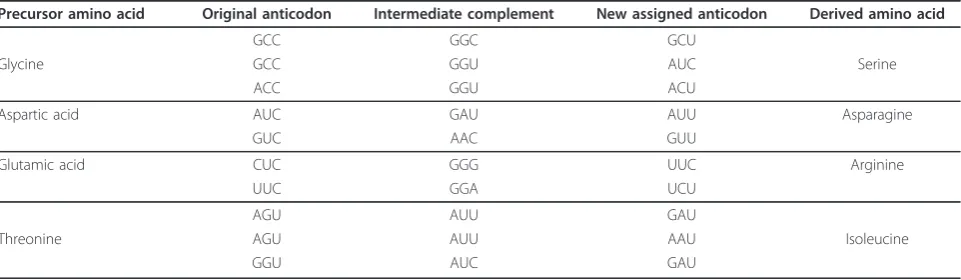
The assignment of the new amino acids to new antic-odons had to be established through the proto-adapter-pairing mechanism described in the section “Evolution of the adapters”, but with the slight difference that instead of attaching the same amino acid to an equiva-lent codon, it is the biosynthetically-derived amino acid that is attached to it. In fact, we do indeed find some signatures in the extant (universal) genetic code where the derived amino acids are assigned to similar antico-dons: serine®glycine, glutamic acid® arginine, aspar-tic acid ® asparagine, and threonine® isoleucine. In addition, we also find threonine ® methionine, which are “brothers” (both derived from aspartic acid) rather than precursor-product, but since they share intermedi-ates, it is plausible that there were pathways that could convert one to the other. Table 5 summarises the path-ways involved in these assignments.
This begs the question of whether the biosynthetic modifications improve the fermentation yield. By chan-ging the oxidative potential in the biosynthesis, the Stickland role can be altered, as in the case of the inter-conversion of serine and glycine, or aspartic acid and asparagine. In the other cases the Stickland role is con-served. At the moment the evidence is not conclusive, although by considering posterior modifications to the code we might gain considerable insight. Nevertheless the biosynthesis of amino acids could have evolved after selective pressure was established by the use of amino acids that were scarce but beneficial, and which were therefore already assigned to some anticodons.
Concluding remarks
The Oparin-Haldane hypothesis, and Miller’s experi-ment were major contributions to the understanding of the material basis of life. However, after the discovery of the genetic code, it became obvious that it is much sim-pler to synthesise the simple building blocks of life, than to assemble them in units that are capable of evolution. The RNA world has become one of the central para-digms for this early stage of life, but how it emerged remains unexplained. The origin of genetic code is one of the most puzzling questions about the transition from this RNA world to the modern modes of life. The pervasiveness of the genetic code in the tree of life, with its minor deviations, suggests that it must date back to the last universal common ancestor.
The hypothesis presented in this article complements the current understanding stating that the amino acids and proto-adapters were added to the code in pairs [6,44,45]. Stickland pairing is an appealing candidate mechanism because (a) it imposes constraints to the amino acids to be assigned to newly evolved proto-adap-ter pairs, and (b) it favours redundancy by assigning good electron donors or acceptors to proto-adapters in a way that allows it to react with several amino acids with complementary Stickland role. The evidence that supports or that is in favour of the hypothesis can be
Table 5 Assignation of biosynthetically derived amino acids to new anticodons
Precursor amino acid Original anticodon Intermediate complement New assigned anticodon Derived amino acid
GCC GGC GCU
Glycine GCC GGU AUC Serine
ACC GGU ACU
Aspartic acid AUC GAU AUU Asparagine
GUC AAC GUU
Glutamic acid CUC GGG UUC Arginine
UUC GGA UCU
AGU AUU GAU
Threonine AGU AUU AAU Isoleucine
summarised in the following points:
• Bacteria of the genusClostridium employ pairs of amino acids as energy sources.
• The energetic yield of amino acid fermentation is comparable to that of carbohydrate fermentation [36].
• In the abiotic syntheses of amino acids, Stickland pairs are readily produced.
•The composition of the ribosomal proteins of early organisms is biased towards the use of the simpler amino acids, specially alanine, asparagine, and gly-cine [51].
• The code within the codon suggests the ancient origin of the four basic amino acids alanine, aspartic acid, glycine and valine [61].
•Amino acids that are favoured in the stereochemi-cal theory [5] are underrepresented in the deep ancestral branches [51], implying the coding might have been established earlier by other means.
• Several anticodons that are complementary are assigned to amino acids that are conjugated Stick-land pairs, which include the simpler Miller amino acids (Figures 6 and 7).
• A significant correlation exists between the num-ber of complementary anticodons of an amino acid and the free energy of the Stickland reaction (Figure 8).
• The melting temperature of the 11-nucleotides proto-adapter is compatible with the conditions at which amino acid degradation is thermodynamically favourable (30 - 50°C) [59,60].
• By increasing the number of amino acids used as substrate, the numbers of possible reactions is increased in a combinatorial manner.
• The multiple complementarity of the proto-adap-ters (by considering U-G pairs) increases the syno-nymy of the reactions.
•The inclusion of more amino acids to a proto-code can increases the ATP yield, especially if refined by selection (Figures 9 and 10).
As mentioned above, we need to invoke a specific evo-lutionary model in order to account for plausible evolu-tionary histories. This in itself is an independent research subject; for example, we might make different assumptions about the modes of selection: did it act in a directional way, or was it stabilising? What kinds of costs could have been involved in the inclusion of new amino acids to the early metabolism? To what extent were the codes heritable? What is the distribution of mutation effects on the adapters? Questions such as these are relevant in determining the details of the asso-ciations. Fortunately, these are accessible by combining
RNA models with state of the art of evolutionary genet-ics theory.
But even sparing from these details, the theory pro-posed here helps us to understand the early steps in the establishment of the code. It explains stages prior to the CCH in terms of bioenergetic advantages to a hypotheti-cal protobiont living prior to proteins being implemen-ted for enzymatic and structural roles. Although we can not know with certainty what actually happened, the ideas exposed in this article give a testable coherent pic-ture about some factors that could have moulded the genetic code.
Acknowledgements
I am grateful to J.P. Bollback, C. Guet and M. Sixt for our discussions and comments on the manuscript, to J. Schwarz for his help with the chemistry, and to T. Ellis for copyediting the manuscript. I would like to acknowledge E. Szathmáry for kindly hosting me at the Collegium Budapest for a short visit, where the stimulating exchange on the origins of the genetic code was ignited. The author was supported by the ERC-2009-AdG Grant for project 250152 SELECTIONINFORMATION.
Authors’contributions
HPdV carried out all analyses and simulations and wrote the text.
Reviewer’s report
Title:Bioenergetic origin of the genetic code
Version:2 Date: 27 June 2011
Reviewer:William Martin
Reviewer number:1
Report form: Review of Vladar for BD
The author suggests that there is a connection between the structure and evolution of the genetic code with the Stickland reaction, a fermentation reaction in anaerobes like Clostridia and relatives.
I would like to start by clarifying that I do not claim that the extant pathways of the Stickland reaction are directly derived from the putative ancient pathways for amino acid fermentation, as discussed in the main text. But the existence of these pathways in extant organisms make amino acid fermentation plausible.
“The proposition is that the origin of the genetic code traces back to the origin of metabolism”, that is a nice thought but Copley et al. (2005) should developed that previously, but from a very different angle.
The mechanisms presented by Copley et al (2005) [2] predict that several of the amino acids can be synthesised from their corresponding keto acids in dinucleotide complexes. The dinucleotides match the first two codons of the amino acids in the code; this provides a possible mechanism for the coevolution theory of the code [62], and to the code within the codon [61]. Personally, I regard the biosynthesis of amino acids as a later stage in the evolution of the code. This is particularly appealing from Copley et al’s (2005) [2] ideas; the amino acids, synthesised in dinucleotides corresponding to codons, would be transferred to adapters in a synthetase-like reaction. This would necessarily force codon swapping and reorganisation of an existing proto-code. But at this point the function of the amino acids would have departed from bioenergetics, otherwise we would have a circular argument and aperpetuum mobile.
On the topic of amino acids and bioenergetics, Amend & Shock (1998)[59]
show that the synthesis of amino acids (and proteins) from H2and CO2and
ammonium is thermodynamically favourable under hydrothermal vent conditions. Amend and McCollom (2009)[60]show that the synthesis of cell material from H2and CO2and ammonium is thermodynamically favourable
under specifically alkaline hydrothermal vent conditions, whereby the synthesis of amino acids (not their breakdown via the Stickland reaction) delivers the strongest contribution to the overall exergonic reaction.

![Figure 8 Correlation between thecomputed using the available free energies for distinct electrondonors when fermented against glycine (actual data indicated bycircles) [37]](https://thumb-us.123doks.com/thumbv2/123dok_us/375729.1530191/8.595.306.539.88.242/correlation-thecomputed-available-energies-electrondonors-fermented-indicated-bycircles.webp)