Abstract Many meiofaunal copepods and plathelminths enter the tidal waters at night thus exhibiting a life-style intermediate between benthic and planktonic. At the same time, ostracods may leave their interstitial dwelling and move across the sediment surface. In laboratory ex-periments, the percentage of plathelminth populations emerging from the sediment varied with the species, temperature, light conditions, and the dimensions of the sediment cores studied, but not with tidal level, season, ambient density of conspecifics, or the sediment compo-sition. Therefore, the swimming activity may be utilised for extraction of semiplanktonic meiofauna provided that the extraction procedure is standardised with respect to temperature, light and core size. For free-living plathel-minths from the Wadden Sea intertidal a robust standard procedure is as follows: sediment cores 1.6 cm in diame-ter (2 cm2surface area) and 3 cm deep are fitted into cy-lindrical containers and submerged into aquaria contain-ing filtered seawater (ambient salinity, room tempera-ture, darkness) for 24 h. The sediment containers are then removed and the aquarian water filtered through ap-propriate meshes; the residue contains the emergent fa-unal component. For plathelminths, this procedure re-duces sorting time by some 90% compared with the stan-dard shaking–decantation method and thus makes it pos-sible to process a high number of samples in a short time. Similar procedures may be developed for copepods and epibenthic ostracods.
Keywords Meiofauna · Emergence · Abundance · Extraction method · Spatial pattern
Introduction
Meiofauna constitute a highly diverse component of the benthic fauna in coastal waters. In terms of species rich-ness they exceed the macrozoobenthos by about an order of magnitude (e.g. Reise et al. 1998; Armonies and Reise 2000). Although the individuals are small, their high densities and high P:B ratios result in a productive share similar to that of the macrofauna (Giere 1993). Never-theless there is a general paucity of studies on meiofauna and plathelminths in particular. One of the reasons is that meiofaunal studies depend on tedious extraction and sorting methods while a high number of replicates is needed for reliable estimates of population parameters because of strong small-scale patchiness. In addition, many meiofaunal taxa perform a life-style intermediate between benthic and planktonic. In shallow coastal ar-eas, many harpacticoids resting in the sediment during low tide may enter the water column during high tide, preferentially in the dark (Walters and Bell 1986; Arlt 1988; Armonies 1988a, b, c; Bell et al. 1988; Hicks 1988; Palmer 1988; Walters 1988). Epibenthic ostracods moving across the sediment surface may be lifted off the sediment by the incoming tide to float at the water sur-face (Armonies 1988a, b, c). Finally, in free-living plat-helminths life-styles seem to range continuously between exclusively benthic and planktonic (Armonies 1989). Due to transportation with the tidal currents, the benthic distributional patterns of these swimming or floating meiofauna change continuously (e.g. Palmer and Brandt 1981; Kern and Bell 1984; Coull and Feller 1988; Fegley 1988; Armonies 1990, 1994; Hicks 1992). Hence any es-timate of abundance is merely a snapshot in a movie which may, or may not, be typical for a larger area or longer time, depending on the frequency of swimming and the net horizontal transportation of individuals. In order to arrive at a reliable estimate of abundance, large spatial scales need to be sampled, e.g. by using a map-ping approach. However, considering the usual limita-tions of manpower, repeated mapping of a larger area be-comes impossible in practice when using the traditional Communicated by H.-D. Franke
W. Armonies (
✉
)Alfred-Wegener-Institut für Polar- und Meeresforschung, Wattenmeerstation Sylt, 25992 List, Germany
e-mail: [email protected] DOI 10.1007/s101520000052
O R I G I N A L A R T I C L E
Werner Armonies
A method for rapid abundance estimation of semiplanktonic meiofauna
methods for extraction. This is particularly true for the soft-bodied species such as plathelminths, which are best studied alive immediately after extraction from the sedi-ment samples.
Therefore, a less time-consuming method is proposed here to estimate the abundance of the semiplanktonic meiofauna. It utilises the swimming behaviour itself as a convenient method for separating the specimens from the sediment. During experimental submergence of con-tainers with sediment samples into aquaria, many speci-mens actively left the sediment (Armonies 1988a, b, c). They were separated by filtering the aquarian water through fitting meshes after removing the sediment con-tainers. However, the percentage of specimens leaving the sediment samples varied with the species, the period of submergence, and physical conditions such as temper-ature, current velocity and salinity. In addition, the size of the sediment cores and the dimensions of the aquaria might affect the effectiveness of extraction. Therefore, some standardisation is needed. Based on two sets of ex-periments, a standard procedure for plathelminths in the Wadden Sea was developed.
The first set of experiments aimed to find optimum conditions with respect to (1) maximising the percentage of emergence, and (2) minimising its variability; that is, finding the most robust procedure. The second set of ex-periments checked for the effects of sediment composi-tion and tidal level to give an overall estimate of the effi-ciency. Since the results of a single experiment often af-fected the experimental set-up of the succeeding ones, this paper deviates from the traditional organisation by describing the experiments one-by-one, including experi-mental set-up, results, and a short discussion. This is fol-lowed by a general discussion.
Although this study concentrated on plathelminths, copepods and ostracods were also enumerated in some experiments, indicating that the method may be useful for these taxa as well. Only a few experiments are needed to check whether the “Wadden Sea plathelminth” standard is also adequate for other geographical areas, respectively, to develop taxon- or habitat-specific other standards.
Methods
Study area
The study was performed using sediment and associated fauna from the Königshafen Wadden area, a semi-enclosed bight com-prising about 5 km2 of tidal flats, near the island of Sylt in the northern Wadden Sea (German Bight). Tides are semidiurnal with an average range of 1.8 m. Salinity remains close to 30 psu and the annual mean of sea water temperature is about 10°C. Com-pared with other parts of the Wadden Sea, the sediment is rather coarse-grained, which is due to aerial input of dune sand. A de-tailed description of the area is given by Reise (1985).
Experimental set-up
The following experiments all included collection of sediment cores in the field, transfer of the cores into fitting vessels, and
sub-sequent submergence into aquaria under the specific experimental conditions. In each of the experiments, the sediment cores were si-multaneously collected in the field and randomly distributed over the treatments as appropriate. The aquaria were filled with filtered seawater one day before the experiments started and allowed to adapt the experimental temperature. Prior to submersion the outer surface of the sediment containers was cleaned of adhering parti-cles by dipping into fresh water. Then the containers were careful-ly filled with filtered seawater from a squeezing-bottle to the rim. This was done to prevent superficial sediment disturbance as the containers are submerged into the aquarian water. After the period of experimental submersion the containers were immediately re-moved and the aquarian water filtered through 0.063 mm square meshes. Specimens adhering to the aquarian walls were removed by a jet of filtered seawater from a squeezing-bottle. The residue from sieving was transferred into Petri dishes, the fauna counted, and plathelminths determined to species level using a stereo-microscope or compound stereo-microscope if necessary.
Two environmental factors, light and salinity, were not manip-ulated during this study. In the northern Wadden Sea, all species hitherto tested either showed a higher swimming activity in the dark than in daylight, or showed no difference between light levels (Armonies 1988a, c). Therefore, and because darkness is easier to standardise than a specific light level, all experiments were per-formed in the dark. However, specimens from other geographical regions or other taxa may show a different reaction to light (e.g. Bell et al. 1988). Therefore, the effect of light should be tested when dealing with specimens from outside the Wadden Sea.
While a reduced salinity increased activity of some plathel-minth species (Armonies 1988c), other species might become inactive, at the same time. This is expected because in intertidal sediments short-term salinity fluctuations may either be due to precipitation, or evaporation, during low tide or in rather shallow waters. Both sources of salinity fluctuations usually affect a larger area and specimens have little chance to escape from adverse sa-linity by swimming. On the other hand, a sit-and-wait tactic will result in a return to the usual conditions as soon as the tidal flat is flooded again. Therefore, seawater of ambient salinity (30 psu) was used throughout. However, salinity may be a problem in estu-arine habitats with strong salinity fluctuations. In supratidal salt marshes of the North Sea, activity of single species varied with sa-linity, with different sets of species becoming active as the salinity changed (Armonies 1986). Thus, salinity should be adapted to am-bient salinity if the set of actually active rather than the potentially active species is concerned. Otherwise, several sets of samples may be submerged into water with different salinity to revive the passive (e.g. in tarpar or encysted) species as well. Note that there may be salinity–temperature interactions on the different species, as has been observed in some salt marsh plathelminths (Armonies 1986).
Results
Experiment I: core diameter
The sediment samples were collected on 30 June 1997, on a sandy tidal flat at mid-tide level. The “large” sediment cores were 3.5 cm in diameter and 5 cm high (equivalent to 10 cm2of sediment surface area, which is often used as a unit for meiofaunal abundance data). They were transferred into cylindrical vessels of 3.9 cm diameter and 4.4 cm height. The “small” sediment cores were 1.6 cm in diameter and 5 cm high (equivalent to 2 cm2surface area which is commonly used in plathel-minth studies in the Wadden Sea) and were transferred into vessels of 2.0 cm diameter and 4.4 cm height. There were six replicates per treatment. The cores were indi-vidually placed into aquaria of 2,500 cm3volume filled with 2,000 cm3 of filtered seawater. Submersion (for 15 h, at 18°C) started half an hour after sample collec-tion.
Results
In absolute numbers, more specimens emerged from the larger sediment cores and the total number of recorded species was higher. However, based on volume units of the sediment, extraction efficiency from the small cores was higher for all of the abundant plathelminth species as well as for copepods and ostracods (Fig. 1). There-fore, the hypothesis claiming no effect of core size on extraction is rejected. Small sample units yielded about 50% more copepods, twice as many plathelminths (U-test: P<0.01), and nearly five times more ostracods (U-test: P<0.01).
Discussion
The superiority of smaller over larger sediment cores may generally hold true. For plathelminths in the Wadden Sea, sediment cores of 2 cm2surface area were a suitable size but even smaller cores may be appropriate for other taxa. However, as the statistical meaning of da-ta becomes more doubtful as abundance decreases to <1 per sampling unit (Downing 1989), problems may arise in low-abundance habitats or with rare species. Then, submerging several small cores into a single aquarium may be better than using a few larger ones (see below). As a consequence of these results, all subsequent experi-ments used small cores (1.6 cm in diameter, equivalent to some 2 cm2of sediment surface area).
Experiment II: aquarium dimensions
Besides the diameter of the sediment cores, aquarium size might influence the probability of an accidental re-turn to the sediment cores after swimming. Therefore, this experiment tested the hypothesis H0: the dimensions of the aquaria do not affect net emergence.
The experiment included two runs. In the first one, a single sediment core was submerged into aquaria varying in size (“aquarian size” experiment, Table 1). In the sec-ond one, the dimensions of the aquaria were kept con-stant (type D in Table 1) but the number of cores per aquarium varied (1, 2, 4, 8 or 16 cores of 2 cm2surface area and 5 cm depth, collected on an intertidal sand flat at mid-tide level on 7 July 1997). Accordingly, the rela-tion between aquarium bottom area and total area of the sediment cores varied between 104 (one core) and 6.5 (16 cores per aquarium). Both experiments were replicat-ed six times.
Results and discussion
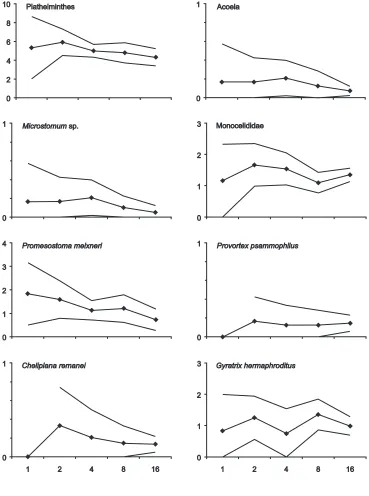
Within the tested range, aquarium size did not signifi-cantly affect emergence of plathelminths, copepods, and ostracods (H-test, P>0.1; Fig. 2). The smallest aquaria yielded the fewest plathelminths. Presumably, this is an artefact that does not refer to the size of the aquarium. Instead, the smallest aquaria had a wavy wall while all others had plain walls. Since many plathelminths (such as Cheliplana remanei, Fig. 2) may quite effectively ad-Fig. 1 Emergence from sediment cores varying in diameter. Num-ber per 10 cm2 of sediment surface area emerging from small
(2 cm2surface area) and large (10 cm2) cores, respectively
Table 1 Set-up of the “aquarium size” experiment (2 July 1997; samples collected on an intertidal sandflat at mid-tide level)
Treatment Aquarium volume Water volume Aquarium dimensions Water height Bottom area
(cm3) (cm3) L×W or diameter (cm) (cm] (cm2)
A 300 250 6.5 7.6 33
B 600 500 6.1×8.8 9.5 53
C 2,000 1,000 11.3 10 100
D 2,500 2,000 18×11.7 9.5 208
here to solid surfaces, a jet of water from a squeezing-bottle may have been ineffective in removing them from the wavy walls of the smallest aquaria. Therefore, smooth-walled aquaria should be used when dealing with specimens able to adhere to solid surfaces.
Varying the number of cores per aquarium did not af-fect emergence of plathelminth taxa (H-test, P>0.1; Fig. 3). In some taxa (e.g. Microstomum spp. and Pro-mesostoma meixneri) the numbers emerged per core show a (non-significant) tendency towards a lower effi-ciency in the treatments with a high number of cores. Presumably, this is a result of counting error. As an av-erage of 70 plathelminths emerged from the 16-core treatment, small and sluggish individuals are more like-ly to be missed than in treatments with fewer individu-als. In addition, predators such as Pseudograffilla are-nicola are more likely to find a victim. Thus, since aquarium dimensions did not affect emergence within the tested range, an aquarium size of 500 cm3 (e.g. a beaker) may be convenient for submergence of single cores while an aquarium capacity of 2,500 cm3was still handy for the simultaneous submersion of several sedi-ment cores.
Experiment III: height of the sediment cores
The vertical distance between the sediment surface in the core containers and the upper rim of these
contain-ers might also influence extraction efficiency. This dis-tance may either be reduced by using shorter containers or the sampled sediment depth may be varied. In the Wadden Sea, plathelminths occupy the top oxygenated sediment layer plus the uppermost zone impoverished in oxygen (Reise 1985; Scherer 1985). Depending on sediment composition and season, these zones vary in thickness between 1 mm and about 5 cm (excluding the more exposed beaches). However, emergent plathel-minths are usually restricted to the uppermost few mil-limetres of the sediment; thus sampling the top 1 cm would suffice to collect these species. Experiment III tested shallow cores against deeper cores that harbour no additional extractable fauna but leave less distance between the core surface and the rim of the core con-tainers (H0,1: emersion does not depend on the core height; including the anoxic sediment layer does not af-fect the percentage of specimens leaving the cores). In addition, cores placed into empty glasses were com-pared with cores of the same size which were placed in-to glasses previously filled with paraplast in-to half their volume (H0,2: emersion does not depend on the wall height between the sediment surface and the rim of the core containers).
Each treatment was replicated ten times (one core per aquarium, aquarium size 500 cm3). Treatment A cores included a 5 cm sediment layer (top 1 cm of oxygenated or micro-oxic sediment and 4 cm of black anoxic ment). Treatment B cores included the top 2 cm of sedi-Fig. 2 Meiofaunal emergence
ment only. Treatment C: as B, but filled into containers that were previously filled with melted paraplast to half their volume. The core containers were rolled-rim glasses 4.5 cm high with an inner diameter of 1.8 cm. The wall height between the sediment surface and the upper rim of the containers was 1 cm in treatment A, 3.0 cm in treatment B, and 0.5 cm in treatment C. Sam-ples were collected on 10 July 1997, from an intertidal sandflat at mid-tide level. Submersion (17 h) started im-mediately afterwards. Since this experiment gave signifi-cant results for copepods and ostracods but only a ten-dency for plathelminths, treatments A and B were repeated for the latter group using larger aquaria (2,500 cm3) equipped with five sediment cores each (14 July 1997).
Results
Most ostracods left the containers with the smallest wall height above the sediment (H-test, P<0.05) and there was the same tendency in copepods (H-test, 0.1>P>0.05). Comparing treatment A (top 5 cm layer of sediment) with treatment C (top 2 cm layer placed onto paraplast) indicates that the presence of the black sedi-ment layer did not influence emergence (U-test, P>0.05). Finally, there was no significant difference between the treatments in plathelminths (Table 2).
Repetition of treatments A and B with five sediment cores per aquarium showed that the height of the sedi-ment column is not important in most of the plathelminth species. Only Gyratrix hermaphroditus tended to emerge Fig. 3 Plathelminth emergence
in higher numbers from the higher cores (U-test, 0.1>P>0.05; Table 3).
Discussion
The sediment cores should fit tightly into the sediment containers leaving a small (and, if possible, constant) dis-tance between the sediment surface and the rim. The sedi-ment depth that needs to be sampled to include all of the (potentially) emerging specimens may vary with the habi-tat and the season. While this may not be a problem in muddy sediments, meiofauna may, at times, retreat deep into coarse sand such as beaches exposed to wave action. In this case the sediment column may be split into horizon-tal layers and the same may be done if the vertical distribu-tion in the sediment of the studied species is unknown.
Experiment IV: shape of the sediment containers
This experiment tested whether sediment containers with a straight vertical wall were superior to rolled-rim glasses (H0: the shape of the sediment containers does not affect emersion). The rolled rim glasses were 4.5 cm high and 1.8 cm in inner diameter while aluminium caps (3.0 cm high and 1.8 cm wide) were used as straight-walled ves-sels. Sediment samples were collected on 15 October 1997, from ten intertidal sites with medium, fine, or muddy sand. Each aquarium (ten replicates per treatment) was equipped with five sediment cores from one of the ten sites.
Results and discussion
Fitting the samples into aluminium caps instead of glass tubes significantly increased the numbers of ostracods
and plathelminths (ostracods, total=532 from aluminium caps versus 496 from glass vessels, sign test P<0.05; plathelminths 29 versus 20, sign test P<0.05). In part, this may be an effect of the smaller vertical distance be-tween the sediment surface inside the containers and their upper rim. However, the rolled rim of the glasses might also be a barrier for these organisms as they try to climb the vertical walls. Therefore, straight-walled ves-sels are recommended as containers for the sediment.
Experiment V: sample storage and the period of submersion
In a previous experiment, storage of the sediment sam-ples prior to submersion significantly increased swim-ming activity in some species (Armonies 1988c), possi-bly because of oxygen depletion during storage. On the other hand, species differ in the period needed to leave the sediment, which may be due to differential swim-ming frequency (Armonies 1988a, b, c). Experiment V tested the combined effects of storage (H0,1: storage of the sediment samples prior to submersion does not affect emersion) and the period of submersion (H0,2: prolonged submersion does not affect emersion).
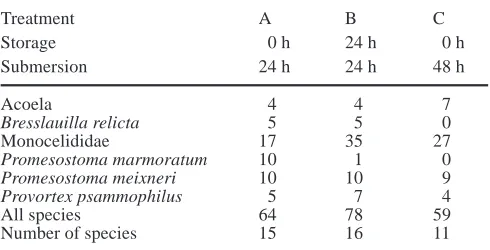
There were three treatments (each replicated six times using aquaria of 2,500 cm3 volume equipped with five sediment cores of 2 cm2each). Treatment A and C sam-ples were submerged for 24 and 48 h, respectively, with-out intermittent storage. Treatment B samples were stored for 24 h (20°C, darkness) prior to submersion for another 24 h. The sediment was collected along a tran-sect of six sites between low tide level and mid-tide level (25 August 1997) and each of the replicates received sediment samples from a different site.
Results
A comparison of treatments A and C indicates that a pro-longed period of submersion increased the abundance of juvenile monocelidids only (Table 4). Since some of them were very small, hatching from egg-capsules dur-Table 2 Emergence from sediment cores varying in height (mean
and (SD) of ten replicates)
Treatment A B C
Core height 5 cm 2 cm 2 cm/paraplast
Plathelminths 5.6 (1.8) 4.2 (1.7) 3.4 (2.5) Copepoda 9.4 (4.6) 7.8 (3.6) 13.4 (6.1) Ostracoda 107.0 (21.7) 82.6 (29.4) 128.0 (47.7)
Table 3 Plathelminth emergence from high (top 5 cm of ambient sediment) versus low (top 2 cm) sediment cores [means and (SD) per aquarium; only species with >ten individuals listed]
High cores Low cores
Promesostoma meixneri 2.1 (1.8) 2.2 (1.7)
Promesostoma caligulatum 2.8 (1.9) 3.7 (1.9)
Archilopsis spp. 16.4 (4.7) 16.8 (5.2)
Acoela 0.9 (0.9) 0.6 (0.8)
Gyratrix hermaphroditus 4.7 (4.9) 1.4 (1.5)
Cheliplana remanei 2.6 (2.0) 2.4 (1.5)
Provortex psammophilus 0.5 (0.5) 0.9 (0.9)
All species 30.7 (9.9) 28.9 (5.8)
Table 4 Plathelminth emersion after variable periods of storage and submersion. Totals of six replicates; only taxa represented by ≥10 individuals listed
Treatment A B C
Storage 0 h 24 h 0 h
Submersion 24 h 24 h 48 h
Acoela 4 4 7
Bresslauilla relicta 5 5 0
Monocelididae 17 35 27
Promesostoma marmoratum 10 1 0
Promesostoma meixneri 10 10 9
Provortex psammophilus 5 7 4
All species 64 78 59
ing the experiment cannot be excluded. On the other hand, prolonged submersion tended to decrease the abundance of Promesostoma marmoratum but did not re-sult in an overall increase in efficiency.
A comparison of treatments B and C indicates that storage of the samples prior to submergence did not sig-nificantly affect any of the plathelminth species (species-wise U-tests, all P>0.05). Thus, storage was not harmful, indicating that submersion does not need to be started immediately after sample collection. A 1 day delay is un-likely to affect the results.
Discussion
As the species living in the Wadden Sea need to be adapted to irregular short-term extremes of physical fac-tors, intermittent storage of the sediment samples for up to 24 h was not a problem. This facilitates the timing of sample collection because the samples may be collected during an evening low tide and stored until the next morning, thus avoiding night-work after the 24 h of sub-mersion. However, studying subtidal or tropical habitats, intermittent storage may no longer be possible.
A 24 h period of submersion may be equally suited for non-tidal regions and habitats with a diurnal or semi-diurnal tidal cycle. Since many species respond to either tidal cycles or dark/light-rhythms (e.g. Bell et al. 1988; Decho 1988) a shorter period of submersion is not rec-ommended unless specifically tested. A longer period of submersion might be useful in Arctic regions. However, as we observed that some plathelminth species with a boreal–arctic distribution were equally active in the Wadden Sea in winter as are species with a distribution in temperate regions in summer (personal observations), this may not be necessary.
Experiment VI: temperature during submersion
In previous experiments (Armonies 1988c) swimming activity in copepods and plathelminths correlated posi-tively with temperature, suggesting that submersion in a warm environment would speed up emersion. During these experiments a temperature of 20°C (±2°C) was used, which is close to the average sea water tempera-ture in the northern Wadden Sea in summer. Also when the ambient temperature increased to a record maxi-mum of 26°C in August 1997 (up to 32°C in the inter-tidal) the experimental temperature was kept at a con-stant level of 20°C; otherwise some species of plathel-minths may have become inactive by encystment (Armonies 1987) and thus cause underestimation of abundance. However, even 20°C might be a too high temperature as specimens are adapted to a much lower one during the cold season. Therefore, experiments VI and VII tested the effect of temperature during submer-gence of the samples, and previous sample storage, re-spectively.
The experiment on temperature effects during sub-mergence was run twice, first in October 1997, when the Wadden Sea had cooled down to 12°C, and second in March 1998, when ambient temperature reached 6°C again. The experimental temperatures tested were 10°C and 20°C in both cases (H0: increasing temperature does not affect emersion). Each treatment was replicated ten times using sediment cores of 2 cm2 submerged into aquaria of 500 cm3volume. The sediment came from ten different intertidal sites.
Results
Increasing temperature resulted in significant increases in plathelminth and copepod emergence in March (ambi-ent seawater temperature 6°C; Table 5) while there was only a slight increase of plathelminth and ostracod emer-gence in October (ambient sea water temperature 12°C). Thus, submerging the sediment cores in a rather warm environment accelerated emersion. On the other hand, considering plathelminths at the species-level there was no sign for a detrimental effect to any species.
Experiment VII: temperature during storage
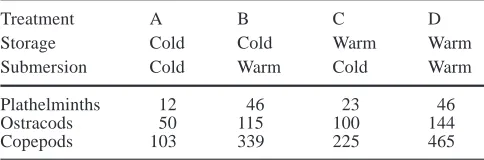
This experiment tested for possible effects of storage when the temperature is outside the ambient range (H0: temperature during storage does not affect emersion). Samples were collected on 30 March 1998, when the ambient seawater temperature was 7°C. There were four treatments varying in the temperature during storage and extraction. Treatments A and B were stored at 10°C, while treatments C and D were stored at 20°C. Tempera-ture during submersion was 10°C in treatments A and C, and 20°C in B and D. Each treatment was replicated six times using sediment from six different intertidal sites.
Results
In all taxa, emergence was highest in the samples kept in the warm throughout and lowest in the cold/cold combi-nation (Table 6). This is similar to the results of experi-ment VI. In plathelminths, storage of the samples in the cold did not affect emergence if succeeding submersion Table 5 Meiofaunal emergence during submergence in cold (10°C) versus warm (20°C) seawater (totals from ten replicates)
Season Cold Warm Sign test
Plathelminth abundance October 33 45 n.s. Plathelminth species number October 6 8 n.s.
Ostracods October 251 282 n.s.
Plathelminth abundance March 15 102 P<0.05
Plathelminth species number March 6 14 P<0.05
Ostracods March 51 56 n.s.
was in the warm (sign test, P>0.05). However, when submersion was done in the cold, significantly more plathelminths emerged from samples previously stored in the warm (sign test, P<0.05; Table 6). In copepods and ostracods storage of the samples in the warm signifi-cantly increased emergence (sign test, P<0.05) irrespec-tive of the temperature during submergence. Detrimental effects of the warm environment were not detected in any species.
Discussion
The results fit previous findings that meiofaunal popula-tions of the Wadden Sea intertidal generally show the highest abundance in summer. From this it is concluded that both storage and submersion should be done in quite a warm environment; the average summer temperature of the ambient water may be adequate. Possible effects of temperature increases beyond that level should be tested. However, the situation may be different in supra-tidal salt marshes and beaches because these habitats may harbour species with a more boreal–arctic distribu-tion which are adapted to lower temperatures. They be-come active when their supratidal habitats are flooded during storm tides in winter (Armonies 1987; Hellwig 1987). In such cases a lower temperature may be more appropriate.
Experiment VIII: efficiency of the method
Swimming activity of single species might vary with the sediment composition, the density of conspecifics, sea-son and tidal level. Therefore the overall efficiency of the method was tested by evaluating both the emergent fauna and the specimens that rested in the sediment after submergence (H0,1: emergence does not vary with the sediment composition; H0,2: emergence does not depend on the ambient density; H0,3: emergence does not vary with the season).
Sediment cores (1.6 cm in diameter and 3 cm height) were fitted into aluminium containers (1.8 cm in diame-ter and 3 cm high) leaving a vertical distance ≤5 mm be-tween the sediment surface and the upper rim of the con-tainers. Submersion in filtered seawater (one core per
aquarium of 500 cm3volume) started the day after sam-ple collection at 8.00 a.m. Intermittently, samsam-ples were stored in the dark (20°C). After submersion for 24 h, the sediment containers were removed and the emergent fau-na separated from the aquarian water by sieving. The fauna that remained in the sediment cores were extracted by a shaking–decantation procedure using seawater for the first six runs, then twice with fresh water, and final-ly 90% ethanol [methods combined from Noldt and Wehrenberg (1984) and Armonies and Hellwig (1986)]. In total ten sites varying in tidal elevation, exposure to wave action, and sediment composition were studied (Table 7, sites 11–20; five replicates per site). Half of the sites were studied in April 1998, when the Wadden Sea had warmed up to 6–8°C. The other five sites were stud-ied in July, when ambient sea water temperature was 14–16°C.
A second set of ten sites was studied using a slightly different method. Sediment cores (1.6 cm diameter, 5 cm deep) were transferred to rolled-rim glasses, experimen-tal submersion started immediately afterwards (i.e. no storage), and the period of submersion was 16 h only. In this set, the granulometric sediment composition was analysed from the pooled replicates (n=5) of any site (Table 7, sites 1–10) according to the procedures de-scribed by Buchanan (1984).
Results
On average over the ten sites, about half of all plathel-minths left the sediment cores during experimental sub-mergence for 24 h (equivalent to two semi-diurnal tidal cycles) and a quarter when submersion was for 16 h (in-cluding a single tidal cycle; Table 8). Most species showed the same tendency with respect to the period of submersion while the most active swimmers (Cheliplana remanei, Promesostoma caligulatum and Promesostoma meixneri) were notable exceptions (Table 8).
The percentage of all plathelminths leaving the sedi-ment did not correlate significantly with tidal level (Spear-man’s rank correlation coefficient, rs=0.224, n=10, P>0.1; Fig. 4). However, fine grained sediment (respectively, habitats with a low exposure to wave action) harboured significantly more emergent species (Spearman’s rank correlation coefficient, rs=0.665, n=10, P<0.05; Fig. 4).
Considering emergence from single cores, the per-centage of emerging plathelminths did not correlate sig-nificantly with ambient density (Spearman’s rank corre-lation coefficient calculated on all cores that harboured >1 individual; rs=–0.220, n=40 cores, P >0.05 for the 16 h submersion series; rs=+0.283, n=45 cores, P>0.05 for the 24 h submersion series). The same was true for single species; however, this may in part be due to low abundance. Therefore, density-dependent emersion can-not generally be excluded.
In the 24 h submersion series, five of the sites were studied in April and five in July. Using chi-square tests on 2×2 contingency tables (with the entities months, April or Table 6 Meiofaunal emergence from sediment samples either
stored cold (10°C) or warm (20°C) with subsequent submersion in the cold or warm (totals of six replicates from different intertidal sites)
Treatment A B C D
Storage Cold Cold Warm Warm
Submersion Cold Warm Cold Warm
Plathelminths 12 46 23 46
Ostracods 50 115 100 144
July, and residence after submersion, sediment or water; df=1) showed no seasonal differences in single species. Plathelminths as a whole, however, showed a significantly higher percentage emersion in July (Table 9). This was mainly caused by a higher abundance of Promesostoma meixneri which is one of the most active swimmers in this intertidal plathelminth assemblage.
Discussion
The percentage of emergent plathelminths varied with the species composition but not with tidal elevation, indicating
that emergent species do not differ in swimming activity throughout these intertidal flats. A few cores from the sub-tidal Wadden Sea, collected in August 1998, showed that emergent plathelminths and copepods occur down to a wa-ter depth of 30 m (which was the deepest site tested) while epibenthic ostracods occurred down to 10 m at least (per-sonal observations). However, the percentages of emergent specimens in the meiofaunal community was not evaluated in these subtidal sites. Similarly, emergence also occurred in supratidal salt marsh meiofauna when these marshes were flooded during a storm tide (personal observations). Thus, emergence is not restricted to intertidal areas. Table 7 Sampling sites for
Ex-periment VIII. Sediment gives the modal diameter of grain size in µm and tidal level refers to cm above mean low tide level (average tidal range is 180 cm). Exposition gives the relative influence of wave action; 1=low, 2=moderate, 3=strong
Site no. Habitat Sediment Tidal level Exposition Date
1 Sandy beach 334 110 3 24.07.1997
2 Sand flat 196 90 2 28.07.1997
3 Sand flat 203 80 2 30.07.1997
4 Sand flat 218 50 2 07.08.1997
5 Sand flat 164 30 2 10.08.1997
6 Sand flat 163 20 2 11.08.1997
7 Muddy sand 148 90 1 13.08.1997
8 Sand flat 262 150 2 14.08.1997
9 Sand flat 173 140 2 18.08.1997
10 Muddy sand 143 120 1 25.08.1997
11 Sand flat 0 2 24.04.1998
12 Sand flat 40 2 21.04.1998
13 Sand flat 90 2 23.04.1998
14 Sand flat 40 2 27.04.1998
15 Sand flat 90 2 27.04.1998
16 Sand flat 150 1 01.07.1998
17 Muddy sand 130 1 01.07.1998
18 Sand flat 50 2 07.07.1998
19 Sand flat 80 2 07.07.1998
20 Sand flat 110 2 07.07.1998
Table 8 Plathelminth emergence during 16 h (including one tidal cycle) or 24 h (two tidal cycles) of experimental submersion (n, totals and %, percentages from ten intertidal sites; only species with >10 individuals in at least one of the two sets)
Submersion period 16 h 24 h
n % n %
Acoela indet. 34 35% 47 74%
Acrorhynchides robustus 14 7% 21 24%
Bresslauilla relicta 3 33% 19 11%
Cheliplana remanei 11 91% 11 82%
Gyratrix hermaphroditus 50 40% 6 33%
Macrostomum pusillum 17 18% 8 63%
Microstomum cf. jenseni 25 60%
Monocelididaea 55 20% 93 54%
Neoschizorhynchus parvorostro 22 0% 29 0%
Paromalostomum dubium 4 0% 23 17%
Parotoplanidaeb 15 7% 5 80%
Pogaina suecica 19 74%
Promesostoma caligulatum 7 86% 21 81%
Promesostoma meixneri 13 85% 148 84%
Provortex psammophilus 22 9% 40 10%
Ptyalorhynchus coecus 5 0% 19 5%
Total plathelminths (54 spp.) 361 26% 590 52%
a Mainly Archilopsis arenaria
b Mainly Parotoplana papii and Parotoplanina geminoducta
With respect to sediment composition, emergent spe-cies were most abundant in sheltered habitats (with muddy sediments) and least in sandy beaches exposed to wave action (coarse-grained sediment; Fig. 4). However, pure mud (i.e. a sediment containing >50% of dry weight of particles <0.063 mm) does not occur around the island of Sylt, and therefore was not tested. There were no sea-sonal differences in emergence of single species; howev-er, as the community composition changed towards a higher percentage of active swimmers in July, total plathelminth emergence was higher in summer.
General discussion
A standard screening procedure for plathelminths in the Wadden Sea
Based on the results of experiments I–VII, the following “screening standard” is proposed for plathelminths in the Wadden Sea intertidal:
● Sediment cores of 2 cm2surface area and 3 cm depth are fitted into cylindrical containers.
● Submerge for 24 h into aquaria filled with filtered seawater of ambient salinity, at room temperature, in the dark.
● Remove the sediment containers after the submersion period, and filter the aquarian water through appropri-ate meshes. Study the emergent fauna immediappropri-ately af-terwards.
● If necessary, the sediment samples may be stored for up to 24 h before submersion; this should be done at room temperature. Use the same period of storage within a set of experiments.
Some experiments showed (statistically non-significant) trends in single species which may deviate from the average of the other species. Since only single or few factors have been tested in each of the experiments, the combination of such trends might achieve significant ef-fects, particularly when several factors strongly deviate from the above recommendations. As an example, pro-longing the period of storage and/or submersion in a warm room may result in oxygen depletion, causing emergence of specimens that would otherwise not leave
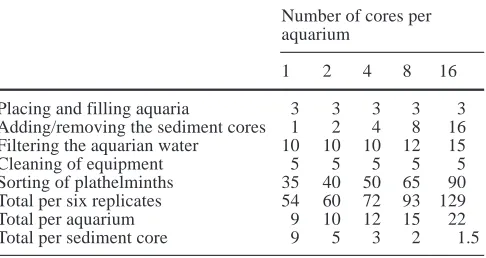
the sediment, or it might kill others. In addition, species interactions may change the faunal composition during submersion. As an example, plathelminth predators of the taxon Promesostoma (distributed world-wide in coastal waters) on an average consume 1–2 harpacticoids (or ostracods, depending on species) per day (Menn and Armonies 1999). Assuming typical intertidal abundances of these predators and their prey, prolonging submersion may reduce harpacticoid abundance by some 5% per day. Since several samples may be submerged into a single aquarium at a time, the replicates needed to compensate for small-scale spatial heterogeneity may be evaluated si-multaneously – provided that there is no need for an esti-mate of within-site variability. High core-number treat-ments are the most cost-efficient in terms of handling time (Table 10). For comparison, shaking–decantation ex-traction of plathelminths takes an average of 30 min per core, depending on the sediment composition. Thus, us-ing the proposed screenus-ing standard may estimate abun-dance in all replicates in the same time that is usually needed to handle a single core. However, this tenfold in-crease in efficiency is counterbalanced by a restricted subset of species.
Since emergence did not vary with tidal elevation or season (experiment VIII), species-specific factors might be calculated to correct for an extraction efficiency <100%. However, as emergence is influenced by a multi-tude of other factors (e.g. Armonies 1988a, b, c), caution is advised. In fact, the proposed “screening method” was designed to compare large-scale spatial distribution pat-Table 9 Seasonal differences
in plathelminth emergence.
N = total of specimens per
five sites (25 sediment cores of 2 cm2surface area), E% = percentage emersion during 24 h. Only species represented by >5 individuals per season, n.s.=P>0.05
April July
Taxon N E% N E% Chi2
Acoela 13 92% 34 68% 3.008 n.s.
Acrorhynchides robustus 7 43% 14 14% 2.100 n.s.
Bresslauilla relicta 13 15% 6 0% 1.032 n.s.
Microstomum cf. jenseni 13 46% 12 75% 2.163 n.s.
Monocelididae 35 51% 58 55% 0.123 n.s.
Paromalostomum dubium 11 18% 12 17% 0.009 n.s.
Promesostoma meixneri 18 83% 130 84% 0.003 n.s.
Provortex psammophilus 12 17% 28 7% 0.847 n.s.
Total of all species 185 43% 405 56% 9.402 P<0.01
Table 10 Time needed to separate plathelminths from the sedi-ment by the screening standard method (min per set of six repli-cates, estimated from experiment II)
Number of cores per aquarium
1 2 4 8 16
Placing and filling aquaria 3 3 3 3 3
Adding/removing the sediment cores 1 2 4 8 16 Filtering the aquarian water 10 10 10 12 15
Cleaning of equipment 5 5 5 5 5
Sorting of plathelminths 35 40 50 65 90 Total per six replicates 54 60 72 93 129
Total per aquarium 9 10 12 15 22
terns over a longer period of time. For this purpose, the number of emergent specimens may be an equally valid indicator of change as (absolute) density.
Modifications for other geographical areas or other taxa
The procedure suggested above is based on the physical conditions in the northern Wadden Sea. Studying other geographical areas it may require some modifications. The effects of intermittent sample storage and light should always be tested. A time series of submergence periods may be run if, for some reason, a 24 h period of submersion is not deemed adequate. Temperature and sa-linity effects should be tested if values outside the sea-sonal mean are used. After these experiments, the effi-ciency of the adapted procedure should be checked by counting both the emergent fauna and the fauna resting in the sediment after submersion.
While sediment composition did not affect plathel-minth emersion in the Wadden Sea, this may not hold true for other habitats or taxa. Particularly in copepods, swimming behaviour may vary over habitats (e.g. sand versus seagrass; Hicks 1986). Within habitats, emer-gence may vary with food concentration, intraspecific density, and age composition (Service and Bell 1987; Kern 1990), the latter may in part derive from differen-tial feeding habits of adults and juveniles (Decho and Fleeger 1988). Therefore, when including markedly dif-ferent habitats some extra experiments should be done to check for habitat-specific differences in emergence. Otherwise the number of emerged specimens may be a biased estimate of abundance.
References
Arlt G (1988) Temporal and spatial meiofauna fluctuations in an inlet of the south west Baltic (Darss-Zingst Bodden Chain) with special reference to the Harpacticoida (Copepoda, Crustacea). Int Rev Ges Hydrobiol 73:297–308
Armonies W (1986) Plathelminth abundance in North Sea salt marshes: environmental instability causes high diversity. Helgol Meeresunters 40:229–240
Armonies W (1987) Freilebende Plathelminthen in supralitoralen Salzwiesen der Nordsee: Ökologie einer borealen Brackwas-ser-Lebensgemeinschaft. Microfauna Mar 3:81–156
Armonies W (1988a) Active emergence of meiofauna from inter-tidal sediment. Mar Ecol Prog Ser 43:151–159
Armonies W (1988b) Hydrodynamic factors affecting behaviour of intertidal meiobenthos. Ophelia 28:183–193
Armonies W (1988c) Physical factors influencing active emer-gence of meiofauna from boreal intertidal sediment. Mar Ecol Prog Ser 49:277–286
Armonies W (1989) Semiplanktonic Plathelminthes in the Wadden Sea. Mar Biol 101:521–527
Armonies W (1990) Short-term changes of meiofaunal abundance in intertidal sediments. Helgol Meeresunters 44:375–386 Armonies W (1994) Drifting meio- and macrobenthic
inverte-brates on tidal flats in Königshafen: a review. Helgol Meeres-unters 48:299–320
Armonies W, Hellwig M (1986) Quantitative extraction of living meiofauna from marine and brackish muddy sediments. Mar Ecol Prog Ser 29:37–43
Armonies W, Reise K (2000) Faunal diversity across a sandy shore. Mar Ecol Prog Ser 196:49–57
Bell SS, Hicks GRF, Walters K (1988) Active swimming in meio-benthic copepods of seagrass beds: geographic comparisons of abundances and reproductive characteristics. Mar Biol 98: 351–358
Buchanan JB (1984) Sediment analysis. In: Holme NA, McIntyre AD (eds) Methods for the study of marine benthos. Blackwell, Oxford, pp 41–65
Coull BC, Feller RJ (1988) Site-to-site variability in abundance of meiobenthic copepods along a tidal gradient over 24 hours. Hydrobiologia 167/168:477–483
Decho AW (1988) How do harpacticoid grazing rates differ over a tidal cycle? Field verification using chlorophyll-pigment ana-lyses. Mar Ecol Prog Ser 45:263–270
Decho AW, Fleeger JW (1988) Microscale dispersion of meio-benthic copepods in response to food-resource patchiness. J Exp Mar Biol Ecol 118:229–243
Downing JA (1989) Precision of the mean and the design of ben-thos sampling programmes: caution revised. Mar Biol 103: 231–234
Fegley SR (1988) A comparison of meiofaunal settlement onto the sediment surface and recolonization of defaunated sandy sedi-ment. J Exp Mar Biol Ecol 123:97–113
Giere O (1993) Meiobenthology. Springer, Berlin Heidelberg New York
Hellwig M (1987) Ökologie freilebender Plathelminthen im Grenzraum Watt-Salzwiese lenitischer Gezeitenküsten. Micro-fauna Mar 3:157–248
Hicks GRF (1986) Distribution and behaviour of meiofaunal cope-pods inside and outside seagrass beds. Mar Ecol Prog Ser 31:159–170
Hicks GRF (1988) Evolutionary implications of swimming behav-iour in meiobenthic copepods. Hydrobiologia 167/168:497– 504
Hicks GRF (1992) Tidal and diel fluctuations in abundance of meiobenthic copepods on an intertidal estuarine sandbank. Mar Ecol Prog Ser 87:15–21
Kern JC (1990) Active and passive aspects of meiobenthic cope-pod dispersal at two sites near Mustang Island, Texas. Mar Ecol Prog Ser 60:211–223
Kern JC, Bell SS (1984) Short-term temporal variation in popula-tion structure of two harpacticoid copepods, Zausodes
are-nicolus and Paradactylopodia brevicornis. Mar Biol 84:53–63
Menn I, Armonies W (1999) Predatory Promesostoma-species (Plathelminthes, Rhabdocoela) in the Wadden Sea. J Sea Res 41: 309–320
Noldt U, Wehrenberg C (1984) Quantitative extraction of living Plathelminthes from marine sands. Mar Ecol Prog Ser 20: 193–201
Palmer MA (1988) Dispersal of marine meiofauna: a review and conceptual model explaining passive transport and active emergence with implications for recruitment. Mar Ecol Prog Ser 48:81–91
Palmer MA, Brandt RR (1981) Tidal variation in sediment densi-ties of marine benthic copepods. Mar Ecol Prog Ser 4:207–212 Reise K (1985) Tidal flat ecology. Springer, Berlin Heidelberg
New York
Reise K, Köster R, Müller A, Armonies W, Asmus H, Asmus R, Hickel W, Riethmüller R (1998) Austauschprozesse im Sylt-Rømø Wattenmeer: Zusammenschau und Ausblick. In: Gätje C, Reise K (eds) Ökosystem Wattenmeer: Austausch-, Trans-port- und Stoffumwandungsprozesse. Springer, Berlin Heidel-berg New York, pp 529–558
Service SK, Bell SS (1987) Density-influenced active dispersal of harpacticoid copepods. J Exp Mar Biol Ecol 114:49–62 Scherer B (1985) Annual dynamics of a meiofauna community
from the ‘Sulfide Layer’ of a North Sea sand flat. Microfauna Mar 2:117–161
Walters K (1988) Diel vertical migration of sediment-associated meiofauna in subtropical sand and seagrass habitats. J Exp Mar Biol Ecol 117:169–186