University of Pennsylvania
ScholarlyCommons
Publicly Accessible Penn Dissertations
Fall 12-21-2011
Perceptually Driven Simulation
Ben Sunshine-Hill
University of Pennsylvania, [email protected]
Follow this and additional works at:http://repository.upenn.edu/edissertations
Part of theArtificial Intelligence and Robotics Commons, and theGraphics and Human Computer Interfaces Commons
This paper is posted at ScholarlyCommons.http://repository.upenn.edu/edissertations/435 Recommended Citation
Perceptually Driven Simulation
Abstract
This dissertation describes, implements and analyzes a comprehensive system for perceptually-driven virtual reality simulation, based on algorithms which dynamically adjust level of detail (LOD) for entity simulation in order to maximize simulation realism as perceived by the viewer. First we review related work in simulation LOD, and describe the weaknesses of the analogy that has traditionally been drawn between simulation LOD and graphical LOD. We describe the process of "perceptual criticality modeling" for quantitatively estimating the relative importance of different entities in maintaining perceived realism and predicting the consequences of LOD transitions on perceived realism. We present heuristic cognitive models of human perception, memory, and attention to perform this modeling. We then propose the "LOD Trader", a framework for perceptually driven LOD selection and an online approximation algorithm for efficiently identifying useful LOD transitions. We then describe "alibi generation", a method of retroactively elaborating a human agent's behavior to maintain its realism under prolonged scrutiny from the viewer, and discuss its integration into a heterogeneous perceptually driven simulation. We then present the "Marketplace" simulation system and describe how perceptually driven simulation techniques were used to maximize perceived realism, and evaluate their success in doing so. Finally, we summarize the dissertation work performed and its expected contributions to real-time modeling and simulation environments.
Degree Type
Dissertation
Degree Name
Doctor of Philosophy (PhD)
Graduate Group
Computer and Information Science
First Advisor
Norman I. Badler
Subject Categories
PERCEPTUALLY DRIVEN SIMULATION
Ben Sunshine-Hill
A DISSERTATION
in
Computer and Information Science
Presented to the Faculties of the University of Pennsylvania in Partial
Fulfillment of the Requirements for the Degree of Doctor of Philosophy
2011
Supervisor of Dissertation
Norman I. Badler, Professor, Computer and Information Science
Graduate Group Chair
Jianbo Shi, Associate Professor, Computer and Information Science
Dissertation Committee
Jan Allbeck, Adjunct Assistant Professor, Computer and Information Science
Stephen H. Lane,
Acknowledgements
I am first and foremost grateful to my wife, Jessamyn, for her love and support. I could not
ask for a better friend, partner, confidante, listener, critic of ideas, recommender of books,
guide to physics and mathematics, or maker of pies. I am likewise grateful to the rest of
my family, and in particular to my parents (all of them), who kindled both the critic and the
dreamer in me.
I have been privileged to belong to the most interesting and lively lab in the department,
and am thankful to the colleagues who made it so: Jan Allbeck, Cory Boatright, Chris
Czyzewicz, John Drake, Pengfei Huang, Joe Kider, Aline Normoyle, Alex Shoulson, Damian
Slonegger, and Catherine Stocker. I couldn’t ask for a better group to bounce ideas and
paper drafts off of.
No man is an island, least so one who works in a graphics lab and can’t draw. I am
indebted to Grace Fong, Samantha Raja, Kaitlyn Reese, and Alice Yang for creating the art
assets used in my research. Without them, it would all be white boxes. I am also grateful to
the undergraduate and masters student programmers with whom I’ve worked most closely
over the years: John Drake (again), Jon McCaffrey, Rob Mead, and Ian Perera.
I am indebted to my many, many, many teachers over the years. My advisor at UPenn, Dr.
Norm Badler, has been an incredible source of wisdom and counsel, and his tireless work on
behalf of me and the rest of his students has been a priceless gift. And I am likewise indebted
of academic research, and instilling in me the valuable lesson that when something seems
impossible, the solution is usually to learn more math. And to Austin Ellis at EA, who
taught me so much about the practice of development in just a few months, and to Kevin
Dill and Dave Mark, who also guided my entry into the world of getting real stuff done.
And to so many others, but in particular Alan Kay, Steve Lane, Michel Melkanoff, Benjamin
Pierce, Alla Safonova, Stefano Soatto, and Lyle Ungar during my graduate education, and
very much in particular Mrs. Henderson, Mrs. Paolini, and Mrs. Swovelin, the high school
English teachers who gave me the skills that, by far, I use most.
It is staggering, and humbling, to look back upon how much these people have invested
in me, and how much of what I am – to my very core – is a result of that investment. And
perhaps ‘investment’ is the wrong word for it – no sane investor would stake so much on so
ABSTRACT
PERCEPTUALLY DRIVEN SIMULATION
Ben Sunshine-Hill
Supervisor: Norman I. Badler
This dissertation describes, implements and analyzes a comprehensive system for
percep-tually-driven virtual reality simulation, based on algorithms which dynamically adjust level
of detail (LOD) for entity simulation in order to maximize simulation realism as perceived by
the viewer. First we review related work in simulation LOD, and describe the weaknesses of
the analogy that has traditionally been drawn between simulation LOD and graphical LOD.
We describe the process of “perceptual criticality modeling” for quantitatively estimating
the relative importance of different entities in maintaining perceived realism and predicting
the consequences of LOD transitions on perceived realism. We present heuristic cognitive
models of human perception, memory, and attention to perform this modeling. We then
propose the “LOD Trader”, a framework for perceptually driven LOD selection and an
online approximation algorithm for efficiently identifying useful LOD transitions. We then
describe “alibi generation”, a method of retroactively elaborating a human agent’s behavior
to maintain its realism under prolonged scrutiny from the viewer, and discuss its integration
into a heterogeneous perceptually driven simulation. We then present the “Marketplace”
simulation system and describe how perceptually driven simulation techniques were used to
maximize perceived realism, and evaluate their success in doing so. Finally, we summarize
the dissertation work performed and its expected contributions to real-time modeling and
Contents
Acknowledgements ii
Abstract iv
1 Introduction 1
1.1 Of simulation and perception . . . 1
1.2 Perceptually motivated simulation . . . 2
1.3 The limits of realism discrimination . . . 3
1.4 Rationing computational resources . . . 4
1.5 Perceptually driven simulation . . . 5
1.5.1 Perceptual criticality modeling . . . 6
1.5.2 The LOD Trader . . . 6
1.5.3 Alibi generation . . . 6
1.6 Organization . . . 6
2 Related work 8 2.1 Level of detail . . . 8
2.2 Simulation level of detail . . . 9
2.2.1 Perceptual validation . . . 10
2.3 Behavioral level of detail . . . 11
2.3.2 The LOD membrane . . . 15
2.4 Presence . . . 16
2.5 Breaks in Presence . . . 17
3 Perceptual criticality modeling 19 3.1 The arithmetic of unrealism . . . 20
3.1.1 Independence . . . 20
3.1.2 Log-scaling . . . 21
3.2 Categories of unrealism . . . 22
3.2.1 Unrealistic state . . . 22
3.2.2 Fundamental discontinuity . . . 23
3.2.3 Unrealistic long-term behavior . . . 23
3.3 Unrealism and linear functionals . . . 24
3.4 Factor modeling . . . 26
3.4.1 Observability . . . 27
3.4.2 Attention . . . 27
3.4.3 Memory . . . 29
3.4.4 Duration . . . 31
3.4.5 Return time . . . 32
3.5 The criticality multiplier . . . 34
4 The LOD Trader 35 4.1 Proactive and reactive LOD . . . 35
4.2 The difficulties of reactive simulation LOD . . . 37
4.2.1 Heterogeneous resources . . . 37
4.2.2 Short- and long-term LOD selection . . . 39
4.3 Optimal resource allocation as a knapsack problem . . . 41
4.4 The trader analogy . . . 44
4.4.1 Benefits and penalties . . . 44
4.5 The environment of the LOD trader . . . 45
4.5.1 Specification of resources . . . 45
4.5.2 Specification of capabilities . . . 45
4.5.3 Enumerating feature solutions . . . 48
4.5.4 Costs, penalties, and transitions . . . 49
4.5.5 The cost multiplier . . . 51
4.5.6 Upgrades and downgrades . . . 51
4.5.7 Evaluating usefulness . . . 52
4.6 The design of the LOD trader . . . 54
4.6.1 Efficiently eliminating un-promising transitions . . . 55
4.6.2 Entity selection . . . 57
4.6.3 Downgrades . . . 59
4.6.4 Initial LOD assignments . . . 60
5 Alibi generation 61 5.1 Introduction . . . 61
5.2 Motivating example . . . 64
5.2.1 World schema . . . 64
5.2.2 Agent behavior . . . 65
5.3 Components of perceptual simulation . . . 66
5.3.1 Creating and deleting . . . 66
5.3.2 Alibi generation . . . 68
5.5 Alibi Sampling . . . 72
5.6 Results . . . 73
5.7 Drawbacks . . . 75
5.8 Integration with the LOD trader . . . 76
5.8.1 Cells as entities . . . 76
5.8.2 Cells as triggers . . . 77
5.8.3 Discussion . . . 78
5.9 Beyond pedestrians . . . 79
6 The Marketplace Project 82 6.1 Overview . . . 82
6.2 The simulation . . . 83
6.2.1 Architecture . . . 83
6.2.2 Graphics . . . 83
6.2.3 Behavior . . . 83
6.2.4 Navigation . . . 87
6.2.5 Animation . . . 87
6.3 LOD control . . . 87
6.3.1 EXISTENCE . . . 89
6.3.2 BEHAVIOR . . . 89
6.3.3 GOALPICKING . . . 91
6.3.4 INCIDENTALACTIONS . . . 91
6.3.5 NAVIGATION . . . 92
6.3.6 LOCOMOTION . . . 93
6.3.7 ACTION ANIMATIONS . . . 94
6.4 Tuning . . . 95
6.4.1 Measuring costs . . . 95
6.4.2 Tuning the criticality model . . . 96
6.4.3 Tuning audacity . . . 98
6.5 Alternative implementation . . . 99
6.6 Evaluation . . . 99
6.6.1 Performance testing . . . 99
6.6.2 Perceptual study . . . 101
6.6.3 Subjective evaluation . . . 103
6.6.4 Personal impressions . . . 105
6.7 Discussion . . . 105
6.7.1 Cascaded tuning . . . 106
6.7.2 Transition costs and penalties . . . 106
6.7.3 Costs and visibility . . . 107
6.7.4 Feature graph design . . . 107
6.7.5 Types of attention . . . 108
6.7.6 RAM and memory . . . 108
7 Conclusions 110 7.1 Future directions . . . 112
7.1.1 Black-box alibi generation . . . 112
7.1.2 Multi-horizon LOD planning . . . 112
7.1.3 Better criticality modeling . . . 113
7.1.4 Practical use . . . 113
List of Tables
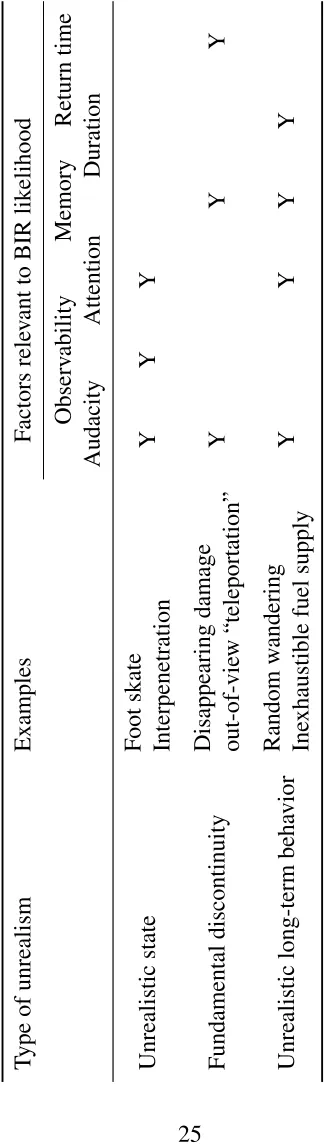
3.1 The different categories of unrealism, and the factors which affect the
likelihood that each will cause a BIR. . . 25
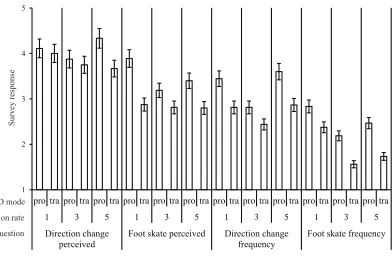
6.1 Perceptual study responses, on a five-point Likert scale, for the incidence
and frequency of BIRs from low LODs at different population rates and
with either the LOD trader (“tra”) or proactive selection (“pro”) controlling
LODs. Lower numbers are better. Error bars represent 95% confidence
List of Figures
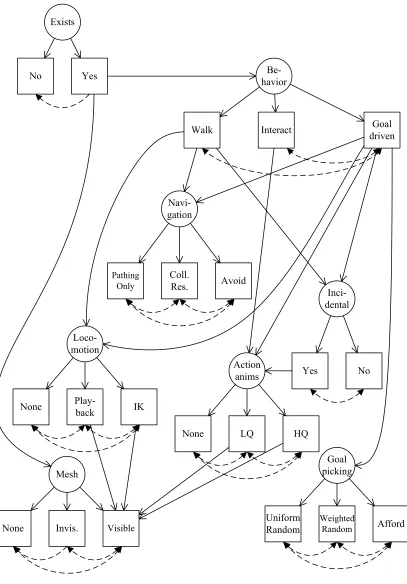
4.1 An example feature graph, with eight features. This feature graph has 252
feature solutions. . . 47
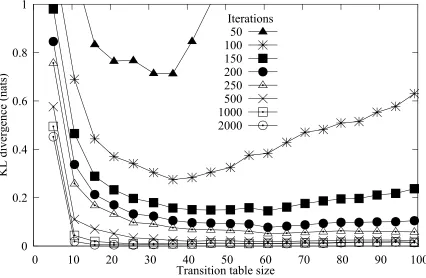
5.1 Kullback-Liebler divergence of alibi sampling versus ground-truth
probabil-ities, under varying Metropolis-Hastings transition table size and number of
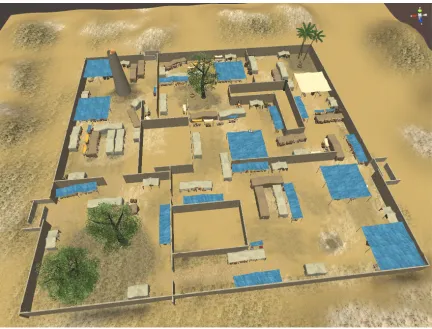
iterations. . . 74
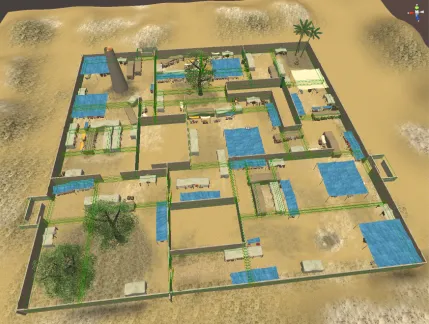
6.1 A birds-eye view of the Marketplace simulation environment. . . 84
6.2 Affordance sites, and the volume within which they are offered to agents, in
the Marketplace simulation environment. . . 86
6.3 Cells used for visibility testing and agent creation in the Marketplace
simu-lation. . . 88
6.4 Per-frame execution time during a 60-second flythrough of the Marketplace
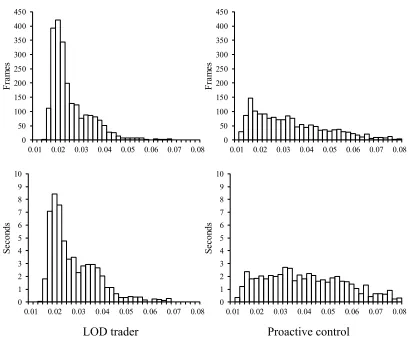
simulation, as a proportion of total frames rendered and as a proportion of
total simulation time. . . 100
6.5 A frame from one of the videos shown to participants in the perceptual study
List of Algorithms
4.5.1 FINDFEATURESOLUTIONS . . . 48
4.6.1 RUNLODTRADER . . . 54
4.6.2 MAKEEXPANSIONQUEUE . . . 56
4.6.3 EXPANDENTITY . . . 57
4.6.4 FILLTRANSITIONHEAP . . . 58
4.6.5 EXPANDREQUIREDENTITIES . . . 58
Chapter 1
Introduction
1.1
Of simulation and perception
Computer simulation has long proceeded along a viewer-agnostic trajectory.
That is, the role of a computer simulation has traditionally been to compute the complete
state of a simulated system at a particular time, given information about the complete state
of the system at some time in the past and rules for how the system must change over time.
From there, the state of system isvisualizedas needed: The information is processed into
graphics which can be perceived visually by a human participant. In scientific computing,
these visualizations are generally a compromise between the quantity and precision of the
information which can be presented, and the clarity and intuitiveness of the presentation.
The purpose is to enable the viewer to quickly discard irrelevant information about the
simulation state, while identifying and quantifying those bits of data which are of particular
importance.
The standard approach has been to make simulation independent of visualization: The
simulation produces, and the visualization consumes. Certainly this is true to reality: The
particular bits of it are important to the viewer.1 A user who desired realistic results from a
simulation would be justifiably suspicious if it turned out those results changed whenever
her back was turned.
1.2
Perceptually motivated simulation
However, for a certain class of simulations (of which video games are the largest and most
visible example), “realistic” is a very different sort of thing. First of all, the “realism” in
question may relate to how “realistically” the magic fireballs cast by an elf wizard affected
the zombies surrounding him – a topic on which the medical literature is curiously silent.
More to the point, however, the realism sought here isperceptual. The simulation must be
realistic not because some rocket engine being designed won’t work right if the answers
were wrong, but because a palpably unrealistic depiction of reality risks destroying the user’s
suspension of disbelief. Visualization is no separate concern here. The rules about what the
viewer sees when the simulated world is in a particular state are every bit as important as
the rules about how that world works. It can be safely assumed that objective realism is a
sufficient condition for perceptual realism.2 But is it a necessary condition? Clearly not!
As a simple example, it is a standard practice to break a video game world up intolevels,
with the user present in, and able to perceive, exactly one level at a time. The game doesn’t
bother to simulate the other levels. They are frozen in time until awakened by the player’s
arrival; awaiting their cues, like actors in a play, because it doesn’t matter how you act if
you aren’t on stage. For video games, this laziness is a matter of necessity. Taken together,
the demand for realism, and for large, open worlds, far outstrips the available computational
1At quantum scales, observing a system may indeed change its state, although what constitutes an
“observation” here is murky. Although quantum mechanics in some respects inform this work, the simulations considered here, as a rule, do not rely on the faithful simulation of quantum effects.
2That might be an oversimplification – stage magicians make a living by conjuring apparently unrealistic
power. Video games simply could not provide the necessary real-time experience, rendered
at dozens of frames per second, without this sort of culling.
1.3
The limits of realism discrimination
This compromise of realism in the service of performance may not even be a “compromise”
at all. Humans are not perfect, objective judges of realism. Recent behavioral studies have
demonstrated that people can be surprisingly insensitive to major, unrealistic changes in
their environment [Simons and Levin, 1998]. With that in mind, it is worth exploring two
distinct forms of perceptual realism.
On the one hand isideal perceptual realism, the quality of being indistinguishable from
real life to a viewer with perfect perception of detail, memory of past events, and statistical
analysis of the patterns of those events. This is distinguished from objective realism in
that the data that can be gathered by the world is limited by conventional human rules of
perception – at any given moment, the viewer is located at a particular point, looking in
a particular direction, and cannot gather direct data about anything not visible from that
perspective. This is an easy quality to pin down: The output of a perceptual simulation
possesses ideal perceptual realism if and only if there exists an objectively realistic simulation
which would produce identical output. For instance, consider a simulation of a parking
garage which showed only the entrance and exiting of cars. As long as the series of entrances
and exits were feasible (i.e. the garage was never over- or under-loaded with cars, the only
cars exiting were those which had previously entered, etc.) the simulation would possess
ideal perceptual realism, regardless of whether there were actually an assignment of cars to
parking spaces being simulated.
On the other hand ispractical perceptual realism, the quality of being indistinguishable
parking garage simulation no longer bothered to simulate the current inventory of parked
cars, instead only generating random car exits, at plausible intervals. The simulation would
no longer possess ideal perceptual realism, as before long, a car would exit which had never
entered. It being beyond the capacity of mere mortals to keep track of the full inventory of
cars based on entrances and exits, however, the simulation could be reasonably considered
to possess practical perceptual realism.
Practical perceptual realism is a much more difficult quality to pin down comprehensively,
because there’s no recourse to objective equivalence. Our only models of human cognition
are empirical. That is, the only way to verify that a simulation possesses practical perceptual
realism is to run human experiments. And a lot of human experiments, at that – a simulation
may be noticed as unrealistic only in a small percentage of runs (when the Wienermobile
happened to exit twice in a row3), or only by a small percentage of users (ones with unusually
apt memory), or only as a result of the user viewing the simulation from an unusual and
unexpected perspective (if the simulation was only intended to be viewed for a few minutes,
but the user decided to view it for three days and thereby was able to clearly discern that
the number of exits far exceeded the number of entrances). For a wide range of simulations
which do not possess ideal perceptual realism, it would not be possible to definitively prove
that they possessed practical perceptual realism.
1.4
Rationing computational resources
The real utility of defining practical perceptual realism is not to create an absolute test, but
to suggest a relative ordering. In any real-time simulation, computational resources must be
rationed – if it is possible to build a computer with more computational power than anyone
could possibly want, it has certainly not yet been done – and there are good and bad ways of
rationing computational resources. For example, consider a crowd simulation which has run
out of available memory, and must discard some people from the crowd in order to continue
executing. Should the victims be chosen randomly? To do so might introduce a serious loss
of realism, if one of the victims was nearby and fully visible to the viewer – people do not
generally disappear like this. Better to choose a faraway agent, hidden behind something or
out of the viewer’s frustum. The comparisons won’t always be apples-to-apples, though:
we may instead choose to reclaim the memory from some other area of the simulation, say,
by discarding the set of cars in a nearby parking garage. Better to lose this agent, or that
car? In other words, what is the relativeperceptual criticalityof different entities? Again,
defining “perceptual realism” does not by itself answer these questions, but it does provide
an ideal framework within which to tackle them.
1.5
Perceptually driven simulation
This dissertation presents a framework for “perceptually driven simulation”. A perceptually
driven simulation is a realtime simulation which rations computational resources in order to
maximize perceptual realism.
A perceptually driven simulation must have the ability to perform the following tasks:
1. Simulate an individual entity through multiple strategies, and during the simulation,
change which strategy is used to simulate an entity;
2. Estimate the importance of the individual entities for the viewer, and thereby the
probable effect of changing their simulation strategies on the realism of the simulation
as a whole; and
3. Coordinate the simulation strategies of all entities in order to maximize realism while
The framework has the following components, which will be explored in subsequent
chapters.
1.5.1
Perceptual criticality modeling
We have developed a system for estimating the expected impact of certain simulation
decisions on perceptual realism, based on simple heuristic models of human perception.
1.5.2
The LOD Trader
The LOD Trader is a system for dynamically changing the way in which different entities in
the simulation are simulated, in order to maintain an allocation of computational resources
which provides near-optimal realism.
1.5.3
Alibi generation
Alibi generation is a technique we have developed for transparently upgrading the realism of
agents in order to increase perceptual realism with a low computational cost. It provides two
simulation strategies for virtual human agents, and the means to transition between them.
We have integrated this technique into our perceptually driven simulation framework.
To evaluate this framework, we have developed the “Marketplace” simulation, which
uses these components to maximize the perceived realism of a virtual-reality simulation of a
crowded marketplace.
1.6
Organization
In the remainder of this dissertation, we will first review past work directly concerned
related work will be discussed in context. We will then describe the three components
of the perceptually driven simulation framework listed above. We will then describe the
“Marketplace” simulation, the process of integrating perceptually driven simulation into it,
and tests performed to determine how effective these techniques proved to be. Finally, we
will summarize the work performed, and its potential contributions to real-time modeling
Above all Siddhartha learned how to listen with a quiet heart, with a waiting, open soul, without passion, without desire, without judgment, without rebuke.
Herman Hesse,Siddhartha
Chapter 2
Related work
This chapter reviews existing work in perceptual simulation and simulation level of detail
(simulation LOD or SLOD).
2.1
Level of detail
It is difficult to pinpoint where work on simulation LOD began. From the earliest days
of computer graphics, the limited computational power of rendering systems1 required
aggressive optimization techniques to perform interactive-rate rendering. Clark [1976]
first introduced the concept of rendering different objects in a scene at different levels of
detail, depending on their apparent size. This concept was embraced by many commercial
rendering toolkits, and quickly became a standard element of interactive virtual reality
rendering [Luebke, 2003]. Granieri et al. [1995], among others, extended this concept
from still rendering to motion, using different articulation models to maximize the speed
of animating faraway characters without compromising the realism of nearby characters.
Because Granieri et al.’s characters used the output of their articulations to drive the motion
1At least, by modern standards. In thirty years, researchers to come will no doubt pity us our own limited
of their root positions, this could technically be seen as simulation LOD, with more detailed
articulations producing more nuanced paths. However, as all levels of articulation involved
playback of prerecorded motion clips, this was still simulation LOD only in the loosest
sense.
2.2
Simulation level of detail
Carlson and Hodgins [1997] first introduced real, rendering-decoupled simulation level of
detail to computer graphics. Their simulation consisted of a crowd of one-legged creatures
attempting to escape a “giant puck”. Each creature could be simulated dynamically (as a
driven articulated body with four torque-controllable degrees of freedom) with collisions
against rigid bodies in the world; via a hybrid model which displayed animations generated
by interpolating prerecorded joint motions but directly accelerating a point-mass
represen-tation of the creature, or by a simple, unarticulated model which likewise accelerated the
model as a point-mass but which did not synthesize joint motions and was therefore not
appropriate for simulating on-screen creatures. Carlson and Hodgins defined conditions
under which the LOD of a creature changed, based on both the immediate importance of
the creature to the rendered scene and the capability of the different simulation levels to
realistically react to the creature’s current state. For instance, because the point-mass models
were not capable of reacting to inter-object collisions, fully dynamic simulation was used
for creatures near a potentially colliding object. Other than that constraint, visibility and
distance were used to select LOD: Off-screen creatures were simulated as pure point-masses,
faraway visible creatures used the hybrid model, and nearby creatures used the fully dynamic
model. The camera distance used to choose between the dynamic and hybrid models was
chosen experimentally, but was not reactive to the simulation; the authors observed that
but did not discuss the automatic and dynamic selection of an optimal threshold. Their
results showed a great difference between the average and worst-case observed performance
with far thresholds, although they did not comment on this result. This difference implies
that with a far threshold distance, performance was determined largely by the population
of the area near the camera. There was, therefore, a significant potential for experience
improvements from dynamic threshold selection.
Much later work in real-time physical simulation likewise focused on modifying the
type or parameters of an object’s physical model by tracking the importance of the object
and/or the capability of different models to realistically react to current state. For instance,
Redon et al. [2005] adapted the detail in articulated dynamic characters in response to their
distance from the camera (although they mention this criterion for level selection only in
passing, concentrating instead on the mathematics of the joint simplification). Likewise,
Debunne et al. [2001] performed real-time deformation of volumetric bodies by dynamically
increasing the finite element resolution of areas of bodies undergoing more deformation
and reducing the resolution of areas of bodies at rest. Although camera distance was not a
factor in resolution adaptation, the increase in resolution in highly deformed areas led to
realistic haptic feedback, arguably the most appropriate measure of perceptual quality in
their application. Brogan and Hodgins [2002] built on the ideas introduced in [Carlson and
Hodgins, 1997] with a bicycle race simulation which more accurately predicts the ability of
a reduced-DOF controller to accurately model the outcome of the fully dynamic controller.
2.2.1
Perceptual validation
Dingliana and O’Sullivan [2000] developed an anytime collision detection algorithm which
could produce approximate results in a guaranteed time limit, and a collision reaction system
determine the perceptual consequences of different levels of collision approximation, thereby
qualifying the types of inaccuracies which were most likely to be perceived by participants;
this data could be used to tune the degree of approximation during simulation. O’Sullivan
and Dingliana were nearly unique in actually performing controlled testing on the
percep-tual effects of their approximations; most authors stopped short of perceppercep-tual validation,
concentrating instead on showing real-time performance at “good enough” accuracy levels.
2.3
Behavioral level of detail
Other work focused on behavioral rather than physical simulation. O’Sullivan et al. [2002]
developed the ALOHA system for real-time simulation of groups of human agents through
LOD adaptation. The ALOHA system encompasses rendering, physical, and behavioral
LOD. For instance, there are three levels of detail for conversations between agents: One in
which prerecorded sequences of dialogue and associated nonverbal behavior (e.g. gestures)
are performed, one in which nonverbal behavior is randomly generated while respecting
basic conversational rules (for situations in which agents can be seen but not heard), and
one in which nonverbal behavior is randomly generated and does not correspond to actual
communication. In [MacNamee et al., 2002], the technique of “role-passing” was integrated
into the ALOHA system. In role passing, a character’s (initially simplistic) behavior is
externally augmented in certain situations in order for them to realistically accomplish the
activities expected of them in certain roles. For instance, a character behind a bar could
assume the “bartender” role, with the behaviors specific to that role, and later doff the role
and be able to walk home without accidentally mixing anyone a drink. While not precisely
LOD in the classical sense, the authors made the case that externalizing roles in this manner
reduces the computational expense of characters on average by freeing them from even
Musse et al. [1999] enumerated discrete “levels of autonomy” to describe the ability of a
virtual human agent to successfully complete a goal with varying levels of input: “guided”,
indicating that the agent must be given explicit and exhaustive action instructions specific to
the situation; “programmed”, indicating that the agent is given an explicit and exhaustive
description of the goal but is capable of determining a set of actions to accomplish that goal;
and “autonomous”, indicating that the agent need only perceive the environment and will
determine goals and actions for itself. Although the authors did not approach these levels
as potentially on-the-fly substitutable, as conventional “levels of detail” would be, they did
discuss the types of situations in which different levels of autonomy would be necessary
or sufficient, and provided a formalism for externalizing intelligence from the agent to its
environment, a common component of high-performance human simulation [e.g. Brom
et al., 2007, Stocker et al., 2010, Kistler et al., 2010].
Niederberger and Gross [2005], drawing on the levels of autonomy described by Musse
et al., described a system for level of detail in human behavior. Each agent is assigned
an LOD depending on their distance and visibility, and this level determines how often
the agent’s simulator is invoked, how much time it has to complete, and whether it may
plan autonomously or must be managed by a higher level planner. From there, the system
determines what type of behavior is used. High-level agents use proactive planning and
are allowed to spend a long time searching for optimal plans, while low-level agents only
behave reactively, with their higher-level functioning driven by a grouped planner. This
system actively manages the total time spent on agent simulation, apportioning the total
time-slice based on LOD rather than independently assigning time-slices with no regard for
their sum. Although the selection of LOD is similar to that of other approaches, considering
only distance and visibility, the system does use a “nearly visible” zone which allows for
higher levels of detail for agents just outside the viewing frustum. The detection of nearly
no independent cost. The authors motivated higher levels of detail for nearly visible objects
“just to make sure that they really behave correctly.”
Kistler et al. [2010] and Wißner et al. [2010] described a city simulation and a beer
garden simulation, apparently branches of the same underlying project, which uses multiple
dimensions of behavioral LOD. At lower levels of detail2, the optimality of planned paths is
reduced, inter-agent avoidance is removed, update rates are reduced, and “some behavior is
dropped”. (There is additionally LOD applied to rendering, animation, and sound generation,
but these do not affect the ongoing state of the simulation.) Similar to [Chenney, 2001], large
and infrequent simulation steps are taken for out-of-view agents. A set of integrated levels
of detail is defined in the application, with each integrated level specifying the LOD along
all dimensions. The choice of integrated LOD is entirely determined by camera distance
and visibility.
Brockington [2002] described the behavioral LOD used in the computer role-playing
game Neverwinter Nights. In this multiplayer game (unlike earlier games by the same
developers), players can wander around the world independently rather than remaining
grouped tightly into the same area. Brockington developed five levels of behavioral LOD.
While distance from the (closest) player character is used to choose between two levels, and
a semantic view of game areas is used to choose within two others, levels of detail are also
chosen based on the current activity of agents: Those fighting or otherwise interacting with
a player character are given a higher LOD than those merely nearby a player character. At
lower LODs, characters move coarsely from tile to tile or directly to their destination, do
not execute random walks, and are allowed a lower percentage of the total computational
budget (with their simulation steps not invoked on every frame).
2The authors actually used “higher LOD” to refer toreducedlevels of detail, denoting full simulation as
Brom et al. [2007] developed a village simulation, noting in particular the simulation
of miners drinking in a pub. Agents draw their behavior from an “and-or tree” [Thornton,
2007], with atomic actions as leaves, and composite actions as and-nodes. Agent behavior
can be simplified by executing composite actions atomically. Additionally, a semantic
hierarchy is defined over the simulation area, allowing areas of the world to be collapsed
at low levels of detail; although agents can still perform actions, they do so in an abstract
manner. However, the agents themselves are never removed from the simulation as a result
of collapsing an area. Brom et al. made the unique observation that the viewer might not be
the only entity around which LOD should be high, suggesting that “important places” and
characters should create a halo of high LOD around them.
2.3.1
Non-comprehensive simulations
Some work focused on LOD in particular types of behavior, rather than human behavior
in general. Osborne and Dickinson [2010] demonstrated the hierarchical grouping of
flocking agents to minimize computational costs for faraway agents: Nearby agents are
individually simulated, while faraway agents are simulated in progressively coarser group
nodes. Although this technique drastically reduces the cost of simulation, the authors did
not explore the effect of different grouping thresholds on perceptual or objective realism,
and in fact did not so much as mention the consequences of grouping on realism. As such,
their results are not terribly useful.
Jan and Traum [2005] described an algorithm for simulating conversation between
background characters; this simple algorithm was intended for use as a low behavioral
LOD, as an alternative to earlier conversational models developed by the authors, but only
evaluated believability in a limited manner, and did not evaluate performance.
deadlocks, but suggest that in sparser areas a technique such as reciprocal velocity
obsta-cles [Van den Berg et al., 2008] could be used for more realistic individual agent paths, and
show that the two techniques can interact realistically in boundary areas. The choice of levels
here would be motivated by capabilities rather than perceptual importance. Going further in
this direction, Singh et al. [2011] developed a modular architecture for crowd simulation
which featured several steering algorithms, dynamically changing the steering algorithm on
a per-agent basis to minimize computational cost without compromising the quality of the
steering. Although distance from the viewer and other perceptual considerations were not
considered for algorithm selection in these projects, the basic architectures would support
that use.
2.3.2
The LOD membrane
The work of Brom et al. [2007] and that of Osborne and Dickinson [2010] share the concept
of an “LOD membrane”, a formalism for guaranteeing completeness when simplifying a
hierarchical simulation. An LOD membrane is a partitioning over the nodes of a tree into
simulated and non-simulated objects, such that:
1. The root is simulated.
2. Either all of a node’s children are simulated, or none of its children are simulated.
3. If a node is not simulated, none of its descendants are simulated.
This partitioning implicitly defines a set of “membrane” nodes, which are simulated but
whose children are not simulated. If these nodes are leaves, they simulate as normal for
a fully-detailed simulation. If they are not leaves, they are responsible for mimicking the
activity of their descendant nodes in an approximated fashion. Nodes which are simulated
certain bookkeeping operations but their simulation is primarily handled by their descendants.
This formalism guarantees that every leaf node has its activity handled by exactly one
membrane node, and membrane nodes can assume that none of their descendants are acting
autonomously. In [Osborne and Dickinson, 2010] the membrane nodes are the flocking
groups which act as a single agent; in [Brom et al., 2007] the membrane nodes are the lowest
non-collapsed spatial areas, within which agents act.
2.4
Presence
While many researchers have studied the perception of realism in the context of rendering
simplification [Luebke, 2003, chap. 9], few have studied it in the context of simulation (but
see subsection 2.2.1). However, a related concept, that ofpresence, has received considerable
attention. Lombard and Ditton [1997] describes presence as “an illusion that a mediated
experience is not mediated.” From a behaviorist standpoint, presence is a human state in
which the human’s reactions to mediated (that is, simulated under controlled circumstances)
stimuli are the same as that human’s reactions to the same stimuli would be in an unmediated
setting. The concept is applicable to virtual reality, telepresence, movies, books – any
medium in which stimuli are intended to be evocative, rather than merely descriptive, of a
specific unmediated experience.
Presence is a larger, more holistic concept than perceptual realism as described here. A
person viewing a simulation on a 9-inch monochrome monitor would feel less presence than
if she were to view it on a stereoscopic 60-inch full color display. However, her perception
of the realism ofthe simulation itself would be the same, or might even be higher for the
monochrome monitor (if the low fidelity covered flaws in the rendering). Perceptual realism
as described here is more analytic: The viewer, provided with sensory input, determines a
realistic, rather than judging whether the sensory input itself is realistic. Nevertheless, there
is obvious overlap between the two concepts.
The association of presence with telepresence and media studies (both of which involve
recorded and reproduced stimuli) has led some presence researchers to invent catalogues of
the determinants of presence which are not readily applicable to simulation; the determinants
focus on how accurately and vividly stimuli are reproduced, and how plausible recorded
actors’ behaviors are, but do not consider the situation where the world is entirely
computer-simulated. The models are not fundamentally incompatible, however.Social realism, the
feeling that other people encountered in a virtual environment are behaving in a reasonable
and consistent manner, is commonly mentioned as a determinant of presence. If one extends
the concept of social realism beyond social behavior to encompass the simulation of all
entities, the result is very much like perceptual realism.
2.5
Breaks in Presence
Slater and Steed [2000] introduced the concept of aBreak in Presence (BIP), a discrete
event in which a viewer transitions from feeling present in a virtual environment, to feeling
present in the real world.3 Many things can cause a BIP; the viewer noticing a particular
unrealistic event in the simulation is a sufficient but not a necessary condition. Though
discrete events in themselves, a particular BIP may not have a discrete external cause: they
can occur at unpredictable intervals, the products of unobservable mental processes, with
their frequency being partially determined by ambient external factors.
The subset of BIPs which have proximal external causes – and, further, causes relating
to the perception that the simulation is behaving in a realistic manner, are of importance to
perceptually driven simulation. We term theseBreaks in Realism(BIR), and discuss them
further in chapter 3.
As mentioned earlier, vividness of presentation can have opposed effects on presence
and perceived realism; and it seems clear that perceived realism has an effect on presence.4
It is unclear whether there is any causal force in the other direction – whether an increase in
a viewer’s sense of presence, from whatever source, affects the likelihood of BIRs.
4This effect may not be consistent or monotonic. Vinayagamoorthy et al. [2004], studying the effect of
The brain has its own language for testing the structure and consistency of the world. But we never see the machinery of logical analysis, only the conclusions.
Carl Sagan,Cosmos
Chapter 3
Perceptual criticality modeling
In this chapter we discuss the design of heuristic models to measure the relative potential
impact of per-object LOD decisions on the viewer’s overall perception of realism. The basic
question to be answered is, given an entity in the world and a potential event affecting how
the entity is simulated, “what is the probability that, if this event is made to take place, the
viewer would perceive the entity as unrealistic”? The potential consequence of the viewer
perceiving the entity – and, by extension, the simulation as a whole – to be unrealistic, is
abreak in realism(BIR).1An unrealistic event is one which has a nonzero probability of
causing a BIR event; an event which has a greater probability of causing a BIR than another
is more unrealistic than the other.
As we shall argue, estimating the impact of an entity’s LOD decision on the perceived
realism of a simulation involves evaluating both thea prioriunrealism of the LOD itself,
and the degree to which the viewer’s relationship with that particular entity can exacerbate
or mitigate that unrealism. We refer to this latter factor asperceptual criticality, and will
describe the space in which it exists and how it may be estimated.
1To be contrasted with a “break in presence” as defined by Slater and Steed [2000]. A BIR is a sufficient
3.1
The arithmetic of unrealism
3.1.1
Independence
We make the important simplifying assumption that BIRs caused by different entities are
independent random variables. That is, it assumes that if, in the event, the viewer perceives
entity A as unrealistic, the posterior likelihood of perceiving B as unrealistic does not change.
This assumption may be criticized on several fronts.
Sensitization. If a viewer experiences a BIR, this may cause her to be more alert to other
unrealistic entities, particularly similar ones. Noticing that a broken mailbox has been
mysteriously repaired, for instance, may sensitize her to notice other entities which
likewise are unexpectedly restored to their pristine state.
Location. Certain BIRs are dependent on the uncertain event of the viewer being able to
perceive them in the future, so BIRs of entities near each other in the world become
positively correlated. If and when a viewer experiences a BIR from a given entity, she
must be located near that entity, and therefore BIRs from entities nearby it become
more likely; likewise, BIRs from faraway entities become less likely.
Correlation. Two or more entities may be perceived as unrealistic due to the relationship
between them. For instance, if two blue mailboxes next to each other on the street
change to grey while the viewer is not watching them, the result may be less likely to
be noticed than if only one of them changes to grey and the other remains blue.
Of these potential dependencies, the first may be disregarded as long as the viewer does
not notice sources of unrealism to begin with. As the viewer noticing even a single unrealism
should be regarded as a failure of the system, the subsequent greater or lesser likelihood of
in section 3.2.2. It is unclear in what, if any, situations the third dependency would arise as a
result of LOD simplification, and in our opinion is unlikely to be encountered in the dseign
of a simulation LOD system.
3.1.2
Log-scaling
In our system, rather than working directly with BIR probabilities, we look at their negated
log inverse probability – that is,−log(1−p), the negated logarithm of the probability that a
source of unrealism isnotnoticed. This quantity (which we will refer to as the “log-scale”)
has the following properties:
1. 0is the minimum possible value in the log-scale, equating to p=0 in the linear scale.
2. The sum of log-scale values for two unrealistic events is equal to the log-scale of the
probability thatneitherevent causes a BIR, assuming the independence criterion from
section 3.1.1.
3. Multiplying a log-scale value by a nonnegative real numbernproduces the log-scale
of the probability that none ofnindependent copies of the event cause a BIR.
The first two properties make it possible to determine the “total unrealism” of a simulation
through a simple summation. The third allows us to assign mathematical meaning to a
phrase such as “twice as unrealistic”; one event isntimes as unrealistic as another if getting
away with the first event is as likely as getting away withncopies of the second event. (n
need not be an integer.) This interpretation is better behaved than operating directly onp: it
means that an event which is “twice as unrealistic” as some event which would be noticed
50% of the time, need not be noticedallthe time, and it does not restrict us from describing
an event as, say, “three times as unrealistic” as some event which would be noticed 50% of
3.2
Categories of unrealism
In order to determine the likelihood of a BIR, one must first decide what situations can give
rise to a BIR. Under ideal circumstances, these situations are undesirable but not unexpected:
they are the known consequences for LODs which have lower computational resource
requirements relative to higher-fidelity LODs. We have identified the following categories of
unrealism, which are not intended to be exhaustive but are intended to be nearly exhaustive
of realism that might be created in the service of increased performance:
3.2.1
Unrealistic state
In this category, the immediately and directly observable state of an entity, or the directly
observed propagation of that state over a short period of time, would be unlikely or
impos-sible in real life. Two pedestrians occupying overlapping positions in space, or a vehicle
traveling without its wheels turning, could cause a BIR of this sort. This category has direct
analogues in graphical LOD: If an object is rendered at a detail level which is not perfectly
indistinguishable from highest detail at its current draw distance, its state is unrealistic.
Likewise, if a character is animated with a low-quality skeleton at a distance which allows
the discernment of its joints, its short-term behavior is unrealistic.
The probability of a BIR from unrealistic state is affected by the audacity of the unrealism
(the degree to which it is distinct from any likely or possible state), the observability of
that portion of the state which exhibits the unrealism, and the attention which the viewer
is paying to that exhibited state. In comparing BIR probabilities between heterogeneous
entities, it is likely that the first factor can only be determined empirically.2
2Attentional factors also play a part in visual fidelity metrics, as an entity which the viewer is watching
3.2.2
Fundamental discontinuity
In this category, an entity’s current state is perceived as being incompatible with its observed
state in the past. For example, a mailbox which the player had earlier crashed into being later
observed as undamaged could cause a BIR of this sort. As another example, a pedestrian
who, after temporarily being out of view, had traveled a distance which was patently
incompatible with their walking speed. This category does not focus on situations where the
discontinuity occurs while the entity is being continuously observed; those situations are
adequately covered by the previous category. For this sort of BIR to occur, the viewer must
draw on her recollection of past observations. The probability of a BIR from fundamental
discontinuity is proportional to the audacity of the discontinuity, the degree of recollection
of prior observations, and the expected attenuation of memory upon return to the entity
(which is, in turn, dependent on the amount of time before that return).
Because this type of BIR is predicated on an uncertain future return to an entity, it is
susceptible to compromising the assumption of independence described in section 3.1.1,
by introducing positive covariance for memory attenuation for entities near each other, and
negative covariance for entities far from each other. Our model for expected return time does
not take physical location as input, and so sidesteps this issue. A more elaborate system
could estimate fundamental discontinuity on a spatial basis instead of a per-entity basis,
but this would not be appropriate for moving entities and, in our opinion, would not yield
significant marginal benefits.
3.2.3
Unrealistic long-term behavior
In this category, an entity’s behavior is perceived as realistic in the short term, but observing
it for a sufficient quantity of time demonstrates unrealism. A pedestrian who is forever
cannot cause a BIR of this category based on only a short period of observation. Likewise,
a car which never runs out of fuel becomes unrealistic only if the viewer follows it for
several hours. This type of BIR has no analogue in graphical LOD, though weak parallels
may be drawn with impostor-based rendering. This category is distinct from fundamental
discontinuity in that it can (though does not necessarily) result from continuous observation
of an entity.
The factors of the likelihood of a BIR from unrealistic long-term behavior are similar to
those of fundamental discontinuity, but include the duration of continued observation of the
entity.
The different categories of unrealism are summarized in table 3.1.
3.3
Unrealism and linear functionals
The various factors of BIR probability listed in table 3.1 may be broadly separated into
two categories. The first, consisting of the “audacity” factor, contains properties of the
event itself, rather than the viewer; the second, consisting of “observability”, “attention”,
“memory”, and “duration”, are products of the viewer’s situation and his relationship to the
entity associated with the event – thecriticalityof that entity. If the viewer’s observability
of an entity increased, we would expect the BIR probability for all BIRs associated with
that entity to increase in equal proportions. Conversely, if a viewer had equal observability
and attention factors for two different entities, we would expect two unrealistic state events
with the same audacity, one for each entity, to result in equal BIR probabilities.
This leads to an elegant mathematical model of BIR probability. If the audacity factors
for the three categories of unrealism from a single event are gathered into a column vector,
and the criticality factors for the categories of unrealism as induced by the current state of
two vectors is the total BIR probability of the event. In this model, the audacity vector of
an event is fixed for all instantiations of that event and independent of the specific viewer,
and a particular criticality induces a positive linear functional over the audacity vector space
which is independent of the particular events taking place. We refer to this functional as a
“criticality multiplier”.
For instance, consider a human entity who has just approached the viewer and asked
her for directions, before being momentarily obscured by a passing door. Attention and
return time factors are high, and memory and observability factors are low. This leads
to a high probability of BIRs from unrealistic state, and a low probability of BIRs from
fundamental discontinuity or unrealistic long-term behavior. An event which is audacious
as to unrealistic state only, such as the entity’s animation being temporarily frozen, will lead
to a low BIR probability overall, while an event which is audacious as to both unrealistic
state and fundamental discontinuity, such as the entity’s face changing to someone else’s
face, has a somewhat higher BIR probability (though still low, because of the low memory
factor). If, on the other hand, the viewer has been conversing with the human entity for
several minutes before the events occur, the frozen animation event will still lead to a low
BIR probability but the face changing event will lead to a high BIR probability, without any
need to change the audacity vectors for the two events.
3.4
Factor modeling
In this section, simple computational models for the various non-audacity factors involved
in criticality modeling are derived. These models are not intended to be precise; are based
on simple, informal reasoning about the underlying processes, with only occasional recourse
to settled science; and have only informal empirical support. They are intended to be simple
More detailed models may be substituted, e.g. the inattentional blindness model of Gu et al.
[2005] or the ACT-R declarative memory system [Douglass et al., 2009].
3.4.1
Observability
Observability is the property of being capable of being observed, as opposed to the property
of actually being observed. As a result, it may be confidently estimated based purely on
output from the renderer. An entity which is not on-screen, either because it is outside the
viewing frustum or because it is hidden by an occluding object, has an observability of 0.
An entity which is on-screen and subtends a large enough proportion of the screen to have
its details clearly visible, has an observability of 1. Visible but faraway entities present the
only real difficulty for quantifying observability. We take the simple expedient of measuring
the solid angle subtended by unoccluded portions of an entity, a quantity which is roughly
proportional to the number of pixels in which the entity can be found. Above a certain
solid angle (the “saturation angle”), the entity is considered “visible enough” to be fully
observable; beyond that distance the observability is proportional to the solid angle:
Oi =
Ωi
Ωsat ifΩi <Ωsat,
1 ifΩi ≥Ωsat.
(3.1)
3.4.2
Attention
Modeling attention is an important aspect of criticality modeling for two reasons. First,
scrutiny of an entity’s realism increases with attention. Simons and Chabris [1999] found
that subjects who were shown a video of several people playing with balls, and a gorilla
unexpectedly walking across the scene, were less likely to notice the gorilla if they were
concentrating on a challenging cognitive task related to the people playing with balls.
memorization should take expected attention into account to the extent that it depends on
initial encoding strength.
Human attention is a limited resource. A viewer watching a crowd of one hundred
people will be less likely to notice a single person’s momentary unrealistic behavior than if
she was watching a single person. It is tempting, therefore, to model attention as a constant
which is divided among the entities in a simulation. At the same time, however, human
attention is not a fixed quantity: A person performing an unchallenging cognitive task, such
as watching a colored dot and waiting for it to change color, will not have their performance
drop to half if a second dot is added. A simple model to account for these phenomena is the
addition of a constantambient attentional loadbefore normalizing. This quantity represents
that portion of the viewer’s intellect which is not devoted to any entity in the simulation. For
some per-entity indicator of attempted attentionAˆi, theeffective attentionAi given to an
entity is then
Ai = ˆ Ai
L, where total attentional loadLis (3.2)
L= ˆAamb + n
X
j=1
ˆ
Aj. (3.3)
This behaves reasonably: For a small number of low-attentional-load entities, total
at-tentional load is largely taken up by ambient atat-tentional load. As the number of entities
increases, per-entity effective attention decreases, but the total proportion of attentional load
taken up by entities in the simulation increases.
It remains to model the input to this equation. Our model of attempted attention primarily
draws on an exponential moving average of observability as an input. Certain behaviors,
however, may be taken as indicative of increased attention:
• Following, in which the viewer manipulates the viewing position in order to limit the
distance to the entity.
Time-averaging is likewise used to typify these behaviors. The degree of focusing is
determined as an exponential moving average of the cosine of the angle between the viewer’s
forward-vector and a ray connecting the viewer to the centroid of the entity, modulated by
observability. Similarly, the degree of following is determined as an exponential moving
average of the distance between the viewer and the entity (saturated to a particular maximum
range), also modulated by observability. The total attempted attention for an entity is the
sum of these three factors, linearly weighted by empirically determined constants and with
decay factors for the exponential moving averages also empirically determined.
3.4.3
Memory
Although no precise, comprehensive description of the structure and operation of human
memory has yet gained wide acceptance, many memory researchers have proposed
math-ematical models to predict and explain the performance of experimental participants in
memory tests. Of the various memory tasks commonly studied, one of the most relevant for
this area is that ofassociative recognition. Associative memory tasks call for participants to
memorize associations between pairs of items in a study list. The most common associative
task is known as thecued recallorpaired associatetask, in which participants are shown
one item from a pair of items from the study list and asked to respond with the other item
from the pair. In the associative recognition task, in contrast, participants are shown either a
pair of items drawn directly from the study list (anintact pair, ortarget) or a pair of items
created by combining items from two pairs from the study list, but which did not occur
together in the study list (arearranged pair, orlure), and asked to respond whether the pair
hit, and a lure item incorrectly recognized as a target item is afalse alarm.)
Item recognition tasks are well-described by adual-process model, which describes two
strategies by which a participant can successfully recall a target item:familiarity, in which
the participant feels that they “know” that the item was on the study list, andrecollection, in
which the participant “remembers” the experience of studying the item [Yonelinas, 1994].
Yonelinas [1997] found that although both processes are required to account for observed
performance on item recognition tasks, associative recognition draws almost exclusively
on recollection. Moreover, in the case of associative recognition tasks, recollection has a
second effect which is not found in item recognition tasks: A participant may recognize a
test pair as a lure by recalling the original intact pair which was modified to produce the
lure.
A well-known effect in human memory performance isretroactive interference(RI),
whereby a participant’s ability to remember studied material is reduced if they study other
material in the interim between the original material and the test of that original
mate-rial [Britt, 1935].3 RI is maximized if the interpolated material is similar to the original study
material. Many studies have demonstrated RI in cued recall tasks, but have generally failed
to demonstrate a significant RI effect in associative recognition. Verde [2004], however, has
proposed that this is due to RI causing opposed effects for recognition, reducing recollection
but increasing familiarity. This hypothesis predicts that RI increases false-alarm rates, which
was borne out by studies performed by Verde.
In the case of fundamental discontinuities, associative recognition provides a reasonable
model for the cognitive task undertaken by viewers. An association between an entity’s
identity (“the mailbox at that location”) and its state (“dented”) is memorized. Later, the
participant is shown either the same identity/state pair, or one with the same identity but
3Proactive interference, whereby a participant’s ability to remember studied material is adversely affected
modified state (“not dented”), and asked to determine if the pair is intact. The goal of
criticality modeling here is to determine the false-alarm rate – that is, to quantify the
probability that the participant will “accept” the rearranged pair. RI will increase this
probability, particularly RI from similar items.
We have developed a simple model for memory estimation, based on exponential decay
of the estimated memory of the viewer for an entity towards the current estimated attention
for that entity. Two decay rates are used: α for increasing estimated memory, andβ for
decreasing estimated memory. The latter rate is multiplied by the current total attentional
load, representing retroactive interference.
dMi dt =
α(Ai−Mi) ifAi > Mi
βL(Ai−Mi) otherwise.
(3.4)
αcontrols the rate of memorization;βcontrols the rate of forgetting. The parameters are
chosen such thatα βLfor reasonable values ofL, such that estimated memory tends
towards the maximum recent attentional estimate for the entity.
An important consequence of this model is that the fractional fall-off of memory of
an entity over time, assuming zero ongoing attention for that entity and a constant total
attentional load, is given by
Mi(t+ ∆t) Mi(t)
=e−βL∆t. (3.5)
3.4.4
Duration
The duration factor represents the quantity of separate observations which, taken together,
reveal unrealistic behavior. It may be simply represented as the sum of attention, modulated
by observability, over time:
dDi
3.4.5
Return time
Fundamental discontinuity events are unique in that the unrealism they create is not
experi-enced immediately, but is deferred until the viewer next perceives the entity. As such, in
order to quantify the probability of a BIR from fundamental discontinuity, it is necessary
to estimate the expected memory of the viewer for the entity not at the time of the event
but at that later meeting. We assume that only the next time the viewer returns to the entity
is significant for an LOD decision. Assuming no BIR occurs, the entity’s new state will
thereafter be the most recently observed state for that entity, “removing” the discontinuity
by bringing the viewer’s expected expectation of the entity’s state back into agreement with
the entity’s actual state.4
Analyzing the expected amount of time (“lifetime”) which passes between the beginning
of a period and the occurrence of a particular event is known assurvival analysis. (The
occurrence of that event is known as a “failure”.) A lifetime probability distribution induces
a particularhazard function, the momentary event rate at a particular age, conditioned on
survival up to that age.
The lifetime distribution can be used along with a function relating the lifetime to the
subsequent expected “reward” (resultant BIR probability). The distance between the viewer
and the entity places a lower bound on the time to return to a point from which the entity
may be observed. For a lifetime distribution functionF(x)and an expected reward function
R(x), if it has beent0units since the viewer last encountered the entity, the expected reward
is
E[R|t > t0] =
Z ∞
t0
F0(t)R(t)dt 1−F(t0)
.
Although many probability distributions can be used to describe the lifetime of a survival
4This assumption is supported by the Comprehensive Holographic Associative Recall Model (CHARM)