DEVELOP TRANSPORT LAYER
PROTOCOL FOR SENSOR NETWORK
Lalita Yadav*, Dr. S.S. Riaz Ahamed**
*Research Scholar in Computer Science, Research and Development Centre, Dravidian University, Kuppam, AP, India-517426
** Principal/Director, Sathak Institute of Technology, Ramanathapuram, Tamilnadu, India. Email: [email protected], [email protected]
ABSTRACT
In recent years there has been a growing interest in Wireless Sensor Networks (WSN). Recent advancements in the field of sensing, computing and communications have attracted research efforts and huge investments from various quarters in the field of WSN. The various areas where major research activities going on in the field of WSN are deployment, localization, synchronization, data aggregation, dissemination, database querying, architecture, middleware, security, designing less power consuming devices, abstractions and higher level algorithms for sensor specific issues, the locally distributed solution SeToMCaD seems to provide some features that increases the network lifetime, thanks to the execution of the Sec-TMP, and it improves the protection against insider attackers, thanks to the capture detection protocol. While, among the bio-inspired solutions the most secure solutions seem the Uniform/Weighted Result Selection. In fact, in the Uniform/Weighted TMP Selection solutions, an eavesdropper can understand which protocol is used by node u during the state-transition tests. After node u has selected a protocol P, it only executes the tests of P, thus listening to the node communication an adversary can infer the protocol P that u is executing. On the contrary, with the Uniform/Weighted Result Selection solutions, a node u executes the tests of all the protocols and after the tests, node u chooses which protocol to comply with. In these solutions, the adversary cannot infer the TMP protocol used by node u for its state-transition decision before the transition itself takes place. This bio-inspired proposals are an initial foray into the design of secure TMP based on Bio-Inspired systems.
Keywords: Wireless Sensor Networks (WSN), Topology Maintenance Protocols (TMPs)
1. INTRODUCTION
The innovative enhancements have as of late made the arrangement of little, low-control, reasonable and dispersed gadgets, which can have neighborhood handling and wireless correspondence. Such gadgets are known as sensor nodes. Every sensor hub is able to do just a particular measure of handling, yet when coordinated with the data from a tremendous amount of different nodes, they can quantify a given physical condition in enormous detail. Differentiating to the conventional networks, sensor networks rely on upon the extraordinary organization and co-appointment to do their given errands.
Prior, the sensor networks have modest number of sensor nodes that were wired to a focal handling station. Be that as it may, these days, the concentrate is given more on the appropriated, wireless, detecting nodes. Likewise, in numerous different cases, the various sensor nodes are expected to conquer the natural snags like deterrents, observable pathway limitations, and so on. Much of the time, nature which is to be observed does not have a current framework for both of the vitality or correspondence. Along these lines it winds up noticeably basic for the sensor nodes to make due on little, limited vitality sources and after that impart through a channel of wireless correspondence.
is the main security requirement as the confidentiality deals with the confidential or the important data. It deals with the situation in which the data is not disclosed to the third party is between the two party and don’t get exchanged by others as we already discussed it is the most requested application of the WSN. It is easy to the attacker to exchange the data during the transfer of confidential data so, for these problems there are many techniques to handle it like we can apply cryptography.
In the cryptography we can hide the data in the form of image, audio, video etc.in this we use asymmetric cryptography. Basically the asymmetric cryptography is special choice as it completely hides the data from the third party. So that the data remains confidential and secure.
Authentication is the process of identifying whether the user which is getting information is the correct user or not. Basically it authenticates the identity of the both end-users. This property is also attained by the use of the asymmetric cryptography. Sometimes the asymmetric cryptography is not affordable in confidentiality security requirement. Therefore than we have use the symmetric cryptography which is compulsory whether we use asymmetric cryptography or not. Authentication is the process of identifying whether the user which is getting information is the correct user or not. Basically it authenticates the identity of the both end-users. This property is also attained by the use of the asymmetric cryptography.
2. REVIEW OF LITERATURE
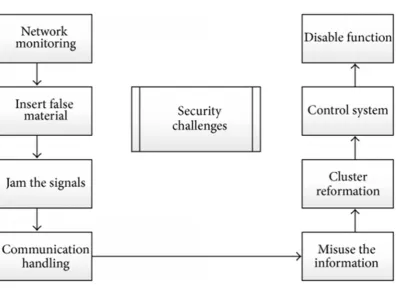
Various combinations of procedures have been foreseen in the written work to postpone the future of a WSN. A portrayal of these systems is addressed in [4]. There are traditions, as [24, 37, 43], that depends either on the changing and modifying the transmission vitality of each and every hubs, or on the geometrical structure-based procedures remembering the ultimate objective to pick the accompanying hop neighbors. Now days WSN are in the peak of its use, Each application of Wireless Sensor Network play a major role. Now days WSN are in the peak of its use, there is the widely use of WSN in different- different applications. Each application of Wireless Sensor Network play a major role. As we all know that if there is a progress its means higher security need. WSN is cannot made by without security as if the WSN is without security than the theft of network and data is possible and there is also a chances that an adversary compromise the functioning of network. In the wireless sensor network the data is stored in the sensor itself if the surety is not given to WSN their will definitely the loss and theft of the confidential data.it includes:
FIG 1: challenges of security
Encryption requires an extra processing memory and battery. Secure asymmetric keys requires more completion as we already described that the asymmetric cryptography is not affordable in confidentiality security requirement. Therefore than we have use the symmetric cryptography which is compulsory whether we use asymmetric cryptography or not. Although the sensor location information are important most of the current proposal are static for the WSNs. The third usage circumstance which is regularly analyzed for the sensor systems is the accompanying of a named address. There can be various conditions where one might need to track the scope of critical assets or personnel. Current stock control structures attempt to track dissents by recording the last checkpoint that a question experienced. Moreover, with these systems it is hard to find the present region of a question. For example, UPS tracks each and every shipment by inspecting it with an institutionalized ID at whatever point it experiences a coordinating core interest.
The structure isolates when things don't spill out of one checkpoint to another. In regular work environments it is not real to envision that things will be continually experienced the checkpoints. Likewise, in numerous different cases, the various sensor nodes are expected to conquer the natural snags like deterrents, observable pathway limitations, and so on. Much of the time, nature which is to be observed does not have a current framework for both of the vitality or correspondence. Along these lines it winds up noticeably basic for the sensor nodes to make due on little, limited vitality sources and after that impart through a channel of wireless correspondence. Another necessity for the sensor networks would be conveyed preparing ability.
3. SECURITY VULNERABILITIES OF TOPOLOGY MAINTENANCE PROTOCOLS
are the state in which the hub takes decision to move in a resting state or in a working one and the data utilized for the state change, are basic for the TMP vulnerabilities examination.
The quicker the people will comprehend the capacities of a wireless sensor network the more applications spring to mind. It would appear that an immediate mix of modern technology. In any case, joining radios, sensors and CPU's into the best WSN needs a complete comprehensive on an idea of every constraint and capacities of every fundamental segments of the hardware, and a point by point comprehension understanding of the frameworks hypothesis. Each of the individual nodes ought to be planned to give the primitives set imperative to orchestrate the interconnected web that will on and all rise , during meeting strict prerequisites of cost, size and power utilization. In the wireless sensor network the data is stored in the sensor itself if the surety is not given to WSN their will definitely the loss & theft of the confidential data. The plan of these traditions presumes that the sensor hubs will be passed on in a non-opposing & place stock in condition, & does not consider the possible results of the strikes moved by the dangerous insider or untouchable hubs.
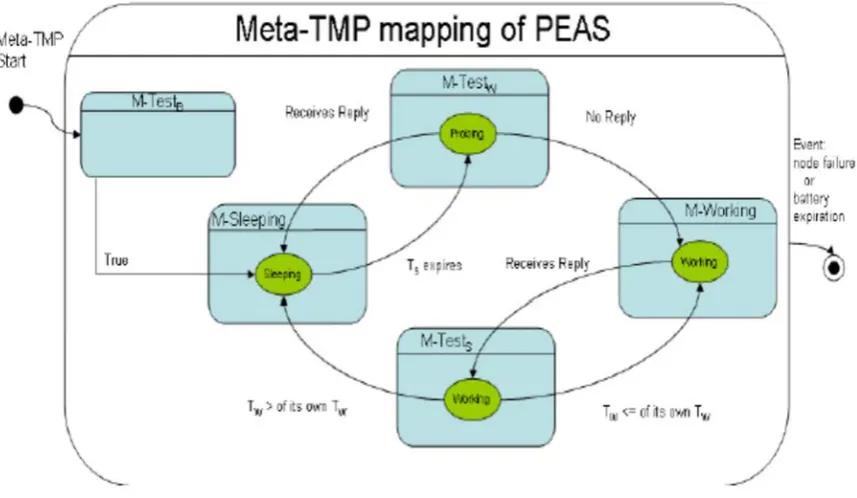
The communication between protocol peas and Meta-TMP, as proposed is shown in Figure 2 Each of the nodes begin to participate in protocol peas, when it is switched on, ie "Meta-TMP Start" corresponds to the introduction of knots. In peas M-Test B absent from the first put in each node in the dream state, ie Test B The test always meets this requirement M-CB S is true. The state of hibernation-M state corresponding to sleeping peas, where the knot of the radio and made no observation. Preliminary event state M EAWAKE M Sleep corresponding termination of the shutdown timer Ts, which therefore makes the unit transition capable of sampling.
Figure 2: Correspondence between PEAS and the Meta-TMP
4. A SECURITY TOPOLOGY MAINTENANCE PROTOCOL FOR WSN
In ProbingState,we find the operation that a nod performs during Probing state .the PROBE is determined by node v with key Ky and it contains a counter esteem counter.
If(Ts)I=I(λd/ρ)e−(λd/ρ)TsI(5.1)
answering node u.
Take note of that the esteem Dense is processed by the BS. Particularly, the BS figures Densu by tallying the quantity of tokens asked for by a node u in Working state. At that point, the BS embeds Dense, into the tokens answered to u. This esteem speaks to the neighbor's thickness of node u —node u asks for a token for each of its neighbors.
AlgorithmI1:ISec-TMP:IProbing
5. CAPTURE DETECTION TO PREVENT INTERNAL ATTACKS
Here we describe the class of some capture protocol to monitor nearby gland water system, the cure physical capture attacks. During the scheduling of the discovery capture protocol we consider various types of advertising agencies with a scheduling protocol stopped to be used as part of a different number of ads -Hoc possible agreement. We have focused on two systems and not the purpose, consider reasonable portable and portable theory and situations. An appropriate protocol for the situation versatility, as a person moving between light, allows us to ensure WSNs to gadgets is transmitted by person, similar to what PDA indicates. By combating information is embarking on a problem for organizing any consideration information as the different may share with other media or the Internet. Although it will be difficult to avoid that the carrier, without resorting to businesses, usually few organizations can use to reduce this risk. A couple of organizations have now been proposed to solve this writing problem; However, management has concentrated or focused light hypothesis only. In the case of the first agreement it fails to fit with the way the system is scattered, while in the case of the nature of the management obtained for reasonable versatility on the front of the results for a hypothetical. One of the reasons is guided by a sense Re: Portable Case Experience of Social Relationships.
6. CONCLUSION
The development of WSNs and the upcoming of the universal computing empowers the new sorts and methods of studies, research and uses in diverse and various departments. as with the new innovations and the power that is far reaching distribution brings new and many security issues. Morever, now dealing with various security issues that disappoint the humans condition with experiencing the WSNs. Many challenges arises with the introduction of large number of sensors, energy unfriendly surrounding and the unpredictable application of sensor networks.
for particular security issues of Wireless Sensor Networks.
REFERENCES
[1] CRAWDAD: A Community Resource for Archiving Wireless Data At Dartmouth. http://crawdad.cs.dartmouth.edu/, 2009.
[2] Akyildiz, I. F., Su, W., Sankarasubramaniam, Y., and Cayirci, E. Wireless sensor networks: a survey. Journal of Computer and Telecommunications Networking - Elsevier 38, 4 (2002), 393–422.
[3] Anastasi, G., Conti, M., Di Francesco, M., and Passarella, A. Energy conservation in wireless sensor networks: A survey. Journal of Ad Hoc Networks- Elsevier 7, 3 (2009), 537–568.
[4] Anastasi, G., Conti, M., Francesco, M. D., and Passarella, A. How to prolong the lifetime of wireless sensor networks. Chapter 6 in Mobile Ad Hoc and Pervasive Communications , American Scientific Publishers (to appear).
[5] ARGO - Global Ocean Sensor Network.
[6] Arisha, K. A., Youssef, M. A., and Younis, M. F. Energy-aware tdma-based mac for sensor networks. In Proc. of the IEEE Workshop on Integrated Management of Power Aware Communications, Computing and Networking (IMPACT’02) (May 2002).
[7] Bandyopadhyay, S., and Coyle, E. An energy efficient hierarchical clustering algorithm for wireless sensor networks. In IEEE INFOCOM (2003), vol. 3, Citeseer, pp. 1713–1723.
[8] Basagni, S., Carosi, A., Melachrinoudis, E., Petrioli, C., and Wang, Z. M. Controlled sink mobility for prolonging wireless sensor networks lifetime. ACM/Springer Journal on Wireless Networks (WINET) 14, 6 (2008), 831–858.
[9] Beckwith, R., Teibel, D., and Bowen, P. Pervasive computing and proactive agriculture. In Pervasive Computing Second International Conference (PERVASIVE’04) (April 2004).
[10] Broch, J., Maltz, D. A., Johnson, D. B., Hu, Y.-C., and Jetcheva, J. A performance comparison of multi-hop wireless ad hoc network routing protocols. In Proc. of the 4th ACM/IEEE International conference on Mobile computing and networking (MobiCom’98) (1998), pp.
85–97.
[11] Brooks, R., and Iyengar, S. Multi-sensor fusion: fundamentals and applications with software. Prentice-Hall (1998). [12] Bryan, P., Perrig, A., and Gligor, V. Distributed detection of node replication attacks in sensor networks.
[13] Bulut, E., and Korpeoglu, I. Dssp: A dynamic sleep scheduling protocol for prolonging the lifetime of wireless sensor networks. In Proc. of the 21st International IEEE Conference on Advanced Information Networking and Applications Workshops (AINAW’07) (2007), pp. 725– 730.
[14] C. Castelluccia, A. Francillon, D. P., and Soriente, C. On the difficulty of softwarebased attestation of embedded devices. [15] C.A.Janeway. Immunobiology: The immune system in health and disease. Garland Publishing (2001).
[16] Capkun, S., Hubaux, J.-P., and Butty´an, L. Mobility helps security in ad hoc networks. In Proc. of the 4th ACM Interational Symposium on Mobile Ad Hoc Networking and Computing (MobiHoc’03) (2003), pp. 46–56.
[17] Carman, D., Kruus, P., and Matt, B. Constraints and approaches for distributed sensor network security. DARPA Project report,(Cryptographic Technologies Group, Trusted Information System, NAI Labs #00-010, tech. Rep.) (2000).
[18] Cerpa, A., Elson, J., Estrin, D., Girod, L., Hamilton, M., and Zhao, J. Habitat monitoring: application driver for wireless communications technology. SIGCOMM Computer Communication Review 31, 2 supplement (2001), 20–41.
[19] Cerpa, A., and Estrin, D. Ascent: Adaptive self-configuring sensor networks topologies. IEEE Transactions on Mobile Computing 3, 3 (2004), 272–285.
[20] Chaintreau, A., Mtibaa, A., Massoulie, L., and Diot, C. The diameter of opportunistic mobile networks. In Proc. of the 3rd ACM SIGCOMM International Conference on emerging Networking EXperiments and Technologies (CoNEXT’07) (2007), pp. 1–12.
[21] Chan, H., and Perrig, A. Security and privacy in sensor networks. IEEE Computer 36, 10 (2003), 103–105.
[22] Chan, H., and Perrig, A. Ace: An emergent algorithm for highly uniform cluster formation. vol. 2920 of LNCS, Springer, pp. 154–171. [23] Chen, B., Jamieson, K., Balakrishnan, H., and Morris, R. Span: An energy-efficient coordination algorithm for topology maintenance in ad
hoc wireless networks. ACM Wireless Networks Journal 8, 5 (2002), 481–494.
[24] Chuah, M. C. Social network aided multicast delivery scheme for human contact-based networks. In Proc. of the 1st ACM Workshop on simplifying complex networks (SIMPLEX’09) (2009), pp. 1–6.
[25] Conti, M., Di Pietro, R., Gabrielli, A., Mancini, L. V., and Mei, A. The quest for mobility models to analyse security in mobile ad hoc networks. In Proc. of the 7th International Conference on Wired / Wireless Internet Communications (WWIC ’09) (2009), pp. 85–96.
[26] Conti, M., Di Pietro, R., Mancini, L. V., and Mei, A. Mobility and cooperation to thwart node capture attacks in manets. Wireless Communications and Networking (EURASIP), to appear .
[27] Conti, M., Di Pietro, R., Mancini, L. V., and Mei, A. A randomized, efficient, and distributed protocol for the detection of node replication attacks in wireless sensor networks. In Proc. of the 8th ACM International Symposium on Mobile Ad Hoc Networking and Computing (MobiHoc’07) (2007), pp. 80–89.
[28] Conti, M., Di Pietro, R., Mancini, L. V., and Mei, A. Emergent properties: Detection of the node-capture attack in mobile wireless sensor networks. In Proc. of the 1st ACM Conference on Wireless Network Security (WiSec’08) (2008), pp. 214–219.
[29] Coyle, G., Boydell, L., and Brown, L. Home telecare for the elderly. Journal of Telemedicine and Telecare 1 (1995), 183–184. [30] Crossbow Technology Inc. MICA Sensor Node. http://www.xbow.com.
[31] Daly, E. M., and Haahr, M. Social network analysis for routing in disconnected delaytolerant manets. In Proc. of the 8th ACM international symposium on Mobile Ad Hoc Networking and Computing (MobiHoc’07) (2007), pp. 32–40.
[32] Deng, J., Han, R., and Mishra, S. Intrusion tolerance and anti-traffic analysis strategies for wireless sensor networks. In Proc. of the 34th IEEE International Conference on Dependable Systems and Networks (DSN’04) (2004), pp. 637–646.
[33] Deng, J., Han, R., and Mishra, S. Countermeasures against traffic analysis attacks in wireless sensor networks. In Proceedings of the 1st IEEE International Conference on Security and Privacy for Emerging Areas in Communications Networks (SECURECOMM’05) (2005), pp. 113–126.
[34] Di Pietro, R., Mancini, L. V., and Mei, A. Energy efficient node-to-node authentication and communication confidentiality in wireless sensor networks. ACM Wireless Networks Journal 12, 6 (2006), 709–721.
[35] Di Pietro, R., Mancini, L. V., Soriente, C., Spognardi, A., and Tsudik, G. Data security in unattended wireless sensor networks. IEEE Transactions on Computers 58, 11 (2009), 1500–1511.
Mobile computing and networking (MobiCom’99) (1999), pp. 263–270.
[37] fan Hsin, C., and Liu, M. A distributed monitoring mechanism for wireless sensor networks. In Proc. of the 1st ACM workshop on Wireless security (WiSe’02) (2002), pp. 57–66.
[38] fan Hsin, C., and Liu, M. Self-monitoring of wireless sensor networks. Computer Communications (Elsevier) 29, 4 (2006), 462–476. [39] Francillon, A., and Castelluccia, C. Code injection attacks on Harvard-architecture devices. In Proc. of the 15th ACM conference on
Computer and communications security (CCS’08) (2008), pp. 15–26.
[40] F.Ye, Zhong, G., Lu, S., and Zhang, L. Peas: A robust energy conserving protocol for long-lived sensor networks. In Proc. of the 23rd IEEE International Conference on Distributed Computing System (ICDCS’03) (2003), pp. 28–37.
[41] Gabrielli, A., Conti, M., Pietro, R. D., and Mancini, L. V. Capture detection vs. secure topology maintenance protocol. In Technical Report 3/2009, Dipartimento di Informatica of the University of Rome “La Sapienza” (2009).
[42] Gabrielli, A., Conti, M., Pietro, R. D., and Mancini, L. V. Sec-tmp: a secure topology maintenance protocol for event delivery enforcement in wsn. In Proc. of the 5th International Conference on Security and Privacy in Communication Networks (SecureComm’09) (2009), p. to appear.
[43] Gabrielli, A., and Mancini, L. V. Bio-inspired topology maintenance protocols for secure wireless sensor networks. In Bio-Inspired Computing and Communication (2008), vol. 5151 of LNCS, Springer, pp. 399–410.
[44] Gabrielli, A., Mancini, L. V., Setia, S., and Jajodia, S. Securing topology maintenance protocols for sensor networks. IEEE Transactions on Dependable and Secure Computing (TDSC), to appear.
[45] Gabrielli, A., Mancini, L. V., Setia, S., and Jajodia, S. Securing topology maintenance protocols for sensor networks: Attacks and countermeasures. In Proc. of the 1st IEEE/CreateNet International Conference on Security and Privacy for Emerging Areas in
Communication Networks (SecureComm’05) (2005), pp. 101–112.
[46] Gaubatz, G., Kaps, J.-P., and Sunar, B. Public key cryptography in sensor networks - revisited. vol. 3313 of LNCS, pp. 2–18.
[47] Grossglauser, M., and Vetterli, M. Locating nodes with ease: last encounter routing in ad hoc networks through mobility diffusion. In Proc. of the 22nd Joint Conference of the IEEE Computer and Communications Societies (INFOCOM’03) (2003), vol. 3, pp. 1954– 1964. [48] Dr.S.S.Riaz Ahamed , Review And Implications of Time Division Multiple Access Techniques For Wireless Environment Services And
Applications in Journal of Theoretical and Applied Information Technology (E-ISSN 1817-3195 / ISSN 1992-8645), Pp 22-30, Sep 2008, [49] Dr.S.S.Riaz Ahamed, Comprehensive performance analysis and special issues of Virtual Private Network strategies in the computer