Iran J Public Health, Vol. 48, No.8, Aug 2019, pp.1488-1495
Original Article
Estimation of a Neonatal Health Production Function for Iran:
Secondary Analysis of Iran’s Multiple Indicator Demographic
and Health Survey 2010
Mostafa AMINI-RARANI
1, Arash RASHIDIAN
2,3, *Mohsen BAYATI
4, Esmaeil
KHEDMATI MORASAE
51. Social Determinants of Health Research Center, Isfahan University of Medical Sciences, Isfahan, Iran
2. Department of Health Management and Economics, School of Public Health, Tehran University of Medical Sciences, Tehran, Iran 3. Department of Information, Evidence and Research, World Health Organization, Eastern Mediterranean Region, Cairo, Egypt
4. Health Human Resources Research Center, School of Management & Information Sciences, Shiraz University of Medical Sciences, Shiraz, Iran 5. Center for Systems Studies, Hull University Business School (HUBS), Hull York Medical School (HYMS), University of Hull, Hull, UK
*Corresponding Author: Email: [email protected]
(Received 19 Feb 2018; accepted 16 Apr 2018)
Introduction
Health promotion, as one of the main aims of
healthcare systems, is of salient importance for neonate (1). Consequently, neonatal mortality rates have been used (2), along with other indices Abstract
Background: Despite constant decrease in rate of neonatal mortality, the rate is still higher than that of other under-five children. One of the first steps towards reduction of neonatal mortality is to identify its determi-nants using health production function. The aim of the present study was to estimate neonatal health produc-tion funcproduc-tion for Iran.
Methods: In this cross-sectional study, Iranian Multiple Indicator Demographic and Health Survey (Ir-MIDHS) 2010 was used. Four categories of socioeconomic, mother, neonatal demographic and healthcare sys-tem factors were entered into the Binomial Logistic Regression model to estimate neonate health production function. Households’ economic status was constructed using principal component analysis.
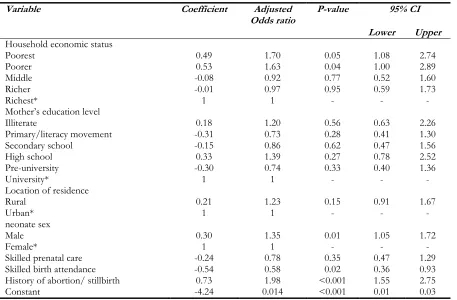
Results: History of abortion/stillbirth had the highest significant positive impact on odds of neonatal mortali-ty (odds ratio=1.98; 95 % CI=1.55-2.75), indicating that neonates of mothers with such a history had 1.98 times higher chance of death compared to other neonates. Moreover, odds ratio of neonatal death for the poorest quintiles was 1.70 (95 % CI=1.08-2.74), indicating that by moving from the poorest quintile to the richest one, the odds of being alive for neonates increased up to 70%. However, skilled birth attendant de-creased the chance of death up to 58% (odds ratio=0.58; 95 % CI=0.36-0.93).
Conclusion: Considering the most significant inputs of neonatal health production function in Iran, provement of economic status of households, provision of appropriate care services for mothers, and im-provement of delivery care provided by trained personnel, could be priorities for health policymakers to act and reduce neonatal mortality in Iran.
of mortality and life expectancy at birth, to evalu-ate societies’ health status (3). Not only neonatal mortality rates considered as health outcomes, but also they reflect societies’ socioeconomic de-velopment level (4, 5). Neonatal mortality (death during first 28 d after birth), among other child mortality indices, is of special significance as most of under-five (more than 60%), and infant (more 70%) happens during neonate period (6). Moreover, illness in neonate period imposes re-markable costs over healthcare, education, and public supportive systems in future (7). Despite falling rates and levels of neonatal mortality (8), declines in the neonatal mortality rate are slower than mortality among children aged 1-59 months. Moreover, regardless of scaling up the relevant child health policies around the globe, the ine-quality in child mortalities are still notable be-tween and among countries (9). According to levels and trends in child mortality report 2017, obvious disparities in neonatal mortality exist across regions and countries. Among regions, neonatal mortality was highest in sub-Saharan Africa and Southern Asia up to 28 deaths per 1000 live births, and across countries, neonatal mortality rates ranged from 46 deaths (per 1,000 live births) in Pakistan to 1 each in Iceland and Japan (8).
In Iran, neonatal mortality rates show that sub-stantial progress has been made in reducing neo-natal deaths per 1000 live births from 25 to 10 since 1990 to 2016 (8). However, in line with achieving Sustainable Development Goal 3 and 10 (SDGs 3 and 10) by 2030, there is still much to hop and do for more reduction in the neonatal mortality rate (6) as well as reduction in the neo-natal mortality inequality (10). The most im-portant step towards reduction of neonatal mor-tality is to identify its determinants. Having that done, relevant interventions can be tailored for before, during, and after delivery that help reduce neonatal mortality (11).
There are different factors that influence neonatal mortality. Basically, neonatal mortality level is related to socioeconomic conditions of society (12). These factors, usually, affect neonatal health through their influence on mothers’ health.
Fac-tors like demographic features of mother and ne-onate (13), delivery type and location, physical conditions of living, mother’s health status (11), provision of pre-pregnancy and delivery care by skilled personnel (14), stillbirth history (15), mother and father education level and their oc-cupation (16) are of factors reported as determi-nants of neonatal mortality.
Health determinants are usually analyzed within a framework called health production function in which determinants are considered as inputs and health status is considered as outcome of func-tion (17).
The paper’s major objectives were to estimate neonatal health production function and to iden-tify the main factors affecting neonatal death in Iran using data from Multiple Indicator Demo-graphic and Health Survey (MIDHS) 2010. The results are expected to inform policymakers about neonatal death determinants and as a result to provide invaluable information to the child health policy-making process.
Methods
Data
In this cross-sectional secondary data analysis, MIDHS data for 2010 was used to conduct the study. To gather required data, multistage strati-fied random cluster sampling method was used in MIDHS to gather data. The minimal number of samples from each province was estimated to be 400 households. Distribution of samples across the country was based on households’ number in each province in Iran and, finally, 31300 house-holds were selected into the survey (18).
Model and variable
Considering relevant literature, neonatal mortality determinants were grouped into 4 categories of socioeconomic (SES), mother (M), neonatal de-mographic (D), and healthcare system factors (HS). Accordingly, the preliminary model will be as follows:
ND= f (SES, M, D, HS)
and using a well-known framework (19), house-hold economic status (HES) and location of resi-dence (L); mother education level (MEL) and history of abortion /stillbirth (HAS); neonate’s sex (S); and skilled prenatal care (SPC) and skilled birth attendant (SBA) were entered into the model from socioeconomic, mother, neonatal demographic, and healthcare system categories, respectively. The model structure, particularly variables selection was built according to the lat-est literature on neonatal mortality/ health (12, 15, 20, 21).
ND= f (HES, MEL, L, S, SPC, SBA, HAS)
Variables definition
Neonatal death, as our dependent variable, was chosen as a dichotomous outcome, i.e. whether each of the mother’s alive birth was still alive or already died (death during the first 29 days after birth). As yearly estimates of mortality are not accurate enough (due to relative scarcity of death numbers) (22), and also as sufficient numbers of births reduces sampling error effects (10), a 10-year long period was used for live birth estimates. Eventually, 33144 live births from 2000 to 2010 were entered into the model.
Using principal component analysis (PCA) (23) and data from 30870 households in 2010, house-holds’ economic status was measured. Conse-quently, economic quintiles of “poorest”, “poor”, “middle”, “rich”, and “richest” were constructed and entered, as a categorical variable, into regres-sion model. Mother education level was also con-sidered as a categorical variable including illit-erate, primary, guidance, high school, pre-academic, and academic categories.
By skilled prenatal care, it was meant any care provided by specialists, General Physicians (GPs), trained midwives, and family health ex-perts. Moreover, by skilled birth attendant, it was meant childbirth attended by specialists, GPs, midwives, trained personnel, and multipurpose health workers (Behvarz).
Abortion was defined as pregnancy finished be-fore 20-week of pregnancy. Stillbirth, in contrast, was defined as pregnancy that spanned more
than 20-week but led to a neonate birth that had no vital signs after delivery.
Data analysis
Descriptive statistics were used to describe varia-bles. In the present study, as dependent variable was binomial (neonates alive or not) and several independent variables were included in the mod-el, the multivariate binomial logistic regression (adjusted logistic regression) was used to estimate neonate health production function. Further-more, it was tried to inter variables that may have potential effects on neonatal death in model as independent variables to control their effects. All analyses were done by in STATA/SE (version 14; Stata Corporation, College Station, TX, USA). The MIDHS stratification, cluster sampling, and unequal selection probabilities were considered in the analyses via svyset command (23). As com-monly used traditional goodness-of-fit tests like Hosmer–Lemeshow and Pearson’s chi-square goodness-of-fit are subjected to some problems associated with logistic regression model using survey data, in this study we applied F-adjusted mean residual test to assess logistic regression goodness-of-fit applying svylogitgof command (24).
Results
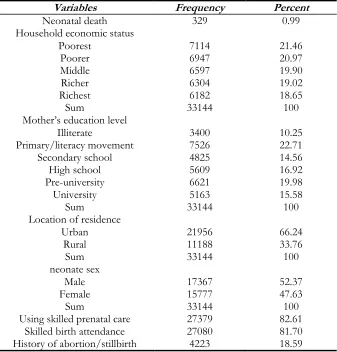
Table 1: Descriptive statistics of variables
Variables Frequency Percent
Neonatal death 329 0.99
Household economic status
Poorest 7114 21.46
Poorer 6947 20.97
Middle 6597 19.90
Richer 6304 19.02
Richest 6182 18.65
Sum 33144 100
Mother’s education level
Illiterate 3400 10.25
Primary/literacy movement 7526 22.71
Secondary school 4825 14.56
High school 5609 16.92
Pre-university 6621 19.98
University 5163 15.58
Sum 33144 100
Location of residence
Urban 21956 66.24
Rural 11188 33.76
Sum 33144 100
neonate sex
Male 17367 52.37
Female 15777 47.63
Sum 33144 100
Using skilled prenatal care 27379 82.61
Skilled birth attendance 27080 81.70
History of abortion/stillbirth 4223 18.59
Moreover, skilled attendant childbirth had the highest significant negative effect on odds of ne-onatal death.
Positive impact abortion or stillbirth history on neonatal death means that neonates of mothers with such a history had 1.98 times higher chance of death compared to other neonates. Across economic quintiles, the poorest and poor quin-tiles had a positive association with neonatal mor-tality. According to Table 2, odds ratio of neona-tal death for the poorest quintile was 1.70, indi-cating that by moving from the poorest quintile to the richest one, the odds of being alive for ne-onates increased 70%. For the poor quintile, the odds ratio was 1.63, meaning that, compared with the richest one, neonates in that quintile had 63%
higher chance to lose their life over their first 29 d of life. In terms of sex, being male increased the chance of death 35% (odds ratio=1.35), compared with their female counterparts.
In terms of negative impact on odds of neonatal death, skilled birth attendant decreased the chance of death around 58%. All other variables including mother education, location of resi-dence, and skilled prenatal care had no significant effect on neonatal death.
Table 2: Estimates of neonatal health production function in Iran (2010), logit model
Variable Coefficient Adjusted
Odds ratio P-value 95% CI
Lower Upper
Household economic status
Poorest 0.49 1.70 0.05 1.08 2.74
Poorer 0.53 1.63 0.04 1.00 2.89
Middle -0.08 0.92 0.77 0.52 1.60
Richer -0.01 0.97 0.95 0.59 1.73
Richest* 1 1 - - -
Mother’s education level
Illiterate 0.18 1.20 0.56 0.63 2.26
Primary/literacy movement -0.31 0.73 0.28 0.41 1.30
Secondary school -0.15 0.86 0.62 0.47 1.56
High school 0.33 1.39 0.27 0.78 2.52
Pre-university -0.30 0.74 0.33 0.40 1.36
University* 1 1 - - -
Location of residence
Rural 0.21 1.23 0.15 0.91 1.67
Urban* 1 1 - - -
neonate sex
Male 0.30 1.35 0.01 1.05 1.72
Female* 1 1 - - -
Skilled prenatal care -0.24 0.78 0.35 0.47 1.29
Skilled birth attendance -0.54 0.58 0.02 0.36 0.93
History of abortion/ stillbirth 0.73 1.98 <0.001 1.55 2.75
Constant -4.24 0.014 <0.001 0.01 0.03
*denote reference group
Discussion
The present study aimed to estimate neonatal health production function in Iran. In overall, of socioeconomic, mother-related, neonatal demo-graphic and healthcare system factors, some fac-tors had a significant association on neonatal mortality.
As it was expected, socioeconomic status had a positive relationship with neonatal health. On other words, neonates of poor families had high-er chance of losing their life early. A plethora of studies have already approved of such a relation-ship; poverty has been shown to be of main de-terminants of neonatal mortality (21, 25). These findings have been more reported from develop-ing countries. For example, studies from Paki-stan, Sudan, Ghana, and Nigeria have shown that low economic status of households is of the sali-ent determinants of neonatal health (20, 26).
Household’s economic status, as a contextual factor, influences neonatal health through having impinges on other factors like mother-related factors, healthcare utilization, and skilled birth attendant.
History of abortion or stillbirth was of main as-sociation of neonatal mortality in the present study. This finding was in line with other studies as availability of relevant facilities for abortion and access to them are of factors that affect neo-natal mortality (25). For instance, those mothers who already experienced death of an infant (un-der 1-year-old), had higher chance losing their neonate in future pregnancies (15).
and low level of consciousness at birth, male ne-onates experience higher rates of death (28). Pre-pregnancy and childbirth care factors were oth-er inputs of developed function. Of these factors, skilled birth attendant had a significant association with neonatal health; mothers who had given birth by help of trained personnel had a lower chance of losing their neonate. This finding has been repeat-edly reported in other studies (27, 29).
Location of residence and mother education are of factors that had no significant association with neonatal mortality. In rural settings that had no appropriate healthcare services, neonate mortality rate was higher (30). However, considering wide-spread coverage of healthcare services and PHC in Iran, there is no such a significant difference between rural and urban settings in terms of ne-onatal mortality in the country. Moreover, with recent scale-up and establishment of national in-tegrated programs, like Inin-tegrated Management of Child Illness, Well Baby Care Program, and National Child Mortality Surveillance System, quality and quantity of child healthcare has signif-icantly improved in Iran’s rural settings. There-fore, lack of such a significant difference between rural and urban settings is not unexpected. For mother education level, as factors of economic status, history of abortion or stillbirth, and skilled birth attendant managed to explain a huge part of neonatal mortality, the effect of mother educa-tion became insignificant.
Considering notable quota of neonatal mortality from infant and under-5 mortalities, focusing on its reduction will work remarkably towards increase in life expectancy at birth in the country. Findings of present study can also be of high value for policy-makers in order to reduce neonatal mortality. Due attention to poverty elimination and alleviation pol-icies, to mothers’ health across their life course, es-pecially during pregnancy and, development of care services and safe delivery facilities are of ways to increase neonatal health.
One of the main strengths points of the present study is its use of DHS data, as one of the most reliable health-related data, Moreover, use of in-dividual-level data may increase reliability and validity of findings. Most important limitation of
the present study was related to input variables. As research team could not access to all neonatal mortality determinants, namely father education and occupation status and history of illness and hospitalization among mothers, the developed model may, for sure, be in need of further devel-opment. However, this matter applies almost to all similar studies.
Conclusion
Economic status of households, history of abor-tion and stillbirth, neonate’s sex, and skilled birth attendant are of most significant inputs of neona-tal health production function in Iran. Resultant-ly, due attention to economic status of house-holds, provision of appropriate care services for mothers, and improvement of delivery care pro-vided by trained personnel can be of high priority strategies for neonatal health promotion in Iran.
Ethical considerations
Ethical issues (Including plagiarism, informed consent, misconduct, data fabrication and/or fal-sification, double publication and/or submission, redundancy, etc.) have been completely observed by the authors.
Acknowledgements
This work was supported by the Tehran Univer-sity of Medical Sciences grant number 136890.
Conflict of interests
References
1. Fottrell E, Osrin D, Alcock G et al (2015). Cause-specific neonatal mortality: analysis of 3772 neonatal deaths in Nepal, Bangladesh, Malawi and India. Arch Dis Child Fetal Neonatal Ed, 100:F439-F447.
2. Malekzadeh R (2014). Global Burden of Disease Study 2010: A Real Advance in Global Descriptive Epidemiology: Perspective For Developing Countries. Arch Iran Med, 17(5):302-3.
3. Nations U (2015). The Millennium
Development Goals Report 2015. (ed)^(eds), United Nations, New York.
4. Rajaratnam JK, Marcus JR, Flaxman AD et al (2010). Neonatal, postneonatal, childhood, and under-5 mortality for 187 countries, 1970-2010: a systematic analysis of progress towards Millennium Development Goal 4. Lancet, 375(9730):1988-2008.
5. Xi B, Zhou C, Zhang M et al (2014). Maternal and child mortality in China. Lancet, 383(9921):953-4.
6. WHO (2014). World health statistics 2014. ed. World Health Organization.
7. Reichman NE, Corman H, Noonan K, Dave D (2009). Infant health production functions: what a difference the data make. Health Econ, 18(7):761-82.
8. UNICEF, WHO, World Bank Group and United Nations (2017). Levels & Trends in Child Mortality: Report 2017, Estimates Developed by the UN Inter-agency Group for Child Mortality Estimation.
9. McKinnon B, Harper S, Kaufman JS, Bergevin Y (2014). Socioeconomic inequality in neonatal mortality in countries of low and middle income: a multicountry analysis. Lancet Glob Health, 2(3):e165-73.
10. Rarani MA, Rashidian A, Khosravi A et al (2017). Changes in socio-economic inequality in neonatal mortality in Iran between
1995-2000 and 2005-2010: an Oaxaca
decomposition analysis. Int J Health Policy Manag, 6(4):219-218.
11. Debelew GT, Afework MF, Yalew AW (2014). Determinants and causes of neonatal mortality in Jimma zone, southwest Ethiopia: a multilevel analysis of prospective follow up study. PLoS One, 9(9):e107184.
12. Siddiqi A, Jones MK, Erwin PC (2015). Does higher income inequality adversely influence infant mortality rates? Reconciling descriptive patterns and recent research findings. Soc Sci Med, 131:82-88.
13. Mekonnen Y, Tensou B, Telake DS et al (2013). Neonatal mortality in Ethiopia: trends and determinants. BMC Public Health, 13:483. 14. Kayode GA, Ansah E, Agyepong IA et al (2014).
Individual and community determinants of neonatal mortality in Ghana: a multilevel analysis. BMC Pregnancy Childbirth, 14:165. 15. Kassar SB, Melo AM, Coutinho SnB et al (2013).
Determinants of neonatal death with emphasis on health care during pregnancy, childbirth and reproductive history. J Pediatr (Rio J), 89(3):269-77.
16. Singh A, Kumar A, Kumar A (2013). Determinants of neonatal mortality in rural India, 2007-2008. PeerJ, 1:e75.
17. Bayati M, Akbarian R, Kavosi Z (2013). Determinants of life expectancy in eastern mediterranean region: a health production function. Int J Health Policy Manag, 1(1):57-61. 18. Rashidian A, Karimi-Shahanjarini A, Khosravi A
et al (2014). Iran's multiple indicator demographic and health survey-2010: Study protocol. Int J Prev Med, 5(5):632-42.
19. Mosley WH, Chen LC (2003). An analytical framework for the study of child survival in developing countries 1984. Bull World Health Organ, 81(2):140-5.
20. Nisar YB, Dibley MJ (2014). Determinants of neonatal mortality in Pakistan: secondary analysis of Pakistan Demographic and Health Survey 2006-07. BMC Public Health, 14:663. 21. Zanini RR, Moraes ABd, Giugliani ERJ, Riboldi
J (2011). Contextual determinants of neonatal mortality using two analysis methods, Rio Grande do Sul, Brazil. Rev Saude Publica, 45:79-89.
22. Kraft AD, Nguyen K-H, Jimenez-Soto E, Hodge A (2013). Stagnant neonatal mortality and persistent health inequality in middle-income countries: a case study of the Philippines. PLoS One, 8(1):e53696.
24. Archer KJ, Lemeshow S (2006). Goodness-of-fit test for a logistic regression model fitted using survey sample data. Stata J, 6:97-105.
25. Corman H, Grossman M (1985). Determinants of neonatal mortality rates in the US: A reduced form model. J Health Econ, 4(3):213-36.
26. Onayade A, Sule S, Elusiyan J (2006). Determinants of neonatal mortality at Wesley Guild Hospital, Ilesa, Nigeria. Niger J Med, 15(3):271-6.
27. Titaley CR, Dibley MJ, Agho K et al (2008). Determinants of neonatal mortality in Indonesia. BMC Public Health, 8:232.
28. Rosenstock S, Katz J, Mullany LC et al (2013). Sex differences in neonatal mortality in Sarlahi, Nepal: the role of biology and environment. J Epidemiol Community Health, 67(12):986-91.
29. Taha TE, Gray RH, Abdelwahab MM (1993). Determinants of neonatal mortality in central Sudan. Ann Trop Paediatr, 13(4):359-64. 30. Upadhyay R, Dwivedi P, Rai S et al (2012).