R E S E A R C H A R T I C L E
Open Access
Relationship between the social support
and self-efficacy for function ability in
patients undergoing primary hip
replacement
Kuan-Ting Wu
1†, Pei-Shan Lee
2†, Wen-Yi Chou
1*, Shu-Hua Chen
2and Yee-Tzu Huang
3Abstract
Background:The World Health Organization (WHO) reported that nearly 25% of people will suffer from physical disability owing to the bone and joint problems until 2050. The condition of patients with this type of difficulty could be improved by increasing positive self-efficacy and instigating suitable medical treatment to implement self-efficacy for functional ability (SEFA) and physical functional ability self-care. In this study, we aim to evaluate the influence of social support on SEFA in patients after total hip arthroplasty.
Methods:This cross-sectional study used structural questionnaires, telephone appointments, and data collection to obtain patient characteristics, such as gender, age, educational level, and marital status. Questionnaires about social support and self-efficacy for functional ability (SEFA) were sent to 200 patients at 3 months following a primary total hip replacement from September 2011 to December 2014. Factor analysis was used to categorize the dimensions of social support; thettest, analysis of variance (ANOVA), and correlation analysis were applied to screen factors influencing SEFA. Multiple regression analysis was employed to ascertain the relationships between patient characteristics, social support, and SEFA.
Results:In total, 134 patients responded to the questionnaires. Lower SEFA scores were observed in patients of an older age, unmarried patients, and those with a low level of education. Correlation analysis showed that emotional information and appraisal support, instrumental support, and SEFA were positively correlated. Multiple regression analysis was applied to ascertain the relationships between patient characteristics, social support, and SEFA. We identified significant coefficient values of−0.187 for age, 5.344 for emotional information and appraisal support, and 1.653 for instrumental support.
Conclusion:The results of this study demonstrated that in patients undergoing primary hip replacement, positive impacts on SEFA were observed in relation to emotional information, appraisal support and instrumental support. The results indicated that enhancing emotional information and appraisal support could improve a patient’s self-efficacy for functional ability.
Keywords:Self-efficacy for functional ability, Social support, Primary hip replacement, Arthroplasty
* Correspondence:[email protected]
†Kuan-Ting Wu and Pei-Shan Lee contributed equally to this work.
1Department of Orthopaedic Surgery, Kaohsiung Chang Gung Memorial
Hospital, No.123, Dapi Rd., Niaosong Dist., Kaohsiung city 833, Taiwan, Republic of China
Full list of author information is available at the end of the article
Background
Degenerative hip disease is the most common form of hip discomfort. According to the World Health Organization (WHO), bone and joint diseases may result in physical disability in nearly 25% of the population until 2050. Degenerative osteoarthritis can be diagnosed via physical examination in almost 80% of patients older than 55–65 years, and 20% of these patients already have a disability [1]. Based on research conducted by the Centers for Disease Control and Prevention (CDC) in the USA, the number of patients with osteoarthritis will double in the population over 65 years of age by 2030 [2].
Degenerative osteoarthritis often results in pain and limitation of daily activity, which are the leading causes requiring medical assistance [3]. Initially, these discomforts can be alleviated by appropriate medical management and self-care modification. In addition, caregivers play a key role in psychological support by providing patients with company [4]. In patients who are refractory to conservative treatment, a total hip replacement (THR) is usually indicated. According to the literature, THR yields excellent pain relief, with a survival rate from 90 to 99.8% during a 10–15-year follow-up period [5–7]. However, functional outcome varies according to preoperative characteristics, such as age, comorbidities, and activity level [8]. In addition to surgical technique, postoperative rehabili-tation, activity adjustment, and posture limitation are also important for better functional recovery. Psycho-social factors are also associated with recovery after THR [9, 10].
Pain from degenerative osteoarthritis has a negative ef-fect on patients in terms of psychosocial issues in the long term, such as effects on mood and sleep, which interact with activity level [11]. Langford and Bowsher [12] pointed out that adequate social support has posi-tive effects on health status and behavior. In patients with a hip fracture, social support is also correlated with the function of the lower limbs [13]. Self-efficacy repre-sents a patient’s personal confidence in completing specific tasks and also brings about a sense of accom-plishment. After lower limb arthroplasty, Moon and Backer identified significant correlations between self-efficacy, walking distance, and lower limb activity frequency [14]. In the elderly population, health status and physical function are key factors affecting the execu-tion of regular exercise; therefore, the condiexecu-tion of patients with this type of difficulty may be improved by increasing positive self-efficacy and social support following THR [15].
In this study, we aimed to examine the relationships between social support, self-efficacy level, and functional ability in patients undergoing primary THR after dis-charge from the hospital.
Methods
Study design and sample
This cross-sectional study used structural question-naires, telephone appointments, and data collection to obtain patient characteristics, such as gender, age, educa-tional level, and marital status. The Institueduca-tional Review Board at our hospital approved this analysis. Patients who had undergone THR due to osteoarthritis of the hip were enrolled from September 2011 to December 2014. Patients with the following conditions were excluded: dementia, psychological disorders, or postoperative com-plications such as cardiovascular accident, fat embolism, vascular or nerve injury, intraoperative acetabulum, or femur fracture. We used modified versions of the self-efficacy for functional ability (SEFA) scale and the social support scale for patient evaluation.
Questionnaires
We collected patient characteristics such as gender, age, educational level, and marital status. Self-efficacy for functional ability (SEFA) and social support question-naires were completed by the patients 3 months follow-ing primary THR. As the average age of the patients was greater than 65 years, we used modified versions of the questionnaires for simplification.
Social support scale
The modified social support scale [16] was revised from the Inventory of Socially Supportive Behaviors (ISSB) developed by Barrera et al. [17] for the measurement of assistance provided in the areas of emotional informa-tion, appraisal support, and instrumental support by a spouse, family, friends, and relatives. The patients were asked to respond to 15 items using a Likert scale from 0 to 3 points, representing no assistance, little assistance, much assistance, and very much assistance, respectively. Hence, the global score ranged from 0 to 90, with higher scores indicating better social support. In addition, we categorized social support into two dimensions. Dimen-sion 1 represented emotional information and appraisal support, with a Cronbach’s alpha of 0.973, while dimen-sion 2 represented instrumental support, with a Cronbach’s alpha of 0.767.
Self-efficacy for functional ability scale
respectively, in performing the activities by themselves. The total score ranged from 9 to 36, with higher scores representing greater confidence in performing daily activities. The Cronbach’s alpha for this scale was 0.969.
Statistical analysis
Factor analysis was used to categorize dimensions of so-cial support. The Kaiser-Meyer-Olkin value was 0.898, and the Barlett test showed a p value < 0.001. Further-more, thettest, analysis of variance (ANOVA), and cor-relation analysis were applied to screen the factors influencing SEFA. Multiple regression analysis was employed to ascertain the relationships between patient characteristics, social support, and SEFA. The reliability of the questionnaires was assessed using Cronbach’s alpha; the higher the Cronbach’s alpha value, the greater the internal consistency.
Results
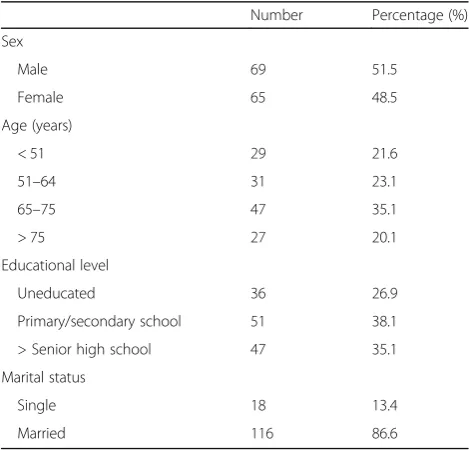
From September 2011 to December 2014, 200 patients underwent THR for advanced osteoarthritis. Following the exclusion of 66 patients who met the exclusion cri-teria, 134 patients were enrolled in this study, 51.5% of whom were male; 21.6% of the patients were under 55 years of age, 23.1% were aged between 51 and 64, 35.1% between 65 and 75, and 20.1% were over 75 years of age. 38.1% of the patients had an educational level ranging from elementary school to junior high school, and 26.9% were uneducated. 86.6% of the patients were married (Table1).
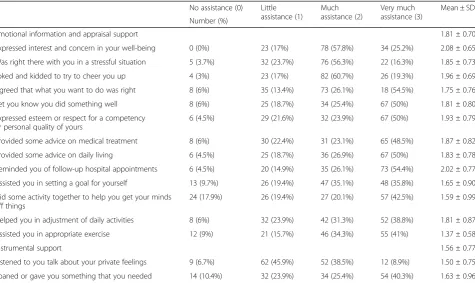
In terms of social support, the average score for the di-mension of emotional information and appraisal support was 1.81 ± 0.7, while that for the dimension of
instrumental support was 1.56 ± 0.77. The highest score (2.08 ± 0.65) of the items in the dimension of emotional information and appraisal support was obtained for
“expressed interest and concern in your well-being,” followed by “reminded you of follow-up hospital appointments” (2.02 ± 0.77). Furthermore, the lowest score was obtained for the item “assisted you in appro-priate exercise”(1.37 ± 0.85). In the dimension of instru-mental support, the lowest score (1.50 ± 0.75) was obtained for the item “listened to you talk about your private feelings”(Table2).
The average SEFA score of the patients after THR was 3.33 ± 0.84. The lowest-scored items in terms of self-efficacy were “wash your lower body (3.24 ± 0.95),”
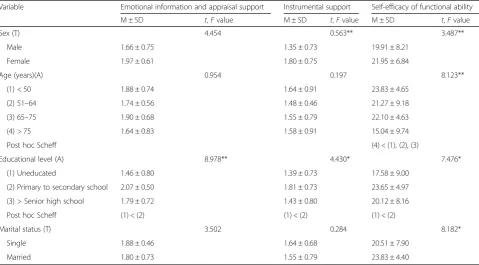
“dress your lower body (3.19 ± 1.00),” and“climb up and down four stairs (2.78 ± 1.21).”The highest score (3.53 ± 0.28) was obtained for“get in and out of bed and chairs” (Table 3). Male patients scored 19.97 ± 8.21 and female patients 21.95 ± 6.84 on average, with apvalue < 0.01.
A positive correlation between emotional information and appraisal support with instrumental support was ob-served, with a Pearson correlation coefficient of 0.6. In addition, a positive relationship between emotional in-formation and appraisal support with SEFA was seen, with a Pearson correlation coefficient of 0.635 (Table4).
Scores on the scales of self-efficacy (17.58 ± 8.98) and emotional information and appraisal support (1.46 ± 0.80) were lower in the uneducated patients (p< 0.01), as was the instrumental support score (p< 0.05). In addition, the elderly patients had lower SEFA scores (p< 0.01) (Table5).
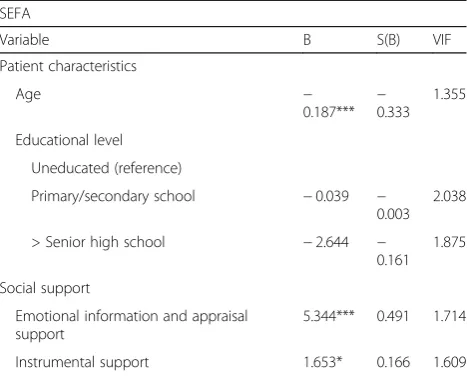
We included predictors selected from t tests and ANOVA, such as sex, age, educational level, marital sta-tus, emotional information, appraisal support, and instrumental support in stepwise multivariable regres-sion analysis. After the elimination procedure, age, edu-cational level, emotional information and appraisal support, and instrumental support were selected as sig-nificant predictors. These sigsig-nificant predictors were analyzed using an all-possible regression procedure. It was found that an older age was related to a lower self-efficacy (b=−0.187, p< 0.001). Emotional informa-tion and appraisal support had a positive influence on self-efficacy (b= 5.344, p< 0.001), as did instrumental support (b= 1.653, p< 0.05). The model explained approximately 52.6% of the variance in SEFA 3 months after THR, and the final regression model explained 50.7% of the variance (Table6).
Discussion
Social support is a key factor related to the daily activity of geriatric patients. Friedland and McColl [19] pointed out that interventions to increase social support in crit-ical patients can improve chronic stress and physcrit-ical
Table 1Characteristics of primary THR patients (n= 134)
Number Percentage (%) Sex
Male 69 51.5
Female 65 48.5 Age (years)
< 51 29 21.6 51–64 31 23.1 65–75 47 35.1 > 75 27 20.1 Educational level
Uneducated 36 26.9 Primary/secondary school 51 38.1 > Senior high school 47 35.1 Marital status
disability. Social support also has positive effects on health status and behavior [12] and can enhance execu-tion of healthy behaviors, such as taking medicines on time, engaging in regular exercise, and diet control [20]. In studies of patients with hip fractures, a significant relationship was also identified between social support and lower limb functional activity [13], especially when supported by their spouse and family [21]. Social sup-port is usually provided by the patient’s family members who live with them. Kiefer identified a higher level of so-cial support in patients living with a spouse, adult child,
or friends while the singles had a lower level of social support [22]. In this study, we found that the item with the highest score (2.08 ± 0.65) was “expressed interest and concern in your well-being.” Because it is easier for a caregiver or family to focus on the patient’s disease-related health status, as they can directly observe their gait, muscle power, and agility following THR. Svei-kata et al. [23] demonstrated better postoperative func-tional results 12 months after total knee arthroplasty in patients who had better social support. McHugh et al. [24] also identified key psychosocial factors and
Table 2Descriptive analysis of social support after THR
No assistance (0) Little assistance (1)
Much assistance (2)
Very much assistance (3)
Mean ± SD Number (%)
Emotional information and appraisal support 1.81 ± 0.70 Expressed interest and concern in your well-being 0 (0%) 23 (17%) 78 (57.8%) 34 (25.2%) 2.08 ± 0.65 Was right there with you in a stressful situation 5 (3.7%) 32 (23.7%) 76 (56.3%) 22 (16.3%) 1.85 ± 0.73 Joked and kidded to try to cheer you up 4 (3%) 23 (17%) 82 (60.7%) 26 (19.3%) 1.96 ± 0.69 Agreed that what you want to do was right 8 (6%) 35 (13.4%) 73 (26.1%) 18 (54.5%) 1.75 ± 0.76 Let you know you did something well 8 (6%) 25 (18.7%) 34 (25.4%) 67 (50%) 1.81 ± 0.80 Expressed esteem or respect for a competency
or personal quality of yours
6 (4.5%) 29 (21.6%) 32 (23.9%) 67 (50%) 1.93 ± 0.79 Provided some advice on medical treatment 8 (6%) 30 (22.4%) 31 (23.1%) 65 (48.5%) 1.87 ± 0.82 Provided some advice on daily living 6 (4.5%) 25 (18.7%) 36 (26.9%) 67 (50%) 1.83 ± 0.78 Reminded you of follow-up hospital appointments 6 (4.5%) 20 (14.9%) 35 (26.1%) 73 (54.4%) 2.02 ± 0.77 Assisted you in setting a goal for yourself 13 (9.7%) 26 (19.4%) 47 (35.1%) 48 (35.8%) 1.65 ± 0.90 Did some activity together to help you get your minds
off things
24 (17.9%) 26 (19.4%) 27 (20.1%) 57 (42.5%) 1.59 ± 0.99 Helped you in adjustment of daily activities 8 (6%) 32 (23.9%) 42 (31.3%) 52 (38.8%) 1.81 ± 0.87 Assisted you in appropriate exercise 12 (9%) 21 (15.7%) 46 (34.3%) 55 (41%) 1.37 ± 0.58 Instrumental support 1.56 ± 0.77 Listened to you talk about your private feelings 9 (6.7%) 62 (45.9%) 52 (38.5%) 12 (8.9%) 1.50 ± 0.75 Loaned or gave you something that you needed 14 (10.4%) 32 (23.9%) 34 (25.4%) 54 (40.3%) 1.63 ± 0.96
Table 3Descriptive analysis of SEFA after THR
Confidence (score) < 20% (1) 20–50% (2)
50–80% (3)
> 80%(4) Mean ± SD Item Number (%)
Wash your upper body 8 (6%) 10 (7.5%) 28 (20.9%) 88 (65.7%) 3.46 ± 0.87 Wash your lower body 9 (6.7%) 21 (15.7%) 33 (24.6%) 71 (53%) 3.24 ± 0.95 Dress your upper body 4 (3%) 12 (9%) 26 (19.4%) 92 (68.7%) 3.48 ± 0.92 Dress your lower body 9 (6.7%) 24 (17.9%) 29 (21.6%) 72 (53.7%) 3.19 ± 1.00 Get on and off the toilet and manage your clothes 8 (6%) 13 (9.7%) 20 (14.9%) 93 (69.4%) 3.48 ± 0.90 Get in and out of bed and a chair 4 (3%) 8 (6%) 31 (23.1%) 91 (67.9%) 3.53 ± 0.82 Walk 50 ft 4 (3%) 12 (9%) 32 (23.9%) 86 (64.2%) 3.43 ± 0.92 Walk 120 ft 6 (4.5%) 12 (9%) 37 (27.6%) 79 (59%) 3.37 ± 0.93 Climb up and down four stairs 22 (16.4%) 26 (19.4%) 31 (23.1%) 55 (41%) 2.78 ± 1.21
Total score 29.96 ± 7.6
biomedical predictors of pain, anxiety, and depression related to recovery following THR in 206 patients. Social support can affect self-efficacy in terms of verbal encouragement. In a randomized control study, im-proved general self-efficacy and physical function were observed in the group who received telephone follow-up appointments conducted by a nurse, which was struc-tured along the lines of the VIPS model (the Swedish acronym for the concepts of Well-being, Integrity, Pre-vention and Safety) [25]. We also identified a significant positive correlation between social support and self-efficacy in our study, with a coefficient of 5.344 for emotional information and appraisal support and 1.653 for instrumental support.
Physical activity is crucial in the elderly and can pre-vent chronic disease, promote physical health, and help to maintain the quality of life [26]. Elderly persons who engage in regular exercise will perform better in func-tions of daily activity and will have an improved health status and reduce few chronic diseases such as stroke, cardiovascular disease, osteoporosis, hypertension, and
diabetes [27, 28]. If patients are restricted in terms of the execution of physical activity, they will be unwilling to perform daily activities [29]. Similar with social sup-port, increase self-efficacy is associated with higher phys-ical activity levels [30,31]. Poor self-efficacy usually leads to greater distress in patients during their recovery; they often worry about their condition getting worse after executing a specific task because they are not confident in their course of rehabilitation. In research into self-efficacy, self-efficacy was taken as an evaluation of capability in terms of achievement in specific tasks, a significant correl-ation between self-efficacy and personal success was identified [32,33]. Dominick et al. demonstrated a signifi-cant correlation between low self-efficacy for exercise and less improvement in functional recovery over time after total knee arthroplasty [34]. Waldrop et al. [35] also addressed self-efficacy predicted significant variance in rehabilitation outcomes in orthopedic surgery. They con-cluded that augmenting self-efficacy beliefs by psycholo-gists could improve functional recovery. The higher the level of induced self-efficacy, the greater the performance accomplishments.
Patients who undergo THR are usually discharged home directly. Therefore, it is easy to assess the correl-ation of functional outcome with the quality of home care. Self-efficacy was identified as a significant predictor of recovery after joint arthroplasty by Moon and Backer et al. [14]. They also found that walking distance and the
Table 4Pearson’s correlations with SEFA scale
Variable Correlation
coefficient,r p value Emotional information
and appraisal support
0.635 < 0.001 Instrumental support 0.489 < 0.001
Table 5Group comparison of emotional information and appraisal support, instrumental support and SEFA
Variable Emotional information and appraisal support Instrumental support Self-efficacy of functional ability M ± SD t,Fvalue M ± SD t,Fvalue M ± SD t,Fvalue
Sex (T) 4.454 0.563** 3.487**
Male 1.66 ± 0.75 1.35 ± 0.73 19.91 ± 8.21 Female 1.97 ± 0.61 1.80 ± 0.75 21.95 ± 6.84
Age (years)(A) 0.954 0.197 8.123** (1) < 50 1.88 ± 0.74 1.64 ± 0.91 23.83 ± 4.65
(2) 51–64 1.74 ± 0.56 1.48 ± 0.46 21.27 ± 9.18 (3) 65–75 1.90 ± 0.68 1.55 ± 0.79 22.10 ± 4.63 (4) > 75 1.64 ± 0.83 1.58 ± 0.91 15.04 ± 9.74 Post hoc Scheff (4) < (1), (2), (3)
Educational level (A) 8.978** 4.430* 7.476* (1) Uneducated 1.46 ± 0.80 1.39 ± 0.73 17.58 ± 9.00
(2) Primary to secondary school 2.07 ± 0.50 1.81 ± 0.73 23.65 ± 4.97 (3) > Senior high school 1.79 ± 0.72 1.43 ± 0.80 20.12 ± 8.16 Post hoc Scheff (1) < (2) (1) < (2) (1) < (2)
Marital status (T) 3.502 0.284 8.182* Single 1.88 ± 0.46 1.64 ± 0.68 20.51 ± 7.90
Married 1.80 ± 0.73 1.55 ± 0.79 23.83 ± 4.40
frequency of lower limb activity increased as self-efficacy improved. In our study, the SEFA item with the highest score was“get in and out of bed and chairs,” while the lowest-scored item was“climb up and down four stairs”. As climbing stairs requires high levels of coordination and strength, it is difficult for patients to complete this task with ease. Self-efficacy might be affected in several ways. According to the literature, there exist two factors that influence the daily activity and self-efficacy of patients who have undergone THR: patient characteris-tics and disease characterischaracteris-tics. In terms of patient char-acteristics, confidence in self-efficacy decreases with aging [36,37]. Janiszewska et al. demonstrated that older age deteriorated general health and decreased general self-efficacy level in women who undergone osteoporosis treatment [38]. With regard to the level of education, Lien and Wei studied 350 patients separated into dia-betic and non-diadia-betic groups, and a better self-efficacy was associated with a higher educational level [39]. Marital status also affects self-efficacy in correlation with social support. Fitzgerald et al. [40] evaluated 222 pa-tients 12 months after joint replacement surgery, and better social support and self-efficacy were noted in patients who were married or living with someone. Re-garding disease characteristics, patients have difficulties in performing daily activities owing to specific posture limitations during the first 6 to 12 weeks following THR [41, 42]. In our study, we evaluated patients 3 months following THR in order to minimize bias and observed better SEFA in married patients and those with a higher level of education.
Some studies have identified different contributions of preoperative and postoperative self-efficacy to patient outcome following THR [43–45]. A higher preoperative self-efficacy means that the patient has more confidence
in their recovery and is willing to undergo THR; further-more, preoperative self-efficacy has also been identified as a predictor of better recovery. However, in a systemic review regarding the influence of self-efficacy on func-tional recovery, the effect of preoperative self-efficacy was inconclusive, while in contrast, the effect of postop-erative self-efficacy was consistent and was found to be associated with functional recovery in terms of distance ambulation, exercise repetition, and frequency [45, 46]. Some studies have indicated that self-efficacy is associ-ated with emotional outcomes [47]. In our study, we attempted to identify factors correlated with postopera-tive SEFA; therefore, we evaluated the relationships of emotional information and instrumental support with postoperative SEFA and identified significant correla-tions, with Pearson coefficients of 0.635 and 0.483, respectively.
Limitations
First, we used modified questionnaires in order to make it easier for the elderly participants to respond to items. The validity of the SEFA and social support question-naires was examined, and both had a high internal consistency, with Cronbach’s alpha values greater than 0.7; however, these values were still lower than those of the primary versions of the questionnaires. Second, all patients were enrolled from a single hospital, and ences in culture in other cities might result in differ-ences in social support and self-efficacy.
Conclusion
This study concluded that in patients undergoing primary hip replacement, emotional information, appraisal sup-port, and instrumental support had positive impacts on self-efficacy for functional ability. The results indicated that enhancing emotional information and appraisal sup-port could improve self-efficacy for functional ability and lead to a better recovery following THR.
Abbreviations
CDC:Centers for Disease Control and Prevention; SEFA: Self-efficacy for
functional ability; THR: Total hip replacement; WHO: World Health Organization
Acknowledgements
We would like to acknowledge Y. H Chuang for formatting the draft and Chang Gung Statistical Analysis Center for the counsel.
Availability of data and materials
The data supporting the conclusion of this study is included in the manuscript
and Table6. All data generated or analyzed during this study are included in
this published article.
Authors’contributions
PSL contributed to the planning of the study, recruitment of the patients, data interpretation, writing of the draft, and literature review and revised and analyzed the data and statistics. KTW contributed to the data interpretation, writing of the draft, literature review, and critical revision of the paper and revised and analyzed the data and statistics. YTH contributed to the data Table 6Multivariable regression analysis of SEFA
SEFA
Variable B S(B) VIF Patient characteristics
Age −
0.187***
−
0.333 1.355 Educational level
Uneducated (reference)
Primary/secondary school −0.039 − 0.003
2.038 > Senior high school −2.644 −
0.161 1.875 Social support
Emotional information and appraisal support
5.344*** 0.491 1.714 Instrumental support 1.653* 0.166 1.609
R2
= 0.526, adjustR2
interpretation and writing of the draft and revised and analyzed the data and statistics. SHC organized the study and contributed to the clinical analysis of the data and critical commenting and improvement of the manuscript. WYC contributed to the critical revision of the paper and submitted revisions. All authors read and approved the final manuscript. PSL and KTW contributed equally to the article and listed as the co-first author.
Ethics approval and consent to participate
This retrospective study was approved by the Institutional Review Board (IRB) of Chang Gung Medical Foundation (IRB Study No. 100-1344C). Written informed consent to participate in this study was obtained from the participants.
Competing interests
The authors declared that they have no competing interests.
Publisher’s Note
Springer Nature remains neutral with regard to jurisdictional claims in published maps and institutional affiliations.
Author details
1Department of Orthopaedic Surgery, Kaohsiung Chang Gung Memorial
Hospital, No.123, Dapi Rd., Niaosong Dist., Kaohsiung city 833, Taiwan, Republic of China.2Department of Orthopedics Operation Room, Kaohsiung Chang Gung Memorial Hospital, No.123, Dapi Rd., Niaosong Dist., Kaohsiung city 833, Taiwan, Republic of China.3Department of Hospital and Health Care
Administration, Chia Nan University of Pharmacy and Science, No.60, Sec. 1, Erren Rd., Rende Dist, Tainan city 717, Taiwan, Republic of China.
Received: 20 April 2018 Accepted: 5 June 2018
References
1. Baird CL, Schmeiser D, Yehle KT. Self-caring of women with osteoarthritis
living at different levels of independence. Health Care Women Int. 2003;24:
617–34.
2. Public health and aging. projected prevalence of self-reported arthritis or
chronic joint symptoms among persons aged >65 years—United States,
2005–2030. MMWR Morb Mortal Wkly Rep. 2003;52:489–91.
3. Murphy L, Helmick CG. The impact of osteoarthritis in the United States: a
population-health perspective: a population-based review of the fourth most common cause of hospitalization in US adults. Orthop Nurs. 2012;31:
85–91.
4. Chen Y-C, Yuan S-C. The effectiveness of an intervention program
among total hip replacement patients. Chung Shan Medical Journal.
2003;14:109–18.
5. Williams HD, Browne G, Gie GA, Ling RS, Timperley AJ, Wendover NA. The
Exeter universal cemented femoral component at 8 to 12 years. A study of
the first 325 hips. J Bone Joint Surg Br. 2002;84:324–34.
6. Clohisy JC, Harris WH. The Harris-Galante porous-coated acetabular
component with screw fixation. An average ten-year follow-up study.
J Bone Joint Surg Am. 1999;81:66–73.
7. Lee YK, Ha YC, Yoo JJ, Koo KH, Yoon KS, Kim HJ. Alumina-on-alumina total
hip arthroplasty: a concise follow-up, at a minimum of ten years, of a
previous report. J Bone Joint Surg Am. 2010;92:1715–9.
8. Fortin PR, Penrod JR, Clarke AE, St-Pierre Y, Joseph L, Belisle P, et al. Timing
of total joint replacement affects clinical outcomes among patients with
osteoarthritis of the hip or knee. Arthritis Rheum. 2002;46:3327–30.
9. Keefe FJ, Smith SJ, Buffington AL, Gibson J, Studts JL, Caldwell DS. Recent
advances and future directions in the biopsychosocial assessment and
treatment of arthritis. J Consult Clin Psychol. 2002;70:640–55.
10. Brembo EA, Kapstad H, Van Dulmen S, Eide H. Role of self-efficacy and
social support in short-term recovery after total hip replacement: a prospective cohort study. Health Qual Life Outcomes. 2017;15:68.
11. Neogi T. The epidemiology and impact of pain in osteoarthritis. Osteoarthr
Cartil. 2013;21:1145–53.
12. Langford CP, Bowsher J, Maloney JP, Lillis PP. Social support: a conceptual
analysis. J Adv Nurs. 1997;25:95–100.
13. Mock C, MacKenzie E, Jurkovich G, Burgess A, Cushing B, deLateur B, et al.
Determinants of disability after lower extremity fracture. J Trauma. 2000;49:
1002–11.
14. Moon LB, Backer J. Relationships among self-efficacy, outcome
expectancy, and postoperative behaviors in total joint replacement
patients. Orthop Nurs. 2000;19:77–85.
15. Struck BD, Ross KM. Health promotion in older adults. Prescribing
exercise for the frail and home bound. Geriatrics. 2006;61:22–7.
16. Wang YH. Study on life quality and its associated factors of
rheumatoid arthritis patients. Journal of Chang Gung Institute of
Nursing. 2000;2:71–95.
17. Barrera M, Sandler IN, Ramsay TB. Preliminary development of a scale of social
support: studies on college students. Am J Community Psychol. 1981;9:435–47.
18. Resnick B. Efficacy beliefs in geriatric rehabilitation. J Gerontol Nurs. 1998;24:
34–44.
19. Friedland JF, McColl M. Social support intervention after stroke: results of a
randomized trial. Arch Phys Med Rehabil. 1992;73:573–81.
20. Chiang W-Y, Chung H-H. Hemodialysis patients’fatigue relating to
depression, social support and blood biochemical data. The Journal of
Nursing Research. 1997;5:115–26.
21. Saltz CC, Zimmerman S, Tompkins C, Harrington D, Magaziner J. Stress among
caregivers of hip fracture patients. J Gerontol Soc Work. 1999;30:167–81.
22. Kiefer RA. The effect of social support on functional recovery and wellbeing
in older adults following joint arthroplasty. Rehabil Nurs. 2011;36:120–6.
23. Sveikata T, Porvaneckas N, Kanopa P, Molyte A, Klimas D, Uvarovas V, et al.
Age, sex, body mass index, education, and social support influence functional results after total knee arthroplasty. Geriatr Orthop Surg Rehabil.
2017;8:71–7.
24. McHugh GA, Campbell M, Luker KA. Predictors of outcomes of recovery
following total hip replacement surgery: a prospective study. Bone Joint
Res. 2013;2:248–54.
25. Szots K, Konradsen H, Solgaard S, Ostergaard B. Telephone follow-up by
nurse after Total knee arthroplasty: results of a randomized clinical trial.
Orthop Nurs. 2016;35:411–20.
26. Lee YS, Laffrey SC. Predictors of physical activity in older adults with
borderline hypertension. Nurs Res. 2006;55:110–20.
27. Nelson ME, Rejeski WJ, Blair SN, Duncan PW, Judge JO, King AC, et al.
Physical activity and public health in older adults: recommendation from the American College of Sports Medicine and the American Heart
Association. Circulation. 2007;116:1094–105.
28. Haskell WL, Lee IM, Pate RR, Powell KE, Blair SN, Franklin BA, et al. Physical
activity and public health: updated recommendation for adults from the American College of Sports Medicine and the American Heart Association.
Circulation. 2007;116:1081–93.
29. Resnick B, Spellbring AM. Understanding what motivates older adults to
exercise. J Gerontol Nurs. 2000;26:34–42.
30. Lewis BA, Marcus BH, Pate RR, Dunn AL. Psychosocial mediators of physical
activity behavior among adults and children. Am J Prev Med. 2002;23:26–35.
31. Trost SG, Owen N, Bauman AE, Sallis JF, Brown W. Correlates of adults’
participation in physical activity: review and update. Med Sci Sports Exerc.
2002;34:1996–2001.
32. Peeters GM, Brown WJ, Burton NW. Psychosocial factors associated with
increased physical activity in insufficiently active adults with arthritis. J Sci
Med Sport. 2015;18:558–64.
33. Stubbs B, Hurley M, Smith T. What are the factors that influence physical
activity participation in adults with knee and hip osteoarthritis? A systematic
review of physical activity correlates. Clin Rehabil. 2015;29:80–94.
34. Dominick GM, Zeni JA, White DK. Association of psychosocial factors with
physical activity and function after total knee replacement: an exploratory
study. Arch Phys Med Rehabil. 2016;97:S218–25.
35. Waldrop D, Lightsey OR Jr, Ethington CA, Woemmel CA, Coke AL.
Self-efficacy, optimism, health competence, and recovery from orthopedic
surgery. J Couns Psychol. 2001;48:233–8.
36. Scult M, Haime V, Jacquart J, Takahashi J, Moscowitz B, Webster A, et al. A
healthy aging program for older adults: effects on self-efficacy and morale.
Adv Mind Body Med. 2015;29:26–33.
37. Liu N, Liu S, Yu N, Peng Y, Wen Y, Tang J et al. Correlations among
Psychological Resilience, self-efficacy, and Negative Emotion in Acute Myocardial Infarction Patients after Percutaneous Coronary Intervention. Front Psychiatry. 2018;9:1.
38. Janiszewska M, Kulik T, Zolnierczuk-Kieliszek D, Drop B, Firlej E, Gajewska I.
General self-efficacy level and health behaviours in women over the age of 45 years who have undergone osteoporosis treatment. Prz Menopauzalny.
39. Lien R-Y, Wei J, Li J-Y, Tung H-H, Chen C-Y. Difference in predictors of self efficacy and compliance between diabetic and non diabetic patients who underwent coronary artery bypass surgery. The Journal of Nursing. 2012;59:
40–50.
40. Fitzgerald JD, Orav EJ, Lee TH, Marcantonio ER, Poss R, Goldman L, et al.
Patient quality of life during the 12 months following joint replacement
surgery. Arthritis Rheum. 2004;51:100–9.
41. Peak EL, Parvizi J, Ciminiello M, Purtill JJ, Sharkey PF, Hozack WJ, et al. The
role of patient restrictions in reducing the prevalence of early dislocation following total hip arthroplasty: a randomized, prospective study. J Bone
Joint Surg Am. 2005;87:247–53.
42. Peters A, Tijink M, Veldhuijzen A, Huis in‘t Veld R. Reduced patient
restrictions following total hip arthroplasty: study protocol for a randomized controlled trial. Trials. 2015;16:360.
43. van den Akker-Scheek I, Stevens M, Groothoff JW, Bulstra SK, Zijlstra W.
Preoperative or postoperative self-efficacy: which is a better predictor of outcome after total hip or knee arthroplasty? Patient Educ Couns. 2007;66:
92–9.
44. Wylde V, Dixon S, Blom AW. The role of preoperative self-efficacy in
predicting outcome after total knee replacement. Musculoskeletal Care.
2012;10:110–8.
45. Magklara E, Burton CR, Morrison V. Does self-efficacy influence recovery and
well-being in osteoarthritis patients undergoing joint replacement? A
systematic review. Clin Rehabil. 2014;28:835–46.
46. de Vries H, Kremers SP, Smeets T, Brug J, Eijmael K. The effectiveness of
tailored feedback and action plans in an intervention addressing multiple
health behaviors. Am J Health Promot. 2008;22:417–25.
47. Ayers DC, Franklin PD, Ring DC. The role of emotional health in functional