A growing number of federal, state and local government organizations are either implementing or planning to imple-ment commercial-off-the-shelf (COTS) Enterprise Resource Planning (ERP) systems. These projects are undertaken to replace aging systems and to re-engineer operational processes for greater cost-effectiveness, efficiency and improved service to constituents.
|
ERP Implementation Success
While the success of an ERP system should ultimately be measured by how it meets organizational objectives— such as improved business operations—implementation success is generally defined by more tactical measures, such as whether the project was completed on time and within budget. Based on these measures it appears that success is difficult. In the literature, it has been reported that 90 percent of ERP implementations are late or over budget.1 Research attention has therefore focused on defining the crit-ical success factors (CSFs) for ERP implementation projects. For example, a survey of chief information officer (CIO) per-ceptions identified 12 factors that contribute significantly to the overall success of ERP implementations.2
While the CSF approach identifies important areas for attention, it does not always suggest best practice in each area. Moreover, most research has thus far focused on implemen-tations in the commercial sector. Although many of the CSFs in the commercial sector are, no doubt, applicable to success in the public sector, it is important to remember the differ-ences between public sector entities and their commercial counterparts. Public sector entities tend to have multiple and complex competing organizational goals as opposed to the overarching wealth maximizing goals of private sector organizations. Besides, the acquisition and decision-making processes in the public sector require a very high degree of transparency, which results in decision-makers who are averse to risk. All these issues complicate the ERP project and make tactical success even harder to achieve.
Practical Approaches for
Improving Project Success
By: Glenn A. Thomas, MBA, CGFM, and
Shyam Jajodia, CPA
COTS ERP systems are software packages offered by commercial vendors that support core administrative processes such as budg-eting,accounting,procurement,performance and human resource management by inte-grating the data required for these processes in a single database. COTS ERP systems are based on the premise that the software vendor can support common business processes more effectively and efficiently than customer organizations. Because ERP software is maintained by the vendor and is based on a reference model of business processes defined by the vendor, total cost savings and return on the buyer’s investment are predi-cated on the organization adopting the vendor’s model. While ERP software sup-ports limited customization through changes to configuration settings, unsupported modifications to the software only serve to increase maintenance costs, thereby reducing the overall return on the buyer’s investment.
Commercial-Off-The-Shelf Enterprise
Resource Planning
Software
Implementations
in the Public Sector:
In this article we examine the factors that significantly impact ERP implementations in the public sector from a practitioner’s point of view and detail some successful approaches to meet these challenges.
|
Focusing Implementation
Methodology
In our experience, many public sector organizations try to adapt the system development life cycle (SDLC) methodologies designed to custom-build systems for COTS implementations. This is because public sector entities have traditionally designed and developed their information systems in-house, and COTS systems are relatively new in the public sector.
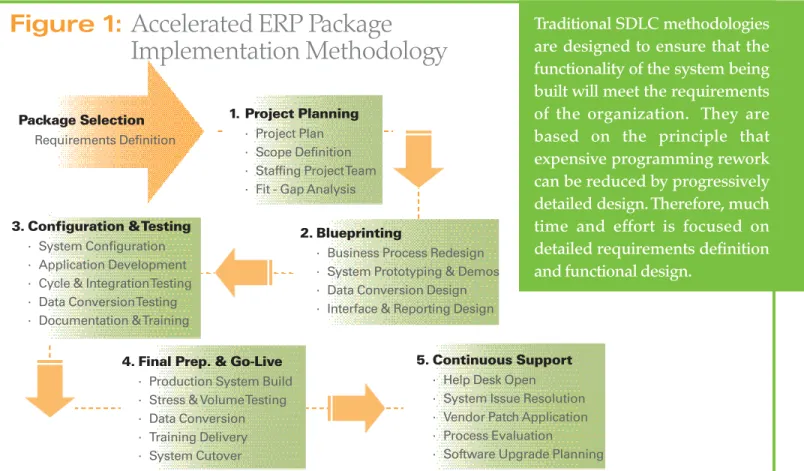
COTS ERP software provides a pre-defined system, which can be adapted to an organization’s requirements by changing configuration settings in the software. Settings can be quick-ly changed and the effects tested immediatequick-ly. Further, programming required for a modern web-based system is usually less than that required for older mainframe-based systems. This process is faster and less expensive than making changes to custom-built systems of similar complexity where each code change must be designed, specified, developed and tested in much greater detail. It is therefore more effective and efficient, in COTS implementations, to use a prototyping methodology based on rapid implementation and continu-ous validation and refinement. A comprehensive COTS ERP implementation methodology such as the one presented in
Figure 1 can significantly reduce the number of paper
deliv-erables required in the project, allowing resources to be redirected to more value-added activities in the system, such as configuring and testing for results.
|
Rethinking Requirements
Definition & Package Selection
Many public sector organizations spend months—some-times even years to compile detailed documents that spell out each required function and feature, such as the ability to define a chart of accounts or to maintain a general ledger. The ostensible purpose of these documents is:• To assist the organization in selecting the right software package, and
• To guide the design of the system to meet the requirements. In our experience, detailed listings of required features rarely differentiate the successful package in the selection process. Any ERP package that has been successfully imple-mented at a peer organization within an industry group contains most of the features required by other organizations in the group. This is why the federal government’s Joint Financial Management Improvement Program (JFMIP) soft-ware certification process centrally evaluates and certifies whether ERP software packages support basic federal finan-cial management requirements. Federal agencies can rely on this testing to screen out packages that cannot meet basic
Package Selection
Requirements Definition
2. Blueprinting
· Business Process Redesign · System Prototyping & Demos · Data Conversion Design · Interface & Reporting Design
3. Configuration & Testing
· System Configuration · Application Development · Cycle & Integration Testing · Data Conversion Testing · Documentation & Training
4. Final Prep. & Go-Live
· Production System Build · Stress & Volume Testing · Data Conversion · Training Delivery · System Cutover
5. Continuous Support
· Help Desk Open · System Issue Resolution · Vendor Patch Application · Process Evaluation · Software Upgrade Planning
1. Project Planning
· Project Plan · Scope Definition · Staffing Project Team · Fit - Gap Analysis
Traditional SDLC methodologies are designed to ensure that the functionality of the system being built will meet the requirements of the organization. They are based on the principle that expensive programming rework can be reduced by progressively detailed design. Therefore, much time and effort is focused on detailed requirements definition and functional design.
Figure 1:
Accelerated ERP Package
federal requirements but will not be able to distinguish between two JFMIP-certified packages based on functions and features alone.
Instead, resources would be better used in defining requirements in the form of mandatory business process scenarios, unique to the organization, which must be supported using the software. The competing software vendors can then be asked to demon-strate to the selection team how these scenarios are executed in their system. Second, since COTS systems only allow limited customization, detailed feature listings do not always serve to guide system design. We have observed that many of these unique feature-based requirements serve no purpose other than to replicate the way the legacy systems work. They are usu-ally eliminated when the project team details the way the business process will work in the new system. Therefore, COTS ERP requirements definition should focus on business processes and not the detailed features and functions desired in the system.
Finally, it should also be noted that package selection is conducted within the context of an organization’s infor-mation system architecture, and the acquisition of an ERP system is not a one-time transaction but a partner-ship with the vendor to design and maintain an important component of the organization’s critical information systems over a long period. Indeed a timeframe of 10 years or more is not unusual while considering the lifetime of a public sector system. Therefore, rather than evaluating a package with a point-in-time checklist, public sector entities would do better to evaluate references to determine how the soft-ware vendor has met requirements over time by delivering new features and supporting its customers.
|
Better Project
Planning
Scope Definition
One of the most important tasks in the project-planning phase is deter-mining the scope of the project—which processes are to be automated and/or systems to be replaced. This is a very difficult balancing act involving many
trade-offs. Decrease the scope and you no longer achieve all the benefits of an integrated system. Increase the scope too much and you dramatically increase the risk of schedule delays and cost overruns. First-time ERP implementations must select an achievable scope to build confidence in the organization’s ability to succeed with a COTS solution, even if it means deferring the implementation of less critical business processes.
Some organizations define the scope of the ERP imple-mentation to simply replace the human resource or property accounting systems while leaving the general ledger or the budget execution system to be implemented at a future date. However, since these components are at the core of financial information integration within any public sector entity, excluding them from the project scope wastes resources. The project team ends up implementing parts of these modules on a temporary basis until the existing general ledger and budget execution systems can be replaced. Implementing budget execution, general ledger accounting, accounts payable and accounts receivable before considering other functionality reduces uncertainty regarding information integration and, in particular, the accounting codes to be used by all other modules. It is therefore imperative when working with public sector organizations to implement these modules first. On the other hand, less central processes such as human resource and property accounting can be deferred without creating unnecessary rework.
Project Staffing
Based on our experience and available research, composi-tion of the project team is one of the most critical factors for success or failure of ERP system implementations.3 Composition of the project team must take into account two critical skills:
• Understanding of existing business processes and • Understanding of the business processes embodied in the
software.
Operational personnel typically understand the existing business processes of the organization. It is therefore critical that these operational personnel be assigned to the project. An ERP implementation is probably the most pervasive change project any organization will ever undertake. It is surprising, given the project’s importance to the organization, that public sector organizations have difficulty assigning operational personnel to work on their ERP implementations.
The typical reason given is that these individuals cannot be released from their day-to-day duties. This is ironic given that the project will probably redesign those very duties and that knowledge of the new processes will be critical to the per-formance of those duties when the system goes live. Indeed, we have worked on public sector projects in which contractors were assigned to the implementation on a full-time basis rather than permanent civil servants. This type of staffing sig-nificantly increases the risk that system and new process expertise gained by the organization during the project will walk out the door with a contractor.
In addition, project implementations by their nature are extremely stressful assignments with arduous work
schedules. Therefore, it’s not surprising that given the choice, many individu-als opt out of working on ERP system implementations. Public sector entities need to consider additional positive incentives—including monetary awards—to attract the most talented employees to work on their ERP system implementations even if it means requesting additional legislative authority to do so.
ERP system implementations require the organization to make hundreds if not thousands of policy and procedur-al choices. Since the early choices have a major impact on subsequent ones, it is critical that the team clearly identify the risks related to the various options. Relevant prior implementation experi-ence not only helps identify risky designs early but also provides keen insight into how one should redesign business processes. Because this insight only comes with the hindsight of a full-cycle implementation, public sector entities generally must rely on the experience of consultants. Many ERP implementation consultants, however, only have experience in the private sec-tor. To improve the chances of success, the public sector organization’s team must include consultants who have implemented ERP solutions in similar organizations. Organizations can ensure this by checking the references of the contractor personnel who will be assigned to the project. Personal inter-views should be conducted with all key contractor personnel.
Success by Design
During the blueprinting phase, the team designs the ‘to be’ business processes and validates them against the organization’s business process scenarios. Since redesign of the business process is best conducted in the context of the reference process embodied in the software, detailed business process reengineering prior to selecting the ERP package is of limited value and can actually inhibit the implementation process. It is important to obtain a good fit between the refer-ence business processes of the vendor and the ‘to be’ business processes of the organization. A poor fit will increase both implementation and maintenance cost over time and can com-plicate business operations.
The blueprinting process is improved significantly if a pro-totype system has been set up to demonstrate the processes embodied in the software. We have experienced public sector implementations in which the prototyping system didn’t become available until after the design process was complete. Without such a demonstration system, there is never much disagreement about a solution because there is never enough substance to disagree about. Only in a system demonstration, all of the details—how a transaction will be entered, what information will be required by users and the actual results of the process—are presented without the generalities that create misunderstandings. The hardware and software for the demonstration system must be quickly installed and made available to the project team so that a prototype system can be developed to demonstrate processes and features to all.
|
Reducing Risk with
Repetitive Testing
The configuration and testing phase is focused primarily on implementing the needed system settings and validating them. During this phase, increasingly detailed and more com-plex tests are performed until the tests prove that the system will work in a real operational environment. About 45 per-cent of all project time should be consumed during this phase.4 The more times the testing cycle is repeated, the lower the risk of undetected errors being propagated to the production system. The general rule of thumb is that fixing errors in production can be up to 10 times costlier than during testing because corrections must be made not just to configuration, but also to related business processes, interfaces, reports, security, user procedures and erroneous data.
Some public sector COTS implementations try to produce fewer testing errors by ‘freezing’ changes to configuration. This approach, intended to reduce test errors, can actually increase project risk by hindering the implementation team’s ability to correct known issues and by increasing the time required to complete a cycle of testing. Since only through changing the testing system will errors be mitigated or resolved, software or business process-related changes cannot be frozen but must be managed effectively.
Testing a COTS ERP system implementation generally consists of unit testing—which is testing individual transactions—and scenario or cycle testing—which tests the chain of transactions that complete a business process. Integration testing is final testing of all busi-ness processes including interfaces and converted data.It tries to emulate how the ERP software system will run in production.Typical ERP methodologies have a minimum of four cycles of scenario- level testing and two cycles of comprehensive integration-level testing.
|
Preparing for a Smooth Launch
Data conversion is one of the most complex and risky activities in an ERP implementation. COTS ERP systems usually have more data quality and integrity checks and are much more integrated than legacy systems. Data from lega-cy systems must therefore be corrected or further processed to meet the new rules before it can be fed into the ERP system. Further, this activity must be conducted in a compressed time frame to minimize disrupting business during the switch from the legacy to the new system.Carefully limiting the volume and detail of historical data to be converted is the best way to reduce this risk. Public sector implementations, however, typically convert signifi-cantly larger volumes of data when compared to private sector projects. This is due in part to both legal and system integration requirements associated with fund accounting. For example, purchase orders have little effect on financial statements in the private sector but affect both the budgetary accounts and the balance sheet accounts in the public sector. Therefore, the only way to minimize the risks associated with data conversion is to practice as many times as practical. This is best accomplished by feeding the data into the integration testing system and checking its validity during integration testing by having the testers use converted data as a part of their tests.
|
Retaining Staff for
Continuous Support
Sustained success of any ERP system implementation is directly dependent on the availability of individuals with the proper process and system knowledge to support it. For the most part, the project team gains this knowledge during implementation. Training begins from the time the prototype system is first demonstrated and effectively never ends.
Often when talented public sector employees step up to the task of working on a system implementation, they work on the project temporarily and then return to their former positions with little or no direct responsibilities for the stabi-lization and maintenance of the COTS system. As a result, much of the critical knowledge transferred to civil servants during the implementation is not available to the support team during the production support phase. Public sector organi-zations must create incentives to retain the individuals who have made the effort to acquire this knowledge; otherwise, they will become more dependent on external contractors to support their critical administrative systems and processes.
Summary of Best
Implementation Practices
1.Implementation Methodology: Use a prototyping methodology based on rapid implementation and continuous validation and refinement.
2.Requirements Definition and Package Selection: Define requirements in the form of business process scenarios and evaluate how vendor has met requirements over time.
3.Project Scoping: Define achievable scope and implement core financial system first.
4.Project Staffing: Assign operational personnel to project, provide them with incentives and ensure that consultants have experience in public sector projects.
5.System Design: Fit the process to the system and use a demonstration system to evaluate fit.
6.Integration Testing: Test early, test often and correct the errors uncovered.
7.System Conversion: Limit data conversion and repeatedly test converted data.
8.Continuous Support: Retain implementation team veterans for support.
|
Conclusion
While research has focused on the critical success factors for implementing ERP systems, the debate over best practices has not been settled. We hope that these practices will help public sector organizations improve their ERP implementa-tion strategy and will also generate addiimplementa-tional research.
End Notes
1. Martin, M.H. “An ERP Strategy,” Fortune, February 2, 1998, pp. 95-97. 2. Nah, Fiona Fui-Hoon, Zuckweiler, Kathryn M. & Lau, Janet Lee-Shang (2003). ERP Implementation: Chief Information Officers’ Perceptions of Critical Success Factors, International Journal of Human-Computer Interaction, 16(1), pp. 5-22.
3. Ibid.
4. SAP AG, (1998). “ASAP91—SAP Implementation,” Participant Handbook, Rel. 4.6a, December 1999, app 1.
Glenn A. Thomas, MBA, CGFM, a member of AGA’s Northern Virginia Chapter, is a financial systems consultant specializing in federal agency implementations for SAP Public Services, Inc. For more than 14 years, he has worked with federal agencies to improve their financial management process-es, including five years with the U.S. General Accounting Office.
Shyam Jajodia, CPA, is director of Public Services at Labyrinth Solutions Inc., a consulting company specializing in ERP implementation in the public sector. He has more than 15 years of experience as an information-systems professional and consultant in the government and nonprofit sector, and has assisted a number of federal government agencies and universities imple-ment ERP systems.
j