ORDINARY LEAST SQUARES REGRESSION OF ORDERED CATEGORICAL DATA:
INFERENTIAL IMPLICATIONS FOR PRACTICE
by
BETH R. LARRABEE
B.S., Kansas State University, 2009
A REPORT
submitted in partial fulfillment of the requirements for the degree
MASTER OF SCIENCE
Department of Statistics
College of Arts and Sciences
KANSAS STATE UNIVERSITY
Manhattan, Kansas
2011
Approved by:
Major Professor
Dr. Nora Bello
Abstract
Ordered categorical responses are frequently encountered in many disciplines. Examples
of interest in agriculture include quality assessments, such as for soil or food products, and
evaluation of lesion severity, such as teat ends status in dairy cattle. Ordered categorical
responses are characterized by multiple categories or levels recorded on a ranked scale that,
while apprising relative order, are not informative of magnitude of or proportionality between
levels. A number of statistically sound models for ordered categorical responses have been
proposed, such as logistic regression and probit models, but these are commonly underutilized in
practice. Instead, the ordinary least squares linear regression model is often employed with
ordered categorical responses despite violation of basic model assumptions. In this study, the
inferential implications of this approach are investigated using a simulation study that evaluates
robustness based on realized Type I error rate and statistical power.
The design of the simulation
study is motivated by applied research cases reported in the literature. A variety of plausible
scenarios were considered for simulation, including various shapes of the frequency distribution
and different number of categories of the ordered categorical response. Using a real dataset on
frequency of antimicrobial use in feedlots, I demonstrate the inferential performance of ordinary
least squares linear regression on ordered categorical responses relative to a probit model.
iii
Table of Contents
List of Figures ...v
List of Tables ... xi
Acknowledgements ... xii
Dedication ...xiv
Chapter 1 - Literature Review ...1
1.1 Introduction ...1
1.2 Ordered Categorical Responses ...2
1.3 Statistically Sound Methods for Ordered Categorical Data ...4
1.3.1 Probit ...4
1.3.2 Proportional Odds Logistic ...5
1.3.3 Multinomial Model ...7
1.4 Interval Methods of Practical Use ...8
1.4.1 T-test ...9
1.4.2 ANOVA ... 10
1.4.3 Ordinary Least Squares Linear Regression ... 12
1.5 Summary ... 13
Chapter 2 - Ordinary Least Squares Regression of Ordered Categorical Data ... 14
2.1 Introduction ... 14
2.2 Data Simulation Methods ... 16
2.3 Analysis ... 24
2.4 Results ... 25
2.4.1 Type I Error ... 25
2.4.2 Statistical Power ... 28
2.4.3 Inferences on Slope ... 36
2.5 Case Study Based on Real Data ... 39
2.6 Discussion ... 41
2.7 Future Directions ... 43
iv
2.9 Final Remarks ... 45
References ... 47
Appendix A - Appendix A: Empirical Distributions of Slope ... 50
Appendix B - Appendix B: Simulation Code for
β
* =
0
Condition ... 66
v
List of Figures
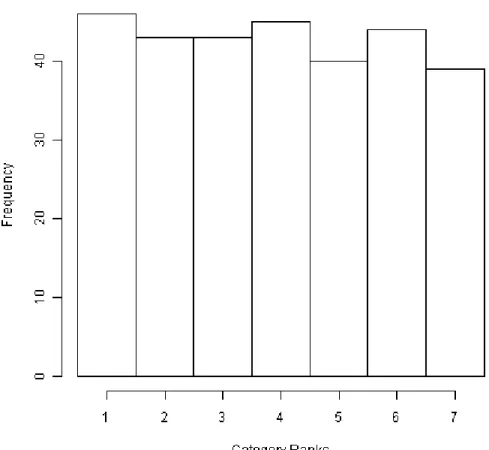
Figure 2-1 Realization of a simulated ordered categorical response with 7 levels and a
Uniformly-Shaped frequency distribution. Histogram is based on a single simulated Monte
Carlo replication with 300 observations. ... 20
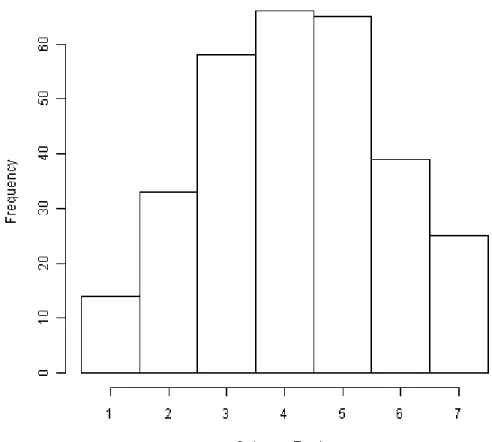
Figure 2-2Realization of a simulated ordered categorical response with 7 levels and a
Bell-Shaped frequency distribution. Histogram is based on a single simulated Monte Carlo
replication with 300 observations... 21
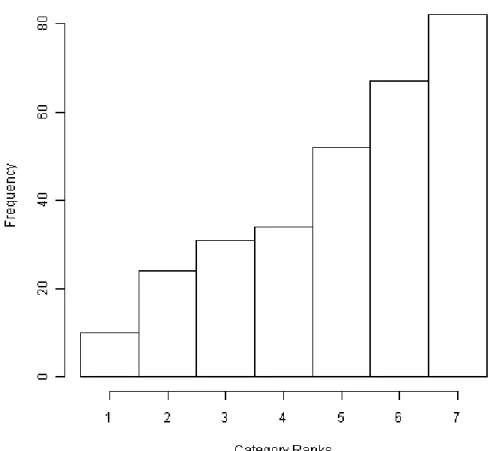
Figure 2-3 Realization of a simulated ordered categorical response with 7 levels and a
Triangularly-Shaped frequency distribution. Histogram is based on a single simulated
Monte Carlo replication with 300 observations. ... 22
Figure 2-4 Realization of a simulated ordered categorical response with 7 levels and a
Exponentially-Shaped frequency distribution. Histogram is based on a single simulated
Monte Carlo replication with 300 observations. ... 23
Figure 2-5 Empirical Type I error for inference on H
0)
β
= 0 based on ordinary least squares
linear regression fitted to an ordered categorical response characterized by increasing
number of levels and Uniform, Bell, Triangular, or Exponentially shaped frequency
distributions. Each scenario is represented by 4000 Monte Carlo replications. The figure
represents settings where the explanatory covariate consisted of 51 levels (
x
i(51)) ranging
from -50 to 50 in intervals of 2. Bounds on
correspond to 2.5th and 97.5th percentiles of
a binomial distribution with probability of 5% and size = 4000, expressed as a proportion. 26
Figure 2-6 Empirical Type I error for inference on H
0)
β
= 0 based on ordinary least squares
linear regression fitted to an ordered categorical response characterized by increasing
number of levels and Uniform, Bell, Triangular, or Exponentially shaped frequency
distributions. Each scenario is represented by 4000 Monte Carlo replications. The figure
represents settings where the explanatory covariate consisted of 5 levels (
x
i(5)) ranging from
-50 to 50 in intervals of 25. Bounds on
correspond to 2.5th and 97.5th percentiles of a
binomial distribution with probability of 5% and size = 4000, expressed as a proportion. .. 27
Figure 2-7 Empirical statistical power for correctly rejecting H
0)
β
= 0 based on a probit or
ordinary least squares linear regression fitted to an ordered categorical response
characterized by increasing number of levels with a Uniformly-Shaped frequency
vi
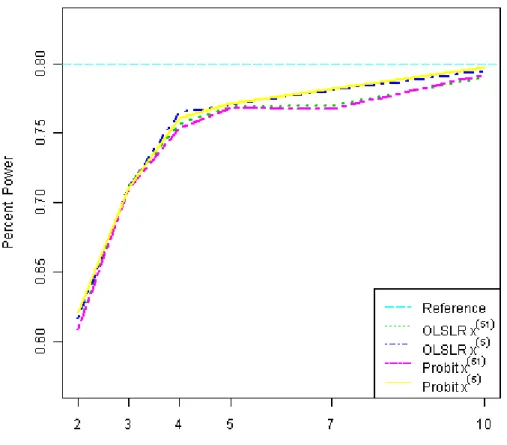
distribution. Slope on the latent variable used to generate the data is 1. The figure
represents settings where the explanatory covariate consisted of either 51 levels (x
(51))
ranging from -50 to 50 in intervals of 2 or 5 levels (x
(5)) ranging from -50 to 50 in intervals
of 25. ... 30
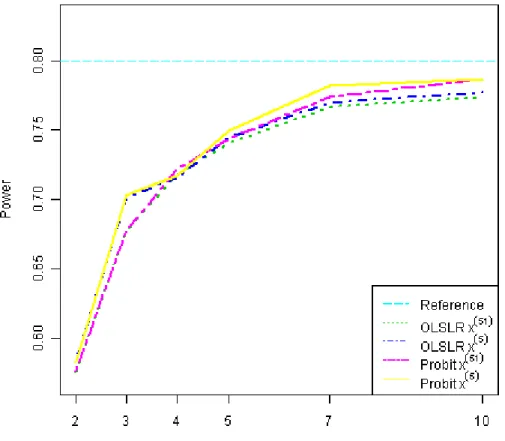
Figure 2-8 Empirical statistical power for correctly rejecting H
0)
β
= 0 based on a probit or
ordinary least squares linear regression fitted to an ordered categorical response
characterized by increasing number of levels with a Bell-Shaped frequency distribution.
Slope on the latent variable used to generate the data is 1. The figure represents settings
where the explanatory covariate consisted of either 51 levels (x
(51)) ranging from -50 to 50
in intervals of 2 or 5 levels (x
(5)) ranging from -50 to 50 in intervals of 25. ... 31
Figure 2-9 Empirical statistical power for correctly rejecting H
0)
β
= 0 based on a probit or
ordinary least squares linear regression fitted to an ordered categorical response
characterized by increasing number of levels with a Triangularly-Shaped frequency
distribution. Slope on the latent variable used to generate the data is 1. The figure
represents settings where the explanatory covariate consisted of either 51 levels (x
(51))
ranging from -50 to 50 in intervals of 2 or 5 levels (x
(5)) ranging from -50 to 50 in intervals
of 25. ... 32
Figure 2-10 Empirical statistical power for correctly rejecting H
0)
β
= 0 based on a probit or
ordinary least squares linear regression fitted to an ordered categorical response
characterized by increasing number of levels with an Exponentially-Shaped frequency
distribution. Slope on the latent variable used to generate the data is 1. The figure
represents settings where the explanatory covariate consisted of either 51 levels (x
(51))
ranging from -50 to 50 in intervals of 2 or 5 levels (x
(5)) ranging from -50 to 50 in intervals
of 25. ... 33
Figure 2-11 Empirical Type statistical power for inference on H
0)
β
= 0 based on ordinary least
squares linear regression fitted to an ordered categorical response characterized by
increasing number of levels and Uniform, Bell, Triangle, or Exponentially shaped frequency
distributions. Ordered categorical variables generated from a latent variable with slope of 1.
Each scenario is represented by 4000 Monte Carlo replications. The figure represents
settings where the explanatory covariate consisted of 51 levels (
x
i(51)) ranging from -50 to
vii
Figure 2-12 Empirical Type statistical power for inference on H
0)
β
= 0 based on ordinary least
squares linear regression fitted to an ordered categorical response characterized by
increasing number of levels and Uniform, Bell, Triangle, or Exponentially shaped frequency
distributions. Ordered categorical variables generated from a latent variable with slope of 1.
Each scenario is represented by 4000 Monte Carlo replications. The figure represents
settings where the explanatory covariate consisted of 5 levels (
x
i(5)) ranging from -50 to 50
in intervals of 25. ... 35
Figure 2-13 Empirical sampling distribution for the slope parameter estimate obtained from
fitting ordinary least squares linear regression to an ordered categorical response with 2
Levels and a Uniformly-Shaped frequency distribution. The histogram is based on 4000
Monte Carlo replications generated under the condition that
β
*
= 0. The figure represented
the setting where the explanatory covariate consisted of 51 Levels (
x
(51))
ranging from -50 to
50 in increments of 2. ... 37
Figure 2-14 Empirical sampling distribution for the slope parameter estimate obtained from
fitting ordinary least squares linear regression to an ordered categorical response with 2
Levels and a Uniformly-Shaped frequency distribution. The histogram is based on 4000
Monte Carlo replications generated under the condition that
β
*
= 1. The figure represented
the setting where the explanatory covariate consisted of 51 Levels (
x
(51))
ranging from -50 to
50 in increments of 2. ... 38
Figure A-1 Empirical sampling distribution for the slope parameter estimate obtained from
fitting ordinary least squares linear regression to an ordered categorical response with 3
Levels and a Uniformly-Shaped frequency distribution. The histogram is based on 4000
Monte Carlo replications generated under the condition that
β
*
= 0. The figure represented
the setting where the explanatory covariate consisted of 51 Levels (
x
(51))
ranging from -50 to
50 in increments of 2. ... 50
Figure A-2 Empirical sampling distribution for the slope parameter estimate obtained from
fitting ordinary least squares linear regression to an ordered categorical response with 3
Levels and a Bell-Shaped frequency distribution. The histogram is based on 4000 Monte
Carlo replications generated under the condition that
β
*
= 0. The figure represented the
setting where the explanatory covariate consisted of 51 Levels (
x
(51))
ranging from -50 to 50
in increments of 2. ... 51
viii
Figure A-3 Empirical sampling distribution for the slope parameter estimate obtained from
fitting ordinary least squares linear regression to an ordered categorical response with 3
Levels and a Triangularly-Shaped frequency distribution. The histogram is based on 4000
Monte Carlo replications generated under the condition that
β
*
= 0. The figure represented
the setting where the explanatory covariate consisted of 51 Levels (
x
(51))
ranging from -50 to
50 in increments of 2. ... 52
Figure A-4 Empirical sampling distribution for the slope parameter estimate obtained from
fitting ordinary least squares linear regression to an ordered categorical response with 3
Levels and an Exponentially-Shaped frequency distribution. The histogram is based on
4000 Monte Carlo replications generated under the condition that
β
*
= 0. The figure
represented the setting where the explanatory covariate consisted of 51 Levels (
x
(51))
ranging from -50 to 50 in increments of 2. ... 53
Figure A-5 Empirical sampling distribution for the slope parameter estimate obtained from
fitting ordinary least squares linear regression to an ordered categorical response with 10
Levels and a Uniformly-Shaped frequency distribution. The histogram is based on 4000
Monte Carlo replications generated under the condition that
β
*
= 0. The figure represented
the setting where the explanatory covariate consisted of 51 Levels (
x
(51))
ranging from -50 to
50 in increments of 2. ... 54
Figure A-6 Empirical sampling distribution for the slope parameter estimate obtained from
fitting ordinary least squares linear regression to an ordered categorical response with 10
Levels and a Bell-Shaped frequency distribution. The histogram is based on 4000 Monte
Carlo replications generated under the condition that
β
*
= 0. The figure represented the
setting where the explanatory covariate consisted of 51 Levels (
x
(51))
ranging from -50 to 50
in increments of 2. ... 55
Figure A-7 Empirical sampling distribution for the slope parameter estimate obtained from
fitting ordinary least squares linear regression to an ordered categorical response with 10
Levels and a Triangularly-Shaped frequency distribution. The histogram is based on 4000
Monte Carlo replications generated under the condition that
β
*
= 0. The figure represented
the setting where the explanatory covariate consisted of 51 Levels (
x
(51))
ranging from -50 to
50 in increments of 2. ... 56
ix
Figure A-8 Empirical sampling distribution for the slope parameter estimate obtained from
fitting ordinary least squares linear regression to an ordered categorical response with 10
Levels and a Exponentially-Shaped frequency distribution. The histogram is based on 4000
Monte Carlo replications generated under the condition that
β
*
= 0. The figure represented
the setting where the explanatory covariate consisted of 51 Levels (
x
(51))
ranging from -50 to
50 in increments of 2. ... 57
Figure A-9 Empirical sampling distribution for the slope parameter estimate obtained from
fitting ordinary least squares linear regression to an ordered categorical response with 3
Levels and a Uniformly-Shaped frequency distribution. The histogram is based on 4000
Monte Carlo replications generated under the condition that
β
*
= 1. The figure represented
the setting where the explanatory covariate consisted of 51 Levels (
x
(51))
ranging from -50 to
50 in increments of 2. ... 58
Figure A-10 Empirical sampling distribution for the slope parameter estimate obtained from
fitting ordinary least squares linear regression to an ordered categorical response with 3
Levels and a Bell-Shaped frequency distribution. The histogram is based on 4000 Monte
Carlo replications generated under the condition that
β
*
= 1. The figure represented the
setting where the explanatory covariate consisted of 51 Levels (
x
(51))
ranging from -50 to 50
in increments of 2. ... 59
Figure A-11 Empirical sampling distribution for the slope parameter estimate obtained from
fitting ordinary least squares linear regression to an ordered categorical response with 3
Levels and a Triangularly-Shaped frequency distribution. The histogram is based on 4000
Monte Carlo replications generated under the condition that
β
*
= 1. The figure represented
the setting where the explanatory covariate consisted of 51 Levels (
x
(51))
ranging from -50 to
50 in increments of 2. ... 60
Figure A-12 Empirical sampling distribution for the slope parameter estimate obtained from
fitting ordinary least squares linear regression to an ordered categorical response with 3
Levels and an Exponentially-Shaped frequency distribution. The histogram is based on
4000 Monte Carlo replications generated under the condition that
β
*
= 1. The figure
represented the setting where the explanatory covariate consisted of 51 Levels (
x
(51))
x
Figure A-13 Empirical sampling distribution for the slope parameter estimate obtained from
fitting ordinary least squares linear regression to an ordered categorical response with 10
Levels and a Uniformly-Shaped frequency distribution. The histogram is based on 4000
Monte Carlo replications generated under the condition that
β
*
= 1. The figure represented
the setting where the explanatory covariate consisted of 51 Levels (
x
(51))
ranging from -50 to
50 in increments of 2. ... 62
Figure A-14 Empirical sampling distribution for the slope parameter estimate obtained from
fitting ordinary least squares linear regression to an ordered categorical response with 10
Levels and a Bell-Shaped frequency distribution. The histogram is based on 4000 Monte
Carlo replications generated under the condition that
β
*
= 1. The figure represented the
setting where the explanatory covariate consisted of 51 Levels (
x
(51))
ranging from -50 to 50
in increments of 2. ... 63
Figure A-15 Empirical sampling distribution for the slope parameter estimate obtained from
fitting ordinary least squares linear regression to an ordered categorical response with 10
Levels and a Triangularly-Shaped frequency distribution. The histogram is based on 4000
Monte Carlo replications generated under the condition that
β
*
= 1. The figure represented
the setting where the explanatory covariate consisted of 51 Levels (
x
(51))
ranging from -50 to
50 in increments of 2. ... 64
Figure A-16 Empirical sampling distribution for the slope parameter estimate obtained from
fitting ordinary least squares linear regression to an ordered categorical response with 10
Levels and an Exponentially-Shaped frequency distribution. The histogram is based on
4000 Monte Carlo replications generated under the condition that
β
*
= 1. The figure
represented the setting where the explanatory covariate consisted of 51 Levels (
x
(51))
xi
List of Tables
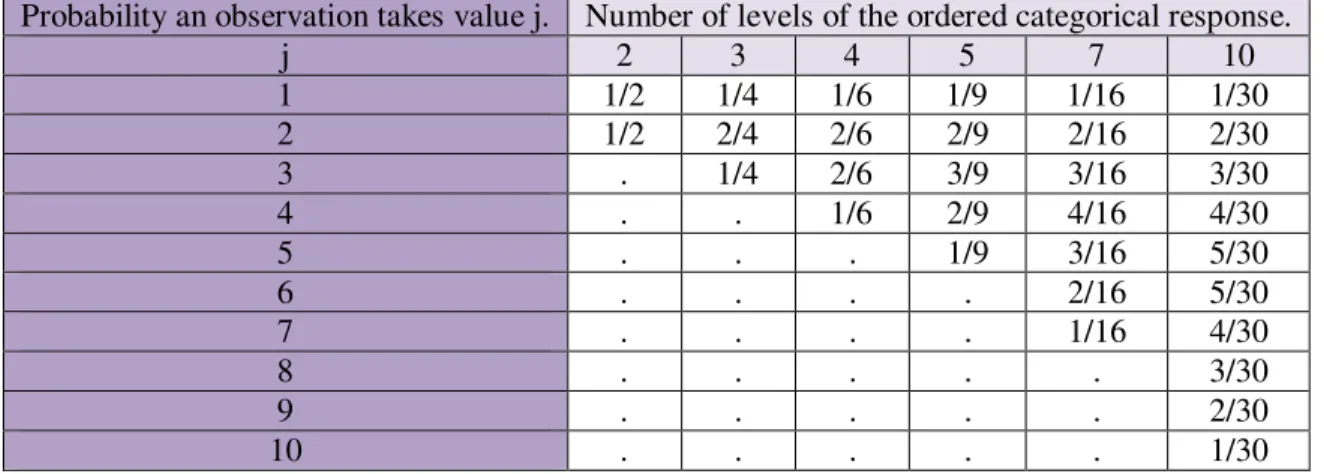
Table 2-1 Probabilities used to define latent-scale thresholds separating sequentially-ranked
levels of an ordered categorical response with a Uniformly-Shaped frequency distribution.
... 18
Table 2-2 Probabilities used to define latent-scale thresholds separating sequentially-ranked
levels of an ordered categorical response with a Bell-Shaped frequency distribution. ... 18
Table 2-3 Probabilities used to define latent-scale thresholds separating sequentially-ranked
levels of an ordered categorical response with a Triangularly-Shaped frequency distribution.
... 19
Table 2-4 Probabilities used to define latent-scale thresholds separating sequentially-ranked
levels of an ordered categorical response with an Exponentially-Shaped frequency
xii
Acknowledgements
In reflecting on my time here at K-State, it strikes me how many people have helped me
along the way. Dr. Loughin showed me his data cloud and wrote me a reference, Dr. Gadbury
helped me with R, Dr. Boyer helped me network, Dr. Higgins answered questions for me even
when I wasn’t in his class, Dr. Dubnicka worked with me extensively in regard to theory in
addition to offering me more personal advice, Robert taught me the Cholesky decomposition,
Karen taught me order statistics, and Troy helped with matrix concepts. I could go on and on in
this fashion. I think if I were to properly acknowledge everyone, this section might be as long as
the report. Instead, let me briefly mention my role models and a few people that have really
helped me a lot along the way.
First and foremost, Dr. Bello is an amazing major professor and role model. She
tirelessly worked with me on this project. She was receptive to my questions in regard to subject
matter, R code, writing, presenting, and even what to wear on an interview. She allowed me the
opportunity to try and do things for myself and encouraged me to grow by offering suggestions
for improvement. She was a great support to me through every stage of this process and I feel
very fortunate to have had a major professor that was there for me so fully. It is her level of
attention to detail, quality of work, and constant professionalism that I should strive to attain.
The department is lucky to have her.
I would also like to mention Dr. Murray, the next of my role models. Dr. Murray has
played an important part in the careers of many of us. I appreciate her taking the time to explain
things in a clear fashion and for guiding me through my consulting projects, regardless of the
kind of complication I was encountering. I am grateful to have had the opportunity to work on
“real” problems and to have had her as my supervisor during this process. It is through watching
Dr. Murray that I may learn how to be an excellent consultant. She explains things to clients in
such a way that they can understand, she is sensitive to how she is impacting the researchers as
people, she is careful in her documentation, and her time management skills are something to be
applauded.
Seth Demel has been essential to my functioning in this department. He tutored me
extensively in Theory I, Theory II and Theory of Linear Models. He was there to comfort me
xiii
when I fell and congratulate me when I succeeded. He is a true friend and I am thankful for all
he has done for me.
Finally, I would like to extend my gratitude to my family. My mother and my sister have
been helping me with my daughter, Maya, since she was born. During the final weeks of my
graduate work they allowed Maya to live with them so that I could stay at school until late in the
night and come back directly in the morning. I am not confident that I could have finished in a
timely fashion without their support. I am appreciative that my daughter is also understanding
of my situation as she has handled the whole situation with a grace and understanding that far
surpasses her age.
It is said that it takes a community to raise a child. It certainly has to raise mine. I think
the same could be said of “raising a graduate student.” Thank you to everyone that has been a
part of my supporting community during my academic infantile stage, you have been great
parents.
xiv
Dedication
I would like to dedicate this work to my daughter, Maya, the one person who can always make
me smile. May she have happiness all of her days. I love you sunshine-passion-flower.
1
Chapter 1 - Literature Review
1.1 Introduction
Ordered categorical responses are prevalent in modern practice. For example, in
medicine, endometrial cancer may be indicated with an ordered categorical response such that
patients are classified as in the diseased state or not in the diseased state (Xu et al., 2007). In
sensory analysis such outcomes may be utilized to describe preferences with the categories
“excellent, very good, good, neutral, poor, and very poor” (Snell, 1964). In public health,
ordered categorical responses have been used to study student tobacco and health knowledge by
forming categories of correct responses to a survey (Hedeker & Gibbons, 1994). In nutrition,
they may be employed to examine macronutrient and micronutrient intake by grouping a
continuous variable into quintiles (Xu et al., 2007). In genetics, they may be used to study
phenotype as it relates to genotype by looking whether or not animals with specific genetics have
0, 1, 2, 3, 4, or more dead fetuses at a various time points of gestation (Yi, Samprit, & Yandell,
2007). Within psychology, ordered replies may be used to study oppositional defiant disorder by
measuring an individual’s reported maladaptive behavior on a frequency of occurrence scale
consisting of the categories, “never in the past month”, “1-2 times in the past month”, “3-4 times
in the past month”, “2-4 times per week”, “1 time per day”, “2-5 times per day”, “6-9 times per
day”, and “10 or more times per day” (Taylor, Burns, Rusby & Foster, 2006). The final score
on the Quality of Life in Schizophrenia Survey is also composed of ranked levels, namely,
“severely compromised quality of life”, “moderately compromised quality of life”, and
“unaltered quality of life” (Abreu, Siqueira, Cardoso, & Caiaffa, 2008). In environmental
science, quality of evaluation of greenhouse emissions may be recorded as A for the highest
quality, most direct assessments through D for fully estimated assessments (
U.S.,
n.d.). NIH
research funding is evaluated using a crude scale of the integers 1 through 5 for less competitive
grants and a more refined scale between 1 through 5, moving in .1 increments, for more
competitive grants (Johnson, 2008).
The objective of the following review of the literature is to discuss the unique
characteristics of ordered categorical data and to examine statistical methods utilized to infer
upon these data.
2
1.2 Ordered Categorical Responses
Ordered categorical responses can be conceptualized as being a discretization of an
underlying continuous latent variable, usually with a normal distribution (Abreu et al., 2008;
Agresti, 1990; Liu & Agresti, 2005; McCullagh, 1980; Winship & Mare, 1984). Let
ω
Equation 1
where
y
i*
is the
i
threalized value of a latent variable defined in the range (-
∞
,
∞
),
ω
*
is an
intercept parameter,
β
*
is a slope parameter,
x
iis the
i
thfixed value for
x,
and
ε
i*
is the error
associated with the
i
thobservation. Let the ordered categorical realization of
Y*
be denoted by
Y
,
whereby
y
iassumes values
j
= 1,...,
J
. Let there be
J+1
cutpoints
τ
m,
m
= 0,... ,
J,
so that
1
2
∞
!
J#$
∞
%
It then follows that:
&'
() &'
* +,# *+,)
that is, the probability that
y
i= j
is the probability that
y
i*
takes a value between
*+,#and
-+..
One may then see that ordered categorical frequency distribution functions may assume a
variety of shapes dependent on the placement of the cutpoints
τ
.
According to Javaras and
Ripley (2007), ordered categorical data that are generated as human reactions to a survey tend to
be influenced by response styles and are frequently asymmetrical. An exemplification of this
may be seen in outcomes from quality of life scales (Abreu et al., 2008) and in responses to
antimicrobial use in feedlot cattle (McIntosh et al., 2009). One can imagine a variety of
scenarios where ordered categorical variables might have frequency distributions that assume
any number of shapes. In fact, in the paper by McIntosh et al. (2009), the probability distribution
functions of various ordered categorical responses to antimicrobial use in feedlot cattle assumed
a range of symmetric and skewed shapes.
It should be noted that, in contrast to continuous variables which have an infinite number
of possible levels that they may assume, ordered categorical responses may only assume a finite
number of levels. For illustrative purposes, I may examine previously mentioned examples in
relation to their number of levels. Endometrial cancer was indicated with a 2-level ordered
3
categorical response: disease absent or disease present (Xu et al., 2007). The final score on the
Quality of Life in Schizophrenia had an additional level, being composed of 3 ordered levels
(Abreu et al., 2008). Quality of measurements of green house emissions (U.S., n.d. ) were
studied using a 4-level ordered categorical response, while micronutrient and macronutrient
intake were examined with a 5-level ordered categorical response (Xu et al., 2007). A 6-level
ordered categorical response was utilized to investigate stillbirth phenotype in mice (Yi et al.,
2007), the survey for student tobacco and health knowledge has 7 levels (Hedeker & Gibbons,
1994), while oppositional defiant disorder was studied using an 8-level outcome (Taylor et al.,
2006). According to Johnson (2008), NIH research funding is evaluated using a 10-level scale
for less competitive grants and a 50-level scale for more competitive grants. The numerical
recording of ordered categorical responses, especially when the ordered categorical responses
have many levels, may potentially lead to confusion as to the theoretically sound methods for
data analysis and inference.
Ordered categorical responses are unique among discrete variables. While categorical in
nature, the ordering of their categories contains additional information about the process of
interest relative to outcomes with nominal categories. The ranking information in ordered
categorical responses may be considered, at least conceptually, to resemble that of interval data.
However, with interval data, the numeric representation of observations is reflective not only of
relative ranking but also of the magnitude of the distance between observations. In contrast, with
ordered categorical data, the numeric representation of the observations is only reflective of rank;
the distances between contiguous categories may not be proportional (Long, 1997).
Failure to recognize this subtlety seems to be rather common in practice, whereby
inferences for ordered categorical responses are often based on statistical methodology
developed for interval data (Liu & Agresti, 2005). In fact, one may find examples in the
literature where this has occurred. Before being analyzed by Yu as ordered categories, the
previously mentioned phenotype example was analyzed with interval level techniques by Rocha,
Eisen, Seiwerdt, Vleck and Pomp (2004). McIntosh et al. (2009) analyzed the numerical scores
assigned to the categories “always”, “often”, “sometimes”, “rarely” and “never” as though they
were realizations of a continuous variable. Russel and Boboko (1992) set up a scenario based
on willingness to revise a manuscript as measured by a 5-point scale ranging from “very
4
unmotivated” to “unmotivated,” where not only did they wish to employ linear regression, but to
investigate interaction effects as well.
1.3 Statistically Sound Methods for Ordered Categorical Data
A number of sound statistical techniques methodologies have been developed, and are
available, for inference on ordered categorical responses. These methods allow one to make
inferences about ordered categorical responses in a way that acknowledges the discreteness of
the response and takes advantage of the additional information contained in the ranked order of
the response categories. Amongst those statistical models most frequently encountered in
practice are the probit model and the proportional odds logistic model. If, instead, one chooses
to disregard the ordering and strictly treat the response categories as nominal, the multinomial
model can serve as an alternative choice (Abreu et al., 2008; Agresti, 1990; Liu & Agresti, 2005;
McCullagh, 1980; Winship & Mare, 1984). I now review these models in further detail.
1.3.1 Probit
When working with the probit model, as is discussed by Long (1997), I assume that the
error (
ε
i*) and the latent variable (
y*
) follow the formula in equation 1, so that the error follows a
standard normal distribution with mean zero and variance one. This probability density function
is:
φ
'
)
1
√20
1
#23The cumulative density function is:
Ф'
) 5
1
√20
1
#63 6
#7
89
The probit model then uses an inverse normal cumulative distribution function, also known as
the probit link function, to map the probability scale (0,1) onto a scale on (-
∞
,
∞
). The standard
normal cumulative distribution function is used to determine the probability of the ordered
categorical response in each ordered category. In illustration,
&'
1 |
) &'
∞
) Φ'
ω
)
&'
2 |
) &'
) Φ'
ω
) Φ'
ω
)
.
.
5
.
&'
! 1 |
) &<
J#J#
= Φ<
$#ω
= Φ'
$#ω
)
&'
! |
) &<
J#J
= 1 Φ<
$#ω
=
where all notation remains the same as it was previously defined during the delineation of the
latent variable conceptualization. In estimating model parameters,
τ
1is usually set
to zero to
ensure model identifiability. It is worth noting that fitting this model necessitates estimation of
J+
1 parameters, namely
J-
1 threshold parameters
τ
m, an intercept
ω
, and a slope,
β
. Estimating
this number of parameters may pose practical difficulties if the data are sparse in any of the
categories (Liu & Agresti, 2005). Additionally, practitioners may have a difficult time
interpreting the parameters of this model in a way that is meaningful for their audiences, causing
hesitance in use. As is further explained in Long (1997), if an appeal to a latent normal variable
seems reasonable, one is faced with the task of explaining what, in a practical sense, it means for
Y* to increase by
β
standard deviations for a unit increase in x while both Y* and it’s variance
remain unknown. It is from the analysis of partial change in probability that I get the meaning of
β
separate from the latent variable. That is, the change in estimated probability that the
j
thcategory is observed as X increases by 1 unit is:
>&'? (|@ 1) &'? (|@)A
BC ̂
*+,ω
E F'@ 1)G ΦC ̂
*+,#ω
E F'@ 1)G
BC ̂
*+,ω
E F@G BC ̂
*+,#ω
E F@G
If one wishes to make additional comments while remaining on the ordered categorical
scale, one is faced with an onerous task. A thorough analysis will utilize a variety of techniques
as no one is sufficient to capture the nonlinear relationship in the probabilities. These
approaches include investigating predicted probabilities and their ranges, both in tabular and
graphic format, and looking at partial and discrete changes in probability.
1.3.2 Proportional Odds Logistic
A popular type of model that has parameters with a somewhat clearer interpretation is the
proportional odds logistic model. In the set of all models created specifically for ordered
categorical responses, this model is the most frequently used (Liu & Agresti, 2005). As one may
learn from Abreu et al. (2008) and Agresti (1990), the proportional odds logistic model enables a
practitioner to estimate and discuss odds ratios as well as probabilities. Odds are defined as the
6
probability of success divided by the probability of failure. I may specify a success to be a
realization of the ordered categorical variable
y
in category j or less whereas a failure is being a
realization of the ordered categorical variable
y
in any remaining category. This results in an
odds model of the form:
H88I
-1 &'? ( | )
&'? ( | )
&'? ( | )
&'? J ( | )
ω
-ω
ω
K
ω
$#where
m
= 1, . . .,
J
-1 with
J
being the number of ordered categories,
ω
-are dichotomy specific
intercept parameters, and where
β
is the common slope parameter. An odds ratio (OR) for a
predictor’s effect on the response is:
LM
&'? ( |
)
&'? J ( |
)
&'? ( |
)
&'? J ( |
)
H88I
H88I
where x
1and x
2are different levels of the predictor variable; for example, exposed and
non-exposed.
In the proportional odds model, the OR is assumed to be the same for all cumulative
dichotomies of the categories of the response variable. This is commonly known as the
proportional odds assumption. According to Agresti (1990), the model structure implies
log'LM) 'P
QP
R)
so that the log of the OR is proportionate to the distances between explanatory variables for all
intercepts
ω
m. Note that it is possible to choose different thresholds
τ
isuch that the underlying
latent variable y* is regrouped into different categories of y. This will not affect
β
, but will
instead only impact the intercepts
ω
m. As is mentioned in Long (1997), the error distribution on
the latent variable is assumed to have a logistic distribution with mean zero and variance
π
2/3.
Its probability distribution function is then
S'T)
U1 1
1
2 2V
and cumulative distribution function
7
The above restraints result in simultaneously fitting
J-1
response curves that are identical in all
aspects but their intercept terms. The differing intercepts result in curves that are shifted along
the x-axis by
(
ω
m-1–
ω
m)/
β
units (Agresti, 1990).
The interpretation of parameter estimates from this model may be more easily understood
by practitioners than those from the probit model. This may be due to the higher frequency of
application of this model; however, neither this ease of comprehension nor the technique’s
frequency of use has surpassed that associated with ordinary least squares linear regression (Liu
& Agresti, 2005). As an additional impediment to a researcher choosing this model, fitting it
still requires a minimum of
J
parameters to be estimated. This means that sparse data in any of
the categories of y
may still create model fitting complications. To further exacerbate the
model-fitting process, one must contend with the fact that it may not be reasonable to impose the
proportional odds assumption. That is, assuming that the response curves in the logit link scale
share the same slope may be too restrictive; the log odds between groups of consecutive
categories may not all be the same. As a consequence, I may need to allow for different slope
parameters for each response curve
β
m, (
m
= 1, . . .,
J
) in the logit scale. Note that when building
a model with multiple covariates, the proportional odds model insists that all covariates meet the
proportional odds assumption. In contrast, a statistical methodology called the partial
proportional odds model allows some covariates to adhere to the proportional odds assumption
while allowing others to deviate from it (Abreu et al., 2008). When working with a model with
multiple covariates, instead of the single covariate modeling primarily discussed in this paper,
this model may provide an option that is more parsimonious than a multinomial regression but
more flexible than a full proportional odds regression. The partial proportional odds model is not
heavily utilized in practice (Abreu et al., 2008).
1.3.3 Multinomial Model
The multinomial model is what is frequently defaulted to if the proportional odds model
assumptions are not reasonably satisfied (Long, 1997). The multinomial model continues to
model the log of the odds to a linear form, but it does so by simultaneously comparing each
category to all remaining categories. This model may be expressed in terms of odds or in terms
of probabilities. The multinomial model does not look at cumulative probability, but can instead
8
be expressed as the probability of a given category. As per Long (1997), the probability
expression of this model is:
&XHYZY[9'
( |P
\)
1
P\Uω]^ _]^ `]V
∑
$1
P\Uωb ^_c ^ `cV*+
where
y
iis the
i
thordered categorical observation, j is the category value currently under
inspection, x
iis the
i
thcolumn of the design matrix x where x contains a row of ones and then
subsequent rows of covariate values, and
ω
jand
β
jare, respectively, the intercept and the slope
corresponding to the
j
thcategory,
m
is an indicator of ordered category (
m
= 1, . . .,
J
), and
c
is a
constant. I must add a constraint to make the model identifiable. If I set an
α
-
β
combination to
zero, say
ω
1and
β
1, then our model becomes:
&XHYZY[9'
( |P
\)
1
P\Uω]^ _]V
∑
$1
P\Uωc^ _cV*+
where x
iis a design matrix with a row of ones for the intercept and a row of covariates; all other
parameters retain their interpretation. This model becomes cumbersome to interpret very quickly
and is the most susceptible to sparse cells of all the models discussed thus far. Oftentimes,
researchers choose not to implement any of the above methods in search of techniques that they
are more accustomed to employing and that are numerically tractable under conditions of
exiguous category counts (Liu & Agresti, 2005).
1.4 Interval Methods of Practical Use
Thus far techniques that acknowledge the categorical nature of ordered categorical data
have been discussed. However, many of these statistical methods are often underutilized by
practitioners, who in turn favor techniques designed for interval data (Liu & Agresti, 2005).
Previous studies have examined the robustness of making inferences about ordered categorical
responses based upon statistical methods developed for continuous data. The limitation of doing
so relies on the assumption of normality of the error term, which is often not satisfied (Long,
1997).
9
1.4.1 T-test
The
t
-test is commonly employed when two groups need to be compared. While this test
has been developed for continuous data, it has also been used for ordered categorical responses
(Boneau, 1960). The t-test statistic is:
d
efQ# efR g∑ eQRh iQjkQl ∑eRRh iRefRiQl iRh R 'iQQ^ iRQ)