How spatial abilities enhance, and are enhanced by, dental education
Mary Hegarty
a,⁎
, Madeleine Keehner
a, Peter Khooshabeh
a, Daniel R. Montello
ba
Department of Psychology, University of California, Santa Barbara, United States b
Department of Geography, University of California, Santa Barbara, United States
A B S T R A C T
A R T I C L E I N F O Article history:
Received 27 June 2007
Received in revised form 28 January 2008 Accepted 5 April 2008 Keywords: Spatial abilities Dental education Mental representations Spatial transformations
In two studies with a total of 324 participants, dentistry students were assessed on psychometric measures of spatial ability, reasoning ability, and on new measures of the ability to infer the appearance of a cross-section of a three-dimensional (3-D) object. We examined how these abilities and skills predict success in dental education programs, and whether dental education enhances an individual's spatial competence. The cross-section tests were correlated with spatial ability measures, even after controlling for reasoning ability, suggesting that they rely specifically on the ability to store and transform spatial representations. Sex differences in these measures indicated a male advantage, as is often found on measures of spatial ability. Spatial ability was somewhat predictive of performance in restorative dentistry practical laboratory classes, but not of learning anatomy in general. Comparisons of the performance of students early and late in their dental education indicated that dentistry students develop spatial mental models of the 3-D structure of teeth, which improves their ability to mentally maintain and manipulate representations of these specific structures, but there is no evidence that dental education improves spatial transformation abilities more generally.
© 2008 Elsevier Inc. All rights reserved.
1. Introduction
The study of anatomy, one of the fundamental components of medical training, includes many spatial concepts, such as the shape of anatomical structures, their relative locations, and how they are connected. When carrying out medical procedures the internal structures of the body are not directly visible, so that medical professionals have to rely on spatial mental models of these structures. Spatial cognition is also central to understanding medical images, including those produced by CT, MRI, X-ray, and ultrasound.
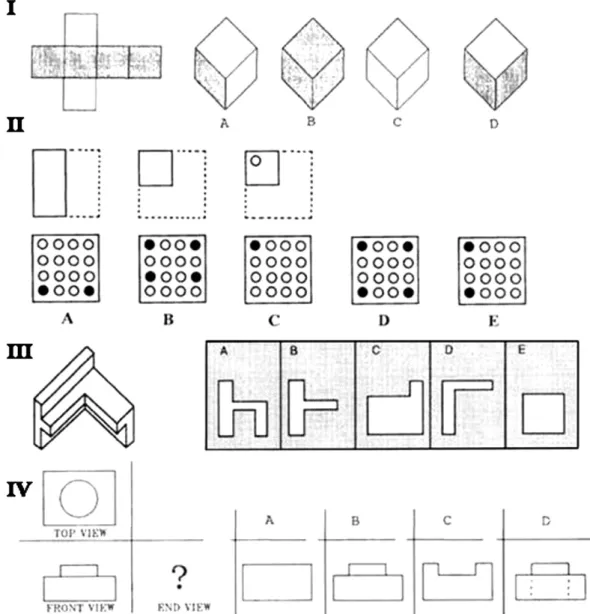
The importance of spatial thinking in medicine raises the question of whether spatial ability tests should be used to select individuals for medical education. This is the current practice in dentistry in North America (Ranney, Wilson, & Bennett, 2005). Since the late 1940s the Dental Admission Test has included a measure of either perceptual-motor or spatial ability. Originally, this was a Chalk Carving Test, which involved interpreting a diagram of a geometric design and carving the design accurately in a block of chalk. However, in 1972, following extensive validation studies (Graham, 1972), this test was replaced by a paper-and-pencil test known as the Perceptual Ability Test (see sample items from this test inFig. 1) so that the current practice in the U.S. is to measure spatial abilities on the basis of paper-and-pencil tests alone (Coy, McDougall, & Sneed, 2003; Gansky et al., 2004). The practice of using spatial tests for selection remains controversial. It is not adopted for dental education in other regions (e.g., Australasia and the United
Kingdom) and it is a topic of debate in surgery (Gilligan, Welsh, Watts, & Treasure, 1999; Graham & Deary, 1991).
The decision of whether or not to use spatial abilities in selection for medicine (or any other spatially demanding profession) depends on alternative models of individual differences in spatial performance (Hegarty, Keehner, Cohen, Montello, & Lippa, 2007). One model, which we will call theabilitymodel, underlies selection procedures in dentistry (Curtis, Lind, Plesh, & Finzen, 2007; Gray & Deem, 2002; Ranney, Wilson, & Bennett, 2005; Sandow, Jones, Peek, Courts, & Watson, 2002). It assumes that performance in certain medical specialties depends substantially on pre-existing abilities, notably spatial ability, that are generally not malleable by training. Another model, theskill model, more common among surgeons (Gawande, 2002), assumes that medical training involves the acquisition of skills, including spatial thinking skills. It assumes that skill acquisition is essentially a matter of practice, and all individuals, regardless of their abilities, are able to acquire the necessary skills. Of course these models are extremes, and it is possible that spatial ability predisposes one to do well in medical training while also being developed further during this training. It is also possible that spatial ability is not equally important at all stages of training (cf.
Ackerman, 1988).
Current debate in the medical profession therefore depends on classic questions of whether individual differences are innate andfixed or malleable by experience, and the relation between ability and skill (Ackerman, 1988; Thorndike, 1908). These issues are relevant not only in selection for medical professions, but also in selection for other spatially demanding professions (e.g., mechanic, pilot) and for education in scientific domains that depend on spatial concepts (e.g., geology, engineering, and chemistry; for recent reviews, seeHegarty & Waller, Learning and Individual Differences 19 (2009) 61–70
⁎Corresponding author. Department of Psychology, University of California, Santa Barbara, Santa Barbara, CA 93106, United States. Fax: +1 805 893 3750.
E-mail address:[email protected](M. Hegarty).
1041-6080/$–see front matter © 2008 Elsevier Inc. All rights reserved. doi:10.1016/j.lindif.2008.04.006
Contents lists available atScienceDirect
Learning and Individual Differences
j o u r n a l h o m e p a g e : w w w. e l s ev i e r. c o m / l o c a t e / l i n d i f2005; National Research Council, 2006). Given that North American dental schools currently select for spatial ability, an examination of the spatial performance of dental students as a function of ability and expertise can inform both theories of causal factors in individual differences and selection policies in a variety of domains.
The degree to which the Perceptual Ability Test (PAT) of the Dental Admission Test (DAT) predicts performance in dentistry has been widely studied. In general, this test is found to predict grades in pre-clinical operative skills classes, which teach hands-on techniques involved in tooth preparation and restoration, such as building and shaping crowns, adding implants, and filling teeth. However, the strength of the relationship varies across studies. For example,Gray and Deem (2002)found a correlation as high as .50 between the PAT and preclinical skills grades, whereas in other studies the correlation was lower—in the .2 to .3 range (Coy et al., 2003; Curtis et al., 2007; Gansky et al., 2004; Ranney et al., 2005; Sandow et al., 2002). The PAT is not typically correlated with general grade point average (GPA) in dental school. In contrast, the other subtests of the DAT (which measure science knowledge, quantitative reasoning, and reading comprehension, respectively) are correlated with GPA.
Findings such as these raise questions about whether the current PAT is the most appropriate selection test for dentistry. In this study, we develop new tests of the ability to infer cross-sections of three-dimensional objects. A cross-section is the intersection of a plane with a solid, that is, a two-dimensional (2-D) slice of a three dimensional (3-D) object. Cross-sections are commonly used in anatomy textbooks to show the internal structure of organs, so that ability to understand cross-sectional diagrams is central to learning about anatomical structure. Medical images, such as X-ray, MRI, and ultrasound images, are also cross-sections, so that understanding these images involves relating 2-D and 3-D representations. The dental profession has acknowledged the importance of this skill; for example, dentists have developed innovative 3-D visualizations for teaching the 3-D structure of teeth, in which students are able to move a cutting plane through a tooth and observe the resulting cross-section (Brown & Herbranson, 2007). These visuali-zations are now being used in 80% of North American dental schools. It is possible that ability to imagine cross-sections is a better predictor of some aspects of dental education than existing items in the PAT, which measure more general facility with representing and transforming spatial forms, as illustrated by the sample items from this test inFig. 1.
Fig. 1.Example items from different subtests of the Perceptual Ability Test. In Item I, participants have to choose the shape on the right that would be made by folding the pattern on the left (correct answer is D). In Item II, participants have to imagine that a square of paper is folded and punched and pick the answer choice that indicates where the holes in the paper would appear after it is unfolded (correct answer is D). In Item III, participants have to imagine that options A, B, C, D and E show apertures and have to pick the aperture through which the object on the left could pass if the left side was introducedfirst (correct answer is C). In Item IV, participants are shown orthographic projections of an object (top view and front view) and have to identify which drawing on the right shows the side view of the same object (correct answer is B). (Reprinted by permission of the American Dental Association).
Goals of the present studies. Our studies had three goals. Thefirst was to develop and validate tests of the ability to infer a cross-section of a three-dimensional structure. Previous studies have found significant correlations between spatial ability and the ability to comprehend and infer cross-sections (Cohen & Hegarty, 2007; Gerson, Sorby, Wysocki, & Baartmans, 2001; Kali & Orion, 1996; Provo, Lamar, & Newby, 2002; Russell-Gebbett, 1985). In many of these studies, the task was to draw a cross-section, so the correlations may reflect drawing ability rather than the ability to infer the appearance of the cross-section per se. To investigate this possibility, we developed tests in which the task was to choose the correct cross-section from several options, so that it did not require drawing ability.
The second goal of the study was to examine whether spatial ability enhances success in dental education. We measured the correlations between the Perceptual Ability Test, other psychometric measures of spatial abilities (mental rotation and perspective taking), our cross-section tests, and success in first year anatomy and restorative dentistry laboratory classes. These analyses examined whether spatial ability predicts an individual's performance in dental education, and if so, how the PAT compares to other measures of spatial ability as a predictor. We also measure general reasoning ability, to assess whether any correlations between spatial abilities and performance in dental education are due to shared variance between spatial abilities and general intelligence (cf.Lohman, 1996). If success in dental education is due to general intelligence rather than spatial abilities, its partial correlation with measures of spatial ability after controlling for reasoning ability should not be significant. If success in dentistry reflects spatial visualization ability specifically, its correlation with spatial visualization ability should remain significant after controlling for reasoning ability.
Thefinal goal of our studies was to examine if and how training in dentistry, especially studying anatomy and developing operative skills, enhances one's spatial performance. There is growing evidence that performance on tests of spatial ability can be improved by various forms of experience (Baenninger & Newcombe, 1989; Newcombe, Mathason, & Terlicki, 2001). Whereas the largest training effects have been found with very direct training, such as practice on the tasks used in spatial ability tests (e.g.,Kail & Park, 1990), and instruction on how to imagine the necessary spatial transformations in these tasks (e.g.,Olson & Bialystok, 1983), researchers have also observed more indirect training effects, for example, improvements in aspects of spatial performance as a result of coursework in engineering (Blade & Watson, 1955), playing video games (Okagaki & Frensch, 1994), and using sign language (Emmorey, Kosslyn, & Bellugi, 1993; Keehner & Gathercole, 2007).
Demonstrations of training effects in spatial task performance raise the questions of what aspects of performance are affected by training and how far this training generalizes. Many studies (Kail & Park, 1990; Pani, Chariker, Dawson, & Johnson, 2005; Sims & Mayer, 2002; Tarr & Pinker, 1989) have found that training effects are quite specific to the stimuli and spatial transformations that were practiced. These studies suggest that what is developed is familiarity with specific shapes in different orientations, rather than an ability to perform spatial transformations per se. On the other hand, some studies have found that spatial training generalizes to transformations of new objects and new tasks that involve some of the same spatial transformations (Leone, Taine, & Droulez, 1993; Wallace & Hofelich, 1992).
In the present studies, we examined effects of dental education on spatial performance by comparing performance of individuals early and late in dental education on measures of spatial ability, and by comparing performance of one group of dentistry students before and after their first year of dentistry training. The spatial measures included a test of mental rotation ability, a test of perspective-taking ability, a test of imagining cross-sections of an unfamiliar object and a test of imagining cross-sections of teeth. If education in dentistry enhances ability to maintain and transform representations of
three-dimensional objects in general, we should observe gains in perfor-mance on all of the spatial ability tests as a result of dental education. If dental education enhances facility in interpreting cross-sections of 3-D structures more specifically, we should observe gains on the cross-section tests but not the other spatial measures. Finally, if education in dentistry leads to domain-specific familiarity with particular spatial forms, we should observe performance gains on the tooth cross-section test alone.
2. Study 1
In thefirst study, we developed a test of ability to imagine cross-sections of an unfamiliar object and examined its correlations with measures of spatial visualization ability and general reasoning ability. We then examined whether performance on all of these tests are related to success in dentistry classes. Finally we compared the performance of students who were relatively early in their dental education to students who were at the end of their dental education on all of the psychometric measures, to examine whether education in dentistry enhances spatial performance.
2.1. Method 2.1.1. Participants
The participants were 82 2nd year dentistry students (33 female, 47 male, 2 unreported) and 36 4th year dentistry students (11 female, 24 male, 1 unreported) at Loma Linda University. Second year students were tested at the point of entry to their second year (i.e., they had completed one year of dental education, which includes the study of anatomy and restorative dentistry techniques in addition to general science courses such as biochemistry, neuroscience and physiology) and 4th year students were tested at the end of their 4th year (i.e., they had almost completed their dental education).
2.1.2. Materials
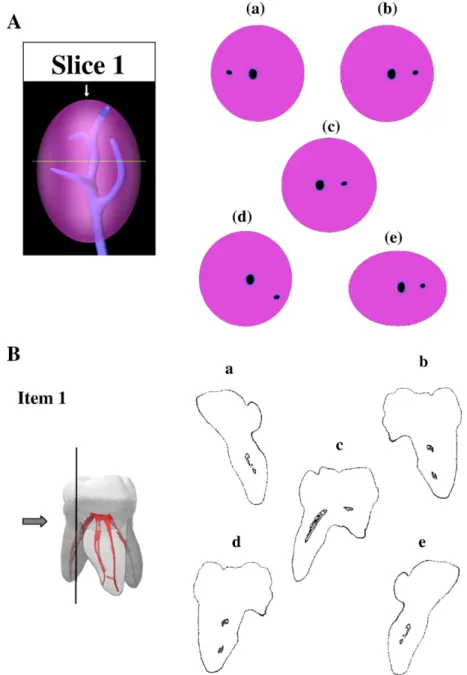
2.1.2.1. Novel Object Cross-Section Test.The Novel Object Cross-Section Test is a 10 item multiple-choice test. On each item, participants view a picture of a novel (unfamiliar) 3-D object with a horizontal or vertical line indicating where the object has been sliced and an arrow pointing towards that line (seeFig. 2A). The task is to choose (fromfive answer choices) the cross-section that would result if the object was sliced at the line and the viewer looked at the resulting cross-sectional plane from the direction of the arrow. The score on the test is the number of correct answers minus one fourth of the number of incorrect answers (to correct for guessing), so the maximum possible score is 10 and chance performance averages 0. Participants were given 5 min to complete the 10 items.
2.1.2.2. Animation. QuickTime Movie Player software was used to present a dynamic 3-D visualization of the object in the Novel Object Cross-Section Test via a digital projector while participants were completing the test. The purpose of this animation was to give participants more information about the 3-D structure of the object by providing motion-based depth cues. The animation consisted of a continuously rotating visualization of the object that looped repeat-edly through alternating horizontal and vertical rotations.
2.1.2.3. Mental Rotation Test.Participants completed the Vandenberg Mental Rotation Test (Vandenberg & Kuse, 1978). In this test, participants view a depiction of a 3-D targetfigure and four testfigures (seeFig. 3A). Their task is to determine as quickly and accurately as possible which two of the four testfigures are rotations of the target
figure. They are allowed 3 min for each of two sections of the test, with 20 items per section, and scoring includes a correction for guessing. The maximum possible score is 80 and chance performance averages 0.
63 M. Hegarty et al. / Learning and Individual Differences 19 (2009) 61–70
2.1.2.4. Visualization of Views Test.Participants completed a modified version of Guay's Visualization of Views Test (Eliot & Smith, 1983). The Visualization of Views Test measures the participant's ability to visualize an unfamiliar 3-D object from an imagined perspective. The criterionfigure is a line drawing of a transparent cube with a small blockfloating in its center (see the sample item inFig. 3B). Below the cube the small block is shown from a different perspective. The participant must identify the corner of the cube from which the alternate view of the small block would be visible. Participants are allowed 8 min to complete 24 items. Their score is the number of items answered correctly minus the number answered incorrectly, divided by 6 (to correct for guessing), so the maximum possible score is 24 and chance performance averages 0.
2.1.2.5. Abstract Reasoning Test.General reasoning ability was measured via the Abstract Reasoning Test from the Differential Aptitudes Test battery (Bennett, Seashore, & Wesman, 1981). Each item of the test shows a sequence of geometric figures with elements changing systematically according to some rule (see the sample item in
Fig. 3C). The task is to infer the rule and choose the next item in the series from 5 answer choices. Participants are allowed 20 min to complete the 40 items in the test. The maximum possible score is 40, and scoring includes a correction for guessing, so that chance performance averages 0.
With their permission, we obtained students' scores on the Perceptual Ability Test, which they had taken when applying for dentistry school (sample items from this test are presented inFig. 1), and theirfirst year grades from three anatomy classes and three restorative dentistry practical laboratory classes.
2.1.3. Procedure
Participants were tested in a group setting in a large lecture room. They werefirst administered the Novel Object Cross-Section Test, followed by the Mental Rotation Test, Visualization of Views Test, and Abstract Reasoning Test. They were given the recommended time limit for each test and were not allowed to start the next test until the allowed time for the previous test was over, and group instructions were given. Due to clinical commitments, most participants in the 4th
year group had to leave before the Abstract Reasoning Test was completed, so analyses involving this test were conducted on the 2nd year sample alone.
2.1.4. Scoring
Letter grades in the anatomy and restorative dentistry laboratory classes were converted to numerical scores by assigning 1 point for a D, 2 points for a C-, 3 points for a C, 4 points for a C+, and so on.1 Performance in the three anatomy and three restorative dentistry classes were averaged to produce anatomy and restorative dentistry achievement scores, respectively.
2.2. Results
2.2.1. Descriptive statistics
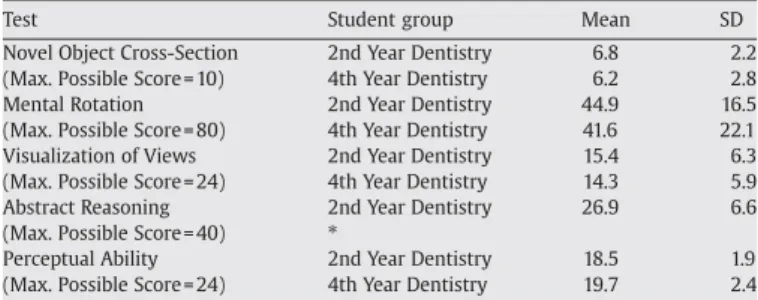
Descriptive statistics for the measures are shown inTable 1. An examination of the distribution of scores on the Novel Object Cross Section Test indicated that 50% of participants had scores of 7.5 (out of 10) or higher. The internal reliability (Cronbach's alpha) of the test was .63. Cronbach's alphas for the other tests were all above .80.
2.2.2. Correlations
Correlations between all measures are presented inTable 2, for the entire sample and also for the 2nd year group separately, both alone and with abstract reasoning ability partialled out. The Novel Object Cross-Section Test was significantly correlated with the Mental Rotation, Visualization of Views, Abstract Reasoning, and PAT measures. The partial correlations of the Novel Object Cross-Section Test with Visualization of Views and the PAT were significant after controlling for differences on the Abstract Reasoning Test (seeTable 2). In contrast, the partial correlation between the Novel Object Cross-Section Test and
Table 1
Descriptive statistics for the measures in Study 1
Test Student group Mean SD
Novel Object Cross-Section 2nd Year Dentistry 6.8 2.2 (Max. Possible Score = 10) 4th Year Dentistry 6.2 2.8 Mental Rotation 2nd Year Dentistry 44.9 16.5 (Max. Possible Score = 80) 4th Year Dentistry 41.6 22.1 Visualization of Views 2nd Year Dentistry 15.4 6.3 (Max. Possible Score = 24) 4th Year Dentistry 14.3 5.9 Abstract Reasoning 2nd Year Dentistry 26.9 6.6 (Max. Possible Score = 40) ⁎
Perceptual Ability 2nd Year Dentistry 18.5 1.9 (Max. Possible Score = 24) 4th Year Dentistry 19.7 2.4 ⁎Note that most students in the 4th year sample did not complete the abstract reasoning test, so this test was analyzed only for the 2nd year group.
1The format for deciding grades in the restorative dentistry class is as follows. Two expert faculty independently rate the practical exams (the teeth that have been worked on). If the ratings are close, as is typical, they are averaged. If they are not close, a third expert is brought in to adjudicate.
Fig. 3.Sample items from (A) the Vandenberg Mental Rotation Test, (B) the Visualization of Views Test and (C) an item of the type given in the Abstract Reasoning Test, showing the correct answer(s) in each case.
65 M. Hegarty et al. / Learning and Individual Differences 19 (2009) 61–70
the Abstract Reasoning Test after controlling for the spatial abilities tests was not significant (partial r= .18,pN.10). These results suggest that performance on the Novel Object Cross-Section Test reflects proficiency in storing and transforming spatial representations specifically and not just differences in general intelligence.
2.2.3. Does spatial ability enhance learning in dentistry?
As Table 2 shows, average grades in anatomy classes were unrelated to the ability measures, whereas average grades in restorative dentistry practical laboratories had modest but statistically significant correlations with all of the ability measures, indicating that spatial ability is somewhat related to learning restorative dentistry skills but not anatomy content. Partial correlations (shown in parentheses inTable 2) indicate that after controlling for abstract reasoning ability, none of the spatial measures remained significantly correlated with class performance.
2.2.4. Does studying dentistry enhance spatial ability?
In this study, we examined two alternative hypotheses regarding the relation between dental education and spatial abilities: (1) dental education enhances spatial ability in general, or (2) dental education enhances ability to imagine cross-sections in particular. Neither of the hypotheses was supported. Comparing performance of the 2nd year and 4th year students (means shown in Table 1) indicates no significant differences between the two groups on the Novel Object Cross-Section, Mental Rotation, or Visualization of Views Tests (t
[116]b1.2,pN.2 in all cases), providing no evidence that education in dentistry improves one's ability to imagine cross-sections or improves spatial ability more generally. The 4th year group had higher spatial ability than the 2nd year group before entering dentistry school, as indicated by their scores on the PAT,t(116) = 2.91,pb.01.2
3. Study 2
Study 1 was limited in that apart from the Perceptual Ability Test, the spatial measures were taken after courses in restorative dentistry, so it was not possible to establish a causal relationship between these spatial measures and course performance on the basis of that study. Furthermore, the 2nd year students in that study had already received
considerable training in dentistry at the time of testing, so were not naïve. Therefore, in Study 2 we examined the performance of two naïve groups (1st year dentistry students and undergraduate psychology students) along with a new sample of 4th year dentistry students. In addition to the measures in Study 1, we also developed a new test of ability to infer cross-sections of a tooth (a three-root molar, seeFig. 2B) in this study.
We tested a group of 1st year students before and after theirfirst year of dental education. We also compared their performance to the 4th year dentistry students and to the undergraduate psychology students. If education in dentistry enhances ability to represent and transform spatial stimuli in general, 4th years and students after theirfirst year of dentistry should have higher scores on all the spatial tests than psychology students and students before theirfirst year of dentistry. If education in dentistry improves ability to imagine cross-sections more specifically, these students should have better performance on the two cross-section tests but not on the tests of mental rotation and perspective-taking ability. If education in dentistry leads specifically to the ability to imagine cross-sections of teeth, these groups should have better performance on only the tooth cross-section test.
Finally, if dental education leads to improvements in imagining cross sections, it is important to examine whether spatial ability remains predictive of performance of this task by more knowledgeable students (i.e., more advanced dentistry students). Previous studies in a variety of domains have indicated that initial relationships between cognitive abilities and domain-specific performance decrease with skill acquisi-tion (Ackerman, 1988), presumably because skilled performance depends less on attention-demanding cognitive processes and more on domain-specific knowledge. However, recent studies of tasks with high spatial content such as air traffic control and laparoscopic surgery have found that correlations with spatial ability remain, even after practice (Ackerman, 1992; Ackerman & Cianciolo, 2002; Keehner, Lippa, Montello, Tendick, & Hegarty, 2006). If individual differences in spatial ability affect performance only in the early stages of training in dentistry and other spatially demandingfields, it may not be important to select individuals for this ability, whereas if the effects of spatial ability are more enduring, then selection based on spatial ability might be advisable.
3.1. Method 3.1.1. Participants
The participants were 79first year students (27 female, 52 male) and 65 fourth year students (22 female, 43 male) at Loma Linda School of Dentistry, and 62 undergraduate psychology students at the University of California, Santa Barbara (31 male, 31 female). None of these students had participated in Study 1, and none of the students had any past experience with the tests used.
3.1.2. Materials
3.1.2.1. Novel Object Cross-Section Test.This test was a modified version of the Novel Object Cross-Section Test used in Study 1. We modified it so that some of the answer choices to some of the items were changed to make the test more challenging, because participants scored highly in Study 1, getting most items correct. The test had 10 items, and its score was the number of correct answers minus one fourth of the number of incorrect answers (to correct for guessing), so chance performance averages 0.
3.1.2.2. Tooth Cross-Section Test.We constructed a test analogous to the Novel Object Cross-Section Test in which the object to be mentally sliced was a tooth (see the sample item inFig. 2B). On each of 20 items, participants were shown a picture of a tooth (three-root molar) with a line indicating where the tooth had been sliced and an arrow pointing at that line. The task was to choose (fromfive answer choices) the
Table 2
Correlations between the measures in Study 1 Cross-section Mental rotation Visualization of views Abstract reasoning PAT Mental Rotation .52⁎ .32⁎(.18) Visualization of Views .40⁎ .45⁎ .43⁎(.34⁎) .43⁎(.31⁎) Abstract Reasoning .37⁎ .47⁎ .30⁎ .36⁎ .48⁎ .37⁎ Perceptual Ability .39⁎ .48⁎ .42⁎ .33⁎ .37⁎(.26§) .49⁎(.37⁎) .49⁎(.40⁎) .40⁎ Anatomy .10 (.04) .21 (.04) .04 (−.02) .17 .19 (.03) Restorative Dentistry .31⁎(.20) .31⁎(.16) .26§ (.15) .37⁎ .33⁎(.21) Numbers on thefirst line in each cell represent the correlation for the whole sample, and numbers on the second line represent the correlation for the 2nd years only. Correlations with anatomy and restorative dentistry class grades are for the 2nd years only. Partial correlations, after controlling for Abstract Reasoning ability, are shown in parentheses.
*pb.01. §pb.05.
2 In a subsequent analysis, groups of 32 2nd year students and 32 4th year students were selected such that they were exactly matched on performance on the PAT. These matched groups did not differ in performance on the Novel Object Cross-Section Test (t [62] = 1.02,p= .31), Mental Rotation Test (t[62] = .92,p= .36), or the Visualization of Views Test (t[62] = .92,p= .55).
cross-section that would result if the tooth was sliced at the line, and the viewer was looking at the resulting cross-section from the direction of the arrow. The score on the test was the number of correct answers minus one fourth of the number of incorrect answers (to correct for guessing), so chance performance averages 0. Two test items were not included in thefinal score because performance on these items was poor, and they had very low correlations with the other items (suggesting that they were unreliable), so the maximum possible score was 18.
3.1.2.3. Other measures. As in Study 1, we also measured students' performance on the Vandenberg Mental Rotation Test (Vandenberg & Kuse, 1978; seeFig. 3A), the modified version of Guay's Visualization of Views Test (Eliot & Smith, 1983; see Fig. 3B), and the Abstract Reasoning Test (Bennett et al., 1981; seeFig. 3C). We also obtained the dentistry students' scores on the Perceptual Ability Test (seeFig. 1) and grades of the 1st year students in anatomy and restorative dentistry.
3.1.2.4. Animations.We used the same QuickTime movie of the novel (egg-shaped) object as in Study 1. We developed a similar animation of the tooth stimulus, which showed a 3-D model of the tooth continually rotating in random directions at a speed comparable to that in the novel object animation.
3.1.3. Procedure
Participants were tested in a group setting in a large lecture room. Participants in the 1st year group were administered the Novel Object Cross-Section, Mental Rotation, Visualization of Views, and Abstract Reasoning Tests in that order on theirfirst testing session, which was conducted in August (before they had received any dental education). They were administered the Tooth Cross-Section Test in November of theirfirst year. Finally they were re-administered the Novel Object Cross-Section and Tooth Cross-Section Tests in September at the beginning of their second year in Dentistry school (i.e., after one year of dental education). The 4th year sample and the psychology students were administered all of the tests in a single session in the following order: Novel Object Cross-Section, Tooth Cross-Section, Mental Rotation, Visualization of Views, and Abstract Reasoning. Fourth year students were tested in September at the beginning of their 4th year (i.e., after 3 years of dental education); psychology students were tested while taking theirfirst college course in psychology.
3.2. Results
3.2.1. Descriptive statistics
Descriptive statistics for the measures are presented inTable 3. Scores on the Novel Object Cross-Section task were lower than those in Study 1, suggesting that this test was more difficult. However the internal reliability of this version of the test was lower (Cronbach's alpha = .57). Cronbach's alpha for the Tooth Cross-Section Test was .77. Measures of internal reliability (Cronbach's alpha) for the other tests were all above .80.
3.2.2. Correlations
Correlations between the measures are presented inTable 4. Both cross-section tests were significantly correlated with the Mental Rotation, Visualization of Views, Abstract Reasoning, and PAT measures. As in Study 1, the correlations of both Cross-Section Tests with the spatial ability measures and the PAT remained significant after controlling for differences in Abstract Reasoning, whereas, the partial correlations of the Abstract Reasoning Test with the Novel Object Cross-Section Test (partial r= .07) and Tooth Cross-Section Test (partial r= .11) after controlling for the spatial ability tests were not significant.
3.2.3. Does spatial ability enhance learning in dentistry?
As Table 4 shows, average grades in anatomy classes were unrelated to the ability measures, as in Study 1. Unlike Study 1, average grades in restorative dentistry in this study were significantly correlated only with the PAT, not with the other spatial ability tests. Partial correlations controlling for abstract reasoning ability (shown in parentheses inTable 4) indicate that a significant correlation remained after controlling for general reasoning ability.
3.2.4. Does studying dentistry enhance spatial abilities?
In this study, we considered three alternative hypotheses regarding the relation between dental education and spatial abilities: (1) dental education enhances spatial ability in general, (2) dental education enhances ability to imagine cross-sections in general, or (3) dental education enhances ability to imagine cross-sections of teeth. To evaluate these hypotheses, we performed two sets of comparisons. First we compared the performance of the 1st year group on the cross-section tests before and after theirfirst year of dental education. This analysis indicated that performance on the Novel Object Cross-Section Test did not differ significantly from thefirst (M= 5.4,SD= 2.0) to the second testing (M= 5.8,SD= 2.4,t[67]= 1.81,p= .07,d= .17). In contrast, performance on the Tooth Cross-Section Test was significantly better on the second testing (M= 11.3,SD= 4.3) than on thefirst testing (M= 8.6,
Table 3
Descriptive statistics for the measures in Study 2
Test Student Group First Testing Second Testing⁎ Mean SD Mean SD Novel Object Cross-Section
(Max Possible Score = 10)
Psychology 3.3 2.6
1st Year Dentistry 5.4 2.1 5.8 2.4 4th Year Dentistry 4.8 2.9
Tooth Cross-Section (Max Possible Score = 18)
Psychology 7.1 3.9 11.3 4.3 1st Year Dentistry 8.4 4.6
4th Year Dentistry 11.2 4.7 Mental Rotation
(Max Possible Score = 80)
Psychology 30.2 15.3 1st Year Dentistry 41.5 18.5 4th Year Dentistry 36.8 17.0 Visualization of Views
(Max. Possible Score = 24)
Psychology 13.1 6.6 1st Year Dentistry 15.3 5.8 4th Year Dentistry 15.2 5.5 Abstract Reasoning
(Max Possible score = 40)
Psychology 24.2 6.9 1st Year Dentistry 27.6 6.7 4th Year Dentistry 25.9 7.5 Perceptual Ability Test§
(Max Possible Score = 24)
1st Year Dentistry 18.6 1.9 4th Year Dentistry 19.7 2.4
⁎The 1st year students were tested twice (at the beginning and end of theirfirst year of dental education) on the Novel Object Cross-Section Test and the Tooth Cross-Section Test.
§
The psychology students did not take the Perceptual Ability Test.
Table 4
Correlations between the measures in Study 2 Novel-Object Cross-Section Tooth Cross-Section Mental Rotation Visualization of Views Abstract Reasoning Perceptual Ability Tooth CS .39⁎(.33⁎) MR .38⁎(.29⁎) .37⁎ (.26⁎) VV .37⁎(.30⁎) .29⁎ (.21§) .53⁎ (.42⁎) AR .28⁎ .21⁎ .51⁎ .38⁎ PAT .29⁎(.23⁎) .45⁎ (.40⁎) .42⁎ (.31⁎) .37⁎(.30⁎) .36⁎ Anatomy .02 (.01) −.08 (−.11) −.08 (−.12) −.03 (−05) .04 .07 (.05) Rest. Dentistry .20 (.16) .21 (.17) .16 (.11) .14 (.10) .14 .35⁎(.33⁎) Numbers in parentheses are the partial correlations between the measures, controlling for Abstract Reasoning ability. Correlations with anatomy and restorative dentistry are for the 1st year students only.
*pb.01. §pb.05.
67 M. Hegarty et al. / Learning and Individual Differences 19 (2009) 61–70
SD= 4.4,t[67]= 5.83,pb.001,d= .60). While this result might be explained as a practice effect on the test, this seems unlikely insofar as practice effects should affect both tasks equally. Instead, these results suggest that dental education improved the specific ability to imagine cross-sections of teeth, but not ability to imagine cross-cross-sections of objects in general.
Second, we compared performance of the 4th year dentistry students, the 1st year dentistry students (first administration of tests), and the psychology students on the psychometric measures. Descrip-tive statistics are presented inTable 3. There were no significant differences between the groups on the Abstract Reasoning Test,F(2, 188) = 2.44, p= .09, suggesting that they were matched on general intelligence. In contrast, there were significant differences between the groups on the Novel Object Cross-Section Test (F[2, 188] = 6.95,
pb.01), Tooth Cross-Section Test (F[2, 188] = 10.155,pb.001), Mental Rotation Test (F[2, 188] = 5.59,pb.01), and the Visualization of Views Test (F[2, 188] = 3.21,pb.05). Post-hoc (Tukey) tests indicated that the psychology students had significantly lower scores than the 4th year students (pb.001) but not the 1st year students (p= .20) on the Tooth Cross-Section Test, as is expected, because 1st year students had received no dental training before this administration of the test. The psychology students had significantly lower scores than both dentistry groups on the Novel Object Cross-Section Test (pb.01). They tended to score lower than the 1st year students (pb.01 for Mental rotation,p= .08 for Visualization of Views), but not the 4th year students, on the spatial ability measures. These results probably reflect the fact that dental students are selected, and may also self-select, for spatial abilities.
A direct comparison of the 4th year and 1st year groups indicated that the 4th years had higher scores on the Tooth Cross-Section Test,t
(142) = 3.55,pb.001,d = .58. This group also had significantly higher scores on the PAT,t(142) = 3.56,p= .001,d= .50. However, an analysis of covariance indicated that the difference in favor of the 4th year students on the Tooth Cross-Section Test remained significant after controlling for differences in PAT scores, F (1, 141) = 4.90, pb.05, suggesting that this difference was at least partially due to the 4th year students' additional experience in dentistry, and not just because this group was somewhat higher in spatial ability to begin. In contrast, the differences between the two dentistry groups on the Novel Object Cross-Section, Mental Rotation, Visualization of Views, and Abstract Reasoning Tests were not significant (t[142]b1.6,pN.10, in all cases). These results again support the view that dental education improves the ability to imagine cross-sections of teeth but does not enhance ability to imagine cross-sections of other objects or increase spatial ability in general.
It is possible that the improvement on the Tooth Cross-Section Test by advanced dental students reflects increased domain-specific knowledge alone, such that spatial ability is no longer important once students have acquired knowledge of the structure of teeth (cf.
Ackerman, 1988). Additional analyses revealed that this was not the case. For the 4th year sample, the Tooth Cross-Section Test had significant correlations with the PAT (r= .41, pb.01) and the MRT (r= .53, pb.001), and these correlations remained significant after controlling for abstract reasoning ability (partial r= .36 and .49 respectively, pb.01). For students at the end of their first year of dental education, the Tooth Cross-Section Test was also significantly correlated with Mental Rotation (r= .28,pb.05), Visualization of Views (r= .34,pb.01), and the PAT (r= .42,pb.01); the correlations with the latter two tests remained significant after controlling for abstract reasoning ability (partial rs= .25,pb.05 and .33,pb.01 respectively).
3.2.4.1. Sex differences. As shown in Table 5, males outperformed females on the Cross-Section Tests, Mental Rotation Test, Visualization of Views Test, and the PAT in both studies. We conducted separate t-tests comparing performance of psychology and dentistry male and female students (for this analysis, 1st and 4th year students in Study 2
were combined into one dentistry student group). Male dentistry students outperformed male psychology students on the Novel Object Cross-Section Test, Tooth Cross-Section Test, and Mental Rotation Test,
t(124)N3.0, pb.01 in all cases. Female dentistry students outper-formed female psychology students on only the Novel Object Cross-Section Test,t(78) = 2.13,pb.05.
4. Discussion
Thefirst goal in these studies was to examine whether inferring the appearance of a cross-section of an unfamiliar object depends on spatial ability. The second was to examine whether spatial ability enhances learning in thefield of dentistry, specifically anatomy and restorative dentistry techniques. The third was to examine whether dental education enhances spatial performance, and whether this enhance-ment is specific to stimuli that are important in dentistry or whether it generalizes to other stimuli and other spatial transformations.
4.1. Does imagining a cross-section of a 3-D object involve spatial ability?
Our results support the hypothesis that ability to imagine the cross-section of a 3-D object depends on spatial ability. In both of our studies, the cross-section tests were correlated with all of the measures of spatial ability. This result replicates previous research (Hegarty et al., 2007; Kali & Orion, 1996; Russell-Gebbett, 1985). Furthermore, in most cases the correlation remained significant after controlling for individual differ-ences in reasoning ability, but the correlation between the cross-section tests and abstract reasoning ability did not remain significant after controlling for individual differences in spatial ability. Therefore, it appears that the ability to infer cross-sections of 3-D objects depends primarily on the ability to maintain and transform spatial representa-tions, and not on general reasoning ability.
4.2. Does spatial ability enhance learning in dentistry?
The second question addressed is whether spatial ability enhances learning in dentistry classes, as suggested by the ability model of individual differences in spatial performance. The answer to this question is a qualified yes. All of the spatial ability measures were significantly correlated with performance in restorative dentistry practical laboratory classes in Study 1, but only the Perceptual Ability Test had a significant correlation with this measure in Study 2. In reconciling this discrepancy across studies, it should be noted that the correlations in both studies were positive but modest, probably reflecting the many other factors (motivation, etc.) that contribute to determining a student's grade. In Study 2, the correlation of restorative dentistry with the PAT remained significant after controlling for differences in reasoning ability; the corresponding partial correlation was marginally significant in Study 1. These results provide some support for the hypothesis that spatial ability enhances learning of
Table 5
Means, standard deviations,t-tests, and effect sizes (Cohen's d) summarizing sex differences observed in Studies 1 and 2
Test Study Mean (SD)
Males
Mean (SD) Females
t p d
Novel Object Cross-Section 1 7.2 (2.1) 5.5 (2.5) 4.07 b.001 .71 2 5.1 (2.5) 3.8 (2.6) 3.53 b.001 .50 Tooth Cross-Section 2 9.6 (4.7) 7.9 (4.5) 2.63 b.01 .36 Mental Rotation 1 48.9 (17.0) 34.7 (17.0) 4.39 b.001 .77 2 42.2 (17.6) 29.4 (15.2) 4.95 b.001 .73 Visualization of Views 1 16.7 (5.4) 12.1 (6.2) 4.22 b.001 .75 2 16.1 (5.6) 12.2 (5.8) 4.82 b.001 .65 Abstract Reasoning 1 26.3 (6.5) 27.0 (6.5) −0.48 n.s. .11 2 26.6 (7.4) 25.3 (6.6) 1.29 n.s. .18 Perceptual Ability Test 1 19.1 (2.0) 18.2 (2.1) 2.45 b.05 .42 2 19.2 (2.1) 18.0 (2.2) 3.21 b.01 .56
restorative dentistry skills and are generally consistent with previous research on the PAT (Coy et al., 2003; Curtis et al., 2007; Gansky et al., 2004; Ranney et al., 2005; Sandow et al., 2002).
In contrast, the spatial ability measures were not significantly correlated with performance in anatomy classes. It should be noted that assessments in these classes were based on multiple-choice tests, and the items were not classified by whether they tested spatial content. In a previous study, Rochford (1985) performed such a classification and found significant correlations between spatial ability tests and anatomy test items that assessed spatial content specifically. In our study, performance on the Tooth Cross-Section Test by more advanced dentistry students can be interpreted as ability to imagine cross-sections of a familiar anatomical structure. Our analyses indicate that spatial abilities predicted performance on this test even for more advanced dentistry students (students in their 2nd and 4th years), who generally performed well on this test. These results suggest that even when anatomical structures are familiar (as we assume that teeth are for 4th year dentistry students), good spatial ability is necessary to accurately perform mental spatial transforma-tions on these structures.
The PAT proved to be a somewhat better predictor of performance in restorative dentistry than the other spatial abilities measures. There are at least two explanations for this result. First, the PAT measures a range of different spatial tasks (see the examples inFig. 1). In contrast, each of the other spatial ability tests measures just one type of spatial transformation. It appears that acquiring skill in restorative dentistry depends more on general facility with spatial judgments than on any single spatial skill, such as mental rotation, perspective taking, or ability to imagine cross-sections. Second, the PAT is probably a more accurate measure of students' spatial abilities because it was taken as part of an admission test, and therefore we can assume that while taking this test, students were highly motivated to do well. In contrast, there were no consequences of performance on our spatial ability tests, so students may not have been motivated to do their best in our testing sessions, although our informal observations of their behavior during the testing sessions did not suggest poor motivation.
4.3. Does education in dentistry enhance performance in spatial tasks generally, cross-sectional spatial tasks more specifically, or dental cross-sectional spatial tasks most specifically?
The third question addressed in this study is whether dental education enhances spatial performance, as suggested by the skill
model of individual differences in spatial performance. Our studies provide no evidence that dental education enhances spatial abilities in general, or ability to imagine cross-sections in general. In both studies, performance of students early and late in their dental education was equivalent on the Novel Object Cross-Section Test and the spatial abilities tests. This was shown both by comparing dentistry students before and after theirfirst year of education, and by comparing the performance of 1st year to 4th year dentistry students.
In contrast, our studies do indicate not surprisingly, that dental education enhances ability to imagine spatial transformations (specifically cross-sections) of teeth. In Study 2, students were more able to infer cross-sections of teeth at the end of theirfirst year of dental education than at the beginning, and 4th year dental students also outperformed beginning dental students and psychology stu-dents on this task. While the former result might partially reflect practice on the test, the latter does not, as all three groups were taking the test for thefirst time. Performance on the Tooth Cross-Section Test was correlated with spatial ability for all groups.
These results allow us to speculate about what aspects of spatial performance are learned as a function of current dental education, and what aspects of performance remain dependent on spatial ability, even in advanced students. We propose that dental educa-tion, specifically learning anatomy of teeth and developing operative
skills for dentistry, leads to the development of spatial mental models of teeth. These mental models facilitate the encoding and maintenance of representations of these familiar structures, perhaps because they allow the structures to be encoded as a single chunk in working memory. This proposal is consistent with previous studies suggesting that what is learned as a function of spatial training is familiarity with particular structures rather than general spatial transformation abilities (Kail & Park, 1990; Pani et al., 2005; Sims & Mayer, 2002). However, spatial ability remains important even after these mental models have been acquired. One possible account of these results is that both skills training and spatial abilities contribute to performance in inferring cross-sections of teeth, with training providing high-quality spatial mental models and spatial ability determining success in imagining novel spatial transforma-tions of these models.
Our results do not preclude the possibility that more general spatial transformation skills can be developed with other forms of training and in other populations. It should be noted that dentistry students are selected and may also self-select for spatial ability, so there is less room for improvement on our measures than would be the case in the general population. Furthermore, we did not control the education and training that they received. Some more controlled studies that focused on training of specific spatial transformations have found evidence for transfer of spatial performance to new stimuli and new tasks (Leone et al., 1993; Wallace & Hofelich, 1992).
Consistent with previous literature on sex differences in spatial ability (Linn & Petersen, 1985; Voyer, Voyer, & Bryden, 1995), males outperformed females on all of the spatial ability measures in this study, including the new cross section tests. These sex differences were found among dentistry students and undergraduate psychology students alike. Given that the undergraduate psychology sample had an equal number of males and females, whereas the dentistry samples in both studies had more males than females, we considered the possibility that the differences in spatial abilities between the psychology students and dentistry students in our samples merely reflected differences in the proportions of males and females in these groups. This was not the case. An analysis by sex indicated that male dentistry students outperformed male psychology students on both cross-section tests and the Mental Rotation Test. Female dentistry students outperformed female psychology students on only the Novel Object Cross-Section Test. Thus, although individuals who self-select or are selected for dental education have higher spatial abilities compared to the general population of college students, this appears to be truer for males than for females.
These studies had some limitations. Most notably, the Novel Object Cross-Section Test suffered from low reliability in both studies. As a result, our conclusion that dental education does not enhance ability to imagine cross-sections in general can only be tentative based on these studies. In contrast, we are more confident about the more central conclusion that dental education enhances ability to imagine spatial transformations of teeth but not other spatial transformations (mental rotation and perspective taking), because these are based on more reliable tests.
A second limitation is that there were some inconsistencies across the studies and samples regarding which spatial ability test (Mental Rotation or Visualization of Views) was more correlated with performance on the cross-section tests. One component process in inferring a cross-section in our tasks involves imagining viewing the cross-section from the arrow in the diagram (seeFig. 2). This process can be accomplished by either mentally rotating the object or mentally switching one's perspective with respect to the object. The incon-sistent pattern of correlations may reflect differential reliance on mental rotation and perspective taking by the various groups of students tested. This speculation could be addressed further in protocol studies, which might provide a more direct measure of the specific cognitive processes employed.
69 M. Hegarty et al. / Learning and Individual Differences 19 (2009) 61–70
5. Conclusion
In conclusion, our results suggest that the skill and ability models of individual differences are complementary rather than competing. In support of the skill model, dental education appears to enhance performance of spatial tasks that are specific to dentistry, suggesting that it leads to the development of spatial mental models of relevant anatomy. In support of the ability model, the Perceptual Ability Test is somewhat predictive of the acquisition of pre-clinical skills and enhances the ability to imagine novel spatial transformations of teeth, even among advanced dental students. Decisions about selection and training for any spatially demandingfield need to be informed by analyses of which aspects of spatial performance are domain specific and learned, and which are more domain general and perhaps less amenable to training.
Acknowledgements
This research was supported by grant 0313237 from the National Science Foundation. We thank Cheryl Cohen and Jerome Tietz for help with constructing the psychometric tests, and Meg Vallas and Rachel Avanessian for assistance with coding and data entry. We are grateful to Paul Brown, DDS, Eric Herbranson, DDS, and Charles Goodacre, DDS, for providing stimuli and participants for our research, for their comments on earlier versions of this paper, and for many discussions of the spatial challenges of dentistry. Madeleine Keehner is now at the School of Psychology, University of Dundee, Scotland.
References
Ackerman, P. L. (1988). Determinants of individual differences during skill acquisition: cognitive abilities and information processing.Journal of Experimental Psychology. General,117, 288−318.
Ackerman, P. L. (1992). Predicting individual difference in complex skill acquisition: Dynamics of ability determinants.Journal of Applied Psychology,77, 598−614. Ackerman, P. L., & Cianciolo, A. T. (2002). Ability and task constraint determinants of
complex task performance.Journal of Experimental Psychology. Applied,8, 194−208. Baenninger, M., & Newcombe, N. (1989). The role of experience in spatial test
performance: A meta analysis.Sex Roles,20, 327−344.
Bennett, G. K., Seashore, H. G., & Wesman, A. G. (1981).Differential Aptitudes Test.San Antonio, TX: The Psychological Corporation.
Blade, M., & Watson, W. S. (1955). Increase in spatial visualization test scores during engineering study.Psychological Monographs,69(No. 397).
Brown, P., & Herbranson, E. (2007).3-D Interactive Tooth Atlas (Version 5.0) [Computer software].Palo Alto, CA: Brown & Herbranson Imaging.
Cohen, C. A., & Hegarty, M. (2007). Individual differences in use of an external visualization while performing an internal visualization task.Applied Cognitive Psychology,21, 701−711.
Coy, K., McDougall, H., & Sneed, M. (2003). Issues regarding practical validity and gender bias of the perceptual abilities test (PAT).Journal of Dental Education,67, 31−37. Curtis, D. A., Lind, S. L., Plesh, O., & Finzen, F. C. (2007). Correlation of admissions criteria
with academic performance in dental students.Journal of Dental Education,71, 1314−1321.
Eliot, J., & Smith, I. M. (1983).An international directory of spatial tests.Windsor, Berks: Nfer-Nelson.
Emmorey, K., Kosslyn, S. M., & Bellugi, U. (1993). Visual imagery and visual-spatial language: Enhanced imagery abilities in deaf and hearing ASL signers.Cognition, 46, 139−181.
Gansky, S. A., Pritchard, H., Kahl, E., Mendoza, D., Bird, W., Miller, A. J., et al. (2004). Reliability and validity of a manual dexterity test to predict preclinical grades. Journal of Dental Education,68, 985−994.
Gawande, A. (2002, January 28).The learning curve. The New Yorker(pp. 52−61). Gerson, H., Sorby, S., Wysocki, A., & Baartmans, B. (2001). The development and
assessment of multimedia software for improving 3-D spatial visualization skills. Computer Applications in Engineering Education,9, 105−113.
Gilligan, J. H., Welsh, F. K., Watts, C., & Treasure, T. (1999). Square pegs in round holes: Has psychometric testing a place in choosing a surgical career? A preliminary report of work in progress.Annals of the Royal College of Surgeons of England,81, 73−79. Graham, K. S. (1972). Substitution of perceptual-motor ability test for chalk carving in
dental admissions testing program.Journal of Dental Education,36, 9−14. Graham, K. S., & Deary, I. J. (1991). A role for aptitude testing in surgery?Journal of the
Royal College of Surgeons of Edinburgh,36, 70−74.
Gray, S. A., & Deem, L. P. (2002). Predicting student performance in preclinical technique courses using the theory of ability determinants of skilled performance.Journal of Dental Education,66, 721−727.
Hegarty, M., Keehner, M., Cohen, C., Montello, D. R., & Lippa, Y. (2007). The role of spatial cognition in medicine: Applications for selecting and training professionals. In G. Allen (Ed.),Applied spatial cognition (pp. 285−315). Mahwah, NJ: Lawrence Erlbaum Associates.
Hegarty, M., & Waller, D. (2005). Individual differences in spatial abilities. In P. Shah, & A. Miyake (Eds.),The Cambridge handbook of visuospatial thinking (pp. 121−169). Cambridge: Cambridge University Press.
Kail, R., & Park, Y. (1990). Impact of practice on speed of mental rotation.Journal of Experimental Child Psychology,49, 227−244.
Kali, Y., & Orion, N. (1996). Spatial abilities of high-school students in the perception of geologic structures.Journal of Research in Science Teaching,33, 369−391. Keehner, M., & Gathercole, S. E. (2007). Cognitive adaptations arising from non-native
experience of sign language in hearing adults.Memory & Cognition,35, 752−761. Keehner, M., Lippa, Y., Montello, D. R., Tendick, F., & Hegarty, M. (2006). Learning a
spatial skill for surgery: How the contributions of abilities change with practice. Applied Cognitive Psychology,20, 487−503.
Leone, G., Taine, M. C., & Droulez, J. (1993). The influence of long-term practice on mental rotation of 3-D objects.Cognitive Brain Research,1, 241−255.
Linn, M. C., & Petersen, A. C. (1985). Emergence and characterization of gender differences in spatial abilities: A meta-analysis.Child Development,56, 1479−1498. Lohman, D. F. (1996). Spatial ability and g. In P. Tapsfield (Ed.),Human abilities: Their
nature and measurement(pp. 97−116). Mahwah: Lawrence Erlbaum Associates. National Research Council (2006).Learning to think spatially.Washington DC: National
Academies Press.
Newcombe, N. S., Mathason, L., & Terlicki, M. (2001). Maximization of spatial competence: More important thanfinding the cause of sex differences. In A. V. McGillicuddy-DeLisi, & R. DeLisi (Eds.),Biology, society, and behavior: The development of sex differences in cognition(pp. 183−206). Westport, CT: Ablex Publishing.
Okagaki, L., & Frensch, P. (1994). Effects of video game playing on measures of spatial performance: Gender effects in late adolescence.Journal of Applied Developmental Psychology,15, 33−58.
Olson, D. R., & Bialystok, E. (1983).Spatial cognition.Hillsdale, NJ: Erlbaum. Pani, J. R., Chariker, J. H., Dawson, T. E., & Johnson, N. (2005). Acquiring new spatial
intuitions: Learning to reason about rotations.Cognitive Psychology,51, 285−333. Provo, J., Lamar, C., & Newby, T. (2002). Using a cross-section to train veterinary students
to visualize anatomical structures in three dimensions.Journal of Research in Science Teaching,39, 10−34.
Ranney, R. R., Wilson, M. B., & Bennett, R. B. (2005). Evaluation of applicants to predoctoral dental education programs: Review of the literature.Journal of Dental Education,69, 1095−1106.
Rochford, K. (1985). Spatial learning disabilities and underachievement among university anatomy students.Medical Education,19, 13−26.
Russell-Gebbett, J. (1985). Skills and strategies: Pupils' approaches to three-dimensional problems in biology.Journal of Biological Education,19, 293−298.
Sandow, P. L., Jones, A. C., Peek, C. W., Courts, F. J., & Watson, R. E. (2002). Correlation of admission criteria with dental school performance and attrition.Journal of Dental Education,66, 385−392.
Sims, V. K., & Mayer, R. E. (2002). Domain specificity of spatial expertise: The case of video game players.Applied Cognitive Psychology,16, 97−115.
Tarr, M. J., & Pinker, S. (1989). Mental rotation and orientation-dependence in shape recognition.Cognitive Psychology,21, 233−282.
Thorndike, E. L. (1908). The effect of practice in the case of a purely intellectual function. American Journal of Psychology,19, 374−384.
Vandenberg, S., & Kuse, A. (1978). Mental rotations: Group test of three-dimensional spatial visualization.Perceptual and Motor Skills,47, 599−604.
Voyer, D., Voyer, S., & Bryden, M. P. (1995). Magnitude of sex differences in spatial abilities: A meta-analysis and consideration of critical variables.Psychological Bulletin,117, 250−270.
Wallace, B., & Hofelich, B. G. (1992). Process generalization and the prediction of performance on mental imagery tasks.Memory & Cognition,20, 695−704.