Abstract of my presentation:
Quantum computing promises an unprecedented ability to solve intractable problems by harnessing quantum mechanical effects such as tunneling, superposition, and entanglement. The Quantum Artificial Intelligence Laboratory (QuAIL) at NASA Ames Research Center is the space agency’s primary facility for conducting research and development in quantum information sciences. QuAIL conducts fundamental research in quantum physics but also explores how best to exploit and apply this disruptive technology to enable NASA missions in aeronautics, Earth and space sciences, and space exploration. At the same time, machine learning has become a major focus in computer science and captured the imagination of the public as a panacea to myriad big data problems. In this talk, we will discuss how classical machine learning can take advantage of quantum computing to significantly improve its effectiveness. Although we illustrate this concept on a quantum annealer, other quantum platforms could be used as well. If explored fully and implemented efficiently, quantum machine learning could greatly accelerate a wide range of tasks leading to new technologies and discoveries that will significantly change the way we solve real-world problems.
National Aeronautics and Space Administration
www.nasa.gov
Quantum Machine Learning
Dr. Rupak Biswas
Director, Exploration Technology Directorate
Manager, NASA High End Computing Capability (HECC) Project
NASA Ames Research Center, Moffett Field, Calif., USA
SIAM Conference on Parallel Processing for Scientific Computing Waseda University, Tokyo, Japan, 7–10 March 2018
Why Quantum Computing at NASA
Data Analysis andData Fusion
Air Traffic Management
Mission Planning and Scheduling, and Coordination
Anomaly Detection and Decision Making
V&V and optimal sensor placement Topologically aware Parallel Computing Key: Potential quantum speedup
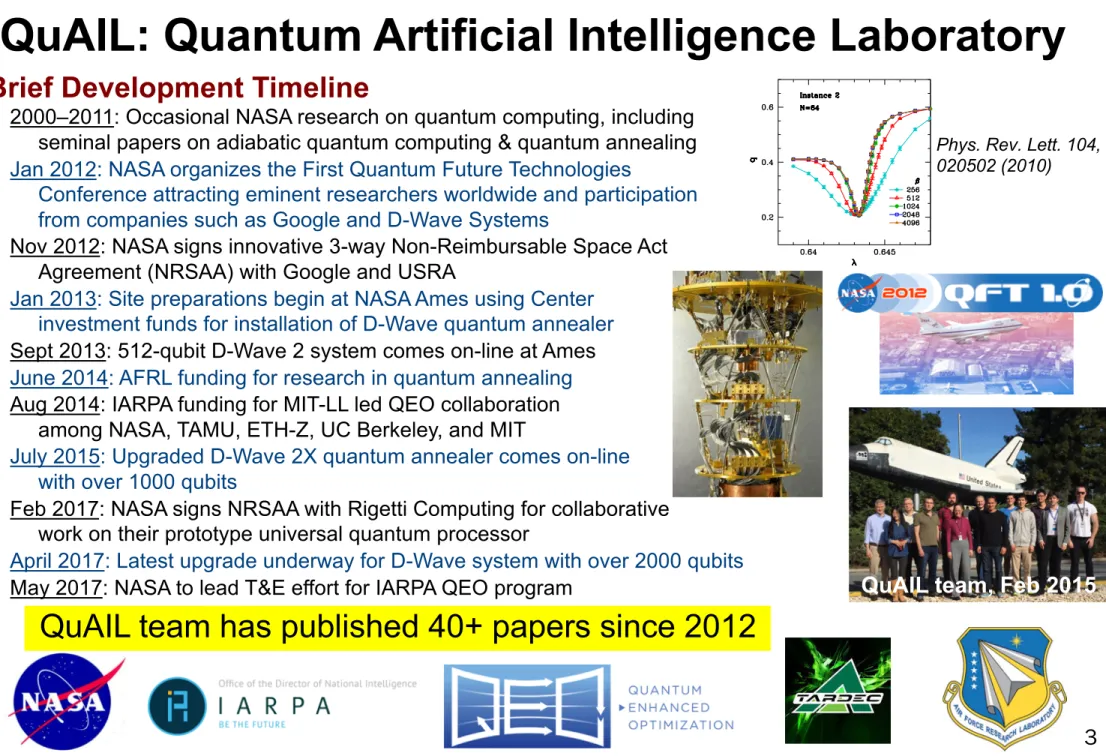
QuAIL: Quantum Artificial Intelligence Laboratory
Brief Development Timeline
2000–2011: Occasional NASA research on quantum computing, including seminal papers on adiabatic quantum computing & quantum annealing
Jan 2012: NASA organizes the First Quantum Future Technologies
Conference attracting eminent researchers worldwide and participation from companies such as Google and D-Wave Systems
Nov 2012: NASA signs innovative 3-way Non-Reimbursable Space Act Agreement (NRSAA) with Google and USRA
Jan 2013: Site preparations begin at NASA Ames using Center investment funds for installation of D-Wave quantum annealer
Sept 2013: 512-qubit D-Wave 2 system comes on-line at Ames
June 2014: AFRL funding for research in quantum annealing
Aug 2014: IARPA funding for MIT-LL led QEO collaboration among NASA, TAMU, ETH-Z, UC Berkeley, and MIT
July 2015: Upgraded D-Wave 2X quantum annealer comes on-line with over 1000 qubits
Feb 2017: NASA signs NRSAA with Rigetti Computing for collaborative work on their prototype universal quantum processor
April 2017: Latest upgrade underway for D-Wave system with over 2000 qubits
May 2017: NASA to lead T&E effort for IARPA QEO program
3
FIG. 1: (Color online) An instance with a first order transition withN= 128. Note the expanded horizontal scale.
value of the gap at the transition. If∆Emin≫T,δs
is the range ofsover which∆Echanges by an amount
∆Emin, whereas if∆Emin≪T,δsis the range ofsover
which∆Echanges by an amount equal toT. Hence
δs= ⎧ ⎪ ⎨ ⎪ ⎩ ∆Emin %∂∆E ∂s &−1 ,(∆Emin≫T),
T%∂∆E∂s&−1, (∆Emin≪T).
(6)
Figure 2 shows the finite-size rounding for an instance withN = 64, small enough that we can equilibrate through the (first order) transition. Forβ<
∼1024 the
width of the transition region increases asβ≡1/T de-creases, but forβ>
∼1024 the width is independent ofβ.
For this instance we find∆Emin= 0.0021 as shown in the
inset, so the width of the rounding becomes independent ofTwhenT≪∆Eas expected.
In Fig. 3 we plot the fraction of instances with a first order transition. For each size we have studiedNinst= 50
instances. If we denote the first-order fraction byrthen the error bar inris'
r(1−r)/(Ninst−1). The figure
shows thatrincreases rapidly withNand, very plausi-bly, tends to 1 forN→ ∞. We see that the first order fraction is slightly greater than a half forN= 128. In our earlier work [5] we found that themediancomplexity con-tinued to be polynomial up toN= 128 (the largest size studied). However, there is no contrast with the present work because, as already noted in Ref. [8], the models used are slightly different, and as a result the crossover to a first order transition occurs at a slightly lower value ofNin the present model. The crossover to first order would have been seen in the earlier model if somewhat
FIG. 2: (Color online) The main figure shows the spin glass order parameterq, defined in Eq. (5), as a function ofsfor an instance withN= 64 which has a first order transition. The different curves are for different values ofβ. The inset shows the energy gap∆Eas a function ofsforβ= 2048, indicating that∆Emin= 0.0021 (same value was found forβ= 1024
and 4096). From the main figure one sees that the width of the finite-size rounding increases withT≡1/βforT≫∆E
but is independent ofTin the opposite limitT≪∆E, as expected from Eq. (6). Note the expanded horizontal scale.
FIG. 3: (Color online) The fraction of instances with a first order transition (defined in the way discussed in the text) as a function of size. For each size, 50 instances were studied.
Phys. Rev. Lett. 104, 020502 (2010)
QuAIL team, Feb 2015
NASA QuAIL Team Focus
Long Term
• Determine the breadth and range
of quantum computing applications
• Explore potential quantum
algorithms and applications of
relevance to NASA
• Evaluate, influence, and utilize
emerging quantum hardware
-
Develop programming principles,
compilation strategies, etc.
-
Characterize the hardware
capabilities, noise, etc.
-
Evaluate and implement the most
promising NASA applications
• Projections based on fundamental
Ongoing Efforts
• Initial target: Quantum Annealing
-
Only significant quantum hardware
available are quantum annealers
from D-Wave Systems
-
Currently the most prominent
quantum heuristic
-
Widely applicable to optimization
problems, and sampling for ML
-
Early hardware used to develop
intuitions and identify potential
• Near-term target: Emerging
quantum computing hardware
-
Small universal quantum systems
-
Advanced quantum annealers
Foundational Theory of Quantum Annealing
E({z}) E({z}) E({z}) Te m p er at u re TimeSimulated Annealing
(Kirkpatrick et al., 1983)• Algorithm: Start with high temperature; then, gradually reduce intensity of thermal fluctuations to obtain optimal configuration • Transitions between states via jumping
over barriers due to thermal fluctuations
{z}=configurations in solution space
E({z}): Free energy surface (cost function)
Quantum Annealing
(Finnila et al., 1994, Kadawaki & Nishimori, 1998, Farhi et.al., 2001)
Final state a bit string encoding the solution with probability E({z}, τ=1) {z} Initialize in an easy to prepare full quantum superposition E({z}, τ=0) {z}
• Algorithm: Start with large amplitude A(τ) responsible for quantum fluctuations; then, gradually turn it off while
turning on the cost function of interest B(τ)
• Transitions between states via tunneling through barriers due to quantum fluctuations Time, τ Quantum states explored by quantum tunneling E({z}, τ<1) {z} tunneling 3 3 2 1 2 1
APPLICATION PROBLEMS
Tailored problems to show quantum
enhancement
QA solvers for complex planning and
scheduling problems Hidden bottlenecks of large-scale problems Annealing theory of embedded problems Phase transitions in application problems Graph-based fault-detection problems Device calibration
techniques Study of annealing in 1D chains
NASA Quantum Research Approach
Design of new application-focused QA architectures Error suppression techniques Static and dynamical
noise in SQUIDs Machine Learning and Artificial Intelligence Performance estimators New embedding techniques
Insights into and intuitions for quantum heuristics Future architectural design elements Optimal parameter setting
D-Wave System Hardware
Magnetic Flux
• Collaboration with Google and
USRA led to installation of
system at NASA Ames in 2013
• Started with 512-qubit Vesuvius
processor (currently upgrading to
2000-qubit Whistler)
• 10 kg metal in vacuum at ~15 mK
• Magnetic shielding to 1 nanoTesla
• Protected from transient vibrations
• Single annealing takes 20 μs
• Typical run of 10,000 anneals
(incl. reset & readout takes ~4 sec)
• Uses 12 kW of electrical power
1
0
Focused on solving discrete optimization problems using quantum annealing
Superconducting Loop
D-Wave System Capability
Vesuvius
to
Washington
to
Whistler
D-Wave Two
D-Wave 2X
D-Wave 2000Q
512 (8x8x8) qubit “Vesuvius” processor 1152 (8x12x12) qubit “Washington” processor 2048 (8x16x16) qubit “Whistler” processor
509 qubits working – 95% yield 1097 qubits working – 95% yield 2038 qubits working – 97% yield
1472 J programmable couplers 3360 J programmable couplers 6016 J programmable couplers
20 mK max operating
temperature (18 mK nominal)
15 mK max operating
temperature (13 mK nominal)
15 mK max operating temperature (nominal to be measured)
5% and 3.5% precision level for
h and J
3.5% and 2% precision level for
h and J
To be measured
20 us annealing time
12 ms programming time
5 us annealing time (4X better)
12 ms programming time
5 us annealing time
9 ms programming time (25% better)
New: anneal offset, pause, quench
Programming the D-Wave System
Embedding not needed for native Chimera problems
2
Embed the QUBO coupling
matrix in the hardware graph
of interacting qubits
D-Wave qubit hardware connectivity is a Chimera graph, so embedding methods mostly based on heuristics
Q
ij
=
Mapping not needed for random spin-glass models
1
Map the target
combinatorial optimization
problem into QUBO
No general algorithms but smart mathematical tricks (penalty functions, locality reduction, etc.)
αijk yijzk + βijk(3yij −2ziyij −2zjyij +zizj) P ijQijzizj ! P ihisi+ P i,jJijsisj Performance can be improved dramatically with smart pre-/post-processing
3
Run the problem
several times and
collect statistics
Use symmetries,
permutations, and error correction to eliminate the systemic hardware errors and check the solutions
Probability
Mapping to QUBO: Graph Coloring Example
Costing cases
(1) No color or Multi-colored
(2) Same color for connected vertices
H = 0 corresponds to a valid coloring
Graph Coloring Problem:
Assign one of
k
colors to each
vertex so that no two vertices
sharing an edge have the same
color
Embedding the QUBO
1b 1a3
2
12
3
original QUBO
hardware connectivity
QUBO embedded
H
0and H
1have the same ground state but the
energy landscape of the search space differs
Current research investigation: How best
to set the magnitude of these “strong”
couplings to maximize probability of success
Embed a triangle onto a bipartite graph
Strong, but not too strong, ferromagnetic coupling between physical qubits
x
1aand
x
1bencourages them to take the same value, thus acting as a single logical qubit
x
1Embedding a realistic problem instance:
Physical qubits on each colored path
represent one logical qubit
Current NASA Research in Applications
Graph Isomorphism
Complex Planning and Scheduling
• General Planning Problems (e.g., navigation, scheduling, asset allocation) can be solved on a quantum annealer
• Developed a quantum solver for Job Shop Scheduling that pre-characterizes instance
ensembles to design optimal embedding and run strategy – tested at small scale (6x6) but
potentially could solve intractable problems (15x15) with 10x more qubits
• Analyzed simple graphs of Electrical Power Networks to find the most probable cause of multiple faults – easy and scalable QUBO mapping, but good parameter setting (e.g.,
gauge selection) key to finding optimal solution – now exploring digital circuit Fault Diagnostics and V&V
• Subgraph Matching Problems are common in
applications of interest to the intelligence
community – similarly, finding Longest Matching
Sequences important in genomics and
bioinformatics
Graph-based Fault Detection
1 2 3 4 5 6 7 8 9 10 11 12 13 14 15 16 17 18 19 20 21 22 23 24 25 26 27 28 29 30 31 32 33 34 35 36 37 38 39 40 41 42 43 44 45 46 0 1 00 1 0 0 01 0 001 1 11 Circuit Breakers Sensors Observations
Current NASA Research in Quantum Physics
• Developed technique to determine and correct
residual persistent biases in the programmable
parameters of quantum annealers (h and J) – correction significantly improves performance and reliability (reduction in variability)
• First realistic noise analyses show how low-frequency noise dramatically affects the
performance of quantum annealers – results being used to design hardware improvements • Limited hardware connectivity makes embedding
challenging – good runtime parameters determined by considering the nature and
dynamics of chains – quick scans can be used
to predict performance of extensive scans • Small instances of hard problems at phase
transitions in combinatorial optimization are intractable – they can be designed by looking at solvability phase transitions
• Predict tractability of application problems by
Calibration of Quantum Annealers
Nu m be r of q ubi ts Nu m be r of q ubi ts
hbiases (before) correction hbiases after correction
h
prog=
h
spec+
h
bias0
Effect of Noise on Quantum Annealing
Quantum annealing capabilities
1) As a discrete optimization solver:
2) As a physical device to sample from Boltzmann-like distributions:
Potential NASA applications:
- planning
- scheduling
- fault diagnosis
- graph analysis
- communication networks, etc.
QUBO: Quadratic Unconstrained Binary Optimization
(Ising model in physics jargon).
Computationally bottleneck
Our work: Benedetti et al. PRA 94, 022308 (2016)
• Algorithm uses the same samples that will be used for the estimation of the gradient
• We provide a robust algorithm to estimate the effective temperature of problem instances in quantum annealers.
NP-hard problem
⇠
(
s
1, ..., s
N) =
NX
j=1h
js
j+
NX
i,j2EJ
ijs
is
j Given {hj, Jij}, find {sk = ± 1} that minimizesP
Boltzman
/
exp
[
⇠
(
s
1
, ..., s
N
)
/T
ef f
]
Early work:Bian et al. 2010. The Ising model: teaching an old problem new tricks.
Follow-up work:
Raymond et al. Global warming: Temperature estimation in annealers. Frontiers in ICT, 3, 23 (2016). Widely used in generative unsupervised Visible units Hidden units RBM
Potential NASA applications:
- machine leaning (e.g., training of deep-learning networks)
“Most of the previous work in
generative models
has focused on variants of
Boltzmann
Machines
[...] While these models
are very powerful
, each iteration of
training requires a
computationally costly step of MCMC
to approximate derivatives of an intractable partition
function (normalization constant), making it
difficult to scale
them
to large datasets.
”
Unsupervised learning relies on
sampling
“In the context of the deep learning approach to undirected modeling, it is rare to use any
approach other than Gibbs sampling.
Improved sampling techniques are one possible research
frontier.
”
Goodfellow,
Bengio
, Courville,
Deep Learning
, book in preparation for MIT Press,
2016
“Unsupervised learning [... has] been overshadowed by the successes of purely supervised
learning. [... We] expect
unsupervised learning to become far more important in the longer
term
. Human and animal learning is largely unsupervised: we discover the structure of the
world by observing it, not by being told the name of every object.”
LeCun, Bengio, Hinton
,
Deep Learning
,
Nature 2015
Lesson 1: Move to intractable problems of interest to ML experts (e.g., generative
models in unsupervised learning).
Quantum advantage in near term.
Learning
algorithm
MODEL
P
( Image )
LEARNED MODEL
P
( Image )
DATASET
Example application:
Image reconstruction
Damaged
image
Unsupervised learning (generative models)
NO LABELS
Learn the “best” model distribution that
can generate the same kind of data
Reconstructed
image
Learning
algorithm
MODEL
P
(
Label
| Image )
LEARNED MODEL
P
(
Label
| Image )
Supervised learning (discriminative models)
Learn the “best” model that can
perform a specific task
Example application:
Image recognition
Predicted
label
Image to be
recognized
61
26624 98 66 175
Labels
A near-term approach for quantum-enhanced machine learning
Lesson 2: Hybrid approaches for generative
modeling in unsupervised machine learning.
LEARNING
Stochastic gradient descent Θt+1 = Θt + G [P(s|Θt) ]
PREDICTIONS
F [ P(s|Θt) ]
HARD TO COMPUTE
Estimation assisted by sampling from quantum computer
DATA s = {s1,…, sD} Computationally bottleneck Widely used in unsupervised learning Visible units, v Hidden units, u RBM
Ex.: Restricted Boltzmann
Machines (RBM)
h
v
iu
ji
p(v,u) Where,p(v,u) = eE(v,u|✓)/Teff
Z(✓)
Perdomo-Ortiz, et al. Opportunities and
Challenges in Quantum-Assisted
Machine Learning in Near-term Quantum Computer. arXiv:1708.09757. (2017). Invited article to special QST issue. Benedetti, et al. Quantum-assisted learning of hardware-embedded
probabilistic graphical models.
arXiv:1609.02542 (2016). Accepted in PRX.
Benedetti, et al. Estimation of effective
temperatures in quantum annealers for
sampling applications: A case study with possible applications in deep learning.
PRA 94, 022308 (2016).
Benedetti, et al. Quantum-assisted Helmholtz machines: A quantum-classical deep learning framework for
industrial datasets in near-term devices.
arXiv:1708.09784 (2017).
Quantum-assisted unsupervised learning on digits
OptDigits Datasets
Dataset: Optical Recognition of Handwritten Digits (OptDigits)
8x8
7x6
7x6, binarized
32x32
Quantum-assisted unsupervised learning on digits
OptDigits Datasets
Quantum-assisted unsupervised learning on digits
46 fully-connected logical (visible)
variables
- Are the results from this training on 940
qubit experiment meaningful?
- Is the model capable of generating digits?
42 for pixels + 4 to one-hot encode the class
(only digits 1-4)
Overcoming the curse of limited connectivity in
hardware.
Benedetti, et al. Quantum-assisted learning of
(quantum)
machine
Human
Human or (quantum) machine? (Turing test)
Dataset: Optical Recognition of Handwritten Digits (OptDigits)
Results from experiments using 940 qubits, without post-processing.
The hardware-embedded model represents a 46 node fully connected graph.
Quantum-assisted unsupervised learning on digits
A near-term approach for quantum-enhanced machine learning
Challenges of the hybrid approach:
Benedetti et al.
arXiv:1609.0254
2
Fully visible models
Visible units
- Robustness to noise,
intrinsic control errors,
and to deviations from
sampling model (e.g.,
Boltzmann)
-
Curse of limited
connectivity
–
parameter setting
How about large complex datasets
with continuous variables?
All previous fail to do that (fully
quantum and hybrid here)
- Need to solve classical-quantum model
mismatch
Training Method:
Stochastic gradient ascent
Benedetti et al .
Phys. Rev. A 94,
022308 (2016)
Classical
-
Quantum
T
eff?
No progress in five years since QA
sampling was proposed as a
Perspective on quantum-enhanced machine learning
Compresse d data i~d⇢ˆ✓(t) dt = [ ˆH✓,⇢ˆ✓]i
~
d
⇢
ˆ
✓(t)
dt
= [ ˆ
H
✓,
⇢
ˆ
✓]
✓
Raw input data Quantum sampling Measurement Hidden layers Classical generation or reconstruction of data In fe re nc e Qu an tu m pr oc es si ng Cl as si ca l pr e-an d p os t-pr oc es si ngVisible units Hidden units Qubits Training
samples Generated samples
•
New hybrid proposal that works directly on a low-dimensional representation of the
data.
Benedetti, Realpe-Gomez, and Perdomo-Ortiz. Quantum-assisted Helmholtz machines: A quantum-classical deep learning framework for industrial datasets in near-term devices. arXiv:1708.09784 (2017).
Perspective on quantum-enhanced machine learning
Compresse d data i~d⇢ˆ✓(t) dt = [ ˆH✓,⇢ˆ✓]i
~
d
⇢
ˆ
✓(t)
dt
= [ ˆ
H
✓,
⇢
ˆ
✓]
✓
Raw input data Quantum sampling Measurement Hidden layers Classical generation or reconstruction of data In fe re nc e Qu an tu m pr oc es si ng Cl as si ca l pr e-an d p os t-pr oc es si ngVisible units Hidden units Qubits Corrupted
image Reconstructed image
•
New hybrid proposal that works directly on a low-dimensional representation of the
data.
Experimental implementation of the QAHM
Experiments using 1644 qubits (no further postprocessing!)
Benedetti, Realpe-Gomez, and Perdomo-Ortiz. Quantum-assisted Helmholtz machines: A quantum-classical deep learning framework for industrial datasets in near-term devices. arXiv:1708.09784 (2017).
Lesson 1: Focus on the hardest problems of interest to ML experts (e.g.,
generative models in unsupervised learning).
Quickest path to demonstrating quantum advantage in the near-term
Lesson 2: Focus on novel hybrid quantum-classical approaches.
• Understanding and harnessing the fundamental power of quantum
computing is a formidable challenge that requires:
-
New insights in physics and mathematics
-
Innovations in computer and computational science
-
Breakthroughs in engineering design to produce robust, reliable, scalable technologies
• NASA QuAIL team has successfully demonstrated that discrete
optimization problems can be run on quantum annealers
-
Effectively using such systems needs judicious mapping, embedding, execution strategies
• Exciting decade in quantum computing ahead of us
-
Compilation and performance capabilities of today’s annealers are improving rapidly
-
New and better quantum algorithms, particularly quantum heuristics, are emerging
-
Small-scale universal quantum computers are becoming available
The task of taking a problem and mapping it onto the machine was complex, and usually took weeks. After the program was figured out on paper, the process of getting the program "into" ENIAC by manipulating its switches and cables took additional days. This was followed by a period of verification and debugging […] (source: http://en.wikipedia.org/wiki/ENIAC)